Nuclear Transparency Watch warns on the unwisdom of UK government subsidising Small Modular Nuclear Reactors (SMRs)
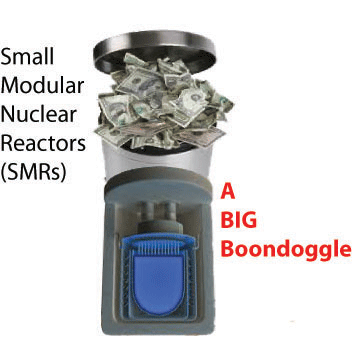 Small Modular Reactors – of SMRs and ANTs, by Jan Haverkamp http://www.nuclear-transparency-watch.eu/activities/small-modular-reactors-of-smrs-and-ants-by-jan-haverkamp.html
15 April 2019 The debate on Small Modular Reactors continues to warm up. The IAEA recently updated its webpages on the issue. SMRs are currently promoted by parts of the nuclear industry as an answer to the decrease of interest in normal gigawatt (GW)-scale reactors because of economic and technical realities.
Dr. David Lowry thinks it is time for a warning: “This article focuses on the UK, but similar arguments as I brought forward in Bratislava would apply to any other European government confronted with requests for support of this new sector.”
Climate change rallies block London roads
SBS News, 17 Apr 19 Thousands of activists led by Extinction Rebellion have blocked major roads in London to demand action on climate change, and promised to keep it up a week. Thousands of environmental activists have paralysed parts of central London by blocking Marble Arch, Oxford Circus and Waterloo Bridge in a bid to force the government to do more to tackle climate change.Under sunny skies on Monday, activists sang songs or held signs that read “There is no Planet B” and “Extinction is forever” at some of the capital’s most iconic locations.
Roadblocks will continue night and day at each site and the demonstrators say the protests could last at least a week….
The group is demanding the government declare a climate and ecological emergency, reduce greenhouse gas emissions to net zero by 2025, and create a citizen’s assembly of members of the public to lead on decisions to address climate change. ….
Extinction Rebellion wrote to Prime Minister Theresa May on Monday outlining their demands and asking for face-to-face talks, warning that they will escalate their disruptive actions over the coming weeks unless the government acts.
“Make no mistake, people are already dying,” the letter states. “In the majority world, indigenous communities are now on the brink of extinction. This crisis is only going to get worse … Prime Minister, you cannot ignore this crisis any longer. We must act now.”
Organisers of the protests circulated legal advice to anyone planning to attend, requesting they refrain from using drugs and alcohol, and asking them to treat the public with respect.
London’s police have advised people travelling around the city in the coming days to allow extra time for their journey in the event of road closures and general disruption. …… Extinction Rebellion wrote to Prime Minister Theresa May on Monday outlining their demands and asking for face-to-face talks, warning that they will escalate their disruptive actions over the coming weeks unless the government acts.
“Make no mistake, people are already dying,” the letter states. “In the majority world, indigenous communities are now on the brink of extinction. This crisis is only going to get worse … Prime Minister, you cannot ignore this crisis any longer. We must act now.”
Organisers of the protests circulated legal advice to anyone planning to attend, requesting they refrain from using drugs and alcohol, and asking them to treat the public with respect.
London’s police have advised people travelling around the city in the coming days to allow extra time for their journey in the event of road closures and general disruption………https://www.sbs.com.au/news/climate-change-rallies-block-london-roads
The untold story of the campaign to smear Julian Assange
This prospect prompted the UN Working Group on Arbitrary Detention and 33 EU parliamentarians to issue strongly worded statements to both the UK and Ecuadorian governments in December last year, warning against facilitating the prosecution of a journalist, editor and publisher for “publishing the truth”. The statements demanded Assange’s “immediate release, together with his safe passage to a safe country”, and reminded the UK of its “binding” legal obligations to secure freedom for Assange.
A critical task for propagandists such as those waging a psychological war on Wilkileaks, then, is to feed audiences material that supports official narratives and exclude that which does not. Since its inception, the smear campaign against Julian Assange and Wikileaks has been remarkably concerted and consistent in that regard.
With the new year, however, news broke that the International Monetary Fund (IMF) had offered Ecuador a $10 billion bailout in return for handing Julian Assange over to the United States. This bounty came on top of earlier US pressures and inducements, reportedly including increased oil exports, military co-operation and another $1.1 billion in IMF loans, with the US representative of the IMF instructing Ecuador that it must “resolve” its relationship with Julian Assange in order to receive the IMF money.
Australian Barrister Greg Barns has called it the blackmailing of a nation. News website 21st Century Wirecalled it “one of the biggest international bribery (or extortion) cases in history.”
While there is “not a single shred of evidence that any of [Wikileaks’] disclosures caused anyone harm”, writes journalist and author Nozomi Hayase, what Wikileaks did do in 2010 was expose thousands of previously unreported civilian deaths in Iraq and Afghanistan. These deaths included the nonchalant gunning down of children, journalists and their rescuers, and other “indiscriminate violence… torture, lies [and]bribery”, writes Chris Hedges. According to Pentagon Papers whistleblower Daniel Elsberg, the leaks exposed “a massive cover-up over a number of years by the American authorities”.
Julian in ‘critical danger’, new rules ‘torture’ – Assange mother *AUDIO*
The Psychology Of Getting Julian Assange, Part 2: The Court Of Public Opinion And The Blood-Curdling Untold Story, New Matilda, By Dr Lissa Johnson February 25, 2019 In her ongoing special investigation into the detention of Julian Assange, Dr Lissa Johnson turns to the art of smear, and how to corrupt a judicial system.
On Friday 14th February, the Editor in Chief of news website Consortium News, Joe Lauria, visited Sydney to host a ‘Politics in the Pub’ event: Whistleblowing, Wikileaks and the Future of Democracy. The event took place in anticipation of upcoming rallies to free Assange…….
. It is imperative that we pressure the Australian government to make sure its citizen, Julian Assange, is protected from the lawlessness of the American Empire.” Continue reading
UK Nuclear workers vote to strike over pay
Nuclear workers vote to strike over pay, David McPhee, https://www.energyvoice.com/other-news/196648/nuclear-workers-vote-to-strike-over-pay/ Workers including security guards at an airport and nuclear site have voted to take industrial action in separate disputes over pay and other issues.
Members of the Unite union employed by Mitie at London City Airport and the
Sellafield reprocessing site in Cumbria voted heavily in favour of action.
Security guards, catering staff and other workers at Sellafied will stage a series of strikes from April 19 to 29 and from May 4 to 13 as well as banning overtime.
Unite said its members at the airport, including security guards and staff helping passengers with mobility issues, will also be taking industrial action.
Unite regional officer Michelle Cook said: “Mitie is treating its workforce with complete contempt. Workers are being subjected to low pay and third rate conditions.
“Mitie is drinking in the last chance saloon and if it wants to avoid industrial action they need to immediately enter into meaningful negotiations and properly address the workers concerns.”
UK’s National Grid prepares for 100 per cent renewable energy by 2025.
to the Australian Energy Market Operator, says it is preparing to change
its systems so it can operate the electricity grid with 100 per cent
renewable energy by 2025.
transition to renewables, but the progress in other countries is usually
overlooked.
out coal completely by 2025 and the grid operator says it needs to develop
a system in which it doesn’t need coal or gas back-up. The document
identifies the areas where traditional generation has delivered services
such as inertia, frequency control and voltage, which will now have to come
from wind and solar, plus various storage technologies and other “demand
side” options. This will require a re-design of the markets to better
represent the new technologies and the passing of the old ones. It has now
set a work plan that sets various deadlines in coming years, and tenders
for providers of new technologies.
https://reneweconomy.com.au/uks-national-grid-operator-gets-ready-for-100-renewables-by-2025/
Safety rules relaxed for UK radioactive wastes, due to fears of supply disruption after Brexit
Ministers are under pressure to own up to any potential risks to health and security, after emergency advice was quietly issued to organisations and businesses.
Under the measure, they are being allowed to bust limits if they are unable to export waste because of Brexit – or if they fear they will be unable to obtain the radioactive material they need.
The rules have been relaxed regardless of whether the UK leaves the EU or – as seems increasingly likely – there is an extension to Article 50 until next year or beyond.
Rosie Duffield, a Labour MP and supporter of the People’s Vote campaign for a new Brexit referendum, said it was another example of consequences “nobody voted” for in 2016.
“It is essential that a minister comes to the Commons and makes a statement about the environmental and security risks that storing more waste at industrial or NHS sites pose,” Ms Duffield said.
“It is not acceptable that the rules on something like this can be changed without proper public discussion and accountability.”
The Environment Agency acknowledged the substances were hazardous but insisted there was “no risk to the public or the environment” from the new rules…… https://www.independent.co.uk/news/uk/politics/brexit-radioactive-supply-limit-hospitals-universities-factories-a8856796.html
Creative action against nuclear waste dumping
https://theecologist.org/2019/apr/05/creative-action-against-nuclear-waste Chris Bluemel, Stop New Nuclear Network , 5th April 2019 Campaigners will gather at the Springfields nuclear site in Lancashire to raise awareness on the twin fronts of new nuclear generation and radioactive waste disposal.
In the UK, the costs of nuclear developments have been borne by the taxpayer. Under the ‘Contracts for Difference’ scheme, bills for electricity from the new plant at Hinkley C will be twice what we currently pay.
This does not cover the costs of accidents, which are underwritten by the Government. Nuclear plants typically run overtime and over-budget.
Nuclear waste
The Government’s consultation about burying nuclear waste is about to end, kicking off a five-year search for a willing host community with ‘suitable’ ground conditions.
We are presented with two options: leave the waste in crumbling storage facilities like Sellafield; or bury it and let it contaminate the environment.
In Scotland, new surface-level management facilities are being built but in England this is deemed too expensive. It is clear that we need a solution to managing the waste before we create more of it.
Springfields is where nuclear fuel is produced for both civil and military use, and waste processed from both the UK and abroad.
‘Surround Springfields’ on 27 April is an opportunity to follow the route of radioactive waste and to understand how this issue affects everyone, everywhere.
Creative action
We will even be dressing as barrels of waste in an attempt to break a world record for surrounding a nuclear site.
We will also be having a live conversation with indigenous people in other countries via a webinar about the impacts of uranium mining and nuclear waste. You can join this remotely if you cannot get there – check our Facebook page for details.
Do we choose a long term, socially responsible and ethical energy supply, with a moral commitment to the wellbeing of future generations?
We need to come together and make the Government approach these challenges with vision and creativity, not with the poverty of ambition, opacity and lack of foresight that characterises the nuclear solution.
Take part
Surround Springfields will take place on Saturday 27 April. For more information, contact the organisers.
This Author
Chris Bluemel is a music teacher and campaigner and part of the Stop New Nuclear network. He has been involved in a wide range of campaigning from standing in elections as a Green Party candidate to direct action against road-building, fracking, the DSEI arms fair, and Trident. He is also part of the radical protest-folk band Seize The Day.
Doctors want UK to be at the forefront of international nuclear disarmament.
Nuclear war and a new arms race , Guardian, Bruce Kent, Vice-president, Campaign for Nuclear Disarmament, 5 Apr 19
We write as members of Medact, an organisation of health professionals working to make the world a safer place by drawing attention to the links between nuclear disarmament, the environment and social justice.
Medact is the British affiliate of IPPNW, International Physicians for the Prevention of Nuclear War, set up in 1980 by two eminent cardiologists, one American and one Soviet, and both doctors to their heads of state. Last week we met with the director of programmes for IPPNW and heard first-hand just how worried people in the US are about the potential use – deliberate or inadvertent – of nuclear weapons.
The BMA produced a report in 1983 entitled The Medical Effects of Nuclear War, describing the humanitarian catastrophe that would result. The World Medical Association and the International Red Cross and Red Crescent Movement have echoed these sentiments.
It is worth noting that 122 nations voted in favour of the 2017 UN treaty on the prohibition of nuclear weapons. The UK was not among them. Having heard from our American colleagues just how dangerous the current situation is, we urge people to encourage their political representatives to push for the UK to engage with the treaty and be at the forefront of international nuclear disarmament.
Dr Lesley Morrison GP
Dr Duncan McIntyre Retired physician
Dr Michael Orgel Retired clinician
Dr Judith McDonald GP
Dr Danuta Orlowska Clinical psychologist
Dr Georgina Race Junior doctor
Dr Margaret Craig GP
Dr Cath Dyer Retired GP
Dr Richard Dyer Retired GP
Dr Guy Johnson GP
• May I urge the dean of Westminster Abbey to cancel the ceremony planned for 3 May. It is to be held in thanksgiving for 50 years of continuous at-sea (nuclear weapon) deterrence. That means 50 years of being ready and wiling to commit mass murder. Is this something to thank God for?
Nuclear weapons are supposedly there to ensure our security. They actually have precisely the opposite effect, and are, of course, a standing invitation to other countries to copy our example. As Robert McNamara, a former US defence secretary, said: “It was luck that prevented nuclear war.”
We are rarely told about the many accidents and miscalculations that have taken us, too often, to the brink of disaster. Perhaps it would be better to hold a day of prayer for the success of the current UN nuclear weapon abolition treaty, which this country has yet to support. https://www.theguardian.com/world/2019/apr/05/nuclear-war-and-a-new-arms-race
4 Sound reasons why Blackwater Against New Nuclear Group opposes Sizewell nuclear project
BANNG 2nd April 2019 BANNG’s primary purpose is to oppose the development of new nuclear power
at Bradwell in Essex. We also have an interest in generic and specific
processes and proposals for new nuclear developments which may have a
bearing on the Bradwell development.
Our response to the Sizewell application reflects a number of common concerns. One, is that Sizewell and
Bradwell are projects being developed by a partnership between EDF and CGN.
Although Sizewell is based on the UK EPR while Bradwell is intended for the
UK HPR1000, both comprise reactors, waste stores and other buildings which
must be accommodated on coastal sites.
A second feature is that the sites
are hemmed in by areas of environmental significance with many
designations, the most notable being the Suffolk Coast and Heaths AONB and
Minsmere RSPB reserve in Suffolk and the Marine Conservation Zone in Essex.
Thirdly, both are close to substantial populations with Leiston (Suffolk)
and West Mersea (Essex) within two to three miles from the sites.
Fourth,
both sites are vulnerable to coastal processes, in the case of Sizewell,
coastal erosion and at Bradwell flooding and storm surges, problems which
will only get worse as climate change wreaks havoc on the fragile and
low-lying east coast while the operation and decommissioning of the plants
continues into the next century and beyond. And, fifth, as the UK’s
nuclear strategy collapses, Sizewell and Bradwell are the two remaining
sites which puts enormous pressure on government, developers, regulators
and the IPC to ensure the delivery of the two new nuclear power stations.
Indeed, CGN has responded to the opportunity presented by stating that,
‘In simple terms, we have ramped up. We are bringing forward [the
Bradwell project]’1.
https://www.banng.info/news/sizewell-c-stage-3-pre-application-consultation-banng-paper-no-40/
Explosion at Vulcan nuclear submarine site at Dounreay
which occurred at the Vulcan nuclear submarine site at Dounreay. Alexander
Glasgow believes the incident could have caused serious injuries and is
critical of the lack of information provided by the Ministry of Defence
(MoD) which operates the facility. He raised the issue at the latest
meeting of the Thurso community council and said he is “still chasing it
up” but colleagues wondered why he was asking questions when Vulcan is not
within the community council boundary. Mr Glasgow said: ” I find it
extraordinary that this isn’t considered within our bailiwick. As well as
the local economy, a great many employees live in Thurso. We could have had
multiple serious injuries here.”
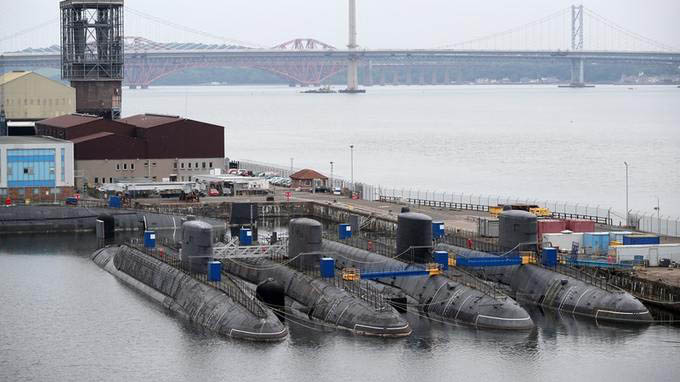
Scottish National Party demands public inquiry into the decommissioning of nuclear-powered submarines
nuclear-powered submarines, following the publication of a damning report
on how the Ministry of Defence (MoD) has handled the process. The National
Audit Office (NAO) found the MoD still does not know how it will finally
dispose of 20 decommissioned vessels, several of which remain laid up
afloat at Rosyth Dockyard in Fife. The UK now has twice as many submarines
in storage as it does in service, and has not disposed of any of the boats
decommissioned since 1980. The estimated cost of disposing of a submarine
is £96 million, the NAO found, while the MoD has put its total future
liability for maintaining and disposing of the 20 stored and 10 in-service
nuclear-powered boats at £7.5 billion over the next 120 years. SNP defence
spokesman Stewart McDonald has now called on UK Government ministers to be
held to account and “face up to the consequences of their actions”.
Britains nuclear submarines, intended to harm foreign lands, now pose grave danger at home!
Britain’s ageing nuclear submarines are dangerous, Morning Star 3rd April 2019
https://morningstaronline.co.uk/article/britain%E2%80%99s-ageing-nuclear-submarines-are-dangerous
REVELATIONS that the Ministry of Defence has failed to dispose of any of the 20 nuclear submarines it has decommissioned in nearly 40 years underlines the unique risks associated with nuclear weapons.
What passes for debate in Parliament on our nuclear arsenal is deeply frustrating.
Ministers airily dismiss concerns about the staggering cost of Trident renewal (over £200 billion), ignore advice from top brass that these “useless” weapons swallow up money that would be better spent on conventional equivalents, sidestep questions about whether the ability to incinerate whole cities at the push of a button is a relevant deterrent to modern threats from terrorism to climate change.
Even Tony Blair has said the utility of a nuclear arsenal was “non-existent in terms of military use,” admitting in his memoirs that he only supported renewal when PM because he felt foreigners would see it as “too big a downgrading of our status as a nation” if we voluntarily abandoned it.
Yet his successors portray any attempt to discuss these questions rationally as evidence of being soft on Britain’s security.
They could not be more wrong, as the National Audit Office’s investigation into how we dispose of decommissioned submarines attests.
We have not disposed of a single one since 1980. The MoD has not been in a position to remove radioactive fuel from retired submarines since 2004, when the Office for Nuclear Regulation ordered it to stop as its facilities for doing so — at the Devonport naval base in Plymouth — were not safe enough.
An original plan to have a new disposal process operational by 2011 has now been postponed to 2026; the MoD stores twice as many mothballed nuclear subs as it operates and some have been cooling off in retirement for longer than they ever roamed the seas.
This is not simply a matter of bad organisation or rising costs.
Dr Philip Webber of Scientists for Global Responsibility (SGR) warned in 2017 that of the 12 retired submarines docked at Devonport, eight still contained fuelled nuclear reactors.
These “have to be continually cooled using external power and water to avoid overheating, which could lead to a fire, meltdown or a release of radioactive particles and gases.”
The risks involved in defuelling nuclear reactors are considerable – that’s why the MoD has felt unable to do so safely for 15 years — and older reactors (as we would expect to find on vessels that haven’t been operational for up to 40 years) tend to pose a greater risk of igniting, exploding or releasing radiation if anything goes wrong in the process than newer ones.
In an excellent article published in the SGR newsletter of winter 2017, Dr Webber points out that the MoD is actually aware of how dangerous keeping decommissioned subs knocking around is: following freedom of information requests, minutes of a Defence Board Meeting of 2011 were released.
The MoD’s senior nuclear safety regulator Commodore Andrew McFarlane notes that “all pressurised water reactors are potentially vulnerable to … structural failure,” which could lead to “release of highly radioactive fission products outside the reactor core.”
This would be a public safety hazard “out to 1.5 kilometres” (almost a mile) from the submarine.
Dr Webber estimates that 32,000 residents of Plymouth would fall within that range.
Safely defuelling and disposing of these radioactive hulks should be a priority for any government that takes public
safety seriously.
The enormous difficulties of doing so are a warning of exactly what risks we take on by blithely opting to renew our nuclear weapons programme.
It’s tragic that for most of our politicians “national security” rests on our ability to harm the peoples of other nations, rather than keep people on these shores safe.
Local Councils in England, Northern Ireland and Wales reject any involvement in nuclear waste dumping.
NFLA 1st April 2019 The Nuclear Free Local Authorities (NFLA) has submitted its comments of the
Radioactive Waste Management’s (RWM) ‘Site Evaluation’ criteria.
These criteria are supposed to assist RWM in the process to deliver a
suitable site for a deep underground radioactive waste repository should
prospective volunteer communities / Councils interested come forward.
The RWM consultation has been mired in two parallel processes that have led to
considerable concern and even anger expressed by a number of Councils,
particularly in Wales and Northern Ireland – these include a letter from
the UK Government that has gone to all Councils in England, Wales and
Northern Ireland seeking ‘expressions of interest’ in taking part in a
process to find a volunteer location for a deep underground repository; and
RWM placing downloadable films on their website considering the regions of
the three nations and generic geology that may be suitable for such a
facility.
A number of Councils, such as Newry, Mourne and Down and
Fermanagh and Omagh Council in Northern Ireland, and Swansea, Ceredigion
and Powys County Councils in Wales, have passed resolutions expressing
their opposition to such a development in their or neighbouring areas.
Anger at UK’s Ministry of Defence over mucking about with submarine nuclear waste disposal
The Ferret. Rob Edwards, 2nd April 2019 Plans by the Ministry of Defence (MoD) to rethink the disposal of radioactive waste from 27 defunct nuclear submarines have come under fierce fire from campaigners.
A recent meeting of local authority advisors was told that the MoD is “considering alternative options for the management of the waste”. This is despite previous decisions made after an exhaustive, 16-year public consultation process.
Those who were involved in the consultations are alarmed that the MoD is thinking of changing what has been agreed – and are pressing for more information. It was “incredibly frustrating”, said one critic.
Since the 1980s seven aged nuclear-powered submarines have been taken out of service and laid up at the Rosyth naval dockyard in Fife. Since the 1990s, thirteen more have been laid up at Devonport naval dockyard in Plymouth, nine of them still containing radioactive fuel.
A further three reactor-driven submarines are due to be retired in the next few years. They will be followed by the four Vanguard-class submarines, currently armed with Trident nuclear missiles and based at Faslane on the Clyde.
The MoD began a public submarine dismantling project in 2000. It announced in 2016 that a nuclear plant at Capenhurst in Cheshire had been chosen as an “interim storage site” for radioactive waste.
A proposal to store the waste on a former nuclear site at Chapelcross near Annan in south west Scotland was rejected after objections from the Scottish Government. The Ferret revealed in December that in the past the MoD has contemplated dumping the submarines on the seabed near Scotland.
Work on dismantling the first “demonstrator” submarine, Swiftsure, began at Rosyth in 2016. The MoD said in December 2018 that over 70 tonnes of radioactive and non-radioactive waste had been removed, and that dismantling of a second submarine, Resolution, would start in 2019.
But now future plans have been thrown into confusion by the MoD reportedly having second thoughts. The change of heart was disclosed by the Nuclear Legacy Advisory Forum (NuLeAF), an expert group working with 113 local planning authorities in England and Wales.
A report posted online for a steering group meeting on 20 March outlined NuLeAF’s role in previous submarine dismantling consultations. “The Ministry of Defence, working with the regulators, has now indicated it is considering alternative options for the management of the waste,” it said.
“It is understood that they are in discussion with the Nuclear Decommissioning Authority who will be managing an engagement process to gain stakeholder input.”…….
Campaigners have reacted angrily. “Given the amount of time, effort and public money that went into the consultation process, it is alarming to hear that the MoD now appear to be changing its mind,” said Jane Tallents, who was an advisor to the MoD’s submarine dismantling project.
“I can only guess that in the three years that they have been dismantling the first submarine they have come across problems not anticipated by all the experts who informed the public during the consultation.”
She and others had urged the MoD to extend its “unprecedented openness” on the submarine dismantling project to other areas of policy-making. “It would be disappointing if the project itself does not come clean and tell us what alternative options they are now looking at.”
Edinburgh-based nuclear consultant and critic, Pete Roche, accused the MoD of undermining its prolonged public consultations. “Communities and environmentalists thought the MoD had pulled off the impossible and come up with a consensus on what to do with nuclear waste from submarines,” he told The Ferret.
“Now it seems they want to pour all this hard work down the drain. This is incredibly frustrating and makes you wonder if banging your head against a wall would be more fruitful than getting involved in these consultation processes.”
In January a group including former naval staff campaigning to “Save The Royal Navy” described the failure to promptly deal with submarine waste as “a national scandal”. Progress had been “painfully slow” because “successive governments have avoided difficult decisions and handed the problem on to their successors,” it argued.
An article on the group’s website warned that maintaining the submarines safely while they awaited dismantling was “a growing drain on the defence budget”. It estimated the total cost of disposing of 27 submarines to be at least £10.4 billion over 25 years………. https://theferret.scot/mod-rethink-nuclear-submarines-waste/
Britain’s Ministry of Defence’s failure to dispose of retired nuclear submarines
MoD criticised over failure to dispose of retired nuclear submarines https://www.itv.com/news/2019-04-03/mod-criticised-over-failure-to-dispose-of-retired-nuclear-submarines/ The Ministry of Defence has been condemned for a “dismal” failure to dispose of decommissioned nuclear-powered submarines.
The MoD has submarines which have been in storage longer than they have been in service and the UK now has twice as many submarines in storage as it does in service.
The National Audit Office (NAO) said the department has not disposed of any of the 20 boats no longer in service since 1980.
Some of these vessels still contain nuclear fuel and the failure to address the issue risks damaging the UK’s international reputation as a “responsible nuclear power”.
The issue was raised during Prime Minister’s Questions by Labour MP Luke Pollard who asked whether the prime minister will extend the nuclear clean up to include all the royal navy submarines.
Mrs May responded to say the MoD will continue to work with the nuclear decommissioning service to achieve “steady state disposal of our laid up submarines.”
The estimated cost of disposing of a submarine is £96 million, the NAO said.
Decommissioned vessels are being stored at Devonport and Rosyth, while arrangements are made to safely dispose of them and the radioactive waste they contain.
No submarines have been defuelled since 2004, when regulators said facilities did not meet required standards.
The process is not due to start again until 2023 and has been delayed for 11 years, with a £100 million cost increase to £275 million, a £12 million annual bill for maintaining and storing the nine fuelled submarines and pressure on dock space at Devonport.
The MoD has put its total future liability for maintaining and disposing of the 20 stored and 10 in-service nuclear-powered boats at £7.5 billion over the next 120 years, underlining the long-term nature of nuclear waste.
The Government said the ministry “needs to get a grip urgently” on the matter.
Meg Hillier, chairwoman of the Commons Public Accounts Committee, said: “For more than 20 years the Ministry of Defence has been promising to dismantle its out-of-service nuclear submarines and told my committee last year that it would now address this dismal lack of progress.
“It has still not disposed of any of the 20 submarines decommissioned since 1980 and does not yet know fully how to do it.
“The disposal programmes have been beset by lengthy delays and spiralling costs, with taxpayers footing the bill.
“The ministry needs to get a grip urgently before we run out of space to store and maintain submarines and we damage our reputation as a responsible nuclear power.”
The vessels being stored include the first submarines used to carry the UK’s nuclear deterrent – the Polaris boats HMS Revenge, HMS Renown, HMS Repulse and HMS Resolution.
Attack submarine HMS Conqueror, which sank the Argentine cruiser General Belgrano during the Falklands War is another of the boats in storage.
A Ministry of Defence spokesman said: ““The disposal of nuclear submarines is a complex and challenging undertaking.
“We remain committed to the safe, secure and cost-effective de-fuelling and dismantling of all decommissioned nuclear submarines as soon as practically possible.”
1 This Month





PLEASE OPPOSE HR 8255 AND S.3639 – bills would accelerate satellite deployment, with no environmental review or safeguards – https://ncstd5li.quorum.us/campaign/169331/
To see nuclear-related stories in greater depth and intensity – go to https://nuclearinformation.wordpress.com
-
Archives
- September 2026 (339)
- August 2026 (330)
- July 2026 (355)
- June 2026 (287)
- May 2026 (306)
- April 2026 (356)
- March 2026 (251)
- February 2026 (267)
- January 2026 (308)
- December 2025 (358)
- November 2025 (359)
- October 2025 (375)
-
Categories
- 1
- 1 NUCLEAR ISSUES
- business and costs
- climate change
- culture and arts
- ENERGY
- environment
- health
- history
- indigenous issues
- Legal
- marketing of nuclear
- media
- opposition to nuclear
- PERSONAL STORIES
- politics
- politics international
- Religion and ethics
- safety
- secrets,lies and civil liberties
- spinbuster
- technology
- Uranium
- wastes
- weapons and war
- Women
- 2 WORLD
- ACTION
- AFRICA
- Atrocities
- AUSTRALIA
- Christina's notes
- Christina's themes
- culture and arts
- Events
- Fuk 2022
- Fuk 2023
- Fukushima 2017
- Fukushima 2018
- fukushima 2019
- Fukushima 2020
- Fukushima 2021
- general
- global warming
- Humour (God we need it)
- Nuclear
- RARE EARTHS
- Reference
- resources – print
- Resources -audiovicual
- Weekly Newsletter
- World
- World Nuclear
- YouTube
-
RSS
Entries RSS
Comments RSS

