Bloomberg 12th July 2019 Chancellor of the Exchequer Philip Hammond is blocking a set of government proposals to overhaul the U.K. energy industry because of the potential
spending implications for a new prime minister, people familiar with the
matter said.
The plans are included in a long-awaited energy white paper
that the business department has been working on for months, according to
the officials, who asked not to be identified because the policies
haven’t been announced.
Measures include the way nuclear power plants get funding, boosting technology to capture industrial greenhouse gas emissions for storage, accelerating the decarbonization of the power industry and efforts to make housing more energy efficient.
Greg Clark hoped to publish the proposals in July, but Hammond is reluctant to give the go-ahead to new spending before a successor to Theresa May is in place, the people said.
Whitehall officials across departments are also concerned the document is
both incomplete and too sizable a policy plan to put forward just before a
new premier takes over, according to two of the people familiar. One option
being considered is to publish more urgent sections before recess leaving
the rest for the next government to handle.
July 15, 2019
Posted by Christina Macpherson |
politics, UK |
Leave a comment
Times 14th July 2019 If all goes to plan Hinkley Point C should start powering 6m homes from
2025, earning its developers the hefty, taxpayer-backed price of £92.50
per megawatt-hour of electricity produced.
Hinkley is a rare dash of activity in a sector battered by bad news and government inactivity. This week, business and energy secretary Greg Clark will try to sketch out a
future for the new nuclear industry with a funding blueprint that will pass
some of the risks and costs on to bill-payers.
He has been spurred intoa ction by Japan’s Hitachi and Toshiba, which have both pulled the plug on new nuclear projects in Britain. Clark’s paper was meant to appear
alongside a broader revamp of energy policy, but sources suggest political
turmoil and Treasury concerns are expected to delay the full white paper
until autumn, when a new energy secretary is in post.
In a sector being upended by technological change, from electric cars to smart power grids,
every delay in devising a coherent, long-term policy further weakens the
power system and Britain’s competitiveness. For now, the industry is likely
to have to settle for Clark’s nuclear blueprint. Even if a full energy
paper emerges, it could be torn up by his successor. Many tip the current
chief secretary to the Treasury, Liz Truss. If they are right, Truss will
arrive to a full in-tray.
https://www.thetimes.co.uk/article/a8f5d97c-a589-11e9-97a3-6b6d400e533
July 15, 2019
Posted by Christina Macpherson |
politics, UK |
Leave a comment
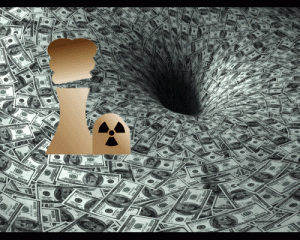 BBC 5th July 2019 The company behind plans to build a new nuclear power station on Anglesey has reported a £1.68bn pre-tax loss. Work at Wylfa Newydd was suspended in
January by Hitachi due to rising costs. The latest accounts filed by its
subsidiary Horizon Nuclear Power Ltd show it cut the value of the land and
equipment by £1.52bn as it does not intend to build a new power station.
The accounts also show that staff redundancies and winding up work also
cost £127m. Horizon will now be put into a “suspended state” following the
release of most of its workforce and termination of most of its commercial
contracts, according to its annual report.
A report by the Welsh Affairs Committee said the UK government should encourage Hitachi to sell the site if it is not prepared to resume work. Horizon previously said its main
planning permission was being considered, as it keeps its options open.
“They are going ahead with the application because they’ve done so much
work already, it’s worth spending the additional money to finish that
work,” said Dr Edward Jones, economics lecturer at Bangor University.
https://www.bbc.co.uk/news/uk-wales-48888093
July 8, 2019
Posted by Christina Macpherson |
business and costs, UK |
Leave a comment
 “Even if a safe and affordable design were to emerge from the current research projects, the whole concept relies on there being a sufficient guaranteed pipeline of orders for the construction and ramping up to scale of a large and expensive production facility,” NCG said.
“Without such a pipeline – itself requiring an unlikely level of long-term policy consistency – it is difficult to see the private sector being willing to finance such a facility.”
“We need to rapidly scale up investments in clean, safe renewable power and improving energy efficiency rather than fall for the latest sales pitch of the failing nuclear industry.”
Small nuclear reactors for Scotland? No thanks, say experts, The Ferret, Jenny Tsilivakou on July 7, 2019
A report by scientists proposing that Scotland should consider building an array of small nuclear power reactors to help combat climate warming has been dismissed as “disingenuous”.
Three experts under the banner of the Nuclear Consulting Group think tank say that a new report from the Royal Society of Edinburgh (RSE) displayed a “disappointingly poor grasp of the realities of the nuclear issue”.
They have been backed by campaigners, but the RSE has warned against ruling out energy technologies that may not meet “every possible criterion”. The nuclear power industry welcomed RSE’s report.
The RSE report on ‘Scotland’s Energy Future’ was published on 17 June 2019 following a two-year inquiry. Its lead authors were Sir Muir Russell, who was head of the Scottish civil service and principal of the University of Glasgow, and Rebecca Lunn, an engineering professor at the University of Strathclyde.
It accepted that there were “well recognised challenges” with nuclear such as costs, decommissioning, and the disposal of radioactive waste. “Addressing these issues will require substantial investment over a prolonged period of time,” it said.
But the RSE report suggested that “small modular reactors” (SMRs) could be a solution. They are reactors designed to be assembled from pre-made parts to generate under 300 megawatts of electricity, a quarter of that produced by current nuclear stations……
“SMRs could provide many of the benefits of large-scale nuclear energy, but in a form that may prove more acceptable to the public,” the report said.
“There is a high level of uncertainty over how long this technology will take to sufficiently develop.”
The RSE report cautioned that “no energy policy, no matter how well-considered, will ever solve all of the problems and paradoxes of energy supply and use”. There was an “energy quadrilemma”, it contended, that had to take account of climate change, affordability, energy security, and social acceptability and economic wellbeing.
The Nuclear Consulting Group (NCG) has now issued a sharp riposte to the RSE report. It has published a paper by three experts: Dr Paul Dorfman from University College London; Tom Burke from the climate think tank E3G; and Steve Thomas, emeritus professor of energy policy from the University of Greenwich.
They concluded that “Scotland’s energy future has no need for nuclear”. They criticised the RSE report for “conflicting” and “confusing” messages about nuclear power.
The RSE report didn’t provide evidence to back up some of its claims, the NCG paper argued. The RSE failed “to note that all nuclear is significantly more carbon intensive than all renewables”.
NCG maintained that renewables such as wind power were cheaper than new nuclear. It was particularly critical of the idea that SMRs could help Scotland achieve its climate targets. Continue reading →
July 8, 2019
Posted by Christina Macpherson |
Small Modular Nuclear Reactors, UK |
Leave a comment
The nuclear fight for Sizewell on Suffolk’s coast, BBC, 7 July 2019
July 8, 2019
Posted by Christina Macpherson |
environment, opposition to nuclear, UK |
Leave a comment
The simple reason why nuclear power is finished – Dr Richard Dixon https://www.scotsman.com/news/opinion/columnists/the-simple-reason-why-nuclear-power-is-finished-dr-richard-dixon-1-4957211
Half of Scotland’s nuclear reactors are off-line over safety concerns, but the lights still stayed on, writes Dr Richard Dixon. July 3 2019
Nuclear power is the ultimate unsustainable form of energy. For some electricity today, we are leaving a thousand generations of future humans dangerous radioactive waste.
During the 1990s public inquiry into the Hinkley Point C nuclear station, I saw a poster showing a Roman legionary standing outside a nuclear plant and carrying the message “If the Romans had had nuclear power, we would still be guarding the waste”.
I thought it was terribly clever but it took me quite a while to realise that Roman Britain was far too close at hand. To cover the generally accepted 25,000 years, it would need to have referred to Cro-Magnon humans.
The politics of Scotland mean that new reactors here are almost unthinkable and the price of the renewable energy alternatives has fallen so far below the cost of nuclear that you would have to be crazy to go for new nuclear.
Labour’s Jack McConnell was the First Minister who said he would block new nuclear plants until there was a solution to the waste problem (14 years later, there is none). And while it is in the SNP’s DNA to oppose nuclear power. EDF and some unions do still try to lobby Scottish Ministers and officials, but to no avail. Meanwhile the industry is doing a great job of showing how terrible a bet nuclear is.
The nuclear industry is almost unique in that every new reactor costs more than the last, while everything else gets cheaper, including offshore wind power which is now coming in at just over half the price of nuclear for a unit of energy.
Hinkley Point C, the only nuclear station under construction in the UK, was supposed to be cooking the Christmas turkey in 2017. It is now expected to be producing electricity at the end of 2025 at the earliest. The only way it could be built was for the UK Government to agree that electricity consumers would pay bills well over the odds for the next 35 years.
The same sort of reactor is being built in Finland. It may start producing electricity next year – 11 years late. The other one of the same design is in France and is currently running 12 years late, at twice the original budget.
The latest wheeze the industry has come up with is to ask the UK Government to agree to pay any costs more than 30 per cent above the original budget for any more reactors. Not a good bet given their history.
Of course we already have four reactors in Scotland. The two at Torness are the second newest in the UK, having been opened by Margaret Thatcher in 1989. The two at Hunterston in Ayrshire are already well past their sell-by date, having started up in 1976. They were supposed to have closed in 2006 but have had three extensions with planned closure now in 2023. Because of a large number of cracks in their cores one reactor stopped generating in March last year and the other in October. Owners EDF are arguing with regulators about whether they can safely restart.
Did you notice the lights going out across Scotland with Hunterston not producing a single electron for eight months? No, thanks largely to renewables having a record first quarter of 2019 and supplying nine out of ten households in Scotland.
We certainly don’t need new nuclear and, with renewables rapidly on the rise, we should not take the unnecessary risk of starting up the Hunterston reactors ever again.
Dr Richard Dixon is director of Friends of the Earth Scotland.
July 4, 2019
Posted by Christina Macpherson |
renewable, UK |
Leave a comment
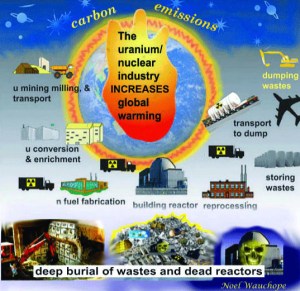 Nuclear power is helping to drive the climate crisis, Guardian, 3 July 19 Linda Rogers says the CBI has its head in the sand over nuclear reactors and Iain Climie wants politicians prepared to fund action to combat the climate emergency
Has the Confederation of British Industry got its head in the sand, or in the record levels of carbon-intensive concrete just poured at the Hinkley C nuclear site (
Build more nuclear reactors to help climate crisis, says CBI, 28 June)? Nuclear power, apart from destroying biodiversity throughout its life cycle, produces up to 37 times the CO2 emissions of renewable energy sources, owing partly to the mining and refining of uranium. The impact of this process on people and the environment is not included in the rationale for nuclear power in the UK.
As the CBI looks for investment from abroad, UK taxpayers will pick up the bill for the likely time and cost overruns of new nuclear build under the regulated asset-based funding proposals so welcomed by the CBI. Nuclear has failed to achieve the investment needed so far because it is no longer seen as economically viable. Even Hitachi (one of the world’s largest multinationals) cannot magic Wylfa Newydd into a commercially viable business. In January this year, Hitachi announced it had failed to squeeze the UK government for the very high levels of subsidies desired by large investors upfront for Wylfa. Nobody can afford the costs or the many risks attached to building new nuclear power stations.
Linda Rogers
July 4, 2019
Posted by Christina Macpherson |
business and costs, climate change, politics, UK |
Leave a comment
Daily Mail 26th April 2019 , Exposed: Britain’s largest nuclear power plant Sellafield is rocked by claims of bullying and sexual harassment with female staff ‘routinely
propositioned by male bosses’ https://www.dailymail.co.uk/news/article-6965179/Exposed-Britains-largest-nuclear-power-plant-rocked-claims-bullying-sexual-harassment.html
July 4, 2019
Posted by Christina Macpherson |
culture and arts, UK |
Leave a comment
David Lowry’s Blog 28th June 2019 A week ago the UK national nuclear regulator, the Office for Nuclear Regulation (ONR), released its annual report and accounts to zero media
attention. But embedded in its 164 pages was the following intriguing
revelation:
“Early in the reporting year, a number of security events
required us to apply regulatory attention to several of Sellafield Ltd’s
security investigations.” It then added: ” Appropriate lessons have been
identified and we will continue our regulatory focus on security culture
and on influencing improvements in the security competence of the internal
assurance function.
” Sellafield is a big nuclear site that, inter alia,
holds 140,000 kilogrammes of plutonium. A devastating warhead can be made
with just 5kgs. We cannot afford any serious security events at
Sellafield!
http://drdavidlowry.blogspot.com/2019/06/sellafield-security-questioned-by.html
July 1, 2019
Posted by Christina Macpherson |
safety, UK |
Leave a comment

Gaps revealed in nuclear convoy crash preparations, A series of shortfalls in Scotland’s emergency arrangements for coping with a nuclear bomb convoy crash have been exposed by a Scottish Government review. The Ferret, Rob Edwards on June 28, 2019
Leaking radioactivity from an accident would put “strains” on the resources for monitoring the contamination of people, food and the environment, it says. Monitoring may be required “at scale” because of the large number of people involved.
The review reveals that the fire service hasn’t finalised its emergency procedures for convoy crashes, the police need to be better briefed and vetted, while the ambulance service is not told about convoy movements.
The emergency services have also failed to properly record the lessons they learn from emergency exercises, it adds.
Convoys comprising up to 20 or more military vehicles transport Trident nuclear warheads by road at least six times a year between the Royal Naval Armaments Depot at Coulport on Loch Long, near Glasgow, and the bomb factory at Burghfield in Berkshire. The warheads have to be regularly maintained at Burghfield.
Though the Ministry of Defence attempts to keep them secret, the convoys are often photographed, filmed and followed on social media. They travel close to major centres of population such as Glasgow, Edinburgh, Newcastle, Manchester and Birmingham.
The Ferret revealed on 23 June 2019 that an emergency exercise in Scotland called Astral Climb in 2016 had suffered communication breakdowns that could have put people at risk.
A report by campaigners in August 2017 warned that Scotland was “wholly unprepared” to deal with an accident or an attack on a convoy. When the issue was raised in the Scottish Parliament in May 2018, Scottish ministers promised to ask the police and fire inspectorates to conduct a review. ……..
According to the review, the hazards from a bomb convoy crash come from the “explosive, radioactive and toxic materials” that are transported. “The explosive hazard is the same as that which is associated with any chemical high explosive,” it said.
“The main radioactive materials are plutonium and uranium. Plutonium and uranium are both toxic and radioactive. The convoy may also contain other toxic (but not radioactive) materials such as beryllium and lithium. Beyond the immediate hazard area, the potential dispersion of airborne plutonium particles represents the dominant radioactive hazard.”The Scottish Government’s review listed five emergency procedures that have still to be “finalised” by the Scottish Fire and Rescue Service, including operational guidance and intelligence sharing. They should be completed “as a matter of priority”, the review concluded.
Police Scotland were criticised for only conducting a “verbal briefing” for officers prior to convoy movements. “There would be merit in considering a more formal process to provide a record of the information given to officers,” the review said.
“We found that Police Scotland uses appropriate measures to secure information but there was a lack of clarity regarding vetting and which staff and officers have access to sensitive information.”
The fire and police services were both upbraided for failing to record the lessons learned from emergency exercises such as Astral Climb in 2016. They were urged to introduce new systems to ensure that that improvements were made. ……….. https://theferret.scot/nuclear-convoy-safety-scotland-review/
July 1, 2019
Posted by Christina Macpherson |
safety, UK, weapons and war |
Leave a comment
BEIS 27th June 2019 The final policy is published in Implementing geological disposal: working
with communities, which updates and replaces the 2014 white paper,
Implementing Geological Disposal in England.
This consultation was on
behalf of the UK government and the Department of Agriculture, Environment
and Rural Affairs (DAERA) in Northern Ireland. The Department of
Agriculture, Environment and Rural Affairs (DAERA) has published separately
a summary of responses from respondents in Northern Ireland.
Future policy decisions in relation to geological disposal in Northern Ireland would be a
matter for the Northern Ireland Executive, which is currently suspended.
Accordingly, the summary of the responses and consequential final policy
decisions referred to in this document, apply solely to England. The Welsh
Government consulted in parallel with the UK government on policy proposals
for working with communities as part of a consent-based approach to finding
a location for a GDF for higher activity radioactive waste. The Welsh
Government will publish its response to the consultation shortly.
https://www.gov.uk/government/consultations/working-with-communities-implementing-geological-disposal
July 1, 2019
Posted by Christina Macpherson |
politics, UK, wastes |
Leave a comment
BEIS 27th June 2019 Department for Business, Energy & Industrial Strategy, Eighth annual report explaining the background to the Geological Disposal Programme and covering progress between April 2017 and April 2019. In its
November 2010 response to the House of Lords Science and Technology Select
Committee’s report, Radioactive Waste Management: a Further Update (March
2010), the UK government committed to producing an annual report to
Parliament, setting out progress in relation to the management of higher
activity radioactive waste.
The eighth report sets out progress made in
relation to the management of higher activity radioactive waste for the
period April 2017 to April 2019. Following the publication of the updated
policy framework for higher activity radioactive waste in December 2018,
and the launch of the process to identify a location to develop a
geological disposal facility (GDF), this will be the last report produced
under our 2010 commitment.
July 1, 2019
Posted by Christina Macpherson |
UK, wastes |
Leave a comment
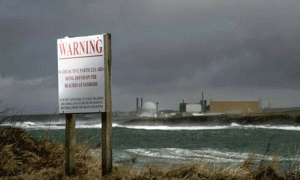 Radioactive contamination triggers evacuation at shuttered nuclear site in Scotland, https://www.rt.com/uk/462857-radioactive-contamination-evacuation-scotland/ 28 Jun, 2019 Workers tasked with cleaning the decommissioned Dounreay nuclear facility in northern Scotland were evacuated from the site after “human error” resulted in low-level radioactive contamination, it has been revealed.
After an employee detected the contamination, a further investigation was quickly launched revealing several other “hot-spots” around the facility. Workers were immediately forced to vacate the area and work temporarily suspended, reportedthe Aberdeen-based Press and Journal.
Site managing director Martin Moore told a stakeholder group on Wednesday that the contamination had been “insignificant,” and was a result of a “lack of due diligence in monitoring around one of the barriers.”
It was human error. It shouldn’t have happened and we’re very disappointed that it did.
The incident actually took place on June 7, but it was only revealed to the public on Wednesday. Some people expressed anger that there was no public statement made on the day it occurred, although the Office for Nuclear Regulation was reportedly informed.
Officials from Dounreay Site Restoration Ltd (DSRL), the company tasked with decommissioning the plant, said that the measure had been precautionary and that the public was never in any danger.
There was no risk to members of the public, no increased risk to the workforce and no release to the environment.
DSRL has been working to decommission the site, which was shut down in 1994. Although they are also tasked with ensuring the area is decontaminated and clean of nuclear waste, they have already been censured for a safety violation at the same site in 2014, when a fire caused by employees released radioactivity into the atmosphere. In the wake of that incident, the company promised to “learn lessons” and implement a wide-ranging new safety strategy, which seemingly turned out to have issues as well.
Located in northern Scotland, Dounreay was established in 1955 to test UK nuclear reactor technology and shuttered in the mid-1990s. Barring any further accidents, work is expected to be completed between 2030 and 2033.
June 29, 2019
Posted by Christina Macpherson |
incidents, UK |
Leave a comment
The National 28th June 2019 , SCOTLAND produced a record amount of renewable energy in the first three
months of 2019, with enough power generated to supply almost nine out of 10
homes. A total of 8877 Gigawatt hours (GWh) of green electricity were
generated in the first quarter of this year – 17% more than in the same
period of 2018. The bulk of this power – 5792 GWh – came from onshore wind
farms, the figures from the UK Department for Business, Energy and
Industrial Strategy (BEIS) show.
Overall, the amount of renewable energy
generated was enough to power around 88% of Scottish households for a year,
the Scottish Government said. Energy minister Paul Wheelhouse said the
sector is going from “strength to strength”. The BEIS data also shows
renewable energy capacity in Scotland rose from 10.4 Gigawatts (GW) in
March 2018 to 11.3 GW in March this year. Electricity exports from Scotland
were at their highest since the last three months of 2017, rising to 4543
GWh – the equivalent of enough energy to power more than 1.1 million homes
for a year. https://www.thenational.scot/news/17735413.scotland-producing-record-renewable-energy-output/
June 29, 2019
Posted by Christina Macpherson |
renewable, UK |
Leave a comment








