Large and small nuclear reactors should not be included in UK’s ‘clean, green’ 10 point plan

NFLA 18th Nov 2020, The UK & Ireland Nuclear Free Local Authorities (NFLA) has read with
interest, but concluded with real disappointment, the UK Prime Minister’s
10 Point Plan for a Green Industrial Revolution.
We see it as a missed opportunity when radical, appropriately funded action to tackle the climate
emergency is sorely needed. The 10-point plan is supposed to reset UK
Government policy as it prepares for the global climate change conference
taking place in Glasgow next year.
It is expected an Energy White Paper and
National Infrastructure Strategy will follow later this month.
Some of the 10 points the Government is taking forward include some welcome areas of
support – for example a major increase of offshore wind, supporting the
development of electric vehicles in conjunction with support for public
transport, cycling and walking strategies, laudable aims on energy
efficiency (despite completely inadequate resource for it), protecting and
restoring the natural environment and looking at ways to increase green
finance across the country.
However, the amount of new money committed to
such work is totally inadequate to claim this to be part of a new green
industrial revolution. NFLA is particularly disappointed with the
Government’s commitment to new nuclear, which, given the carbon footprint
in the construction period of building such reactors as Sizewell C, will
have next to no positive low carbon impact in the time required to be
getting to zero carbon.
Is nuclear power truly ‘green’ and ‘clean’ when it still creates large amounts of radioactive waste for which there is
still is no long-term management solution for?
The amount of public money required to deliver both small modular reactors, a nuclear fusion
experimental reactor and new large nuclear reactors at sites like Sizewell
and Bradwell is massive. Hinkley Point C alone is coming in at around
£22.5 billion.
Small modular reactors could require similar figures given
there is no agreed or approved design for them, or an established supply
chain that can deliver them in a cost-effective way. An experimental
nuclear fusion reactor requires billions more. In all three cases the
delivery of such projects is years away and completely diverts attention
for more effective alternatives.
Hinkley Point B nuclear reactor offline now, and will be shut down earlier than planned
 EDF confirms Hinkley Point B to be shut down earlier than planned
Cracks in reactor’s graphite core leads to decision to begin process no later than July 2022, Jillian Ambrose Energy correspondent, Fri 20 Nov 2020 . EDF Energy has confirmed it will begin shutting down the 45-year-old reactors at Hinkley Point B nuclear power plant in Somerset within the next two years, earlier than scheduled.
The “defuelling” will begin no later than July 2022, according to the French energy group.
The shutdown was scheduled for 2023, but cracks were discovered in the graphite core of the reactor.
…….. The power plant, which has been Britain’s most productive and whose operational life was extended, is offline for further inspections and is scheduled to return to service next year, pending approval from Britain’s nuclear safety watchdog…….
However, the scheduled start date has been delayed to between 2025 and 2026 owing to slow progress in agreeing with the government a guaranteed price for the electricity produced……
Boris Johnson’s 10-point climate plan, which was revealed on Tuesday, promised to advance large-scale nuclear projects and the developments of so-called “mini nuclear reactors” with a £525m support package.
But the plan failed to give the greenlight to EDF Energy’s planned followup to the Hinkley Point C project at the Sizewell site, which the firm hopes to build alongside a Chinese nuclear company.
The NIA said it hoped the government provided a clear path towards new nuclear capacity in an energy white paper, which is expected before Christmas. https://www.theguardian.com/uk-news/2020/nov/19/edf-confirms-hinkley-point-b-to-be-shutdown-earlier-than-planned
Mayor of London announces solar and energy efficiency projects funded by ‘Green New Deal’
Business Green 19th Nov 2020, A host of green projects in London are set to benefit from £10m in funding
announced yesterday as part of the capital’s ‘Green New Deal Fund’, which
the Mayor of London claims could create up to 1,000 new jobs. Announced
yesterday, Sadiq Khan said the first tranche of £10m in funding would be
invested in green projects such as solar panel installations and home
energy efficiency improvements, targeting inequalities exacerbated by the
Covid-19 pandemic such as fuel poverty by helping to improve energy
efficiency, cut energy bills, and improve living conditions.
https://www.businessgreen.com/news/4023653/mayor-london-ploughs-gbp10m-green-deal-projects
Bankrupt AREVA, resuscitated as ‘Framatome’, joins the the Sizewell C nuclear build Consortium

companies and organisations from across the UK working to design, supply
and construct the proposed nuclear power station in Suffolk, England.
Consortium, we are engaging new partnerships with British companies and
suppliers to support lifetime management of the country’s existing
nuclear facilities and new build projects,” said Marc Duret, managing
director of Framatome in the UK.
https://www.neimagazine.com/news/newsframatome-joins-sizewell-c-consortium-8368345
Cheap and effective, but solar energy is omitted from UK govt’s 10 point plan
 Energyst 19th Nov 2020, Despite being the most cost-effective electricity generating technology for
the foreseeable future according to the Government’s own forecasts, solar
was noticeably absent from the Prime Minister’s announcement, which is
largely a repackaging of policies already announced earlier this year.
While the Government has yet to make its ambitions for UK solar clear there
is lively activity taking place in other parts of the public sector. The
City of London has announced a new 15-year Power Purchase Agreement (PPA)
with developer Voltalia, which will see a 50MW solar park built in Dorset
to supply the City with clean power. STA chief executive Chris Hewett said,
“It is disappointing that Number 10 has yet to grasp the opportunity
presented by solar in the UK. Not only is it set to be the cheapest power
source for years to come, it also provides good jobs and business
opportunities up and down the country.
https://theenergyst.com/uk-solar-industry-body-criticises-lack-of-support-in-ten-point-green-plan/
UK: Both Hinkley Point B and Hunterston B nuclear power stations will close early due to cracks in graphite cores
 Times 20th Nov 2020, The Hinkley Point B nuclear power station will close by July 2022 at the
latest, EDF has announced, triggering renewed calls to invest in
replacement reactors. The Somerset plant started generating in 1976 and was
due to close in 2016 but in 2012 EDF secured an extension until March 2023.
However, the reactor developed cracks in its graphite core, which has
limited its operation. EDF said this summer that the Hunterston B plant in
Scotland, which also has cracks in the core, would close earlier than
planned, in January 2022. Tom Greatrex of the Nuclear Industry Association,
said it was “a reminder of the urgency of investing in new nuclear
capacity to hit net zero”.
Extradition hearing of Julian Assange – defence witnesses destroy myths, demonstrate his integrity
 Julian Assange: Three myths destroyed by defence witness statements, Independent Australia, By Sara Chessa | 19 November 2020
Witness statements towards the journalistic integrity of Julian Assange have been heard in court, debunking various myths in the process. Sara Chessa reports from the UK.
THE EXTRADITION HEARING of Julian Assange closed last month in London’s Central Criminal Court, the world-famous “Old Bailey”. We will have to wait until 4 January next year for the decision of the Judge. However, the Court heard impressive and authoritative witness statements highlighting the importance of Assange’s journalistic work and years of smear campaigns carried out by those states which were embarrassed by the way WikiLeaks disclosures made civil society aware of war crimes and the reality of the public interest.
Reconstructing the events starting from these accounts means getting out of the chronic opinionism of our time and taking the first fundamental step to return to the concrete facts. Therefore, while we wait for Judge Vanessa Baraitser to announce her decision, let’s go through the main myths that have been debunked by the witness statements heard at the Old Bailey.
Debunked myth one: On the redaction of the classified documents
|
The subtle game of the prosecution has been to deny that the charges against Mr Assange are about the disclosure of information that the public had the right to know, such as the Collateral Murder video. They have rather claimed to have identified WikiLeaks fault in the failure to redact the secret papers in deleting names of people who gave information to the American military and intelligence services whose life could have been in danger after the release. However, several WikiLeaks media partners were heard in Court testifying that strenuous steps had been taken by Wikileaks to redact any names before the release of documents. John Goetz, the German journalist who collaborated with WikiLeaks on their reporting about the U.S. military Afghan and Iraq War logs before publication, testified under oath that the redaction initiative put in place by Assange was “robust” and had involved a huge investment by WikiLeaks, both financially and in human resources. The Court also heard from one of the most celebrated whistleblowers in history, former U.S. Marines officer Daniel Ellsberg, best known for leaking to the New York Times in 1970 the huge tranche of U.S. Government documents on the Vietnam War – the “Pentagon Papers” – showing that the American Government had lied to the public from the very beginning of the conflict. Ellsberg told the packed court that Assange’s approach was the exact opposite of that of a reckless publication. He also explained that the U.S. Government could have prevented sensitive names from being released merely by revealing those that raised concerns, so they could be redacted. They didn’t do this, Ellsberg suggested, so to leave open the possibility of future prosecution……….. Debunked myth two: On the Trump supporters desperately believing he was going to save AssangeIf before September hearings we could have said that only a complete ignorance of the case had led people to think of U.S. President Donald Trump as a “hope” for Assange, now, after listening to the witness statements, we have a complete dossier of facts proving how harshly the incumbent U.S. President is fighting against WikiLeaks and investigative journalism. ……….. Moreover, the naïve vision of Trump as Assange’s saviour does not match with the witness statement of Mark Feldstein, Professor in the Journalism Department of the University of Maryland. He told the Court that the Trump Administration wanted a “head on a spike” to discourage future leaks. Feldstein explained that in 2010 and 2011, the Obama Administration wanted to prosecute WikiLeaks. However, the Justice Department stated that this would have been unconstitutional and would have set a precedent that could lead to many other journalists being prosecuted, as Assange’s conduct was “too similar” to that of journalists in hundreds of different newspapers. However, the Trump Administration decided to prosecute him anyway, leveraging the attempt by Assange to access classified documents. “It can’t be right that the only way journalists can get information is anonymously by post,” Feldstein said, concluding by highlighting that the nature of the accusation showed that the Trump Administration had journalism firmly in its sights. Debunked myth three: On the fact that Assange prosecution will only destroy his lifeKey witnesses have been clear: Assange’s conviction would criminalise all journalists. Trevor Timm, the founder of the Freedom of the Press Foundation, told the court that there have been numerous attempts by the U.S. Government to use espionage charges against journalists and none have ever succeeded. His qualified opinion is that this prosecution would mean that any journalist in possession of confidential information could be arrested. As he explained, if the charges against Assange were applied in 1970, the journalists who revealed the Watergate scandal under the Richard Nixon Administration – Bob Woodward and Carl Bernstein – could have been thrown in jail under this standard. Reconnecting the issue to the present, he said that if asking a source for classified information is espionage, then the secure “dropbox” systems used by more than 80 publications worldwide to encourage whistleblowers to send them information would also be illegal, since they “solicit classified information” — one of the charges against Assange. Despite this, we are still waiting for a massive reaction from journalists. Of course, the International Federation of Journalists has taken action and the UK National Union of Journalists is finally organising to do the same. However, a lot of work still needs to be done to explain the impact that a decision to extradite Assange would have on the freedom of the press to inform the public, so the people could truly assess the action of their rulers.https://independentaustralia.net/life/life-display/julian-assange-three-myths-destroyed-by-defence-witness-statements,14531
|
|
|
British govt produced no evidence that nuclear plants are essential, in secret deals for the convenience of the nuclear industry
Greenpeace 17th Nov 2020, Greenpeace briefing on SMRs and Sizewell. The government has produced no analysis to show that nuclear reactors are essential, despite being asked by select committees to do so. It is making the same strategic mistakes in decision making as the Cameron and May governments did with Hinkley. Being drawn in to commitments they can’t pull out from, by conducting secretive deals behind closed doors with no scrutiny or competition, for the convenience of the nuclear industry.
What energy policies is Greenpeace calling for instead of nuclear?
A commitment to ensuring at least 80% of the UK’s power is generated from renewables by 2030; In addition to a commitment to delivering at least 40GW of total offshore wind generation by 2030, publicly commit to targets for total generation of 45GW of solar and 35GW of onshore wind by 2030.
Hazardous plan for Peel Ports to take over the decommissioning of Britain’s dead nuclear submarines
|
Ferret 17th Nov 2020. The company that runs the port at Hunterston in North Ayrshire wants to useit to break up the radioactive hulks of defunct nuclear submarines, The Ferret can reveal. A plan by Peel Ports, released under freedom of information law, discloses that the firm sees “opportunities” for military submarine decommissioning at Hunterston.
But the idea has brought condemnation from politicians, environmental and community groups. They warn that the transport and dismantling of submarines would be “potentially hazardous” and could cause “significant environmental damage”. The 50-strong group of nuclear free-local authorities (NFLA) in the UK pointed out that prolonged public consultations had resulted in
agreement that decommissioning should only take place at Rosyth and Devonport. “If Peel Ports is lobbying for a change in that policy to undertake this work at Hunterston port, we would be concerned,” said NFLA Scotland’s convenor, SNP Glasgow councillor, Feargal Dalton. There were “complicated and potentially hazardous transport issues of moving
submarines from the east to the west coast of Scotland, and the required level of expertise to do this,” he argued. “It would also require a new consultation process at a time when the last one took years to deliver. I doubt the Ministry of Defence would like to reopen that process – and if they do, we and others will robustly challenge any significant change that increases the hazards to this operation.” https://theferret.scot/hunterston-peel-ports-nuclear-submarines/ |
£525 million pledged to build UK small nuclear reactors, no funding package yet revealed for £20 billion Sizewell plant
Times 18th Nov 2020. A total of £525 million has been pledged “to help develop large and
smaller-scale nuclear plants, and research and develop new advanced modular
reactors”. However, there is no word as yet on a funding package to
support the proposed £20 billion new nuclear plant at Sizewell in Suffolk.
British govt’s foolhardy plan to pay up for non existent Rolls Royce small nuclear reactors
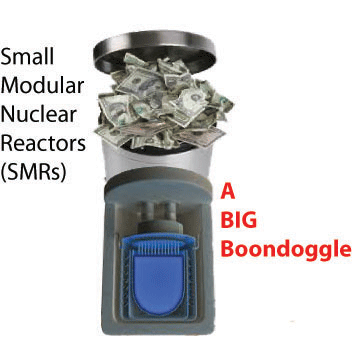 Guardian 17th Nov 2020, Boris Johnson’s £12bn plan for a “green industrial revolution” spans renewable energy, nuclear power and countryside restoration. However, some of the objectives are likely to be difficult to reach, and the plan has been criticised for a lack of ambition in key areas.
UK government wastes tax-payer money on small and large nuclear reactors that will never be cheap or safe
 FoE Scotland 17th Nov 2020, Friends of the Earth Scotland gave a scathing reaction to
  the UK Government’s announcement of a 10-point plan on climate and energy, calling for much more priority on solutions which can reduce emissions and create jobs today.
crisis like carbon capture and storage, hydrogen and nuclear. “While there are some crumbs from the table in terms of the welcome new target of 2030 to phase out fossil-fuelled cars, overall there is too little new money and too much funding committed to long-term, dangerous distractions.
https://foe.scot/press-release/response-to-the-uk-10-point-climate-plan-for-net-zero/
Sizewell C nuclear plant ‘not value for money’, and would sabotage the govt’s pledge for nature
|
New Civil Engineer 18th Nov 2020, Plans for proposed Sizewell C nuclear power station on the Suffolk coast,
which is currently waiting for planning approval, would “sabotage” the |
|
Destruction of wildlife habitat, Coronation Wood to be felled, for Sizewell C nuclear project
(TASC), and the invaluable financial and moral support from many concerned
citizens, TASC are devastated to learn that the Courts have refused its
application to make a final appeal to overturn the decision to allow the
destruction of Coronation Wood.
case to court, said “Due to the crass decision-making of East Suffolk
Council, EDF have now been given the green light to carry out their
Sizewell B relocation plans which include taking their chain-saws to and
destroying the whole of Coronation Wood.
allow the felling of the wood. Sizewell C may never get permission and a
100 year old wood cannot be replaced. Due to its removal there will be a
major loss of visual screening of the nuclear industrial complex causing
increased noise and light pollution, totally ignoring the site’s status
as an Area of Outstanding Natural Beauty.
setts, bird and bat habitats blows EDF’s environmental credentials out of
the water. There are alternatives but EDF and the council chose not to
pursue them. EDF is not concerned in any way, shape or form for the well
being of the ecology of the area, nor that of locals who are deeply upset
by their plans”
https://tasizewellc.org.uk/latest-on-coronation-wood-judicial-revue/
 |
ReplyForward
|
The Irish sea – plagued by dumped munitions and radioactive trash
Belfast Telegraph 13th Nov 2020, A report highlighting the dangers of underwater explosions and radioactive
waste has cast doubt on the viability of any Irish Sea bridge. The UK and Ireland Nuclear Free Local Authorities (NFLA) study focused on Beaufort’s Dyke, one of the deepest sections of water in Europe and a training sitefor nuclear submarines. Munitions from both world wars and radioactive waste, when it was permitted in Europe, are known to have been dumped in the stretch of sea.
1 This Month




PLEASE OPPOSE HR 8255 AND S.3639 – bills would accelerate satellite deployment, with no environmental review or safeguards – https://ncstd5li.quorum.us/campaign/169331/
To see nuclear-related stories in greater depth and intensity – go to https://nuclearinformation.wordpress.com
-
Archives
- September 2026 (330)
- August 2026 (330)
- July 2026 (355)
- June 2026 (287)
- May 2026 (306)
- April 2026 (356)
- March 2026 (251)
- February 2026 (267)
- January 2026 (308)
- December 2025 (358)
- November 2025 (359)
- October 2025 (375)
-
Categories
- 1
- 1 NUCLEAR ISSUES
- business and costs
- climate change
- culture and arts
- ENERGY
- environment
- health
- history
- indigenous issues
- Legal
- marketing of nuclear
- media
- opposition to nuclear
- PERSONAL STORIES
- politics
- politics international
- Religion and ethics
- safety
- secrets,lies and civil liberties
- spinbuster
- technology
- Uranium
- wastes
- weapons and war
- Women
- 2 WORLD
- ACTION
- AFRICA
- Atrocities
- AUSTRALIA
- Christina's notes
- Christina's themes
- culture and arts
- Events
- Fuk 2022
- Fuk 2023
- Fukushima 2017
- Fukushima 2018
- fukushima 2019
- Fukushima 2020
- Fukushima 2021
- general
- global warming
- Humour (God we need it)
- Nuclear
- RARE EARTHS
- Reference
- resources – print
- Resources -audiovicual
- Weekly Newsletter
- World
- World Nuclear
- YouTube
-
RSS
Entries RSS
Comments RSS

