Planning inspectors recommended against Wylfa Newydd project on Anglesey
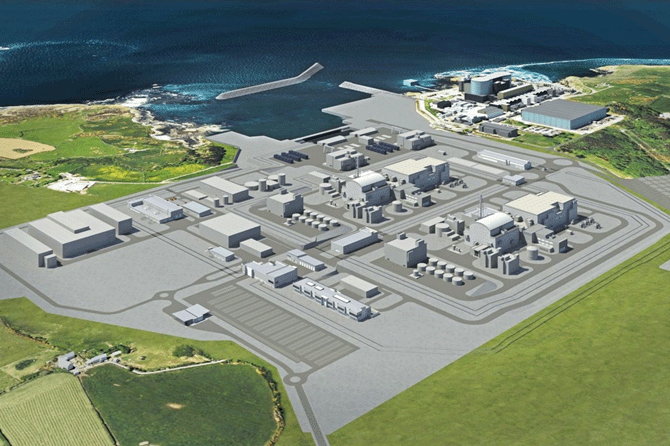
Planning inspectors recommended refusal for new nuclear power plant, Nation Cymru Gareth Williams, local democracy reporter
Plans to build a new nuclear power station were likely to be refused even before the project was shelved by backers.
UK Government appointed planning inspectors had recommended that the Wylfa Newydd project on Anglesey be rejected over a number of concerns from experts.
The application has since been withdrawn after Hitachi, the company behind the project, decided that the power plant was too expensive to build without a funding deal with the UK Government in place.
Energy company Horizon – a subsidiary of Hitatchi – needed an Approval of the Development Consent Order (DCO) to allow the £16bn project to go ahead.
DCOs are needed for any planning application regarded as a major UK infrastructure project and DCO process for Wylfa Newydd had been underway since 2018.
The Planning Inspectorate’s conclusion, which was made public for the first time on Thursday, was intended to be considered as a recommendation – with the final decision down to the UK Government.
But expert planning officers felt that the scheme would fail to meet some of the United Nations’ biological diversity standards.
Inspectors also told UK Government ministers it had concerns over the project’s impact on the local economy, housing stock and the Welsh language…..
The findings of the planning inspectors’ report, which were made public for the first time on Thursday, said there was a lack of scientific evidence put forward by developers to demonstrate that the Arctic and Sandwich tern populations around the Cemlyn Bay area, where the plant was set to be built, would not be disturbed by construction.
There were fears that these birds would subsequently abandon nearby Cemlyn Bay as a result.
It also raised wider concerns over the general impact on Cemlyn Bay, the Cae Gwyn site of special scientific interest and Tre’r Gof……..
It went on to conclude: “Having regard to all the matters referred in this report, the ExA’s conclusion is that, on balance, the matters weighing against the proposed development outweigh the matters weighing in favour of it.
“The ExA therefore finds the case for development is not made and it recommends accordingly.”
‘Pulling the plug’
Before pulling the plug on the DCO application last month, Hitachi confirmed that talks had been taking place with potential new investors. But with no concrete offer forthcoming, Hitachi announced it would wind up its Horizon Nuclear Power subsidiary by March 2021……… https://nation.cymru/news/planning-inspectors-recommended-refusal-for-new-nuclear-power-plant/
Daily Post 5th Feb 2021, The UK’s Planning Inspectorate has released its report into Wylfa Newydd –
showing they had recommended refusal over biodiversity issues.
At last, UK government will investigate birth defects amongst children of nuclear test veterans
Mirror 3rd Feb 2021, Thousands of sick children and adults have finally been offered government research into whether their DNA was damaged by Cold War nuclear bomb tests.
An estimated 155,000 descendants of National Servicemen who took part in atomic weapons tests in the 1950s now report 10 times the normal rate birth defects, and are five times more likely to die as infants. Now Veterans Minister Johnny Mercer has promised to consider thorough research into whether they suffer a genetic legacy from Britain’s radiation
experiments.
https://www.mirror.co.uk/news/uk-news/thousands-offered-research-dna-damage-23436272
UK’s Infrastructure Planning Inspectorate recommends against development of Wyfa nuclear project
Planning Inspectorate 4th Feb 2021, Following the recent withdrawal of the application, and in the interests of openness and transparency, we have taken the decision to publish the
Examining Authority’s Recommendation Report. In the light of the ExA’s
findings and conclusions, the ExA under s105 of the PA2008 recommends the
Secretary of State for Business, Environment and Industrial Strategy does
not grant the Wylfa Newydd Project Development Consent Order.
Pandemic causes Britain’s Trident nuclear submarine replacement to be delayed by another year
Announcement raises new questions as to whether UK’s current ageing fleet can be relied on, Guardian, Dan Sabbagh Defence and security editor. Fri 5 Feb 2021
Official documents released at the end of last year quietly confirmed that the current phase of the Dreadnought programme had been put back to March 2022, although the update was not highlighted and it was only spotted by a pressure group.
An SNP member of the defence select committee has now called for it to hold an inquiry into the Trident replacement programme, complaining about a lack of transparency.
An annual update on nuclear replacement, released to MPs before Christmas, said that “recognising the high levels of uncertainty caused by the pandemic” and its impact on supply chains, “delivery phase 2 will continue until March 2022”.
It did not say that this amounted to a one-year delay to the sprawling programme. This was spotted by David Cullen, of the Nuclear Information Service, who recalled a promise made a year earlier to conclude the work in March 2021.
“Covid is going to be with us for a while, and nobody will be surprised if there are other delays to Dreadnought,” Cullen said, arguing that the relative secrecy suggested “this isn’t the behaviour of a department that is confident it can deliver on its promises”.
The Dreadnought programme, first approved by Labour in 2007, has been repeatedly delayed by governments since. The first submarine was initially due to come into service in 2024, then 2028, and now the “early 2030s”, the Ministry of Defence (MoD) says……….
Britain prefers to shroud its nuclear programme in secrecy, but there have been accidents in the past. In 1998 HMS Vanguard, carrying 96 nuclear warheads and 135 crew, plunged into a deep dive following a power failure between Cornwall and the south of Ireland. The crew only managed to regain control through a backup power system.
In February 2009, Vanguard collided with a French nuclear submarine, Le Triomphant, in a freak accident in the Atlantic. Details were initially hushed up, before it was leaked to a newspaper. Fortunately the accident happened at a relatively low speed. Ministers were told that at the time that nuclear safety had not been compromised.
Martin Docherty-Hughes, an SNP member of the defence select committee, said: “It is simply unacceptable that we need to parse UK government statements for half phrases and words which the MoD could be using to cover its own backside.” He said he would be writing to the chair of the committee to demand an inquiry…… https://www.theguardian.com/uk-news/2021/feb/04/trident-nuclear-submarine-replacement-delayed-by-year
Britain’s unaffordable nuclear power plans collapse, one by one
 Times 31st Jan 2021, Nuclear winter for Britain as power plants close. Hinkley Point is last man standing as other power stations are scrapped. Hitachi president Hiroaki Nakanishi had a grand dream when
the Japanese giant paid £696 million for the right to build two nuclear power stations in the UK. “Today starts our 100-year commitment to the UK and its vision to achieve a long-term, secure, low- carbon and affordable energy supply,” declared Nakanishi in 2012, as he signed a deal to buy the Horizon nuclear project from Germany’s RWE and Eon.
particularly when they are the first of a new design. Theresa May’s government eventually offered to take a third of the equity in Horizon alongside the Japanese government and Hitachi. Boris Johnson’s administration is exploring a new financial model, the regulated asset base, where investors could earn a return during construction.
that had begged Hitachi to grant the project a reprieve, executive Toshikazu Nishino said that it had not received adequate backing from government.
https://www.thetimes.co.uk/article/nuclear-winter-for-britain-as-power-plants-close-gb8c5dx07
In its failed search for a national dump site, UK govt rebrands its nuclear waste agency, promises honesty this time.
 Cumbria Trust 30th Jan 2021, Today marks the 8th anniversary of the last attempt to bury the UK’s nuclear waste in Cumbria. On 30th January 2013, Eddie Martin, then Leader of Cumbria County Council, made an impassioned speech to his Cabinet and urged them to call a halt to the search in Cumbria.
The Cabinet agreed and by 7 votes to 3 the process known as Managing Radioactive Waste Safely (MRWS) was stopped. Since West Cumbria was the only area in the country to volunteer, that decision also marked the end of the national search process.
During the 8 years since that decision, the government have been working on a new search process and have been busily rebranding in an attempt to distance themselves from some of the less honest practices which were used during the failed MRWS process.
This time the developer is called Radioactive Waste Management (RWM), a subsidiary of the Nuclear Decommissioning Authority. RWM frequently talk about transparency and openness of the new process, and to be fair we have seen some improvements in our discussions with them, but our suspicion remains that old habits die hard.
Isle of Man Wakes Up to What is Planned – SUB SEA NUCLEAR DUMP — Keep Cumbrian Coal in the Hole

At last there is some Grrrrr over the plan to dump heat generating nuclear waste under the Irish Sea – so far the plan appears to be to looking in all seriousness at having above surface nuclear sprawl at Ghyll Scuar quarry ( on the edge of Millom Deer Park ) with the drift tunnels shunting planetary destroying nuclear wastes under the Marine Conservation Zone outwards towards the Isle of Man. Whats not to like? EVERYTHING!
Good on the Isle of Man Examiner for this headline and write up. To read the article in full (for £1) go to the Isle of Man Examiner
Isle of Man Wakes Up to What is Planned – SUB SEA NUCLEAR DUMP — Keep Cumbrian Coal in the Hole
From both UK and Ireland – calls for independent review into dumping Hinkley nuclear mud into the sea
Nation Cymru 29th Jan 2021, Campaigners on both sides of the Bristol Channel have called for a full independent review into proposals to dump mud from the construction of a
nuclear power plant in the sea off the coast of Cardiff, following the
announcement that a new dumping site off the Somerset coast is also being
considered.
Despite public opposition, in 2018 the Welsh Government
permitted EDF to dump large quantities of mud dredged from construction of
the new Hinkley C nuclear power plant at the Cardiff Deep Grounds inshore
disposal site. EDF insisted the site- only two miles from Cardiff Bay –
was the only suitable site available in the Bristol Channel.
Earlier this month EDF announced its intention to apply to the Marine Management
Organisation (MMO) for a license to dump at Portishead, while also making a
further application to dump at the Cardiff site. No reason has been given
by EDF for the Portishead proposal.
In a joint statement issued with Stop Hinkley and the Geiger Bay campaign, UK & Ireland Nuclear Free LocalAuthorities Steering Committee Chair, Councillor David Blackburn said:
“NFLA was surprised to hear that EDF are now seeking to look at dumping
mud from the Hinkley Point site off the Somerset coast in addition to
continuing to look to dump off the south Wales coast.
Huge legacy of radioactive trash in UK, much of it already in Cumbria
Whitehaven News 30th January 2021, CHRIS WHITESIDE County councillor for Egremont North & St Bees (Conservative) Any consideration of the issue of nuclear waste in Cumbria
must start by recognising one basic fact. No matter how much some people
might wish it were otherwise, Britain already has thousands of tons of
low-level waste material, and a substantial amount of high-level nuclear
material, as a legacy of our existing and historical nuclear programmes.
And much of it is already in Cumbria.
Imagining that the tens of thousands
of cubic metres of nuclear material which is already here at sites like
Sellafield and the LLWR will somehow magically go away if you put up
posters demanding that there should be no nuclear waste in Cumbria or,
worse, try to sabotage any attempt to get a rational discussion going about
how we can most safely manage the nuclear waste which we already have by
vilifying anyone who takes part in a conversation about it, is not just
incredibly stupid but utterly irresponsible.
https://www.whitehavennews.co.uk/news/19051819.whitehaven-news-letters-nuclear-waste-years/
Why nuclear power is a bad way to balance renewable energy
Why nuclear power is a bad way to balance renewable energy https://100percentrenewableuk.org/why-nuclear-power-is-a-bad-way-to-balance-renewable-energy
David Toke, Ian Fairlie and Herbert Eppel from 100percentrenewableuk discuss how nuclear power effectively switches off wind and solar power and how a 100percent renewable energy system is much better for the UK than one involving nuclear power
The Government, backed by a lot of public policy reports paid for by pro-nuclear interests, constantly pushes out the view that nuclear power is ‘essential’ to balancing wind and solar power.
But what they never mention is the massive waste of renewables that occurs in such a scenario.
Under the scenarios planned by the Government nuclear power is paid very high prices to generate power even when there is excess electricity, which pushes renewables to close down.
The Government also refuses to undertake serious investigations of how a system that uses excess renewables to create short and long term storage is a much better way of organising our energy needs rather than wasting more money on building nuclear power statitons.
If you agree the aims of 100percentrenewableuk please join the discussion via our email group.
Half a £billion here, half a £billion there – the costs of Hinkley Point C go up again
 NFLA 28th Jan 2021, Half a billion here, half a billion there – the costs of Hinkley Point C
go up again, just as Hitachi finally gives up on Wylfa B.
The UK & Ireland .Nuclear Free Local Authorities (NFLA) note with little surprise the announcement from EDF Energy that the costs of building the Hinkley Point C has gone up again, now to an eye-watering £23 billion.
It also comes as the Japanese nuclear utility Hitachi formally withdraws its interest from the possible development of the Wylfa B site, criticising the UK Government’s lack of support in its decision.
https://www.nuclearpolicy.info/news/costs-hinkley-point-c-up-again-hitachi-finally-gives-up-wylfa-b/
EDF plans 2 new sites for dumping radioactive mud dredged from Hinkley Point
 NFLA 27th Jan 2021, The UK & Ireland Nuclear Free Local Authorities (NFLA), the ‘Stop
Hinkley’ campaign and the ‘Geiger Bay’ campaign have been involved in
raising concerns over the dumping of large amounts of dredged materials
from the EDF site at Hinkley Point into sites between the south Wales and
the Somerset coast.
building a new nuclear reactor at Hinkley Point, has announced that the
Portishead marine disposal site LU070 is now a possible dumping ground for
the seabed sediment it is seeking to dredge from Bridgwater Bay in order to
sink cooling water intake and outfall tunnels for the new reactors at
Hinkley Point.
Government permitted EDF to dump large quantities of Hinkley C dredged mud
at the Cardiff Deep Grounds inshore disposal site, only 2 miles off the
Cardiff Bay sea front.
suitable site available in the Bristol Channel. However, EDF has recently
announced its intention to apply to the Marine Management Organisation
(MMO) for a license to dump at Portishead, while also making a further
application to dump at the existing Welsh site. No reason has been given by
EDF for the Portishead proposal.
It is all over for Britain’s £20bn Wylfa nuclear project
 Wylfa: End for £20bn nuclear plant bid as plans ditched, It is all over for the £20bn project to build a new nuclear power plant on Anglesey, after developers dropped their planning bid.
Horizon Nuclear Power has pulled a request to approve reactor designs at Wylfa, blaming UK government funding options as one reason.
Japanese backers Hitachi pulled out of the development last September.
Another firm has since unveiled plans for a smaller hybrid nuclear and wind plant on a separate site at Wylfa.
The Development Consent Order (DCO) process, which is the name given to planning applications for major UK infrastructure projects such as Wylfa, has been under consideration since June 2018.
A decision was due to be made on the plan by the UK’s business and energy secretary at the end of April, following a series of requests by Horizon to extend the process while it held talks with other interested parties.
But Horizon has now written to the Planning Inspectorate and the Department for Business, Energy and Industrial Strategy, confirming the end of the troubled project.
Its letter said negotiations on the future of Wylfa had been “positive and encouraging”.
However, it added: “They have not, unfortunately, led to any definitive proposal that would have allowed the transfer to some new development entity.
“In light of this and in the absence of a new funding policy from HM Government, Hitachi Ltd., has taken the decision to wind-up Horizon as an active development entity by 31 March 2021.
“As a result, we must now, regretfully, withdraw the application.”…… https://www.bbc.com/news/uk-wales-55833186
Ho hum – another delay, another cost rise – for the beleaguered Hinkley nuclear power project
expected to rise again, the energy firm behind the plant revealed. EDF said
significant progress has been made on the site in Somerset but the start of
electricity generation is now expected in June 2026, compared with previous
estimates of an opening date at the end of 2025. The cost for the project
is now estimated at between £22 billion and £23 billion, compared with
projected costs of £21.5 billion and £22.5 billion announced in 2019. The
coronavirus crisis led to a number of changes on the Hinkley site,
including reducing the number of workers to enable social distancing, and
concentrating on the most critical areas of construction.
https://www.somersetlive.co.uk/news/uk-world-news/uks-new-nuclear-power-plant-4932726
Pandemic adds to delays and costs of Hinkley Point C nuclear project
|
Hinkley Point C nuclear power station cost rises by £500m, French group EDF warns pandemic delays will push back estimated start-up date to 2026 Ft.com, 27 Jan 21,
France’s EDF has again revised up the expected cost of Hinkley Point C, the nuclear power station under construction in south-west England, warning that delays arising from the pandemic will add about £500m and push back the station’s estimated start-up date to 2026.
The group, which is financing the construction of the plant along with its junior partner CGN of China, said it expected the project in Somerset to cost up to £23bn compared with a 2019 estimate of a maximum of £22.5bn. EDF quotes costs in 2015 prices in order to maintain consistency for the markets but the real bill is likely to be higher after accounting for inflation. …….https://www.ft.com/content/fbc43de5-d3ae-49fd-9f5f-9e84f1db508d
|
|
1 This Month




PLEASE OPPOSE HR 8255 AND S.3639 – bills would accelerate satellite deployment, with no environmental review or safeguards – https://ncstd5li.quorum.us/campaign/169331/
To see nuclear-related stories in greater depth and intensity – go to https://nuclearinformation.wordpress.com
-
Archives
- September 2026 (330)
- August 2026 (330)
- July 2026 (355)
- June 2026 (287)
- May 2026 (306)
- April 2026 (356)
- March 2026 (251)
- February 2026 (267)
- January 2026 (308)
- December 2025 (358)
- November 2025 (359)
- October 2025 (375)
-
Categories
- 1
- 1 NUCLEAR ISSUES
- business and costs
- climate change
- culture and arts
- ENERGY
- environment
- health
- history
- indigenous issues
- Legal
- marketing of nuclear
- media
- opposition to nuclear
- PERSONAL STORIES
- politics
- politics international
- Religion and ethics
- safety
- secrets,lies and civil liberties
- spinbuster
- technology
- Uranium
- wastes
- weapons and war
- Women
- 2 WORLD
- ACTION
- AFRICA
- Atrocities
- AUSTRALIA
- Christina's notes
- Christina's themes
- culture and arts
- Events
- Fuk 2022
- Fuk 2023
- Fukushima 2017
- Fukushima 2018
- fukushima 2019
- Fukushima 2020
- Fukushima 2021
- general
- global warming
- Humour (God we need it)
- Nuclear
- RARE EARTHS
- Reference
- resources – print
- Resources -audiovicual
- Weekly Newsletter
- World
- World Nuclear
- YouTube
-
RSS
Entries RSS
Comments RSS

