Protests against nuclear storage plans that could kill the tourist industry
Protesters warn nuclear storage plans could kill tourism as council moves
forward with talks. Protesters are unhappy after county councillors agreed
to talk to the government company behind a potential nuclear waste disposal
site in Lincolnshire. Lincolnshire County Council’s Environment and
Economy Scrutiny Committee on Tuesday morning agreed to join a working
group to look at Radioactive Waste Management’s (RWM) potential plans for
a Geological Disposal Facility in Theddlethorpe. Campaigners against the
plans who gathered outside the council before the meeting, however, are not
happy with the decision and have said moving the plans forward creates
uncertainty for local businesses and residents.
Lincolnite 14th Sept 2021
Protesters warn nuclear storage plans could kill tourism as council moves forward with talks
Climate change, sea level rise – real and present danger to UK’s Bradwell and Sizewell nuclear sites
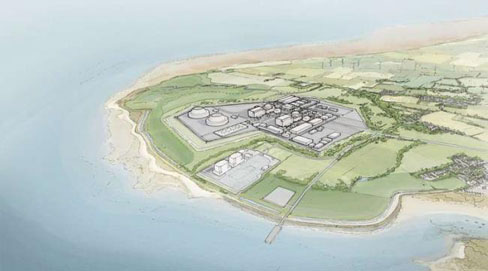
Climate Change the big issue for nuclear power on the East coast, https://www.banng.info/news/press-releases/climate-change-and-nuclear-power/ 11 September 2021 According to Andrew Blowers, Emeritus Professor of Social Sciences at the Open University, Climate Change has become the overriding issue facing the future of the proposed Sizewell C and Bradwell B nuclear power projects on the East Anglian coast. ‘Far from being a solution to the problem of Climate Change, new nuclear power stations like Sizewell C and Bradwell B on the fragile and vulnerable east coast, are likely to become victims of the inevitable, imminent and irreversible consequences of global warming’, he said.
Speaking at a Specific Hearing at the Sizewell C Examination to discuss Policy and Need, Professor Blowers stated that Climate Change was the ‘transformative issue’ of Policy and should be at the very heart of the discussion about building coastal infrastructures like nuclear power stations.
He was disappointed that the Examination Agenda was narrowly framed and the process favoured a legalistic approach. This encouraged a fragmented discussion and a tendency to focus on specific details while losing sight of the bigger picture.
The Examination process must raise its sights from the interminable and obfuscating legalistic debates controlled by developers and give attention to the real and present danger that Climate Change poses for the security and viability of projects in such unsuitable locations. ‘
‘Put simply, there is little justification for these huge structures in terms of need. But, regardless of need, given the threat to the integrity of the sites and the risks to present and future generations and environments, the proposals should be scrapped forthwith’.
The recent Report of the Intergovernmental Panel on Climate Change (IPCC) has spelled out in uncompromising, incontrovertible and unequivocal terms that a rise in global temperatures of 1.50C above pre-industrial levels is already inevitable. It is highly likely that 20C, the level which scientists say may just be manageable, will be reached by the end of the century, and possibly before, if present trends are not arrested. Sea level rise will be around a metre and, as ice melts and oceans heat up, it will continue thereafter. The IPCC states that a sea level rise of 2 metres by 2100 and 5 metres by 2150 ‘cannot be ruled out due to deep uncertainty in ice sheet processes’.
As sea levels rise, the frequency and severity of coastal flooding and erosion will increase and extreme events that occurred once in a century in the recent past are projected, in some scenarios, to occur annually in future. Of course, there is great uncertainty the further forward we look. But, what is certain, is that the impacts of climate change on sea level rise, storm surges and coastal processes could render these east coast sites unviable. This would pose a threat to the security of the highly radioactive wastes remaining stored on site until the latter half of the next century.
At the Hearing, Sizewell C’s developer, EDF relied on governmental polices enshrined in National Policy Statements (NPSs), now ten years old, to claim that the nuclear energy from Sizewell C was necessary. In its more recent pronouncements, the Government is far more equivocal in its support for nuclear energy from such large-scale power stations.
Regardless of whether nuclear is needed at all, Sizewell and Bradwell are manifestly not ‘potentially suitable’ sites as originally indicated in the NPS all those years ago. At both sites the developers claim that the hard defences proposed will be sufficient to protect the nuclear islands against the ravages of climate change.
But, beyond the end of the century, sea level will continue to rise and the impacts become more severe and scenarios for the worst case but plausible change are increasingly uncertain. It becomes impossible to make specific projections and modelling of more extreme coastal conditions is problematic. ‘What possible use will be projections into an unknowable future?’, asks Professor Blowers.
‘It is all too little, too late. I believe we must take the issue of Climate Change seriously and refuse permission to develop these coastal nuclear power stations. It seems inconceivable that the defensive structures can survive intact into the unknown but worsening conditions of continuing sea level rise and extreme events that are inevitable in the future. There can be no possible justification for inflicting this legacy on our coastal communities now and in the future.’
The Cold War near disasters at RAF Lakenheath could have left Suffolk as a nuclear wasteland

The Cold War near disasters at RAF Lakenheath could have left Suffolk as a nuclear wasteland https://www.suffolknews.co.uk/mildenhall/go-anywhere-just-get-away-from-here-how-suffolk-almost-9215663/ By Dan Barker – dan.barker@iliffepublishing.co.uk , 13 September 2021 During the height of the Cold War nuclear bombs were dotted across the country, ready to wipe the USSR off the face of the map at a moment’s notice: but, on two separate occasions, Suffolk almost became victim to the very weapons which were meant to protect it.
July 27, 1956 was like any other summer’s day. Across the country attention was glued to the Ashes fourth test at Old Trafford, and four American airmen were in a B-47 bomber, on a routine training mission from RAF Lakenheath. But, as they were practising touch-and-go landings, their bomber careered out of control and went off the runway.
it ploughed into an igloo containing three Mark-6 nuclear weapons, tearing the building apart.
The plane then
exploded, killing all four men on board, and showered the world-ending weapons with burning aviation fuel.
Most of A/C [Aircraft] wreckage pivoted on igloo and came to rest with A/C nose just beyond igloo bank which kept main fuel fire outside smashed igloo. “Preliminary exam by bomb disposal officers says a miracle that one Mark Six with exposed detonators sheared didn’t go. Firefighters extinguished fire around Mark Sixes fast.” – Telegram from RAF Lakenheath to Washington DC
Fortunately the atomic power of the bomb was missing that day, with the cores un-installed in all three for storage, but the explosives needed to trigger the deadly nuclear reaction were still in place.
With 8,000 pounds of high explosives combined with depleted uranium-238, they were a nuclear ticking time bomb as firefighters fought to put out the blaze.
Had they exploded the radioactive uranium would have been scattered over a wide area, and, depending on the wind, tens of thousands of people would have been at risk from the toxic dust across Suffolk.
Knowing the enormity of the situation base fire chief Master Sgt L. H. Dunn ordered his crew to ignore the burning wreckage of the bomber, and the airman inside, and douse the flames engulfing the nuclear storage building.
At the time it had been shrouded in secrecy, but decades later one senior US officer made it very clear how lucky Suffolk was to have narrowly missed out on a nuclear disaster. “It is possible that part of Eastern England would have become a desert,” the then former officer told Omaha World Herald in Nebraska, who revealed the potentially catastrophic incident in November 1979.
Another said that “disaster was averted by tremendous heroism, good fortune and the will of God”.
A top secret telegram sent to Washington DC from the base, which has since been revealed, told of the near miss. “Most of A/C [Aircraft] wreckage pivoted on igloo and came to rest with A/C nose just beyond igloo bank which kept main fuel fire outside smashed igloo.
Suffolk was lucky this time, but the incident caused great alarm in the British government, and it was decided it would try and block US authorities from ordering base evacuations because of the concern of causing mass panic in the country.
But what would happen if word got out that its most important ally had, almost, accidentally, made a huge part of the United Kingdom a nuclear wasteland?
Simple: Its policy for decades, if the press ever caught wind of the near miss, was to just deny it. After the news was broken in the American press in 1979, only then was it acknowledged something happened.
On November 5 that year the US Air Force and the Ministry of Defence would only admit the B-47 did crash.
In fact it took until 1996, some four decades after the near disaster, for the British state to accept the true scale of the accident in public.
But that near miss wasn’t the only one.
For on January 16, 1961, an F-100 Super Sabre, loaded with a Mark 28 hydrogen bomb caught on fire after the pilot jettisoned his fuel tanks when he switched his engines on.
As they hit the concrete runway the fuel ignited and engulfed the nuclear weapon – a 70 kilotons – and left it “scorched and blistered”.
Suffolk was saved again by the brave work of base firefighters who brought the blaze under control before the bomb’s high explosive detonated or its arming components activated.
T
errifyingly it was later discovered by American engineers that a flaw in the wiring of Mark 28 hydrogen bombs could allow prolonged heat to circumvent the safety mechanisms and trigger a nuclear explosion.
Had it gone, thousands of people would be dead within seconds, and thousands more would have been injured. As with the first incident, as well as the immediate blast, radioactive debris could have fallen in towns as far away as Ipswich and Lowestoft, given the right wind direction, spreading the toxic dust across Suffolk.
Since Clement Attlee ordered the scientists to investigate the creation of a nuclear bomb in August 1945, the British state has known that being a nuclear power comes with risk as well as reward.
It also knew it paid to be part of a nuclear alliance,
NATO, and with it came American nuclear bombs and the risk they brought.
Beyond the maths of working out how large the explosion would have been, it is impossible to know the true implications.
RAF Lakenheath was listed as a probable target for Soviet attack according to now released Cold War era documents, and intelligence agencies and war planners expected two 500 kiloton missiles to hit the site if the West was under attack.
Disaster creates uncertainty. Nobody would have known it was an accident within the minutes and hours after a blast, they would have just been dragged into a nuclear bunker and told of a large explosion at an airbase in Suffolk.
Where would that have left a British prime minister, an American president, and the rest of NATO, thinking they have come under attack?
In July 1956, and again in January 1961, those firefighters didn’t just save Suffolk … they might have saved the world.
Earthquakes Stopped Fracking – So Why the Monstrous Silence On “Likely” Induced Seismicity Five Miles From Sellafield? Exactly Who is Protecting Who? — RADIATION FREE LAKELAND

Originally posted on Keep Cumbrian Coal in the Hole: The following letter has been sent to Cumbria County Council and the Planning Inquiry. Our trembling earth was the reason fracking was halted – the siesmic impacts from the Cumbrian Coal Mine are set to be far worse than that from fracking and yet there is…
Earthquakes Stopped Fracking – So Why the Monstrous Silence On “Likely” Induced Seismicity Five Miles From Sellafield? Exactly Who is Protecting Who? — RADIATION FREE LAKELAND
The real-life anti-nuclear peace camp that is the subject of BBC drama ”Vigil”
‘BAN THE BOMB’ Inside real-life anti-nuclear peace camp that inspired Vigil’s Dunloch from mass arrests to blockades BBC drama Vigil has had viewers glued to their screens. https://www.thesun.co.uk/news/16093525/real-nuclear-peace-camp-vigil-faslane/
The series, which pulled in 5.4 million viewers with its second episode, stars Suranne Jones as a detective sent on to a Trident submarine after the death of a sailor.
While Suranne’s character DCI Amy Silva has been trying to uncover who murdered Craig Burke underwater, her colleague and lover DS Kirsten Longacre, played by Rose Leslie, has been visiting the fictional Dunloch camp to probe possible links to a cover-up.
And it turns out that Dunloch was based on the world’s longest-running anti-nuclear peace camp in Scotland, Faslane, set up in 1982.
The camp only has three members left now – but used to have thousands of occupiers.
Faslane was set up in 1982 by anti-nuclear campaigners Margaret and Bobby Harrison, in response to the decision by former Prime Minister Margaret Thatcher to replace the ageing Polaris submarines with Trident – which were even bigger.
It began as just a couple of tents pitched outside the Faslane naval base, then slowly evolved into more permanent shacks, huts and caravans.
Margaret and Bobby eventually left after a few months – but thousands of other activists have held the fort over the years.
Nicola Sturgeon protested
In its four decades, the camp has lived on through the end of the Cold War and changes in government on either side of the Scottish border.
It has been the focus of a great number of protests at the naval base.
First Minister of Scotland Nicola Sturgeon, and her deputy John Swinney are just two of the politicians who’ve joined protests at Faslane
In 2001’s “Big Blockade”, left-wing rebels Tommy Sheridan and George Galloway were among 300 arrested, along with 15 church ministers.
In 1983, an Easter march by 1,500 Campaign for Nuclear Disarmament supporters, all singing and dancing, led to five arrests, including two women dressed as Easter bunnies.
Year-long protest
But the last major event at the camp was Faslane 365 – which was originally meant to be a year-long protest running from 2006 to 2007.
The protest, which was in response to Labour PM Tony Blair ’s decision to replace Trident with more modern nuclear weapons rather than get rid of it, saw police arrest 1,110 people over 190 days.
On 7 January 2007, a group of around 40 world-renowned academics including Sir Richard Jolly and 25 students from Oxford, Cambridge, Sussex and Edinburgh held a seminar discussing the replacement of the Trident missiles at the base.
Protesters subsequently managed to stage the most successful blockade of the campaign, closing the North Gate for six hours.
All those who blockaded were arrested and held overnight.
The vast majority of arrested protesters were released, receiving a letter from the Procurator Fiscal’s office explaining that although “evidence is sufficient to justify my bringing you before the Court on this criminal charge”, the Procurator Fiscal has “decided not to take such proceedings”.
Dwindling members
Since then, the more urgent climate emergency has been a focus for the peace camp, and, by 2017, the camp only had 10 residents.
It now has just three – however just one woman is still permanently living there, Willemein Hoogdendoorn.
She is on remand awaiting trial after refusing bail conditions following her arrest last month at a blockade on the anniversary of the Hiroshima bomb.
Despite the dwindling number of members, Faslane still definitely cares about stopping nuclear weapons.
One banner at the camp reads: “£200billion Trident Renewal. Let’s fund our NHS instead”.
A bus is colourfully graffitied with the words “Ban the bomb”.
‘We don’t want to be misrepresented’
Camp dwellers turned away Vigil producers hoping to film on location at the camp, claiming the plot is “unrealistic”.
Johnny Rodgers, 36, from Bingley, West Yorks, told the Mirror: “The BBC came and offered £500 to film on site.
“When we saw the script we said, ‘No, that’s not realistic. We don’t want to be misrepresented’.”
‘Vigil is unrealistic’
Another protester, Andy – who has lived there on and off for 15 years – claimed Vigil is unrealistic due to the fact that sailor Craig Burke was secretly dating peace camp protester Jade Antoniak.
He added: “We were told one of the women from the camp falls in love with a submariner. That just isn’t realistic.
“Sailors aren’t even allowed to come here any more as far as I’m aware, or they’d get into trouble.
“They stay at the base and we stay here, there’s no fraternisation at all.”
Michael McGuinness, 35, from nearby Helensburgh, agreed.
He said no sailors have visited in more than a decade.
He recalled: “Back in 2006 you’d have all the drunk sailors in. They’d sit and have a laugh with you.”
The remaining Faslane residents may not be onboard with Vigil, but there’s no denying the BBC drama has put it firmly back on the map.
Nuclear weapons out of Scotland within three years of independence, SNP agrees,
Nuclear weapons out of Scotland within three years of independence, SNP agrees, The National, By Kirsteen Paterson @kapaterson 12 Sept 21,
NUCLEAR weapons must be removed from the River Clyde within three years of an independence vote, SNP members agree.
At today’s party conference, which is being held remotely, members voted by 528 to 14 in favour of a resolution calling upon “a future SNP government of an independent Scotland to remove nuclear weapons from Scotland within three years”.
Speaking in favour of the move, SNP CND convener Bill Ramsay urged members not to allow HM Naval Base Clyde, which houses the Trident system, to become “Guantanamo on the Clyde”, retained as UK territory in a sovereign Scottish state, and Joan Anderson of the party’s Glasgow Kelvin branch spoke against the potential for a “Gibraltar model” which would allow “de facto colonial possession” of the site, near Helensburgh………..
Under SNP defence diversification plans, the base could become the headquarters of an independent Scottish conventional military, a move which could cushion the local economy from the impact of Trident removal. https://www.thenational.scot/news/19575650.nuclear-weapons-scotland-within-three-years-independence-snp-agrees/
Merthyr Tydfil County Borough Council supports Treaty on Prohibition of Nuclear Weapons
The UK & Ireland Nuclear Free Local Authorities (NFLA) welcomes
yesterday’s decision of Merthyr Tydfil County Borough Council to
unanimously pass a resolution supporting the Treaty on the Prohibition of
Nuclear Weapons (TPNW), as part of the ICAN Cities Appeal. Merthyr Tydfil
becomes the fourth Welsh Council to pass such a resolution, following on
from Gwynedd County Council, Bangor City Council and Nefyn Town Council.
NFLA 9th Sept 2021
We must listen to young people on the climate crisis as-they will inherit the earth if theres anything left of it
Here in Scotland 50 young activists from across the country have joined
forces to create an official COP26 Youth Climate Programme. The initiative
has been designed to equip other young Scots with the knowledge, skills and
confidence to engage with proceedings at the conference. With Scottish
Government support, it will see youngsters from all backgrounds and regions
come together to take part in tailored training schemes.
Scotsman 10th Sept 2021
Planned UK-Australia trade deal – a dangerous precedent for climate change policy
Green groups and opposition MPs have responded angrily to news the UK
government has agreed to drop binding climate targets from the planned
UK-Australia trade deal, accusing Ministers of “a massive betrayal of our
country and our planet”.
Greenpeace’s John Sauven offered a withering
assessment of the government’s decision, warning that it set a dangerous
precedent for future trade deals with other carbon intensive nations. “It
will be a race to the bottom, impacting on clean tech sectors and farmers’
livelihoods. There should be a moratorium on trade deals with countries
like Australia until they improve on their weak climate targets and end
deforestation. At the moment the public and parliament are being duped by
the Prime Minister into thinking this deal is great for Britain when in
reality nothing could be further from the truth.”
Business Green 9th Sept 2021
Earthquake risks for proposed coal mine in Cumbria, all too close to Sellafield nuclear site
Geotechnical experts have urged caution over claims from a campaign group
that the proposed Cumbrian coal mine could cause earthquakes. Before the
start of the public inquiry into the mine – which began yesterday –
campaign group Radiation Free Lakeland said that the development poses
induced earthquake and subsidence risk. The group believes that “mining
induced seismicity is likely to occur” at the coal mine, and also
emphasised that nuclear waste site Sellafield is 8km away.
“The majority
of anthropogenic-related earthquakes were caused by coal mining and the
decline in their numbers from the 1980s to the 2000s was concurrent with a
decline in UK coal production,” Radiation Free Lakeland said. “The coal
mine will induce earthquakes in the vicinity of the world’s riskiest
nuclear site – that is a given – let’s hope and pray that the massive
silence from NGOs over the nuclear elephant in the room does not give the
government (who are employing the coal boss) wriggle room to approve the
coal mine.
“We urge all those speaking against the mine at the public
inquiry to give at least a mention to the fact that this coal mine would
mine out voids faster than any previous coal mine in UK history and would
induce earthquakes and cause subsidence in the Irish Sea and Sellafield
area.” Geotechnical specialist Clive Edmonds said that “in principle,
mining can induce low magnitude, shallow depth earthquake activity”.
“Such activity has been noted in many former coal field areas where
several different depth coal seams underlying each other were extracted in
close proximity to fault lines,” he said.
However, Edmonds emphasised
that “whether and to what degree” the Cumbrian coal mine will cause
earthquake activity “will depend upon the specific mine design and
development plan over time taking account of the known regional structural
geology”.
New Civil Engineer 8th sept 2021
Trident: Scots urged to write to UN to demand removal of nuclear weapons
Trident: Scots urged to write to UN to demand removal of nuclear weapons, The National, 5 Sept 21, By Martin Hannan THE Yes activist behind the project for Scots to make a declaration of sovereignty to the United Nations has taken the idea further with a plea for the UN to be told that Scotland doesn’t want nuclear weapons on its soil.
Mike Fenwick started the Declaration of a Sovereign Scot project asking people to send letters to the secretary general of the UN confirming the desire for self-determination, and now he wants letters sent to Antonio Guterres to draw attention to Scotland’s opposition to Trident and all nuclear weapons.
Fenwick says this concept is set against the background of the UN Treaty on the Prohibition of Nuclear Weapons and how that compares with Prime Minister Boris Johnson’s announcement that he intends to increase the stock of such weapons.
He said: “At the beginning of this year at the United Nations, a treaty which had been in discussion for at least four or five years was finally announced and it was open to countries to ratify the Treaty on the Prohibition of Nuclear Weapons.
Straightforward you would think, but it only took a few months before Boris Johnson decided to announce it was not for the UK, and we’re going to increase our warheads despite any treaties prohibiting them.
“We’ve got 180 so far, and now they are to go up by a third to 240. How many people does Boris Johnson want to threaten with annihilation?
“My question is what, if anything, can we do about it?”…………..
Sometimes even the smallest action starts a chain of events where it is only with hindsight that you can tell what caused that event to occur.
“That will be true of how we regain independence for Scotland – lots of small actions which seem insignificant but which produce a chain of events that leads to independence for our country.”
Fenwick also suggested that a petition be submitted to the Petitions Committee at the Scottish Parliament calling for a referendum on the subject of nuclear warheads harboured in Scotland.
He said: “The parliament should allow a referendum in which all of us can voice our opinion on support for the UK’s position, or support for the UN’s position. We should be doing this well in advance of indy.”https://www.thenational.scot/news/19560455.trident-scots-urged-write-un-demand-removal-nuclear-weapons/
The Faslane Peace Camp inspired the BBC drama Vigil
Meanwhile the series recalls the real drama
Sitting on Scotland’s strikingly beautiful west coast, the world’s longest-running anti-nuclear peace camp has been uniting protesters for 39 years. But after dropping out of the headlines as its numbers dwindled from 400 to just three, Faslane Peace Camp has the nation’s attention once more – as the inspiration for gripping BBC drama Vigil.
Mirror 4th Sept 2021
https://www.mirror.co.uk/tv/tv-news/inside-worlds-longest-running-anti-24909945
UK government scared that Scotland’s Nicola Sturgeon will use COP25 to further SCotland’s independence
No 10 has been plotting how to cut Nicola Sturgeon out of Cop26 to prevent
the first minister stealing the limelight, The Independent can reveal.
Advisers at No 10 and the Cabinet Office have been trying to work out how
to prevent this autumn’s landmark Glasgow summit from becoming an
“advert” for Scottish independence.
Independent 4th Sept 2021
https://www.independent.co.uk/news/uk/politics/cop26-scotland-independence-indyref2-b1902613.html
Virgin Galactic ‘ignored red warning light’ in Branson’s race against Bezos to be first billionaire to space

FAA currently investigating 11 July flight for veering off course https://www.independent.co.uk/space/virgin-galactic-branson-jeff-bezos-b1913228.html, Anthony Cuthbertson, 3 Sep 21,
Virgin Galactic is under investigation after veering off course and reportedly ignoring a red warning light during the 11 July flight that took billionaire Richard Branson to space.
The Federal Aviation Administration (FAA) noted that the space craft “deviated from its Air Traffic Control clearance as it returned to Spaceport America” during the Unity 22 flight.
A report in The New Yorker, which first drew attention to the FAA investigation, also claimed that a red warning light flashed due to the flight path being too shallow.
The Red Warning Light on Richard Branson’s Space Flight
The F.A.A. is investigating the ship’s off-course descent. more https://www.newyorker.com/news/news-desk/the-red-warning-light-on-richard-bransons-space-flight, By Nicholas Schmidle 3 Sept 21, On July 11th, nearly a minute into the rocket trip carrying Richard Branson, the British billionaire, to space, a yellow caution light appeared on the ship’s console. The craft was about twenty miles in the air above the White Sands Missile Range, in New Mexico, and climbing, travelling more than twice the speed of sound. But it was veering off course, and the light was a warning to the pilots that their flight path was too shallow and the nose of the ship was insufficiently vertical. If they didn’t fix it, they risked a perilous emergency landing in the desert on their descent.
Riding rockets is dangerous stuff. Around 1.4 per cent of Russian, Soviet, and American crewed spaceflight missions have resulted in fatalities. The foremost commercial space companies—Branson’s Virgin Galactic, Elon Musk’s SpaceX, and Jeff Bezos’s Blue Origin—must, over the coming years, bring that number down. Their profits depend on making frequent and safe human spaceflight a reality. “A private program can’t afford to lose anybody,” Branson has said.
And yet, perhaps more than any of its competitors, Branson’s company is already hard at work fashioning its identity as a luxury life-style brand. Virgin Galactic is marketing its space-tourism business but for the time being remains an experimental flight-test program. I’ve been covering this company for almost seven years, reporting on its triumphs and tragedies, and on the disconnect between its lofty rhetoric (“Virgin Galactic’s mission is to democratize space,” Branson has said) and its supersonic risks. This account was informed by discussions with eight people knowledgeable about the program.
Virgin Galactic’s space vehicle is unique among its competitors. Whereas SpaceX and Blue Origin operate traditional, vertical-launch rockets that are automated by engineers, Virgin Galactic uses a piloted, winged rocket ship. Every test flight is crewed, which makes each one a matter of life and death. (SpaceX, on the other hand, completed scores of launches before it flew with a human onboard; Blue Origin completed more than a dozen launches before it did the same.)
The success of Virgin Galactic’s program, therefore, will ultimately depend on its pilots, high-calibre but nonetheless fallible, making the right decisions and adjustments in specific moments—like when a yellow caution light comes on. Alerts on the console can be triggered by any number of issues. On the July 11th flight, with Branson on board, it was a trajectory problem, or what’s known as the “entry glide cone.” The ship uses rocket power to get into space, but glides back to Earth and lands on a runway, like the space shuttle would do. This method, mimicking water circling a drain, enables a controlled descent. But the ship must begin its descent within a specified, imaginary “cone” to have enough glide energy to reach its destination. The pilots basically weren’t flying steeply enough.
Not only was the ship’s trajectory endangering the mission, it was also imperilling the ship’s chances of staying inside its mandated airspace. The Federal Aviation Administration regulates the private space industry and sets aside airspace for each mission, seeking to prevent collisions with general air traffic, including commercial airliners, and to limit civilian casualties in the event of an accident. The regulator uses formulas detailed in a hundred-and-twenty-one-page document—including an equation for calculating expected casualties—to assess the safety of a given spaceflight. According to the F.A.A., an acceptable Ec, as the equation is called, involves no more than one expected casualty per ten thousand missions. The agency designates airspace for flights with that equation in mind.
The rocket motor on Virgin Galactic’s ship is programmed to burn for a minute. On July 11th, it had a few more seconds to go when a red light also appeared on the console: an entry glide-cone warning. This was a big deal. I once sat in on a meeting, in 2015, during which the pilots on the July 11th mission—Dave Mackay, a former Virgin Atlantic pilot and veteran of the U.K.’s Royal Air Force, and Mike Masucci, a retired Air Force pilot—and others discussed procedures for responding to an entry glide-cone warning. C. J. Sturckow, a former marine and nasa astronaut, said that a yellow light should “scare the shit out of you,” because “when it turns red it’s gonna be too late”; Masucci was less concerned about the yellow light but said, “Red should scare the crap out of you.” Based on pilot procedures, Mackay and Masucci had basically two options: implement immediate corrective action, or abort the rocket motor. According to multiple sources in the company, the safest way to respond to the warning would have been to abort. (A Virgin Galactic spokesperson disputed this contention.)
Aborting at that moment, however, would have dashed Branson’s hopes of beating his rival Bezos, whose flight was scheduled for later in the month, into space. Mackay and Masucci did not abort. Whether or not their decision was motivated by programmatic pressures and the hopes of their billionaire bankroller sitting in the back remains unclear. Virgin Galactic officials told me that the firm’s top priority is the safety of its crew and passengers. Branson, however, is known for his flamboyance and showmanship. On the morning of the flight, Branson, an outspoken environmentalist, appeared on the “livestream” arriving at the spaceport on a bicycle. But this turned out to be false: Branson did not pedal to work that day; the bike ride was filmed a week earlier and then made to look like it happened that morning. When Reuters called out the company, an anonymous official said, “We regret the error and any confusion it may have caused.”
Although Mackay and Masucci attempted to address their trajectory problem, it wasn’t enough. And now they were accelerating to Mach 3, with a red light glowing in the cockpit. Fortunately for Branson and the three other crew members in the back, the pilots got the ship into space and landed safely. But data retrieved from Flightradar24 shows the vehicle flying outside its designated airspace. An F.A.A. spokesperson confirmed that Virgin Galactic “deviated from its Air Traffic Control clearance” and that an “investigation is ongoing.” A Virgin Galactic spokesperson acknowledged that the company did not initially notify the F.A.A. and that the craft flew outside its designated airspace for a minute and forty-one seconds—flights generally last about fifteen minutes—but said that the company was working with the F.A.A. to update procedures for alerting the agency.
Virgin Galactic has faced close calls and calamities in the past. In 2011, with the company contracting its flight-test program to Scaled Composites, a boutique aviation firm, a crash was narrowly averted when the spaceship got into an inverted spin. And in 2014 an accident killed one pilot, badly injured another, and left their spaceship in ruins. Two recent episodes are perhaps more revealing.
In July, 2018, Mackay and Masucci were conducting a test flight thirty miles above the Earth when the ship got away from them, spinning and tumbling in the thin air. Virgin Galactic’s lead test pilot and flight-test director, Mark Stucky, was monitoring the flight from mission control, fearful that if Mackay and Masucci didn’t steady the ship soon, their off-kilter descent could seriously damage the vehicle and put the pilots in danger. They landed safely, though a post-flight inspection exposed manufacturing defects that required months of repairs.ctic has faced
UK might have to move its nuclear submarines overseas, if Scotland gains independence.
MoD could move UK nuclear subs abroad if Scotland breaks away Contingency plans for Trident look at US and French bases if no long-term lease possible on navy facilities like Faslane Ft.com Sebastian Payne and Helen Warrell in London, and Mure Dickie in Edinburgh. 1 Sept 21,
The UK has drawn up secret contingency plans to move its Trident nuclear submarine bases from Scotland to the US or France in the event of Scottish independence. Another option under consideration is for the UK to seek a long-term lease for the Royal Navy’s nuclear bases at their current location in Faslane and Coulport on the west coast of Scotland. This would create a British territory within the borders of a newly separate Scotland, said people briefed on the plans.
The UK government is fiercely opposed to Scottish independence but the prospect of a potential break-up of the Union is worrying Whitehall. The governing Scottish National party returned to power in May and has pledged to ban all nuclear weapons in an independent Scotland.
Several senior officials told the Financial Times that the contingency plans for moving the submarines underscored the difficult choices ministers will have to make for Britain’s nuclear programme after a potential Scottish breakaway. The exercise was undertaken recently, said people briefed on the plans, although one senior government official disputed the timing. The exercise concluded that the Trident programme would have three options after the formation of an anti-nuclear independent Scottish state. The first would be to relocate the bases elsewhere on the British Isles, with the Royal Navy’s Devonport base cited as the most likely location to replace Faslane.
An analysis by the Royal United Services Institute think-tank written just ahead of the 2014 Scottish independence referendum estimated the relocation costs of such a move at £3bn to £4bn.
The second option would be to move the UK’s nuclear bases to an allied country such as the US, with one defence expert citing Kings Bay, Georgia, the base for the US Navy’s Atlantic fleet of Trident submarines. Officials also examined moving the UK’s submarine base to Île Longue in Brittany, France. Moving the bases to the US is the preferred option of the UK Treasury, as it would require minimal capital investment, according to officials. But basing Trident outside Britain could be politically difficult, as it would likely be viewed as a threat to defence sovereignty.
The third option is to negotiate a new British Overseas Territory within an independent Scottish state that would contain the Faslane and Coulport bases, dubbed by one insider as a “Nuclear Gibraltar”.
Following negotiations on Scotland exiting the UK, Whitehall would hope to lease the land for “several decades”, according to officials……..
The MoD declined to comment on contingency plans for a Scottish breakaway. Asked about the UK contingency plans,
the Scottish government said it firmly opposed the possession, threat and use of nuclear weapons and was “committed to the safe and complete withdrawal of Trident from Scotland”. ………………. https://www.ft.com/content/2e73ab9d-772b-4112-871a-24207f0e982a
1 This Month

Read the Public Inquiry Report, the Commissioners’ report, Surrendering Australia: The AUKUS Deception is available to download for free at aukuspublicinquiry.com. Or just watch the replay of the National Press Club Luncheon.


19 November – Webinar – The Reality of Reprocessing
Time: 11:00 AM Pacific Time (US & Canada) / 2:00 PM Eastern / 7:00 PM UK / 8:00 PM CET
Register for the Zoom Event Here



Shut down the radiation-damaged Heysham nuclear reactors now
To see nuclear-related stories in greater depth and intensity – go to https://nuclearinformation.wordpress.com

Say No to NASA’s Reckless Nuclear Reactor on the Moon
Say No to NASA’s Reckless Nuclear Reactor on the Moon
-
Archives
- November 2026 (94)
- October 2026 (302)
- September 2026 (339)
- August 2026 (330)
- July 2026 (355)
- June 2026 (287)
- May 2026 (306)
- April 2026 (356)
- March 2026 (251)
- February 2026 (267)
- January 2026 (308)
- December 2025 (358)
-
Categories
- 1
- 1 NUCLEAR ISSUES
- business and costs
- climate change
- culture and arts
- ENERGY
- environment
- health
- history
- indigenous issues
- Legal
- marketing of nuclear
- media
- opposition to nuclear
- PERSONAL STORIES
- politics
- politics international
- Religion and ethics
- safety
- secrets,lies and civil liberties
- spinbuster
- technology
- Uranium
- wastes
- weapons and war
- Women
- 2 WORLD
- ACTION
- AFRICA
- Atrocities
- AUSTRALIA
- Christina's notes
- Christina's themes
- culture and arts
- Events
- Fuk 2022
- Fuk 2023
- Fukushima 2017
- Fukushima 2018
- fukushima 2019
- Fukushima 2020
- Fukushima 2021
- general
- global warming
- Humour (God we need it)
- Nuclear
- RARE EARTHS
- Reference
- resources – print
- Resources -audiovicual
- Weekly Newsletter
- World
- World Nuclear
- YouTube
-
RSS
Entries RSS
Comments RSS

