Another ageing Royal Navy nuclear-armed submarine completes a 200-day patrol amid fears absence of replacements will make epic voyages ‘the new normal’

Daily Mail, By BY MARK NICOL DEFENCE EDITOR, 3 October 2025
An ageing Royal Navy nuclear submarine has completed a 200-day patrol amid fears of shortages of alternative vessels.
The Vanguard class submarine was welcomed back to port with her hull covered in slime and barnacles.
The marine growth indicated how long the submarine – which carries the UK’s nuclear deterrent – had spent submerged.
Nuclear submarines remain undetected by spending the majority of their time on patrol at very slow speed. This is to minimise their noise signature.
Biofouling as it is also known, can also indicate a submarine has been operating in either shallower or warmer waters.
Nuclear submarine patrols are being extended as Navy chiefs await new vessels.
This submarine was understood to have spent 203 days at sea. Earlier this year another spent 204 days at sea.
While only last year another Vanguard-class submarine broke the 200 day barrier for the first time. At least ten patrols are understood to have exceeded five months.
The trend for extended patrols is dangerous according to Admiral Sir Tony Radakin, the recently retired former Chief of the Defence Staff (CDS).
In his final speech he decried the decrepit state of the Royal Navy’s subsurface fleet at a time when the world is getting more dangerous.
In September Admiral Sir Tony said: ‘Our armed forces are not as strong as we would wish. There is something wrong when governments profess the nuclear deterrent at sea is our highest priority but our sailors are having to put to sea for extraordinarily long patrols in some of the most complex machines on the planet that are beyond their original design life.’……………………….
The oldest of the Vanguard class submarines first put to sea 33 years ago. The vessels have a recommended service life of 25 years.
The physical strain on the Vanguard class submarines is mirrored by the psychological effects on their crews of spending six months and longer at sea.
Each submarine has a crew of around 130 sailors and officers
Experts have also warned of the growing risk of a catastrophic accident as parts are being cannabalised from other submarines which are more than 30 years old…………………………….
The shortage of submarines is also compounded by the length of time it takes to conduct repairs.
The Vanguards will be replaced by Dreadnought submarines – but these are not expected to enter service before the early 2030s……………………… https://www.dailymail.co.uk/news/article-15159175/Another-ageing-Royal-Navy-nuclear-armed-submarine-completes-200-day-patrol-amid-fears-absence-replacements-make-epic-voyages-new-normal.html
Sellafield nuclear workers to strike over pay

ITV 3rd Oct 2025, https://www.itv.com/news/border/2025-10-03/sellafield-nuclear-workers-to-strike-over-pay
Construction workers at the Sellafield nuclear site are to strike from Saturday in a dispute over pay.
Unite said 1,500 of its members, including electricians, joiners and welders, at the Cumbria site will walk out until 13 October.
The union said other nuclear projects pay premiums it wants Sellafield to match, and it warned of further industrial action if the dispute is not resolved.
Unite general secretary Sharon Graham said: “Our members are highly skilled workers operating in an extremely challenging environment.
“That this is the most significant industrial action at Sellafield in recent history speaks volumes about the levels of feeling among the workforce.”
As well as the strikes, a continuous overtime ban will start on 14 October.
Leah McGrath Goodman, Tony Blair and issues on torture (with added radiation)


Published by arclight2011- date 15 Sep 2012 -nuclear-news.net
[…]
Accusations: Despite the mockery of the film Borat, leaked U.S. cables suggest the country was undemocratic and used torture in detention
Other dignitaries at the meeting included former Italian Prime Minister and ex-EU Commission President
Romano Prodi. Mr Mittal’s employees in Kazakhstan have accused him of ‘slave labour’ conditions after a series of coal mining accidents between 2004 and 2007 which led to 91 deaths.
[…]
Last week a senior adviser to the Kazakh president said that Mr Blair had opened an office in the capital.Presidential adviser Yermukhamet Yertysbayev said: ‘A large working group is here and, to my knowledge, it has already opened Tony Blair’s permanent office in Astana.’
It was reported last week that Mr Blair had secured an £8 million deal to clean up the image of Kazakhstan.
[…]
Mr Blair also visited Kazakhstan in 2008, and in 2003 Lord Levy went there to help UK firms win contracts.
[…]
Max Keiser talks to investigative journalist and author, Leah McGrath Goodman about her being banned from the UK for reporting on the Jersey sex and murder scandal. They discuss the $5 billion per square mile in laundered money that means Jersey rises, while Switzerland sinks.
http://www.youtube.com/watch?v=gA_aVZrR5NI&feature=player_detailpage#t=749s
And as well as protecting the guilty child sex/torturers/murderers of the island of Jersey I believe that they are also protecting the tax dodgers from any association.. its just good PR!
FORMER Prime Minister Tony Blair was reportedly involved in helping to keep alive the world’s biggest takeover by Jersey-incorporated commodities trader Glencore of mining company Xstrata.
11/September/2012
[…]
Mr Blair was said to have attended a meeting at Claridge’s Hotel in London towards the end of last week which led to the Qatari Sovereign wealth fund supporting a final revised bid from Glencore for its shareholding. Continue reading
Powering forward the Transatlantic Nuclear Free Alliance
2 Oct 25, https://www.nuclearpolicy.info/news/powering-forward-the-transatlantic-nuclear-free-alliance/
The UK/Ireland Nuclear Free Local Authorities were proud to partner with Canadian and United States anti nuclear activists at a lively webinar, kindly hosted and organised by SOS: The San Onofre Syndrome, last Thursday (25 September).
Richard Outram, NFLA Secretary, was humbled to join an online panel of distinguished speakers who are working in opposition to new nuclear plants and nuclear waste dumps in both nations. There was an audience of around 50 activists joining us from across the globe, from Colwyn Bay to Hawaii, who had been invited to view the award-winning film ‘SOS – The San Onofre Syndrome: Nuclear Power’s Legacy’.
This time the focus was upon examining the situation in Canada.
Britain’s Nuclear Waste Services, being responsible for locating and building an undersea repository for our nation’s legacy and future high-level radioactive waste – the so called Geological Disposal Facility – has established strong ties with its Canadian counterparts, the Nuclear Waste Management Organisation which has determined to build a similar, though inland and underground, repository – called a Deep Geological Repository – at Ignace in Ontario.
Dr Gordon Edwards is a mathematician, physicist, nuclear consultant, and president of the Canadian Coalition for Nuclear Responsibility (https://www.ccnr.org). CCNR is a not-for-profit organization, federally incorporated in 1978, dedicated to education and research on all issues related to nuclear energy, whether civilian or military — including non-nuclear alternatives — especially those pertaining to Canada. He is based in Montreal.
Brennain Lloyd from We the Nuclear Free North (https://wethenuclearfreenorth.ca/) is a community organizer, public interest researcher and writer. For the last 30 plus years, Brennain has worked with environmental, peace and women’s organizations as a facilitator and adult educator supporting public participation in environmental and natural resource decision-making and various planning processes. She is based in northeastern Ontario.
The panel was also joined by Team SOS in the United States, namely
Mary Beth Brangan and James Heddle, who are award-winning filmmakers of ‘SOS – The San Onofre Syndrome: Nuclear Power’s Legacy’ and co-directors of EON – the Ecological Options Network (https://www.eon3.org) and Morgan Peterson is an Oscar-nominated producer/director and director/editor of ‘SOS – The San Onofre Syndrome’. Mary Beth and James are based in Northern California, USA, whilst Morgan is based in Indiana, USA.
Richard is delighted that colleagues in the USA are looking to start work to build a network of nuclear free local authorities based on the model established from 1981 in the UK and Ireland.
It is almost 45 years since Manchester declared itself the world’s first nuclear free city and hosted the Secretariat of the Nuclear Free Local Authorities. Many cities across the globe followed Manchester’s lead in making similar declarations, many notably in the United States. It would be gratifying if these nuclear free cities could take the lead in establishing a new network across the Atlantic.
Richard said: “The purpose of establishing this Transatlantic Nuclear Free Alliance was to bring together anti-nuclear activists from both sides of the huge ocean which physically divides us in an online forum where we can share information on developments, support one another with campaigns, celebrate our successes, and share our common goals for a nuclear-free, peaceful and sustainable world.
“The UK / Ireland NFLAs would be delighted if from this meeting our colleagues in the United States could begin work to build their own network of nuclear free municipalities and we stand ready to lend support to such an initiative, where we can”.
Lisa Smithline from Moca Media TV, who ably performed the critical job of facilitating the event, summarised the event: “It was a deep and meaningful conversation. The feedback has been extremely positive, people are hungry for this information, the attendees didn’t want it to end!”
A future event will be held in around two months’ time – so do watch out for the invitation.
If you would like to attend and are not yet on the NFLA mailing list for news and future events, please email Richard Outram at richard.outram@manchester.gov.uk
In the meantime, the 25 September event can be viewed online at:
https://us02web.zoom.us/rec/share/Y3wQ_8YDumxukIDLCS5_uuBpUxnuYe9SbUHTF2PhVWEmPtE0Id2qNglFWDShT91n.dY8SN70Lrx5xxyqc
Passcode: RgMr442*
The ‘Golden Age of nuclear’ deal is all a veneer
2 October 2025, https://morningstaronline.co.uk/article/golden-age-nuclear-deal-all-veneer
Once again, working people have been betrayed with false promises about jobs in an industry that is actually making climate change worse, writes LINDA PENTZ GUNTER
AT THIS point there is no need for any of us who are inclined toward commentary to further point out the utter dereliction of the Keir Starmer government. It is doing a perfectly fine job on its own.
One clear indication of the malaise running rampant through the ranks of Starmer’s seemingly ever-diminishing inner circle, is the craven subservience to war criminals. The British government managed to kowtow to two in the space of one week — first the Israeli President Isaac Herzog, followed by US President Donald Trump.
Upon arrival, Herzog might have heard the distant echo of a door slamming behind the departing deputy prime minister, Angela Rayner. He might also have caught sight of disgraced British ambassador to the US, Peter Mandelson, who was summarily sent back to Britain the day after Herzog’s arrival in London.
Now the turmoil has turned to Starmer’s inside — and right-hand — man, Morgan McSweeney, another “we told you so” category of rogue who has been accused of potentially buying Starmer’s party leadership victory.
Amid the general gloating and glee on the right, inevitable and hypocritical albeit self-inflicted by the Starmer team, came this observation by Daily Mail columnist Dan Hodges. “Keir Starmer hoped the stench of sleaze and scandal enveloping his administration would begin to dissipate following the successful state visit of Donald Trump.”
If Starmer truly believed that embracing Trump, the one person whose stench of sleaze and scandal is even more malodorous than his own, was likely to restore confidence in the current Labour government, we are in even bigger trouble than we thought.
And we are. Because far from “successful,” one outcome of Trump’s visit was yet another great betrayal of British working people. This time it came in the form of the “golden age of nuclear” contract struck between the US and British governments. The title alone betrays its false veneer and utter subservience to Trump and his cabal.
On May 23, Trump had proudly announced in an executive order that he was “restoring gold standard science,” although it will come as no surprise that it in fact dismantles anything that smacks of actual science.
Trump is also promoting his “Golden Dome” missile defence system and on the day he unveiled his commitment to “gold standard science” he also “unleashed” (a favourite word) four executive orders trumpeting a nuclear renaissance.
How sad then, that neither Starmer nor energy secretary Ed Miliband can come up with their own language to describe the new nuclear contract. They must, perforce, sing from Trump’s golden hymnbook.
Their plagiarised “golden age” announcement was replete with Trump-style hyper-masculine hyperbole. They boasted of “homegrown energy” and “major new deals that will turbocharge the build-out of new nuclear power stations.”
The deal would drive forward “the government’s energy superpower mission to take back control of Britain’s energy for good.” Working people will be the big winners.
Unfortunately, the track record of nuclear power to date, and the extreme uncertainty surrounding whether any of the companies vying to build new reactors will actually deliver, means that the opposite is true.
Timelines for reactor construction, even for the known, familiar models such as the two being built at Hinkley Point C, for example, are far longer than before. Recently completed new reactors in the US, Finland and France have uniformly run well over budget, sometimes as much as three times over or more.
There will be no jobs in new nuclear power projects for working people anytime soon. When and if jobs do materialise, those suited to working people will likely be temporary, in construction. Many jobs will require highly specialised skills for which working people will not have been trained.
Instead of wasting time and money on new, unproven reactor designs, including so-called small modular reactors, we could achieve greater carbon emissions far faster for the same investment in renewable energy. Therefore, choosing the slow, expensive nuclear path instead of renewables results in more use of fossil fuels in the meantime.
Furthermore, the “golden age” contract lists a whole rogues’ gallery of companies who have already proven to be unreliable at best and certainly devoid of any interest in serving the needs of working people. Indeed, as with all major corporations their sole motive is profit.
Among them are companies such as Holtec, mired in corruption, and TerraPower, owned by billionaire, Bill Gates, who went cap in hand to score a $2 billion subsidy from the US Department of Energy for his $4bn Natrium reactor. British taxpayers can expect to be similarly fleeced.
None of the reactors promoted by the US companies on the list have actually received a licence. They are simply paper reactors.
The notion that somehow this deal will deliver “energy independence” and “homegrown energy” is, to be generous, disingenuous. What’s missing from the conversation is the uranium necessary to make the fuel for these reactors. Unless the Starmer government is plotting to reopen the fight with residents of Orkney, who already beat back efforts in the mid-1970s to mine uranium there, there is nothing “homegrown” about nuclear energy.
Where will that uranium come from? The main uranium exporting countries are Canada, Australia and Kazakhstan. Niger is also high on the list. In almost all cases around the world, uranium is mined on the land of Indigenous peoples who take the full burden of the contamination this causes to their air, water and land, but languish in poverty while the mining companies profit.
When the mines close, the companies leave, abandoning surrounding populations to suffer the often serious and even fatal health consequences resulting for endless exposure to the radioactive waste left behind.
The high-assay low enriched uranium (HALEU) fuel needed for some of the new reactor designs — including the one promoted by Gates — is almost exclusively produced by Russia. Trump has bragged about opening HALEU production facilities in the US, but nothing has happened. Whilst he has deployed an embargo on Russian oil and gas, uranium imports remain exempt.
Perhaps the most alarming aspect of the “golden” nuclear deal is the declared intention to shortcut the regulatory process. Nuclear power plants are inherently dangerous. The new designs have not demonstrated that they have overcome these challenges. Indeed, most if not all of them are new versions of old designs whose predecessors have a record of fires, explosions and meltdowns.
But the British-US contract states it “will make it quicker for companies to build new nuclear power stations in both countries, for example by speeding up the time it takes for a nuclear project to get a licence from roughly three or four years to roughly two.”
Shortcutting safety oversight in any sector is never a good idea. It is particularly reckless when dealing with nuclear power. And it is even more so if Britain is to take the Trump administration on its word that a particular reactor has been deemed safe by the US and therefore requires no safety scrutiny by British regulatory authorities.
That’s because Trump has set about to dismantle the US Nuclear Regulatory Commission, ordering the agency to “rubber-stamp” new licence applications and prioritise production over safety. He is picking off anyone within the agency that disagrees and replacing them with “yes-men,” one of whom is the compliant lapdog chair of the NRC, David Wright, a Republican appointee.
Starmer calls the US nuclear partnership a “landmark.” He says it’s about “powering our homes, it’s about powering our economy, our communities, and our ambition.” It’s that last word that contains the only morsel of truth.
Linda Pentz Gunter is a writer based in Takoma Park, Maryland, where she works as the international specialist at Beyond Nuclear. She is currently covering events in London.
The nuclear choice: a people’s economy or the bosses’ bomb?
30 September 2025, https://www.morningstaronline.co.uk/article/nuclear-choice-peoples-economy-or-bosses-bomb
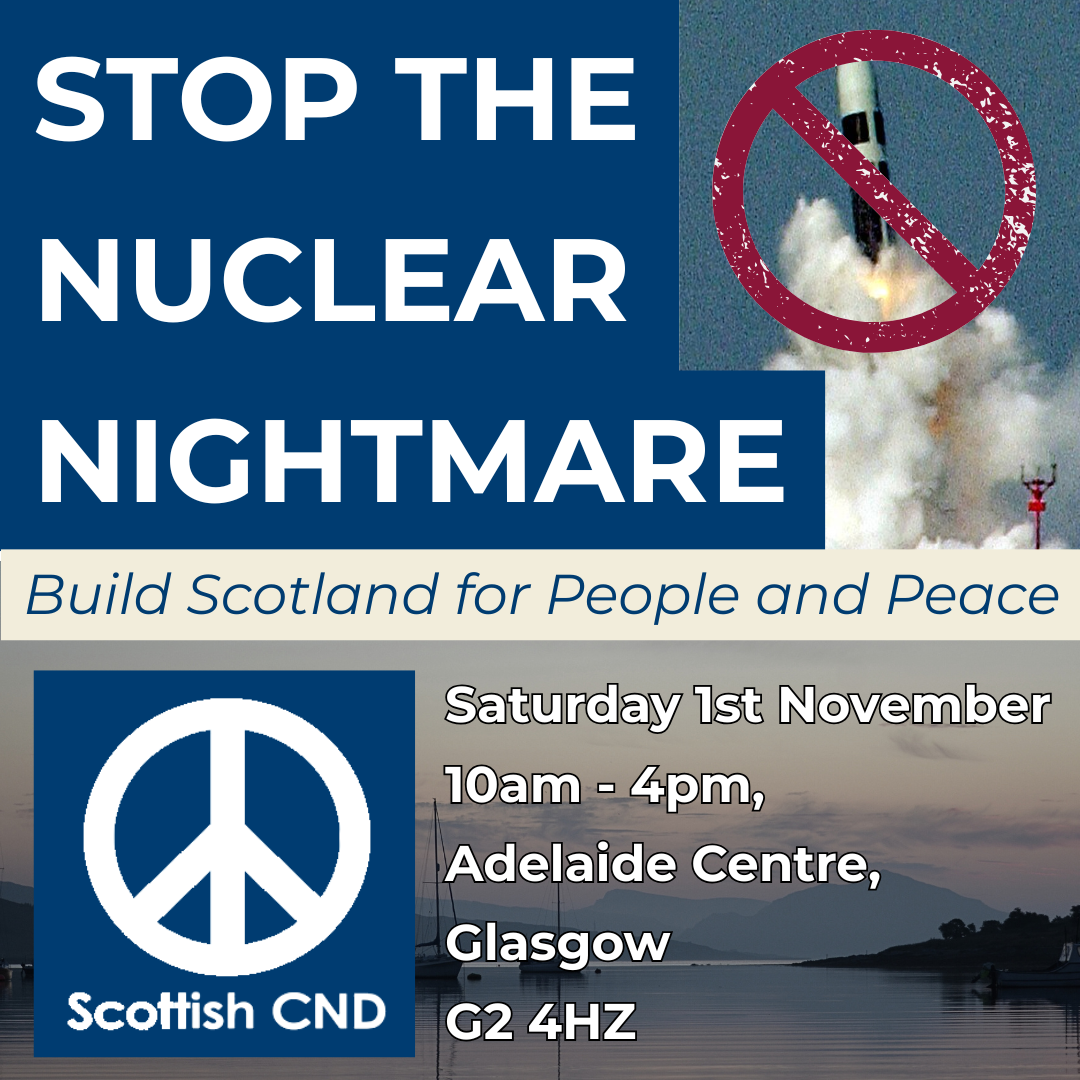
CND’s Stop the Nuclear Nightmare conference in Glasgow will be an important step towards destroying the false arguments that weapons and war spending will lead to job creation and prosperity, rather than bringing Armageddon closer, writes SIMON BARROW
N a month’s time, trade unionists, environmentalists, community organisations and political activists will gather in Glasgow to push back firmly against the British government’s drive towards rearmament and further investment in Britain’s dangerous and wasteful nuclear weapons programme.
The gathering, organised by Scottish CND, will bring together campaigners from across these islands. But the particular spectre of Trident submarines located just a few miles down the road at Faslane will not be lost on anyone attending in person or online.
Bluntly entitled Stop the Nuclear Nightmare, the aim of this timely event in the heart of Scotland’s largest city — a former shipbuilding and heavy industry powerhouse — is to make the direct connection between the threat nuclear weapons pose in an increasingly unstable world and the vast misdirection of economic resources they represent.
As large arms companies savour the prospect of many more billions being poured into military production across Europe, and as the Labour government powers ahead with an unstable, unreliable and unnecessary Trident replacement programme, the choices facing us become abundantly clear.
Will the AI-driven technological revolution of the coming decades lead to an unprecedented era of opportunity and possibility for the great majority, or will our needs and future be sacrificed to the remorseless drive for accumulation by a heavily armed few?
A major focus of Scottish CND’s mobilising conference will therefore be on the back-to-front economics of nuclear-fronted militarism, and the huge potential benefits in terms of jobs, prosperity and environment which a genuinely “just transition” way from both nuclear and fossil fuel dependence could represent.
At the centre of this debate is the political challenge of reframing the discourse about defence towards the concrete issues of human need and security arising from a continuing cost-of-living crisis and the political fragmentation which a lack of a clear vision around this worsens.
The spin from Prime Minister Keir Starmer and his defence secretary John Healey is that a massive expansion of military industry and capability is necessary to ensure Britain’s security and to guarantee jobs and prosperity for its people. Neither of these assertions is true.
As far as security goes, the reality is that the drive to rearmament will increase insecurity and deepen potential conflict, likely leading to a new and perilous wave of nuclear proliferation. But the grim lesson of modern history is that almost all arms races lead to war.
Nor is this expansion necessary. Britain’s military spending was among the highest in the world, well before the latest hike was proposed, and in real terms exceeded spending on defence at the height of the cold war in 1980.
Yet this Labour government has committed to vast increases in the arms bill, from 2.3 per cent of GDP currently (£66.3 billion) to 2.5 per cent by 2027/2028 (£80.5bn) and 3.5 per cent (£121.2bn based on the 2029/30 GDP forecast) by 2035.
Unsurprisingly, it is transnational arms companies themselves who are lobbying hard for all this. They smell profits and the chance to retool in a way which will create neither sustainable jobs nor socially beneficial production.
The promise of “military Keynesianism” (a big boost to civilian benefit from military investment) is a false one. A people’s economy is effectively being sacrificed for a bosses’ bomb.
That picture is reinforced by research coming from an unlikely source, the leading military think tank the Royal United Services Institute (RUSI).
“Framing defence spending as a path to prosperity ignores its poor economic returns, limited job creation, and the opportunity costs of not making alternative public investments,” argue Noah Sylvia and Khem Rogaly in their recent RUSI paper, The False Promise of Defence as Prosperity.
They continue: “Starmer’s government claims that the defence sector will become an ‘engine for growth,’ a route to ‘prosperity’ and a source of security for working people. These arguments are now lynchpins of the government’s narrative as it fails to deal with stagnation and real incomes are squeezed.”
Sylvia and Rogaly then proceed systematically to dismantle such claims, citing sobering arguments and data from the European Commission, the Rand Corporation and other eminently Establishment sources.
Trade unions are among those who are waking up fast to the spectre of a dangerous and damaging future unless we make the link between economic security and a major shift away from the old technologies of human and climate destruction.
Others are yet to be convinced. There is understandable concern about the future of jobs and livelihoods currently tied to the arms sector and nuclear weapons.
But unless we start to build pressure now, to counteract the new military-industrial complex rhetoric, we will find ourselves with fewer and fewer genuine choices.
The Stop the Nuclear Nightmare conference in Glasgow is a major opportunity to articulate a different vision, to mobilise for change, and to organise for a better and safer future.
Simon Barrow is a writer, trade union activist and consultant to Scottish CND on the Stop the Nuclear Nightmare conference at Adelaide Place, Glasgow, from 10am to 4:30pm on Saturday November 1. Full details at www.banthebomb.org.
Suffolk County Council has no evacuation plan in case of a RAF Lakenheath nukes incident
Suffolk County Council has no evacuation plans in case of an incident
involving the US nuclear weapons which are widely believed to be held at
RAF Lakenheath, a Canary investigation can reveal. RAF Lakenheath nuclear
weapons: council has no evacuation plans in place. The base, which is owned
by the UK’s Royal Air Force (RAF), but operated and managed by the United
States Air Force (USAF), was widely reported to have received a delivery of
US nuclear weapons in July 2025. The UK and US governments have a policy of
neither confirming, nor denying, the alleged locations of deployed nuclear
weapons.
The Canary 30th Sept 2025, https://www.thecanary.co/uk/analysis/2025/09/30/raf-lakenheath-nuclear-weapons-2/
No to nuclear in the Llynfi valley – Community campaign resists reactors built for data centres
Climate Camp Cymru supported the No Nuclear Llynfi campaign in the Llynfi
valley, South Wales, this summer. The group backs local struggles for
environmental and social justice by resisting ecocidal developments. This
year’s camp squatted land within a mile of the proposed site for four
small modular nuclear reactors (SMRs). Venture capitalists Last Energy, a
US firm that has never built a reactor, are applying for planning
permission. SMRs have almost no precedent, and Last Energy is currently
suing the US Nuclear Regulatory Commission to weaken safety regulations
while lobbying for similar deregulation in the UK.
Freedom 1st Oct 2025, https://freedomnews.org.uk/2025/10/01/no-to-nuclear-in-the-llynfi-valley/
UK Government names six decommissioning sites being considered for new nuclear
30 Sep, 2025 By Tom Pashby New Civil Engineer
The government has named UK six nuclear sites currently being decommissioned where there is interest in establishing new nuclear developments.
The SMR ambitions, revealed as part of the US-UK nuclear
deal, named Hartlepool in County Durham, Cottam in Nottinghamshire and
London Gateway port in Kent as potential locations for hosting new small
reactors. The new regulation for nuclear developments, including siting –
National Policy Statement for nuclear energy generation (EN-7) – was
published in draft form in February 2025.
This new policy will open up more
potential locations for new nuclear developments beyond the eight sites
stipulated in the former statement. In April, the government said it
planned to publish the final EN-7 policy by the end of 2025.
Great British Energy – Nuclear is already assessing Wylfa on the Isle of Anglesey in
North Wales and Oldbury-on-Severn in Gloucestershire, as potential sites
for hosting three 470MW Rolls-Royce SMR reactors. Both Wylfa and Oldbury
have historic nuclear power plants, which are undergoing decommissioning.
Now the government has named four additional sites where nuclear reactors
are being decommissioned that are being considered for new nuclear
developments. It named them in response to a parliamentary question. “The
government is also aware of developer or community interest in nuclear
projects at several other sites, including those being decommissioned.
These include Pioneer Park (Moorside), Trawsfynydd (via Cwmni Egino),
Hartlepool, and Dungeness.”
Pioneer Park at Moorside in Cumbria is a
project led by Energy Coast West Cumbria (BEC) which is a joint venture
(JV) between the Nuclear Decommissioning Authority (NDA) and Cumberland
Council. BEC’s website makes reference to the government having announced
in June 2025 that part of the Moorside site was designated as suitable for
nuclear generation. The JV says Pioneer Park “will be a transformative
project designed to diversify and strengthen the local economy in West
Cumbria, reducing reliance on the Sellafield site while creating new
opportunities in the clean energy sector”.
Kent County Council pursuing
one or more SMR at Dungeness. In June 2023, a report from Kent County
Council updated cabinet members “on the opportunity to secure a nuclear
future for Dungeness and seeks support for a coordinated campaign of
action”. The report from Kent County Council cabinet member for economic
development Derek Murphy said: “We believe Dungeness is a perfect
location for one (or more) of the new breed of SMRs safely producing green,
low carbon energy and retaining high-quality jobs and skills in the area
while helping to power local growth.”
It went on to say that the council
would continue to conduct discussions about potential reactors which could
be deployed at the site with vendors, and committed to undertake “soft
market testing to develop a small number of high-level proposals for the
site”.
Cwmni Egino was set up by the Welsh Government in 2021 to explore
opportunities to develop new nuclear projects in Wales at Wylfa and
Trawsfynydd – both of which host nuclear power stations that are being
decommissioned. The organisation says it has confirmed the “viability of
small scale nuclear at Trawsfynydd”. Small scale nuclear could mean small
modular reactors (SMRs), advanced modular reactors (AMRs) or micro-modular
reactors (MMRs). The Trawsfynydd, however, also appears to be being
considered as a potential host for a medical research reactor, under the
Welsh Government’s Project Arthur, according to Cwmni Egino.
New Civil Engineer 30th Sept 2025, https://www.newcivilengineer.com/latest/government-names-six-decommissioning-sites-being-considered-for-new-nuclear-30-09-2025/
Secrets of the deep, deep tunnels where nuclear waste is buried.
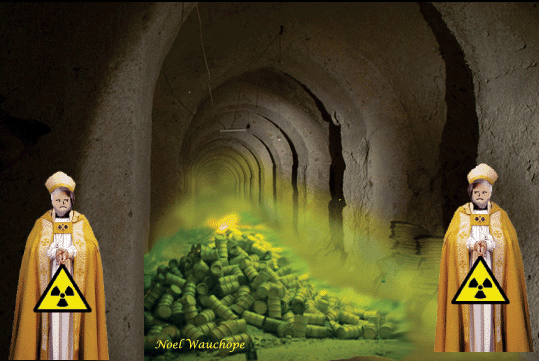
Almost half a kilometre underground, engineers in Finland are about to seal
radioactive material safely for ever. Britain wants to do the same. If all
goes to plan, spent nuclear fuel will be transported early next year down
dedicated lift shafts before robotic machines bury the 24-tonne copper and
iron canisters in the rock where they will remain for the rest of time.
This is the world’s first deep geological disposal facility for nuclear
fuel, a concept that has been discussed by engineers and politicians for
half a century. More than 20 other countries including the UK, US, France
and Sweden have plans to follow suit. But the Finns have got there first.
Fiona McEvoy, 50, the head of site characterisation and research and
development at the British government agency Nuclear Waste Services, is
here as part of a fact-finding mission to see how a similar feat could be
achieved in the UK. She says: “It’s a watershed moment for the nuclear
sector. Long-lived, dangerous waste will be locked away, safe for eternity.
That is amazing.”
Martin Walsh, 51, head of engineering at Nuclear Waste
Services, also on the visit, says: “Nobody disagrees that for the legacy
for nuclear waste in the UK, geological disposal is necessary.” The most
radioactive nuclear waste produced by Britain’s nuclear power stations will
remain hazardous, Walsh says, “beyond our lifetime, and beyond the
lifetime of our children and our children’s children”.
Burying it deep in
the earth is considered a “final disposal”, a solution that has been
calculated to enable the radioactive waste to remain undisturbed for a
nominal 500,000 years, surviving ice ages, tectonic shifts, earthquakes and
sea level rise.
The two private companies that run these facilities, TVO
and Fortum, jointly founded Posiva in 1995, developing this repository to
dispose of their waste. Every week, for the next 100 years, one canister of
spent nuclear fuel will be transported 433m down into the earth.
In the UK,
plans for a similar geological disposal scheme have experienced false
starts because no council has yet agreed to host a site. In June, the newly
elected Reform leadership of Lincolnshire county council pulled the plug on
long-running discussions to site a geological disposal site near the
coastal village of Theddlethorpe.
The most likely location for a site is
now off the Cumbrian coast, close to Sellafield. Nuclear Waste Services is
in discussions with Mid Copeland and South Copeland community partnerships
for a proposal for an access tunnel to be sunk onshore, and then run ten
miles out below the seabed, where 250 miles of disposal tunnels would be
dug, nearly ten times the size of the Finnish scheme.
Subject to local
approval and the go-ahead of whichever government is then in power,
construction is expected to start in the 2040s and start being filled in
the 2050s. It will be filled with waste for 150 years before it is sealed
in 2200.
The lifetime cost of the UK project is estimated at up to £53
billion, compared with about £5 billion for the Finnish scheme, which at
roughly a tenth of the size, serving a nation with a tenth of the
population, is roughly comparable. The speed at which progress has been
made, however, is not comparable. But Walsh defends the cautious pace the
British experts have taken. “The thought process, particularly around
nuclear, has to be robust. You have to make sure your relationship with
safety and security and the environment is sound.”
Times 28th Sept 2025,
https://www.thetimes.com/uk/environment/article/nuclear-power-waste-finland-bkq8sq0lj
Starmer’s new nukes break Non-Proliferation Treaty, legal experts say
Keir Starmer’s plans to splash out on new nukes are in breach of
international law, according to new legal opinion obtained by the Campaign
for Nuclear Disarmament (CND).
The Prime Minister announced his intention
earlier this year to expand Britain’s nuclear capabilities, pledging to buy
nuclear-capable F-35A fighter jets from the US as well as ploughing on with
Trident renewal.
It would mean that, for the first time in decades, Britain
could launch weapons of mass destruction from both air and sea, despite
being a signatory to the nuclear Non-Proliferation Treaty (NPT). By signing
the NPT, Britain committed to “pursue negotiations in good faith on
effective measures relating to cessation of the nuclear arms race at an
early date and to nuclear disarmament and on a treaty on general and
complete disarmament under strict and effective international control.”
Arguing Sir Keir’s plans breach this obligation, the legal opinion from
international law experts Professor Christine Chinkin and Dr Louise
Arimatsu commissioned by the CND argues: “The decision of the UK to
purchase F-35a fighter jets rather than any other model is precisely
because the aircraft can ‘deliver both conventional and nuclear weapons’
and thereby enable the RAF to reacquire ‘a nuclear role for the first
time since 1998.’
Morning Star 26th Sept 2025, https://morningstaronline.co.uk/article/starmers-new-nukes-break-non-proliferation-treaty-legal-experts-say
Britain remade – with a lot of nuclear?
the land on which renewable techs sit is not all lost to other uses and offshore wind farms use no land. And the nuclear fuel cycle (from uranium mining through to eventual waste disposal) also involves land use.
Renew Extra Weekly September 27, 2025
In a new report, the Britain Remade lobby group pushes nuclear strongly, as part of its ecomodernist growth-based future. It models different nuclear build costs and renewable price scenarios to assess long-term impacts on household energy bills. But although it accepts that ‘renewables may have seen large price-falls over the last 15 years’ it says that ‘at high penetrations costs linked to managing intermittency are high: Britain has added 40 GW since 2010 and 120 GW is forecast by 2030, yet balancing, curtailment, backup, and overbuild still add cost and leave gaps that require firm power’.
It is also not very happy about the local environmental impact of renewables, given their high land use compared with nuclear plants. Well yes, but the land on which renewable techs sit is not all lost to other uses and offshore wind farms use no land. And the nuclear fuel cycle (from uranium mining through to eventual waste disposal) also involves land use.
The new report does admit that Britain is the most expensive place to build nuclear capacity. It notes that ‘Hinkley Point C (HPC) is estimated to cost £46 billion, or £14,100 per kW: when finished, it will be the most expensive nuclear power station ever built. British-built plants cost far more per kW than peers: our per-kW costs are about six times South Korea’s, and France and Finland deliver the same EPR design for less per kW (27% and 53% respectively). Britain has gone backwards on cost: Sizewell B in 1995 cost £6,200 per kW, less than half Sizewell C’s budgeted cost.’………………….
To improve things in the UK (not an easy task you might think, using the same vendors) it wants better regulation and reduced planning barriers. Well we will see how that goes with EDF’s new Sizewell C EPR. But better planning systems and regs might also help renewables ! Overall Britain Remade seems a bit desperate in its promotion of nuclear: ‘If renewable costs rise, nuclear can play an even larger role: government forecasts assume falling solar costs (-27% by 2040) and modest wind cost drops (-6%), but recent data show solar prices flat and wind costs rising. If renewables costs climb 30% above baseline, the most cost-efficient plan would be eight new plants at French prices (saving £7.6 bn) or fifteen at Korean prices (saving £21 bn) over 25 years, with benefits lasting decades’.
Lots of assumptions about costs there, and also about demand and markets, with there being some big uncertainties. …………………………
……………………………………………………………Not everyone in the UK will relish American dominance, even in a collaborative context, if that is what we face in this sector, and maybe in others, like AI. However, for good or ill, the Labour government, like most governments, is wedded to technology-led growth. So, with China now politically bared and the EU somewhat out of bounds, US help is evidently seen as vital. Like the US, the UK is now pushing nuclear hard: 75% of the Department of Energy Security and Net Zero’s £6.7bn spending in 2024-25 was allocated to nuclear.
It is true that renewable are also being pushed in the UK (not now under Trump in the US), but mainly via private sector investment e.g. £1.5bn for last year’s CfDs. Which way might it go in future given the US influence? The new US-UK ‘technology prosperity’ deal pushes nuclear and also AI hard, but ignores renewables. You will find exactly the opposite approach in Electrotech, the new Ember global energy report, with renewables dominating, a view also shared by the latest World Nuclear Industry Status report, which depicts nuclear as mostly declining and as something of a dead end option – see my next post. https://renewextraweekly.blogspot.com/2025/09/britain-remade-but-mostly-with-nuclear.html
Paper reactors and paper tigers
John Quiggin, September 27, 2025, https://johnmenadue.com/post/2025/09/paper-reactors-and-paper-tigers/?utm_source=substack&utm_medium=email
The culmination of Donald Trump’s state visit to the UK was a press conference at which both American and British leaders waved pieces of paper, containing an agreement that US firms would invest billions of dollars in Britain.
The symbolism was appropriate, since a central element of the proposed investment bonanza was the construction of large numbers of nuclear reactors, of a kind which can appropriately be described as “paper reactors”.
The term was coined by US Admiral Hyman Rickover, who directed the original development of nuclear powered submarines.
Hyman described their characteristics as follows:
1. It is simple.
2. It is small.
3. It is cheap
4. It is light.
5. It can be built very quickly.
6. It is very flexible in purpose (“omnibus reactor”)
7. Very little development is required. It will use mostly “off-the-shelf” components.
8. The reactor is in the study phase. It is not being built now.
But these characteristics were needed by Starmer and Trump, whose goal was precisely to have a piece of paper to wave at their meeting.
The actual experience of nuclear power in the US and UK has been an extreme illustration of the difficulties Rickover described with “practical” reactors. These are plants distinguished by the following characteristics:
1. It is being built now.
2. It is behind schedule
3. It requires an immense amount of development on apparently trivial items. Corrosion, in particular, is a problem.
4. It is very expensive.
5. It takes a long time to build because of the engineering development problems.
6. It is large.
7. It is heavy.
8. It is complicated.
The most recent examples of nuclear plants in the US and UK are the Vogtle plant in the US (completed in 2024, seven years behind schedule and way over budget) and the Hinkley C in the UK (still under construction, years after consumers were promised that that they would be using its power to roast their Christmas turkeys in 2017). Before that, the VC Summer project in North Carolina was abandoned, writing off billions of dollars in wasted investment.
The disastrous cost overruns and delays of the Hinkley C project have meant that practical reactor designs have lost their appeal. Future plans for large-scale nuclear in the UK are confined to the proposed Sizewell B project, two 1600 MW reactors that will require massive subsidies if anyone can be found to invest in them at all. In the US, despite bipartisan support for nuclear, no serious proposals for large-scale nuclear plants are currently active. Even suggestions to resume work on the half-finished VC Summer plant have gone nowhere.
Hope has therefore turned to Small Modular Reactors. Despite a proliferation of announcements and proposals, this term is poorly understood.
The first point to observe is that SMRs don’t actually exist. Strictly speaking, the description applies to designs like that of NuScale, a company that proposes to build small reactors with an output less than 100 MW (the modules) in a factory, and ship them to a site where they can be installed in whatever number desired. The hope is that the savings from factory construction and flexibility will offset the loss of size economies inherent in a smaller boiler (all power reactors, like thermal power stations, are essentially heat sources to boil water). Nuscale’s plans to build six such reactors in the US state of Utah were abandoned due to cost overruns, but the company is still pursuing deals in Europe.
Most of the designs being sold as SMRs are not like this at all. Rather, they are cut-down versions of existing reactor designs, typically reduced from 1000MW to 300 MW. They are modular only in the sense that all modern reactors (including traditional large reactors) seek to produce components off-site. It is these components, rather than the reactors, that are modular. For clarity, I’ll call these smallish semi-modular reactors (SSMRs). Because of the loss of size economies, SMRs are inevitably more expensive per MW of power than the large designs on which they are based.
Over the last couple of years, the UK Department of Energy has run a competition to select a design for funding. The short-list consisted of four SSMR designs, three from US firms, and one from Rolls-Royce offering a 470MW output. A couple of months before Trump’s visit, Rolls-Royce was announced as the winner. This leaves the US bidders out in the cold.
So, where will the big US investments in SMRs for the UK come from? There have been a “raft” of announcements promising that US firms will build SMRs on a variety of sites without any requirement for subsidy. The most ambitious is from Amazon-owned X-energy, which is suggesting up to a dozen “pebble bed” reactors. The “pebbles” are mixtures of graphite (which moderates the nuclear reaction) and TRISO particles (uranium-235 coated in silicon carbon), and the reactor is cooled by a gas such as nitrogen.
Pebble-bed reactor designs have a long and discouraging history dating back to the 1940s. The first demonstration reactor was built in Germany in the 1960s and ran for 21 years, but German engineering skills weren’t enough to produce a commercially viable design. South Africa started a project in 1994 and persevered until 2010, when the idea was abandoned..Some of the employees went on to join the fledgling X-energy, founded in 2009. As of 2025, the company is seeking regulatory approval for a couple of demonstrator projects in the US.
Meanwhile, China completed a 10MW prototype in 2003 and a 250MW demonstration reactor, called HTR-PM in 2021. Although HTR-PM100 is connected to the grid, it has been an operational failure with availability rates below 25%. A 600MW version has been announced, but construction has apparently not started.
When this development process started in the early 20th century, China’s solar power industry was non-existent. China now has more than 1000 Gigawatts of solar power installed. New installations are running at about 300 GW a year, with an equal volume being produced for export. In this context, the HTR-PM is a mere curiosity.
This contrast deepens the irony of the pieces of paper waved by Trump and Starmer. Like the supposed special relationship between the US and UK, the paper reactors that have supposedly been agreed on are a relic of the past. In the unlikely event that they are built, they will remain a sideshow in an electricity system dominated by wind, solar and battery storage.
Fighter jets purchase would put UK in breach of nuclear treaty, says CND
Legal opinion for campaign group says deal amounts to reversal of UK’s commitment to nuclear disarmament
Dan Sabbagh, 26 Sept 25, https://www.theguardian.com/world/2025/sep/26/uk-fighter-jets-purchase-nuclear-treaty-cnd
Britain will violate its nuclear disarmament obligations if Labour presses ahead with the £1bn purchase of 12 F-35A fighter jets, according to a specialist legal opinion prepared on behalf of the Campaign for Nuclear Disarmament (CND).
Two international lawyers argue that the government’s plan to reintroduce air-launched nuclear weapons for the RAF will break a key provision of the nuclear non-proliferation treaty (NPT) signed by the UK and 190 other countries.
Prof Christine Chinkin and Dr Louise Arimatsu from the London School of Economics argued that the UK would be in breach of article six of the treaty, and they accused ministers of hypocritical behaviour in broadening the country’s nuclear capabilities.
In a piece published before the start of Labour’s annual conference, the authors wrote: “The decision of the UK to purchase F-35A fighter jets rather than any other model is precisely because the aircraft can ‘deliver both conventional and nuclear weapons’ and thereby enable the RAF to reacquire ‘a nuclear role for the first time since 1998’.
“Reinstating a nuclear role for the RAF represents a reversal of the UK’s long-term commitment to nuclear disarmament, including under the NPT.”
Article six of the non-proliferation treaty commits the signatories “to pursue negotiations in good faith on effective measures relating to cessation of the nuclear arms race at an early date and to nuclear disarmament” as well as to a future treaty “on general and complete disarmament”.
Though the lawyers’ conclusions are not necessarily surprising given they were working on behalf of CND, they highlight a growing contradiction between international treaty commitments and a creeping global nuclear rearmament.
Keir Starmer announced at a Nato summit in June that the UK would buy 12 F-35As with the intention of joining the alliance’s “nuclear mission”. US B61-12 nuclear bombs now stored at RAF Lakenheath in Suffolk would be made available for use by the British jets in the event of a major war.
Four years ago the UK said it would lift the cap on the number of warheads it could stockpile by 40% to 260 for its existing nuclear deterrent, the submarine-launched Trident system. It was the first time the UK had said it would increase its nuclear capability since the end of the cold war.
Sophie Bolt, the CND general secretary, accused the government of “yet another breach of international law” and of “escalating nuclear dangers in the world”. She called on MPs to discuss the UK’s nuclear intentions, arguing that the F-35A purchase plan had been announced “without parliamentary debate or scrutiny”.
The Ministry of Defence said the investment in 12 new F-35A aircraft would improve the UK’s national security. “The UK remains committed to the goal of a world without nuclear weapons and upholds all our obligations under the nuclear non-proliferation treaty,” a spokesperson said.
Other countries are also rearming and redeploying nuclear weapons as tensions rise. The US moved B61-12 bombs to Lakenheath in July, while Russia has said it has moved nuclear missiles to Belarus. China is increasing its arsenal by 100 warheads a year and plans to reach 1,500 by 2035, according to the Stockholm Peace Research Institute.
The nuclear non-proliferation treaty came into force in 1970 with article six a core component and has been signed by the world’s largest nuclear powers – the US, Russia, China and France. A handful of countries with nuclear programmes – Israel, India, Pakistan – never signed up, and North Korea pulled out in 2003.
US-UK deal nuclear signed to speed up reactor approval, as companies announce cross-border partnerships
SIR KEIR STARMER and Donald Trump have signed a bilateral agreement to
advance nuclear technology, alongside a series of commercial partnerships
between US and UK companies. The Atlantic Partnership for Advanced Nuclear
Energy, signed between the two leaders during the US president’s second
state visit to the UK, aims to speed up regulatory approval in both
countries for nuclear power projects by allowing assessment results to be
shared.
The deal is focused on next generation nuclear technology as well
as small modular reactors (SMRs). The deal has been welcomed by industry
and is viewed as a step toward deeper transatlantic collaboration on
nuclear development between the US and UK.
The bilateral agreement allows
regulatory tests approved in one country to support reactor assessments in
the other. The UK government expects the agreement to cut the time required
to secure a nuclear project licence from three to four years down to two.
Chemical Engineer 25rg Sept 2025, https://www.thechemicalengineer.com/news/us-uk-deal-nuclear-signed-to-speed-up-reactor-approval-as-companies-announce-cross-border-partnerships/
1 This Month

of the week – Shut Down Drone Warfare!


Tell the Ukrainian Government to Drop Prosecution of Peace Activist Yurii Sheliazhenko

Petition to revoke the licensing of the Near Surface Nuclear Disposal Facility (NSDF) at Chalk River. https://www.ourcommons.ca/petitions/en/Petition/Details?Petition=e-7247
To see nuclear-related stories in greater depth and intensity – go to https://nuclearinformation.wordpress.com
-
Archives
- April 2026 (7)
- March 2026 (251)
- February 2026 (268)
- January 2026 (308)
- December 2025 (358)
- November 2025 (359)
- October 2025 (376)
- September 2025 (257)
- August 2025 (319)
- July 2025 (230)
- June 2025 (348)
- May 2025 (261)
-
Categories
- 1
- 1 NUCLEAR ISSUES
- business and costs
- climate change
- culture and arts
- ENERGY
- environment
- health
- history
- indigenous issues
- Legal
- marketing of nuclear
- media
- opposition to nuclear
- PERSONAL STORIES
- politics
- politics international
- Religion and ethics
- safety
- secrets,lies and civil liberties
- spinbuster
- technology
- Uranium
- wastes
- weapons and war
- Women
- 2 WORLD
- ACTION
- AFRICA
- Atrocities
- AUSTRALIA
- Christina's notes
- Christina's themes
- culture and arts
- Events
- Fuk 2022
- Fuk 2023
- Fukushima 2017
- Fukushima 2018
- fukushima 2019
- Fukushima 2020
- Fukushima 2021
- general
- global warming
- Humour (God we need it)
- Nuclear
- RARE EARTHS
- Reference
- resources – print
- Resources -audiovicual
- Weekly Newsletter
- World
- World Nuclear
- YouTube
-
RSS
Entries RSS
Comments RSS
 nuclear-news