Tight timetable for the Rolls Royce-led conglomeration to ever get their small nuclear reactors built

The reactors themselves will be installed at existing nuclear sites in
Britain. Rolls-Royce has not yet committed to any sites but Wylfa and
Trawsfynydd in north Wales are believed to be under consideration.
The company and its partners, which include Qatar’s sovereign wealth fund and
France’s wealthy Perrodo family, expect to decide on where to locate the
factory this year and to start construction soon after.
They face a tight timetable if they are to stay on track to meet their ambition to complete
the first 470MW plant by the early 2030s. Alongside the site selection, the
companies are putting their SMR design through the UK’s rigorous nuclear
regulatory regime, a process that is expected to take up to four years.
Irish Times 23rd Jan 2022
Anti-radiation pills handed out in case of nuclear emergency at BAE Systems
 | |||
|
Anti-radiation pills handed out in Barrow in case of nuclear emergency at BAE Systems
The Mail. BY Eleanor Ovens @EOvensNews, 24 Jan 22, Reporter NEARLY 13,000 anti-radiation pills have been handed out in Barrow in case of the ‘unlikely event’ of a nuclear emergency.Records reveal that childcare facilities and care homes situated near BAE Systems have received iodine tablets should submarine reactors go into meltdown…….
According to Declassified UK, BAE expects people 400 metres downwind of a submarine would need to take iodine in the ‘first few hours’ of a ‘radiation emergency’……
A spokesman for Cumbria County Council told The Mail BAE Systems have a contract with UKHSA (previously Public Health England) and NHS England to distribute iodine tablets to business and residents in the area around the BAE Systems site in Barrow…………. https://www.nwemail.co.uk/news/19865424.anti-radiation-pills-handed-barrow-case-nuclear-emergency-bae-systems/
13 wards in Cumbria recommended against their will, for UK’s nuclear waste dump
| This week our readers got talking about Allerdale potentially being the host to an underground disposal of nuclear waste. Having a Geological Disposal Facility (GDF) that would store higher level radioactive waste underground is hailed to be the safest and most secure method of disposal. The Allerdale GDF Working Group recommended a Search Area for consideration in 2021 comprised of 13 electoral wards: Aspatria; Broughton St Bridgets; Dalton; Ellen & Gilcrux; Flimby; Harrington & Salterbeck; Maryport North; Maryport South; Moorclose & Moss Bay; Seaton & Northside; St John’s; St Michael’s and Stainburn & Clifton. Cumbrian Lad added: “It is a very strange process which allows one individual, Andy Ross of GenR8 North, to volunteer the part of Allerdale in which he doesn’t live to be the burial site for the UK’s nuclear waste. The 13 wards who have been volunteered against their will, have no say in the matter until 15-20 years of investigations have taken place.” Carlisle News and Star 23rd Jan 2022 https://www.newsandstar.co.uk/news/19865839.nuclear-waste-disposal-allerdale-readers-talking/ |
The production, servicing and berthing of nuclear-powered submarines in or near population centres present unacceptable health risks.

Following revelations in freedom of information requests to Declassified UK records show 97,430 stable iodine tablets were pre-issued to people in Plymouth, Portland and Barrow-in-Furness from 2016-21 to protect them from radiation.
Kate Hudson, general secretary of the Campaign for Nuclear Disarmament (CND), said: “The production, servicing and berthing of nuclear-powered submarines in or near population centres present unacceptable health risks.
“Safeguarding our communities cannot be achieved through limited distribution of pills,” she said, adding that the vessels, some of which carry nuclear warheads, “need to be disarmed and decommissioned.” As Tim Deere-Jones has pointed out “I’m amazed at the way Governments and Regulators allow the “nuclear authorities” to mainstream on publicly highlighting the dangers of one or two radionuclides such as Iodine and Caesium and discuss them endlessly while avoiding the additional issues of the other 50/60 + nuclides that would be released by a meltdown or a LOCA or any other significant event.”
Radiation Free Lakeland 22nd Jan 2022
Row over plans to reform groups at nuclear sites.
Rob Edwards The Ferret, January 23, 2022,
New guidelines which campaigners say could benefit communities around nuclear sites have been boycotted by a UK Government nuclear agency.
Internal documents seen by The Ferret reveal that the Nuclear Decommissioning Authority (NDA) has rejected proposed reforms because they had caused “a great deal of bad feeling”
Guidelines aimed at making local meetings about safety at nuclear sites across the UK more transparent, accountable and representative were put forward in a nuclear industry report.
There are 29 licensed nuclear sites around the UK, six of them in Scotland. They include nuclear power stations operating and being decommissioned, nuclear submarine bases, waste and processing plants.
All of the sites have stakeholder or local liaison groups aimed at keeping local communities informed about events, including shutdowns, safety incidents and radiation leaks. But they differ greatly in how they are run…………………………..
In 2017 the 50-strong group of nuclear-free local authorities in the UK published a report questioning whether the stakeholder and local liaison groups were “fit for purpose”. It concluded that there was an “urgent need” to reform them.
This prompted the nuclear industry’s Safety Directors’ Forum, which brings together senior managers from all the civil and military nuclear sites, to commission a report. It was researched and written by the industry’s industry’s Young Nuclear Professionals’ Forum.
The resulting “Good Practice Guide” was circulated in November 2021. “Nuclear sites often have a reputation of being opaque, secretive and unwilling to engage with the public,” it said.
“This negative reputation is actively damaging, from open opposition to the site’s existence to a general lack of understanding. Active engagement is key to undoing this, the nuclear industry must be open and honest.”
The report argued that local liaison groups at several unidentified nuclear sites had “no accountability”. This included “no terms of reference being in place, no clear action management process, inadequate minute taking and infrequent meetings.”
It pointed out that while some meetings were open to the public, others were not. Some groups only invited “selected stakeholders” and “diversity and inclusion is not always encouraged”.
Some of the groups didn’t have websites. “Meetings are not always accessible and, in some cases, not comprehensible due to the extensive use of acronyms, particularly for those who do not work in the nuclear industry,” the report added.
The report recommended that the groups should all have websites, clear and published constitutions and a “diverse range of stakeholders”. There should be a co-chair independent of the industry and members of the public should be allowed to ask questions.
correspondence released under freedom of information law has disclosed how the report has upset the NDA and some of the existing groups………………………………… https://theferret.scot/nuclear-sites-reforms-row/
Small nuclear reactors a poor solution for UK’s and the world’s climate action.

it is difficult to see how a technology that will only be operational after the UK power system is supposed to be carbon-free will contribute to climate action in the next ten years or so. And the situation is similar globally.
Other questions around traditional nuclear power stations, such as the thorny issue of waste, would also still apply to SMRs…….
Is nuclear power the best solution to climate change? The UK, like China, the US and Canada, is attracted to nuclear power. But high costs and slow delivery means many energy experts remain unconvinced. New Statesman, By Philippa Nuttall 21 Jan 22, debate in the House of Commons on 19 January, led by a group of MPs known as the “atomic kittens”, suggested nuclear energy can be a panacea for all ills – including a solution for the climate crisis and the gas crunch. The facts suggest otherwise.
Isn’t nuclear energy a no-no after Chernobyl and Fukushima?
Disasters clearly reduce appetite among the public and policymakers for nuclear power………………
Today, new nuclear construction projects are few and far between, even in countries such as France and the US whose energy systems are heavily reliant on the technology, and the number of operational reactors is in decline globally.
Are any countries investing heavily in nuclear?
In addition to safety concerns, rising costs are a central reason why the number of new plants under construction remains limited. Since 2011, nuclear power construction costs globally have doubled or even tripled. China is, however, notable in its nuclear ambitions. The country is planning at least 150 new reactors in the next 15 years, more than the rest of the world has built in the past 35, though cost could ultimately change this direction of travel.
The price of nuclear generation has moved in the opposite direction to solar and wind
Mean levelised cost of energy in US$/MWh, 2009–20………..
Others countries such as the UK, the US and Canada also see a limited role for new nuclear as part of their response to climate change. The UK government in its 2021 net zero strategy talked about “cutting edge new nuclear power stations”, and plans to launch a £120m Future Nuclear Enabling Fund.
There are some big nuclear power stations on the cards – think Hinkley Point C or Sizewell C in the UK. But the major excitement among many nuclear enthusiasts, including plenty of UK MPs is around so-called small modular reactors (SMRs). If you believe the hype, they are the answer to all climate and energy ills………………
Rolls Royce, and companies working on the technology in other countries, argue that smaller solutions can be constructed more cheaply and come online more quickly as they can be built in a factory, transported in modules and fitted together “like meccano”, said Rolls Royce’s Alastair Evans. Large nuclear plants are built fully onsite. The idea is that the modules could then be mass produced. However, nothing is rolling off any conveyor belts yet. The only SMR up and running in the world is a 35 MW floating nuclear plant in Russia.
Sounds interesting. Are SMRs the solution to the climate crisis?
Unlikely.
“To meet the requirements of the sixth carbon budget, we will need all new cars, vans and replacement boilers to be zero carbon in operation by the early 2030s,” Virginia Crosbie, a Conservative MP from Wales and the original self-proclaimed “atomic kitten”, enthused to fellow MPs. “We must quickly move away from generating that electricity from fossil fuels… Nuclear power, which has been a neglected part of our energy mix, can bridge the gap.”
There is, however, no silver bullet to the climate crisis, and renewables, in conjunction with other existing technologies, look like a better, cheaper solution.
……….. traditional, big nuclear projects look likely to provide only a sliver of the world’s electricity in the future. They are hugely expensive to build, their construction runs over time, and they are frequently struck by technological issues. Moreover, they need to be built close to the sea or a large river for cooling reasons, highlighted Paul Dorfman from the University of Sussex. France has already had to curtail nuclear power output in periods of heatwaves and drought, which are only set to get worse as climate change takes hold. Greater storm surges and eroding coastlines also don’t make the prospect of building by the sea any easier.
SMRs solve few of these issues………… “The latest economic estimates available for SMRs are still quite expensive relative to other ‘clean’ energy alternatives, and it would be pure speculation to assume that will change dramatically until the concept has been more proven,” said Mike Hogan from the not-for-profit Regulatory Assistance Project.
……. the designs still need to get licensed, factories need to be built, orders placed, projects financed, etc,” said Hogan.
In short, it is difficult to see how a technology that will only be operational after the UK power system is supposed to be carbon-free will contribute to climate action in the next ten years or so. And the situation is similar globally.
Other questions around traditional nuclear power stations, such as the thorny issue of waste, would also still apply to SMRs…….
So what is the solution? Renewables, renewables and more renewables?
In short, yes. The costs of solar, wind power and storage continue to fall, and by 2026 global renewable electricity capacity is forecast to rise by more than 60 per cent, to a level that would equal the current total global power capacity of fossil fuels and nuclear combined, says the IEA.
Some argue nuclear can be a clean back-up option for when the wind doesn’t blow and the sun isn’t shining. But again, other options already exist, including demand response (for example, plugging in your electric car when there is lots of energy and not switching on your washing machine when the system is under strain), large-scale storage and interconnections between different countries.
Final word?
Craig Bennett, chief executive of the Wildlife Trusts, summed up the general mood of those less enthused by nuclear than Crosbie and her fans:
“If successive governments had given even half the love and attention they afford to nuclear power to scaling up home insulation, energy efficiency and smart storage technologies, it’s likely we wouldn’t be facing current challenges around energy and household bills, and we would have done a lot more good for the climate and nature.”….. https://www.newstatesman.com/environment/climate/2022/01/is-nuclear-power-a-genuine-solution-to-the-climate-crisis
Largest increase in the UK nuclear liability regime for 50 years
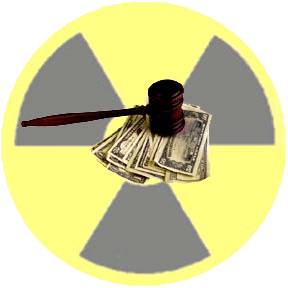
Largest increase in the UK nuclear liability regime for 50 years take, https://www.jdsupra.com/legalnews/largest-increase-in-the-uk-nuclear-6038616/, 21 Jan 22, As we flagged last year in this note, the 2004 Protocols updating the Paris Convention and Brussels Convention have finally been ratified. This is likely the biggest increase in the international nuclear liability regime for decades, and has global impact.
In the UK this means that the Nuclear Installations (Liability for Damage) Order 2016 came into effect on 1 January 2022. This immediately increases the liability cap of nuclear operators in the UK from £140m to €700m (approx. £585m), with those caps increasing annually over the next five years to €1.2bn (approx. £1bn). The UK also now has a new operator duty of care not to cause significant impairment to the environment, new categories of compensation for which an operator will be liable (including loss of profit in some instances), and material extensions to the geographical scope covered by the regime (e.g. now including the Republic of Ireland).
The extension of the limitation period for personal injury to 30 years from the date of the incident is likely the one with the largest impact after it became clear last year that insurance would not be available to cover the full period, at least for the time being. The UK Government instead stepping in and indemnifying operators to cover the insurance gap using the powers granted to the Secretary of State under the amended Nuclear Installations Act 1965.
Similar changes to the liability regime in certain other European and Scandinavian signatory countries should also have taken effect.
Please see our detailed note on the topic here for further information.
[View source.]
Hinkley Point mud dredging and dumping plan faces a legal challenge
Hinkley Point dredging plan for Portishead faces legal challenge. Plans to
dump hundreds of thousands of tonnes of sediment from Hinkley Point into
the Bristol Channel at Portishead face a legal challenge.
Environmental groups represented by Tarian Hafren say the Marine Management Organisation
unlawfully varied EDF Energy’s licence to deposit dredged material at the
Severn Estuary Marine Protection Area. The disposal site is close to
Portbury Wharf Salt Marsh, a Site of Special Scientific Interest and part
of the Severn Estuary Special Protection Area. Tarian Hafren argues that
the MMO did not have the statutory power to change the licence for dredging
to include dumping, did not give adequate reasons for doing so, failed to
examine the potential impact of the dredging on marine life, and ignored a
less harmful method of waste disposal.
High Court judge Beverley Lang ruled
that the grounds for a judicial review are arguable and the claim will be
heard this spring. Cian Ciaran for Tarian Hafren said: “The Welsh
National Marine Plan accepts no dumping in the Welsh half of the estuary,
but the Welsh authorities failed to press MMO to comply on the English
side. “As Geiger Bay, we established at court in 2018 that the Welsh
authorities were wrong to license dumping near Cardiff. Let’s now compel
the MMO to respect the protected status that’s needed for both fish
stocks and wildlife.”
Somerset Live 20th Jan 2022
https://www.somersetlive.co.uk/news/hinkley-point-dredging-plan-portishead-6514361
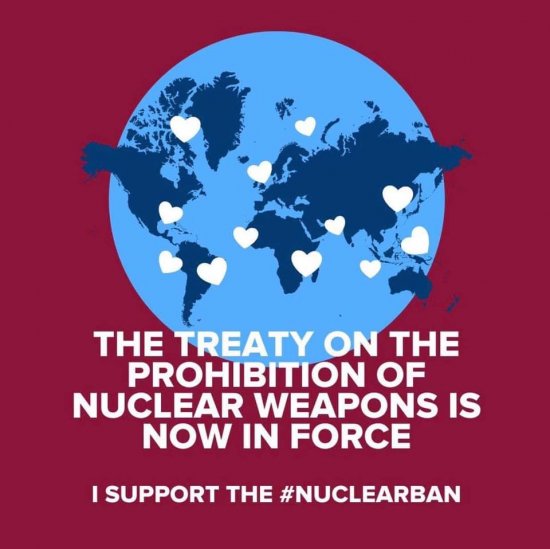
Mayors for Peace UK / Ireland Chapter and NFLA celebrates first nuclear weapons ‘banniversary’.
Richard Outram, UK / Ireland Mayors for Peace / NFLA Secretary, Richard.outram@manchester.gov.uk / 21 Jan 22,
Local authorities working for peace in the UK and Ireland will be celebrating the first ‘banniversary’ of the UN treaty making nuclear weapons illegal (22January).
The United Nations Treaty on the Prohibition of Nuclear Weapons (the Treaty) entered into force on the 22 January 2021, 90 days after the fiftieth nation ratified acceptance of it.
The Treaty requires signatory states to undertake not to develop, test, produce, acquire, possess, stockpile, deploy, use, or threaten to use nuclear weapons or permit or support other states to do so. The Treaty also requires any state which is a party to the treaty to provide assistance to persons and communities affected by the use or testing of nuclear weapons and to work to clear up land contaminated by such activities which lies under its jurisdiction or control[i].
Across the world, campaigners will be celebrating the first so-called ‘banniversary’, and the huge progress that has been made in the cause of advancing nuclear disarmament over the last year, in advance of a much-anticipated First Meeting of the States Parties currently scheduled to be hosted by Vienna, Austria between 22-24 March 2022.
59 UN member states have now ratified their acceptance of the Treaty and a further 27 have signed and are currently in the process of doing so. 101 financial institutions across the world representing almost $4 trillion have also announced they will shun further investment in nuclear weapons because of the Treaty.[ii]
The UK / Ireland Chapter of the international Mayors for Peace movement and the UK / Ireland Nuclear Free Local Authorities will be amongst the many organisations celebrating the date. Both are partner organisations of ICAN (the International Campaign to Abolish Nuclear Weapons).
Born out of the frustration that the UN Non-Proliferation Treaty had failed to deliver nuclear disarmament after almost half-a-century, ICAN, a global coalition of civil society, faith and peace organisations, atomic bomb and test survivors, scientists, doctors, academics and concerned world citizens, began to work for a treaty ban.[iii] Their work led to the Treaty being adopted by 122 of the world’s states at the United Nations on 7 July 2017 and later that year, ICAN and its partners were awarded the Nobel Peace Prize.
Subsequently ICAN worked with these states to bring the Treaty into law.
Commenting, Manchester City Councillor Eddy Newman, speaking on behalf of the UK / Ireland Chapter of Mayors for Peace, said:
“In the past, similar treaties have banned germ and chemical weapons, landmines, and cluster bombs and in the last year we have already achieved so much as a world community in moving forward a nuclear weapons ban. However there remain many challenges. Yesterday (20 January), the Bulletin of Atomic Scientists announced that the Doomsday Clock remains at 100 seconds to midnight in recognition that our world faces many grave threats. One, which is existential, is the ever-present threat of nuclear annihilation. Despite world opinion favouring nuclear disarmament, the nuclear weapon armed states, amongst them the United Kingdom, continue to refuse to engage with this Treaty and continue to renege upon their solemn promise made over 50 years ago as signatories to the Non-Proliferation Treaty to do so.”
The Chair of the Nuclear Free Local Authorities Steering Committee, Leeds City Councillor David Blackburn, added:
“Although the Republic of Ireland has creditably signed the Treaty, one of our priorities as Mayors for Peace Councils and Nuclear Free Local Authorities in the UK must be to continue to put pressure on the UK Government to engage with the treaty. One way to do this is to ask our member Councils to pass resolutions calling on the government to do so. This will be a priority for both of our organisations over the coming year. Leeds and Manchester are both amongst the UK Councils which have already passed such resolutions, and we hope many more will do so in 2022.[iv]”
Small nuclear reactors for Scotland? Expensive, unpopular, and not even small
Nuclear power in Scotland: ‘Small modular reactors’ are expensive, will be
unpopular and they’re not even small – Dr Richard Dixon. The final
shutdown of reactor number four at Hunterston and the announcement the two
reactors at Torness will cease operating in 2028 have led nuclear
enthusiasts to talk even more about small modular reactors. Even if you
were not worried about creating yet more radioactive waste for which we
have no long-term storage solution and the £132bn public-money bill for
decommissioning and you were not worried about terrorists blowing up
reactors or just the likely delays and cost over-runs, these small(ish)
reactors still aren’t likely to become a reality.
Scotsman 20th Jan 2022
Anti-radiation pills given out to residents, nurseries, schools, care homes and clinics near UK’s nuclear submarine ports.
EARLY 100,000 anti-radiation pills have been handed out to residents of three English ports in case nuclear submarines go into meltdown, Declassified UK has found. The medication, issued between 2016 and 2021 in Plymouth, Portland and Barrow-in-Furness, went to nurseries, schools, care homes and clinics near naval docks.
The figures were revealed in a freedom of information request by the investigative website. Nuclear-powered submarines are built for the Royal Navy by arms company BAE Systems at Barrow-in-Furness in Cumbria, and the vessels moor at sites such as Devonport dockyard in Plymouth and Dorset’s Portland harbour.
Campaign for Nuclear Disarmament (CND) general secretary Kate Hudson said: “The production, servicing and berthing of nuclear powered submarines in or near population centres presents an unacceptable health risk. “Safeguarding our communities cannot be achieved through limited distribution of pills.”
Morning Star 18th Jan 2022
Rolls Royce aims to market its Small Nuclear Reactors to Saudi Arabia (a good step towards nuclear weapons?)
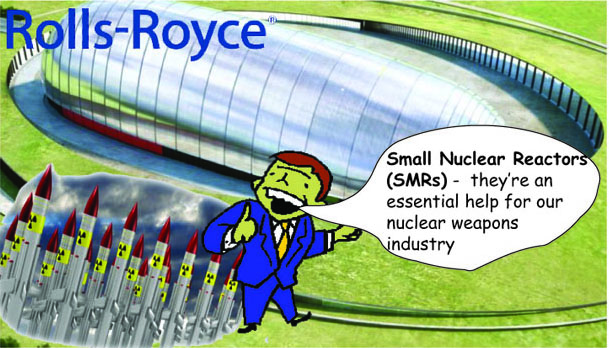
Rolls-Royce heads to Middle East as Saudi Arabia plots £74bn nuclear investment,
ROLLS-ROYCE is looking to the Middle East to export its new [so-called] green technology while Saudi Arabia is reportedly eyeing up a £74billion nuclear investment.
Express UK By JACOB PAUL, Wed, Jan 19, 2022………….. Rolls-Royce looks set to bring its SMR technology to the World Future Energy Summit. This is a global conference showcasing green energy technology. Mr Samson said the company is hoping to start talks with government representatives and large industrial in the Middle East……
And this comes as Saudi Arabia is reportedly exploring options of investing $100 billion (£73.55billion) in several nuclear plants with a combined capacity of 22 gigawatts………
It comes as Rolls-Royce looks set to bring its SMR technology to the World Future Energy Summit.
This is a global conference showcasing green energy technology.
Mr Samson said the company is hoping to start talks with government representatives and large industrial in the Middle East.
And this comes as Saudi Arabia is reportedly exploring options of investing $100 billion (£73.55billion) in several nuclear plants with a combined capacity of 22 gigawatts……..
Mtr Samson – “We have opened up a whole spectrum of customers.”
And Rolls-Royce has already been looking for opportunities to sell its technology to potential UK customers.
But the first SMR units are not expected to come online before the early 2030s. Mr Samson said the company needs to first go through the regulatory processes in Britain. It also needs time to build factories, certify its designs and move on to the production process………… https://www.express.co.uk/news/science/1552184/rolls-royce-middle-east-Saudi-arabia-smr-nuclear-world-future-energy-summit
Anglesey does not need nuclear energy – Nuclear Free Local Authorities (NFLA)
Anglesey does not need nuclear energy, says Welsh NFLA chair https://www.northwaleschronicle.co.uk/news/19853825.anglesey-not-need-nuclear-energy-says-welsh-nfla-chair/
By Matthew Chandler @chandler98_ 17 Jan 22, Report THE chair of the Welsh Forum of Nuclear Free Local Authorities (NFLA) has countered the recent suggestion by Isle of Anglesey County Council’s leader that nuclear energy is needed ‘now more than ever’.
Councillor Llinos Medi, made this claim to Guto Harri on S4C’s current affairs series, Y Byd yn ei Le.
Responding, the chair of the NFLA Welsh Forum, Councillor Ernie Galsworthy, said: “The council leader seems unaware of the reality that is nuclear power and unaware of her own party’s (Plaid Cymru’s) position on the subject.
“Nuclear energy projects are notorious for being delivered years late, being delivered massively over budget, and on occasions – as we have seen at Wylfa in the recent past – being delivered not at all.
“If the council leader really does want to keep the lights on for her electors then it is pointless looking to nuclear energy to deliver the goods.
“The small modular reactors that Councillor Medi talks of are reliant upon designs that are not yet proven and will not be operational until the mid-2030s at the earliest, and we need to tackle energy insecurity and climate change now.
“They would also be delivered at a massive cost to the Welsh taxpayer as everyone will face a ‘nuclear tax’ on their electricity bills to fund it, thanks to the Conservative Government’s Nuclear Energy (Financing) Bill.”
The NFLA is clear on its own position: Wales should move away from nuclear and make a commitment to powering the nation using 100 per cent renewables.
Councillor Galsworthy added: “The Scottish Government has set itself a target of meeting 100 per cent of their nation’s energy needs through renewables alone, and they are now up to 96 per cent, and the Welsh Government should look to do the same.
“Our nation is blessed with natural resources that can, and should, be utilised to meet our current and future energy needs.
“I would urge Councillor Medi not to become another Atomic Kitten. Wales does not ‘need’ nuclear and we do not have to ‘have’ it.
Solar, tidal, wind and hydro-electric power projects can all be delivered now using proven technology far more quickly and at much less cost than nuclear, and without the dangers associated with nuclear power or the need to store safely the resultant radioactive waste.
“Anglesey as the ‘energy island’ could be at the forefront of that renewables’ revolution bringing the many jobs, far more than nuclear, for that island community that would result.
“If Councillor Medi wishes to have a ‘conversation’ about bringing that vision to the island, the Welsh NFLA will be happy to have it.”
Labour tries to curb cost overruns from Sizewell C development
Bill Bordass, Research and Policy Adviser for the Usable Buildings Trust said: ‘Surely the only sensible way to curb Sizewell C is to scrap it entirely? It is just good money after bad.’
Labour bids to curb cost overruns from Sizewell C development, https://100percentrenewableuk.org/labour-bids-to-curb-cost-overruns-from-sizewell-c-development, David Toke, 16 Jan 22, The Labour frontbench has put down an amendment to the Nuclear Financing Bill which would stop the automatic reimbursement of EDF for excess construction costs of the planned Sizewell C nuclear power plant. The amendment, put forward by Shadow Green New Deal and Energy Minister Alan Whitehead, has been defeated by the Conservative majority in the Commons, but will soon come up for a vote in the House of Lords.
The Nuclear Financing Bill sets up a so-called Regulated Asset Base (RAB) means of funding nuclear power. This means the constructors would be be paid for the construction costs before the plant was generating anything. It would save the constructors money whilst making the project a lot more expensive for the energy consumer in the (most likely) event that the project experienced considerable cost overruns.
Although the SNP has also put down useful amendments to make the Government publish details of the costs of the project, Labour’s proposed amendment is potentially significant in that it could, if taken literally, dissuade EDF from moving ahead with any deal to build Sizewell C. As Whitehead told the Commons, analysis of historical experience of building nuclear power plant it is a near certainty that there will be cost overruns on the project.
In fact Whitehead implied he was not trying to stop the project, but merely argued that cost overruns should not automatically be added to consumer bills. If there were cost overruns then the Government could find the extra money to pay for the project from some other source.
Amongst other things, the SNP amendments asked that the Government should have to make public whether Sizewell C was being given a guarantee that its generation would be paid a minimum price for each MWh produced. Labour also sought to block nuclear power plant being owned by foreign companies, although it was argued this would not affect Sizewell C.
Labour joined forces with the Conservatives to vote through the Bill on the Third Reading, with the SNP, the Liberal Democrats and the Green Party whipping against the Bill.
It ought to seem strange that at the very time there is concern about increased energy bills and strident calls to cut back on green levies from some Tory MPs, the very same MPs are unquestioningly voting through a piece of legislation that will add substantial sums onto consumer bills. EDF has said that Sizewell C will cost £20 billion. Considering that interest charges and also cost overruns will have to be added to this sum the total cost may very plausibly amount to £30 billion or more – and that represents more than £1000 for each household in the UK.
The amount of energy generated by Sizewell C will only be of the order of the next tranche of renewable energy projects (to be issued in the coming moths) that will cost the consumer effectively nothing. By contrast Sizewell C will likely not even be seriously begun until Hinkley C is completed (2027?) which means a 2035 or later start. The UK could have deployed a lot more renewable energy by then of course at much lower cost. The current nuclear crisis in France demonstrates how unreliable nuclear power can be.
Bill Bordass, Research and Policy Adviser for the Usable Buildings Trust said: ‘Surely the only sensible way to curb Sizewell C is to scrap it entirely? It is just good money after bad.’
The Commons debate details can be seen here. The House of Lords is due to vote on the Bill in the coming days.
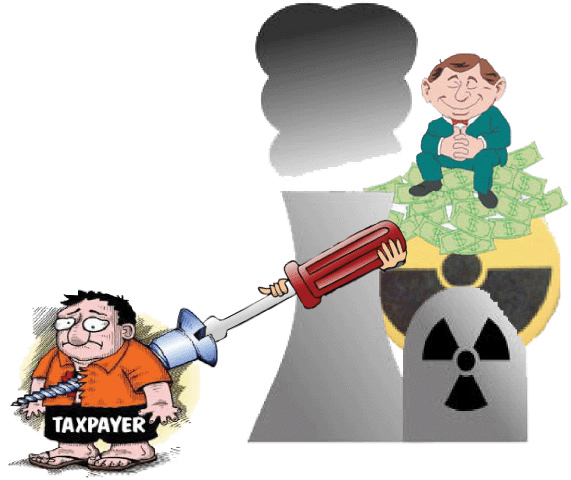
Regulated Asset Base – UK’s nuclear tax on electricity consumers – supposed to attract foreign investment
Energy costs and energy investment, Renew Extra Weekly, January 15, 2022 ”……………………… Energy prices are accelerating seemingly out of control. But actually the way the Contracts for Difference (CFD) is structured, with competition for capacity slots and a claw back of any excess income over strike price costs, it may not be too bad- it does seem to limit excess cost pass-though, unlike the old Renewables Obligation system, which some now see as much less attractive. So, with the CfD apparently doing well, it might be thought to be a bit odd that the government has shifted away from using it for nuclear, to a new Regulatory Assets Base (RAB) system for new large plants. The CfD was used to finance Hinkley Point C EPR, but it did so excessively, with a £92.5/MWh index linked contract being awarded to EDF without competitive bids being considered.
The CfD could in theory have been used again for the next big nuclear project, this time with a competition, but evidently the high project costs, and the high resultant strike prices likely, made it less attractive. So instead the government is going for Regulated Asset Base (RAB), basically a nuclear tax on electricity consumers, raising capital to fund construction of new plants, so that income starts flowing before construction starts.
It’s claimed that this element of RAB will make it easier for companies to finance nuclear, so that they can eventually charge consumers less. Well, we will see. But equally, if there’s a cost overshoot or delay, consumers will get hit hard, and, if the project is abandoned, their involuntary investment will be lost. Interestingly that includes Scottish consumers, despite anti-nuclear Scotland not being likely to allow any new plants to be built there. So Scots would be subsidising projects in England and Wales.
That won’t go down well with the SNP.
The RAB plan, which, even if all goes well, will put some extra costs on power bills, does in any case look odd for all consumers, given that the government says it wants to remove energy taxes from electricity and impose them instead on domestic gas heating. That may be sensible, but, with RAB, it’s going the wrong way.
A subsidy too far?
So why is government adopting for RAB for new nuclear? Evidently it’s to attract foreign investors! The Regulated Asset Base nuclear finance bill has just got through a House of Commons vote unamended.
During the debate, Business & Energy Secretary Kwasi Kwarteng said: ‘The existing financing scheme has led to too many foreign nuclear developers walking away from projects, setting our nuclear industry back a number of years. While the existing Contracts for Difference model was right for Hinkley Point C, the lack of alternative funding models has significantly contributed to the cancellation of recent potential large-scale projects. And this includes Hitachi’s project at Wylfa and Toshiba’s project at Moorside. We urgently need a new approach to attract capital into the sector.’
Somehow that seems to clash with what Energy and Climate Minister Greg Hands said: ‘The Bill will finance new nuclear power stations, making us less dependent on foreign-owned developers and bringing in the private sector and institutional funding.’
All of this, remember.. is because nuclear projects are too costly to win under normal competitive markets terms, whereas, increasingly, mainstream renewables like wind and solar can do that……….
there are some urgent infrastructure projects that could help cut energy costs quite quickly, the most obvious being investment in energy efficiency. For example, the Energy Efficiency Infrastructure Group said that improving insulation on the UK’s least efficient homes would save households around £500 a year on energy bills, totaling £8bn p.a. nationally. ……………
RAB funding might make it cheaper to build new gas stores rather than relying on imports…………
All of which seems to make more sense that using RAB for nuclear, which shows little sign of getting cheaper no matter how much money is chucked at it. Instead it seems to just soak up money, as with the much delayed EPR still being built at Flamanville in France, currently not scheduled for completion until 2023 and full operation in 2024, at an expected cost now put at Euro12.5bn. That is well over three times the original Euro 3.3bn estimate made when work started on it in 2007. And that assumes there are no further problems, like the fault that has shut down the Chinese version of the EPR, just at the point when China is desperate for power. An odd sort of asset that…and a problem that may rebound on the French EPRs. https://renewextraweekly.blogspot.com/2022/01/energy-costs-and-energy-investment.html
1 This Month
26 September – International Day for the Total Elimination of Nuclear Weapons





PLEASE OPPOSE HR 8255 AND S.3639 – bills would accelerate satellite deployment, with no environmental review or safeguards – https://ncstd5li.quorum.us/campaign/169331/
To see nuclear-related stories in greater depth and intensity – go to https://nuclearinformation.wordpress.com
-
Archives
- September 2026 (313)
- August 2026 (330)
- July 2026 (355)
- June 2026 (287)
- May 2026 (306)
- April 2026 (356)
- March 2026 (251)
- February 2026 (267)
- January 2026 (308)
- December 2025 (358)
- November 2025 (359)
- October 2025 (375)
-
Categories
- 1
- 1 NUCLEAR ISSUES
- business and costs
- climate change
- culture and arts
- ENERGY
- environment
- health
- history
- indigenous issues
- Legal
- marketing of nuclear
- media
- opposition to nuclear
- PERSONAL STORIES
- politics
- politics international
- Religion and ethics
- safety
- secrets,lies and civil liberties
- spinbuster
- technology
- Uranium
- wastes
- weapons and war
- Women
- 2 WORLD
- ACTION
- AFRICA
- Atrocities
- AUSTRALIA
- Christina's notes
- Christina's themes
- culture and arts
- Events
- Fuk 2022
- Fuk 2023
- Fukushima 2017
- Fukushima 2018
- fukushima 2019
- Fukushima 2020
- Fukushima 2021
- general
- global warming
- Humour (God we need it)
- Nuclear
- RARE EARTHS
- Reference
- resources – print
- Resources -audiovicual
- Weekly Newsletter
- World
- World Nuclear
- YouTube
-
RSS
Entries RSS
Comments RSS

