”Decommissioming” of UK’s dead nuclear reactors is likely to cost the tax-payer much more than planned for.
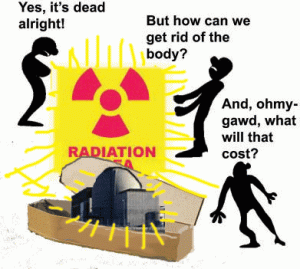
significant additional taxpayer support has been required, and more is likely to be necessary.
there is a risk that the taxpayer will have to make further
contributions.
A report from the UK’s National Audit Office examines whether the
government’s arrangements for decommissioning Britain’s fleet of
advanced-gas-cooled reactors offers value for money.
The UK has eight second generation nuclear power stations accounting for around 16% of total
UK electricity generation in 2020. Seven of the eight stations are Advanced
Gas-cooled Reactors (AGRs), the design of which built on that of the first
generation of now closed Magnox reactors.
Under current plans, all the AGR
stations will have stopped generating electricity by 2028. Decommissioning
is envisaged to take just over 100 years under current plans. The Nuclear
Liabilities Fund (the Fund) was established to meet the costs of
decommissioning all seven AGRs plus a pressurised water reactor at Sizewell
B, but significant additional taxpayer support has been required, and more
is likely to be necessary.
The UK government has provided a guarantee to
underwrite the Fund if its assets are insufficient to meet the total costs
of decommissioning. In 2020, government contributed £5.1 billion ($6.8bn)
to strengthen the Fund’s position and the Fund has recently requested a
further £5.6 billion. The Fund’s assets were valued at £14.8 billion at
the end of March 2021. The aim is that growth in the Fund’s investments
will be sufficient to meet the long-term costs of decommissioning
(currently £23.5 billion).
However, cost estimates have doubled in real
terms since 2004/5. If this trend is maintained and investment growth is
not sufficient, there is a risk that the taxpayer will have to make further
contributions. Last year, the government entered into new arrangements to
decommission the seven AGR nuclear power plants, making EDF Energy
responsible for defueling. The decommissioning of the AGR nuclear power
stations, a 66-page report published by the National Audit Office (NAO)
examines whether these arrangements will lead to better value for money.
The NAO scrutinises public spending to help Parliament hold government to
account and improve public services. It says that while the arrangements
could deliver savings, their success will ultimately depend on the relevant
parties working collaboratively to overcome risks.
Nuclear Engineering International 20th April 2022
https://www.neimagazine.com/features/featurearrangements-for-decommissioning-the-agrs-9640510/
UK’s Nuclear Free Local Authorities join in Wales’call to Japan not to dump radiactive wastewater at sea
The Nuclear Free Local Authorities (NFLA) have joined with leading Welsh
anti-nuclear environmental campaign groups in writing to senior Japanese
Government ministers urging them not to dump radioactive waste from the
Fukushima disaster at sea.
Operated by the Tokyo Electric Power Company
(TEPCO), the Fukushima Daiichi Nuclear Power Plant was hit by an earthquake
and a tsunami on 11 March 2011. A disaster unfolded with three nuclear
meltdowns, three hydrogen explosions and a release of radiation from three
reactors, and Government authorities were forced to evacuate 154,000 people
from the surrounding area over a 20-mile radius. An average of 150 tons of
radioactive water was produced each day last year as rainwater and
groundwater flowed into the damaged reactor buildings mixing with seawater
which has been used to cool the melted nuclear fuel.
One million tons of this water is now stored in barrels on the site. Although the contaminated
water is treated it cannot remove deadly tritium, a beta-emitting
radioactive isotope of hydrogen, and other radioactive materials.
NFLA 21st April 2022
The life and slow death of nuclear power plants

The UK government and EDF have pledged 20% of the cost each, but the additional 60% is yet to be found. Some of that is a levy on our electricity bills for a decade before Sizewell generates a single Kwh.
once planning permission is given, construction of a small-scale wind farm, 10MW or less, could take less than two months.

A further elephant in the room is that the costs of new nuclear are highly “back loaded”, i.e., that by building them you commit to high levels of expenditure at the end of their working life, to remove the fuel rods, decommission, remove and store nuclear waste.
The Life and Death of nuclear power plants By NEWSROOM, Apr 18, 2022, By Peter Rowberry with additional reporting by Newsroom
It seems that the policy [in the UK] to build new nuclear power stations has caused some friction at the heart of the cabinet, with the Prime Minister trying to get the agreement of the Chancellor to spend at least £100 billion on eight new nuclear power stations. This didn’t stop the government issuing its energy security strategy last week.
Such a huge commitment merits careful scrutiny. Hinkley Point C was one of eight announced by the British government in 2010 with a nuclear site licence granted in November 2012. EDF’s board approved the project in July 2016 and on 15 September 2016 the UK government approved the project in principle. Construction work on-site began by late September 2016. Completion of the reactor bases was completed in June 2019 for reactor 1 and June 2020 for reactor 2. The two bases required a total of 633,700 cubic feet of concrete.
Hinkley C is the only one of the 2010 eight designated sites to have commenced construction. The UK government strategy paper calls for 8 further new nuclear plants but does not name locations. This is similar to the Brown government’s announcement in 2008 which the coalition government pinned down in 2010. With only 1 of 8 since 2010 actually under construction the conclusion is the new 8 suggested could be decades from coming online.
Earlier costs for Hinkley C were estimated at around £18 billion. The current cost estimate is around £22 to £23 billion, and the first reactor will not be complete until June 2026 at the earliest, and the second at least six months later.
This timetable is currently being reviewed, with a fault found in similar nuclear reactors in China meaning the design may need to be changed. EDF have not commented on whether this will affect the timescale for completing the project. These delays, and the consequent impact on other nuclear projects, such as Sizewell C and Wylfa, have resulted in serious failures to meet the government obligations to move to low carbon generation and taken up time, time which we are now desperately short of if we are to meet our target of reducing carbon emissions by 50% by 2030 and to net zero by 2050.
The building of the two reactors that form the Sizewell C project is still not fully financed. Nor has the planning process been completed. All the work in progress so far is on vast quantities of paper and construction cannot commence until Sizewell C plant receives planning permission.
There remains considerable opposition to Sizewell C over the high cost of nuclear energy and environmental issues. The cost of a plant that is over 10 years away from generating power will start hitting electricity bills sometime soon. The BBC reported “Legislation allowing construction and financing costs to be added to customer bills, as Sizewell C is built over the next decade, is due for a second reading in the House of Commons next month.”
The UK government and EDF have pledged 20% of the cost each, but the additional 60% is yet to be found. Some of that is a levy on our electricity bills for a decade before Sizewell generates a single Kwh. The government’s plans to have eight nuclear reactors up and running by 2030 seem naively optimistic. New nuclear is not a quick fix, as our near neighbours will attest. The Finnish reactor, Olkiluoto 3, was started in 2005, but only went onto the grid seventeen years later, on 15 March this year.
Of the eight nuclear power plants announced back in 2010, Hinkley Point C might be generating by 2026 (16 years) and Sizewell C by 2032, subject to planning permission (22 years) None of the other 6 proposed nuclear plants are anywhere near getting off the ground.
France, a country which historically generates a large percentage of its electricity from nuclear, is in the process of building only one new reactor, a third at the Flamanville site. EDF, the state-owned energy giant, began work in December 2007 and the cost was estimated to be €3.3 billion. It is now expected to cost more than €12.7 billion and it is yet to generate a single kilowatt of power.
In contrast, according to the European Wind Energy Association, once planning permission is given, construction of a small-scale wind farm, 10MW or less, could take less than two months. A larger 50MW facility may take six months, although considerably smaller in scale, this is substantially quicker than any new nuclear. This has not stopped president Macron from announcing that his government will support the building of between six and fourteen new reactors.
A further elephant in the room is that the costs of new nuclear are highly “back loaded”, i.e., that by building them you commit to high levels of expenditure at the end of their working life, to remove the fuel rods, decommission, remove and store nuclear waste. The UK Nuclear Decommissioning Authority currently spend around £3 billion a year for Site Licence Companies to make the current decommissioned reactors safe.
The Nuclear Provision is the best estimate of how much it will cost to clean up 17 of the UK’s earliest nuclear sites over a programme lasting over 120 years……………………………………………………
All of this will be less significant if nuclear could deliver low carbon electricity at an affordable price. The biggest issue on the cost of nuclear energy is the so called “strike price”, the price which the government has agreed to pay the owners, EDF, for electricity from their nuclear stations. Originally EDF said that electricity from nuclear could be produced at around £24 per megawatt hour. The strike price is now set at £92. It has also been agreed that the strike price should rise in line with inflation, which as we know has reached a thirty-year high and is likely to continue to be high for the foreseeable future.
Although the cost of the raw materials for building wind turbines has increased, copper and steel in particular, the cost of generation by renewables has steadily decreased over time. The latest strike price for offshore wind is around £40 per megawatt hour and less for onshore wind. There have been several missed opportunities and poor decisions by both the Labour and Conservative parties and both party’s obsession with new nuclear have put us in a position where we need urgent action. In February 2004 the Labour party undertook a £40 billion project to update schools, but, despite intense lobbying, energy efficiency did not form part an integral part of that plan.
The Conservative party made changes to the planning system to make it virtually impossible to get permission to build onshore wind farms, although that policy has now been reversed. They also brought an end to the “feed in tariff (FITs)” for local solar power and increased VAT from 5% to 20% on solar installations – now VAT is zero as part of Sunak’s Spring statement.
Although FITs were replaced by the Smart Export Guarantee, this was significantly less financially attractive and has reduced the incentive to install Solar photovoltaic cells…………………………… more https://newsnet.scot/news-analysis/the-life-and-death-of-nuclear-power-plants/
Constant cheap renewable power to Britain – the Sahara wind and solar cables

Within five years, the world’s longest undersea cable will link Devon to
a vast territory of solar panels in the Sahara Desert, supplying
electricity directly into Britain’s grid at a fraction of today’s power
prices. A second cable will land two years later in 2029.
Together they will provide 3.6 gigawatts (GW) of constant baseload power, equivalent to
two Hinkley-sized nuclear reactors. The difference is that we will be able
to afford it.
That, at least, is the plan. The £16bn Xlinks Morocco-UK
Power Project – chaired by former Tesco chief Sir Dave Lewis – has an
elegant feature. It combines wind and solar in perfect geographic
circumstances to make near-constant power for 20 hours a day.
Trade winds on the coast of North Africa raise the average “capacity factor” of
onshore wind turbines to 54pc. A desert convection effect creates a regular
wind current in the early evenings and smooths the handover from solar to
wind. “It picks up every afternoon just as the sun is setting,” said
Simon Morrish, the project’s chief executive.
This overcomes the curse of intermittency, with lithium batteries in the desert to cover the remaining
gaps. Xlinks will be a park of 580 square miles at Guelmim Oued Noun on the
28th parallel south of Agadir, picked because it is at the top of the
global horizontal irradiance index. The yield is three times higher than in
the UK. The sun shines for 10 hours a day in winter. “The space is
unlimited. We could in theory put up 500 of these projects in Morocco,”
he said. The consortium is already planning a second hub to power Benelux.
It could multiply the scale several times over for the UK, constrained only
by the safe limits of energy security.
Telegraph 20th April 2022
Nuclear power stations UK: the new and existing sites at threat of flooding from 2030 amid rising sea levels
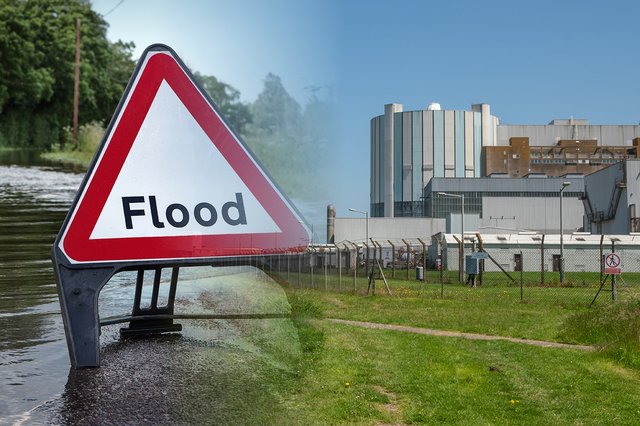
NationalWorld investigates how safe the locations of both the current and proposed nuclear power stations are amid rising sea levels https://www.nationalworld.com/news/environment/nuclear-power-stations-uk-new-existing-sites-threat-flooding-2030-sea-levels-3655640
By Isabella Boneham,, 15th April 2022 All of the current and proposed locations of nuclear power stations in the UK will be at “significant risk” of being flooded from 2030 due to extreme weather events becoming more frequent, a Greenpeace chief scientist told NationalWorld.
UK seas have risen by over 16.5cm since 1901, bringing into question the safety, security and viability of nuclear power stations on Britain’s coastlines. However, in the Government’s latest energy strategy, Boris Johnson ramped up the drive for nuclear energy, proposing plans to build eight new stations with one being approved each year until 2030.
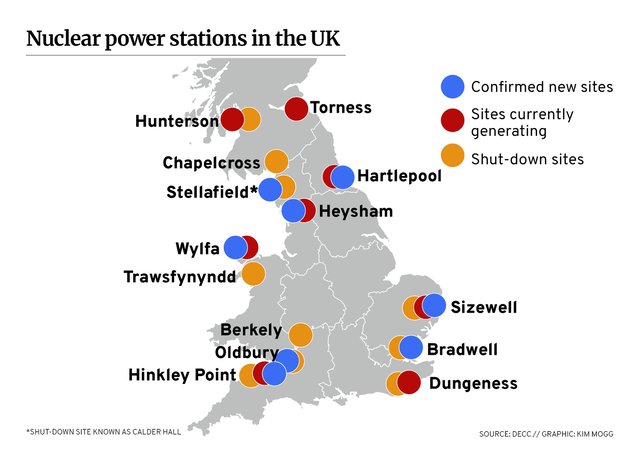
Where are the current and proposed locations of nuclear power stations in the UK?
There are eight nuclear power stations currently generating in the UK
- Hunterston, a coastal area in Ayrshire, Scotland
- Torness, east coast of Scotland
- Hartlepool, located in County Durham
- Heysham, located in Lancashire
- Sizewell, located on the Suffolk coast
- Dungeness, on the coast of Kent
- Hinkley Point, located in Somerset
- Wylfa, on the island of Anglesey in Wales
- In June 2011, eight sites across Britain were chosen as locations for new nuclear stations.
- In the Government’s new energy strategy, announced on 7 April 2022, Boris Johnson confirmed plans for these eight sites:
- Bradwell B is a proposed new nuclear power station at Bradwell-on-Sea in Essex and is currently in the public consultation stages.
- Hartlepool in County Durham was confirmed as a ‘designated nuclear site’ in the Government’s 7 April energy strategy. The town’s existing EDF nuclear power station is due to cease production in 2024.
- Heysham in Lancashire was named in the UK government’s new major energy strategy.
The Government has backed the construction of Hinkley C in Somerset, which will be the largest nuclear station in Britain – it is set to open by the end of 2026.- Oldbury in south Gloucestershire was mentioned as a candidate for a new nuclear reactor site.
- Moorside nuclear power station is proposed for a site near Sellafield in Cumbria – it has received full business case approval from the government.
- There are proposals for a nuclear plant on the coastline of Suffolk called Sizewell C, with ministers throwing in £100m investment to EDF Energy’s £20bn nuclear power station.
- Small Modular Reactors will form a key part of the nuclear project pipeline, with both Trawsfynydd and Wylfa tipped as sites.
- How will rising sea levels affect UK nuclear power stations?
- All of the locations of current and proposed nuclear power stations are deemed to be unsafe.A new interactive tool that looks at flooding risk to coastal regions has revealed the severity of the rising sea level threat to the location of nuclear power stations.
The searchable map from Climate Central, a non-profit organisation focused on climate science, shows the expected rise of sea levels and what areas of the UK are most at risk from flooding.By 2030, based on the current pollution trajectory, it is clear that the locations of current and proposed stations are at threat from rising sea levels.
- The coastlines of these areas, where nuclear stations are located, are at threat of floods from 2030 onwards.These maps identify places that require deeper investigation of risk and are based on global-scale datasets for tides in addition to sea level rise projections.
- Dr Paul Dorfman, Chair of the Nuclear Consulting Group, an independent institute providing expert research and analysis of nuclear issues, told NationalWorld that current and proposed nuclear power stations will be vulnerable to flooding due to rising sea levels and more frequent and severe storms.
How big is the climate threat?
The UK’s sea level has risen by over 16.5cm since 1901, according to the state of the UK Climate Report 2020 published last year by the Met Office.
It also found that 2020 was the third warmest year, fifth wettest and eight sunniest on record.
No other year has fallen in the top 10 for all three variables for the UK
- It also marked the eighth warmest year for UK near-coastal sea-surface temperature in a series from 1870.Parts of the UK will be at risk of being flooded in 2030 due to rising sea levels and warming temperatures.
- Areas at risk of being flooded in 2030 are Portsmouth, East Riding of Yorkshire, Arun (West Sussex), London boroughs on either side of the Thames including Canary Wharf and Fulham, Chichester (West Sussex), Weston-Super-Mare, Cardiff, Great Yarmouth (Norfolk), and West Berkshire (Berkshire) and Worthing (West Sussex), according to Climate Central’s interactive tool.
- Dr Scott Kulp, a senior scientist at Climate Central and lead author of the study, said that these maps show the “potential of climate change to reshape cities, economies, coastlines, and entire global regions within our lifetimes.”
- He added: “As the tideline rises higher than the ground people call home, nations will increasingly confront questions about whether, how much, and how long coastal defences can protect them.”Over 1.3 million residential and commercial addresses in Britain will be at risk of flooding by 2050, intelligence provider Gamma has said.
- What has the government said?
- A spokesperson from the Government’s Department for Business, Energy, and Industrial Strategy, said: “Site licence holders in the civil nuclear industry are required to meet robust standards, overseen by independent regulators, including ensuring that sites have the necessary defences in place to protect them against the effects of climate change, such as flooding, rises in sea levels, coastal erosion and drought.”
The spokesperson added: “The Office for Nuclear Regulation and environmental regulators would not allow a nuclear power station to be developed on a site, or to operate, if they judged that it was not safe to do so.”
Reclaim the Word “Clean” from the Nuclear Industry
PETITION https://you.38degrees.org.uk/petitions/clean-energy-technology-park-is-a-nuclear-nightmare
King Midas turned everthing he touched into gold. This is what the most toxic industry would have us believe nuclear power is …”clean” and “green” and puppy dogs tails. The dark heart of this industry resides in another heartland. That of Nannashire near Preston where the UK’s Nuclear Fuel Manufacturing site hunkers down like a well camouflaged toxic toad between the well known, vigorously and sucessfully opposed fracking sites of Preston New Road and Roseacre. Unlike fracking, Nuclear has co-opted so many ordinary folk with its unprecedented PR machine and largesse to good causes (using public money). And now it has even co-opted the English language with the naming of the “Clean Energy Technology Park” even while it gears up to rip up uranium from far flung countries and manufacture ever more nuclear fuel. There is no “away” for nuclear wastes apart from the Midas curse of turning all life on this fragile biosphere to a nuclear wasteland. How can we fight the “Clean Energy Technology Park” when even language has been twisted so out of shape for the nuclear cause…
What absolute idiot does not want “Clean Energy”?
Its CLEAN ENERGY Why are you Opposing it??
The first step to resistance is to reclaim the world “CLEAN” from the nuclear industry. Join us and sign the petition which will be handed in on the anniversary of the ongoing Chernobyl disaster – 26th April. https://you.38degrees.org.uk/petitions/clean-energy-technology-park-is-a-nuclear-nightmare
To: Trading Standards, Lancashire County Council. “CLEAN” ENERGY TECHNOLOGY PARK IS A NUCLEAR NIGHTMARE We the undersigned call for the the word “clean” to be removed from the UK’s Nuclear Fuel Manufacturing plant which the industry has re-named the Clean Energy Technology Park. We call for Removal of the word “CLEAN” from the CLEAN ENERGY TECHNOLOGY PARK to be replaced with the accurate description of “NUCLEAR”.
To describe Nuclear energy as “clean” is fraudulent and the claim amounts to a mass marketing scam perpetrated on the British public.
Why is this important?
“Clean” Energy Security? The raw material for nuclear is uranium which can be found in in the UK in the Orkneys but which our government buys from, for example Kazakhstan where it is largely mined by leaching out the uranium from the rock using massive amounts of fresh water and chemicals
. “Clean” Carbon footprint? Nuclear is at least the third highest carbon emitter after coal-fired plants and natural gas. As uranium becomes more scarce more energy and chemicals are needed to get the uranium out of the ground. The Nuclear Decommissioning Authority have calculated their carbon footprint for 2019/20 as 1,046,950 tonnes of carbon dioxide equivalent (CO2e). This does not include operation of nuclear reactors or include the building of Hinkley Point C with the biggest pour of concrete in the UK ever. The nuclear and fossil fuel industry are mutually intertwined. The biggest gas plant being constructed in the UK right now is at Sellafield, home to 80 percent of the UK’s existing nuclear waste which needs to be kept cool. The heating effect of discharges to the atmosphere and sea and also the use of water as a coolant for reactors and nuclear wastes are all contributing to ocean temperature rise and climate change. An honest description of Nuclear would be : Radioactive Fossil Fuel by proxy
“Clean” Radioactive Emissions Radioactive emissions occur at every stage of the nuclear fuel cycle from the mining of uranium to enrichment, to fuel manufacture, to operation of the reactors, to the “disposal” of nuclear wastes. These emissions occur both routinely and accidentally and have already resulted in large swathes of the world’s land and oceans becoming irreversibly polluted with man-made radioactive isotopes.
“Clean” and Healthy? Radiation can damage the DNA in our cells. High doses of radiation can cause Acute Radiation Syndrome or Cutaneous Radiation Injuries. There is no such thing as a “safe dose” of radiation
The “Clean Energy Technology Park” just 3.9 miles from the centre of Preston is planning an incinerator to burn intermediate level radioactive wastes from across Europe. This would result in daily plumes of chemical and radio-toxic airborne fine particle emissions blowing accross Preston City Centre. We call for the word “Clean” to be replaced by – Nuclear – at the
“Clean Energy Technology Park”.
.
No room at the dump: NFLA fears Johnson’s nuclear ambitions will lead to need for second unwanted underground facility
Like the standing joke about buses turning up late and in pairs, the
Nuclear Free Local Authorities fear that Boris Johnson’s commitment to
treble Britain’s nuclear generating capacity by 2050 will create so much
new toxic nuclear waste that the government will want to build a second
underground nuclear dump in the next two decades.
A large, and much maligned, element in last week’s UK Energy Security Strategy was the
pledge to build up to eight new large nuclear power stations over the next
three decades, generating 24 gigawatts of electricity, and the UK could run
out of room to store the resultant radioactive waste if the Prime
Minister’s plan becomes reality.
Professor Claire Corkhill is Chair in
Nuclear Material Degradation and EPSRC Early Career Research Fellow and
Reader at the University of Sheffield, and a member of the Committee on
Radioactive waste Management (CORWM) which advises the government.
Professor Corkhill has publicly commented that existing plans for the dump
will only provide sufficient capacity to take the legacy waste from 70
years of operations and waste from up to 16 gigawatts of nuclear new build,
and has expressed concern about ‘rushing to expand nuclear power until
the implementation of radioactive waste policy [i.e. the GDF] has
progressed further’.
NFLA 13th April 2022
Dr Richard Dixon: Scottish and UK governments are on a collision course over nuclear energy and oil.
The UK Government’s new energy strategy
makes no sense at all and puts Westminster on collision course with
Holyrood. In early March, Boris Johnson said he would produce, as a matter
of urgency, a plan to respond to the twin challenges of war in Ukraine and
the cost-of-living crisis.
Four weeks later, we finally have the British
Energy Security Strategy and it does pretty much the opposite of what’s
needed. Supposedly this is because the PM and Chancellor could not agree on
key measures. The result is a strategy that convinces no-one. Even the
right-wing press have roundly lambasted it.
The first thing you are taught
in any class about energy is that using less is much better than producing
it differently. Yet, there is nothing at all in the strategy on the
quickest, cheapest and most obvious way to save energy and reduce bills –
improving the energy efficiency of people’s homes.
The last thing youwould do if you want to change our energy system quickly and at an
affordable cost is invest in new nuclear reactors, yet that is exactly what
the government plans to do, egged on by Labour’s new enthusiasm.
The cover of the strategy shows the construction site at Hinkley Point C,
originally proposed in the mid-1980s, subject of a two-and-a-half year
public inquiry and with construction now running ten years late and many
times over budget. The world’s most expensive power plant is perhaps not
the cleverest example to use.
The plan suggests eight new nuclear reactors.
In 2010, the Conservative-Lib Dem coalition government planned to build
eight new reactors in the next decade … 12 years later the two reactors
at Hinkley are the only ones actually under construction and they might
possibly producing electricity in 2027 with a price tag of £23 billion.
There will be a new round of applications for oil and gas production in the
autumn, given a green gloss by the complete con that is the Climate
Compatibility Checklist. The Cambo oilfield might be back on the table. The
government says it is reviewing the science on fracking, and Ineos has
already kindly offered to start drilling.
The Scottish Government is due to
publish a set of energy scenarios before the summer and a draft Energy
Strategy in the autumn. There will be plenty of energy efficiency and
renewables but no new nuclear and no fracking. Apart from offshore wind,
the UK and Scottish plans on energy are pretty much the opposite of each
other. Sparks will fly.
Scotsman 14th April 2022
Touring exhibition celebrates 40 years on Wales county councils Nuclear Free Zones
A TOURING exhibition is to visit Llandudno next week to celebrate 40 years
since all eight of the (then) county councils of Wales declared themselves
“Nuclear Free Zones”. This was marked on February 23, 1982 by the Clwyd
“Nuclear Free Wales” Declaration. CND Cymru (supported by North Wales
Quakers) are marking the campaigns which led to that signing with a touring
exhibition at 12 centres around Wales, including Llandudno (known as
“Nuclear Free Wales @40”).
North Wales Pioneer 14th April 2022
UK to get ”special weapons”storage sites for USA nuclear weapons, – making a pre-emptive strike easier.

Daryl Kimball, the executive director of the Arms Control Association, said the upgrade of the UK storage facilities is “an early sign that the US and Nato are preparing to engage in a protracted and maybe heightened standoff with Putin’s Russia”.
UK military vaults upgraded to store new US nuclear weapons https://www.theguardian.com/world/2022/apr/12/uk-military-vaults-upgraded-to-store-new-us-nuclear-weapons
A US 2023 budget request shows the UK is one of several European countries where investment is under way at ‘special weapons’ storage sites Julian Borger in Washington and Dan Sabbagh, Wed 13 Apr 2022
Military bunkers in the UK are being upgraded so they can be used to store US nuclear weapons again after 14 years of standing empty, according to US defence budget documents.
In the Biden administration’s 2023 defence budget request, the UK was added to the list of countries where infrastructure investment is under way at “special weapons” storage sites, alongside Belgium, Germany, Italy, the Netherlands and Turkey – all countries where the US stores an estimated 100 B61 nuclear bombs.
Hans Kristensen, the director of the nuclear information project at the Federation of American Scientists (FAS), who first reported on the budget item, said he believed the British site being upgraded is the US airbase at RAF Lakenheath, 100 km north-east of London.
The US withdrew its B61 munitions from Lakenheath in 2008, marking the end of more than half a century of maintaining a US nuclear stockpile in the UK. At the time of the withdrawal, the gravity bombs were widely seen as militarily obsolete and hopes were higher for further disarmament by the nuclear weapons powers.
That optimism has since been dashed, against the backdrop of Vladimir Putin’s invasion of Ukraine, his regime’s nuclear threats against Nato, and extensive nuclear weapon modernisation programmes pursued by both the US and Russia. As part of the US plan, the B61 has been given a new lease of life with a guidance system, the B61-12 variant, due to go into full production in May.
The 2023 budget request says that Nato “is wrapping up a 13-year, $384m infrastructure investment program at storage sites in Belgium, Germany, Italy, the Netherlands, the UK, and Turkey to upgrade security measures, communication systems, and facilities”.
In the 1990s, RAF Lakenheath had 33 underground storage vaults, where 110 B61 bombs were stored, according to the FAS. Since their withdrawal the vaults have been mothballed. Kristensen said he believes the vaults are now being upgraded so the new B61-12 bombs can be stored there, if needed.
The Biden administration has been careful not to make any moves that might be seen as escalatory in the nuclear arena in response to Putin’s announcement he would put Russia’s nuclear forces on higher alert a few days after his invasion of Ukraine. The US has cancelled scheduled tests of its intercontinental ballistic missiles, for example.
For the same reason, Kristensen said he doubted the Biden administration is planning to increase the US nuclear stockpile in Europe. When the new B61-12 bombs are delivered, expected next year, they will replace older models already there. Instead, he thought the Lakenheath upgrade is intended to provided more flexibility to move the nuclear weapons around Europe.
“One of the things they have talked about is protecting the deterrent against Russia’s improved cruise missiles capabilities,” Kristensen said. “So they could be trying to beef up the readiness of more sites without them necessarily receiving nukes, so that they have the options to move things around in a contingency if they need to.”
Britain has become keen to take a more assertive role when it comes to its own nuclear deterrent, and last year announced it would increase its own stockpile of Trident nuclear warheads by 40% to 260, the first such increase since the end of the cold war. Whitehall sources say the UK has “a clearer appreciation” of its role as a nuclear weapons state in a renewed era of state competition with Russia and China.
The UK Ministry of Defence did not comment on the upgrade mentioned in the US budget. One British official said: “We won’t provide anything on this as it relates to the storage of nuclear weapons.” But the news comes just four months after the arrival in Lakenheath of the first of a new generation of nuclear-capable US combat aircraft, the F-35A Lightning II, the first such deployment in Europe.
Daryl Kimball, the executive director of the Arms Control Association, said the upgrade of the UK storage facilities is “an early sign that the US and Nato are preparing to engage in a protracted and maybe heightened standoff with Putin’s Russia”.
“The administration should provide some clarity about the military necessity and goals of possibly bringing nuclear weapons back to the UK,” Kimball added.
The developments in Europe are part of a broader retreat from arms control. The Biden administration’s nuclear posture review, which has been sent to Congress but not yet declassified, is reported not to contain the changes the president pledged during his campaign.
In 2020, he said he would formally declare the sole purpose of nuclear weapons to be deterrence of a nuclear attack against the United States or its allies. But the review leaves open the option of using nuclear arms to respond to non-nuclear threats as well.
The nuclear disarmament group CND said the “quiet announcement” by the US amounted to more militarisation at a time of growing risk and would add to the risks faced by the British public. Kate Hudson, the general secretary of CND, said she feared it could lead to US warheads being redeployed in the UK. “Nuclear weapons don’t make us safe – they make us a target,” she added.
Rolls Royce shares dive as JP Morgan warns that small nuclear reactors will not be profitable

The new markets business of Rolls-Royce, focusing on electrical power for
small aircraft and taxpayer-backed small modular nuclear reactors, could be
lossmaking into the 2030s, a broker has warned, pushing the engineering
group’s share price lower.
Rolls-Royce announced changes to its reporting
structure at its full-year results in February, including the creation of
its new markets unit, which is pursuing opportunities from the transition
to net zero.
In an equity research note to clients yesterday, JP Morgan
Cazenove said the venture “offers good long-term sales potential but
there is no guarantee of good profits”. Rolls-Royce secured £490 million
of funding last year, including about £50 million provided by the company
and £210 million from the government, to help to support investment in the
design of the small modular reactors (SMRs). JP Morgan said demand could
“grow strongly as countries seek to cut emissions and increase ‘energy
security’.
But SMRs need to compete with other energy sources and we see
a high risk of the first SMRs being well over budget.”
Times 13th April 2022
Rolls-Royce dives as JP Morgan casts doubt on its plans for mini nuclear
power stations and electric planes.
This is Money 12th April 2022
Anti- Bradwell B campaigners slam Government’s boost for nuclear – ”never likely to see the light of day!”
Bradwell B campaigners slam Government’s boost for nuclear, Maldon Standard BY JESSICA DAY-PARKERTRAINEE REPORTER, CAMPAIGNERS against a new nuclear power station in the Dengie say the Government’s big boost for new nuclear is “unachievable, delusionary and irrelevant”.
The Government launched its British Energy Security Strategy which signifies a significant acceleration of nuclear energy, as well as renewables.
It sets out plans to boost nuclear power to three times its present capacity to produce 25 per cent of the UK’s electricity by the middle of the century.
Prime Minister Boris Johnson said the strategy will reduce dependence on power sources “exposed to volatile international prices” and increase energy self-sufficiency with cheaper bills.
However, Prof Andy Blowers, Blackwater Against New Nuclear Group’s (BANNG) chair, said: “This policy of nuclear expansion should be dismissed as unachievable, delusionary and irrelevant.
“And there is little prospect of Bradwell being among the sites where new nuclear power stations are likely to be built.”
BANNG argues nuclear power does not provide the answer to energy security for a number of reasons…………………
Prof Blowers added: “Despite the hype, the new nuclear boost is unlikely to get off the ground.
“And, Bradwell B or any other nuclear project is never likely to see the light of day on a wholly unsuitable site. The local communities have made their voices heard and helped to see off the Chinese developer. They are hardly likely to welcome a successor.” https://www.maldonandburnhamstandard.co.uk/news/20064213.bradwell-b-campaigners-slam-governments-boost-nuclear/
Nuclear Free Local Authorities deplore UK govt’s super-costly new nuclear energy strategy, and its rejection of energy conservation measures
THE NUCLEAR FREE LOCAL AUTHORITIES organisation (NFLA) says it is
“incredulous” that Prime Minister Boris Johnson and the UK Government
remains wedded to a new Energy Security Strategy that will rely in large
part upon the development of 24 GW of new nuclear generation capacity to
power Britain.
A plan involving mass investment in renewables and a
reduction in electricity demand through retrofitting the nation’s homes
with insulation would have been far cheaper and quicker to deliver, it
says.
In response to the government’s commitment to build the equivalent
of eight new large nuclear power stations by 2050, NFLA National Chair,
Councillor David Blackburn, said: “It defies common sense that the
current government is turning to a technology that is too slow to install,
too costly to build, remains risky to operate and vulnerable to military
and terrorist attack, and leaves a toxic legacy of radioactive waste that
has to be safely stored for 100,000 years.”
Ekklesia 13th April 2022
UK’s energy strategy ”cowardly and incoherent” – solar and onshore wind are the practical options
Michael Grubb: The writer is professor of energy and climate change at
University College London and was former senior adviser to energy regulator
Ofgem.
The UK energy strategy is both cowardly and incoherent. The defining
feature of the UK energy strategy is its incoherence. It does not know what
problem it is trying to solve – and thus it does not solve any. By
failing to boost energy efficiency and kicking the only possible short-term
supply option – that of cheap onshore wind – into the long grass, it
most certainly will not help those struggling with energy bills in the
coming winters.
Offshore wind is the great success story of the past decade
and capacity has grown sharply in recent years. The strategy increases the
offshore target for 2030 from 40GW to 50GW. That’s very ambitious but
possible. But offshore wind involves big and complex kit from only a few
suppliers, it usually takes three to five years from bid to completion, and
the pace of expansion could stress supply chains and drive up costs. If it
were all concentrated in the North Sea, there would be immense challenges
for the grid – both in transmission and in managing the peaks and
troughs. Wind is best when distributed more widely.
The most cowardly failure concerns onshore wind. It is not only our cheapest energy resource
– it typically costs about a third to a quarter of what people will soon
be paying for their electricity – but it is, with solar, the only one
that could make a dent in the short term. The strategy outlines a plan for
nuclear to 2050, kicked off with one new plant to be funded before the next
general election. If it takes an energy crisis to actually make a decision,
so be it, but it will not help solve the crisis.
Nuclear is not only slow
and expensive, it would need to be flexible to ramp up and down with the
swings of demand, wind and solar. This further undermines the economics.
Launching a 30-year plan for nuclear also raises the question – why
can’t the government set out even a coherent 30-month plan for energy
efficiency?
FT 10th April 2022
https://www.ft.com/content/3fe73617-5f8f-4b70-8856-ca53e2ec92b3
No community in the UK has agreed to host a nuclear waste facility
Under normal conditions, generating nuclear power produces hazardous
radioactive waste. This needs to be safely managed and stored for hundreds
of years.
However, a House of Lords paper from October 2021 said the issue
of nuclear waste remains “unresolved in the UK”. It is currently stored in
temporary facilities that are not designed for the permanent storage of
“high-level” radioactive waste.
The Government’s preferred solution is
“geological disposal” – placing waste deep in a rock formation that would
prevent radioactivity from escaping. However, no community has agreed to
host such a facility.
National World 8th April 2022
1 This Month
26 September – International Day for the Total Elimination of Nuclear Weapons





PLEASE OPPOSE HR 8255 AND S.3639 – bills would accelerate satellite deployment, with no environmental review or safeguards – https://ncstd5li.quorum.us/campaign/169331/
To see nuclear-related stories in greater depth and intensity – go to https://nuclearinformation.wordpress.com
-
Archives
- September 2026 (313)
- August 2026 (330)
- July 2026 (355)
- June 2026 (287)
- May 2026 (306)
- April 2026 (356)
- March 2026 (251)
- February 2026 (267)
- January 2026 (308)
- December 2025 (358)
- November 2025 (359)
- October 2025 (375)
-
Categories
- 1
- 1 NUCLEAR ISSUES
- business and costs
- climate change
- culture and arts
- ENERGY
- environment
- health
- history
- indigenous issues
- Legal
- marketing of nuclear
- media
- opposition to nuclear
- PERSONAL STORIES
- politics
- politics international
- Religion and ethics
- safety
- secrets,lies and civil liberties
- spinbuster
- technology
- Uranium
- wastes
- weapons and war
- Women
- 2 WORLD
- ACTION
- AFRICA
- Atrocities
- AUSTRALIA
- Christina's notes
- Christina's themes
- culture and arts
- Events
- Fuk 2022
- Fuk 2023
- Fukushima 2017
- Fukushima 2018
- fukushima 2019
- Fukushima 2020
- Fukushima 2021
- general
- global warming
- Humour (God we need it)
- Nuclear
- RARE EARTHS
- Reference
- resources – print
- Resources -audiovicual
- Weekly Newsletter
- World
- World Nuclear
- YouTube
-
RSS
Entries RSS
Comments RSS


