A big pile of Plutonium – UK reprocessing ceases, leaving deadly waste and no plan

in the end, reprocessing became a commercial venture rather than producing anything useful. Nine countries sent spent fuel to Sellafield to have plutonium and uranium extracted for reuse and paid a great deal of money to do so. In reality, very little of either metal has ever been used because mixed oxide fuels were too expensive, and fast breeder reactors could never be scaled up sufficiently to be economic.
UK reprocessing ceases, leaving deadly waste and no plan
A big pile of PU — Beyond Nuclear International https://beyondnuclearinternational.org/2022/02/06/a-big-pile-of-pu/120 tons of plutonium is legacy of Britain’s dirty decades of reprocessing, By Paul Brown, The Energy Mix
Seventy years after the United Kingdom first began extracting plutonium from spent uranium fuel to make nuclear weapons, the industry is finally calling a halt to reprocessing, leaving the country with 120 tons of the metal, the biggest stockpile in the world. However, the government has no idea what to do with it.
Having spent hundreds of billions of pounds producing plutonium in a series of plants at Sellafield in the Lake District, the UK policy is to store it indefinitely—or until it can come up with a better idea. There is also 90,000 tons of less dangerous depleted uranium in warehouses in the UK, also without an end use.
Plans to use plutonium in fast breeder reactors and then mixed with uranium as a fuel for existing fission reactors have long ago been abandoned as too expensive, unworkable, or sometimes both. Even burning plutonium as a fuel, while technically possible, is very costly.
The closing of the last reprocessing plant, as with all nuclear endeavours, does not mean the end of the industry, in fact it will take at least another century to dismantle the many buildings and clean up the waste. In the meantime, it is costing £3 billion a year to keep the site safe.
Perhaps one of the strangest aspects of this story to outside observers is that, apart from a minority of anti-nuclear campaigners, this plutonium factory in one of prettiest parts of England hardly ever gets discussed or mentioned by the UK’s two main political parties. Neither has ever objected to what seems on paper to be a colossal waste of money.
Continue readingUK close to opening coal mine under Marine Conservation Zone just 5 miles from Sellafield nuclear facility!
The Coal Mine planning inspector Stephen Normington will, any day now, be
making his recommendation to government (the same government who have
appointed the coal boss as nuclear dump advisor). Then the final decision
will be with Secretary of State Michael Gove on whether or not to open a
new coal mine under the Marine Conservation Zone off St Bees and just five
miles from Sellafield. Concerns, aside from climate, raised by Keep
Cumbrian Coal in the Hole since 2017, regarding seismic, nuclear and marine
impacts have been well and truly ‘talked over’ despite our vehement
campaigning.
Keep Cumbrian Coal in the Hole 5th Feb 2022
In New Mexico, two Bills to block the storage of high level nuclear waste

Efforts by New Mexico lawmakers to block the storage of high-level nuclear
waste in the state built momentum this week as two bills in the House and
Senate advanced in legislative committees.
Senate Bill 54 and House Bill
127 contain identical language that would prohibit State agencies from
issuing permits for high-level nuclear waste storage facilities, introduced
in direct opposition to the project proposed by Holtec International in
southeast New Mexico near Carlsbad and Hobbs. The Holtec project would see
about 100,000 metric tons of spent nuclear fuel rods from generator sites
across the U.S. shipped via rail to the location on about 1,000 acres in a
remote area by the Eddy-Lea county line.
Carlsbad Current-Argus 5th Feb 2022
BBC Inside Science Nuclear Waste Podcast Kicks Off With a Big Fat Lie – Fact Check!?

BBC Inside Science Nuclear Waste Podcast Kicks Off With a Big Fat Lie – Fact Check!? https://www.lakesagainstnucleardump.com/post/bbc-inside-science-nuclear-waste-podcast-kicks-off-with-a-big-fat-lie-fact-check
Listen to BBC Inside Science Here Reporting from the BBC which holds the newly “green” nuclear industry to account has been in short supply and this was no exception despite the promising headline.
Listen to BBC Inside Science Here Reporting from the BBC which holds the newly “green” nuclear industry to account has been in short supply and this was no exception despite the promising headline. The podcast kicked off with some big fat lies about nuclear being low carbon (radioactive carbon it produces in spades) and stating that “Sizewell C will produce 7% of the UKs energy needs.” “Inside Science” is the arbiter of truth for many people including Cumbrian politicians who have repeated these lies. Sizewell C would only produce 2% of the UKs energy needs – an amount that could easily be saved by insulating houses. What the podcast presenter should have said was that Sizewell C may produce up to 7% of the UK’s ELECTRICITY – rather different from ENERGY and a big fat lie that the nuclear industry likes to promote.
Professor Claire Corkhill did reveal some home- truths about nuclear such as reprocessing produces a net result of more hazardous waste and that low level waste does not equate to low hazard “it is still hazardous.” When the interviewer asked Professor Corkhill if digging a big hole for nuclear waste was expensive the reply was that ‘its the right thing to do and it means that future generations won’t have the expense.’ This is the mantra that the Committee on Radioactive Waste Management like to promote as a truism. It is the wrong thing to do and denies future generations the ability to protect themselves from nuclear waste. Professor Corkhill was appointed to the Committee on Radioactive Waste Management ( CoRWM) in January 2020. Mark Kirkbride the CEO of West Cumbria Mining was appointed to CoRWM in November 2019 and has been putting together costings for the digging of a big hole or two. The total cost of decommissioning is around £132 Billion and counting. The eyewatering amounts of money are the very least of the bottomless Bill that this and future generations will be picking up from the nuclear experiment in any event.
Nuclear Free Local Authorities (NFLA) demands deadly plutonium stockpile be placed ‘out of use’

The Nuclear Free Local Authorities (NFLA) of the UK and Ireland has called for Britain’s deadly Plutonium stockpile to be placed ‘out of use’, for an early end to reprocessing, and for greater accountability and more transparency about the long-term management of radioactive materials arising from decommissioning operations at the UK’s former nuclear power plants.
The Nuclear Decommissioning Authority (NDA) is the agency charged with making safe and cleaning closed civil nuclear plants. It has just published a draft Business Plan for 2022-5 and invited comments.
In its response, the NFLA also expressed its disappointment that reprocessing at Sellafield did not end in 2020 as was originally promised and that there isstill no clear end date.
The NFLA also wants to see a comprehensive inventory of all radioactive materials created for each site, including those arising from decommissioning operations, and for local authorities to be consulted over arrangements for their transport and management.
NFLA 3rd Feb 2022
Nuclear Free Local Authorities (NFLA) of the UK and Ireland call for clear commitment to employ LOCAL nuclear decommissioning workers.
The Nuclear Free Local Authorities (NFLA) of the UK and Ireland has called
for a clear commitment to offer work to local people on decommissioning
work when nuclear plants close.
In its response to the consultation just carried out by the Nuclear Decommissioning Authority (NDA), the agencycharged with making safe and clearing closed civil nuclear plants, on its
future Business Plan, the NFLA has called for support to be made available
to staff losing employment from a decommissioned plant to enable them to be
either reengaged in a role supporting the decommissioning process or find
alternate employment’. The NFLA also wants to see local contractors
continue to be hired to supply goods and services to the work.
NFLA 1st Feb 2022
Predictions of technical problems for Hinkley nuclear design turn out to be well founded
When the scheme started, EDF were confident that the facility would be
open within five years. The cost budget was £19 billion. Today the
situation is very different and many of the concerns expressed have proved
to be well founded.
There remain major concerns regarding the technical
solution being used by EDF. The reactor is a new generation design,
produced by France and Germany. To say that there are teething problems
with this would be an understatement. This system is being used to upgrade
France’s fleet of 56 ageing nuclear reactors. They are currently building
a new reactor in Flamanville. The project cost for this has quadrupled.
North Devon Gazette 3rd Feb 2022
https://www.northdevongazette.co.uk/news/opinion-we-should-celebrate-not-decry-nuclear-power-8649918
Swedish drones shine light on potential threat to nuclear plants, say Nuclear Free Local Authorities (NFLA)

Recent reports of mysterious drones overflying several nuclear power plants in Sweden have illustrated just one of the possible future threats faced by Britain’s reactors that must be addressed, say the UK and Ireland Nuclear Free Local Authorities (NFLA).
In his letter to the Nuclear Decommissioning Authority, NFLA Steering Committee Chair, Councillor David Blackburn, has identified ‘a void (of information) on the preparations in place to deter physical attacks upon nuclear facilities or the theft of nuclear materials from site’, and he has called the absence of such information in the agency’s latest Draft Business Plan for 2022-25 ‘not reassuring’.
In December 2021, the Non-Proliferation Policy Education Centre published a paper outlining the risks posed by military and terrorist strikes on nuclear facilities in the Middle East. Although the dynamic in the UK is not the same, the NFLA wants the NDA to draw from it the relevant lessons about the vulnerability of nuclear plants to strikes by missiles and drones, sophisticated technologies now increasingly available to terrorist groups as well as nation states.
On 18 January, BBC News reported sightings of drones in preceding days over the Forsmark, Ringhals, and Oskarshamn nuclear power plants. The Swedish Police appealed to the public to come forward with information, and the Swedish Security Service, Sapo, launched an investigation into the perpetrators who were suspected of ‘grave unauthorised dealing with secret information’.[i]
These recent developments have prompted the NFLA to call for the NDA to include in its final Business Plan ‘some record of any activity or exercises, or future plans, to address these threats (subject to restrictions on the disclosure of sensitive information on grounds of security)’.
Speaking for the NFLA Steering Committee Chair, Cllr David Blackburn, said:
‘Although the NFLA welcomes the NDA’s stated commitment to participate in exercises to counter cyber attacks, it is worrying that the current draft Business Plan is silent on the preparations that the NDA and its partners has in place to counter any potential physical terrorist attack on a facility, which might be by land, air or sea, or upon nuclear waste in transit, or to prevent the theft of nuclear materials from sites. It is our hope that we can see further detail in the final version.’
Sizewell C nuclear project issues have been glossed over
Sizewell C nuclear project issues have been glossed over https://www.theguardian.com/environment/2022/feb/01/sizewell-c-nuclear-project-issues-have-been-glossed-over
Former Labour MP Derek Wyatt points out three critical issues surrounding the government’s £100m investment in EDF’s nuclear power plant
Three critical issues surrounding the future of the Sizewell C project were missing from the recent announcement (Ministers invest £100m in EDF’s £20bn Sizewell C nuclear power station, 27 January). The first is the appalling state of EDF’s finances. This is coupled with shutdowns at its French power stations, using similar technology to Sizewell C. Newer nuclear power stations are not working.
“Community Partnership” alerted to surveillance and “intimidation” by Radioactive Waste Management —

LETTER to All Council Members of the Community Partnership with RWM
Dear Council Member of the Community Partnership with RWM This information has been sent to local and national press but in case it is not flagged up by media you should be aware that South Lakes MP Tim Farron has described surveillance and “intimidation” by Radioactive Waste Management as “severely concerning.” Opponents of the plan for a Geological Disposal Facility in Cumbria have been placed under surveillance with social media/online conversations/letters monitored and analysed by companies specialising in behavioural science. This has extended to false information being passed to the police about a leading campaigner by Radioactive Waste Management. The police have been informed that the information passed to them by RWM is false.
Following our own investigation, campaigners at Radiation Free Lakeland discovered that Oxfordshire based Radioactive Waste Management, tasked with “Delivery” of a UK Geological Disposal Facility (GDF) have employed three companies, Brandwatch, MHP and Press Data to carry out surveillance. Councillors may be aware that Cumbrian group Radiation Free Lakeland have set up a dedicated volunteer campaign called Lakes Against Nuclear Dump to counter RWM’s remit to Deliver a Geological Disposal Facility for High Level Nuclear Wastes and Near Surface Disposal (at Drigg?) for Intermediate Level Nuclear Wastes.
Information on surveillance from Radioactive Waste Management was asked for by wildlife artist and opponent of nuclear dump plans Marianne Birkby through a Data Subject Access Request. The information is, say campaigners astonishing in its breadth of surveillance, analysis of what has been said in opposition to the deep nuclear dump plans and in discussing RWM actions aimed at discrediting voices opposed to GDF as “scaremongering.”
The extent of surveillance includes correspondence with Cumbria Police and the Civil Nuclear Constabulary. An email was sent by Radioactive Waste Management on 7/27/21 to Cumbria Police saying “The RWM lead [name redacted] has expressed concerns that there could be some local protestors at the event as a well-known local activist Marianne Birkby (Radiation Free Lakelands) has a holiday home nearby.” This says the campaigner is “news to me, I haven’t got a holiday home anywhere! Also I wasn’t even at the event referred to, surely passing false information onto the police is illegal and it feels pretty intimidating.”
Campaigners say that it is frightening that Local Authorities Copeland and Allerdale have now entered into a “Community Partnership” with Radioactive Waste Management which so patently advocates against local communities expressing any dissent to RWM’s remit to Deliver a Geological Disposal Facility.
In a letter to Radiation Free Lakeland, Tim Farron MP states: “I am severely concerned …The police should not be used as a method to harass or intimidate peaceful law-abiding protestors. This surveillance seems wholly unnecessary and is another example of the Government’s growing hostility towards those who would exercise their political freedoms.I am pleased to confirm that I have written to the Minister of State for Energy, Clean Growth and Climate Change and Radioactive Waste Management to ask them to confirm that such surveillance has been authorised and what cause they have to harass my constituents in this manner.”
Yours sincerely
Marianne Birkby, Lakes Against Nuclear Dump a Radiation Free Lakeland campaign
The Nuclear Free Local Authorities (NFLA) of the UK and Ireland call for truly green energy on old nuclear sites
NFLA endorses call for real green energy on former nuclear sites
The Nuclear Free Local Authorities (NFLA) of the UK and Ireland has called for renewable technologies to be used to produce ‘real green energy’ on land formerly occupied by now decommissioned nuclear power plants.
The NFLA was pleased to see the Nuclear Decommissioning Authority (NDA), the agency charged with making safe and clearing closed civil nuclear plants, committing itself in its latest draft Business Plan to being a ‘net (carbon) zero’ business, but disheartened by the lack of detail.
In its response to the consultation on the plan concluded today by the NDA, the NFLA hopes that ‘active consideration can be given to generating onsite power and heat to support decommissioning operations using renewable technologies.
Councillor David Blackburn, Chair of the NFLA Steering Committee, said:
“We are surprised that the NDA has not picked up on the obvious. The land formerly occupied by nuclear power plants, whilst not being so attractive for residential, leisure or office developments, has great potential to be the location for solar farms, wind turbines and ‘green’ hydrogen. Or, where these plants are located by the sea, even to support offshore generation through being a support base for wind farms and tidal schemes. By their nature, nuclear plants are also linked to the electricity grid. Why not use their geographical situation and infrastructure for ‘real green’ energy generation?”
In its draft Business Plan, the NDA has indicated that the following land on each of these redundant power plant sites has now been ‘de-designated’ from nuclear use: Berkeley – 11 hectares; Harwell – 23 hectares; Oldbury – 32 hectares; Winfrith – 10 hectares; and Capenhurst – 17 hectares, but over the next decade all of the UK’s remaining outdated Advanced Gas Cooled reactors will be closed and decommissioning will begin, a process that will take over 100 years.
Councillor Blackburn added: “Clearly NDA operatives will be on-site for a long-time so an investment in micro-generation schemes, such as roof-mounted solar, a solar farm or wind turbines, would pay for itself many fold. Not only would the NDA reap the dividend of generating renewable power to support decommissioning operations, but it would also reduce the agency’s carbon footprint. And as 1,043 hectares is expected to be eventually freed up, there is no reason that the agency could not become a net exporter of renewable energy to the National Grid.”
In its response, the NFLA references a community-owned renewable energy provider which has a 915 KW solar farm on a 1.6 hectare site, and points out that the Oldbury ‘de-designated land’ is 32 hectares, enough to theoretically host twenty such schemes. For more information please contact: Richard Outram, Secretary, NFLA email Richard.outram@manchester.gov.uk / mobile 07583 097793
Nuclear power – a burden that will only slow the energy transition – UK Greens

‘Nuclear power is a burden’ – Green Party slams Government’s £100 million Sizewell C cash injection. The Green Party’s comments come after the Government pledged £100 million of taxpayer cash towards the Sizewell C project.
The Green Party has slammed the Government’s decision to commit £100 million of public money towards Sizewell C. Ministers hope that the £100 million pledge will attract further private investment in the Sizewell C project. But Adrian Ramsay, the Green party’s co-leader and Suffolk MP candidate, said: “Nuclear power is a burden and a risk, not a solution”.
Mr Ramsay added: “The next decade is crucial for cutting carbon emissions but nuclear will only slow the energy transition, not speed it up. “Even with constant injections of yet more taxpayers’ cash, the
energy from Sizewell C won’t come onstream for years, whereas more cost-effective solar and wind can be deployed right now.
“At a time when people are already struggling with energy prices, it is absurd to throw yet more millions of pounds into a nuclear plant that could just drive energy prices up further when we could be expanding cheaper, cleaner alternatives like solar or wind.”
Suffolk Live 28th Jan 2022
https://www.suffolklive.com/news/nuclear-power-burden-green-party-6565875
Decommissioning of the AGR nuclear power stations: National Audit Office UK
 |
The decommissioning of the AGR nuclear power stations, National Audit Office
| Published | January 28, 2022 |
|---|---|
| Full report | The decommissioning of the AGR nuclear power stations |
The government has entered into new arrangements to decommission seven AGR nuclear power stations. While the arrangements could deliver savings, their success will ultimately depend on the relevant parties working collaboratively to overcome risks, according to the National Audit Office (NAO).
The UK has eight second generation nuclear power stations, accounting for around 16% of UK electricity generation in 2020. Seven of the eight stations are Advanced Gas-cooled Reactors (AGRs), which are all due to stop generating electricity by 2028.
The Nuclear Liabilities Fund (the Fund) was established to meet the costs of decommissioning these eight stations, but significant additional taxpayer support has been required with more likely to be necessary. The UK government has provided a guarantee to underwrite the Fund in the event that its assets are insufficient to meet the total costs of decommissioning. In 2020, government contributed £5.1 billion to strengthen the Fund’s position and the Fund has recently requested a further £5.6 billion. The Fund’s assets were valued at £14.8 billion at the end of March 2021. The aim is that growth in the Fund’s investments will be sufficient to meet the long-term costs of decommissioning (£23.5 billion). However, cost estimates have doubled in real terms since 2004-05. If this upward trend is maintained and investment growth is not sufficient, there is a risk that the taxpayer will have to make further contributions.
In June 2021, the AGR stations’ owner EDF Energy (EDFE) agreed to defuel each of the stations in an arrangement that the Department for Business Energy & Industrial Strategy (the Department) estimates could save the taxpayer around £1 billion.2 Once defueling is completed, ownership of the stations will transfer to the government’s Nuclear Decommissioning Authority (NDA) for its subsidiary Magnox Ltd to complete the rest of the decommissioning process, which is likely to take several decades.
The rate at which stations can be defueled will impact on overall costs. The estimated cost of defueling could be between £3.1 billion and £8.0 billion. A bottleneck at any point between EDFE removing fuel, and the NDA transporting the fuel to safely store at Sellafield, could have repercussions across the programme. The costs to be borne by the Fund are therefore dependent on how quickly defueling begins once a station stops generating electricity, as well as the rate of defueling. Early unexpected closures of stations may increase costs……………………
“Government needs to maintain a clear view of how the nuclear decommissioning programme is performing as a whole, and given the large amounts of public money at stake it must act decisively should performance begin to lag.”
Gareth Davies, head of the NAO………………
Contact
NAO Press Office
+44 (0)20 7798 7400 or email pressoffice@nao.org.uk https://www.nao.org.uk/press-release/the-decommissioning-of-the-agr-nuclear-power-stations/
What’s plan B if the government can’t attract investors willing to fund Sizewell C?
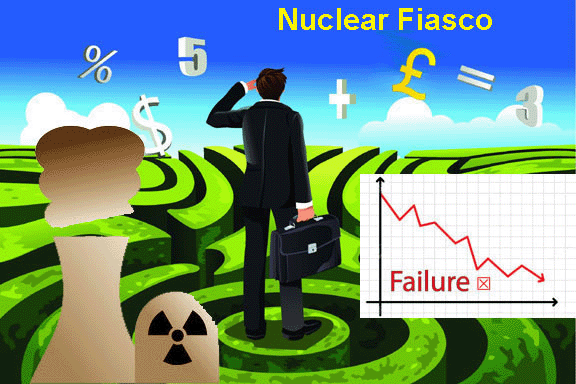
What’s plan B if the government can’t attract investors willing to fund Sizewell C? Guardian Nils Pratley 27 Jan 22. Development money for nuclear power station is an attempt to draw in investors that could replace China’s CGN sum of £100m is peanuts in the expensive world of nuclear power stations, so regard the business secretary Kwasi Kwarteng’s funding for a round of development work on Sizewell C as a form of advertising. The cash is intended to send a message that the government is serious about getting the plant built in Suffolk. And it is an appeal for outside investors to volunteer to sit alongside developer EDF, the French state-backed group.
There was also a definition of a desirable investor: “British pension funds, insurers and other institutional investors from like-minded countries”. Note the nationality test. It is the closest we have come to official confirmation that China General Nuclear (CGN), originally slated for a 20% stake in Sizewell, will be kicked off the project. It remains to be seen how, legally, the government will rip up the 2015 deal with CGN signed by David Cameron’s government, but the intention is clear.
So, too, is the intended funding mechanism. It will be a regulated asset base (RAB) model, a version of the formula used at Heathrow Terminal 5 and the Thames Tideway giant sewer. The key point for investors is that they will see some income before Sizewell is built, unlike at Hinkley Point C where EDF and CGN earn their princely cashflows only when the electricity starts to flow.
What, though, if those British and like-minded institutions still refuse to play? Nuclear represents unknown territory for most of them. What if competition to invest, which is meant to be the other way in which RAB lowers financing costs, doesn’t materialise? What’s the government’s plan B?

The only possible solution is for the state to invest directly. If that is so, wouldn’t it be better to run an upfront benchmarking exercise at the outset to compare the numbers? Sizewell, unfortunately, is probably inevitable given the current panic over high gas prices and long-term energy security. But taxpayers, on the hook anyway via household bills, deserve to know that the odd billion or three isn’t being diverted unnecessarily to intermediaries.
By the time Sizewell’s sums become enormous, transparency will be essential…….https://www.theguardian.com/business/nils-pratley-on-finance/2022/jan/27/whats-plan-b-if-the-government-cant-attract-investors-willing-to-fund-sizewell-c
Map shows the horrible impact a nuclear bomb would have on Coventry
|

Map shows the horrible impact a nuclear bomb would have on Coventry
We used NUKEMAP to find out the effects nuclear bombs would have on Coventry, Coventry Live, ByJaspreet Kaur, 30 Jan 22, t’s a chilling thought – but have you ever wondered what would happen if a nuclear bomb was suddenly detonated in Coventry as part of an attack on the UK?
CoventryLive has used specialist research to find out what would happen if a nuclear bomb hit the city.
The website NUKEMAP calculates the effects of the detonation of a nuclear bomb. And although of course none has ever hit the UK before, they were used to terrible effect in Japan at the end of the Second World War.
And of course our city faced dreadful destruction in Nazi bombing raids.
The website that now looks into the horrifying impact a nuclear disaster could have was created by Alex Wellerstein, a historian of science who specialises in the history of nuclear weapons and nuclear secrecy.
He created Nukemap in February 2012, and it has been used by over 25 million people globally since its launch.
In one experiment, we looked at what happened if ‘Davy Crockett’ detonated in our city – one of the smallest nuclear bombs ever built in the United States……………
all-in-all the impact of the smallest US bomb is very bad in real terms, but relatively small for a nuclear attack. Wr then looked at a much larger bomb.
And chillingly, the ‘Gadget’ bomb was found to have a much more awful impact.
If detonated in Coventry city centre this particular bomb would cause thermal radiation to several Coventry areas, including Earlsdon , Cheylsmore , Ball Hill and Daimler Green .
It would also cause moderate blast damage to areas further afield, such as Radford , Coundon , Whitley and Styvechale .
In total, the number of estimated injuries would rise significantly to 48,060 with 23,900 estimated fatalities. Which is terrifying.
The test may seem arid – but the threat of nuclear war hung over the world for decades during the Cold War.
There are still around 3,750 active nuclear warheads and nearly 14,000 total nuclear warheads in the world today…………………………… https://www.coventrytelegraph.net/news/map-shows-horrible-impact-nuclear-22918995
1 This Month


of the week– Nuclear Reactor Information Task Force

14 May – online event From Bombs to Data Centres: the Face of Nuclear Colonialism
To see nuclear-related stories in greater depth and intensity – go to https://nuclearinformation.wordpress.com
-
Archives
- May 2026 (156)
- April 2026 (356)
- March 2026 (251)
- February 2026 (268)
- January 2026 (308)
- December 2025 (358)
- November 2025 (359)
- October 2025 (376)
- September 2025 (257)
- August 2025 (319)
- July 2025 (230)
- June 2025 (348)
-
Categories
- 1
- 1 NUCLEAR ISSUES
- business and costs
- climate change
- culture and arts
- ENERGY
- environment
- health
- history
- indigenous issues
- Legal
- marketing of nuclear
- media
- opposition to nuclear
- PERSONAL STORIES
- politics
- politics international
- Religion and ethics
- safety
- secrets,lies and civil liberties
- spinbuster
- technology
- Uranium
- wastes
- weapons and war
- Women
- 2 WORLD
- ACTION
- AFRICA
- Atrocities
- AUSTRALIA
- Christina's notes
- Christina's themes
- culture and arts
- Events
- Fuk 2022
- Fuk 2023
- Fukushima 2017
- Fukushima 2018
- fukushima 2019
- Fukushima 2020
- Fukushima 2021
- general
- global warming
- Humour (God we need it)
- Nuclear
- RARE EARTHS
- Reference
- resources – print
- Resources -audiovicual
- Weekly Newsletter
- World
- World Nuclear
- YouTube
-
RSS
Entries RSS
Comments RSS
 nuclear-news