Remediation work through £4.6bn Sellafield framework
US engineering and technology firm Amentum and a joint venture of Altrad
Support Services and Atkins Réalis will deliver remediation work at the
Sellafield nuclear power station over the next 15 years. The two bidders
were named for Lot 1 of a £4.6bn Decommissioning and Nuclear Waste
Partnership (DNWP) framework, which covers four lots. Procured by
Sellafield Ltd, the agreement will see chosen contractors support
high-hazard risk reduction programmes at the Cumbrian plant.
Ground Engineering 3rd Nov 2025. https://www.geplus.co.uk/news/pair-bag-remediation-work-through-4-6bn-sellafield-framework-03-11-2025/
Escalating nuclear waste disposal cost leads senior MP to demand ‘coherent’ plan.
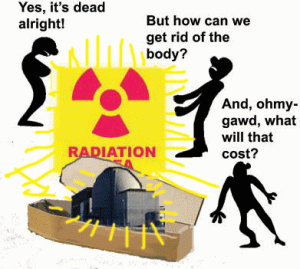
The escalating costs of the geological disposal facility (GDF) have led the Public Accounts Committee (PAC) chair to demand that the government produce a “coherent plan” to manage the country’s nuclear waste legacy
29 Oct, 2025 By Tom Pashby
https://www.newcivilengineer.com/latest/escalating-nuclear-waste-disposal-cost-leads-senior-mp-to-demand-coherent-plan-29-10-2025/
A GDF represents a monumental undertaking, consisting of an engineered vault placed between 200m and 1km underground, covering an area of approximately 1km2 on the surface. This facility is designed to safely contain nuclear waste while allowing it to decay over thousands of years, thereby reducing its radioactivity and associated hazards.
PAC chair Geoffrey Clifton-Brown’s comments were made in reaction to the revelation that the total life cost of the GDF is up to £15bn more than the sum listed in the National Infrastructure and Service Transformation Authority’s (Nista’s) recent annual report. Nista is a government body and works with the Cabinet Office and Treasury and its August 2025 report published figures from Nuclear Waste Services (NWS), the government body responsible for the GDF, showing the GDF as having a whole life cost of from £20bn to £53.3bn.
However, Nista’s Infrastructure Pipeline dashboard lists the GDF’s CapEx (capital expenditure) range for new infrastructure in 2024/2025 prices as being from £26.2bn to £68.7bn, with the top end being slightly over £15bn higher than the figure published in the annual report.
A government source explained to NCE earlier that the discrepancy is because the figures published in Nista’s annual report was based on 2017/2018 prices, meaning the effects of long-term inflation were not accounted for.
Criticism has previously been levied at High Speed 2 (HS2) because of its use of historic pricing figures to reduce the impact of inflation on budget projects and make the total cost of the project appear to be lower than it would end up being.
Government must have coherent plan to manage nuclear waste – senior MP
The House of Commons PAC is one of the most active and powerful select committees in Parliament, able to formally request that the National Audit Office carry out investigations into government projects.
Nuclear decommissioning is a key area of focus for the Committee because of the high total costs, which will hit the public purse into the far future. Sellafield is seen as the government’s flagship project within the wider nuclear decommissioning programme.
The scale of future nuclear decommissioning is clear in the Nuclear Decommissioning Authority: Annual Report and Accounts 2024 to 2025, which says: “the discounted best estimate of the future costs of the decommissioning mission of £110.1bn”. This is a £5bn increase on the previous year.
Nuclear power in Scotland would have same problems as fossil fuels

NUCLEAR power has the “same fundamental challenges” as fossil fuels, international experts have said, as they criticised the UK Government’s embrace of the nuclear industry.
Four academics, from the UK and the US,
argued that costs for nuclear power are “huge” and “rising” and
that “significant delays” in getting projects online are the norm.
They also described how in the space of a year nuclear “adds as much net
global power capacity as renewables add every two days”, and criticised
the drive by Labour ministers to deregulate the industry. The group of
academics includes Amory Lovins and Professor Mark Jacobsen, from the
University of Stanford, Professor Stephen Thomas, from the University of
Greenwich, and Dr Paul Dorfman, Bennett Scholar at the University of
Sussex.
In a joint statement, published in The National, they say that Ed
Miliband’s plans to assess Scottish sites for nuclear projects and Keir
Starmer’s plans to usher in a “golden age of nuclear” with Donald
Trump are hampered by a “few awkward facts”. They said: “The reason
is simple. Nuclear costs are huge, rising, and significant delays are the
norm.
The National 29th Oct 2025,
https://www.thenational.scot/news/25579222.nuclear-power-scotland-problems-fossil-fuels/
The UK is at risk of a nuclear attack as the US is set to house nuclear weapons in Suffolk, England, which would make the country a target in a US and Russia war

Emily Malia Mirror UK, GAU Writer, 27 Oct 2025
RAF Lakenheath in Suffolk, operated by the United States, is expected to house US/ NATO nuclear weapons in the near future. This development places the UK on the frontline of potential conflict between America and Russia.
The presence of American nuclear weapons on British soil significantly increases the nation’s risk of becoming a target. Military analysts suggest that in the event of war, Lakenheath would likely face strikes before attacks spread to other parts of the country.
Whilst experts acknowledge that nuclear conflict between the US, NATO and Russia would prove devastating globally, it’s crucial to grasp the direct consequences for British towns and cities. The Campaign for Nuclear Disarmament warns: “A single nuclear strike on any town or city would be catastrophic for the local community and environment, and the radioactive impact would spread much further.
“But a nuclear war would be catastrophic for all humanity, forms of life, and the entire planet. Yet the possibility of nuclear war is the greatest for many decades.”
Casualties
Their report reveals if a Russian warhead, such as an SS-25 or SS-27, were to strike the heart of London, nearly a million people would die. Similarly, a hit on Glasgow could result in 326,000 casualties, while in Cardiff, 196,000 lives would be lost.
The epicentre of the nuclear explosion is believed to reach a staggering temperature of several million degrees centigrade. Consequently, a heat flash would obliterate all human tissue within a 1.5 square mile radius.
Back in 1945, when the United States unleashed two atomic bombs over Hiroshima in Japan, all that was left within a half-mile radius were shadows seared into stone. The aerial bombings claimed up to 200,000 lives, most of whom were civilians………………………………………..
Further afield from the zone of instant devastation, there would be a gradual rise in fatalities among those who endured the initial explosion. Approximately seven miles from the blast site, individuals would sustain lethal burns or even require amputations, while others would be blinded or suffer internal injuries.
Unlike a typical disaster, the mortality rate would be shockingly high as most emergency services would be unable to respond due to their own personnel being killed and equipment destroyed. The sheer number of casualties would simply swamp the UK’s medical resources, with people as far as 11 miles away potentially suffering injuries from shattered windows or structural damage.
The long-term impact
In the ensuing days, even those fortunate enough to survive would now be impacted by the radioactive fallout, with the majority succumbing within a week. This would manifest in various ways, from hair loss to bleeding gums, fever, vomiting, delirium and even internal bleeding.
Those with lower levels of exposure would still face complications, including pregnant women who are at a high risk of miscarriage and birth complications. In addition, long-term effects could include radiation-induced cancers affecting many civilians, up to two decades after the event.
It’s believed that children of those exposed to radiation are statistically more likely to be born with abnormalities and suffer from leukaemia. Aside from public health, nuclear weapons are known to cause severe damage to the environment and climate on an unprecedented scale.
Predictions suggest that in the aftermath of a nuclear war, two billion people could face starvation due to climate disruption and its impact on food production. https://www.mirror.co.uk/news/world-news/horrifying-number-people-who-could-36139768
The Next Nuclear Renaissance?

Will a new wave of nuclear power projects deliver the safe and economical electricity that proponents have long predicted?
CATO Institute, Fall 2025, By Steve Thomas
Over the past decade, there has been a growing interest in building new nuclear power stations, particularly among policymakers. This comes some two decades after a previously forecast “nuclear renaissance” petered out, having produced few orders, all of which went badly wrong.
This article reviews the previous renaissance: What was promised, what was delivered, and why it failed. It then considers the current claims of a new renaissance led by Small Modular Reactors, forthcoming “Generation IV” designs, new large reactors, and extending the lifetime of existing nuclear plants. Despite the need for clean generation, the growing demand for electricity to power new technologies and global development, and claims of nuclear generation breakthroughs that are either here or soon will be, this new renaissance appears destined for the same failure as the previous ones.
The Last Renaissance
Around the start of this century, there was a great deal of publicity about a new generation of reactors: so-called Generation III+ designs. These would evolve from the existing dominant “Gen III” designs—Pressurized Water Reactors (PWRs) and Boiling Water Reactors (BWRs), collectively known as Light Water Reactors (LWRs)—rather than be radical new designs. There was no clear definition of the characteristics that would qualify a design as Gen III+ rather than just Gen III LWRs. However, Gen III+ was said to incorporate safety advances that would mitigate the risks of incidents like the 1979 partial meltdown at Three Mile Island (a Gen II design) and the 1986 Chernobyl meltdown (a Soviet design that used Gen I/II technology). Three Gen III+ designs received the most publicity: the Westinghouse AP1000 (Advanced Passive), the Areva EPR (European Pressurized Water Reactor), and the General Electric ESBWR (Economic Simplified Boiling Water Reactor).
The narrative was that Gen III designs had become too complex and difficult to build because designers were retrofitting safety features to avoid another Three Mile Island. Gen III+ supposedly went back to the drawing board, rationalizing existing systems and incorporating new safety features, thereby supposedly yielding a cheaper and easier-to-build design. A particular feature of these designs was the use of “passive safety” systems. In an accident situation, these did not require an engineered safety system to be activated by human operators and were not dependent on external sources of power; instead, the reactor would avoid a serious accident by employing natural processes such as convection cooling. These had an intuitive appeal, and a common assumption was that because they were not mechanical systems, they would be cheaper, and because they involved natural processes, they would never fail. Neither assumption is correct.
Another major safety feature resulting from the Chernobyl disaster was a system that, if the core was melting down, prevented the molten core from burning into the surrounding ground and contaminating it. A common approach was a “core-catcher” (already used in a few early reactors) that would be placed underneath the reactor. An alternative, often used for smaller reactors, was a system to flood the core with so much water that it would halt the meltdown.
After the September 11, 2001, terrorist attacks, designers attempted to further increase safety by strengthening the reactor shell so it could withstand an aircraft or missile impact. The core-melt and aircraft protection features inevitably tended to increase the size and complexity of the Gen III+ designs.
Nuclear advocates also claimed that the large cost and time overruns of previous plants were caused in part by the high proportion of work carried out on site. To combat this and the additional complexity noted above, designers vowed to rely more on factory-made modules that could be delivered by truck, reducing sitework mostly to “bolting together” the pieces. In practice, there was significant variability between the Gen III+ designs, with the AP1000 and ESBWR relying much more on passive safety and modular construction than the EPR.
What sold these designs to policymakers were some extraordinary claims about construction costs and times. It was claimed that their cost (excluding finance charges; so-called “overnight cost”) would be around $1,500–$2,000 per kilowatt (kW), meaning a large, 1,000-megawatt (MW) reactor would cost $1.5–$2 billion. Construction time would be no more than 48 months. While there were few existing nuclear projects then to compare the new designs with, these projected costs and times were far below the levels then being achieved with existing designs.
These claims convinced the US government, under President George W. Bush, and the UK government, under Prime Minister Tony Blair, to launch large reactor construction programs. As those countries were two of the pioneering users of nuclear power, this appeared to be a strategically important victory for the nuclear industry.
US / In 2002, President Bush announced his Nuclear 2010 program, so-called because it was expected the first reactor under the program would come online in 2010. It was assumed the new nuclear designs would be competitive with other forms of generation,………………………………………..
In states with regulated electricity markets, utilities were concerned that regulators might not allow them to recover their costs from consumers if there were time and cost overruns. Most of the other projects were abandoned on these grounds, leaving only two to enter the construction stage: a two-reactor project to join an existing reactor at the V.C. Summer plant in South Carolina, and a two-reactor project to join two existing reactors at the A.W. Vogtle project in Georgia. All four new reactors would be Westinghouse AP1000s.
In those two states, regulators gave clear signals that the utilities would be allowed to recover all their costs. The state governments broke with regulatory practice by passing legislation allowing the utilities to raise rates and start recovering their costs from the date of the investment decision, not the date when the reactors entered service…………………………………………….
Consumers started paying for the reactors in 2009–2010, even though construction didn’t start until 2013. By 2015, both projects were in bad shape, way over time and budget. Westinghouse, then owned by Toshiba of Japan, was required to offer fixed-price terms to complete the projects. Those prices soon proved far too low, and in March 2017 Westinghouse filed for Chapter 11 bankruptcy protection. The whole of Toshiba was reportedly at risk as a result. In August 2017, the V.C. Summer project was abandoned. The A.W. Vogtle project continued, and the first reactor was completed in July 2023 with the second unit following in April 2024, six or seven years behind schedule and at more than double the forecasted cost. There are now no proposals for additional large reactor projects in the United States.
UK / In 2003, a UK Energy White Paper (DTI 2003) concluded there was no case for nuclear power because renewables and energy efficiency measures were cheaper. According to the report, “the current economics of nuclear power make it an unattractive option for new generating capacity and there are also important issues for nuclear waste to be resolved.” Only three years later and despite the lack of evidence that nuclear had become cheaper or that renewables and energy efficiency had become more expensive, Blair reversed the government’s position, claiming nuclear power was “back on the agenda with a vengeance.”
As with the US program, the assumption was that the new designs would be competitive. A key promise that made the program politically acceptable was there would be no public subsidies. Politicians—even those who were favorable to nuclear—were aware that previous UK nuclear projects had gone badly and the costs of this had fallen on taxpayers and electricity consumers. The energy minister told a Parliamentary Select Committee:
There will be no subsidies, direct or indirect. We are not in the business of subsidizing nuclear energy. No cheques will be written; there will be no sweetheart deals.
This promise of no subsidies remained government policy until 2015, despite it being clear long before then that new nuclear projects were only going forward in anticipation of large public subsidies……………………………………………………………
Three consortia were created, each led by some of the largest European utilities………………………………………………….. As early as 2007, the consortium led by EDF established a leading presence, with the CEO of EDF Energy, Vincent de Rivaz, notoriously claiming that Christmas turkeys in the UK would be cooked using power from the Hinkley Point C EPR in 2017. In 2010, the UK energy secretary still claimed Hinkley would begin generating no later than 2018.
The Final Investment Decision (FID) for Hinkley was not taken until October 2016, when it was expected the two reactors would be completed by October 2025 at an overnight cost of £18 billion (in 2015 pounds sterling, equivalent to $35 billion in today’s dollars). ……………………………………………..In January 2024, EDF issued a new cost and time update—its fifth—with completion now expected to be as late as 2032 at a cost of £35 billion (in 2015 pounds sterling, equivalent to $68.7 billion in today’s dollars). As a result, EDF wrote off €12.9 billion ($14 billion) of its investment in Hinkley Point C in 2023. By 2018, EDF recognized the error it made in accepting the risk of fixing the power price, and it abandoned plans for an EPR station at Sizewell using the Hinkley C financial model. In July 2025, an FID was taken on the Sizewell C project using a different financial model and completion is not expected before 2040.
The effect of the 2011 Fukushima, Japan, nuclear plant disaster, where a tsunami resulted in meltdowns in three reactors, combined with the effect of competition in wholesale and retail markets in electricity meant that European utilities could not justify to their shareholders the building of new reactors. The Horizon and Nugen consortia were sold to reactor vendors Westinghouse and Hitachi–GE, respectively. Those firms did not have the financial strength to take significant ownership stakes in the reactors, but they saw this as an opportunity to sell their reactors on the assumption that investors could later be found. Westinghouse (then planning three AP1000s for the Moorside site) filed for Chapter 11 bankruptcy protection in 2017. Hitachi–GE abandoned its two projects (four ABWRs, two each at Wylfa and Oldbury) in 2019 when it became clear that, despite the UK government offering to take a 30 percent stake in the reactors and to provide all the finance, other investors were not forthcoming.
Lessons learned / Thus ended the last nuclear renaissance. Its failure does not determine the outcome of the present attempt, but there are some important lessons that will shape the outcome this time:
- While governments have always had to play a facilitating role in nuclear power projects, such as providing facilities to deal with the radioactive waste, they were centrally involved in the 2000 renaissance. This trend has continued, and governments are now offering to provide finance, take ownership stakes, offer publicly funded subsidies, and impose power purchase agreements that will insulate the reactors from competitive wholesale electricity markets.
- Forecasts of construction costs and times made by the nuclear industry must be treated with extreme skepticism. The claim that the new designs would be so cheap they would be able to compete with the cheapest generation option then available—natural gas generation—proved so wide of the mark that other claimed characteristics, such as supplying base-load power and offering low-carbon generation, are now given as the prime justifications for the substantial extra cost of nuclear power over its alternatives.
- The technical characteristics claimed to give advantages to the Gen III+ designs (such as factory-manufactured modules and passive safety) have not been effective in controlling construction times and costs.
- The large reactor designs now on offer are the same ones that were offered previously. No fundamentally new designs have started development this century. It is hard to see why these designs that have failed by large margins to meet expectations will now be so much less problematic……………………………………………… https://www.cato.org/regulation/fall-2025/next-nuclear-renaissance#small-modular-reactors
America’s $80bn nuclear reactor fleet exposes Sizewell C costs.

The plants are expected to be bankrolled by Japanese investors as part of the $550bn investment pledged by Tokyo under the new US-Japan trade deal.
The United States has announced an $80 billion plan to build a fleet of nuclear power plants for less than two thirds of the cost per gigawatt of
Britain’s Sizewell C project. About eight of Westinghouse’s one
gigawatt AP1000 reactors are to be built across America, under a
partnership between the US government and the reactor-maker’s owners,
Brookfield and Cameco, to accelerate nuclear power deployment. The plants are expected to be bankrolled by Japanese investors as part of the $550 billion investment pledged by Tokyo under the new US-Japan trade deal.
The cost of about $10 billion (£7.5 billion) per gigawatt of new capacity is
significantly cheaper than the UK government’s recently approved plans
for the Sizewell C plant in Suffolk. Sizewell is due to generate 3.2
gigawatts of electricity — enough to power six million homes — at a
cost of £38 billion, or £11.9 billion per gigawatt. The contrast will do
nothing to alleviate concerns about the high costs of Britain’s nuclear
programme, although the US plans are still at a much earlier stage.
Critics have blamed factors including the UK’s choice of EDF’s “EPR”
reactor and safety red tape for inflating nuclear construction costs in
Britain. The costs of the 3.2GW Hinkley Point plant in Somerset, already
under construction, are estimated to have risen to as much as £48 billion.
Times 28th Oct 2025,
https://www.thetimes.com/business-money/companies/article/americas-80bn-nuclear-reactor-fleet-exposes-sizewell-c-costs-qxcqfdv5z
Dounreay waste particle ‘most radioactive’ find for three years

Steven McKenzie, Highlands and Islands reporter and Rachel Grant, BBC Scotland. 23 Oct 25
A fragment of waste found near the decommissioned experimental nuclear power facility in Dounreay in April was the most radioactive to be detected in the past three years, the Highland site’s operator has said.
The fragment, categorised as “significant”, was discovered during monitoring work around the nuclear power plant near Thurso. It is the latest in a long line of particle discoveries in the area.
Dounreay was built in the 1950s as the UK’s centre of fast reactor research, but during the 1960s and 1970s sand-sized particles of irradiated nuclear fuel got into the drainage system.
Work to clear the pollution began in the 1980s, after particles were found washed up on the nearby foreshore.
The facility closed in 1994. The multi-billion pound decommissioning process involves hundreds of workers and is expected to last into the 2070s.
The full decontamination of the site is expected to take more than 300 years.
A Dounreay spokesperson said: “Particles are a legacy of industrial practices dating back to the early 1960s and our commitment today to environmental protection includes their monitoring and removal from the marine environment and transparent reporting of our activities.”
A group of independent experts, who advise the Scottish Environment Protection Agency (Sepa) and Dounreay, classify particles by the radioactivity of their caesium-137 content.
The categories are minor, relevant and significant.
Significant means a reading greater than one million becquerels of CS-137.
A becquerel is the standard unit of radioactivity.
The particle was found on the western part of Dounreay’s foreshore on 7 April. Eight other finds reported since then have been categorised as “minor” or “relevant”.
A significant-category particle was last discovered in March 2022.
Thousands of particles of different categories have been removed from beaches, foreshore and seabed at Dounreay.
The site’s operator said monitoring on the site on the north Caithness coast continued to be done on a fortnightly basis.
On occasions it said the scheduled work could be interrupted by bad weather or the presence of protected species of ground-nesting birds……………………………………………………..
What risk is there to the public?
According to official reports, risk to people on local beaches is very low.
Guidance issued by the UK government’s Nuclear Restoration Services says the most at-risk area is not accessible to the public.
The particles found along the coast vary in size and radioactivity with smaller and less active particles generally found on beaches used by the public.
Larger particles have only been found only on the foreshore at Dounreay, which is not used by the public.
The particles found on beaches are believed to come from the disintegration of larger fragments in the seabed near Dounreay. The area is continuously monitored for traces of radioactive materials.
Harvesting of seafood is prohibited within a 2km (1.2 mile) radius of a point near Dounreay. This is where the largest and most hazardous fragments have been detected.
Dounreay’s radioactive history
- 1954 – A remote site on the north coast of Scotland is chosen as the site of a new type of nuclear reactor. Modern homes were built in Caithness to attract workers to the sparsely populated area.
- 1957 – A chain reaction which provided sustained and controlled nuclear energy is achieved for the first time.
- 1959 – A new disposal site for radioactive waste called the Shaft opens. It drops 65.4m (214.5ft) below ground.
- 1962 – The fast reactor inside the dome is the first in the world to provide electricity to a national grid.
- 1977 – The original “golf ball” reactor is shut down and waste disposal in the Shaft ends after an explosion.
- 1994 – Dounreay nuclear power generating facility closes.
- 1998 – Decommissioning programme is announced.
- 2008 – Operation to scour the seabed for hazardous material begins and the Shaft shaft is encircled in a boot-shaped ring of grout to prevent contamination.
- 2020 – Clean-up begins of the highly contaminated Shaft – a three decades-long project.
- 2333 – Decontamination expected to be complete, making the 148-acre site available for other uses. https://www.bbc.com/news/articles/cz91nx0lv59o
ED MILIBAND’S NUCLEAR NIGHTMARES
Jonathon Porritt, 22 Oct 25, https://jonathonporritt.com/uk-nuclear-subsidies-desnz-spending/
Meanwhile, in a parallel universe, the legions of nuclear fat cats residing here in the UK are smiling very broadly indeed. It would appear that both Rachel Reeves and Ed Miliband have nothing better to do with our money, as taxpayers, than to go on filling up their subsidy saucers more or less on demand.
Taxpayers really don’t know very much about how DESNZ spends our money. More problematically, not a lot of the UK’s more or less mis-informed energy correspondents are particularly interested in helping taxpayers to understand what’s really going on – for the most part because they’re ‘ideologically captured’, with very little interest in the truth.
A bit harsh? Well, why is it, for instance, that not one of them provides any serious analysis of DESNZ’s annual expenditure? Not least as the details of this (on p.18 of its 2024-2025 Annual Report & Accounts) are completely mind-blowing. To summarise:
DESNZ TOTAL DEPARTMENTAL SPEND
Total departmental spend: £8.6 billion
Total spend on nuclear power: £5.1 billion (60%)
Total spend on everything else: £3.5 billion (40%)
See what I mean? Literally mind-blowing! A few more details on the nuclear side of things:
*Great British Nuclear: £26 million (the more or less useless quango overseeing this fiasco).
*Nuclear Decommissioning Agency : £3 billion (dealing with the legacy of past nuclear programmes).
*Support for Sizewell C power station: £1.67 billion.
*UK Atomic Energy Agency (UKAEA): £400 million (doing bonkers stuff like nuclear fusion).
That’s the size of the nuclear sink hole: roughly £5.1 billion! Leaving roughly £3.5 billion for everything else, including all direct support for renewables, ‘delivering affordable energy’, science, research and ‘capability’, as well as other arm’s length bodies. Moreover, even that low figure is not quite what it seems: roughly £450 million is set aside for another of Ed Miliband’s sink holes, namely Carbon Capture and Storage.
Do you need any more persuading that this is obviously a completely mis-titled Department: instead of DESNZ, it really should be called DNPB&B – the Department of Nuclear Power and Bits & Bobs.
Where the hell are you, Rachel Reeves? For those sick of your hangdog ‘black hole blathering‘, it would be wonderful to think you might instruct just a few of your civil servants to instruct the ever-well-meaning Ed Miliband to undertake an exercise in zero budgeting for FY 25/26. Great British Nuclear could go at a stroke of a pen – no one would notice. The UKAEA’s budget could be halved, leaving it to focus on decommissioning redundant reactors and dealing with nuclear waste. Subsidies for Sizewell C could be massively reduced – although the Department did such a poor deal with various private sector investors that there will be significant compensation to be paid.
Sadly, of course, there is nothing that can be done about the £3 billion set aside, EVERY YEAR, for dealing with the legacy of earlier nuclear programmes – decommissioning, site security, managing nuclear waste and so on. Nuclear campaigners have struggled for years to explain that our ‘nuclear legacy’ is in fact our ‘current nuclear reality’, and that this is a figure which can only grow and grow over the years. The Public Accounts Committee looked recently at the cost of decommissioning many of the facilities at Sellafield, currently assessed at £396 million through to 2070, and couldn’t have made their incredulity any clearer. On top of that, we have the looming additional cost of building a long-term Geological Disposal Facility, for which taxpayers will be paying hundreds of billions of pounds through to the end of this century.
Ask the Treasury or officials at DNPN&B what they believe that total legacy figure will be in FY2030/2031,or FY2040/2041, and you can be absolutely guaranteed to get literally no answer at all.
And yet – AND YET – we go on pouring yet more billions into NEW waste-generating nuclear monstrosities like Hinkley C and now Sizewell C.
It’s nearly 50 years since the highly influential Flowers Report was published in 1976. Its single most important recommendation was as follows:
“There should be no commitment to a large programme of nuclear fission power until it has been demonstrated beyond reasonable doubt that a method exists to ensure the safe containment of long-lived, highly radioactive waste for the indefinite future.”
We are, truly, led by nuclear donkeys.
Meanwhile, back in the real world, all this never-ending filling-up of the industry’s subsidy saucers has massive opportunity costs for what we should really be doing with precious taxpayers’ money.
As in:
- getting as enthusiastically as possible behind the potential for tidal power (see yesterday’s blog).
- getting as enthusiastically as possible behind retrofitting and the green economy (see tomorrow’s blog).
I’ll return to the whole question of just how many billions Rachel Reeves could divert from these nuclear sink holes as we get a little closer to the budget in November.
Managing our ‘Energy Legacy’: £85 million (roughly half the total figure).
Miliband starts fight with SNP over deploying new nuclear in Scotland
By Tom Pashby
Miliband starts fight with SNP over deploying new nuclear in Scotland.
Energy secretary Ed Miliband has asked Great British Energy – Nuclear to
explore deploying new nuclear at Torness, Hunterston and potentially other
parts of Scotland, despite the fact that the SNP-run Scottish Government
does not allow new nuclear developments in Scotland.
New Civil Engineer 24th Oct 2025, https://www.newcivilengineer.com/latest/miliband-starts-fight-with-snp-over-deploying-new-nuclear-in-scotland-24-10-2025/
MPs ‘deeply concerned’ about government’s proposed new nuclear siting policy
By Tom Pashby
MPs ‘deeply concerned’ about government’s proposed new nuclear
siting policy. MPs have said they are “deeply concerned” that the
government’s proposed new siting policy for new nuclear reactors “fails
to present a truly joined-up approach across planning, safety and
environmental regulation”.
New Civil Engineer 24th Oct 2025, https://www.newcivilengineer.com/latest/mps-deeply-concerned-about-governments-proposed-new-nuclear-siting-policy-24-10-2025/
Early engagement launched on £360m nuclear waste capping scheme
By Harmsworth
Nuclear Waste Services (NWS), the state-owned body responsible for
managing the UK’s radioactive waste, has launched early market engagement on a £360m programme to cap and extend the Low Level Waste Repository (LLWR) in Cumbria.
NWS operates the repository on behalf of the Nuclear
Decommissioning Authority (NDA), a non-departmental public body sponsored by the Department for Energy Security and Net Zero.
The scheme will involve installing a permanent engineered cap over disused trenches and Vault 8 at the LLWR site near Drigg. Capping is a method used to isolate radioactive waste from the environment. It involves layering materials such as clay, concrete and geomembranes to prevent water from reaching the waste and to contain any gas emissions.
Construction News 24th Oct 2025,
https://www.constructionnews.co.uk/civils/early-engagement-launched-on-360m-nuclear-waste-capping-scheme-24-10-2025/
Nuclear construction workers plan third strike.
Construction workers employed by contractors at a nuclear site are to go
on strike for a third time in two months in a dispute over pay. Unite
members at Sellafield in Cumbria will take action from Monday until 2
November after previously striking earlier in October and for four days in
September.
The union said it was because construction workers at other
nuclear projects received pay premiums that contractors at Sellafield did
not match. Sellafield Ltd said it did not directly employ those taking part
in the action but “safety and security” would continue to be its priority
throughout the strike.
BBC 24th Oct 2025,
https://www.bbc.co.uk/news/articles/cwy16l08eldo
UK Government look at bypassing SNP amid block on ‘billion pound’ nuclear investment.

The Scottish Government is refusing to give planning permission for any new nuclear reactors to be built in Scotland – despite the possibility of billions of pounds of investment.
UK Government look at bypassing SNP amid block on ‘billion pound’ nuclear
investment. The Scottish Government is refusing to give planning permission for any new nuclear reactors to be built in Scotland – despite the possibility of billions of pounds of investment. There has been interest
from the likes of Rolls Royce in building nuclear reactors north of the
border, but any planning applications would be rejected by the SNP
Government.
However, a source close to the UK Government suggested that it was pushing for reactors to be built in Scotland. It would put it on a
collision course with the SNP who are anti-nuclear. Former Scottish
Secretary Alister Jack suggested a few years ago that his office were
already plotting a similar move, if the SNP are kicked out of office in
2026. Now, this idea has been revived, it is understood, with Scotland set
to miss out on billions of pounds of investment if John Swinney clings on
to power in May next year. The UK and USA signed a lucrative deal last
month which will fast track the creation of small nuclear power stations,
halving the time it takes to gain regulatory approval for nuclear projects
from up to four years to two.
Express 22nd Oct 2025, https://www.scottishdailyexpress.co.uk/news/politics/uk-government-look-bypassing-snp-36109802
True cost of nuclear waste disposal facility £15bn higher than recent Treasury figures

MP says ministers ignore long-term waste costs of nuclear power
“Government ministers are very happy to talk about the so-called benefits of nuclear power without reference to its long-term impacts and the eye-wateringly large amounts of money associated with storage and security of nuclear waste, which is in the tens of billions of pounds just to create the GDF,” he said.
23 Oct, 2025 New Civil Engineer, By Tom Pashby
The true cost of an underground facility for long-term storage of nuclear waste has been revealed to be up to £68.7bn – £15bn more than the sum listed in the National Infrastructure and Service Transformation Authority’s (Nista’s) recent annual report.
A Geological Disposal Facility (GDF) represents a monumental undertaking, consisting of an engineered vault placed between 200m and 1km underground, covering an area of approximately 1km2 on the surface. This facility is designed to safely contain nuclear waste while allowing it to decay over thousands of years, thereby reducing its radioactivity and associated hazards.
Nuclear Waste Services (NWS) is responsible for the GDF project and declares that this method offers the most secure solution for managing the UK’s nuclear waste, aimed at relieving future generations of the burden of storage. NWS is part of the Nuclear Decommissioning Authority (NDA), which is itself an executive non-departmental public body, sponsored by the Department for Energy Security and Net Zero (DESNZ).
Nista is a unit of HM Treasury and published its NISTA Annual Report 2024 to 2025 in August 2025, where it described the GDF project as ‘Red’, meaning the projects appears to be “unachievable”, and as having a whole life cost of from £20bn to £53.3bn.
However, Nista’s Infrastructure Pipeline lists the GDF’s CapEx (capital expenditure) range for new infrastructure in 2024/2025 prices as being from £26.2bn to £68.7bn, with the top end being slightly over £15bn higher than the figure published in the annual report.
A government source explained to NCE that the discrepancy is because the figures published in Nista’s annual report are based on 2017/2018 prices, meaning the effects of long-term inflation were not accounted for.
Criticism was previously levied at High Speed 2 (HS2) because of its use of historic pricing figures to reduce the impact of inflation on budget projects and make the total cost of the project appear to be lower than it would end up being.
Parliamentarians told NCE that ministers should face up to the long-term legacy costs associated with the nuclear industry.
Current GDF pricing only provided by Nista to ensure consistency with pipeline
A government source told NCE that the difference in the two ranges for whole-life costs for the GDF is a factor of the price basis for each quoted figure.
They said that the NDA provided Nista with data in 2017/18 prices with the total range of £20bn-53.3bn, which was reflected in the Nista annual report.
The same data for this project was converted to 2024/25 prices for the Nista Infrastructure Pipeline, to ensure consistency with the rest of the data in the set, the source said. This is reflected in the higher figure of £26.1bn-£68.7bn.
NWS did not provide any comment.
MP says ministers ignore long-term waste costs of nuclear power
SNP spokesperson for energy security and net zero, transport, and science, innovation and technology, Graham Leadbitter MP, told NCE that ministers ignore the long term legacy of nuclear power when promoting projects.
“Government ministers are very happy to talk about the so-called benefits of nuclear power without reference to its long-term impacts and the eye-wateringly large amounts of money associated with storage and security of nuclear waste, which is in the tens of billions of pounds just to create the GDF,” he said.
He added that the waste would have to be managed for 1,000’s of years, and the money budgeted for nuclear waste management would be better spent on “more valuable infrastructure projects … that would support high-quality employment, investment in skills and vastly improved public services.”
Government must ‘face up to the legacy’ of nuclear – peer
Liberal Democrat Lords spokesperson for energy and climate change Earl Russell told NCE: “If this Government truly want to see a renaissance in nuclear power, it must finally face up to the legacy it leaves behind.”
Russell reiterated the fact that Nista described the GDF as “unachievable” and added: “The government must have a credible, long-term strategy for managing the waste new nuclear projects will produce.”……………………………………………………………………… https://www.newcivilengineer.com/latest/true-cost-of-nuclear-waste-disposal-facility-15bn-higher-than-recent-treasury-figures-23-10-2025/
Parliamentary Committee calls for clear direction on Oldbury and Wylfa, and a “one-stop shop” to finally overcome excessive cost and delays in deployment of nuclear energy
House of Commons Energy Security and Net Zero Committee, 24 October 2025
In a report today the Commons Energy Security and Net Zero Committee says new planning guidance for building Britain’s future nuclear energy generation brings a welcome ‘presumption of consent’ for low-carbon generation across a range of nuclear technologies.
But the UK’s move into unprecedented territory of private development of new nuclear sites creates new challenges. The Committee is concerned that the “exhaustive” drafting of the criteria in EN‑7, intended to introduce the flexibility to consider a wide range of factors towards approval, may in fact just duplicate issues also addressed by specialist regulators and create more uncertainty, delay and cost.
It concludes that new policy statement EN-7 “fails to present a truly joined-up approach across planning, safety, and environmental regulation” and so risks undermining its own purpose: to provide a definitive and coherent framework for decision-making. Commercial developers, facing a front-loaded application system and potential review both by multiple regulators and in Court, may be driven to “gold plate” applications with excessive detail. ……………………………………………………………………………… https://committees.parliament.uk/committee/664/energy-security-and-net-zero-committee/news/209808/committee-calls-for-clear-direction-on-oldbury-and-wylfa-and-a-onestop-shop-to-finally-overcome-excessive-cost-and-delays-in-deployment-of-nuclear-energy/
1 This Month
10 March A LIVE WEBINAR THE REAL EFFECTS OF NUCLEAR POWER
What the Industry Isn’t Telling Us
1:00 PM Mountain, 2 pm Central, 3 pm Eastern. Live on the Keepers of the Water Facebook page



18 March Webinar @ 1 PM EST: An Assessment of SMR Projects: The Case of Canada
register for the zoom:
https://us02web.zoom.us/webinar/register/WN_o8BIIOUvQ2ONJR1nta65DQ#/registration


of the week – STOP SMALL MODULAR REACTORS IN CANADA
To see nuclear-related stories in greater depth and intensity – go to https://nuclearinformation.wordpress.com
-
Archives
- March 2026 (109)
- February 2026 (268)
- January 2026 (308)
- December 2025 (358)
- November 2025 (359)
- October 2025 (376)
- September 2025 (258)
- August 2025 (319)
- July 2025 (230)
- June 2025 (348)
- May 2025 (261)
- April 2025 (305)
-
Categories
- 1
- 1 NUCLEAR ISSUES
- business and costs
- climate change
- culture and arts
- ENERGY
- environment
- health
- history
- indigenous issues
- Legal
- marketing of nuclear
- media
- opposition to nuclear
- PERSONAL STORIES
- politics
- politics international
- Religion and ethics
- safety
- secrets,lies and civil liberties
- spinbuster
- technology
- Uranium
- wastes
- weapons and war
- Women
- 2 WORLD
- ACTION
- AFRICA
- Atrocities
- AUSTRALIA
- Christina's notes
- Christina's themes
- culture and arts
- Events
- Fuk 2022
- Fuk 2023
- Fukushima 2017
- Fukushima 2018
- fukushima 2019
- Fukushima 2020
- Fukushima 2021
- general
- global warming
- Humour (God we need it)
- Nuclear
- RARE EARTHS
- Reference
- resources – print
- Resources -audiovicual
- Weekly Newsletter
- World
- World Nuclear
- YouTube
-
RSS
Entries RSS
Comments RSS
 nuclear-news