Macron’s nationalisation of EDF could have major implications for the UK
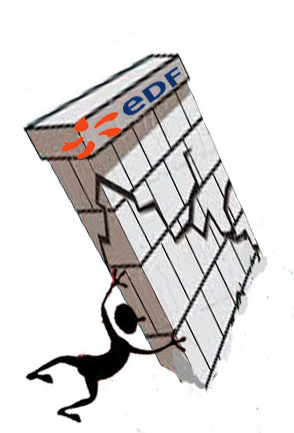
EDF has a more fundamental problem than state ownership can fix: the expense and long build times of nuclear power, compared to other technologies. “[Nationalisation] may change the capacity of the state to directly back the plans, but it doesn’t change the fact that it won’t be profitable,” argues Yves Marignac, at the négaWatt Association think-tank. “Nuclear is profoundly uneconomic. The market has said no,” adds Dr Paul Dorfman, associate fellow at the University of Sussex.
What Macron takeover means for Britain and France’s ‘nuclear renaissance’.
EDF nationalisation could have major implications for the UK’s nuclear fleet. France’s prime minister Elisabeth Borne faced boos and heckling as she set our her government’s plans to the National Assembly last week, striving for coalition after President Emmanuel Macron lost his outright majority in June.
High on her list was an announcement for France to take full ownership of its debt-laden energy giant EDF, as the weakened president tries to tackle the deepening energy and cost of living crisis
rippling across Europe amid the war in Ukraine.
Across the Channel, political turmoil was also affecting EDF. An announcement on planning approval for its Sizewell C nuclear project in Suffolk was pushed back until July 20 amid the chaos surrounding Boris Johnson’s resignation.
The company has a massive role in the UK’s energy sector, as owner of the UK’s nuclear fleet and only developer currently forging ahead with the country’s nuclear renaissance. Yet ballooning debts, outages and delays have raised doubts about its abilities on both sides of the Channel.
Will nationalisation in France be enough to fix its problems? The company’s problems stretch back beyond the turmoil in energy markets this year. Its debts of €43bn have swelled over several years amid high capital costs and spells of low electricity prices. Each year, EDF has to sell a chunk of its output at a fixed price to rivals, under state efforts to encourage competition.
Meanwhile, development of its flagship next-generation EPR reactors has been troubled. Though the first EPR power plant started running in China in 2018, one of its units has had to be shut for repairs due to cracked fuel rods. EDF says the problems have been “investigated and understood” and a solution found, with no risk posed to people or the environment. A second plant opened in Olkiluoto, Finland, in March – more than 10 years late and €8bn over budget. A third EPR in Flamanville, France, is running more than a decade behind schedule.
Meanwhile, Hinkley Point C, the new EPR power plant that EDF is building in Somerset, is now not expected to start generating until June 2027, with the pandemicdisrupting work. Sceptics of nuclear power argue EDF has a more fundamental problem than state ownership can fix: the expense and long build times of nuclear power, compared to other technologies. “[Nationalisation] may change the capacity of the state to directly back the plans, but it doesn’t change the fact that it won’t be profitable,” argues Yves Marignac, at the négaWatt Association think-tank. “Nuclear is profoundly uneconomic. The market has said no,” adds Dr Paul Dorfman, associate fellow at the University of Sussex.
Telegraph 10th July 2022
US nukes in UK ‘would provoke Putin and put Britons on front line in any nuclear war’
THE RETURN of US nukes to the UK would be “insanely provocative” and put Britons on the front line of a nuclear war, it has been claimed.
https://www.express.co.uk/news/uk/1636941/vladimir-putin-russia-us-nuclear-weapons-lakenheath-return-latest By JON KING. Jul 9, 2022 US Government budget papers revealed earlier this year that vaults at RAF Lakenheath in Suffolk are being upgraded so they can store B61-12 nuclear bombs. The air base received the latest nuclear capable fighter jet, the F-35A, in December with 48 expected to be stationed there.
Hans Kristensen, Director of the Nuclear Information Project at the Federation of American Scientists, spotted the US Department of Defense had added the UK to a list of NATO nuclear weapons storage locations.
RAF Lakenheath has been home to US nuclear weapons in the past and has been undergoing upgrade work amounting to £600million, most of which is paid for by US taxpayers.
The Ministry of Defence (MoD), however, has neither confirmed nor denied that US nuclear weapons are in Britain or going to come to UK shores.
CND General Secretary Kate Hudson, commenting on US nuclear weapons coming to Britain, told Express.co.uk: “We should be very worried by this. Allowing the US to bring these weapons back to Britain is a very dangerous development.
“It would be insanely provocative. It would put us even more on the front line in any nuclear exchange. To have new, US [nuclear weapons] here when there’s a considerable possibility of a war between NATO, the US, and Russia – it is very, very dangerous.
“We hope the US will pull back from any actual deployment.”
An MOD spokesperson said: “It is NATO and UK policy to neither confirm nor deny the presence of nuclear weapons at a given location.”
It comes at a time of heightened tensions between Russia and the West with Russian President Vladimir Putin having put his country’s nuclear deterrent on alert at the beginning of the war in Ukraine.
Russia’s foreign ministry said last month Moscow would supply ally Belarus with missile systems capable of carrying nuclear weapons.
Former Russian President Dmitry Medvedev told the United States on Wednesday (July 6) attempts by the West to punish a nuclear power such as Russia for the war in Ukraine risked endangering humanity.
Commenting before Boris Johnson announced he was stepping down as leader of the Conservative Party, Ms Hudson accused the PM of being a “vociferous advocate” of escalating the war against Russia and putting Britain in a “very dangerous” position.
She continued: “If that continues, it is likely we will have a nuclear exchange. It is pretty impossible to imagine Britain would not be at the front of that exchange, knocking out Lakenheath and Faslane.”
Nationalisation of French energy giant EDF means it is unlikely to spearhead future nuclear power projects in UK, according to top industry insider
By FRANCESCA WASHTELL, FINANCIAL MAIL ON SUNDAY,
The nationalisation of French energy giant EDF means it is unlikely to spearhead future nuclear power projects in the UK, according to a top industry insider.
The Hinkley Point C developer will instead focus investment on reactors in France, the source said.
French Prime Minister Elisabeth Borne announced last week that the state would buy the 16 per cent of shares in EDF it does not already own.
EDF, one of Britain’s big household energy suppliers, will continue work on Hinkley in Somerset, as well as Sizewell C in Suffolk, which is still being approved by the UK Government.
But the source said EDF would now shift its focus to France as it battles the energy crisis sweeping Europe, adding: ‘The odds of it putting money into another UK plant are incredibly small.
‘This has been a long time coming because being fully nationalised means it can put more money into French projects without having to worry about state aid.’ ……………………………… https://www.thisismoney.co.uk/money/markets/article-10998301/Nationalised-EDF-wont-build-new-nuclear-sites-UK.html
Fears environment bills could be sidelined in Tory leadership race
Greg Clark is now being given the task of deciding on the proposed
Whitehaven coalmine in Cumbria but has not worked in the department for
years. On Thursday the government also announced it was postponing for a
second time a decision on whether to approve the £20bn Sizewell C nuclear
power plant in Suffolk. The treasury, with its new chancellor, Nadhim
Zahawi, is to decide whether to go ahead with a windfall tax on oil and gas
companies. A decision on this is due next week, and while it is a popular
measure with voters it is unknown whether Zahawi will press ahead with it,
and whether he will remove the loophole that would provide tax relief for
new oil and gas. There could also be a wait of some time for a government
response to the fracking review. The British Geological Survey has given
its report on the safety and feasibility of fracking to the Department for
Business, Energy and Industrial Strategy (BEIS), but the results will not
be seen until the government responds to it, with BEIS sources saying they
do not know when that will be. BEIS will also have to deal with the cost of
living and energy crises, with insulation measures and direct support for
the poorest households the most urgent priority. The energy security bill
is also coming, with an opportunity to overhaul the energy market so the
low cost of renewable electricity feeds through to consumers. Greenpeace
UK’s policy director, Doug Parr, said: “No matter how dire things may
seem in Westminster right now, when it comes to the climate crisis things
risk getting much worse without immediate action. However, delays to
decisions on whether or not to backtrack on coal and build a new mine, or
waste untold time and money on a new nuclear power station that will only
distract from genuine energy solutions, could be taken as positive, if they
were set to be given the green light as rumours suggest. “This
parliamentary reset must deliver a new prime minister that will take bolder
action on climate and nature. They must invest in real solutions like
cheap, clean, homegrown renewables and fixing the vast number of cold,
damp, energy-wasting homes. If not, we may lose even more time and find
ourselves in a far worse position than we already are.”
Guardian 9th July 2022
Sizewell C – just the latest nuclear scam

Whatever chaos unfolds between today (Thursday) and tomorrow, Boris
Johnson is apparently still planning to confirm his Government’s
commitment to a new nuclear power station at Sizewell tomorrow.
As we all know, Johnson’s default political tactic is to lie, regardless of which
particular issue or crisis he’s having to address. For those who’ve
made something of a labour of love tracking Johnsonian mendacity, watch out
for this latest nuclear nonsense tomorrow – it’s absolutely guaranteed
to be brimful of outright lies, half-truths, omissions and rhetorical
boosterism of the kind that has made him (probably!) the least trustworthy
politician in the world apart from Vladimir Putin.
On this occasion, that’s simply because this whole ‘nuclear renaissance’ story is one
great big scam from start to finish. If I could count the ways,
anticipating the lying drivel that will be emerging from the BEIS press
release.
Jonathon Porritt 7th July 2022
http://www.jonathonporritt.com/sizewell-c-just-the-latest-nuclear-scam/
Why would anybody invest in Sizewell C nuclear plant? – An unlikely proposition?
Why would anybody invest in Sizewell C nuclear plant? – An unlikely
proposition? The Government has tasked Barclays Bank with finding investors
for the proposed Sizewell C (SZC) plant.
Reports surfaced in the Mail on
Sunday that Centrica is planning on taking a stake in the company. Perhaps
the fact that the report emerged in the Mail on Sunday rather than the
Financial Times is a sign that the decision is still subject to vagaries.
This report has me scratching my head so hard it hurts!
Why would Centrica,
which in 2016 abandoned plans to invest in Hinkley C partly because of
‘the lengthening time frame for a return on the capital invested in a
project of this scale‘ now opt for an investment in SZC? After all the
doubt about return on investments in SZC may be viewed as, if anything,
even more threadbare, to that of Hinkley C.
100% Renewables 7th July 2022
With EDF’s parlous finances and France nationalising EDF – decision on Britain’s planned Sizewell C nuclear station has been delayed

A decision on a new nuclear power station at Sizewell in Suffolk has been
delayed again by the government. French energy company EDF wants to build
Sizewell C, a £20 billion two-reactor nuclear plant, next to Sizewell B. A
decision on Sizewell C was expected today (7 July), but it has been pushed
back to 20 July at the latest. Paul Scully MP said: “I have decided to set
a new deadline of no later than 20 July 2022 for deciding this application.
This is to ensure there is sufficient time to allow the Secretary of State
to consider the proposal.”
On Wednesday, the French government announced
the state was taking full control of EDF, in a drive to boost its domestic
nuclear expansion.
Reacting to the delay, Alison Downes, of campaign group
Stop Sizewell C, said it would have been farcical if a decision on Sizewell
C had been made today, following the news from Paris. She added: “We also
hope that announcements of EDF’s re-nationalisation have given ministers
pause, especially when EDF’s parlous finances are at least in part down to
their disastrous track record at building the type of reactors proposed for
Sizewell C.”
ITV 7th July 2022
Rolls Royce lacking investment for its planned small nuclear reactors
Nuclear: Rolls-Royce lacking investment for its SMRs. The manufacturer
presented its short-list of British sites to launch the manufacture of its
small modular reactors. But the technology is far from ready.
L’Opinion 6th July 2022
https://www.lopinion.fr/international/nucleaire-rolls-royce-en-manque-dinvestissement-pour-ses-smr
”Allerdale Community Partnership” now looking very much like a nuclear front group, – Nuclear Free Local Authorities reveal

| The Allerdale Community Partnership may boast that its latest appointees are ‘independent’, but, as the Nuclear Free Local Authorities have discovered, a little research reveals their business links to the nuclear industry. The Community Partnership is the lead local body working in partnership with Nuclear Waste Services, an arm of the Nuclear Decommissioning Agency, to determine if Allerdale could become the location for a Geological Disposal Facility, an underground or undersea dump for Britain’s toxic legacy of nuclear waste. Now the Community Partnership has announced the appointment of four new board members, three are individuals, Adrian Davis-Johnson, Phil Davies, and John Coughlan, whilst the fourth is an organisation, the Cumbria Youth Alliance. In its March recruitment drive, the Allerdale Community Partnership pledged to appoint new members that were ‘both representative (of the local community) and diverse’, but the three appointed individuals all have a long history of working for or providing services to the nuclear industry. NFLA 5th July 2022 https://www.nuclearpolicy.info/news/nuclear-free-local-authorities-question-independence-of-allerdale-appointees-linked-to-nuclear-industry/ |
Seventy years after first UK atom bomb, time to right this ‘criminal wrong’, says NFLA
As the international community and civil society marks the fifth
anniversary of the adoption of the UN Treaty on the Prohibition of Nuclear
Weapons tomorrow (7 July), the Nuclear Free Local Authorities have written
to the Prime Minister and Minister for Veterans Affairs calling for urgent
recognition and compensation for Britain’s atom and nuclear bomb test
veterans.
NFLA 6th July 2022
Julian Assange files new appeal fighting extradition to US.
Washington Examiner. by Ryan King, Breaking News Reporter, July 01, 2022
WikiLeaks founder Julian Assange is appealing the United Kingdom’s order to extradite him to the United States.
Two appeals were filed in the High Court of Justice in London to challenge the extradition, and the court will decide whether to evaluate the case, Assange’s attorney Gareth Peirce announced, according to the Wall Street Journal……………………………………
Friday was the deadline for Assange to appeal the extradition order, according to the BBC. He is being held at Belmarsh prison in London.
His lawyers claimed that he could face up to 175 years behind bars if he stands trial in the U.S., but the U.S. argued he will likely face between four and six years.
A myriad of groups championing freedom of the press urged the U.K. not to extradite Assange, arguing that doing so could set a bad precedent and hamper press freedoms in the future. For example, the International Federation of Journalists has expressed concerns the move could pose a “chilling effect” on journalists worldwide.
“The US pursuit of Assange against the public’s right to know poses a grave threat to the Fundamental tenets of democracy, which are becoming increasingly fragile worldwide,” the group said. “Irrespective of personal views on Assange, his extradition will have a chilling effect, with all journalists and media workers at risk.”
“The case sets a dangerous precedent that members of the media, in any country, can now be targeted by governments, anywhere in the world, to answer for publishing information in the public interest,” the group added.https://www.washingtonexaminer.com/policy/courts/julian-assange-files-appeal-fighting-extradition
Could nuclear plant ruin Suffolk haven for avocets, bitterns and harriers?

Guardian, Robin McKie Science editor 3 July 22, The Bittern Hide at the RSPB’s Minsmere reserve was doing steady business last Wednesday. More than a dozen birdwatchers were crammed into the elevated shelter which overlooks a broad band of heath, freshwater pools and reed beds stretching to the Suffolk coast. Marsh harriers swirled overhead and an occasional bittern swept across the landscape. In front of another nearby hide, avocets waded leisurely across a lagoon. Minsmere is an ornithologist’s paradise.
But a threat hangs over its wildlife glories. In a few days, the government is set to announce its decision on whether to allow the Sizewell C nuclear power plant to be built by EDF on land that overlooks the 1,000-hectare (2,500-acre) reserve.
Threat to the wetlands
Approval will trigger the go-ahead for one of Europe’s biggest construction projects, and the impact on the reserve will be intense. New roads and a temporary port may be built, and dozens of huge cranes erected across land that borders Minsmere. For at least a decade, construction of the giant plant’s twin nuclear reactors will proceed – day and night.,,,,,,,,,,
Minsmere, which is celebrating its 75th anniversary this year, is rated as one of the UK’s finest wildlife reserves, though its origins are unusual. At the beginning of the second world war, it was decided the area’s low-lying farmland should be flooded as a protection against German invasion. After the war ended, it was discovered that avocets, which had been extinct in the UK for more than 100 years, had started nesting there.
“At the time, there was all sorts of pressure being put on landowners to drain land and boost food production in the UK in the years after the war,” added Rowlands.
“However, in the end it was decided to keep the area as a natural mix of shingle beaches, coastal lagoons, grazing marshes and woodland. The RSPB took this over in 1947. Essentially, the land was rewilded, long before the term became an ecological buzzword.”
Many rare species, such as the marsh harrier and the bittern, found precious refuge at Minsmere. However, it was the return of the avocet that had the greatest impact. After a century’s absence from Britain, the black-and-white wader, with its distinctive up-curved beak, established a small colony at Minsmere. From there it spread slowly across the nation. Today, there are about 1,500 breeding pairs in the UK and the bird is now depicted in the RSPB’s emblem, a symbol of hope in the cause of saving threatened bird species.
Nor are avocets, bitterns and marsh harriers the only Minsmere residents. Otters, water voles, kingfishers, nightjars, woodlarks, Dartford warblers, adders, natterjack toads and silver-studded blue butterflies have also made homes on the reserve. “It is the range of habitats that makes Minsmere special,” said Rowlands. “There are reed beds, wet grassland, ditches, coastal shingle, woodland, heather heathland and acid grassland. This is a precious space.”
The prospect of a vast construction project proceeding on adjacent land, therefore, causes concerns. In Somerset, where EDF is building the Hinkley Point C nuclear plant, about 1,600 workers are on site every day; 3m tonnes of concrete and 230,000 tonnes of steel will eventually be used to make the new power plant while the site is dominated by giant 40-metre (130ft) cranes. The construction of its twin at Sizewell C will be identical in scale.
Sizewell C will also require vast amounts of water for its workers, and to make the concrete needed for its construction. It is not clear where this water will come from in an area where supplies are already stretched.
After its completion, even greater amounts will be needed to cool its reactors. “There is also the issue of the warm water leaving the reactor,” said Rowlands. “That could have a significant impact on the marine environment on the coast at Minsmere, affecting the populations of fish and shellfish there and the birds that feed on them.”……………….. https://www.theguardian.com/uk-news/2022/jul/02/could-sizewell-c-nuclear-plant-ruin-minsmere-rspb-suffolk
Nuclear Free Local Authorities join in Seminar ‘Sizewell C: More Questions than Answers’
As decision day nears on the Sizewell-C development, the Chair and
Secretary of Nuclear Free Local Authorities will be joining local
campaigners opposed to the new build plan at a special conference in
Saxmundham on Saturday 2 July.
Councillor David Blackburn and Richard
Outram are amongst a line-up of speakers who will talk on a range of topics
related to the proposed Sizewell-C and Bradwell nuclear power plant
developments.
The public conference titled ‘Sizewell C: More Questions
than Answers’ is being hosted by local campaign group, Together Against
Sizewell C, at Saxmundham Market Hall, High St, Saxmundham, IP17 1AF from
10am until 1.30pm on Saturday 2nd July. The decision by the Secretary of
State Kwasi Kwarteng to award a Development Consent Order for Sizewell-C is
expected on 8 July, but it is anticipated to be a formality as the Minister
and his Government have already made repeated statements in favour of the
project and have pledged to take a 20% stake in the plant.
Sizewell-C has been in the news recently with media reports that the government’s French
backers, EDF, are threatening to pull out if Ministers do not make a
cast-iron commitment to take their stake by 21 July; that trades unions are
lobbying Minsters for the same commitment citing a threat to jobs; and
because of a spat between Lord Deben, Chair of Parliament’s Climate Change
Committee, and EDF over his challenge to their competence in building new
nuclear power plants and the suitability of the Sizewell-C site.
The prospects for Bradwell in Essex are even more uncertain as Chinese
involvement in British nuclear projects has now been vetoed by the
Government, with a former Conservative Party leader pointedly describing
them as ‘not a trusted vendor’.
NFLA 27th June 2022
UK govt scratching for money for new nuclear, hires Barclays to search for investors.
UK ministers tap Barclays to secure investment for new nuclear plant. https://www.ft.com/content/4adac154-2a6d-4f13-95b1-a1b8592aa1fe
Search for 60% of facility’s financing comes as government aims to boost domestic energy supply Nathalie Thomas in Edinburgh and Jim Pickard in London .
UK ministers have hired Barclays to lead a search for investors willing to back a large new nuclear power plant at Sizewell on England’s east coast as part of a push to secure more domestic energy sources, according to four people familiar with the appointment. The government is keen to forge ahead with a 3.2 gigawatt plant, capable of generating electricity for 6mn homes, at Sizewell in Suffolk as part of Prime Minister Boris Johnson’s aim to build eight nuclear reactors by 2030.
Ministers have drawn up plans with Sizewell’s promoter, French state-backed EDF Energy, for a new company to replace the current joint venture that has been working on the Suffolk plant. Both the government and EDF would each take a 20 per cent stake in the new company. Bankers at Barclays have been tasked with finding investors to cover the remaining 60 per cent, according to people familiar with the plans.
The revised structure would force out the Chinese state-backed nuclear company CGN from Sizewell C. CGN owns 20 per cent of the current joint venture, with EDF holding the remaining 80 per cent. But UK ministers want to avoid further Chinese involvement in British nuclear facilities, given a deterioration in diplomatic relations between London and Beijing in recent years. CGN is already funding a third of the cost of the Hinkley Point C plant that is under construction in Somerset and upon which Sizewell C is based.
But nuclear industry experts say the government will have to tread carefully as CGN’s expertise will remain crucial to delivering Hinkley Point C. The company’s Taishan nuclear power plant in southern China was the first in the world to operate using a Franco-German European Pressurised Reactor technology that is being installed at Hinkley, and more than 100 Chinese engineers have been at work on the Somerset facility. Hinkley Point C is already running years behind schedule and billions over budget. EDF said in May that the plant’s estimated construction budget had ballooned by a further £3bn to between £25bn and £26bn, compared with an estimate of £18bn when it received the go-ahead in 2016. The first reactor is not expected to start generating electricity until June 2027.
1 This Month


of the week– Nuclear Reactor Information Task Force

14 May – online event From Bombs to Data Centres: the Face of Nuclear Colonialism
To see nuclear-related stories in greater depth and intensity – go to https://nuclearinformation.wordpress.com
-
Archives
- May 2026 (156)
- April 2026 (356)
- March 2026 (251)
- February 2026 (268)
- January 2026 (308)
- December 2025 (358)
- November 2025 (359)
- October 2025 (376)
- September 2025 (257)
- August 2025 (319)
- July 2025 (230)
- June 2025 (348)
-
Categories
- 1
- 1 NUCLEAR ISSUES
- business and costs
- climate change
- culture and arts
- ENERGY
- environment
- health
- history
- indigenous issues
- Legal
- marketing of nuclear
- media
- opposition to nuclear
- PERSONAL STORIES
- politics
- politics international
- Religion and ethics
- safety
- secrets,lies and civil liberties
- spinbuster
- technology
- Uranium
- wastes
- weapons and war
- Women
- 2 WORLD
- ACTION
- AFRICA
- Atrocities
- AUSTRALIA
- Christina's notes
- Christina's themes
- culture and arts
- Events
- Fuk 2022
- Fuk 2023
- Fukushima 2017
- Fukushima 2018
- fukushima 2019
- Fukushima 2020
- Fukushima 2021
- general
- global warming
- Humour (God we need it)
- Nuclear
- RARE EARTHS
- Reference
- resources – print
- Resources -audiovicual
- Weekly Newsletter
- World
- World Nuclear
- YouTube
-
RSS
Entries RSS
Comments RSS
 nuclear-news