Call to end practice of transporting nuclear warheads through Cumbria
A CAMPAIGN group have called for an immediate end to the practice of
transporting nuclear warheads by lorry along motorways and roads in Cumbria
and elsewhere. Their renewed call comes in response to news that the
Ministry of Defence has admitted that 40 safety incidents involving convoys
transporting nuclear warheads were logged during 2019, 2020 and 2021,
following a freedom of information request.
Carlisle News & Star 18th Jan 2023
https://www.newsandstar.co.uk/news/23256357.call-end-practice-transporting-nuclear-warheads-cumbria/
Many years for removal and disposal of radioactive waste from historic subterranean vaults at Berkeley nuclear power station.
Work is underway to remove intermediate level radioactive waste (ILW) from
historic subterranean vaults at Berkeley nuclear power station. The removal
and transfer of this ILW into newly designed concrete boxes before moving
it into an interim on-site storage facility is a milestone step in the
decommissioning of the site.
This is part of Magnox’s strategy for dealing
with legacy waste in a consistent and cost-effective manner across its
different sites. The first concrete box of radioactive waste has now been
filled and safely stored at the Gloucestershire site, pending long-term
disposal in a future Geological Disposal Facility (GDF).
It is expected to take between four and five years to remove the full inventory of waste from
the vaults at Berkeley. ONR has maintained regulatory oversight throughout
the planning phase and will continue to do as the retrieval phases
progress.
ONR 17th January 2023
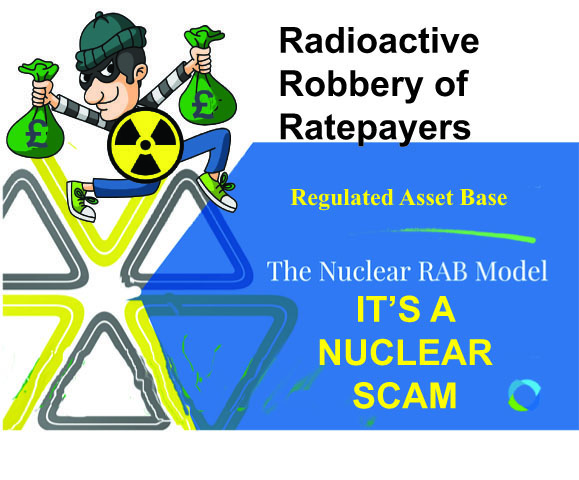
The British government’s Regulated Asset Base – the test case for reviving its nuclear power dream
After years of false dawns, can Britain realise its nuclear ambitions? FT, 19 Jan 23 “…………………………………………………………………………………. Nuclear test case
Fresh hopes of encouraging the development of a new fleet of nuclear reactors — both large and small — now rest on a complex hybrid public-private partnership financing model known as the Regulated Asset Base. Already used for other infrastructure projects such as energy networks and airport terminals, RAB promises potential investors an “allowed revenue” — overseen by a regulator — from the start of construction, funded via a surcharge on consumer energy bills.
Supporters of the model, such as EDF, argue it significantly cuts the cost of financing because it lowers the interest that builds up during the construction phase and reduces the amount of compounded debt that needs to be serviced and paid off during the station’s lifespan. Financing costs account for roughly two-thirds of the overall cost of a nuclear plant. The allowed revenue payments continue after the plant is operational. Rather than paying a price for every unit of electricity produced, the model essentially pays for new nuclear power stations to be available.
But the RAB model is also divisive. Critics argue it would saddle bill payers with high additional costs if projects run over time and over budget.
The UK government intends for that risk to be shared between the project’s owners and consumers, according to people familiar with the discussions, although it is yet to reveal how that would work in the case of Sizewell C, which is unlikely to be connected to the electricity grid before the 2030s.
“If the cost of overruns and delays cannot just be lumped on to consumers, I think it would be implausible any investor would look at the deal,” says Steve Thomas, emeritus professor of energy policy at the University of Greenwich. “How would you feel if your pension fund was taking the risk of a nuclear project not being built to time and cost?”
For long-running nuclear sceptics, the latest attempt at ushering in a new civil nuclear golden age in Britain risks diverting attention and investment away from other technologies, such as wind, solar and storage, which could be delivered sooner to achieve the country’s near-term emissions targets.
The UK government is working towards a fivefold increase in offshore wind to 50GW by 2030 — which it claims would be enough to “power every home” — and to raise solar deployment to 70GW from 14GW by 2035. Renewables supporters claim these could still meet a lot of demand even on calmer, less bright days.
“If you want to hit your 2035 target and Sizewell C is not going to get you there [in time] then you have got to do something else . . . so why do Sizewell C as well if you are going to get there without it?” says Alison Downes, a former head of direct actions at Greenpeace UK who is now spearheading a campaign to stop Sizewell C being built.
Among longstanding nuclear proponents, there are still nerves about whether Britain’s latest attempt to revive an industry will come to fruition, even if they feel the politics are now on their side.
If a final investment decision is taken by the end of 2024 as hoped, Sizewell C will be the first test of the financing model for nuclear projects and only the second nuclear power station to enter construction since 1995, when the last of the current fleet opened. The other, Hinkley Point C, began construction in 2016 but is running over-time and over-budget. It is not currently envisaged to generate any electricity before mid-2027.
Nuclear industry executives have also been pushing ministers to confirm a new nuclear reactor construction programme beyond Sizewell C as part of GBN’s launch.
This should, in the short-term, include a commitment to take final investment decisions on two further nuclear projects in the next parliament.
But to get to that stage and avoid adding to the roster of failed nuclear projects, the impasse within government must first be resolved.
Graham Stuart, energy and climate minister at the BEIS, alluded on Wednesday to the tussle between departments, saying a date for the launch of GBN would be set once it had “a resolved and finalised agreement with His Majesty’s Treasury”.
A government insider confirmed the rollout was being held up by chancellor Jeremy Hunt who “wants to do due diligence on GBN before approving it”.
“Is there haggling over money?” the person says. “There always is.” https://www.ft.com/content/c4c481d3-99e0-4c2f-8d4e-96b4c9a3bd59
Mini nuclear reactor firm snubs Britain for the French: Newcleo blames political chaos for decision to build prototype across Channel
Britain’s nuclear power ambitions suffered another setback as a UK company
chose France to build its prototype reactor. Newcleo blamed political
upheaval in Westminster for its decision. The mini-nuclear power station
company said it waited in vain for ministers to give the green light over
where to site the project – leaving it no option but to take the work over
the Channel.
The move will cost hundreds of potential UK jobs and casts
further doubt on the country’s nuclear future. Speaking at the World
Economic Forum in Davos, Newcleo chief executive Stefano Buono told the
Mail: ‘Changing government three times has not helped. ‘We were
expecting a decision before, but I understand that when the government
changes, it’s very difficult to take decisions.’ Britain is scrambling to
replace its fleet of six large nuclear plants, five of which are due for
closure by 2028 and one, Sizewell B, in 2035.
Hopes for the mini-nuclear sector were raised by Boris Johnson’s plans for a government-backed body
called Great British Nuclear (GBN) to support the development of new sites.
Speaking in the Commons yesterday, the former prime minister urged the
Government ‘to exploit this country’s technological lead and build a
fleet of small modular nuclear reactors as part of our Great British
Nuclear programme’. Business Secretary Grant Shapps said GBN would be up
and running shortly and said small modular reactors would play ‘an
important part’ in boosting nuclear power supplies. The Government wants 25
per cent of power to come from nuclear by 2050. Last year it supplied 15.5
per cent. Privately-owned Newcleo, which is about to launch a £900million
funding round, is one of a number of companies planning to build
mini-nuclear power stations around the UK.
Daily Mail 17th Jan 2023
A bit of panic in the UK small nuclear reactor lobby?

‘No regrets?”
Quite a lot of people have regrets about the introduction of nuclear power.
And that’s even when the reactor types have been tested.
The new gee-whiz nuclear reactors haven’t even been tested.
Pipeline of ‘no-regrets’ new nuclear schemes needs ‘expediting’
New Civil Engineer16 JAN, 2023 BY ROB HORGAN
A pipeline of “no-regrets” new nuclear schemes must be fast-tracked if the UK is to meet its net zero carbon emission targets, according to an independent [how independent?] review set up to assess the UK’s decarbonisation plans.
It is one of 129 recommendations made by former energy minister Chris Skidmore in his government-ordered net zero review titled Mission Zero.
The report calls for the formation of Great British Nuclear (GBN) to be “expedited in early 2023” so that a “clear roadmap” of future schemes can be developed this year to tackle “rising power demand”.
The government first announced its intention to set up GBN to develop a project pipeline in its British Energy Security Strategy published in April last year.
Skidmore concludes that speeding up the formation of GBN will address industry concerns about a “lack of clarity on the pathway” to achieving the UK government’s ambition for nuclear energy to provide a quarter of power consumed within the country. (Nuclear energy currently supplies 15% of the UK’s power needs.)
The review concludes: “Building new nuclear is a no-regrets option, despite high upfront costs and long construction times”……………….

- YOU ARE HERE:LATEST
Pipeline of ‘no-regrets’ new nuclear schemes needs ‘expediting’
16 JAN, 2023 BY ROB HORGAN
A pipeline of “no-regrets” new nuclear schemes must be fast-tracked if the UK is to meet its net zero carbon emission targets, according to an independent review set up to assess the UK’s decarbonisation plans.
It is one of 129 recommendations made by former energy minister Chris Skidmore in his government-ordered net zero review titled Mission Zero.
The report calls for the formation of Great British Nuclear (GBN) to be “expedited in early 2023” so that a “clear roadmap” of future schemes can be developed this year to tackle “rising power demand”.
The government first announced its intention to set up GBN to develop a project pipeline in its British Energy Security Strategy published in April last year.
Skidmore concludes that speeding up the formation of GBN will address industry concerns about a “lack of clarity on the pathway” to achieving the UK government’s ambition for nuclear energy to provide a quarter of power consumed within the country. (Nuclear energy currently supplies 15% of the UK’s power needs.)
The review concludes: “Building new nuclear is a no-regrets option, despite high upfront costs and long construction times.
“In view of rising power demand, nuclear energy can provide reliable baseload power which is not weather dependent and can provide other services to power networks.”
It adds: “To achieve affordability and efficiency, the Government needs to commit to funding a fleet of projects. Recognising the start times for new build nuclear, a clear roadmap for nuclear deployment up to 2035 is required.”
The government is currently committed to building Sizewell C, while construction of Hinkley Point C continues to gather pace. Ambitions to develop a fleet of small nuclear reactors has also been widely supported by government in the past few years.
Skidmore’s review concludes that as well as delivering a pipeline of projects, the government must act to remove barriers to its nuclear ambitions.
It identifies “the main barrier for new nuclear projects is the need for stable, long-term policy and funding commitments given the long timeframes involved in the building of nuclear plants”.
It also points out that “rapid expansion of nuclear power could lead to some bottlenecks in supply chains and skills pools”.
However, the report stresses that “understanding the timings of different projects” would allow “any supply chain and skills pinch points [to] be identified early, allowing for coordinated action to prevent bottlenecks”.
The review also concludes that streamlining planning and consenting decisions would “ensure nuclear projects are not unnecessarily delayed”. Likewise, Skidmore’s review calls for the lengthy protocols required for innovations like SMRs to be accelerated.
National Infrastructure Commission chair Sir John Armitt supports Skidmore’s calls for clarity and accelerated action.
He said: “Chris Skidmore’s clarity in his call for accelerated action is as compelling as it is commendable, nailing the argument that inaction now will cost us all in the long run.
“Given the economic opportunities offered by leading the pack internationally, securing policy and funding stability over the coming years is paramount.”

Nuclear energy recommendations made in Skidmore’s net zero review:
- Expedite the set-up of Great British Nuclear in early 2023, ensuring required funding and skills are in place.
- Government and GBN to set out clear roadmap in 2023, including interim targets to reach 2050 ambition, and government to ensure funding is in place. As part of the roadmap, government should assess the possibility to increase the current ambitions, supporting the development of supply chain to service a fleet of projects.
- Roadmap to set out clear pathways for different nuclear technologies (including small modular reactors) and the selection process. This should consider how to use programmatic approach to deliver further cost reductions in a competitive environment.
- Government to deliver on siting strategy by 2024
UK police powers increased, to shut down climate protests
The police are to be given powers to shut down protests before they cause
widespread disruption, under plans being announced by ministers today. In a
move to clamp down on so-called guerrilla tactics used by groups such as
Just Stop Oil and Insulate Britain, officers will for the first time be
allowed to shut down protests before they cause disruption.
They will also
be able to treat a series of protests by the same group as one incident
when defining what can be classed as “serious disruption” under the
Public Order Bill going through parliament. The measures are designed to
give more clarity to the police about when they can intervene to disrupt
protests such as the blocking of roads or slow marching to cause
disruption.
Times 16th Jan 2023
UK govt to tighten anti-protest restrictions, despite criticism from human rights groups
https://www.ft.com/content/57730f56-6966-4c35-8d32-67a52f5efe6e 16 Jan 23
Rishi Sunak will on Monday propose new measures to help the police stop disruptive public protest in Britain, heading further down a route that has drawn heavy criticism from civil rights groups.
The prime minister wants to broaden the legal definition of “serious disruption” in a new public order bill, to help police stop what he calls a “disruptive minority” who use tactics such as blocking roads or slow marching.
Sunak believes the public and business will support the government’s efforts to stop protesters causing serious disruption following a series of high-profile protests by groups such as Just Stop Oil and Insulate Britain. But Human Rights Watch, the international NGO, last week criticised the government for a series of recent measures, including restrictions on protest………
The government will this week table an amendment to the bill, currently in the House of Lords, which it says will give police “greater flexibility and clarity” over when to intervene to stop a “disruptive minority”.
Police have already been given additional powers to prevent protesters using what Downing Street calls “guerrilla tactics”, but police chiefs say there is uncertainty over what reaches the threshold of “serious disruption”.
The changes would mean that police will not need to wait for disruption to take place and can shut protests down before any “chaos” is caused, Downing Street said.
Police would not need to treat a series of protests by the same group as standalone incidents but would be able to consider their total impact; they would also be able to consider the cumulative effect of long-running campaigns over a number of weeks intended to cause repeat disruption. Sunak said: “The right to protest is a fundamental principle of our democracy, but this is not absolute.
A balance must be struck between the rights of individuals and the rights of the hard-working majority to go about their day-to-day business.” Recommended Extinction Rebellion Extinction Rebellion abandons disruptive climate protests in UK Sir Mark Rowley, Metropolitan Police commissioner, said: “Increasingly police are getting drawn into complex legal arguments about the balance between that right to protest and the rights of others to go about their daily lives free from serious disruption. “The lack of clarity in the legislation and the increasing complexity of the case law is making this more difficult and more contested.” But Hassan said last week: “A slew of legislation was passed last year where fundamental human rights are being challenged.
The protest law is something we are deeply concerned about. “When you talk about civic space and about people’s right to participate in a democratic society, the right to peaceful assembly and the right to protest are key pillars of that. We’ve seen an outright assault from this government on that.”
HRW also criticised government measures including a new elections act which will require voter identification in polls and the plan to allow offshore processing of asylum claims in Rwanda.
40 safety incidents with UK nuclear weapons convoys over past 3 years
The nuclear bomb convoy that regularly criss-crosses the UK by road has
logged 40 safety incidents in the last three years, according to
information released by the Ministry of Defence.
Convoy vehicles crashed
twice and got caught up in other road accidents five times. They also
suffered multiple brake faults, breakdowns and power losses. The convoy,
which carries nuclear warheads, caused the closure of roads or motorway
lanes 11 times. It was delayed by lorry fires, a spillage and two outbreaks
of Covid.
In one case the convoy had to deal with an “erratic driver
interfering with the convoy”. In another, it closed a road after a
motorist caught using a mobile phone tried to run away.
Campaigners
described the safety lapses as “concerning” and argued that small
incidents could easily escalate into something more serious. They said that
the risks being taken by the Ministry of Defence (MoD) were unjustified. An
SNP MP criticised the MoD for keeping the locations, dates and other
details of the incidents secret.
The Ferret 15th Jan 2023 https://theferret.scot/nuclear-bomb-convoys-40-safety-incidents/
Man arrested on suspicion of terror offences after uranium found at Heathrow
Traces of the potentially lethal chemical element were found
within a cargo package on Dec 29. A businessman has been arrested on
suspicion of terrorism over an alleged attempt to import radioactive
uranium into the UK.
The British citizen was detained by counter-terrorism
police after the discovery of traces of uranium at Heathrow Airport just
after Christmas, in a consignment of scrap metal intended for an Iranian
registered business based in the UK.
He was questioned under section nine
of the Terrorism Act 2006, which created an offence “of making or
possessing a radioactive device or possessing radioactive material with the
intention of using it” in the commission or preparation of an act of
terrorism. The use of the section is incredibly rare.
Telegraph 15th Jan 2023
Man arrested on suspicion of terror offence after Heathrow uranium nuclear
scare.
Mirror 15th Jan 2023
https://www.mirror.co.uk/news/uk-news/breaking-man-arrested-suspicion-terror-28960671
Uncertainty over government funding for Rolls Royce’s small nuclear reactors

Concerns have been raised that the rollout of small modular reactors
(SMRs) in the UK could be delayed due to funding challenges. According to
The Times, a funding deal for the first fleet of mini nuclear reactors is
not expected to materialise for at least another 12 months, with a row
ongoing in government over the cost of Britain’s wider nuclear ambitions.
Going forward, SMRs, alongside large-scale nuclear plants, are seen as a
crucial tool in the country’s battle against the energy crisis and drive
towards net zero.
The government established a new body called Great British Nuclear (GBN) in conjunction with the release of its energy
security strategy with the aim of facilitating the growth of nuclear power on the grid.
However, Whitehall sources have now revealed that there
remains uncertainty over the government’s SMR investment plans. Rolls-Royce
has called for ministers to enter funding talks and start placing orders.
The firm is planning on building SMR power stations and recently announced
three shortlisted locations for its proposed factory and four potential
sites for the SMR plants themselves.
New Civil Engineer 9th Jan 2023 https://www.newcivilengineer.com/latest/fears-over-potential-delay-to-small-nuclear-reactor-rollout-09-01-2023/
A plan to build a fleet of mini nuclear reactors across the UK could be
delayed by at least another 12 months amid a row in the government over the
cost of Britain’s nuclear power ambitions. The Sunday Times cited sources
stating that there was still a large degree of uncertainty over the scale
of state investment in small modular reactors (SMRs).
Energy Live News 9th Jan 2023
Nuclear convoys: 40 safety reports in three years

Sunday Post By Rob Edwards, January 15, 2023,
The nuclear bomb convoy that regularly crisscrosses the UK by road has logged 40 safety incidents in the last three years, according to official figures.
Convoy vehicles have crashed twice and got caught up in other road accidents five times. They have suffered multiple brake faults, breakdowns and power losses.
The convoy has also caused the closure of roads or motorway lanes 11 times and been delayed by lorry fires, a spillage and two outbreaks of Covid. In one case it had to deal with an “erratic driver interfering with the convoy” and in another it closed a road after a driver caught using a mobile phone tried to run away.
Campaigners described the safety lapses as “concerning” and argued that small incidents could easily escalate into something more serious. They said the risks being taken by the Ministry of Defence (MoD) were unjustified……
A convoy of 20 or more vehicles transports nuclear warheads between the Burghfield nuclear weapons factory in Berkshire and the Royal Navy’s armaments depot at Coulport on Loch Long in Argyll and Bute at least six times a year. The warheads require regular maintenance.
In response to a request under freedom of information, the MoD released short summary logs of incidents involving the convoy during 2019, 2020 and 2021. The dates are blacked out and no locations are given.
Of the 40 incidents, 22 are categorised as “operational” and 18 as “engineering”. One of the two crashes involving a convoy vehicle caused “minor injuries” and a delay of two hours and 45 minutes. The other was attended by the police and caused a 32-minute delay.
The Ferret news website reported in 2018 the MoD recorded 157 safety incidents involving the convoy between 2008 and 2017. The number logged in 2017 (44) was a record high…………. more https://www.sundaypost.com/fp/nuclear-convoys-40-safety-reports-in-three-years/
—
New delay for Hinkley Point C nuclear power – could start operating in 2036.
Hinkley C ‘on schedule’ despite new delay claim after new agreement.
SUGGESTIONS that completion of the Hinkley Point C nuclear power station
could be delayed by 11 years have been dismissed by the company which is
building it. A number of delays have already hit Europe’s largest
construction site and currently Hinkley is not set to start generating
electricity until June, 2027, two years behind its original schedule. Now,
French company EDF has struck a new deal with the Government which would
allow it to start operating as late as 2036.
West Somerset Free Press 8th Jan 2023
https://www.wsfp.co.uk/news/hinkley-c-on-schedule-despite-new-delay-claim-after-new-agreement-586884
UK should not be building Sizewell C, and rollout of small nuclear reactors will be a nightmare – energy boss.
A nationwide rollout of small nuclear reactors has been hailed as a “nightmare” by Dale Vince
Dimitris Mavrokefalidis 10 Jan 23, https://www.energylivenews.com/2023/01/10/uk-should-not-be-building-sizewell-c-says-energy-boss/
The Founder of a British energy company has expressed his doubts about the government’s backing of Sizewell C.
A few months ago, ministers confirmed the first state backing of a nuclear project in more than 30 years, with a £700 million stake in Sizewell C in Suffolk.
Speaking to GB News, Dale Vince, Founder of Ecotricity, said: “It (nuclear energy) is much more expensive. It eats tens of billions of more public money than renewables have. And we will do it for a very long time because we have to actually deal with the radioactive waste as well.
“I think that what we have, we should keep and we should use it as we transition into 100% green energy. We shouldn’t be building Sizewell, the next one.”
Mr Vince questioned the turnover of such large projects and when asked about Rolls-Royce’s small reactors said: “What a nightmare. A proliferation of mini nukes around the country.”
Counter terror police investigate uranium package found at Heathrow airport.
A shipment of uranium discovered at Heathrow could have been part of a dry
run operation by Iranian terrorists to test the resilience of security
measures during recent Border Force strikes, a military intelligence expert
has warned.
Counter-terror police have launched an urgent investigation
after the radioactive substance was identified among a shipment of scrap
metal on board an Oman Air flight from Pakistan. The consignment – bound
for an Iranian-registered business in the UK – arrived at Heathrow on Dec
29, when Border Force staff were in the grip of an eight day walk-out.
The suspicious material, which could be used in the manufacture of a “dirty
bomb”, was detected by officials who were not on strike using
sophisticated radioactive scanning equipment.
Telegraph 11th Jan 2023
Nuclear Heathrow airport scare could be Litvinenko-style attack, claims
former general. Met Counter Terrorism Command officers raced to Heathrow
Airport Terminal 4 on December 29 after a package set off alarms over
“contaminated’ material- which turned out to be uranium
Mirror 11th Jan 2023
https://www.mirror.co.uk/news/uk-news/nuclear-heathrow-airport-scare-could-28927109
Rolls Royce’s frustration as government holds back on orders for mininuclear reactors.
Treasury will reportedly not sign off on investment until
technology approved by regulators. A funding deal for the first fleet of
mini nuclear reactors may not materialise for another 12 months, to the
dismay of domestic leaders in the technology. The government made small
modular reactors a central element of its plans to generate 24GW of energy
from nuclear by 2050, but according to The Times there is significant
uncertainty in Whitehall over the scale and state of investment plans.
Building 10th Jan 2023
1 This Month
26 September – International Day for the Total Elimination of Nuclear Weapons





PLEASE OPPOSE HR 8255 AND S.3639 – bills would accelerate satellite deployment, with no environmental review or safeguards – https://ncstd5li.quorum.us/campaign/169331/
To see nuclear-related stories in greater depth and intensity – go to https://nuclearinformation.wordpress.com
-
Archives
- September 2026 (293)
- August 2026 (330)
- July 2026 (355)
- June 2026 (287)
- May 2026 (306)
- April 2026 (356)
- March 2026 (251)
- February 2026 (267)
- January 2026 (308)
- December 2025 (358)
- November 2025 (359)
- October 2025 (375)
-
Categories
- 1
- 1 NUCLEAR ISSUES
- business and costs
- climate change
- culture and arts
- ENERGY
- environment
- health
- history
- indigenous issues
- Legal
- marketing of nuclear
- media
- opposition to nuclear
- PERSONAL STORIES
- politics
- politics international
- Religion and ethics
- safety
- secrets,lies and civil liberties
- spinbuster
- technology
- Uranium
- wastes
- weapons and war
- Women
- 2 WORLD
- ACTION
- AFRICA
- Atrocities
- AUSTRALIA
- Christina's notes
- Christina's themes
- culture and arts
- Events
- Fuk 2022
- Fuk 2023
- Fukushima 2017
- Fukushima 2018
- fukushima 2019
- Fukushima 2020
- Fukushima 2021
- general
- global warming
- Humour (God we need it)
- Nuclear
- RARE EARTHS
- Reference
- resources – print
- Resources -audiovicual
- Weekly Newsletter
- World
- World Nuclear
- YouTube
-
RSS
Entries RSS
Comments RSS

