Rolls Royce hyping up risky and unproven small nuclear reactors

The seeds of a recovery are in place. The company’s nascent small
modular nuclear reactor operation is hugely promising. They can be built
for a fraction of the cost [ed -this is a dubious claim] and are much quicker to assemble. The Government
has thrown its weight behind the technology with £210m of grants. Yet the
project will require four new factories to be built and the first reactor
isn’t expected until 2029. There are high hopes, too, for a move into
electric powered planes and clean fuel. With a cutting edge in combustion
engines that burn hydrogen or artificial fuels, the real elephant in the
room for Rolls is decarbonisation. Yet, the newer technologies it is
pouring money into are risky and unproven.
Telegraph 27th July 2022
https://www.telegraph.co.uk/business/2022/07/27/rolls-royce-existential-crisis-new-unknown-b
Campaign groups in Wales join to fight nuclear power plans
More than 30 anti-nuclear campaigners representing the major Welsh
campaign groups met in Caernarfon on Saturday to discuss their strategy to
withstand plans from the Welsh and UK governments to develop new nuclear
power stations at Wylfa and Trawsfynydd. The UK government confirmed in
April this year that re-opening Wylfa nuclear power station was part of its
energy strategy, with the idea to move ahead with the project “as soon as
possible this decade”. Scotland, meanwhile, will not see any new nuclear
reactors as part of the UK government’s energy strategy.
The National (Wales) 27th July 2022
https://www.thenational.wales/environment/20513304.wylfa-campaigners-fight-nuclear-power-wales/
Anti-nuclear groups gather in Wales
Organizations meeting to oppose nuclear energy in the north. In Caernarfon
on Saturday, a number of anti nuclear organizations came together to oppose
any plans to build new power stations on Anglesey and Trawsfynydd. The
organizations present – PAWB, CADNO, Cymdeithas yr Iaith, Welsh Anti
Nuclear Alliance and the Nuclear Free Local Authorities – claimed that
nuclear energy is not the way forward to meet Wales’ power needs. They were
also concerned about the effect that nuclear projects in Welsh speaking
areas would have on the language.
BBC 24th July 2022
EDF’s new demand means that Hinkley Point C will be further delayed, with costs escalating to £34 billion.
EDF have implicitly admitted that the construction of Hinkley C may take
at least 11 years to finish signalling cost overruns of 70 per cent or
more. Bloomberg reports that EDF is requesting the Government that EDF be
given another 15 months to complete the plant and be fully generating
beyond 2029.
Under the terms of EDF’s contract with the UK Government if
Hinkley C fails to generate power by 2029 it will start losing the amount
of subsidy it can claim. Adding 15 months to this as requested (under a
‘force majeure’ clause) will take us into 2030. Hinkley C construction
was begun seriously in early 2019, meaning a total construction period of
over 11 years.
The plant was supposed to be operating by the end of 2025
according the EDF’ earlier plans. Using the rule of thumb that
construction cost is directly proportional to the length of construction
time this would imply a 70% cost overrun. That could mean a cost rise, in
today’s prices from around the original £20 bn to £34 billion. However,
one should in no way assume this will be all the time that is needed.
Things may well get worse.
100% Renewables 22nd July 2022
Guardians of the East Coast (Gotec) fight to stop nuclear waste dumping in the sea near holiday resorts UK

As Boris Johnson forged ahead with plans to triple Britain’s nuclear output in the shift away from a reliance on Russia and fossil fuels, he pledged to build a mini-nuclear reactor in almost every garden across the country.
The outgoing prime minister’s plan was typically bombastic, yet reflected the Government’s ambitious target to deliver up to a quarter of the country’s electricity from nuclear technologies by 2050.
What is less clear, however, is exactly where to put the hazardous waste produced from
reactors. Currently, Britain stores spent nuclear fuel at a number of nuclear sites including Sellafield, in Cumbria, and Sizewell B, in Suffolk.
But these on-land sites are not intended to be a permanent solution to the radioactive material building up as a by-product of Britain’s nuclear programme. The Government’s arms-length body Nuclear Waste Services (NWS) has been tasked with finding a permanent disposal site. Bruce Cairns, chief policy adviser at NWS, says: “We’re talking about a solution that should last hundreds of thousands of years. “What do you trust the most? Do you really want to leave this stuff at the surface, where it is vulnerable to
extreme weather events, climate change, sea level rise, terrorism, war or the breakdown in society?
“Everyone reaches the same conclusion. We just can’t give any guarantees that there will be people on the surface capable of looking after it over those timescales.” Countries worldwide with nuclear programmes are all trying to find ways to store the waste so that it will not endanger future civilisations, with policy makers discussing how to make it completely inaccessible to future populations likely to
speak different languages, hold different values and have access to new technologies. The best way forward, they have decided, is to store the waste in rocks deep underground.
But finding a local area happy to host the site has its challenges, and has come up against opposition. A number of locations in Cumbria are being vetted by the Government, with the communities near Sellafield considered more amenable because they are already better acquainted with nuclear technologies and aware of the economic benefits of the industry.
However, a new entrant has emerged on the east coast. A community group assessing plans for a GDF has been set up in Lincolnshire. The facility’s entrance would be located at a former gas terminal near the village of Theddlethorpe and the popular seaside town of Mablethorpe. Underground tunnels dug out of layers of deep rocks would lead to the underwater site around six miles from the coastline. NWS and other proponents of the site point out that granting a GDF in the area will unlock significant government funding for local projects.
Yet opponents fear it would wreck the local tourism industry. A group called the Guardians of the East Coast (Gotec) are fighting the plans through protests, petitions and coverage in local and national newspapers. Ken Smith, chairman of Gotec, says: “Mablethorpe is one of the east coast’s principle bucket-and-spade holiday resorts. “I imagine that having four square miles of nuclear waste just six miles off the coast is not exactly going to encourage people to send their children along to bathe in the sea.” Local Conservative MP Victoria Atkins has also expressed reservations and held meetings with site organisers.
Telegraph 23rd July 2022
The brutal reality of the US-UK ‘Special Relationship’, and the persecution of Julian Assange

In an exclusive article, the world’s leading public intellectual says the handover of global imperial power from Britain to the US is at the root of the UK’s continued persecution of Julian Assange.
Declassified UK, NOAM CHOMSKY, 21 JULY 2022,
The abject submission of British authorities to the Master in Washington in the case of journalist Julian Assange is painful to observe but – unfortunately – not difficult to understand.
The roots go back to the Second World War, when Britain handed the mantle of world domination over to its former colony. The US had long surpassed the UK as an economic power and had displaced it from “our little region over here,” as Secretary of War Henry Stimson described the Western hemisphere. But it had not yet become a truly global power.
At the time, British officials were well aware that the UK was becoming a “junior partner” to the US, now subject to its will, which was often exercised crudely.
Given their own ample experience with imperial arrogance, brutality and hypocrisy, British diplomats could easily read between the lines when their American counterparts protested that US global domination is “part of our obligation to the security of the world…what was good for us was good for the world”, as Abe Fortas, a leading figure in the New Deal administrations, put it.
The British Foreign Office, parsing this apparent altruistic concern, concluded that Washington was, in fact, guided by “the economic imperialism of American business interests” and was “attempting to elbow us out…under the cloak of a benevolent and avuncular internationalism”.
UK officials continued that their American counterparts believe “that the United States stands for something in the world – something of which the world has need, something which the world is going to like, something, in the final analysis, which the world is going to take, whether it likes it or not.” What true believers in the historical profession call “Wilsonian idealism”.
From then, Britain takes it, whether it likes it or not. Things could have gone a different way at various points in modern history, recently if Jeremy Corbyn hadn’t been destroyed by a vicious media campaign. But today’s British authorities just take the orders and Julian Assange is one of the victims.
Intricate handover
While Britain had become the “junior partner” by 1945, the handover process had played out in an extended and intricate way.
One of the reasons why the now-famous Second Amendment of the US Constitution called for “a well regulated militia” was fear that “the Brits are coming”. The first foreign policy goal of the new Republic, apart from cleansing what became the national territory, was to take Cuba.
The British Navy was in the way. But, as the great grand strategist John Quincy Adams explained, over time British power would decline while that of the US would increase and Cuba would then fall into US hands by the laws of “political gravitation”.
This did happen in 1898 when the US intervened to prevent Cuba’s liberation from Spain and turn it into a virtual colony. This is called “the liberation of Cuba” in preferred doctrine…………………………………………..
The vast gap between law and practice is illustrated by the Assange case. Here Britain, adopting its usual role of “junior partner,” has been savagely supporting the effort of the inheritors of the Framers to infringe radically on freedom of the press. The media response has ranged from tepid to cowardly.
The precedent is all too clear. If the states that claim, with some justice, to be in the forefront of defence of freedom are granted licence to crush it when it interferes with state power and violence, the limited freedoms that have been won by popular struggle suffer a severe blow everywhere. https://declassifieduk.org/the-brutal-reality-of-the-us-uk-special-relationship/—
Time for the UK government to tell the truth about nuclear power
Targeting scarce public resources at ailing nuclear initiatives flies in the face of all known data, says Prof Andy Stirling
The UK is sadly becoming habituated to an officially sponsored attrition of truth about nuclear power. Despite intensifying propaganda, even government data shows this military-backed technology to be, in reality, an expensive, slow, unreliable, risky and unpopular way to deliver affordable, secure, zero-carbon energy.
The gap in efficacy and competitiveness between nuclear and other options is continually growing. Supporting nuclear, rather than energy efficiency, wind and solar, slows down climate action, bleeds taxpayers, forgoes jobs and forces unnecessarily large and regressive burdens on consumers.
BEIS says: “Nuclear is the only form of reliable, low-carbon generation
which has been deployed at scale to date.”
The] manifest falsity of this starkly unqualified statement is extraordinary. As the government’s own
data also shows, the costs of managing variable supply are rapidly diminishing and are already far smaller than the competitiveness gap between nuclear and renewables.
Current renewable contributions to UK electricity far surpass the peak achieved by nuclear. When did it become acceptable in British public life that a supposedly democratic government should so seriously misrepresent reality in a formal policy document?
In a period when stakes are unprecedentedly high for climate, economy, energy security and hard-pressed households, it is time to renew reasoned scientific and democratic debate in this field and prevent this national self-harm by unaccountable special interests.
Guardian 21st July 2022
EDF worried that its delays in building Hinkley Point C nuclear station might lessen the huge subsidies it gets from the UK government
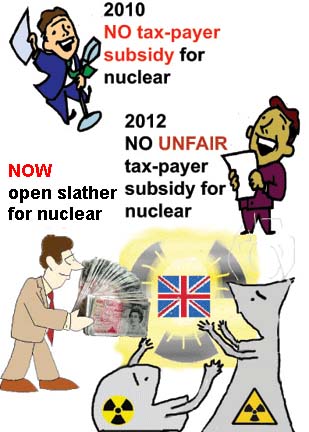
EDF pushes UK government to alter Hinkley Point C penalty clauses. EDF is trying to alter a key subsidy contract to avoid missing out on trillions of pounds in guaranteed revenue after the Covid-19 pandemic caused further delays to Hinkley Point C, the first new nuclear power station under construction in the UK in almost 30 years.
The French utility is in negotiations with the British government over penalty clauses in a
controversial agreement struck in 2013 to finance the building of the plant in Somerset.
EDF started work on the 3.2 gigawatt plant in 2016 but has repeatedly pushed back its completion date while costs have spiraled. In the latest setback, EDF warned in May that the first of Hinkley’s two reactors would not be completed until June 2027, 18 months behind schedule. It attributed 12 months of the delay to Covid-related problems, when it had to reduce staff on site from 5,000 to 1,500.
But the company cautioned that there was the possibility of a further 15-month delay to September 2028,
adding that date could slip again if there was another wave of pandemic or there were knock-on effects from the war in Ukraine.
Penalty clauses in the subsidy agreement — which guarantees a price that is more than double
those offered to developers of rival technologies such as offshore wind — would reduce the 35-year term if Hinkley is not generating electricity by May 2029.
EDF would lose one year of guaranteed payments for every year of delay up to 2033. If the delays extended beyond that date the government has the option to terminate the subsidy contract. EDF has already pushed the construction budget of Hinkley up several times with the revision in May raising the total cost by a further £3bn to as much as £26bn in 2015 prices, compared to an estimate of £18bn in 2016. Crooks said about a third of May’s revision to the budget was Covid-related. About £500mn was down to performance being “less than we would expect”, he added. The other cost overruns were due to issues such as completion of some of the outstanding design work and a failure to accurately estimate the quantities of materials, such as the number of bolts needed, to complete the build.
FT 21st July 2022
https://www.ft.com/content/cb715de2-1c95-4a13-8b48-33717b1dcc44
EDF seeks guarantees from UK government to keep its big subsidies
EDF is seeking to amend the controversial subsidy contract for its £26
billion Hinkley Point C nuclear plant so that it will not be penalised even
if the plant does not start to generate power until 2030.
Hinkley was
supposed to start up in 2025 but EDF has pushed this back to mid-2027,
primarily blaming Covid disruption, and warned of the risk of a further
15-month delay. Stuart Crooks, managing director of Hinkley Point C, said
at least some of this delay was now “likely” to materialise as the
project battles issues including labour shortages.
He revealed that EDF was
seeking extra leeway in the already contentious subsidy contract to protect
its revenues even if the plant suffers additional delays and does not start
up this decade. Further delays would also raise the prospect of additional
increases in costs, which have risen from £18 billion when it got the
go-ahead in 2016 to as much as £26 billion at 2015 prices.
Times 22nd July 2022
https://www.thetimes.co.uk/article/edf-seeks-hinkley-delay-guarantees-2g6tqt522
The Royal Society for the Protection of Birds (RSPB) condemns ludicrous Sizewell C planning approval.

The Royal Society for the Protection of Birds (RSPB) has expressed its
disappointment that “ludicrous” plans for a nuclear power plant near the
internationally-important RSPB Minsmere reserve have been approved. RSPB
chief executive Beccy Speight said: “The RSPB is extremely disappointed to
learn that the government has approved plans for Sizewell C, the proposed
new nuclear power station that will affect our nature reserve at Minsmere
in Suffolk.
East Anglian Daily Times 20th July 2022
https://www.eadt.co.uk/news/business/rspb-condemns-ludicrous-sizewell-c-planning-approval-9157422
Against advice of the Planning Inspectorate the UK’s interim government gives go-ahead to Sizewell C nuclear power plant.
UK government gives go-ahead to Sizewell C nuclear power plant, Decision goes against advice of Planning Inspectorate, which rejected project owing to impact,
Guardian, Alex Lawson Energy correspondent, Thu 21 Jul 2022 ,
The UK government has given planning consent to the £20bn Sizewell C nuclear power plant in Suffolk.
The decision by the business secretary, Kwasi Kwarteng, which had been repeatedly delayed, was finally announced on Wednesday and went against the advice of the independent Planning Inspectorate.
French energy company EDF wants to build the 3.2 GW, two-reactor plant next to its existing site at Sizewell B, which began operating in 1995.
However, the proposals have faced fierce opposition from local campaigners, who have argued against the project because of the environmental impact and the cost to energy billpayers. Campaigners now have six weeks to decide whether to appeal against the decision.
Planning permission was seen as a key hurdle for the project which remains subject to a further final investment decision, expected next year. It is hoped the plant can generate enough power for six million homes.
The approval process for Sizewell C has so far included four rounds of public consultation which began in 2012 and has involved more than 10,000 East Suffolk residents.
The Planning Inspectorate rejected the scheme because of concerns over the plant’s impact on protected species and habitats, and the long-term water supply at the site.
EDF worked with Chinese state-backed nuclear specialist CGN on the first phase of the project. However, it is understood the UK government is keen to ease CGN out amid concerns over Chinese involvement with sensitive assets.
Bankers at Barclays have been hired to secure new financial backing for the project alongside EDF and the UK government.
Boris Johnson’s government put £100m of funding behind the project in January to support its development………………………………………………..
Alison Downes, of the Stop Sizewell C campaign, said: “The wrong decision has been made but it’s not the end of our campaign to Stop Sizewell C. Not only will we be looking closely at appealing this decision, we’ll continue to challenge every aspect of Sizewell C, because – whether it is the impact on consumers, the massive costs and delays, the outstanding technical questions or the environmental impacts – it remains a very bad risk.”
Beccy Speight, the chief executive of the Royal Society for the Protection of Birds, said: “The construction of the proposed development will be damaging and it has been granted with insufficient consideration for the effects on nature as described by the government’s own experts. This is a ludicrous decision for an interim government to make.”
Greenpeace UK’s chief scientist, Dr Doug Parr, called the project a “red herring energy solution” as the UK attempts to move towards a low-carbon energy system……………………
The French government said on Tuesday it was prepared to pay €10bn (£8.5bn) to fully nationalise EDF amid concerns over its finances. Ministers in France want to keep a handle on soaring energy bills.
Johnson has set a target of making investment decisions on eight new nuclear projects by the end of the decade. https://www.theguardian.com/business/2022/jul/20/uk-government-gives-go-ahead-to-sizewell-c-nuclear-power-plant
All at Sea: Energy Security Bill reveals UK government preference to dump waste offshore

https://www.nuclearpolicy.info/news/all-at-sea-energy-security-bill-reveals-government-preference-to-dump-waste-offshore/ 20 July 22, The Government has published a factsheet in support of the new Energy Security Bill which has confirmed the long-held suspicion of Britain’s Nuclear Free Local Authorities that the nuclear industry intends to dump its deadly legacy of radioactive waste out at sea.
Tucked away in this page-turner is a reference that could be missed on page seven revealing that with refence to the government stated ambition to Prepare for our nuclear future and clean up the past’, that ‘The Bill will also facilitate the safe, and cost-effective clean-up of the UK’s nuclear sites, ensuring the UK is a responsible nuclear state by clarifying that a geological disposal facility located deep below the seabed will be licensed.’[1]
That the intention is to dump the waste at a location out at sea has helpfully been made plain in the latest infomercial published by the Theddlethorpe GDF Community Partnership
20th July 2022
All at Sea: Energy Security Bill reveals government preference to dump waste offshore
The Government has published a factsheet in support of the new Energy Security Bill which has confirmed the long-held suspicion of Britain’s Nuclear Free Local Authorities that the nuclear industry intends to dump its deadly legacy of radioactive waste out at sea.
Tucked away in this page-turner is a reference that could be missed on page seven revealing that with refence to the government stated ambition to Prepare for our nuclear future and clean up the past’, that ‘The Bill will also facilitate the safe, and cost-effective clean-up of the UK’s nuclear sites, ensuring the UK is a responsible nuclear state by clarifying that a geological disposal facility located deep below the seabed will be licensed.’[1]
That the intention is to dump the waste at a location out at sea has helpfully been made plain in the latest infomercial published by the Theddlethorpe GDF Community Partnership

This latest plan to jeopardise the marine environment is par for the course for successive British Governments which, without a care for the ecology of British waters, have previously chosen to recklessly dump deadly munitions and poison gas into our oceans.
In November 2020, the NFLA published a horrifying report commissioned from marine pollution expert, Tim Deere-Jones, which revealed that evidence was mounting that around two million tons of unused wartime munitions were dumped in, or around, the Beaufort’s Dyke in the Irish Sea in the interwar and post-war years, up until at least the mid-1970’s.[2]
Alongside conventional explosives, this deadly legacy included at least 14,000 tons of phosgene gas and a cocktail of other nasties such as ‘canisters of chemical warfare agents including sarin, tabun, mustard gas, cyanide, … and the biological warfare agent anthrax’.
The New Scientist has reported instances of munitions washing up on Scottish beaches and the British Geological Survey confirmed that explosions generated by degrading munitions are a relatively frequent occurrence and that at least one of those explosions was observed to have generated an explosive force equivalent to approximately 5.5 tonnes of TNT.
The report also revealed that radioactive waste has previously been dumped into the Irish Sea, in the Beaufort’s Dyke, in the Firth of Tay and off the island of Arran, including radium-coated aircraft dials, laboratory waste, luminous paint and waste encased in concrete within metal drums.
Responding to the latest revelation, Councillor David Blackburn, Chair of the NFLA Steering Committee, said:
“Clearly then the Energy Security Bill demonstrates that once again the British Government’s plan is to dump its deadly legacy of high-level radioactive waste offshore whatever the long-term detriment to the marine environment and regardless of local and international opposition, and the Theddlethorpe Community Partnership diagram makes this intention writ large.
“The NFLA has far from convinced that however well engineered a nuclear waste dump, or Geological Disposal Facility as the nuclear industry likes to call it, is that the structure of such a facility will not become compromised over the 100,000 years it is required to hold waste whilst it remains radioactive. We fear that in future centuries we shall see radioactive waste poisoning our oceans and beaches.
“This is an especial issue of concern in West Cumbria, where three of the possible four current sites for the dump are under consideration; for here for generations Sellafield has been leaking its toxics into the Irish Sea.
“The NFLA will continue to oppose a GDF, especially one at sea. Our policy is to see radioactive waste properly monitored and managed in a near surface facility, rather than dumped out of sight, out of mind and forgotten about!”
For more information, please contact NFLA Secretary Richard Outram by email on richard.outram@manchester.gov.uk or mobile 07583097793
France’s costly nationalisation of the nuclear industry

The French government is poised to pay nearly €10bn (£8.5bn) to fully
nationalise EDF as ministers attempt to tackle the European energy crisis.
The French finance ministry said on Tuesday it had offered €9.7bn or
€12 a share to buy the 16% of debt-laden EDF it does not already own. The
government of the French prime minister, Elisabeth Borne, government is
trying to shore up domestic energy supplies amid concerns over the finances
of the energy company, which is also building the Hinkley Point C nuclear
power station in Somerset.
Guardian 19th July 2022
https://www.theguardian.com/business/2022/jul/19/france-to-pay-nearly-10bn-to-fully-nationalise-edf
Consultation on proposed changes to storage of radioactive wastes at Hinkley Point C NPP
The Environment Agency has launched a consultation on a proposed change to
the way radioactive waste will be stored at Hinkley Point C nuclear power
station near Bridgwater. Currently the Office for Nuclear Regulation
states: The waste will be stored on the Hinkley Point C site pending
availability of the GDF and the waste meeting the waste acceptance criteria
for the site (e.g. some heat generating radioactive waste may require
on-site storage until the thermal output has reduced).
Pressurised water reactors at Hinkley Point C will use uranium fuel to create heat and
generate electricity when operating. Once used within the reactor, nuclear
fuel will be stored on-site before being sent off-site to a Geological
Disposal Facility (GDF).
NNB Generation Company (HPC) Limited was
originally issued a radioactive substances environmental permit in 2013. In
the original design radioactive waste was to be stored on-site in ‘wet
storage’ – a method of submerging and storing in water. The operator has
now decided to change the technology by which it will store spent nuclear
fuel, from wet storage to ‘dry storage’.
Dry storage will see used nuclear fuel stored in sealed containers within a facility, before it is
sent to the GDF. This means the operator now seeks to change its
radioactive substances environmental permit to remove or amend specific
conditions related to the previous wet storage technology that are no
longer relevant. The operator has said altering the storage method will not
change the expected radiation dose to the general public from discharges or
the wider environment, which remains incredibly small. Separately, NNB
Generation Company (HPC) Limited will be seeking the necessary changes to
its Development Consent Order for Hinkley Point C in the autumn.
Somerset Live 20th July 2022
https://www.somersetlive.co.uk/news/somerset-news/locals-urged-say-proposed-change-7351721
UK govt to decide on whether or not £20bn Sizewell C nuclear power plant should go ahead
A decision on whether to approve the building of a new £20bn nuclear
power plant is due later. The government was expected to make an
announcement about the application for Sizewell C in Suffolk two weeks ago.
Business minister Paul Scully said he had “set a new deadline of no later
than 20 July for deciding this application”. “This is to ensure there is
sufficient time to allow the secretary of state to consider the proposal,”
he said. The government was previously due to announce a planning decision
by 25 May, but it said it needed more time to look at new information and
it set a new deadline of 8 July.
BBC 20th July 2022
1 This Month
Chernobyl: The Lost Tapes – A good documentary on Chernobyl on SBS available On Demand for the next 3 weeks– https://www.sbs.com.au/ondemand/tv-program/chernobyl-the-lost-tapes/2352741955560

of the week–London Campaign for Nuclear Disarmament

Tell the Ukrainian Government to Drop Prosecution of Peace Activist Yurii Sheliazhenko
To see nuclear-related stories in greater depth and intensity – go to https://nuclearinformation.wordpress.com
-
Archives
- April 2026 (152)
- March 2026 (251)
- February 2026 (268)
- January 2026 (308)
- December 2025 (358)
- November 2025 (359)
- October 2025 (376)
- September 2025 (257)
- August 2025 (319)
- July 2025 (230)
- June 2025 (348)
- May 2025 (261)
-
Categories
- 1
- 1 NUCLEAR ISSUES
- business and costs
- climate change
- culture and arts
- ENERGY
- environment
- health
- history
- indigenous issues
- Legal
- marketing of nuclear
- media
- opposition to nuclear
- PERSONAL STORIES
- politics
- politics international
- Religion and ethics
- safety
- secrets,lies and civil liberties
- spinbuster
- technology
- Uranium
- wastes
- weapons and war
- Women
- 2 WORLD
- ACTION
- AFRICA
- Atrocities
- AUSTRALIA
- Christina's notes
- Christina's themes
- culture and arts
- Events
- Fuk 2022
- Fuk 2023
- Fukushima 2017
- Fukushima 2018
- fukushima 2019
- Fukushima 2020
- Fukushima 2021
- general
- global warming
- Humour (God we need it)
- Nuclear
- RARE EARTHS
- Reference
- resources – print
- Resources -audiovicual
- Weekly Newsletter
- World
- World Nuclear
- YouTube
-
RSS
Entries RSS
Comments RSS
 nuclear-news