Faslane set for £15bn upgrade to ‘future-proof it for war-fighting’

15th July, By Gregor Young
MORE than £15 billion will be spent transforming Faslane over the next decade, the UK Government has announced.
HMNB Clyde, which houses the UK’s nuclear
submarines, will receive £15.1bn in a move expected to support thousands of
jobs. It is part of the £26bn Project Royal Oak investment programme into
critical UK naval bases which defence minister Luke Pollard said will
increase the “readiness, availability and lethality” of the Royal Navy.
On a visit to Faslane on Tuesday, he said it is the biggest upgrade of the
UK’s naval bases since the end of the Cold War.
The National 14th July 2026,
https://www.thenational.scot/news/26280622.faslane-set-15bn-upgrade-future-proof-war-fighting/
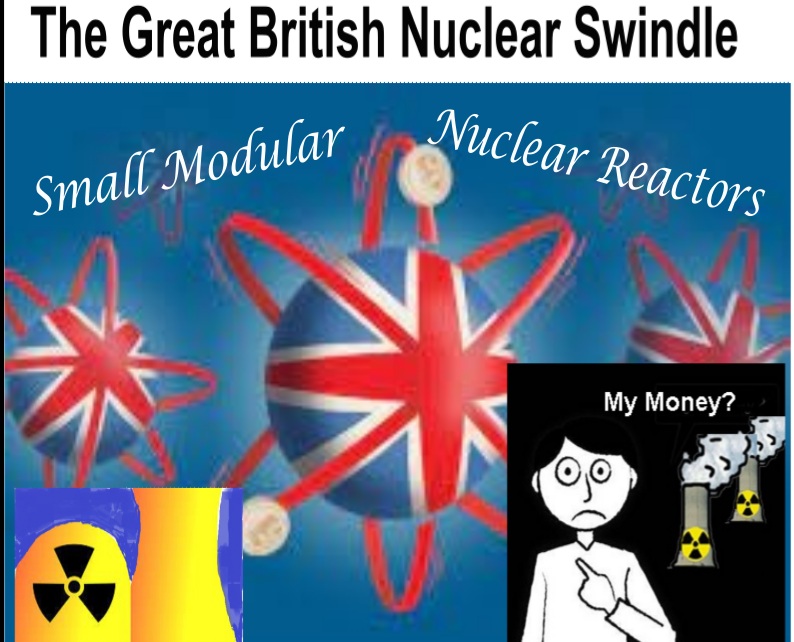
The global small nuclear reactor bandwagon is led by Britain. It ought to fail, but will it?

14 July 2026 Noel Wauchope, https://theaimn.net/the-global-small-nuclear-reactor-bandwagon-is-led-by-britain-it-ought-to-fail-but-will-it/
Why on Earth does the Small Nuclear Reactor media bandwagon exist?
That’s a fair question, because it has been shown time and time again that small modular nuclear reactors (SMRs) are not an economically viable way to provide electricity.
I can only conclude that there are other reasons for the present juggernaut of promotion of SMRs.
You may not have noticed the blithering onslaught of media promotion of SMRs going on over the past weeks, (interestingly, in conjunction with the political demise of Sir Keir Starmer). With the dramatic events in the Persian Gulf, and in climate extremities, dominating the media, a fuss about SMRs seems a small matter.
But it is not a small matter.
The global media juggernaut for SMRs is potentially essential for the survival of the global nuclear industry. If one nation sets up a multitude of, or even a few, small nuclear reactors, that will provide the necessary respectability for the industry – to be accepted as cheap. clean. safe, and embraced by local communities.
Hooray – Britain to the rescue!.
Now, there’s extraordinary excitement in both the British and overseas media. A current example:
The High Value Manufacturing (HVM) Catapult has launched a national consultation, to help UK industry capture the economic and industrial benefits of more than £100bn of expected investment in the country’s civil and defence nuclear programmes over the next decade. Industry, government, academia and regional partners are invited to contribute to the consultation through written submissions, stakeholder workshops and a programme of regional engagement running throughout 2026.
HVM Catapult doesn’t specifically state SMRs, but that’s where the UK media fervour is at. In a previous article, I have mentioned The Times, Telegraph, PR Newswire, Energy Live, Business Green, among the British enthusiasts. Internationally, there’s Construction News, Global Banking and Finance Review, World Nuclear News, Indux, and more.
What is new and remarkable about this UK SMR media fervour?
Well, there are two things. One is that it is all pitching the UK as the leader for the new nuclear renaissance. The other is that this will be a privately-led renaissance. Hence the importance of the “private” SGE £35bn plan for a fleet of SMRs across Britain, rather than the government supported Rolls Royce plan.
I digress here to point out that three nations have tried and failed to set up small nuclear reactors. Russia and China have each managed to develop one actually functioning small nuclear reactor. – in both cases – that took decades, and neither is working out very successfully – Russia – (Akademik Lomonosov floating NPP) and China (HTR-PM high temperature gas cooled reactor). The USA nearly got one happening – The Rise and Fall of NuScale: a nuclear cautionary tale.
So – at last it’s all going to happen ! And the UK is the leader – hip hip hooray! Except that the UK’s biggest SMR promoter, PM Keir Starmer is about to bow out at any moment. The policies of the heir apparent, Andy Burnham, are curiously unknown. He’s got a respectably Leftie background in supporting nuclear veterans, but I couldn’t find anything on his nuclear industry views. And, I’m inclined to think that he, or any new UK Prime Minister, would not be able to withstand the pressure of the cavalcade of vested interests in the nuclear industry. Those vested interests include not only all the UK and global stakeholders in the industry’s supply chain, but the fawning corporate media and the financially dependent universities.
There are some strong voices that speak out against this smr folly. Phil Johnstone and Andy Stirling of the University of Sussex have given a powerful condemnation of this SMR push – The hidden military pressures behind the new push for small nuclear reactors.
The nuclear industry was inaugurated in the early 1940s, specifically for creating an atomic bomb. That has continued to be its purpose for nearly a century, and it its sole real purpose today. Commercial “peaceful” nuclear power was set up as a temporarily successful fig leaf over that truly inhuman purpose. Temporarily successful, because it did provide efficient and seemingly cheap, seemingly clean, seemingly safe electricity for millions of people. We now know that not only are there long term costs – financial, environmental, health and safety costs – but that new big nuclear reactors are monumentally unaffordable.
In this 21st Century – how to make this industry look peaceful, clean, safe, and attractive to bright young career-oriented people? Well if that’s now an impossible task for dirty great Big nuclear reactors, how about a plethora of Small fig-leaves – Small Modular Nuclear Reactors.?
There may be a continued media deluge about UK’s golden SMR future, as promised by the dear soon-to- be-departed Starmer. But I doubt that there will be a deluge of investors keen to get on board the juggernaut. One saving grace of our capitalist society is that our financial writers tend to tell the truth about investment prospects. They might save the UK from this SMR folly. Then the nuclear lobby will have to really ramp up the war-mongering fever that already exists.
The risk of nuclear war is rising. This is what Burnham must do.
In his first Downing Street briefing, the incoming prime minister is going to learn some hard truths about his country’s ultimate deterrent
David Blair
The risks of nuclear war are rising. This is what Burnham must do. In his
first Downing Street briefing, the incoming prime minister is going to
learn some hard truths about his country’s ultimate deterrent. The ritual
for an incoming prime minister, unchanged for decades, has never been so
fraught with significance.
Soon after Andy Burnham enters No 10, he will be
taken to a secure room where Air Chief Marshal Sir Richard Knighton, the
Chief of the Defence Staff, will brief him on how to authorise a British
nuclear strike. At that moment, Burnham will join the handful of world
leaders with the individual power to inflict a greater measure of
destruction than has ever been wrought before.
Burnham will be inducted
into the dreadful – in the true sense of the word – and singular
responsibility of what Lord Hennessy, the constitutional historian, calls
the “purely prime ministerial function” of overseeing Britain’s
ultimate deterrent and deciding this country’s nuclear policy.
Telegraph 13th July 2026, https://www.telegraph.co.uk/news/2026/07/13/burnham-must-bolster-britains-nuclear-defences/
Why is Britain spending huge amounts on nuclear militarism?

11th July, Campaign for Nuclear Disarmament (CND) By Samuel Rafanell-Williams
NATO outspends Russia 10 to one on nuclear weapons, yet this has seemingly not bought adequate “security” for the nuclear alliance
One mightexpect this to prompt a serious discussion and re-imagination of what
“security” means in the 21st century, and what role nuclear weapons
actually play in international affairs.
Nevertheless, “deterrence”
ideology still has firm purchase within the mind of the British political
and military establishment. This was confirmed by Keir Starmer’s Defence
Investment Plan (DIP), in which nuclear weapons spending was central.
Indeed, the Prime Minister announced the Defence Nuclear Enterprise would
receive a staggering £62 billion over the next four years. The investment
required in sustaining and renewing Britain’s nuclear programme is
enormous.
The National 11th July 2026, https://www.thenational.scot/politics/26271804.britain-investing-huge-amounts-nuclear-militarism/
Add stopping Sizewell C to Andy Burnham’s “to do” list.

10 July 2026,
Alison Downes, Executive Director
Paul Collins, Chair, Stop Sizewell C
Andy Burnham is on the cusp of succeeding Keir Starmer as Prime Minister, and one more nomination by a Labour MP will guarantee it. Help us add to his swelling in-box by asking him to reconsider Sizewell C!
We’ve drafted a very short sample email at the bottom of this email, but we strongly encourage you to write your own message as it will be more impactful. You could use some of the following suggestions:
It would free up £ billions of taxpayers’ money (£14.2bn was committed to the end of this parliament but some has been spent), but we recognise money would have to be spent to restore East Suffolk.- It would reduce household expenses by removing the Regulated Asset Base (RAB, or “nuclear tax”) from energy bills.
- It would save us from expensive electricity in future: the National Audit Office found Sizewell C’s electricity would cost £133 – £155/MWh [2024/25 prices], more than Hinkley C.
- Sizewell C cannot provide value for money given it is unlikely to operate at 90% load factor and there is a major risk of placing so much electricity generation capacity on an eroding coastline. It will be another HS2.
- The EPR reactor is an unproven technology in the UK and has a catastrophic delivery track record elsewhere in the world.
- Call on Andy Burnham to keep the UK progressing to net zero by prioritising cheaper renewable energy, responsibly delivered, and developing storage capacity.
- If you want more ideas, read our report “Sizewell C, the Unanswered Questions”:https://stopsizewellc.org/sizewell-c-the-unanswered-questions/.
How to contact Andy:
Once you have written your message you can email it to: andy.burnham.mp@parliament.uk or copy it into the contact form on andyformayor.co.uk/contact or contact.no10.gov.uk. Or post a letter to House of Commons, London SW1A 0AA or 10 Downing Street, London SW1A 2AA.
Quick news roundup
- For supporters in the East, BBC Look East is running a big piece on the impacts of Sizewell C in this evening’s programme (10 July 6.30pm). Watch live on iplayer and for 24 hours afterwards here: https://www.bbc.co.uk/programmes/b006mj5w
- Sizewell B’s long-mooted life extension was made public yesterday. For reactions from TASC and Stop Sizewell C read here: https://www.bbc.co.uk/news/articles/c1dy1rdv17lo or watch last night’s BBC Look East (third item, hurry, link expires at 6.30pm) https://www.bbc.co.uk/iplayer/episode/m002yqwk/look-east-evening-news-09072026
- Quality issues have been found in the manufacture of Sizewell C’s pressure vessels. Read more including reaction from TASC: https://www.newcivilengineer.com/latest/more-issues-reported-during-manufacture-of-sizewell-cs-reactor-vessels-than-hinkley-point-cs-01-07-2026/
- Stop Sizewell C contributed to a news report by Canadian broadcasters about the use of RAB for Canada’s nuclear programme, which has been picked up by other international outlets https://www.cbc.ca/news/science/nuclear-strategy-pensions-electricity-9.7257049
- “Atomic Ties”. On 16 July at 7pm the Transatlantic Nuclear Free Alliance is holding a free webinar on the link between nuclear power and nuclear weapons. For more info and to register go to https://us02web.zoom.us/meeting/register/2YPRekqkTH2inxmbqld1ww#/registration
Is London shifting from nuclear deterrence to war-fighting?

The deployment of high-precision, variable-yield counter-force weapons signals a willingness to carry out retaliatory or pre-emptive nuclear strikes on an adversary.
Bulletin, By S.M. Amadae, Tom Stevenson | Analysis | July 10, 2026
For most of the past three decades, one might almost have said the United Kingdom had a glowing record on nuclear non-proliferation: Britain was the only major nuclear power to operate a minimum deterrent based on a single delivery system; it supported international non-proliferation initiatives; and the UK government had spent 30 years reducing its nuclear stockpile. No more. Instead, London now builds momentum supporting a new wave of nuclear proliferation under the auspices of NATO’s nuclear sharing.
In the last five years, Britain has quietly moved to increase the maximum size of its nuclear stockpile and revise its nuclear doctrine, and it is now acquiring an additional nuclear capability. In concert with the United States, the UK government is expanding the deployment of non-strategic (tactical) nuclear weapons in a way that could destabilize the strategic balance in Europe.
In doing so, London is reversing decades of gradual progress on disarmament without serious analysis of the strategic implications or public consultation, and at a time when there is less support for nuclear diplomacy than at any point in recent history.
New systems and more weapons. In June 2025, the United Kingdom announced plans to acquire Lockheed Martin F-35As that are the first stealth fighter jets certified to carry variable-yield thermonuclear B61-12 gravity bombs. The 12 F-35As would be ordered in place of F-35B fighter jets, which are designed for use on aircraft carriers but are not nuclear-capable. At the Hague summit last year, the United Kingdom then announced it would be joining NATO’s air-launched nuclear mission and putting those planes to work carrying US nuclear bombs. Though it has still not been officially confirmed, US B61-12s were almost certainly moved to RAF Lakenheath in July 2025.[1] Media briefings at the time suggested the UK government was also in talks with Washington on acquiring non-strategic B61-12 bombs of its own, but no such agreement has publicly emerged yet.
On the surface, the United Kingdom’s decision to acquire tactical nuclear capability appeared to be part of a natural evolution in European strategic planning prompted by Russia’s invasion of Ukraine in 2022. But London’s acquisition of F-35As and the deployment of US B61-12s are just the latest examples of a longer trend in the United Kingdom’s nuclear posture. In 2022, RAF Lakenheath had already undergone infrastructure modernization necessary for the return of US nuclear weapons.
Before that, in 2021, the UK government decided to raise the maximum cap on the number of warheads in its arsenal by more than 40 percent. In 2010, the UK government stated that it would continue to reduce its warhead stockpile—at the time numbering 225 warheads—and cap its future arsenal at a maximum of 180 warheads. But in 2021, it suddenly raised the cap to 260 warheads. Despite being a reversal of decades of gradual reductions in the United Kingdom’s projected nuclear stockpile, that decision was slipped onto page 76 of the government’s Integrated Review of Security, Defence, Development, and Foreign Policy.
Policy implications. The United Kingdom has also made a quiet change to its nuclear doctrine, introducing a “right to review” the use of nuclear weapons against non-nuclear states under certain circumstances. Together with the decision to raise the warhead cap, this constituted a dramatic strategic change for which there was no discernible democratic mandate and no public discussion.
At the time, even the best-informed commentators on UK nuclear affairs were unaware of the motivation. One argument, put forward by nuclear historian Lawrence Freedman, was that a larger stockpile of 260 warheads might allow the United Kingdom to have two fully armed nuclear submarines (each potentially carrying a maximum of 128 warheads on 16 missiles) on patrol at once. That the increase in stockpile size was motivated by plans for the United Kingdom to have the option of acquiring a non-strategic nuclear capability only emerged later.
The decision to station B61-12s on UK soil amounts to a de facto settlement of the long‑running debate over adopting a doctrine of no‑first‑use or sole‑purpose, and over the future of tactical nuclear weapons in NATO. The deployment of high-precision, variable-yield counter-force weapons signals a willingness to carry out retaliatory or pre-emptive nuclear strikes on an adversary.
Due to their enhanced guidance systems, B61-12 bombs, coupled with the dual-capable stealth F-35A, also have the potential to alter the geopolitical balance in Europe. The UK B61-12 adoption paves the way for further proliferation of these weapons throughout Europe, cements the normalization of nuclear weapons, and challenges the guaranteed second-strike survivability of adversaries’ nuclear command and control and strategic weapons systems.
Since the end of the Cold War, the United States and, by extension, NATO have become, in the words of the now Under Secretary of Defense for Policy Elbridge Colby, “accustomed to escalation dominance,” the strategic objective of achieving battlefield superiority on all rungs of escalation. This aim relies on maintaining asymmetrical advantage, which is not a sound doctrine against a nuclear peer competitor: It is destabilizing and stokes further arms races.
The combination of F-35A fighter jets and B61-12 bombs gives NATO a stealth-enabled, precision counterforce tool designed to deter by denial by holding Russian nuclear and nuclear command and control assets at credible risk. In theory, they provide limited escalation-control options, such as pre-emptive or tit-for-tat strikes at tailored yield. These technological developments make Russian nuclear forces and command systems both more vulnerable in crisis and less certain for guaranteeing second-strike capability.
From arms control hero to nuclear war fighter. Until recently, UK efforts on exemplary disarmament were comparatively good. The United Kingdom was the only major nuclear state that had limited itself to a single deterrence system (the Trident submarine-launched ballistic missile). The UK government had made incremental reductions in its nuclear stockpile since 1980. With US B61s having returned to the United Kingdom, that record has now been overturned…………………………………………………………………………………………………………………………………………………………………………….
No rationale, real danger. The strategic need for the United Kingdom to operate air-launched tactical nuclear weapons has not been clearly presented either by US officials or the UK government. In addition, these weapons arguably increase the United Kingdom’s reliance on US weapons platforms at a time of transatlantic political divergence…………………………………………………………………………………………………….
The UK government and the United States should carefully revisit the assumptions that led to this point. There is no justifiable reason for the United Kingdom and NATO to expand non-strategic capabilities while also maintaining a no-first-use doctrine unless they are planning a pre-emptive nuclear strike deep into Russian territory, or the territory of another nuclear weapons state, or against a non-nuclear weapons state. NATO member states, like Finland and Poland, are promoting their participation in nuclear sharing and planning. Both understandably perceive an existential threat from Russia, and they are now also considering hosting US nuclear weapons and joining France’s forward deterrence initiative. But with the United Kingdom having already made that choice, it has the dubious distinction of leading the way in normalizing more first-use tactical nuclear capabilities in Europe without comprehensive analysis of the strategic implications. This nuclear brinkmanship, directly pertinent to the Ukraine war, offers the false promise of security for some at the cost of dooming security for all. https://thebulletin.org/2026/07/is-london-shifting-from-nuclear-deterrence-to-war-fighting/?utm_source=ActiveCampaign&utm_medium=email&utm_content=Is%20London%20shifting%20from%20nuclear%20deterrence%20to%20war-fighting%3F&utm_campaign=20260709%20Thursday%20Newsletter%20%28Copy%29
Government U turn as Sizewell B is to get a fixed-price government contract.

Government awards the last UK nuclear power station a fixed power
contract, backing away from its shift towards a new model of funding.
The UK energy department has extended the life of the Sizewell B nuclear power
plant in Suffolk by 20 years with a fixed-price government contract, after
energy price shocks following the war on Iran.
Chancellor of the Exchequer,
Rachel Reeves, called the nuclear power project “a vital part of
Britain’s energy future”. French project owner EDF said it has secured
a 20-year fixed price power contract from the UK government that will last
from 2035 to 2055.
Previously EDF had planned to commence decommissioning
of the plant in 2035. The French power company said it is “funding a
refurbishment of the nuclear power station during planned outages over the
next fifteen years, costing around £800 million”.
British Gas owner Centrica also said it is investing an undisclosed amount in the extension
of the 1.2 GW operational nuclear power project in Suffolk. It is the first
time that the Sizewell B nuclear power project will operate under a fixed
government power contract, priced at £70.50 per megawatt, after delayed
project Hinkley Point C was awarded such a contract a decade ago.
The energy department has since moved to shift nuclear power projects onto a
regulated asset base (RAB) structure for funding, the model that will be
used to finance Sizewell C at the Suffolk coastal site, a replica of yet to
be finalised nuclear power station Hinkley Point C in Somerset.
Energy Voice 8th July 2026,
https://www.energyvoice.com/renewables-energy-transition/600397/government-u-turn-as-sizewell-b-is-first-nuclear-plant-to-get-cfd/
The UK’s countryside could be filled with small nuclear reactors after billionaire announces £35bn new investment

techradar pro7 July 26, By Rahim Ami
- Polish billionaire Michał Sołowow’s SGE announces £35bn plan to build 14 GE Vernova Hitachi BWRX-300 reactors across three UK sites
- The project aims to deliver 4.2GW of power starting in 2034, effectively powering 8m homes for over 60 years
- The project is looking to secure government backing, with guaranteed prices intended to be locked in for the power producer before it would be offered to investors
…………. Poland-based SGE (Synthos Green Energy) is looking to build up to 14 reactors across three locations in the UK, with six at its primary site and four each at its two secondary sites.
With an estimated build-out cost of £35 billion ($46.5 billion), the project, if approved, is expected to be one of the biggest SMR projects the UK government signs on to as part of its Advanced Nuclear Framework, unveiled earlier this year, to support the development of privately funded projects.
………….. The first disclosed site for SME’s project, Oldbury in South Gloucestershire, is a former Magnox nuclear station that generated up to 434MW of power, is now expected to be home to as many as six 300W SMRs, according to SGE’s plans
While the other two sites are not yet publicly named, they are expected to have a 4+4 reactor split, bringing the total to 14 reactors.
Part of the reason the UK government is interested in outsourcing power generation, even nuclear, to private equity is that it expects a spike in power demand from AI datacenters over the next few years, even as the nation’s overall power needs increase.
This is also why Google Cloud, a key AI data center player, has joined in on SME’s project as a strategic partner that could, as per Michał Sołowow, invest as much as £4.5 billion in data centers in the country to make use of some of the added capacity.
Given that both SMRs (including the proposed GE Vernova Hitachi BWRX-300) and data centers require access to water and space for construction, one can assume that both will prefer cheap, easily accessible coastal, estuarine, or riverside land, which means that the UK’s countryside could soon see certain areas change meaningfully in terms of aesthetics at the very least.
Smaller rivers, however, might not cut it, as SMRs also require the water bodies they use to act as ‘heatsinks’ for their operation, and 6 or 4 in the same location might overwhelm them, limiting the number of areas that are viable for such buildouts, which means that SME’s proposed project might set the baseline for how privatized nuclear power will shape the UK countryside in the days to come even as AI data center demand is expected to increase pressure on the national grid.
For now, SME’s proposal has yet to be approved by the government, making the £35 billion figure an estimate that may or may not apply, given that it still needs to secure financing and lock in government guarantees on pricing before it moves meaningfully towards construction. https://www.techradar.com/pro/the-uks-countryside-could-be-filled-with-small-nuclear-reactors-after-billionaire-announces-gbp35bn-new-investment
UK has ‘no future’ if it fails to act on ecosystem collapse threatening national security

Members of parliament have demanded full publication of an explosive
report by the UK’s spy leaders that found the collapse of ecosystems
overseas would have catastrophic consequences for the UK’s national
security, warning that the UK has “no future” if the findings are not
urgently acted on.
Despite growing concerns for the UK’s food security,
likely to be worsened by the third heatwave this summer currently
afflicting the UK and swathes of the northern hemisphere, the government
has refused to publish the full report, which has circulated among defence
officials for more than a year.
The report paints a devastating picture of
severe food shortages, price rises, migration, political destabilisation
and possible war, resulting from the collapse of ecosystems, fuelled by the
human-induced climate crisis and over-exploitation, as the Guardian has
previously revealed. Food shortages could result within five years.
Guardian 8th July 2026, https://www.theguardian.com/global-development/2026/jul/08/uk-report-ecosystem-collapse-national-threat-food-security
Great British Energy appoints Amentum and Cavendish in £360M SMR deal
06 Jul, 2026 By Gavin Pearson, https://www.newcivilengineer.com/latest/great-british-energy-appoints-amentum-and-cavendish-in-360m-smr-deal-06-07-2026/
Great British Energy – Nuclear (GBE‑N) has awarded a long-term Owner’s Engineer (OE) contract worth up to £300M to two contractors.
Amentum Clean Energy and Cavendish Nuclear were signed to the role in a 14‑year contract which formally runs from 23 April 2026 to 23 April 2040.
The contract notice also states the possibility for an extension that could take it to October 2041.
The total value for the contract including VAT is listed as £360M and £300M without VAT, although GBE‑N said the contract’s final value is uncertain and depends on how the project progresses.
This will include timetables and milestones agreed with the SMR technology partner but the procurement notice envisages the OE supporting the client up to the completion of the first fuel cycle for the initial reactor.
The OE role will provide independent technical assurance and oversight to GBE‑N’s “Intelligent Customer” and “Intelligent Client” teams as the SMR programme moves through design stages and towards a final investment decision.
Responsibilities will include specification, audit, review and advice on design, scope, budgets, risk, delivery and contract compliance and acting as a subject matter expert delivering “Line of Defence 2” assurance on major design and build contracts.
Amentum and Cavendish are both established contractors in energy and nuclear services. Cavendish Nuclear is part of Babcock International Group, known for nuclear construction and engineering work in the UK and Amentum is an international engineering and technical services company.
The contract includes monthly reporting against key performance indicators such as deliverable quality, core team availability and social value measures, including targets for female apprenticeships.
Nuclear power costs billions. Here are seven better ways to use that money – Martin Roche
Given Scotland’s renewables capacity and reserves of oil and gas, opting for expensive nuclear is daft, argues Martin Roche
There’s an energy project in Britain that will take twice as long to build as originally planned. It will at least double its forecast construction costs and require a UK bill-payer subsidy of £1 billion a year.
. Given Scotland’s renewables capacity and reserves of
Toil and gas, opting for expensive nuclear is daft, argues Martin Roche.
There’s an energy project in Britain that will take twice as long to build
as originally planned. It will at least double its forecast construction
costs and require a UK bill-payer subsidy of £1 billion a year
. It’s the nuclear power station being built by the French state-owned company EDF at
Hinkley Point in Somerset. Begun in 2017, its opening date has been pushed
back to 2030. The plant’s cost, unadjusted for inflation, stands today at
£35bn but the final total may reach £50bn.
The argument of the nuclear
power lobby is that we must have wholly reliable ‘baseload’ energy for
when the wind doesn’t blow and the sun doesn’t shine. I saw one
nonsensical argument that nuclear would be there when renewable energy went
into decline. This is desperate nonsense. The wind will continue to blow
off Scotland’s coast and high places on most days of the year, for as
long as there is a Scotland.
That’s not to say we should rely entirely on
renewables. We must have wholly dependable sources of power. Scotland has
options for both reducing its energy demand and building an energy economy
that can have much more impact over decades than nuclear. We should be
working to reduce energy costs for households and create a far bigger
energy employment sector than anything nuclear can offer.
And we can start
now. No need to wait decades for new nuclear stations. Nuclear generation
may enrich some giant companies and provide jobs in operation and
construction, but the numbers are modest when compared with smarter
thinking.
Labour’s policy may be good for US tech giants that want to
gobble up Scotland’s abundant energy to drive data centres, but it’s
not yet clear what’s in these facilities for the Scottish economy, jobs
or the public purse. Nuclear is a naïve 20th-century solution to complex
21st-century problems.
Nuclear power stations are also big targets and at
the mercy of drones, as we know from Ukraine. So much for energy security.
There is a far better way to spend our money than shovelling public cash
into the board rooms of energy giants or the pockets of California tech
bros billionaires.
It’s called the broader public good. Here are some
thoughts: One, a ten-year programme to bring Scottish homes up to the
highest possible thermal performance standards, so they are more efficient
and cheaper to run in deep winter and high summer. Better homes at less
cost and using less energy. Two, all new buildings – homes, schools,
offices, factories – to be built to the world’s most exacting energy
performance standards.
Three, grid connection costs to be slashed so that
small generation projects in rural areas, like mini-hydro and biogas,
become economically viable.
Four, every tenement building in Scotland to be
made suitable for solar panels, with owners benefiting from their share of
the income to help maintain properties. Our tenement homes can become our
own energy production factories.
Five, localised generation such as
tenement solar means that a network of small battery storage facilities can
be created across Scotland. Connected to the National Grid, they can be the
first line of defence on the odd days when wind can’t do the job.
Six,
some 12 per cent of Scotland’s energy comes from hydro power. We can
double that. Seven, all this will cost money. There are opportunities here
to create new long-term projects and consumer finance products, perhaps
with state guarantees (rather than being a cash cow for nuclear). Better
ways can be found of encouraging community energy firms. A new Scottish
private sector capital markets organisation can be established to provide
start-up and growth capital for new energy sector businesses.
Scotsman 9th July 2026, https://www.scotsman.com/news/opinion/columnists/nuclear-power-costs-billions-here-are-seven-better-ways-to-use-that-money-8786542
Labour MP Brian Leishman opposes new nuclear energy near Clacks
10th July, By Hannah Emma Shedden,
https://www.alloaadvertiser.com/news/26259252.brian-leishman-opposes-new-nuclear-energy-near-clacks/
BRIAN Leishman MP says he “cannot support” new nuclear power plants – despite his party earmarking Fife and Stirling for future development.
Last Tuesday, a UK Government report identified six locations across Scotland where the Labour administration would like to develop as part of their drive towards alternative energy sources.
To the east of Clackmannanshire, “the north coast of the Forth” was listed, which many local politicians understood as referring to Longannet, a site next to Kincardine and just over seven miles from Alloa town centre.
West of the Wee County, the “south bank of the Forth” near Stirling, was identified, though the exact location remains unclear.
Currently, through devolved powers, the Scottish Government have the power to block planning, and said they would not permit the building of any nuclear sites.
Mr Leishman, Labour MP for Alloa and Grangemouth, said: “On balance, I simply cannot support plans to expand nuclear power plants, including any potential sites in Scotland.
“The reasons for this are numerous and even if issues such as the huge construction costs to the taxpayer were resolved, the problem of nuclear waste remains.”
He said it is often ignored that there are “considerable” carbon emissions from nuclear fuel and waste disposal cycles, adding: “We also need to look at the sky-high cost of decommissioning, Sellafield being a prime example.
“We are yet to deal with all the waste from previous nuclear programmes, and I do not see how nuclear would help us with the climate emergency, considering the length of time it takes to plan and build such power plants.
“I believe that pound for pound, renewables such as wind and solar offer much better value for money as we look to achieve net zero.”
What is it like living near the site of a new nuclear power station?
Richard Daniel,at Sizewell andLaura Devlin, BBC 11th July 2026
New satellite images show how one of the largest construction projects in Europe has transformed the Suffolk countryside. But what is it like living close to the site of a new nuclear power station and associated infrastructure?
Sizewell C itself is yet to take shape – but construction work has already hugely changed the landscape on one part of the Suffolk coast.
Satellite images reveal how the surrounding countryside looked in 2024, before work began, with swathes of green fields around the town of Leiston, up to the existing Sizewell B power station.
Fast forward to April this year, and it is a very different picture. Almost all the sandy-brown areas are construction sites, where a new link road off the A12, a new bypass, two park and ride sites and a new railhead are all being built simultaneously.
Sizewell C has said the infrastructure will ease congestion and improve safety, but residents say they have had to put up with noise, diversions and road closures.
Diane Flowitt-Hill lives beside a recently completed new roundabout at Yoxford. She is also close to the construction site of a four-mile (6.5km) link road, which will take Sizewell C traffic straight to the A12, bypassing the villages of Theberton and Middleton Moor.
“It’s been absolutely horrendous – the vibrations, the dust, the noise,” she explains.
“It’s non-stop.”……………………………………………………………………………………………………………………………………………………………………………………………………………………. https://www.bbc.co.uk/news/articles/c0lyj21jrxeo
Sizewell B nuclear power plant granted a 20-year life extension
Britain’s most recently completed nuclear power plant will continue
generating electricity until 2055 after the government granted the power
plant, which was first synchronised with the National Grid in 1995, a
20-year life extension. Sizewell B in Suffolk was due to shut down within
the next decade, but under a deal with the government its lifetime will be
extended to 60 years to help meet the UK’s growing demand for low-carbon
electricity.
Under the deal, EDF will receive £70.50 for every
megawatt-hour Sizewell B generates, starting from 2035, when it was
originally due to close. The extra investment needed to maintain the plant
will come from Centrica, which owns a 20% share in EDF’s reactors in the
UK. Sizewell B is the latest nuclear reactor to strike a deal with the
government to continue running, following the decision to extend the life
of four nuclear plants built across the country in the 1980s. The Heysham 2
nuclear reactor in Lancashire and the Torness nuclear plant in East
Lothian, Scotland, were originally expected to shut in 2018 but will keep
producing low-carbon electricity to March 2030. Meanwhile, the Heysham 1
plant and the Hartlepool nuclear plant in Teesside, which were initially
expected to close in 2008, will run until March 2028.
Guardian 8th July 2026,
https://www.theguardian.com/environment/2026/jul/08/sizewell-b-nuclear-power-plant-granted-a-20-year-life-extension
Stirling nuclear site plan mooted in new report as politicians hit out

A report from Great British Energy Nuclear has highlighted a number of potential sites in Scotland which could host a nuclear power station – with a location in Stirling among them.
Stuart McFarlane, 07 Jul 2026, https://www.dailyrecord.co.uk/news/local-news/stirling-nuclear-site-plan-mooted-37398446
A report identifying Stirling as a possible location for a future nuclear power station has been met with criticism.
The report was penned by Great British Energy Nuclear on behalf of UK Government Energy Secretary Ed Miliband amid a possible push into increasing the capacity of nuclear power across the UK.
As part of the document, a number of potential sites across Scotland are put in the spotlight for being host sites if the Scottish Government’s opposition to hosting nuclear sites was to change in the future.
Among the six locations of interest is the south bank of the River Forth in Stirling.
The experts commissioned for the report state: “Parts of the south bank of the River Forth meet key siting criteria, offering flat land, access to transport networks and proximity to an established energy producing region.
“Cooling water availability is likely to be a limiting factor, with reliance on river abstraction and no supporting flow data currently available.
“The inland nature of the area suggests smaller scale reactors and cooling units may be more appropriate than large GW-scale deployment. Flood risk, interaction with other river users and nearby COMAH sites require further assessment.”
Stirling is mentioned alongside Torness in East Lothian, the land around the existing nuclear site at Dounreay in Caithness, Hunterston in North Ayrshire, the north shore of the Firth of Forth Estuary and the coastline of Angus and Aberdeenshire as possible locations.
But Mid Scotland and Fife Green MSP Mark Ruskell hit out at UK Government ministers and energy chiefs for the report.
Mr Ruskell said: “Labour’s obsession with forcing a new generation of nuclear power on Scotland rides roughshod over devolution and ignores the will of the Scottish Parliament.
“It is also a costly and counterproductive distraction from the real energy priorities facing Scotland.
“It’s an absurd suggestion from the Labour Westminster Government that there could be a nuclear power station in the Stirling area.
“We generate far more energy than we need locally, with wind farms and hydro power schemes benefiting the climate, energy security and local communities. We can’t let this Westminster Government impose a toxic legacy on Scotland. Folks in Stirling do not want to be part of this costly nuclear power experiment.
“Instead of pouring money into expensive nuclear projects, the UK Government should be backing renewable energy that can create jobs, cut bills and strengthen energy security at a fraction of the cost.
“Our priority should be creating clean, green, secure jobs that support nuclear workers into new industries while revitalising communities across Scotland
The opposition was echoed by Stirling MSP Alyn Smith, who posted on his Facebook page: “This very odd paper just published by Labour’s GB Energy Nuclear has identified Stirling as a suitable site for a nuclear plant, but also seemingly dismissed it, read for yourself.
“The paper also recognises that Scotland’s government will block any new nuclear, and quite right too because we don’t need this old expensive tech when Scotland has won the energy lottery with renewables.”
1 This Month



Shut down the radiation-damaged Heysham nuclear reactors now
To see nuclear-related stories in greater depth and intensity – go to https://nuclearinformation.wordpress.com

Say No to NASA’s Reckless Nuclear Reactor on the Moon
Say No to NASA’s Reckless Nuclear Reactor on the Moon
-
Archives
- October 2026 (247)
- September 2026 (339)
- August 2026 (330)
- July 2026 (355)
- June 2026 (287)
- May 2026 (306)
- April 2026 (356)
- March 2026 (251)
- February 2026 (267)
- January 2026 (308)
- December 2025 (358)
- November 2025 (359)
-
Categories
- 1
- 1 NUCLEAR ISSUES
- business and costs
- climate change
- culture and arts
- ENERGY
- environment
- health
- history
- indigenous issues
- Legal
- marketing of nuclear
- media
- opposition to nuclear
- PERSONAL STORIES
- politics
- politics international
- Religion and ethics
- safety
- secrets,lies and civil liberties
- spinbuster
- technology
- Uranium
- wastes
- weapons and war
- Women
- 2 WORLD
- ACTION
- AFRICA
- Atrocities
- AUSTRALIA
- Christina's notes
- Christina's themes
- culture and arts
- Events
- Fuk 2022
- Fuk 2023
- Fukushima 2017
- Fukushima 2018
- fukushima 2019
- Fukushima 2020
- Fukushima 2021
- general
- global warming
- Humour (God we need it)
- Nuclear
- RARE EARTHS
- Reference
- resources – print
- Resources -audiovicual
- Weekly Newsletter
- World
- World Nuclear
- YouTube
-
RSS
Entries RSS
Comments RSS

