Wiped out: Scientist’s ‘gigantic tsunami’ warning signals ‘grave threat’ to Sizewell C
The warning given yesterday by leading scientist Sir David King that London
and other UK coastal cities could be inundated in the future by a gigantic
tsunami reveals that coastal nuclear power developments in the South-East
of England would also be under a ‘grave threat’, says UK/Ireland Nuclear
Free Local Authorities English Forum Chair Councillor David Blackburn.
Sir David King was for seven years Chief Scientific Advisor to the British
Government. In widely reported press articles yesterday, Sir David warned
that a gigantic tsunami could hit Britain ‘at any time’ should there be a
landslide in the Canary Islands, which would trigger a huge wave headed for
this country.
In such an eventuality, coastal cities such as Portsmouth,
Plymouth and Southampton would be inundated and so too would London and the
Thames Estuary, and much of low-lying South-East England.
NFLA 14th March 2023
Sir David Attenborough urges people to unite to save ‘nature in crisis

Sir David Attenborough said “nature is in crisis” as he urged people to
unite to save it for future generations. He spoke out after last night’s
first episode of his five-part show about British wildlife.
His plea comes
as the National Trust, RSPB and WWF have launched their first joint
campaign, Save Our Wild Isles, which encourages people to “go wild”
once a week, by doing activities such as sowing bee-friendly plants or
creating “hedgehog highways”, and urges citizens to call on the
government to make changes to halt nature’s decline.
The series features a
sixth, iPlayer-only episode called Saving Our Wild Isles, commissioned by
the RSPB and WWF. “[It] shows what amazing people are doing to turn the
UK round and how quickly it can recover,” Alastair Fothergill, the
producer, said.
Times 13th March 2023
Independent 13th March 2023
UK political row over ‘expensive and unnecessary ‘ spending on nuclear power stations.
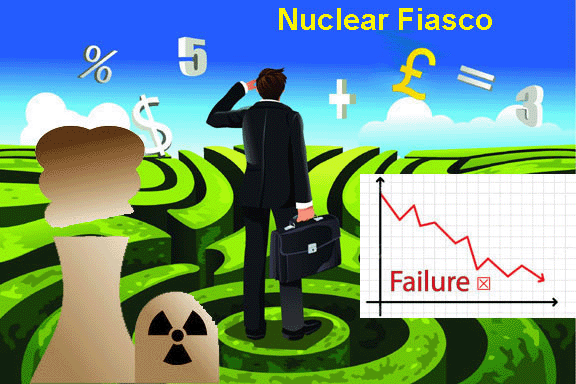
Tory Aberdeenshire MP accused of ‘failing to stand up for north-east’ in
nuclear power row. The UK Government has been hit with criticism over what
is being described as ‘expensive and unnecessary’ spending on nuclear power
stations, with the Aberdeenshire MP slated by the SNP’s Energy
spokesperson.
A political row has broken out after an Aberdeenshire MP was
accused of prioritising ‘expensive and unnecessary’ nuclear stations over
carbon capture storage (CCS) and renewable energy. In a letter to Mr Bowie,
the MP for West Aberdeenshire and Kincardine, SNP energy spokesman Alan
Brown expressed concerns over updated costs to nuclear station Hinckley
Point C in Somerset.
The project is now slated to cost the taxpayers
£33billion, a 40 per cent real terms increase to the original 2016 estimate
of £18billion. Despite the soaring costs, it was revealed earlier this week
the UK government has not engaged with EDF over what that means for the
delivery of the project, while still pressing ahead for another new station
at Sizewell C.
Aberdeen Live 14th March 2023
https://www.aberdeenlive.news/news/aberdeen-news/tory-aberdeenshire-mp-accused-failing-8250696
Nuclear crash exercise beset by blunders, says UK’s Ministry of Defence
Rob Edwards March 12, 2023
An exercise testing emergency responses to a nuclear bomb convoy crashing,
exploding and spreading a cloud of radioactive contamination was plagued
with “errors” and “confusion”, according to official assessments by
the Ministry of Defence (MoD).
There were shortages of vital medical
equipment, “poor” arrangements for casualties and multiple mistakes in
radiation monitoring. One set of radiation readings was wrong “by a
factor of 1,000 times”. At one point MoD firefighters ran out of water,
and at another an MoD commander refused help from the civil fire service.
There was no official assessment of whether or not the crash was caused by
a terrorist.
The Ferret 12th March 2023 https://theferret.scot/nuclear-crash-exercise-blunders/
Britain’s Office for Nuclear Regulation warns on the need for a safety case, as EDF wants to extend the life of 2 nuclear power Stations

A spokesperson for the Office for Nuclear Regulation (ONR) said: “We are
aware of EDF’s announcement today (9 March 2023) of its intention to extend
the operating life of Heysham 1 and Hartlepool Power Stations.
“Although a plant life extension decision does not require formal regulatory
assessment or approval by ONR, it is a requirement of the site licence that
operations be carried out at all times under a valid safety case. “A
number of the current safety cases for the stations will need to be updated
to achieve EDF’s stated ambitions, together with investment in plant to
sustain equipment reliability, all while ensuring that the necessary people
and skills are on site.
“The ongoing safety of operations will need to be
fully demonstrated to us as part of the ongoing regulation of the sites in
Lancashire and Teesside, which will be informed though our extensive
inspection and assessment regime. “Once we receive them, the safety cases
from EDF will be thoroughly assessed by our team of expert inspectors.
ONR 9th March 2023
Graphite – deadly dirt or dusty diamonds?
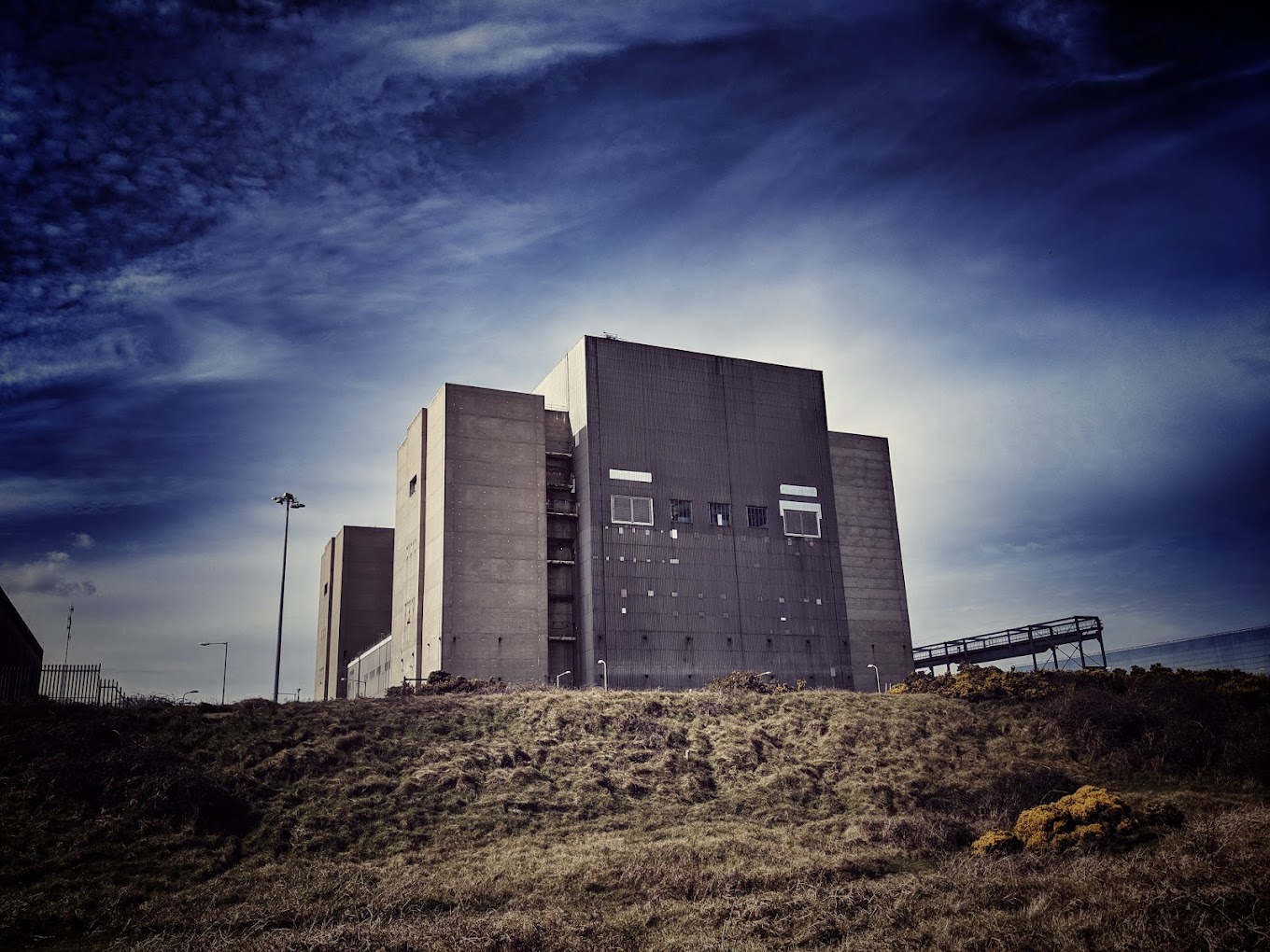
Blackwater Against New Nuclear Group , 8 Mar 23, BANNG’s Coordinator Peter Banks exposes the hidden danger lurking on the Blackwater in the March 2023 column for Regional Life. https://www.banng.info/news/regional-life/radioactive-graphite/
On the Southern shore of the Blackwater Estuary the shiny, grey/blue reactor buildings of the former Bradwell nuclear power station are now a landmark visible for many miles. The power station ceased operating in 2002 and now, in a state of ‘care and maintenance’, remains a visible monument to the early nuclear age.
Contained within the Bradwell buildings (and within all but one of the UK’s civil nuclear power stations) are blocks of graphite forming the very heart of the reactors, called the ‘core’. Once the reactor goes critical the graphite becomes impregnated (technically ‘irradiated’) with a range of radioactive isotopes such that it will remain dangerously contaminated for decades.
Back in the 1960s when Bradwell was commissioned, little forethought was given to the future when these behemoth plants would be taken out of service and decommissioned. The irradiated graphite was far too dangerous for humans to remove as stations were being demolished. Furthermore, the blocks were highly inaccessible as they were at the core of the sealed reactor vessel.
And the reactor chamber metalwork itself had also been irradiated. Recently the process of dismantling was given the new, self-explanatory name of ‘deferred decommissioning’ by the Nuclear Decommissioning Agency (NDA). Whilst this is totally understandable from a health and safety perspective, it does mean that the promises made when Bradwell closed in 2002 that the site would soon be cleared and returned to unrestricted land use were ridiculous.
And diamonds? If the graphite had also been subjected to great pressure as well as heat it would have converted to, amazingly, diamonds! But never think of the contents as precious diamonds, they are actually nasty radioactive wastes – a deadly dirt indeed.
Regardless, irradiated graphite and diamonds both need to be robustly protected. Therefore, expect to see the shiny reactor buildings of Bradwell for at least another 60 years. And, with nowhere else to go, they could remain on our shores into the unknown future.
British government poised to label nuclear as “green”, but investors are not impressed

The British government is poised to redefine nuclear power as “green”
as it seeks to drum up more private investment in the sector to improve
domestic energy resilience. Ministers are set to consult on proposals to
change the so-called “taxonomy” — or financial classification system
— of energy in order to redefine nuclear projects as sustainable
investments. It is expected to lead to a reversal of the decision by the
Treasury as recently as 2021 to exclude nuclear power from the so-called
green investment framework.

The move echoes a decision last year by the
European Commission to label both nuclear and some forms of gas as
“green” investments, which prompted legal challenges from Greenpeace
and a coalition of WWF and Client Earth.

The consultation comes as thegovernment is set to provide about £80mn
in seed funding for the launch ofGreat British Nuclear, a new body which will
oversee plans to build a new
generation of nuclear power stations in the UK, according to two people
familiar with the negotiations. Ministers are anxious to accelerate the
programme which has been dogged by delays and cost overruns on the only new
nuclear plant under construction at Hinkley Point in Somerset. The
government, together with French state-backed utility EDF, are trying to
raise £20bn in private finance for the next power station at Sizewell in
Suffolk.
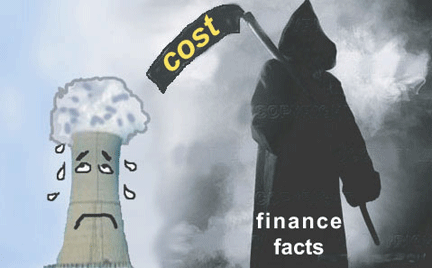
But investors have shown little interest in backing greenfield
nuclear projects, because of the construction risks in the highly
regulated, safety- critical sector. All new nuclear projects across Europe
have been hit by delays and big cost overruns.
Nick Stansbury, head of
climate solutions at Legal and General Investment Management, warned that
the changes to the taxonomy were unlikely to drive investment. Ministers
will also update their strategy for reaching net zero by 2050 after a judge
ruled last July that the original document provided insufficient detail and
gave the government a deadline to rewrite it by the end of this month. The
energy department refused to comment.
FT 9th March 2023
https://www.ft.com/content/2bef8242-d04b-47b9-84f8-b301692ea2f4
Britain’s “Regulated Asset Base” funding method for nuclear power is deemed not likely to work

National Infrastructure Commission model spells trouble for nuclear RAB
funding. Dr Jim Cuthbert questions whether the government’s funding method
for its nuclear power programme provides value for money, given it now
expects the plants to take nearly twice as long to build.
A major part of
the government’s energy strategy is a programme of eight new nuclear power
stations, to be funded by the Regulatory Asset Base (RAB) funding method.
One of the main features of RAB is that it involves consumers paying from
the start of construction for benefits they will only begin to receive when
construction is completed, and the plant is producing electricity.
One of
the key questions that should be answered in assessing whether a RAB-funded
project should go ahead is whether the eventual benefit consumers could
receive, in this case through cheaper electricity charges in the long run,
is enough to compensate them for the opportunity cost of the payments made
while receiving no benefit.
Given the long construction periods now
anticipated for new nuclear plants, it is unlikely that RAB financing will
be able to attain a sufficient cost advantage to do so. In 2019, the
National Infrastructure Commission (NIC) produced a paper on the
application of the RAB approach to nuclear energy, illustrating a
methodology including an approach to answering the above key question.
The NIC paper set out the results of illustrative calculations of the impact of
a range of factors on the likely value for money of RAB projects.
Unfortunately, it is something of a mixed bag. On the negative side, the
results in the paper are not presented in a way that allows the impact of
different factors to be separately identified: and, critically, the NIC
makes a central assumption about the likely length of the construction
period for new nuclear projects only about half of what the government now
assumes. On the plus side, having clarified with the NIC what methodology
it was using in the opportunity cost component of their model, their basic
approach seems sensible.
Although not clear from the original NIC paper,
the length of the construction period has a critical effect on the likely
value for money of a RAB-funded nuclear project. If the NIC’s basic model
is applied to a project with the government’s current assumption of a
13-to-17-year-long construction period, instead of the NIC’s central
assumption of eight years, then RAB nuclear is unlikely to achieve a
sufficient cost advantage over alternative approaches to compensate
consumers for the opportunity cost of their initial payments.
Public Finance 9th March 2023
Low-dose radiation linked to increased lifetime risk of heart disease

by British Medical Journal, https://medicalxpress.com/news/2023-03-low-dose-linked-lifetime-heart-disease.html 8 March 23,
Exposure to low doses of ionizing radiation is associated with a modestly increased excess risk of heart disease, finds an analysis of the latest evidence published by The BMJ today.
The researchers say these findings “have implications for patients who undergo radiation exposure as part of their medical care, as well as policy makers involved in managing radiation risks to radiation workers and the public.”
A linked editorial suggests that these risks “should now be carefully considered in protection against radiation in medicine and elsewhere.”
It’s well recognized that exposure to high dose radiation can damage the heart, but firm evidence linking low dose radiation to heart disease (e.g., scatter radiation dose from radiotherapy or working in the nuclear industry) is less clear.
To address this knowledge gap, an international team of researchers examined scientific databases for studies evaluating links between a range of cardiovascular diseases and exposure to radiation (mostly radiotherapy and occupational exposures).
They excluded uninformative datasets or those largely duplicating others, leaving 93 studies, published mainly during the past decade, suitable for analysis. These studies covered a broad range of doses, brief and prolonged exposures, and evaluated frequency (incidence) and mortality of various types of vascular diseases.
After taking account of other important factors, such as age at exposure, the researchers found consistent evidence for a dose dependent increase in cardiovascular risks across a broad range of radiation doses.
For example, the relative risk per gray (Gy) increased for all cardiovascular disease and for specific types of cardiovascular disease, and there was a higher relative risk per dose unit at lower dose ranges (less than 0.1 Gy), and also for lower dose rates (multiple exposures over hours to years).
At a population level, excess absolute risks ranged from 2.33% per Gy for a current England and Wales population to 3.66% per Gy for Germany, largely reflecting the underlying rates of cardiovascular disease mortality in these populations.
This equates to a modest but significantly increased excess lifetime risk of 2.3-3.9 cardiovascular deaths per 100 persons exposed to one Gy of radiation, explain the authors.
Substantial variation was found between studies, although this was markedly reduced when the authors restricted their analysis to higher quality studies or to those at moderate doses (less than 0.5 Gy) or low dose rates (less than 5 mGy/h).
The authors suggest that mechanisms for these cardiovascular effects are poorly understood, even at high dose.
They also acknowledge that few studies assessed the possible modifying effects of lifestyle and medical risk factors on radiation risk, particularly major modifiable risk factors for cardiovascular disease like smoking, obesity, diabetes, high blood pressure and high cholesterol, and say further research is needed in this area.
In conclusion, they say their findings support an association between acute high dose and (to a lesser extent) chronic low dose radiation exposure and most types of cardiovascular disease and suggest that “radiation detriment might have been significantly underestimated, implying that radiation protection and optimization at low doses should be rethought.”
This view is supported by Professor Anssi Auvinen at Tampere University in Finland in a linked editorial, who points out that while inconsistencies and gaps remain in the evidence linking vascular disease to low dose radiation exposure, “evidence for cardiovascular disease will soon need to be added to the existing list of radiation-induced health risks.”
This will involve revisiting concepts and standards in radiological protection, while more stringent standards for justification and optimization, especially for high dose procedures, will have to be considered, he explains.
Their implementation will also require training to improve awareness, knowledge, and understanding of the risks associated with specific procedures and cumulative exposure, as well as risk communication for patients and the public, he concludes.
Nuclear and space lobbies increase their grip on universities, a new example in UK

Bangor University in Wales will develop a nuclear thermal fuel system to
support deep space exploration with funding provided by the UK Space
Agency. It is one of eight projects receiving a total of GBP1.6 million
(USD1.9 million) in funding through the agency’s Enabling Space Exploration
fund.
World Nuclear News 7th March 2023
https://www.world-nuclear-news.org/Articles/Welsh-university-to-develop-space-nuclear-propulsi
The extraordinary popularity of renewable energy university courses

The number of students on renewables-related courses in Scotland has
soared by 70% in four years, figures reveal. Scottish Renewables found that
22,000 undergraduates were studying subjects which cover the sector,
ranging from engineering to maths. The same survey in 2019 reported around
13,000 young people studying in similar areas. Scottish Renewables said it
demonstrated the attractiveness of the industry.
BBC 7th March 2023
Britain’s Public Accounts Committee reveals that UK’s nuclear reactors have been a poor investment
It’s almost a year since Boris Johnson’s announcement that a new
nuclear power station will be built at Wylfa, Ynys Môn. ‘Wylfa
Newydd’ is part of the proposed new nuclear scheme, Great British Nuclear
(GBN). But GBN, if it goes ahead, will be the third generation of nuclear
reactors in the UK.
Let’s look back at the past two generations of
nuclear power stations in the UK, and see how they’ve performed, and ask
if Wylfa Newydd is really the boon for Cymru that the Tories claim it is.
As Johnson made his Wylfa announcement in April 2022, the Public Accounts
Committee (PAC) was busy finalising a report on the economic performance of
Britain’s previous, second generation of reactors. The PAC report,
entitled ‘The Future of Advanced Gas-cooled Reactors [AGRs],’ was
released just a month after Johnson’s announcement.
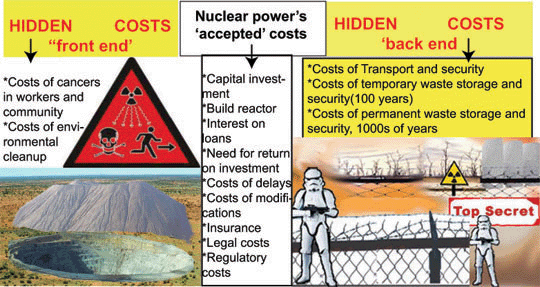
It revealed: hownthese retirement-age AGR reactors have been a poor investment, not serving
Britain well economically; how the estimated cost of decommissioning them
had nearly doubled since 2004, and would likely climb further; and how
these astronomical, escalating costs of decommissioning the AGR sites (now
at £23.5 billion) is being put onto UK tax-payers.
Nation Cymru 7th March 2023 https://nation.cymru/opinion/great-english-nuclear-should-wales-be-involved/
The nuclear war for Lincolnshire – a toxic nuclear waste plan for a bucolic village
There are certain English villages, wrote Bill Bryson, “whose very names
summon forth an image of lazy summer afternoons”. One example was
Theddlethorpe All Saints. Lying on the quiet Lincolnshire coast north of
Skegness, Theddlethorpe’s approximately 500 residents are served by a
thatched pub and two handsome medieval churches, which stand out against
huge skies.
Yet storm-clouds are building on the horizon; soon, this
obscure corner of England could be the backdrop to a dystopian tale.
Theddlethorpe has always had an industrious underbelly. Between 1972 and
2018, it was known for the Theddlethorpe Gas Terminal, where natural gas
gathered from beneath the North Sea was collected, then fed into the
National Grid. At its peak, Theddlethorpe handled around 5% of the UK’s gas
supply, but with the shift away from fossil fuels, the plant became
redundant.
In 2021, just as locals were feeling grateful for the site’s
long-promised return to agricultural use, came news that the terminal might
have an unwelcome afterlife — as the landward end of an undersea nuclear
waste dump. It is one of four sites being considered by the government for
a Geological Disposal Facility (GDF), the others all being on the far side
of the country, near Sellafield, a huge nuclear site in Cumbria.
The idea s that vast storage caverns would be blasted into bedrock up to 1,000
metres under the sea, several miles offshore. “Higher activity”
radioactive waste would then be transported to Theddlethorpe from 23
surface storage locations across the UK, and trundled out along a tunnel,
to be walled up and forgotten. The immediate vicinity of Sellafield is
already unfit for many other purposes; why contaminate hitherto unaffected
areas?
Especially because it would clearly be much cheaper to store waste
close to its sources. NWS admits: “The transport provisions to the
Theddlethorpe GDF Search Area are currently limited” and “significant
works” would be required. The Government proposal suggests these works
would cost between £20 and £53 billion — although as the tale of HS2
shows, the cost of extending transport networks is liable to gross
underestimation. This throws up a question considered taboo in the
discourse around large infrastructure projects: would expansion of either
railways or roads really “benefit” an area whose residents generally
value its rural character?
Unherd 6th March 2023
https://unherd.com/2023/03/the-nuclear-war-for-lincolnshire/
Rolls-Royce Small Modular Reactor project running out of cash

3 March 2023 https://www.neimagazine.com/news/newsrolls-royce-smr-faces-financial-problems-10648145
UK-based Rolls-Royce SMR says its £500m ($600m) small modular reactor (SMR) programme will run out of cash by the end of 2024, Reuters has reported. Alastair Evans, Government & Corporate Affairs Director at Rolls-Royce SMR noted: “We aren’t asking the government to make an order (for the nuclear units) today but we need to start negotiations on a deployment plan by the middle of this year. We are facing a cliff edge, by December 2024 the money will have run out.” This would put at risk UK government plans to use SMRs to boost energy security and achieve climate targets.
The 470 MWe Rolls-Royce SMR design is based on a small pressurised water reactor. The design was accepted for Generic Design Assessment review in March 2022 and Rolls-Royce SMR expects to receive UK regulatory approval by mid-2024. A Rolls-Royce-led UK SMR consortium aims to build 16 SMRs. The consortium – which includes Assystem, Atkins, BAM Nuttall, Jacobs, Laing O’Rourke, National Nuclear Laboratory, the Nuclear Advanced Manufacturing Research Centre and TWI – expects to complete its first unit in the early 2030s and build up to 10 by 2035.
Rolls-Royce’s SMR development business received a commitment of £210m from the UK government in 2021 but talks on how the projects would be funded are yet to start. Rolls-Royce’s new CEO Tufan Erginbilgic said recently that there was a sense of urgency in its engagement with government. “We built a capable team (and) without any project, sustaining that team will be a big challenge,” he told reporters after the group published full-year results. He noted that it was vital to move quickly, given that rival companies were developing similar technology.
“It is important that we engage therefore with the UK government urgently, and for a project that we can deploy as soon as possible,” he said. Rolls Royce and shareholders in the SMR business – advisory firm BNF Resources Ltd, US Energy company Constellation and Qatar Investment Authority have invested a total of around £280m.
This and the government money have been used to build the business, which employs some 600 staff across Derby, Warrington and Manchester. The funds have enabled it to start the regulatory process to approve the reactor design and identify sites for plants and factories. In November 2022, Rolls-Royce identified four sites with the potential to deploy multiple SMR units: Trawsfynydd (requiring agreement with Nuclear Decommissioning Authority (NDA) – and the Welsh Government); Sellafield (NDA land availability to be confirmed); Wylfa-South (requiring agreement with Horizon Nuclear Power); and Oldbury-North (also requiring agreement with Horizon Nuclear Power).
Rolls-Royce hopes to build the reactors in UK factories. In July 2022, the company announced six potential locations for the factory, shortlisted from more than 100 submissions from local enterprise partnerships and development agencies. They were: Sunderland in Tyne and Wear, Richmond in North Yorkshire, Deeside in Wales, Ferrybridge in Yorkshire, Stallingborough in Lincolnshire and Carlisle in Cumbria. David White, newly appointed Chief Operating Officer of Rolls-Royce SMR, said another two locations – Shotton in Deeside (Wales) and Teesworks in Redcar (North East) – had been added to the list.
UK government’s commitment to nuclear power wavering, as Hinkley Point C’s costs and delays escalate?

EDF’s reactor for its first nuclear plant in the UK for 30 years arrives by
ship. While the arrival of the reactor could be a positive signal that
progress is being made on the nuclear rollout, some critics say that new
nuclear power will not come online soon enough to ease the current energy
bill crisis.
Hinkley Point C, for instance, is not expected to finish
construction until 2026 at the earliest. Meanwhile, energy bills are at
record highs and the Government has been urged to find a way to quickly
ease the burden of high energy costs.
Hinkley Point C’s repeated delays
have raised concerns as the Government has appeared to hedge its bets on
nuclear. The Somerset project was initially meant supposed to start
producing electricity by 2017 at a cost of £18billion. Now expected to cost
£32billion, the delays have thrown into question whether building more
nuclear plants is an appropriate response to the energy crisis.
Previously
speaking to Express.co.uk, Dr Paul Dorfman, Associate Fellow SPRU
University of Sussex, explained: “The fact is, EDF EPR reactor design costs
have ramped everywhere it’s built with massive delays.”
Express 27th Feb 2023
https://www.express.co.uk/news/science/1740065/edf-reacotr-hinkley-point-c-somerset-nuclear-energy
1 This Month

of the week – Shut Down Drone Warfare!


Tell the Ukrainian Government to Drop Prosecution of Peace Activist Yurii Sheliazhenko

Petition to revoke the licensing of the Near Surface Nuclear Disposal Facility (NSDF) at Chalk River. https://www.ourcommons.ca/petitions/en/Petition/Details?Petition=e-7247
To see nuclear-related stories in greater depth and intensity – go to https://nuclearinformation.wordpress.com
-
Archives
- April 2026 (103)
- March 2026 (251)
- February 2026 (268)
- January 2026 (308)
- December 2025 (358)
- November 2025 (359)
- October 2025 (376)
- September 2025 (257)
- August 2025 (319)
- July 2025 (230)
- June 2025 (348)
- May 2025 (261)
-
Categories
- 1
- 1 NUCLEAR ISSUES
- business and costs
- climate change
- culture and arts
- ENERGY
- environment
- health
- history
- indigenous issues
- Legal
- marketing of nuclear
- media
- opposition to nuclear
- PERSONAL STORIES
- politics
- politics international
- Religion and ethics
- safety
- secrets,lies and civil liberties
- spinbuster
- technology
- Uranium
- wastes
- weapons and war
- Women
- 2 WORLD
- ACTION
- AFRICA
- Atrocities
- AUSTRALIA
- Christina's notes
- Christina's themes
- culture and arts
- Events
- Fuk 2022
- Fuk 2023
- Fukushima 2017
- Fukushima 2018
- fukushima 2019
- Fukushima 2020
- Fukushima 2021
- general
- global warming
- Humour (God we need it)
- Nuclear
- RARE EARTHS
- Reference
- resources – print
- Resources -audiovicual
- Weekly Newsletter
- World
- World Nuclear
- YouTube
-
RSS
Entries RSS
Comments RSS
 nuclear-news