‘Dirty 30’ and its toxic siblings: the most dangerous parts of the Sellafield nuclear site
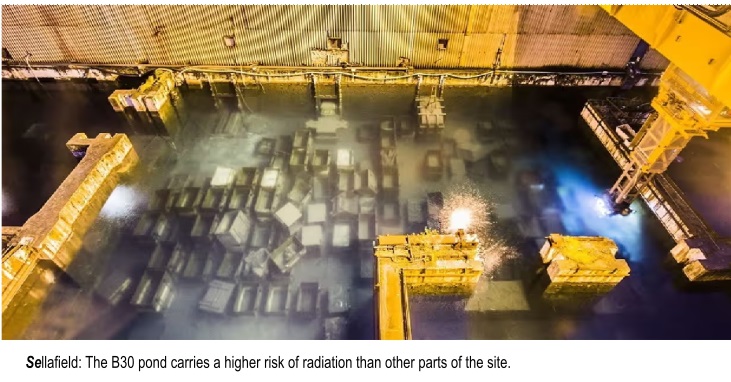
Cracks in ponds holding highly radioactive fuel rods lead to safety fears
https://www.theguardian.com/business/2023/dec/05/dirty-30-dangerous-sellafield-nuclear-site-ponds-safety-fears . by Alex Lawson and Anna Isaac
Radioactive sludge
In the early 1950s, a huge hole was dug into the Cumbrian coast and lined with concrete. Roughly the length of three Olympic swimming pools and known as B30, it was built to hold skip loads of spent nuclear fuel.
Those highly radioactive rods came from the 26 Magnox nuclear reactors that helped keep Britain’s lights on between 1956 and 2015. When B30 was first put to work, it was designed to keep the fuel rods submerged for only three months before reprocessing work was carried out.
But when 1970s miners’ strikes shut down coal power stations and forced greater reliance on nuclear plants, more spent fuel than could be quickly reprocessed was generated. The silos and ponds, built to prevent airborne contamination if the fuel or radioactive sludge dried out, rapidly filled up. Meanwhile, the fuel corroded in the water, breaking down into radioactive sludge.
Debris from elsewhere within Sellafield was later added and the pond was abandoned when new facilities were built in 1986, clouding over and leaving workers on site with little idea what lay beneath its murky waters.
‘A nightmare job with no blueprint’
In 2014, photos of B30 and nearby B29 leaked via an anonymous source to the Ecologist led to concerns over the radioactive risk associated with the poor repair of the ponds.
The two facilities were used until the mid-1970s for short-term storage of spent fuel until it could be reprocessed and used for producing plutonium for the military.
The Ecologist pictures showed hundreds of highly radioactive fuel rods in ponds housed within cracked concrete overgrown with weeds, with seagulls bathing in the water. The images, taken over a period of seven years, led the nuclear safety expert John Large to warn that any breach of the wall would “give rise to a very big radioactive release”.
At the time, the Office for Nuclear Regulation (ONR), the nuclear safety regulator, said that while the old ponds bring “significant challenges”, their appearance “does not mean that operations and activities on those facilities are unsafe”.
It took 15 years and £1.5bn to bring B30 to a point where decommissioning could begin several years ago, with builders limited to working only half an hour a day close to the pool to prevent them from exceeding radiation exposure limits. Remotely operated vehicles, normally used to help with submarine rescues, were originally deployed but quickly failed, often within hours, because of the overpowering radiation. Newer models have since been used to vacuum up nuclear sludge, which is then moved to alternative long-term storage.
Sellafield hopes to have drained the pond by the early 2030s, and demolished it by the 2050s.
A new facility, the sludge packaging plant, has been built to receive radioactive sludge from B30. The nuclear watchdog said there have been some “regulatory challenges along the way … including noncompliance with fire regulations”.
Although the reservoir is still nicknamed “Dirty 30”, it was officially rebranded in 2018 as the First Generation Magnox storage pond.
But one former longstanding employee says that, despite the cracks, the contents of the ponds are gradually improving: “I have seen it at its worst. The water quality was horrendous; you could stand on the roof and look down and not see a single thing in there.
“In the control room, there are a group of lads using PlayStation-like controls for robots to pick up bits the size of a 50p piece and hoover up the sludge. It’s cutting edge.”
He adds: “[Decommissioning Sellafield] is the biggest job in nuclear and there is no blueprint. It’s a dream and a nightmare job. There has been real progress – every skip that comes out makes it safer and reduces the hazard risk.”
Toxic neighbours
B30 sits in a “separation zone” that requires greater security checks, and carries a higher risk of radiation, than the rest of the town-sized site. Although B30 is the most notorious crumbling building on Sellafield’s sprawling estate, it is far from the only problem child.
Nearby is B38, used to store highly radioactive cladding from reactor fuel rods. It was also used heavily during the miners’ strike of 1972, when nuclear plants were relied on to produce extra power, and it proved impossible to process all the waste that was being generated. Two years later, the public’s view of the nuclear industry was sharpened by the launch of the Protect and Survive advice on surviving a nuclear attack.
In B29 lie the toxic remains of Britain’s attempt to become an atomic superpower during the cold war.
Windscale, a former munitions factory, was selected to host the first atomic reactors, known as Pile 1 and Pile 2, after the second world war. They produced plutonium for nuclear weapons, and efforts were rushed through to allow Britain to explode its own atomic bombs by 1952.
The toxic waste from this programme was stored in B29 – which stretched between Piles 1 and 2 – and a massive silo, B41. There have been efforts to secure and remove the waste in B41 in recent years.
There are also grave concerns over leaks from the Magnox swarf storage silo (MSSS), described as “one of the highest-hazard nuclear facilities in the UK”. It was constructed as a radioactive waste store in four stages between 1964 and 1983 and has not been in active use since the 1990s. The waste is stored under water to prevent ignition and to maintain constant temperatures.
The silo was first found to be leaking radioactive water into the ground in the 1970s and there are concerns that work to retrieve the waste, planned over the next three decades, has the “potential to reopen historic leak paths” and introduce new ones, according to the ONR.
Earlier this year, the ONR warned that a leak from the MSSS was likely to continue to 2050, with “potentially significant consequences” if it gathered pace.
The government’s long-term plan is to bury Britain’s nuclear waste deep underground in a geological disposal facility. The project, estimated to cost between £20bn and £53bn, would receive intermediate-level waste from nuclear facilities by 2050 and high-level waste and spent fuel from 2075.
It will echo similar projects in Sweden, France and Finland, which is nearing completion of its storage cave. A government body, Nuclear Waste Services, which is running the project, is in the process of engaging with different communities – two near Sellafield, and another near Mablethorpe on the east coast – in an attempt to win local approval for the plans.
Sellafield nuclear site workers claim ‘toxic culture’ of bullying, sexual harassment and drugs could put safety at risk

Multiple sources warn poor working culture heightens risk of accidents, suicide and sabotage
Guardian, Alex Lawson and Anna Isaac 7 Dec 23
A “toxic culture” of bullying, sexual harassment and drug-taking risks compromising the safety of Europe’s most hazardous nuclear site, multiple employees at Sellafield have claimed.
More than a dozen current and former employees have alleged to the Guardian that the Cumbrian site, a vast dump for nuclear waste, has a longstanding unhealthy working culture, where staff have been bullied, harassed and belittled, with some apparently pushed to suicide.
The site’s human resources department has been accused of taking a “bully, break, bribe” approach to dealing with employees who raise concerns over their colleagues and site safety.
Whistleblowers warn that the toxic culture could have dangerous consequences for safety and security at Europe’s biggest nuclear waste dump, which hosts decades of radioactive material. The revelations have emerged as part of Nuclear Leaks, a year-long Guardian investigation into cyber hacking, radioactive contamination and toxic workplace culture at the 6 sq km (2 sq mile) site.
A whistleblower, Alison McDermott, a consultant who said she was sacked in 2018 after raising concerns over Sellafield’s culture and sexual harassment, warned that this climate heightens the risk of not just accidents and mistakes, but also terrorism and sabotage.
“Those risks are far more likely to materialise if you’re working in a highly toxic and dysfunctional culture,” she claimed.
The vast taxpayer-funded site employs 11,000 staff, who are tasked with making safe crumbling buildings containing nuclear waste. It is one of the biggest employers in the north-west, with generations of the same families working there.
The investigation into Sellafield has found:
Several suicides apparently linked to the pressures of working at the site.
A former young worker who claimed he was bullied to the point where he “just wanted to die” after he was repeatedly mocked over his sexual experience.
Workers who alleged they have either experienced or witnessed incidents of sexual assault.
Staff who allegedly regularly bring cocaine on to the site and keep samples of untainted urine in case of random drugs tests.
It is understood that several suicides have been linked to the pressures of working at the site in recent years.
Sources with knowledge of medical services at the site claimed that there have been a disproportionately high number of severe mental ill-health episodes, suicides and suicide attempts among the workforce…………………………………………
Last year, it emerged that seven workers tested positive for drugs after 741 workers were randomly tested between November 2021 and November 2022.
There are also concerns about allegations of racist, misogynistic and other troubling behaviour at Sellafield. In late 2020, a network of ethnic minority employees wrote to the company’s board, listing 27 alleged racist incidents……………………………………………………………
McDermott, an experienced HR consultant who has consulted for a range of blue-chip organisations, was brought in to identify issues with Sellafield’s culture and make recommendations. However, she alleges she was fired after telling managers that an investigation should be carried out into claims of sexual harassment and a subsequent cover-up. She is awaiting a decision on her case from the court of appeal after a lengthy legal battle with Sellafield.
McDermott said: “The gravity of the bullying and harassment and the abuse employees were being subjected to was just really shocking and off the scale and there clearly was an endemic problem with bullying and harassment at Sellafield.”
McDermott, an equality consultant, has spoken to scores of current and former employees before and after she was let go in 2018. She raised concerns over claims of sexual harassment by an employee and allegations of a subsequent cover-up at Sellafield………………………………………………………………………………………………………………………….more https://www.theguardian.com/business/2023/dec/06/sellafield-toxic-culture-bullying-harassment-safety
In the UK and Ireland, Samaritans can be contacted on freephone 116 123, or email jo@samaritans.org or jo@samaritans.ie. Youth suicide charity Papyrus can be contacted on 0800 068 4141 or email pat@papyrus-uk.org. In the US, you can call or text the National Suicide Prevention Lifeline on 988, chat on 988lifeline.org, or text HOME to 741741 to connect with a crisis counsellor. In Australia, the crisis support service Lifeline is 13 11 14. Other international helplines can be found at befrienders.org
UK nuclear police and workers share WhatsApp jokes about paedophilia, racism and homophobia
Work-linked WhatsApp groups include abusive comments about political figures and television personalities
Sellafield workers claim ‘toxic culture’ could put safety at risk
Guardian, Anna Isaac and Alex Lawson, 7 Dec 23
Specialist police officers and workers at some of the UK’s most secure nuclear sites have been sharing jokes about paedophilia, racism and homophobia in work-linked WhatsApp groups, the Guardian can reveal.
Images and messages reviewed by this newspaper show racist comments about public figures and politicians including a black Labour politician as well as homophobic images and conversations about the paedophiles Jimmy Savile and Rolf Harris.
Two groups’ activities have been examined by the Guardian, including one of which has members of the Civil Nuclear constabulary (CNC) at Sellafield in Cumbria and workers there. The other group largely comprises staff in sensitive areas of two other nuclear sites and CNC officers.
Among the messages are racist comments about a black Labour MP, who has been a frequent target of racist abuse online. The conversations also include homophobic memes about a prominent TV presenter. The Guardian has chosen not to name them but offered specific details about the content of the messages and the groups’ geographic locations to the CNC.
The messages also show explicit images of nudity, as well as racist imagery and descriptions of graphic paedophilic acts. They also show men ridiculing female colleagues at the sites for their appearance and sexual attractiveness.
Among the members of the groups, who have taken part in the conversations, are employees of the CNC, tasked with protecting some of the UK’s most sensitive and toxic sites.
The messages have come to light amid broader revelations in Nuclear Leaks, an investigation into cultural challenges, security and safety concerns at Sellafield and other nuclear sites throughout the country.
The groups also suggest that cultural concerns at Sellafield may extend to a range of other sensitive sites, raising questions about conduct within the nuclear sector as a whole.
Sources told the Guardian that they fear a failure to address a negative working culture and concerns ranging from bullying to a lack of trust in management could ultimately undermine the safety of some of the most hazardous sites in Europe.
Studies examining safety in the nuclear industry have found that working culture can feed into how sites are run. A 2020 report from the Office for Nuclear Regulation argued that poor culture fed into events which led to nuclear disasters, including Chornobyl in 1986 and Fukushima in 2011.
Last year, the Independent Office for Police Conduct (IOPC) began a criminal investigation into messages shared by nuclear police in a WhatsApp group separate to the ones reviewed by the Guardian. The investigation involves “grossly offensive messages” sent by current and former CNC officers. The IOPC said when the investigation was launched that the allegations were “extremely serious and concerning”.
Last year, two Metropolitan police officers were sentenced to three months in prison after being found guilty of sharing racist, homophobic, misogynistic and ableist messages in a WhatsApp group. Another messaging group has been used as an example of a “toxic, abhorrent culture” within the Met……………………………………………………………………………….. more https://www.theguardian.com/business/2023/dec/06/uk-nuclear-police-workers-whatsapp-jok
—
A Scotland without nuclear power would be safer for people and planet.

https://greens.scot/news/a-nuclear-power-free-scotland-would-be-safer-for-people-and-planet 6 Dec 23
Nuclear power is costly, dangerous and leaves a toxic legacy.
A Scotland without nuclear power would be safer for people and planet, says the Scottish Greens climate spokesperson, Mark Ruskell MSP.
Mr Ruskell’s warnings come as the UK government has committed to trebling nuclear capacity by 2050 as part of a COP declaration, and with reports that the Sellafield nuclear site has been targeted by groups linked to China and Russia.
Mr Ruskell said: “The allegations of hacking at Sellafield should alarm all of us. Nuclear energy is costly, dangerous and unsafe for people and planet. It will leave a legacy of toxic waste and higher bills for generations to come. It has no place in Scotland.
“The Tory’s epic failure to deliver Hinkley Point to time and budget shows just how unreliable and costly new nuclear is. That time and money could have been far better spent on expanding our homegrown renewable energy, which is the real solution to ending our reliance on climate-wrecking fossil fuels.
“With Scottish Greens in government here in Scotland are getting on with the job, and building our new wind and solar capabilities at pace. That is how we will ensure a safer and greener future.”
Scotland’s Energy Secretary Neil Gray points to safety risks as he rejects nuclear power attempts
Herald Scotland, 6th December, By David Bol, @mrdavidbol, Political Correspondent
The SNP’s Energy Secretary has turned down the latest plea for nuclear power stations to be constructed north of the Border – insisting the technology “is not safe, it is expensive and it is not wanted”.
The Scottish Government has a long-held opposition to nuclear power and is not part of its plans for the nation to meet net zero.
Instead, the Scottish Government believes it can meet energy demands by drastically ramping up the capacity for offshore wind and other renewables………………
Power and energy is largely reserved to the UK Government, but Scottish ministers can effectively veto proposals for Scotland through devolved planning regulations.
Torness power station in East Lothian is the only remaining operational nuclear power station in Scotland.
SNP Energy Secretary Neil Gray was asked by Conservative MSP Edward Mountain if the Scottish Government will change its mind and embrace nuclear power.
Speaking in Holyrood, Mr Gray said: “We are doing that because it is not safe, it is expensive and it is not wanted in Scotland. In addition, it is not needed in Scotland.
“We have abundant natural energy resources and capital that can contribute and are contributing to our energy mix.”
He added: “As we are all seeing from experiences elsewhere in the United Kingdom, new nuclear power takes years—if not decades—to become operational, and it will push up household and business energy bills even more.
“Under the contract awarded by the UK Government to Hinkley Point C, the electricity that will be generated will be priced at £92.50 per megawatt hour.
“We know that the Tories care little these days about achieving a pathway to net zero, but the Scottish National Party Government still does. We believe that significant growth in renewables, storage, hydrogen and carbon capture provides the best pathway to net zero for Scotland.”
………………………Mr Gray pointed to “evidence of the alleged hacking of Sellafield this week and what we have seen from Russia’s invasion of Ukraine” as “worries around safety”.
He added: “We in Scotland are not the only ones who have such concerns: many colleagues in the European Union are either moving away from or continue to oppose new nuclear power.”https://www.heraldscotland.com/news/23970270.neil-gray-points-safety-risks-rejects-nuclear-power-attempts/
Revealed: Sellafield nuclear site has leak that could pose risk to public
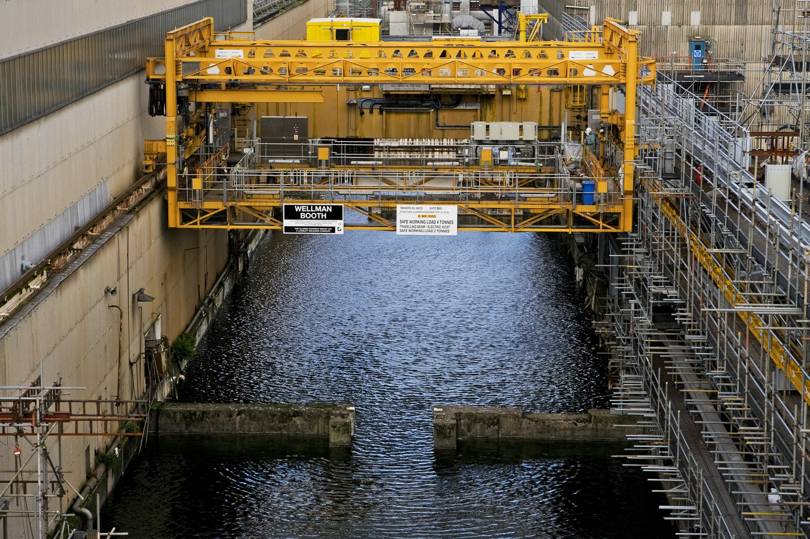
Safety concerns at Europe’s most hazardous plant have caused diplomatic tensions with US, Norway and Ireland
Anna Isaac and Alex Lawson, Guardian, 5 Dec 23
Sellafield, Europe’s most hazardous nuclear site, has a worsening leak from a huge silo of radioactive waste that could pose a risk to the public, the Guardian can reveal.
Concerns over safety at the crumbling building, as well as cracks in a reservoir of toxic sludge known as B30, have caused diplomatic tensions with countries including the US, Norway and Ireland, which fear Sellafield has failed to get a grip of the problems.
The leak of radioactive liquid from one of the “highest nuclear hazards in the UK” – a decaying building at the vast Cumbrian site known as the Magnox swarf storage Silo (MSSS) – is likely to continue to 2050. That could have “potentially significant consequences” if it gathers pace, risking contaminating groundwater, according to an official document.
Cracks have also developed in the concrete and asphalt skin covering the huge pond containing decades of nuclear sludge, part of a catalogue of safety problems at the site.
These concerns have emerged in Nuclear Leaks, a year-long Guardian investigation into problems spanning cyber hacking, radioactive contamination and toxic workplace culture at the vast nuclear dump.
Sellafield, a sprawling 6 sq km (2 sq mile) site on the Cumbrian coast employing 11,000 people, stores and treats nuclear waste from weapons programmes and nuclear power generation, and is the largest such facility in Europe.
A document sent to members of the Sellafield board in November 2022 and seen by the Guardian raised widespread concerns about a degradation of safety across the site, warning of the “cumulative risk” from failings ranging from nuclear safety to asbestos and fire standards.
A scientist on an expert panel that advises the UK government on the health impact of radiation told the Guardian that the risks posed by the leak and other chemical leaks at Sellafield have been “shoved firmly under the rug”.
A fire in 1957 at Windscale, as the site was formerly known, was the UK’s worst nuclear accident to date. An EU report in 2001 warned an accident at Sellafield could be worse than Chornobyl, the site of the 1986 disaster in Ukraine that exposed five million Europeans to radiation. Sellafield contains significantly more radioactive material than Chornobyl.
The report said events that could trigger an atmospheric release of radioactive waste at the plant included explosions and air crashes.
Such is the concern about its safety standards that US officials have warned of its creaking infrastructure in diplomatic cables seen by the Guardian. Among their concerns are leaks from cracks in concrete at toxic ponds and a lack of transparency from the UK authorities about issues at the site. The UK and the US have a decades-long relationship on nuclear technology.
Concerns about how Sellafield is run have also led to tensions with the Irish and Norwegian governments.
Norwegian officials are concerned that an accident at the site could lead to a plume of radioactive particles being carried by prevailing south-westerly winds across the North Sea, with potentially devastating consequences for Norway’s food production and wildlife. A senior Norwegian diplomat told the Guardian that they believed Oslo should offer to help fund the site so that it can be run more safely, rather than “run something so dangerous on a shoestring budget and without transparency”………………………………………………………………………………………………………………….more https://www.theguardian.com/business/2023/dec/05/sellafield-nuclear-site-leak-could-pose-risk-to-public
British government to send surveillance planes to facilitate Israel’s genocide
Robert Stevens, WSWS, 5 December 2023
On Saturday, Britain’s Ministry of Defence (MoD) said that the Royal Air Force (RAF) would carry out surveillance flights over Gaza.
A joint statement by the Ministry of Defence, Foreign, Commonwealth & Development Office, and Home Office, headed “UK military activity in the Eastern Mediterranean”, announced, “In support of the ongoing hostage rescue activity, the Ministry of Defence will conduct surveillance flights over the eastern Mediterranean, including operating in air space over Israel and Gaza.”………………
Britain has been up to its neck in the arming of the Israeli regime that has killed tens of thousands, mainly civilians and the vast majority women and children, and reduced Gaza to rubble. Now everyone is expected to believe that the RAF will be carrying out blanket surveillance of Gaza and a large part of the eastern Mediterranean with no military purpose and will not make information gathered available to its main military ally in the region.
British imperialism is gearing up for an escalation of the war in the Middle East and putting the necessary resources in place. Just two days before the drone surveillance announcement, Defence Secretary Grant Shapps revealed that the UK is sending one of its most lethal warships to the Gulf, HMS Diamond, a Type 45 destroyer with the ability to shoot down missiles…………………………………………..
Britain’s role in supplying Israel’s war-machine is critical. According to the Campaign Against Arms Trade (CAAT), “UK industry provides 15% of the components in the F-35 stealth combat aircraft that are currently being used in the bombardment of Gaza. The contract for the components is estimated… to be worth £336m since 2016.”
Israel has 50 F-35s on order from the US, with 22 already delivered by the end of 2022, reports CAAT. The organisation estimates that “each aircraft involves around $12 million to UK industry. This would imply a value of $72 million (£58m) for total UK deliveries of F-35s to Israel in 2022…”
Much of what the UK sends to Israel’s military is not even documented, with CAAT noting, “Between 2018 and 2022, the UK exported £146m in arms sales via Single Issue Export Licences. However, a large proportion of military equipment exported is via Open General Export Licences. These open licences, which include the F-35 components, lack transparency and allow for unlimited quantities and value of exports of the specified equipment without further monitoring.”………………………………………………….
The Sunak government refuses to confirm whether it has troops on the ground already in Gaza. On Monday, MPs were allotted just one hour to ask the government questions of the “Humanitarian Situation” in the Strip; a debate which hardly any of the mainly pro-war MPs across all parties showed up for.
Former Labour leader Jeremy Corbyn—who remains a party member but sits as an Independent having been expelled from the parliamentary party three years ago by leader Sir Kier Starmer—said in his comments that “Israel is clearly undertaking an act of cleansing of the entire population of Gaza”, which “is illegal in international law.” He then asked, “What is the role, purpose and military objective of British military participation in the whole area? Can he [Leo Docherty, a parliamentary under-secretary of state at the Foreign Office] assure us that there are no British soldiers on the ground in Gaza?”………
Britain’s military role in the region is maintained to ensure its ruling elite profit from the spoils of genocide and war, as the trusted partners of US imperialism. Bloomberg and Newsweek reported in October that the Biden administration is considering sending in “peacekeepers for the Gaza Strip”, once Hamas is wiped out and Gaza depopulated, and that the “Multinational force could include American, UK, French troops.”
Despite a November 1 statement by White House spokesperson John Kirby that there are “no plans or intention to put US military troops on the ground in Gaza, now or in the future”, Bloomberg reported that the Biden administration “is still talking to partners about what a post-conflict Gaza should look like. US Secretary of State Antony Blinken said, “if that means some sort of international presence, then that’s something we’re talking about.”
Bloomberg reported that “one option would grant temporary oversight to Gaza to countries from the region, backed by troops from the US, UK, Germany and France.”
On Monday, John Bolton, the former Republican US national security adviser, proposed at the UK’s Foreign Affairs Select Committee that the Gaza Strip should be split into two territories, with Gaza north of the Wadi Gaza River administered by Israel and an area to the south run by Egypt.
This would be initiated after the ethnic cleansing of most Palestinians and facilitate the transfer of those that remain. No Palestinians would be allowed to settle in Israel, which Bolton said would not even provide work visas, but must all be resettled in other countries. https://www.wsws.org/en/articles/2023/12/05/ttog-d05.html
UK nuclear revelations: how bad could they get and could they affect the US and Europe?

Key things to know about hacking, radioactive leaks and toxic workplace culture at Sellafield, Europe’s most hazardous nuclear site
- Sellafield nuclear site hacked by groups linked to Russia and China
- Sellafield workers claim ‘toxic culture’ could put safety at risk
Guardian, Alex Lawson and Anna Isaac, Thu 7 Dec 2023
Nuclear Leaks, a year-long Guardian investigation, has uncovered problems with cyber hacking, radioactive leaks and toxic workplace culture at Sellafield, the UK’s most hazardous nuclear site.
It has also revealed how a small corner of the UK has an outsized influence on its special relationship with the US, with the countries bound by the shared history of nuclear weapons development. Britain’s neighbours in Europe, particularly Norway and Ireland, also keep a sharp eye on the site, from where previous pollution incidents and radioactivity as a result of a fire have made it to their shores.
What is Sellafield?
The taxpayer-funded site in Cumbria, in the remote north-west coast of England, has the largest store of plutonium on the planet and is a huge nuclear decommissioning and waste dump, handling the remains of decades of atomic power generation and nuclear weapons programmes. It also takes in nuclear waste from countries including Italy, Japan and Germany – which is then processed, packaged and sent back.
Originally named Windscale, the industrial complex dates back to the cold war arms race, and was the original site for the development of nuclear weapons in the UK in 1947, manufacturing plutonium, as Britain raced to build an atomic bomb.
It was the scene of one of Europe’s worst nuclear disasters, the Windscale reactor fire in 1957, which carried a plume of toxic smoke across to the continent.
It was also home to the world’s first full-scale commercial nuclear power station, Calder Hall, which was opened in 1956 and ceased generating electricity in 2003.
The site, which has almost 1,000 buildings, has a workforce of 11,000, with its own railway, road network, laundry services for normal and potentially radioactive garments, and its own police force with more than 80 dogs.
Great Britain still has a group of nuclear power plants, majority owned by France’s EDF, which generate about 16% of the electricity for the power network.
The UK is also building new nuclear power stations, including Hinkley Point C in Somerset, although their waste will eventually be buried in a new geological disposal facility.
What are the cybersecurity concerns?
A Guardian investigation found that Sellafield has been hacked into by cyber groups closely linked to Russia and China and that its potential effects have been consistently covered up by senior staff.
The hack was one of a series of cyber issues at the site, and was covered up by senior managers. Other concerns included external contractors being able to plug memory sticks into the system while unsupervised and staff at remote sites being able to access its computer servers.
The UK’s nuclear watchdog, the Office for Nuclear Regulation (ONR), put the site into a form of “special measures” for consistent failings on cybersecurity.
Sources said cyber breaches were first detected as far back as 2015, when experts realised sleeper malware – software that can lurk and be used to spy on or attack systems – had been embedded in Sellafield’s computer networks. It is still not known if the malware has been eradicated. It may mean some of Sellafield’s most sensitive data on activities, such as moving radioactive waste, monitoring for leaks of dangerous material and checking for fires, have been compromised.
What is leaking?
The investigation revealed a worsening leak of radioactive liquid from one of the “highest nuclear hazards in the UK” – a decaying silo from which radioactive material is leaking into the ground. The leak is likely to continue to 2050.
The Guardian also revealed concerns about B30, a pond containing nuclear sludge from corroded nuclear fuel rods, whose concrete and asphalt skin is ribboned with cracks. These cracks have worsened in recent months, according to sources.
Why are Norway, Ireland and the US so worried and how bad could it get?
Concerns over safety at Sellafield have caused diplomatic tensions with countries including the US, Norway and Ireland. Norwegian officials are concerned that an accident at the site could lead to a plume of radioactive particles being carried by prevailing south-westerly winds across the North Sea, with potentially devastating consequences for Norway’s food production and wildlife. Radioactive contamination from the 1957 Windscale fire reached Norway’s shores.
In 2006, the Irish government tried to take action against Sellafield by referring it to a UN tribunal over concerns about Sellafield’s impact on the environment.
An EU report in 2001 warned an accident at Sellafield could be worse than Chornobyl, the site of the 1986 disaster in Ukraine that exposed five million Europeans to radiation. The report warned that events that could trigger an atmospheric release of radioactive waste at the plant included explosions and air crashes.
Fire safety is a key area of concern. The Guardian investigation revealed an internal document in November 2022 warned of a “cumulative risk” posed by failings in a range of areas, from nuclear safety to managing risks from fire and asbestos. “They can’t handle fire or asbestos on site, let alone the crumbling of nuclear containment materials,” one senior Sellafield employee told the Guardian………………………………………………………………………. more https://www.theguardian.com/business/2023/dec/06/nuclear-leaks-uk-nuclear-site-sellafield-hacking
UK minister demands answers for security failings at Sellafield
Claire Coutinho says cybersecurity issues at UK’s most hazardous nuclear site must be urgently addressed
Anna Isaac and Alex Lawson, Guardian Wed 6 Dec 2023
Cybersecurity vulnerabilities at the UK’s most hazardous nuclear site must be urgently addressed and explanations given for any shortcomings, a cabinet minister has demanded.
Claire Coutinho, secretary of state for energy security and net zero, wrote to the chief executive of the Nuclear Decommissioning Authority (NDA), David Peattie, saying allegations by the Guardian about failings in cybersecurity at Sellafield in Cumbria needed “urgent attention”.
The intervention follows the revelation that the vast nuclear waste and decommissioning dump has been hacked by groups linked to China and Russia, and its potential effects covered up by senior staff. It emerged as part of Nuclear Leaks, a year-long Guardian investigation into problems spanning cyber hacking, radioactive contamination, and toxic workplace culture at Sellafield.
Coutinho said: “The allegations are a worrying reminder of the longstanding nature of some of these issues, specifically cybersecurity at Sellafield, which I understand has been under enhanced regulatory scrutiny since 2014.”…………………………………………………………………………….
The government has also formally requested an update on a range of activities at the site, including work on cleaning up leaking silos of radioactive sludge and liquid after a report by the Guardian on growing safety concerns……………………………………………………………………….
Carla Denyer, co-leader of the Green party, which opposes nuclear power, said: “This toxic legacy of nuclear weapons and nuclear power poses a serious risk to life and public health as well as poisoning relations with other countries, especially Norway, that would be devastated by a radioactive plume if ever there was a major incident at Sellafield.
“This is Europe’s most hazardous nuclear site, so the government must put in place the investment needed to make it as safe as possible.”………………. https://www.theguardian.com/business/2023/dec/05/uk-minister-demands-answers-for-security-failings-at-sellafield
Sellafield: ‘bottomless pit of hell, money and despair’ at Europe’s most toxic nuclear site
Described as a nuclear Narnia, the site is a source of economic support for Cumbria – and a longstanding international safety concern.
by Anna Isaac and Alex Lawson, 5 Dec 23 https://www.theguardian.com/business/2023/dec/04/sellafield-money-europe-toxic-nuclear-site-cumbria-safety
Ministers who visit Sellafield for the first time are left with no illusions about the challenge at Europe’s most toxic nuclear site.
One former UK secretary of state described it as a “bottomless pit of hell, money and despair”, which sucked up so much cash that it drowned out many other projects the economy could otherwise benefit from.
For workers, it is a place of fascination and fear.
“Entering Sellafield is like arriving in another world: it’s like nuclear Narnia,” according to one senior employee. “Except you don’t go through a cupboard, you go through checkpoints while police patrol with guns.” Others call it nuclear Disneyland.
Sellafield, a huge nuclear dump on the Cumbrian coast in north-west England, covers more than 6 sq km (2 sq miles). It dates to the cold war arms race, and was the original site for the development of nuclear weapons in the UK in 1947, manufacturing plutonium. It was home to the world’s first full-scale commercial nuclear power station, Calder Hall, which was commissioned in 1956 and ceased generating electricity in 2003.

It has been at the centre of disaster and controversy, including the Windscale fire of 1957. The blaze was considered one of the worst nuclear incidents in Europe at the time, and carried a plume of toxic smoke across to the continent. The milk from cows on 200 sq miles of Cumbrian farmland was condemned as radioactive.
Sellafield began receiving radioactive waste for disposal in 1959, and has since taken thousands of tons of material, from spent fuel rods to scrap metal, which is stored in concrete silos, artificial ponds and sealed buildings. A constant programme of work is required to keep its crumbling buildings safe and create new facilities to contain the toxic waste. The site is expected to be in operation until at least 2130.
The estimated cost of running and cleaning up the site have soared. Sellafield is so expensive to maintain that it is considered a fiscal risk by budgetary officials. The latest estimate for cleaning up the Britain’s nuclear sites is £263bn, of which Sellafield is by far the biggest proportion. However, adjustments to its treatments in accounts can move the dial by more than £100bn, more than the UK’s entire annual deficit. The cost of decommissioning the site is a growing liability that does not count towards the calculation of the UK’s net debt.
Sellafield is owned by the Nuclear Decommissioning Authority, a quango sponsored and funded by the Department for Energy Security and Net Zero that is tasked with cleaning 17 sites across the UK.
The site has a workforce of 11,000, with its own railway, road network, laundry services for normal and potentially radioactive garments, and its own police force with more than 80 dogs. It has almost 1,000 buildings.
Sellafield’s impact on the environment has been a longstanding concern. Local animals, including swallows, have been found to carry radioactive traces from the site with them. Debate rages locally over just how toxic the “atomic kittens” – stray cats that inhabit the site – may be. Sellafield says cats are screened for radioactivity before they are rehomed.
The activities at the site are a matter of significant scrutiny to countries including the US, Norway and Ireland, given that Sellafield hosts the largest store of plutonium in the world and takes waste from countries such as Italy and Sweden.
Excellent table here on original, showing current status of the world’s nuclear reactors
Norwegians have long feared the effects of an accident at the site, with modelling suggesting that prevailing south-westerly winds could carry radioactive particles from a large incident at the site across the North Sea, with potentially devastating consequences for its food production and wildlife.
Norway and Ireland were involved in efforts to halt the release of technetium-99, a radioactive metal, into the sea by Sellafield. In 2003, Norway accused Sellafield of ruining its lobster business.
Jobs at Sellafield are often considered to be a golden ticket, according to sources, as the site offers long-term employment with above-average wages in a region with few big employers.
Sellafield is at the heart of the so-called “nuclear coast” in West Cumbria, sandwiched between the Lake District national park and the Irish Sea. At its southern end, BAE Systems in Barrow-in-Furness builds nuclear submarines. Land neighbouring the site has long been earmarked for a new nuclear power station but plans for Moorside collapsed in 2018 when the Japanese conglomerate Toshiba walked away.
DOUBLING DOWN ON NUCLEAR POWER IS NO SOLUTION TO CLIMATE CRISIS

https://greens.scot/news/doubling-down-on-nuclear-power-is-no-solution-to-climate-crisis 3 Dec 23
Nuclear power is costly, inefficient and leaves a long and toxic legacy.
Doubling down on nuclear power will not solve the climate crisis, says the Scottish Greens climate spokesperson Mark Ruskell.
Mr Ruskell was responding to the announcement from the COP climate summit that 22 countries, including the US, France and the UK, have signed a declaration to triple nuclear capacity by 2050.
Mr Ruskell said: “Nuclear energy is costly, dangerous and out of date. It’s no kind of solution, and will leave a long and toxic legacy for generations to come. The UK experience of Hinkley Point underlines all of these problems, with delay after delay and ever-ballooning costs.
“The climate emergency is happening all around us. We simply don’t have time to waste on overpriced and dirty solutions like nuclear energy.”
Mr Ruskell welcomed the announcement that 118 countries have pledged to triple renewable energy, saying: “This is a significant step in the right direction and could be key to our shift away from climate-wrecking fossil fuels.
“Locally sourced renewable energy is the cheapest and greenest energy available. We have more and better technology available to us than ever before, all that is missing is the political will.
“I hope that this summit can be when leaders finally turn a corner and start to give renewables the investment and support that they deserve.”
Sellafield has contaminated the Irish Sea with plutonium.
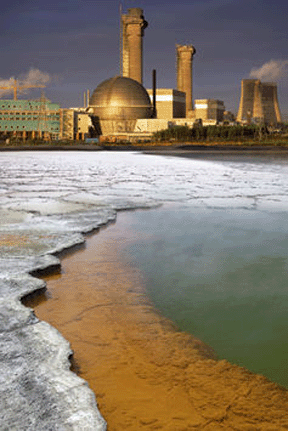
CORE – Cumbrians Opposed to a Radioactive Environment, December 2023
http://corecumbria.co.uk/alternative-tour-of-sellafield/irish-sea/
Sellafield discharges two million gallons of radioactive water into the Irish Sea every day at high tide. This includes a cocktail of over 30 alpha, beta and gamma radionuclides. BNFL admits that radioactive discharges in the 1970’s were 100 times those of today. As a result of these discharges, which include around half a tonne of plutonium, the Irish Sea has become the most radioactively contaminated sea in the world. Caesium-137 and Iodine-129 from Sellafield have spread through the Arctic Ocean into the waters of northern Canada and are having a bigger impact on the Arctic than the Chernobyl accident. Sellafield’s gas discharges of Krypton can be measured in Miami.
The guinea pigs in a ‘deliberate scientific experiment’ to find out levels of contamination in the food chain, were the Cumbrian people and their environment. Claiming then that the radioactive materials discharged from the 2km pipeline would dilute and disperse into the wider oceans, the industry clearly got it wrong, with high levels of radioactive discharge material washed ashore and trapped in the coastal sands and sediments.
A leading government-backed scientist from East Anglia University discovered that plutonium particles, concentrated in waves breaking on the shore, was being blown over West Cumbria, as far as 37 miles inland.This was confirmed by analysis of vacuum cleaner house dust samples taken up and down the coast by a National Radiological Protection Board investigation.
That Sellafield plutonium gets everywhere was shown in post-mortem examinations of former Sellafield workers. Concentrations of hundreds and in one case thousands of times higher than in the general population were found. Cumbrians who never worked at the plant had plutonium levels ranging from 50% to 250% above the average compared to elsewhere in Britain. Atomic Energy Authority scientist, Prof. Nick Priest, studied the teeth of over 3000 young people throughout Britain and Ireland. He found traces of Sellafield plutonium in varying doses, the highest doses being closest to Sellafield.
In November 1983 a team of Greenpeace divers tried to block the Sellafield underwater discharge pipe. When they emerged from the water, their Geiger counters revealed that they were seriously contaminated. It was only when they publicised this fact that BNFL admitted to having problems with their radioactive discharges and that a tankfull of ‘radioactive crud’ had been flushed out to sea. As radioactive flotsam was being washed ashore, posing a danger to health, the Department of the Environment effectively closed the beach and warned the public not to use the fifteen-mile stretch of shoreline north and south of Sellafield. This advice stayed in force for a full six months. In June 1985 BNFL faced a three-day trial, was found guilty and fined £10,000.
BNFL’s own environmental monitoring figures for the first quarter of 1997 revealed alarmingly raised levels of Technetium 99 in seaweed samples from the West Cumbrian coast. A Tc-99 level of 180,000 Bq/Kg in seaweed was sampled from Drigg, just south of the plant. This compared to a level of 71,000 Bq/Kg sampled in the previous quarter and to a level of just 800 Bq/Kg in 1992. Via the food chain Tc-99 is now found in duck eggs, and the use of locally harvested seaweed as a garden fertiliser has led to the discovery of Tc-99 in locally grown spinach. Irish Sea lobster have shown a similar alarming rise from 210 Bq/Kg in 1993 to 52,000 Bq/Kg in 1997 – over 40 times the EU Food Intervention Level set as a safety level for foodstuffs contaminated following a nuclear accident. Raised levels of Tc-99 were subsequently found in Norwegian lobsters.
A wide range of fish, shellfish and molluscs continue to show varying degrees of radioactive contamination from Sellafield’s discharges.
Energy-rich Scotland does not require any nuclear power stations.
Andrew Bowie, undersecretary for nuclear, is pushing expensive and
dangerous nuclear power onto energy-rich Scotland. That’s insane. Nuclear
power has consistently failed to deliver energy on time or on budget.
The much-touted Small Modular Reactors (SMRs) don’t yet exist, are heavily
dependent on government subsidies to come on stream and will generate more
toxic nuclear waste for which there is no safe disposal.
Unlike renewables, where costs are falling, nuclear costs keep climbing. The UK Government has flung billions at Hinkley Point C, guaranteeing £92.50 per MW hour over the
next 35 years, twice as much as is guaranteed for wind. When finished,
Hinkley Point C will be one of the most expensive power stations in the
world. And Scottish households will pay £80 a year for nuclear on top of
already exorbitant energy bills.
The National 30th Nov 2023
UK’s first small nuclear reactor deal ‘poised’ for signing but not with Rolls-Royce
Proactive Investors, 01 Dec 2023 Oliver Haill
Small modular nuclear reactors (SMRs) could be built in the north-east of England but not by Rolls-Royce Holdings PLC (LSE:RR.), Britain’s leading candidate to develop the technology.
In the same week that shockwaves were felt around the industry as an expected first SMR project in the US was cancelled due to a lack of interest from local utilities, US-based Westinghouse Electric was today reported to be close to agreeing a deal to build four SMRs near Hartlepool……………………………….
Rolls-Royce is seen as one of the frontrunners to develop the first UK SMR projects, with its £1.8 billion-per-site design using tech similar to that in nuclear submarines to power up to a million homes.
It was shortlisted in the government-run SMR competition in October, along with Westinghouse’s UK arm, EDF, GE-Hitachi, Holtec Britain, and NuScale Power, the operator with the cancelled US project earlier this week.
But of those names, only Rolls was thought to be currently undergoing assessment from the Office for Nuclear Regulation (ONR) and Environment Agency for the first order, which it insisted put it almost two years ahead of its competitors in bringing an SMR on-stream and receiving funding from the UK government to build the reactors, though others have also applied for regulatory approval.
Rolls chief executive Tufan Erginbilgic has previously said the winner of the UK’s ongoing government-run SMR competition will need “tangible commitments in terms of projects – multiple projects”.
Earlier this week at its much-trumpeted investor event, Rolls said is planning to work with a “broad set of partners” to develop SMRs.
The government is close to publishing its long-awaited nuclear roadmap, which will set out plans to build a new generation of small and large nuclear reactors around Britain.
Westinghouse was bought last year by secretive Canadian infrastructure investor Brookfield. https://www.proactiveinvestors.co.uk/companies/news/1034906/uk-s-first-small-nuclear-reactor-deal-poised-for-signing-but-not-with-rolls-royce-1034906.html
Failure of USA’s NuScale small nuclear reactors (SMRs) not a good omen for Rolls Royce and other UK SMR developers
Concern for Rolls-Royce, other developers after US mini nuclear setback
Proactive ,30 Nov 2023
A major setback in the roll out of mini nuclear power plants in the US has raised concern over the UK’s own bid to introduce the technology, whose developers include Rolls-Royce Holdings PLC (LSE:RR.).
Cancelling plans for its first small modular reactor (SMR) in the US earlier this week, NuScale blamed a lack of interest in the plant’s power output by local utilities.
“Despite significant efforts […] it appears unlikely that the project will have enough subscription to continue toward deployment,” the company said in a statement.
Given the plant was set to be the first of its kind in the US, having been granted regulatory approval in 2022, concern has been raised over the ramifications on other countries looking to utilise modular nuclear technology………………………..
Rolls-Royce is among frontrunners developing such technology in the UK, with its SMR representing the only system currently being assessed by independent regulators.
Cambridge University nuclear energy professor Tony Roulstone commented that failure of NuScale to push through its SMRs was “bad for the broader market”, however.
“They’re the one with a ticket from a safety authority,” he added. NuScale has received some US$600 million from the US government since 2014.
Pointing to the UK, he suggested just one version of the technology was needed, given companies will need several orders to help bring down costs as a whole.
“You can do it if you’ve got an order for ten,” he said. “You can’t do this if you’ve got an order for one.”
A host of companies are indeed looking to build SMRs though, such as EDF, GE-Hitachi and of course Rolls-Royce and NuScale.
Alongside the fact each is looking for public support and contracts, concern has been raised in the UK over a lack of urgency on the government’s part.
Rolls-Royce has previously laid out the need for fast decision making on SMRs, with chief executive Tufan Erginbilgic himself having said the winner of the UK’s ongoing government-run SMR competition will need “tangible commitments in terms of projects – multiple projects”. https://www.proactiveinvestors.co.uk/companies/news/1034737/concern-for-rolls-royce-other-developers-after-us-mini-nuclear-setback-1034737.html
1 This Month
26 September – International Day for the Total Elimination of Nuclear Weapons





PLEASE OPPOSE HR 8255 AND S.3639 – bills would accelerate satellite deployment, with no environmental review or safeguards – https://ncstd5li.quorum.us/campaign/169331/
To see nuclear-related stories in greater depth and intensity – go to https://nuclearinformation.wordpress.com
-
Archives
- September 2026 (281)
- August 2026 (330)
- July 2026 (355)
- June 2026 (287)
- May 2026 (306)
- April 2026 (356)
- March 2026 (251)
- February 2026 (267)
- January 2026 (308)
- December 2025 (358)
- November 2025 (359)
- October 2025 (375)
-
Categories
- 1
- 1 NUCLEAR ISSUES
- business and costs
- climate change
- culture and arts
- ENERGY
- environment
- health
- history
- indigenous issues
- Legal
- marketing of nuclear
- media
- opposition to nuclear
- PERSONAL STORIES
- politics
- politics international
- Religion and ethics
- safety
- secrets,lies and civil liberties
- spinbuster
- technology
- Uranium
- wastes
- weapons and war
- Women
- 2 WORLD
- ACTION
- AFRICA
- Atrocities
- AUSTRALIA
- Christina's notes
- Christina's themes
- culture and arts
- Events
- Fuk 2022
- Fuk 2023
- Fukushima 2017
- Fukushima 2018
- fukushima 2019
- Fukushima 2020
- Fukushima 2021
- general
- global warming
- Humour (God we need it)
- Nuclear
- RARE EARTHS
- Reference
- resources – print
- Resources -audiovicual
- Weekly Newsletter
- World
- World Nuclear
- YouTube
-
RSS
Entries RSS
Comments RSS

