Rolls Royce shares OK for civil aviation, but investment in small nuclear reactors is risky

Will going nuclear send Rolls-Royce shares into meltdown?
Dr James Fox takes a closer look at Rolls-Royce shares. What’s next for the British engineering giant after the recent rally came to an end in March?
The Motley Fool, Dr. James Fox 23 Apr 23
Rolls-Royce (LSE:RR) shares have been red-hot in recent months, going from strength to strength. But the FTSE 100 stock has plateaued since March.
So what could drive the share price forward in the coming years? Could it be Rolls-Royce’s entry into the nuclear space?
Rolls-Royce (LSE:RR) shares have been red-hot in recent months, going from strength to strength. But the FTSE 100 stock has plateaued since March.
So what could drive the share price forward in the coming years? Could it be Rolls-Royce’s entry into the nuclear space?
For some, the jury is out on the future profitability of the modular nuclear reactor programme — the plan was given government approval and funding last year.
………. In theory, Rolls would ‘mass produce’ these small reactors, with a capacity of 470MW, and sell them for around £2bn.
………..there are challenges. First among them are reports that the UK government is preparing to invite international bids for next-generation nuclear power projects, thus removing its backing for Rolls-Royce’s product in development.
With billions of forecast development costs, it would be disastrous if the government started to favour other companies — the share price would really suffer.
What matters more?
The nuclear programme is interesting but, in reality, other sectors are more important — for now at least. In the near term, I’m hoping to see more signs of the recovery in civil aviation. This is Rolls’ biggest sector and a post-pandemic recovery will propel the company forward.
…………………..Despite the risks in the SMR space, I’m not fearing a share price meltdown. https://www.fool.co.uk/2023/04/23/will-going-nuclear-send-rolls-royce-shares-into-meltdown/
—
UK seeks a nuclear energy renaissance – but experts question whether it’s value for money
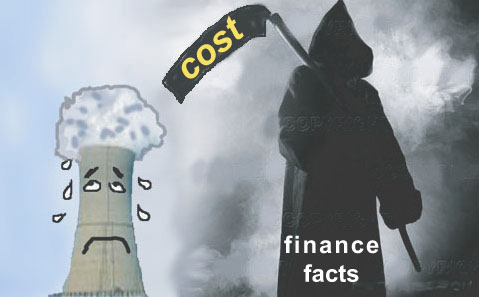
The most powerful argument against nuclear could be economic as most plants take at least ten years to commission, design and build
inews, By Leo Cendrowicz, Brussels Correspondent, 21 Apr 23,
BRUSSELS – As Europe scrambles for new energy sources, Britain has joined the countries seeking a nuclear renaissance.

Chancellor Jeremy Hunt announced last month the creation of Great British Nuclear, a body to oversee the roll-out of a fleet of nuclear power stations.
However, there are concerns about the environmental impact of nuclear, with campaign groups saying that the risks of nuclear reactions and the difficulties in disposing of nuclear waste mean it cannot be considered green.
And the most powerful argument against nuclear could be economic. Most plants take at least ten years to commission, design and build. Delays are frequent: Europe’s largest nuclear reactor, the Olkiluoto 3 plant in Finland, came online last week a full 14 years after its scheduled date, beset by technological problems that led to lawsuits – while its final price tag ballooned to around €11bn (£9.74bn), almost three times the initial estimate.
The steep upfront building costs for nuclear power plants, along with the long construction times, have raised questions about whether nuclear energy represents value for money.
Now that renewable costs are going down – especially in solar, wind and batteries – renewable is likely to be cheaper in the longer term, making nuclear commissions look less worthwhile.
The fact that Europe has built few nuclear plants since the boom wave of the 60s also means there is little expertise available across the value chain. The EU Internal Market Commissioner Thierry Breton has said a “colossal” investment in nuclear energy will be needed over the next 30 years to meet the EU’s emissions-reduction targets and electricity demand.
“The big question on nuclear is the economics of building new nuclear plants,” says Ben McWilliams, an energy research analyst at Bruegel – a Brussels-based think tank. “When you compare it to something like solar or wind, which are also modular technologies, so you can have much larger economies of scale – you have to ask if it is sensible to start building new nuclear plants that will come online in 15 or 20 years when they’re going to compete in a grid that should be largely renewable dominated?”
……………………………… France, Europe’s champion, has not been the best advertisement recently: last November, almost half of the country’s reactors were offline, thanks to maintenance issues in its ageing nuclear fleet.
The UK’s strategy is to focus on small modular reactors (SMRs) to ensure faster build times. These mini reactors would generate between 50 and 500 megawatts of power, compared with the 3.2-gigawatt Hinkley Point C in Somerset, the UK’s only large nuclear plant under construction, which is plagued by delays and cost overruns.
………………………….. . In February, 11 EU energy ministers signed a declaration committing to “cooperate more closely” across the entire nuclear supply chain and promote “common industrial projects” in new generation capacity as well as new technologies like small reactors.
While energy policy is mostly set at national level within the European Union, the long-term push is for green, renewable energy. The European Commission has attempted to nudge governments to wean themselves off fossil fuels, adopting a controversial measure that labels nuclear investments as sustainable “transitional” sources, if they replace dirtier fuels. Last Tuesday, Greenpeace and other campaign groups announced plans to take the Commission to the EU Court of Justice of the EU. https://inews.co.uk/news/world/uk-nuclear-energy-renaissance-expert-money-2289161
Will Environmental, social, and governance (ESG) investment managers follow the govt in backing nuclear?

By Chloe Cheung, 19 Apr 23, https://www.ftadviser.com/investments/2023/04/19/will-esg-investment-managers-follow-the-govt-in-backing-nuclear/
Wind turbines and solar panels are commonly associated with low-carbon energy, but nuclear power is also being considered in the pursuit of net zero.
In a move to encourage private sector investment, chancellor Jeremy Hunt said in the spring Budget that the UK green taxonomy will class nuclear power as ‘environmentally sustainable’, subject to consultation.
Although nuclear fuels are not renewable, the classification would enable nuclear power to have the same investment incentives as renewable energy.
But despite being low-carbon, it is not uncommon to come across ESG funds and investment companies that exclude nuclear power generation. So will investment managers follow the UK government’s approach to nuclear power?
William Argent, lead adviser to the VT Gravis Clean Energy Income Fund, says the fund’s responsible investment statement does not currently allow exposure to nuclear power generation assets.
“There may be some very modest exposure to companies involved in the nuclear energy supply chain, providing services; but we do not have exposure to companies that own nuclear energy generation plants themselves,” he adds.
While the UK government wants to class nuclear power as ‘environmentally sustainable’, Argent says his position on nuclear energy has, at this stage, not changed. “We exclude it as a commonly perceived ‘controversial activity’.
“There would need to be a shift in that perception among our investors and more widely. We would not consider changing the stance unless there was a broader acceptance.”
Other funds avoiding companies that generate revenue from nuclear power generation include Quilter Cheviot’s Climate Assets Funds.
“While we recognise that nuclear power does not generate greenhouse gas emissions, and therefore it has a role to play in the net-zero pathway and transition away from fossil fuels, we do not consider it a ‘sustainable investment’,” says Claudia Quiroz, lead fund manager of the Climate Assets Funds, and head of sustainable investment at Quilter Cheviot.
Citing environmental and safety issues that “outweigh” zero emission credentials, she says: “Nuclear energy generates a significant mass of radioactive waste. In addition, however it is disposed of, that radioactive waste will remain for generations to come.
“Safety concerns, both accidental and deliberate, also exist. While the operation of nuclear power plants is undoubtedly safer than previous generations and an accidental disaster on the scale of Chernobyl is unlikely, safety challenges do remain.
“Nuclear power plants are also easy targets for malevolent acts such as terrorist threats, cyberattacks or acts of war.”
Although Quiroz describes the UK government’s intended sustainable classification of nuclear energy as ultimately a positive move, she adds that as sustainable investors, it will not change the fund’s philosophy on investing in nuclear energy.
Jonathon Porritt: Germany’s nuclear nous vs UK nuclear nutters.

So that’s another dead duck in the case made for new nuclear. Which just leaves the final barrier: the continuing reality that our nuclear weapons capability still depends very heavily on maintaining a civil nuclear power programme – not just to guarantee a continuing supply of nuclear engineers and R&D funding, but to keep the public in the dark about the increasingly insupportable costs of renewing our notionally ‘independent’ nuclear deterrent.
I’m celebrating today – for the simple reason that Germany closed down its three remaining nuclear reactors on Saturday 15th April.
I’ve followed the nuclear debate in Germany ever since I first got involved in green politics back in the 1970s, and was hugely inspired by the campaigns of Die Grünen against both nuclear power and nuclear weapons – seeing the two as inextricably linked. Interestingly, it’s as controversial a debate now as it was then – with a majority of people in Germany (including some Die Grünen voters) still believing that nuclear power should be part of the electricity mix.
As I argued back in 2011, I did not agree with the decision of the Merkel Government (in coalition with Die Grünen) to close down all its remaining reactors in response to the Fukushima disaster – well before the end of their scheduled operational lifetime. Inevitably, this decision caused an (albeit temporary) increase in burning coal and gas.
That’s now water under the bridge – and Germany’s energy system will now be completely nuclear-free, even if it will be dealing with the legacy of its nuclear waste for many years to come. As the German Environment Minster, Steffi Lemke, said: ‘Three generations have benefitted from nuclear power in Germany, but about 30,000 generations will be affected by the ongoing presence of nuclear waste.’
But my celebration has been sadly attenuated by the current nuclear frenzy going on here in the UK. I’ve been through many periods of nuclear hype over the years, but nothing quite like this one – with all the mainstream political parties, the industry itself and all mainstream media (including some sorely deluded muppets in the BBC and the Guardian) ramping up their ‘nuclear renaissance’ rhetoric in increasingly dishonest and fact-free ways.
I suspect they see this as a ‘now or never’ moment before economic reality kills off nuclear power once and for all – when that combination of renewables-storage-efficiency is so massively outperforming nuclear as to starve all nuclear options of the capital they will still need. Government subsidy can only go so far.
In the meantime, however, we have a Government still strenuously seeking investors in its godforsaken plans for two more ludicrously expensive reactors at Sizewell C – an asset that already looks totally stranded even before a Final Investment Decision is taken.
Even that, however, is just a sideshow in comparison to the hype around prospects for Small Modular Reactors (SMRs) here in the UK. In March, the Chancellor announced a new competition to identify the best value SMR design for the UK, with a view to its eventually handing over a full £1bn in co-funding to get that design off the ground. Ludicrous. But full marks to the Tories for ‘recycling’ here: the announcement sounded almost identical to the earlier competition it announced back in March 2016. (And it was only the fifth time that the Chancellor reconfirmed plans for a new Great British Nuclear agency!)

Apart from the nuclear industry itself, and all its happy-clappy cheerleaders, the majority of independent commentators continue to point out that SMRs cannot possibly deliver what we now need: safe, affordable, ultra-low-carbon electricity that can actually make a practical difference in meeting our Net Zero target by 2035.
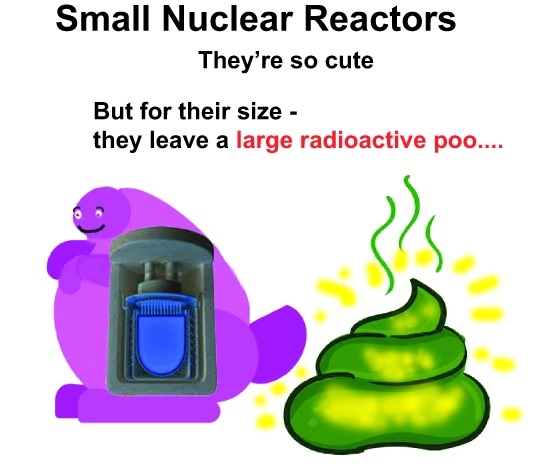
And that’s before one thinks about the nuclear waste nightmare: a new study published in Proceedings of the American National Academy of Sciences estimates that SMRs will create 30 times as much nuclear waste (per unit of electricity generated) as conventional reactors.
It’s all just a massive waste of time and public money – but with devastating consequences. If we could just free ourselves of our residual hankering after nuclear power, we could (finally!) double down on the infinitely more cost-effective renewables-storage-efficiency alternatives. With massive benefits in terms of decarbonisation, jobs, addressing fuel poverty and so on.
The case for this transition (away from fossil fuels and nuclear) is now incontrovertible but two remaining barriers stand in the way of us doing what Germany has managed to do.
The first is the endlessly repeated argument from nuclear industry spokespeople that nuclear power is the only way of providing the baseload generation our current electricity supply system depends on – once big thermal coal and gas plants are taken off the grid. There was indeed a time when grid stability depended on ‘always on’ big power stations. But that is now widely seen (outside the nuclear industry) to be a completely outmoded concept.
……………………… , the Government acknowledges that there is now no specific baseload expectations of nuclear or anything else. It is now all about ‘lowest cost’, rather than baseload,………..
So that’s another dead duck in the case made for new nuclear. Which just leaves the final barrier: the continuing reality that our nuclear weapons capability still depends very heavily on maintaining a civil nuclear power programme – not just to guarantee a continuing supply of nuclear engineers and R&D funding, but to keep the public in the dark about the increasingly insupportable costs of renewing our notionally ‘independent’ nuclear deterrent.

Which takes us right back to the origins of the German anti-nuclear movement in the 1970s. These ‘evil twins’, nuclear weapons and nuclear power, have forever been joined at the hip, and always will be until the world rids itself of the deadly incubus of nuclear weaponry.
Alba MP Neale Hanvey calls for Ministry of Defence to tackle nuclear decontamination at Dalgety Bay
The National, By James Walker @James_L_Walker 19 Apr 23
More than 3,000 radioactive particles have been found at Dalgety Bay.
ALBA Party MP Neale Hanvey has called on the Ministry of Defence to clean-up radiation contamination on the Dalgety Bay shoreline.
In a statement, Hanvey added that “there can be no excuse for inaction”.
Leading a Westminster debate on the issue on Tuesday, the MP for Kirkcaldy and Cowdenbeath – the constituency which includes the West Fife town – listed and condemned what he described as a “historical backlog in remediation”.
Radioactive material was first detected at Dalgety Bay in 1990 and came from WW2 planes, which had aircraft dials coated in radium to help pilots see in the dark.
More than 3,000 radioactive particles, with a half-life of 1,600 years, have been found on the beach and next to Dalgety Bay Sailing Club.
Restrictions were put in place in 2011, with parts of the beach fenced off.
The MoD admitted responsibility for the radioactive pollution in 2014. But plans to tackle the issue have frequently been delayed.
Balfour Beatty took on a £10.5 million contract in 2020 but decontamination work didn’t get under way until May 2021 and hasn’t yet been completed.
Hanvey has repeatedly condemned the Ministry of Defense for continued silence and delays in tackling the issue.
At the debate, Hanvey asked the Minister for Defence Procurement, Alex Chalk, for further clarification as to when the work would be completed, the costs incurred and whether they will be fully covered by the MoD.
Chalk said the cost would be around £15 million. He said that the costs would be be met by the MoD, but added: “I stress that there was absolutely no legal requirement on the Ministry of Defence to do so. However, we decided to take that step.”
Chalk also stressed that many of the delays were unforeseen, including having to “search through many tonnes of sand and soil for minute radioactive particles”.
He added, however, that he was “delighted” to say that work will be completed by September 2023…………………. more https://www.thenational.scot/news/23464754.alba-mp-neale-hanvey-calls-mod-tackle-nuclear-decontamination/
Ciaron says he was arrested for trying to give ‘the key to Julian Assange’s cell’ to Joe Biden

Ciaron O’Reilly says he was attempting to deliver “the key to Julian Assange’s cell” to US President Joe Biden, who is facing calls to drop extradition proceedings against the Wikileaks co-founder.
15 April 2023 By David Aidone, SBS News
KEY POINTS
- An Australian activist says he was arrested for protesting outside Dublin Castle during US President Joe Biden’s visit.
- Ciaron O’Reilly held a key-shaped placard demanding freedom for Julian Assange.
- Mr Assange, co-founder of WikiLeaks, is fighting extradition to the US.
An Australian anti-war activist and former bodyguard to Julian Assange claims he was arrested after staging a protest outside Dublin Castle in Ireland where United States President Joe Biden was attending an event this week.
Ciaron O’Reilly posted pictures of himself on social media holding a novelty-sized key-shaped placard emblazoned with the words “President Biden, Free Julian Assange“.
Mr O’Reilly said he was attempting to deliver the key to Mr Biden, who was on a four-day trip to Northern Ireland and Ireland honouring the 25th anniversary of the Good Friday Agreement.
He said he was arrested by officers of Garda Siochana, the national police service of Ireland, after protesting outside Dublin Castle while a banquet was being held for Mr Biden.
“Joe seemed to have dropped his key to #JulianAssange’s cell, I was merely returning it!,” Mr O’Reilly wrote on Twitter.
“We need to #FreeAssangeNOW! O’Reilly was wrestled to the ground by members of the GardaiSiochana outside #Dublin Castle where a banquet was underway during the #Biden visit,” the post read…………………………………… more https://www.sbs.com.au/news/article/ciaron-says-he-was-arrested-for-trying-to-give-the-key-to-julian-assanges-cell-to-joe-biden/d4rc1q76w
‘It’s time to pump the brakes on reintroduction of nuclear energy to Trawsfynydd’
By Patrick O’Brien | Columnist |Sunday 16th April 2023
‘It’s time to pump the brakes on reintroduction of nuclear energy to
Trawsfynydd’. Giving SMRs a clean bill of health in advance of any
researched-based demonstration that such is justified is bad enough, but en
route there is a sweeping assertion about the utter desirability of all
nuclear power – past and present.
For any deniers of the proposition, this
is a meltdown moment. SMRs, which can generate up to 300 megawatts, or
about two-thirds less than traditional nuclear power reactors. They are
claimed to be safer because of increased use of smart innovative technology
and inherent safety features.
So how solid is the SMR safety case? The
jury’s out. In 2021, the intergovernmental Nuclear Energy Agency (NEA)
established an expert group on SMRs “to handle safety challenges and
develop a solid scientific basis which supports safety demonstration of the
advanced and innovative technologies used for SMRs”.
But the NEA is clear
that much research on safety remains to be done. The Welsh Government,
meanwhile, is brimming over with enthusiasm, insisting its proposed project
will become essential for the diagnosis and treatment of a number of
diseases, and that its north Wales facility would be a global centre of
excellence in nuclear medicine, making Wales the leading location for
medical radioisotope production in the UK, leading to the creation of
highly skilled jobs over several decades.
But it’s time to slow down. The
NEA’s reticence on safety means it’s necessary for the government – and
Patrick Loxdale – to take a deep breath and, no doubt with difficulty,
reserve judgment.
Cambrian News 15th April 2023
Nuclear storage dump opponents sweep into Theddlethorpe parish council
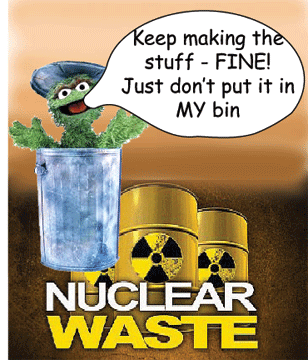
Residents have organised against storage plans
The Lincolnite, By Daniel Jaines Local Democracy Reporter 13 Apr 23
Candidates opposing a nuclear storage dump have surged to power in Theddlethorpe in a demonstration of local opposition.
Eight of the ten seats on two Theddlethorpe Parish Councils – St Helen’s and All Saints – have been filled uncontested by people against to Nuclear Waste Service’s plans for a Geological Disposal Facility in the village.
Nearby residents were in uproar after it was announced last year that the Theddlethorpe Gas Terminal could become the entry point for a nuclear storage facility to dispose of around 10% of the UK’s nuclear waste.
The new councillors, who will automatically become councillors after the May 4 local elections, are all part of Theddlethorpe Residents Association.
Members Brian Swift and Andrew Spink formed it after their application to join the parish councils were rejected in 2021.
Mr Swift said: “We were both turned down, but shortly after this we got together with a few neighbours and formed the Theddlethorpe Residents Association with the aim to give the parish a collective voice and to counter the PC’s negative stance.”
Since its inception, the residents association has garnered more than 120 members and holds regular events.
However, Mr Swift said the anti-GDF sentiment of the members would not mean other views would be unwelcome.
“Despite the fact that the majority of the councillors are now anti-GDF ,we are keen to stress that all points of view are welcome. Our priorities are to carry out the parish council’s functions to the best of our ability and to do our utmost to see that the village thrives and continues to be the friendly, united place we all call home,” he said………………………. more https://thelincolnite.co.uk/2023/04/nuclear-storage-dump-opponents-sweep-into-theddlethorpe-parish-council/—
Nuclear is not the solution to our energy troubles.
France pays a price for its energy security. President Macron has announced plans to build 6 new reactors by 2050 – and they’re much needed to replace the country’s ageing fleet of power stations – but he was warned very publicly just two months ago that he needs to have a credible programme to deal with the fourth issue: nuclear waste and both from the new planned plants and from the new ones. Right now, France’s nuclear waste facilities are close to over-flowing. In reality, if you’re worried about reactor safety, you should really be a lot more worried about nuclear waste. The full decommissioning process for a nuclear plant takes between 20 and 30 years. ……………….Furthermore, those small, modular nuclear power stations on which the Tory position relies? According to research published last year by Stanford University and the University of British Columbia, they produce more waste than conventional nuclear power plants.
Reaction Giga Watt, April 13, 2023
Both the current UK government and the likely next government want to embrace nuclear power.
Rishi Sunak has commissioned an energy review that will focus on “carbon capture and storage, small modular reactors and the like”. Keir Starmer’s proposed “Great British Energy” would invest in nuclear energy alongside wind, solar, tidal and other emerging technologies. There’s nothing new about nuclear power and if it was the solution to all our problems – and on the face of it, it should be – the world would have already fully embraced nuclear, risks and all. So why haven’t we?
………… burning fossil fuels is very much not consequence free and we’re only just starting to get serious about those consequences and no amount of “clean” coal, unleaded fuel, catalytic converters, wonderful though they are, can make up for this.
Secondly, nuclear power is scary: the world’s first public demonstrations of nuclear power were at Hiroshima and Nagasaki. Roughly once a decade since then, the world has provided us with reminders of just how frightening nuclear power can be: the Cuban Missile Crisis, Three Mile Island, Exercise Able Archer, Chernobyl, Fukushima and Zaporizhzhia are all examples from the past 60 years where the perils of a nuclear world have been brought home to us.
………………………………………………………………….. It’s also true that the rise of more sophisticated terrorist organisations made the public and thereby politicians wary of the nuclear industry especially from 9/11 onwards. If terrorists can fly two large aeroplanes into the heart of the biggest financial centre in the world then surely an isolated power station would be a much easier target………….. At Zaporizhzhia in Ukraine during the current conflict, the issue is less about the impact on the reactors themselves from Russian shelling but the impact on waste storage facilities and power supplies to cooling and safety systems
……….As the Zaporizhzhia reactors were being switched off, they still needed to be continuously cooled with water from the Dnieper to ensure safe shutdown because they produce so much heat. Uranium-filled fuel rods, the source of nuclear fission within the reactor, are immersed in water for around 10 years after they are used before they reach a temperature at which they can be safely handled. It’s this efficiency that makes nuclear power an unusual part of the energy mix as, unlike gas or coal, you can’t easily turn the output up or down. Nuclear energy just is.
This means that in a system that requires flexibility, and remembering that UK electricity demand can swing between 40 GWs and 20 GWs in just one day, nuclear power is unsuited to modern demands. ………………….
France pays a price for its energy security. President Macron has announced plans to build 6 new reactors by 2050 – and they’re much needed to replace the country’s ageing fleet of power stations – but he was warned very publicly just two months ago that he needs to have a credible programme to deal with the fourth issue: nuclear waste and both from the new planned plants and from the new ones. Right now, France’s nuclear waste facilities are close to over-flowing. In reality, if you’re worried about reactor safety, you should really be a lot more worried about nuclear waste. The full decommissioning process for a nuclear plant takes between 20 and 30 years. ……………….Furthermore, those small, modular nuclear power stations on which the Tory position relies? According to research published last year by Stanford University and the University of British Columbia, they produce more waste than conventional nuclear power plants.
Part of the problem with waste is that, even as we approach the 70th anniversary of the first nuclear power stations, there is still no global consensus on how best to handle high level nuclear waste because the timeframes are so immense. What seems like an obvious solution today – for example, storing waste in deep geological repositories hundreds of metres below the ground – may end up being a total disaster in 500 or even 5,000 years’ time. What do those timescales mean? It means asking Henry VIII, King of England in 1523, to make decisions about the country we live in today. Unsurprisingly we have ended up with a halfway house: everyone agrees that toxic waste can be treated and converted into less dangerous (but still very dangerous) forms; everyone also agrees that it’s probably best if it’s stored underground but no one can yet agree what underground means and what the risks will be over the centuries to come.
And if the timescales are immense, then so are the costs: the Sellafield facility in Cumbria is being decommissioned with a current cost estimate of £121 billion which does not included the placing of the waste from the site into a geological disposal facility, the location and timing of which are to be determined, which will cost another £53 billion.
At least Henry VIII would not have had to deal with our fifth hurdle: the British planning system and an island cluttered with around 65 million people and it’s this, perhaps above all, that makes new nuclear projects vanishingly unlikely. I don’t want to live next to a nuclear power station of any size and I doubt many Reaction subscribers would either but because we live in an age of Nimbyism, it’s doubtful that any of us will be asked to do so anyway. Even if we are, and if the project is approved, investment is found and if construction starts, you can look forward to the project, counting from today, delivering power in roughly 2035 and that’s being very optimistic.
……………………. over the past ten years, the UK has done so much to change its energy mix that investing in nuclear now, with all the cost, time and controversy involved, would be a significant mistake. It seems unlikely that it will take Sunak and Starmer, arch-pragmatists that they both are, very long to work this out. https://reaction.life/nuclear-is-not-the-solution-to-our-energy-troubles/
An operational domain’: Fear UK nuclear power plan for moon may lead to militarisation of space

Rolls-Royce’s director of future programmes Abi Clayton tellingly said: ‘The technology will deliver the capability to support commercial and defence use cases.’
These activities are all completely contrary to the legal commitments the UK made a half century ago to preserve space for peace.
It may mirror the plot of classic ‘70s British sci-fi series, Space 1999, which also features a moon base and the threat posed by radioactive waste, but the UK/Ireland Nuclear Free Local Authorities also have real concerns that the development of a future British moon base powered by nuclear fission could represent a further unwanted development along the road to the militarisation of space.
Today is the UN International Day of Human Space Flight. On April 12, 2011, the UN General Assembly established the day on the 40th anniversary of Major Yuri Gagarin becoming the first human being to circle the Earth in his spacecraft ‘Vostok’. UN delegates reaffirmed ‘the important contribution of space science and technology in achieving sustainable development goals and increasing the well-being of States and peoples, as well as ensuring the realization of their aspiration to maintain outer space for peaceful purposes’.
Last week, the UK Space Agency announced a £2.9 million grant is to be awarded to Rolls-Royce SMR to collaborate with academic institutions to develop mini-reactors for deployment in space, with most media reports focusing on its potential to power a future moon base as part of the UK’s commitment to an international project to colonise the Earth’s near neighbour (Project Artemis). However, in welcoming the new funding, Rolls-Royce’s director of future programmes Abi Clayton tellingly said: ‘The technology will deliver the capability to support commercial and defence use cases.’
Whilst projects in outer space can be both benign and beneficial, the UK Space Strategy and UK Space Defence Strategy both identify that ‘NATO has made space one of five operational domains’,[1] and the UK Space Defence Strategy is subtitled ‘Operationalising the Space Domain’.[2] To make this a reality, the UK Government is intent upon investing £6.4 billion in a ‘Defence Space Portfolio’[3] for defence ‘in and through space’.[4]
For these purposes, the UK has joined the US and France in developing its own Space Command, and a nuclear moon base could in time become a part of the ‘portfolio’ from which UK Space Command operates,[5] in line with the government and military’s desire to ‘assure our access to, and operational independence in, space’.[6]
These activities are all completely contrary to the legal commitments the UK made a half century ago to preserve space for peace.
“Ironically the UK was in 1967 one of the first three co-signatories of the Outer Space Treaty which pledged the sponsors to ensure ‘that the Moon and other celestial bodies shall be used exclusively for peaceful purposes’”,[7] said Councillor Lawrence O’Neill, Chair of the NFLA Steering Committee.
“Our fear is that any future nuclear-powered moon-base could be ultimately crewed by military personnel from Space Command conducting operations that would be far from benign and beneficial, whether this be the permanent surveillance of perceived hostile states on Earth or more sinisterly as a platform for offensive weapons systems to project military power ‘through space’.
“And of course, once one major power establishes such a base, then the others, all not wishing to be outdone, will seek to do the same.”
The NFLA also has real practical concerns about the environmental impact of such a nuclear-powered base.
Councillor O’Neill added: “We have worries about the transfer of nuclear materials into space. It is not unknown for rockets to malfunction and explode on take-off or in early flight, indeed sadly this has led to the loss of human life, nor for radioactive material to be distributed across the surface of the Earth by exploding space vehicles, witness the accident involving Soviet satellite Kosmos 954.[8] And the UK Government’s own Committee on Radioactive Waste Management dismissed the idea of blasting radioactive waste into space on the grounds of both risk and cost.
“And in turn, a nuclear-powered moon base would generate radioactive waste. Where would this be put? If it came back to Earth, there would remain the risk of an accident on re-entry and states parties to the Outer Space Treaty also pledge to ‘avoid harmful contamination of space and celestial bodies’ so burial in situ below the lunar surface or blasting it into space would be unlawful”.
Lastly there is also a latent threat posed from outer space itself to the facility.
n 2016, NASA announced the findings of their Lunar Reconnaissance Orbiter (LRO) mission. Observing the lunar surface since launch in 2009, NASA scientists reported that ‘200 impact craters (had) formed during the LRO mission, ranging in size from about 10 to 140 feet (approximately 3 to 43 meters) in diameter’. Consequently, NASA recommended that ‘equipment placed on the moon for long durations – such as a lunar base – may have to be made sturdier. While a direct hit from a meteoroid is still unlikely, a more intense rain of secondary debris thrown out by nearby impacts may pose a risk to surface assets.’
In concluding Councillor O’Neill said: “We have all been concerned recently with the potential damage that could be caused on Earth to Ukrainian nuclear facilities from shelling and missile strikes so what happens if a meteoroid, or a fragment thereof, with massive kinetic energy hits a nuclear reactor based on the surface of the moon?[9]
Concern over funding ‘stigma’ from Theddlethorpe nuclear storage
Only a ‘handful’ of applications made
By Daniel Jaines Local Democracy Reporter , The Lincolnite, 12 April 23
There are concerns that community groups in Theddlethorpe are not applying for a share of nearly £1million due to of the money’s links with a potential nuclear storage dump.
Only a handful of applications from Theddlethorpe community groups have been received for the grants.
The money is being made available due to Nuclear Waste Services exploring a potential for the area to host a Geological Disposal Facility.
The money is set to be handed out over the next 15-20 years — with £1million a year allocated while local studies are carried out, and £2.5million a year while drilling boreholes and further exploring the geology of the area.
Lincolnshire County Council’s Environment and Economy Scrutiny Committee were told on Tuesday that few groups had come forward to claim it.
Councillor Matthew Boles said: “It would strike me that the reason there’s a very small uptake in applying for these grants is that the local residents have attached stigma to it.
“They might feel that if they apply for this money they’re somehow supporting and are in favour of it.”
However, council officers said they didn’t believe this was the case.
Councillor Martin Griggs and some others also worried that the £1m budget would be difficult to match after the first year.
Councillors also raised concerns about any strings being attached to the bids and a lack of detailed information around infrastructure needs and the 4,000 jobs NWS has said the GDF works could create over its lifetime………………………….
Councillors were told that Lincolnshire County Council had challenged the jobs figures and called for a more localised report……………… https://thelincolnite.co.uk/2023/04/concern-over-funding-stigma-from-theddlethorpe-nuclear-storage/
Massive undersea works to commence for HinkleyPoint C nuclear project
Two huge vessels have arrived off the coast of Somerset as offshore work
continues on the UK’s newest nuclear power station, Hinkley Point C. Named
Neptune and Sea Challenger, they are ‘jack-up’ vessels, used to create six
vertical shafts into the seabed.
The shafts will be used to install
components for the power station’s cooling water system. The plant will
eventually be cooled by water flowing through six miles (10km) of tunnels.
Hinkley Point C has been under construction by EDF Energy for five years.
Once the shafts, which will go 20m (70ft) into the seabed, are installed,
miners will dig a horizontal connection between them and the cooling
tunnels.
BBC 11th April 2023
Westminster keeps nuclear secrets to avoid upsetting Scottish Government
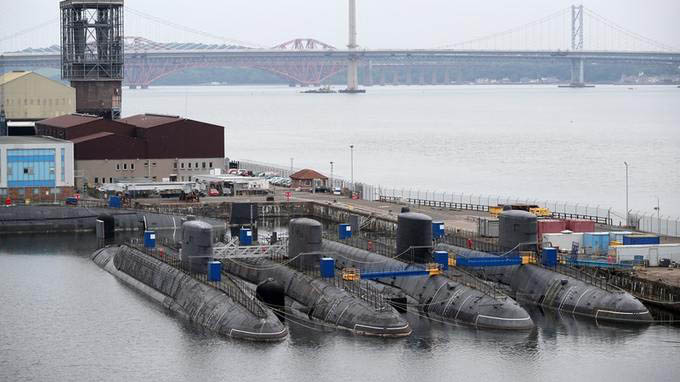
The Ferret, Rob Edwards, April 10, 2023
The UK Government is refusing to say why it is keeping nuclear safety reports secret because it is worried about “anti-nuclear arguments from the Scottish Government”.
The Ministry of Defence (MoD) won’t give its reasons for failing to release annual assessments of the safety of nuclear weapons on the Clyde so as not to “prejudice relations between the UK and Scottish governments”.
The secrecy has been condemned by the Scottish Greens as “outrageous, undemocratic and frankly dangerous”. It was akin to nuclear policies in Russia, China and North Korea, according to a campaigner — and it was described as “totally unacceptable” by a former nuclear submarine commander.
The Scottish Government urged the MoD to be “open and transparent” about the handling of nuclear materials in Scotland. The MoD said it had to “strike a balance” between public interest in safety and protecting information about nuclear weapons.
Annual reports from the MoD’s internal watchdog, the Defence Nuclear Safety Regulator (DNSR), were released for ten years, but ceased being published in 2017. A freedom of information appeal to a UK tribunal to force the MoD to again release the reports was rejected in July 2021.
The Ferret previously revealed that the reports for 2005 to 2015 highlighted “regulatory risks” 86 times, including 13 rated as high priority. One issue repeatedly seen as a high risk was a shortage of suitably qualified and experienced engineers.
Now the MoD has rejected another freedom of information request asking for documents that set out the rationale for refusing to release more recent DNSR reports. It disclosed that the decision was taken in 2017 by then secretary of state for defence, Michael Fallon, but has withheld information on why……………………………………..
The MoD letter also argued that information on reasons for withholding the reports should be kept secret “for the purpose of safeguarding national security”. Secrecy was also necessary so as not to prejudice “the defence of the UK” or “the relationship between the UK and the US” as well as to allow a “safe space” for officials to advise ministers.
Nuclear secrecy ‘totalitarian’
The Scottish Greens argued that the people of Scotland have a “fundamental right” to know the risks they face from hosting weapons of mass destruction on the Clyde. Suppressing information that may support arguments against nuclear weapons poses a “clear and present danger” politically, it warned.
“The extraordinary admission in this letter that the MoD and UK Government are actively concealing key pieces of information from the Scottish Government is outrageous, undemocratic and frankly dangerous,” said Green MSP, Mark Ruskell.
“The MoD is basically saying they won’t share this information because they are scared Scotland won’t like it and it might upset the US. You simply can’t get any more totalitarian than that and this should be challenged further.”
Ruskell added: “If they want to reassure people that there are no unnecessary added dangers, they should share the information urgently and transparently. If not they should pack up and ship out. Scotland doesn’t want nukes here and they know it.”
The nuclear researcher and campaigner who has been challenging the MoD’s refusal to release the nuclear safety reports is Peter Burt. UK citizens are allowed to know “virtually nothing” about the hazards of nuclear weapons despite paying billions of pounds for them, he said.
“We’re not allowed to know whether the Ministry of Defence’s safety watchdog thinks the nuclear weapons programme is complying with public protection arrangements, and Scottish Ministers are not trusted to know what is going on at the Navy’s nuclear bases in Scotland,” Burt told The Ferret.
“It’s pretty clear that this has more to do with politics than security. While the US government regularly releases information about its nuclear weapons programme, the UK Government has decided to model its own nuclear policies on those of countries like Russia, China, and North Korea.”
Rob Forsyth, a former Royal Navy nuclear submarine commander who now campaigns against nuclear weapons, described the MoD’s justifications for secrecy as “totally unacceptable”.
He said: “The way to avoid any misinterpretation is to be honest and fully transparent over matters affecting public safety and our national defence. The notion that government should not allow public discussion is not conduct expected of a democracy.”
The Scottish Government reiterated its opposition to the possession of nuclear weapons and its support for world-wide nuclear disarmament. ……………………………………………………………….. more https://theferret.scot/nuclear-secrets-scottish-government/
DID THE UK DEPLOY A NUCLEAR-ARMED SUBMARINE TO THE FALKLANDS CONFLICT?
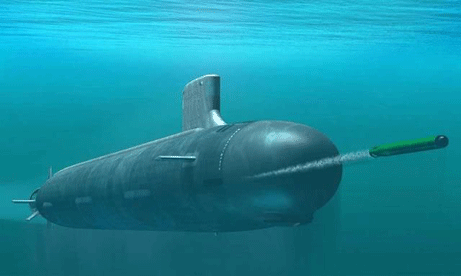
Evidence suggests Britain sent one of its Polaris submarines, which carried 16 ballistic missiles with thermonuclear warheads, to the Falklands during the 1982 war.
RICHARD NORTON-TAYLOR, 6 APRIL 2023 Declassified UK
The war in Ukraine has provoked concern about the use of nuclear weapons, heightened by Russia’s plan to base tactical nuclear arms in Belarus.
While the US and Russia have kmade no secret of their development of these dangerous, indeed potentially devastating, additions to traditional nuclear arsenals, British military planners have also been in on the act – rather more quietly.
The British government, far from taking measures to reduce nuclear tensions in recent years, itself announced, in 2021, that it planned to increase the cap on Britain’s nuclear stockpile to 260 warheads, a 40 per cent increase on previous commitments.
More recently, Britain has refused to comment on reports of a planned new deployment of US tactical nuclear weapons to the American air force base in Lakenheath in Suffolk.
With the exception of the Scottish National Party and Green Party, all British political parties are backing, with growing enthusiasm, the policy of maintaining a Trident missile submarine “continuously at sea”, at an initial estimated cost – not disputed by the Ministry of Defence – of more than £200bn.
The deployment of British nuclear weapons was belatedly highlighted during the 1982 Falklands conflict after the government failed to cover up their presence on ships in the naval task forces. Declassified revealed last year that British warships deployed to the South Atlantic were secretly carrying 31 nuclear depth charges.
But there have been repeated suggestions, never convincingly denied, that even more devastating weapons were deployed during the conflict.
A number of sources have indicated that a submarine equipped with Polaris strategic nuclear missiles – then Britain’s major nuclear weapons system and the forerunner to the current Trident – was diverted to the South Atlantic within range of Argentina.
Polaris
The claims were originally spelled out in a paper on “Sub Strategic Trident” by the widely respected academic, Paul Rogers, emeritus professor of peace studies at Bradford University………………………………………………………..
….the implications of the analysis – that the Thatcher government was prepared to threaten nuclear use against a non-nuclear state………………………………………………….
First use
This was all more than 40 years ago, but is still relevant today, given that the UK has maintained a nuclear posture that includes first-use of nuclear weapons since at least the 1960s. ……………………………….
Confusion, uncertainty
Successive British governments have deliberately used confusion – they call it uncertainty – over the circumstances in which nuclear weapons would be used to boost their argument that they are a “credible” deterrent. …………………………………………
Putin’s deployment of tactical nuclear weapons to Belarus has been condemned by NATO. But as Daniel Hogsta, executive director of ICAN, the International Campaign to Abolish Nuclear Weapons, has pointed out, the US stations nuclear weapons in five European countries – Belgium, the Netherlands, Germany, Italy and Turkey, and now in Britain as well, it seems – and is currently modernising its arsenal.
……………………………………… Putin’s earlier implied threats to use nuclear weapons in the war in Ukraine is rightly viewed as a dangerous and destabilising position to take. It is also uncomfortably close to the UK’s position during the Falklands War over 40 years ago. https://declassifieduk.org/did-uk-deploy-nuclear-armed-submarine-to-falklands-conflict/
Four arrested after blockade of two gates at Trident nuclear base in Scotland
Posted on April 6, 202, by Margaret Ferguson Burns http://www.nukeresister.org/2023/04/06/four-arrested-after-blockade-of-two-gates-at-trident-nuclear-base-in-scotland/?fbclid=IwAR0_QXUS6bh8GFYojhTTaBg7cF7qqXkt2NTNnuDBjGJUVg92m7CVSfxUc_M
This morning, 5th April – an early start and a fine action.
Lying in a lock-on, enjoying the sounds of the gate sliding shut behind us, the warning klaxon overhead, high above the electrified, barbed wire topped main entrance to HMNB Clyde (home of the UK’s nuclear powered and armed submarines of mass destruction) – and the merry call of “Bandit Alarm; North Gate closed; traffic within the base divert to…” blaring out from the loudspeakers.
The heavy rain splashing chill on our faces in the dull coldness, and creeping through the many layers of clothing.
Clad in an International Campaign to Abolish Nuclear Weapons (ICAN) “Nuclear Weapons ARE BANNED” banner (what else could it be?).
And a little later the even merrier message of “Both North and South Gates now closed – all traffic use the Fire Engine Gate” – loudly hailed into the air. So the second team in successful lock-on too.
And then a Ministry of Defence police truck arriving with blue lights flashing; and the cutting crew truck appearing on the scene too.
So it was, for two lock-on teams from Faslane Peace Camp – the four arrested (Alexander, Finlay, Willemien, Margaret), handcuffed and taken off to Clydebank Polis Station (still wearing the ICAN banner through check-in at the Sergeant’s desk – aye). And it’ll be off to Dumbarton Sherriff Court in the morning.
All to protest the UK Government’s plans to provide depleted uranium munitions to Ukraine in its defence against the Russian invasion – it’s known to cause leukaemia, birth defects and much more.
Success was enabled by welfare support from other camp members during the action; and tasty hot food and a blazing hot stove on return to camp late – after release on signing an “Undertaking” to appear in court next day (including the acceptance of various conditions until then e.g. not to go within 20 metres of the base).
[Update – All four activists were out by late afternoon, Thursday, 6th April – court proceedings to follow at some point.]
1 This Month

of the week – Shut Down Drone Warfare!


Tell the Ukrainian Government to Drop Prosecution of Peace Activist Yurii Sheliazhenko

Petition to revoke the licensing of the Near Surface Nuclear Disposal Facility (NSDF) at Chalk River. https://www.ourcommons.ca/petitions/en/Petition/Details?Petition=e-7247
To see nuclear-related stories in greater depth and intensity – go to https://nuclearinformation.wordpress.com
-
Archives
- April 2026 (103)
- March 2026 (251)
- February 2026 (268)
- January 2026 (308)
- December 2025 (358)
- November 2025 (359)
- October 2025 (376)
- September 2025 (257)
- August 2025 (319)
- July 2025 (230)
- June 2025 (348)
- May 2025 (261)
-
Categories
- 1
- 1 NUCLEAR ISSUES
- business and costs
- climate change
- culture and arts
- ENERGY
- environment
- health
- history
- indigenous issues
- Legal
- marketing of nuclear
- media
- opposition to nuclear
- PERSONAL STORIES
- politics
- politics international
- Religion and ethics
- safety
- secrets,lies and civil liberties
- spinbuster
- technology
- Uranium
- wastes
- weapons and war
- Women
- 2 WORLD
- ACTION
- AFRICA
- Atrocities
- AUSTRALIA
- Christina's notes
- Christina's themes
- culture and arts
- Events
- Fuk 2022
- Fuk 2023
- Fukushima 2017
- Fukushima 2018
- fukushima 2019
- Fukushima 2020
- Fukushima 2021
- general
- global warming
- Humour (God we need it)
- Nuclear
- RARE EARTHS
- Reference
- resources – print
- Resources -audiovicual
- Weekly Newsletter
- World
- World Nuclear
- YouTube
-
RSS
Entries RSS
Comments RSS
 nuclear-news