Chris Hedges: Craig Murray on the ‘Slow Motion Execution’ of Assange
And I saw, 100% for certain, that the judge came into court with her ruling already typed out before she heard the arguments, and she sat there almost pretending to listen to what the defense was saying for now and what the prosecution was saying for now. Then she simply read out the ruling.
Chris Hedges: She’s like the Queen of Hearts in Alice in Wonderland giving the verdict before she hears the sentence.
SCHEERPOST, September 17, 2023
Julian Assange continues to fight extradition to the United States to face prosecution under the Espionage Act, a growing chorus of voices is rising to demand an end to his persecution. Hounded by US law enforcement and its allies for more than a decade, Assange has been stripped of all personal and civil liberties for the crime of exposing the extent of US atrocities during the War on Terror. In the intervening years, it’s become nakedly apparent that the intent of the US government is not only to silence Assange in particular, but to send a message to whistleblowers and journalists everywhere on the consequences of speaking truth to power. Former British ambassador to Uzbekistan, Craig Murray, who was fired for exposing the CIA’s use of torture in the country, joins The Chris Hedges Report to discuss what Julian Assange’s fight means for all of us.
TRANSCRIPT
Chris Hedges: Craig Murray, the former British ambassador to Uzbekistan, was removed from his post after he made public the widespread use of torture by the Uzbek government and the CIA. He has since become one of Britain’s most important human rights campaigners and a fierce advocate for Julian Assange as well as a supporter of Scottish independence. His coverage of the trial of former Scottish first minister Alex Salman, who was acquitted of sexual assault charges, saw him charged with contempt of court and sentenced to eight months in prison. The very dubious sentence, half of which Craig served, upended most legal norms. He was sentenced, supporters argued, to prevent him from testifying as a witness in the Spanish criminal case against UC global director, David Morales, being prosecuted for installing a surveillance system in the Ecuador embassy when Julian Assange found refuge that was used to record the privileged communications between Julian and his lawyers.
Morales is alleged to have carried out this surveillance on behalf of the CIA. Murray has published some of the most prescient and eloquent reports from Julian’s extradition hearings and was one of a half dozen guests, including myself, invited to Julian and Stella’s wedding in Belmarsh Prison in March 2022. Prison authorities denied entry to Craig, based on what the UK Ministry of Justice said were security concerns, as well as myself from attending the ceremony.
Joining me to discuss what is happening to Julian Assange and the rapid erosion of our most basic democratic rights is Craig Murray.
And to begin, Craig, I read all of your reports from the trial which are at once eloquent and brilliant. It’s the best coverage that we’ve had of the hearings. But I want you to bring us up to date with where we are with the case at this moment.
Craig Murray: Yeah. The legal procedures have been extraordinarily convoluted after the first hearings for the magistrate ruled that Julian couldn’t be extradited, on essentially, health grounds. Due to the conditions in American prisons, the US then appealed against that verdict. The high court accepted the US appeal on extraordinarily dubious grounds based on a diplomatic note giving certain assurances which were conditional and based on Julian’s future behavior. And of course, the US government has a record of breaking such assurances, and also, those assurances could have been given at the time of the initial hearing and weren’t.
Chris Hedges: I don’t think those assurances have any… It was a diplomatic note. It has no legal validity.
Craig Murray: It has no legal validity. It’s not binding in any sense. And as I say, it is in itself conditional. It states that they may change this in the future. It actually says that –
Chris Hedges: Well, based on his behavior.
Craig Murray: – Based on his behavior, which they will be the sole judges of.
Chris Hedges: Of course.
Craig Murray: And which won’t involve any further legal process. They will decide he’s going into a supermax because they don’t like the way he looks at guards or something. It’s utterly meaningless. And so the US, having won that appeal so Julian could be extradited, it was then Julian’s turn to appeal on all the points he had lost at the original extradition. Those include the First Amendment, they include freedom of speech, obviously, and they include the fact that the very extradition treaty under which he’s being extradited states that there shall be no political extradition and this is plainly a very political case and several other important grounds. That appeal was lodged. Nothing then happened for a year. And that appeal is an extraordinary document. You can actually find it on my website, CraigMurray.org.uk.
I’ve published the entire appeal document and it is an amazing document. It’s an incredible piece of legal argument. And some of the things it sets out like the fact that the US key witness for the charges was an Icelandic guy who they paid for his evidence. They paid him for his evidence and he is a convicted pedophile and convicted fraudster. And since he has said he lied in his evidence and he just did it for the money. That’s one example of the things you find. The documentation is not dry legal documentation at all. It’s well worth going and looking through Julian’s appeal. That appeal ran to 150 pages plus supporting documents.
For a year, nothing happened. Then two or three months ago it was dismissed in three pages of double-spaced A4, in which the judge, Judge Swift, said that there were no legal arguments, no coherent legal arguments in this 150 pages and it followed no known form of pleading and it was dismissed completely. And the thing is that the appeal was written by some of the greatest lawyers in the world. It’s supervised and written by Gareth Pierce, who I would say is the greatest living human rights lawyer. Those people have seen the film In the Name of the Father, starring Daniel Day-Lewis…………………………………….
She’s won numerous high-profile cases. She has enormous respect all around the world and this judge, who is nobody, is saying that there’s no validity to her pleadings which follow no known form of pleading. This is quite extraordinary.
Chris Hedges: Am I correct in that he was a barrister, essentially, for the defense ministry? He was served the interests of the UK government and that’s essentially got him his position. Is that correct?
Craig Murray: Exactly. He was the lead barrister for the security services. Well, he was a banister who specialized in working for the security services.
……………………………………………………And I saw, 100% for certain, that the judge came into court with her ruling already typed out before she heard the arguments, and she sat there almost pretending to listen to what the defense was saying for now and what the prosecution was saying for now. Then she simply read out the ruling.
Chris Hedges: She’s like the Queen of Hearts in Alice in Wonderland giving the verdict before she hears the sentence.
……………………………..On the most basic level, the evisceration of attorney-client privilege because UC Global recorded the meetings between Julian and his lawyers, that in a UK court, as in a US court alone, should get the trial invalidated
Craig Murray: In any democracy in the world, if your intelligence services have been recording the client’s attorney consultations, that would get the case thrown out. ………………………….
……………………………………………………………………………………………………………….at times it seemed as though they were deliberately doing things as slowly as possible.
Chris Hedges: Well, this is what Neils Melzer, the special repertoire on torture for the UN, said that he called it, a slow motion execution, were his words.
………………………………..Craig Murray: It was because of my advocacy for and friendship with Julian. That’s why they put me in jail. I was in the cell, my cell was 12 feet by eight feet which is slightly larger than Julian’s cell, and I was kept in solitary confinement for 23 hours a day, sometimes 23.5 hours a day for four months. And that’s extremely difficult. It’s extremely difficult. But I knew when I was leaving, I had an end date. To be in those conditions as Julian has been for years and years and no idea if it will ever stop, no idea if you’ll ever be let out alive, let alone not having an end date, I can’t imagine how psychologically crushing that would be……………………………………………………………………………….
Craig Murray: The immediate thing that will happen is that Julian’s lawyers will try to go to the European Court in Strasbourg –
Chris Hedges: To the European Court of Human Rights.
Craig Murray: – The European Court of Human Rights to submit an appeal and get the extradition stopped, pending an appeal. The worry is that Julian would instantly be extradited and that the government wouldn’t wait to hear from a European Court.
Chris Hedges: Explain to Americans what it is and what jurisdiction it has in the UK, the European Court.
Craig Murray: Yeah, the European Court of Human Rights is not a European Union body. It’s a body of the Council of Europe. It has jurisdiction over the European Convention on Human Rights which guarantees basic human rights and therefore it has legally binding jurisdiction over human rights violations in any member state of the treaty. So it does have a legally binding jurisdiction and is acknowledged as such, normally, by the UK government. They’re very powerful voices within the current conservative government in the UK which wants to exit the convention on human rights. But at present, that’s not the case. The UK is still part of this system. And so the European Court of Human Rights has legally binding authority over the government of the United Kingdom purely on matters that contravene human rights.
Chris Hedges: And if they do extradite him, they’ve essentially nullified that process, the fear is that, of course, the security services would know about the ruling in advance. He’d be on the tarmac and shuttled in, sedated, and put in a diaper and hooded or something and put on a CIA flight to Washington. I want to talk about if that happens. It’s certainly very possible. What we need to do here, and I know part of the reason you’re in the US, is to prepare for that should it take place. You will try and cover the hearings and trial here as you did in the UK but let’s talk about where we go if that event occurs.
Craig Murray: Yeah. The first thing to say is that if that happens, on the day it happens, it will be the biggest news story in the world; It would be a massive news story. So we have to be prepared. We have to know who, from the Assange movement or who from his defense team, who’s going to be the spokesman, who are going to be the spokespeople, who are going to be offered up to all the major news agencies? We have to affect the story on day one. Because if you get behind the story – And we know what their line will be. They’ll put out all these lies about people being killed because of WikiLeaks, about the American insecurity being endangered, we know all the propaganda that they will try to flood the airwaves with – So we need to be ready and ahead of the game to know who our people are, who are going to be offered up to interview, who are going to proactively get onto the media, and not just the alternative media like this media, but onto the so-called mainstream as well, and get out the story…………………………………………………………………………………………………………………………………………………………………
Chris Hedges. ………………….my reading of it is that they don’t care how they look. And part of it is to send a message. It doesn’t matter what nationality you are, it doesn’t matter where you are. WikiLeaks is not a US-based publication, it doesn’t matter where you are. If you expose the information that Julian and WikiLeaks exposed, we’re going to come for you. Isn’t that the message?
Craig Murray: That’s absolutely right. And this, again, it’s amazing they don’t see the dangers in this claim of universal jurisdiction. …………………….
This claim of universal jurisdiction is extraordinary. And what’s even more extraordinary is they’re claiming universal jurisdiction but Julian is under their jurisdiction because he published American Secrets even though he’s not an American and he wasn’t in America. And at the same time, while they claim jurisdiction over him, they’re claiming he has no First Amendment rights because he’s an Australian.
The combination of we have jurisdiction over you, you have all the liabilities that come with that but you have none of the rights that come with that because you’re not one of our citizens, that’s pernicious. It’s so illogical and so vicious. …………………………………………
Chris Hedges: I want to close because there’s been noise out of Australia. The ambassador, Carolyn Kennedy, said that they might consider a plea deal. I have put no credence in it. It’s all smoke but I wondered what you thought.
Craig Murray: Yeah. It’s an attempt to placate Australian public opinion. Public opinion in Australia is extremely strong. Over 80% of Australians want Julian released and allowed to go home to Australia. Blinken came there and made some very hostile and un-diplomatic remarks at a time when Australia was allowing the US to base nuclear weapons on its side. Caroline Kennedy came out… It’s a lie, frankly. There has been no approach from a justice department or from the State Department to doing any plea deal. It’s purely smoke and mirrors to try to distract the Australian public. Caroline Kennedy was lying to the Australian public. That’s pure and simple.…………..
UK launches search for private investment in Sizewell C nuclear project
Reuters. September 18, 2023
LONDON, Sept 18 (Reuters) – Britain on Monday opened the search for private investment in the Sizewell C nuclear project, inviting potential investors to register their interest.
………. The government, the Sizewell C Company and EDF, the project’s lead developer, are looking for companies with substantial experience in the delivery of major infrastructure projects,” a statement from the Department for Energy Security and Net Zero said.
The British government announced last year that it would support Sizewell C with around 700 million pounds ($895 million) while taking a 50% stake during its development phase. https://www.reuters.com/business/energy/uk-launches-search-private-investment-sizewell-c-nuclear-project-2023-09-18/
September 14, 2023: Dounreay decommissioning end date that proved to be unachievable

By Alan Hendry – alan.hendry@hnmedia.co.uk, 14 September 2023
The end of an era for Caithness… the last chapter in a pioneering
industrial story that began in the black-and-white world of the 1950s… a
final farewell to our great atomic age… Or at least, it would have been
if a prediction made 11 years ago had proved to be accurate.
It was in May 2012 that Roger Hardy, then managing director of Dounreay Site Restoration
Ltd (DSRL), announced a target for the demolition of the nuclear site that
had transformed the county’s socio-economic landscape over the course of
six decades. Dounreay’s operators were setting a specific end date of
September 14, 2023.
That was when all redundant facilities needed to be
flattened and the waste sorted, segregated and made safe for the long term,
according to Mr Hardy. It was a big ask, he acknowledged at the time, but
staff were responding to the challenge: “No-one seems hugely surprised by
what we think is achievable.”
It was destined not to be achievable after
all. The current deadline for the clean-up is 2033, a full decade beyond
that 2012 forecast – although questions have been raised as to whether
even this revised schedule is a realistic one. Earlier this year,
ex-councillor Roger Saxon, a former chairman of Dounreay Stakeholder Group,
expressed the view that 2033 would be unachievable. He was concerned that
momentum had been lost on the decommissioning programme.
John O’Groat Journal 14th Sept 2023
The U.K.’s Goldilocks Moment For Nuclear Power

Christine Ro. Forbes, 17 Sept 23
You hear it up and down the U.K.: the future of nuclear energy will be small and flexible. Of course, people have been claiming for years now that small modular reactors (SMRs) are just about ready. As with so many technological breakthroughs, the reality has lagged behind the optimism.
Scale is not just a matter of technical preference, as the heated debates over the Sizewell C proposal indicate.
Alison Downes is a campaigner with Stop Sizewell C, an organization attempting to put the brakes on a nuclear mega-project on the eastern coast of England. Like the also-contested Hinkley Point C nuclear plant, Sizewell C would be a two-reactor, 3.2-gigawatt power station. It would be located near the smaller Sizewell B plant currently in operation. According to the operator, EDF, Sizewell C would produce enough electricity for around 6 million homes. EDF expects it to be operational in 2034, but construction has already lagged behind expectations.
Stop Sizewell C has a number of reasons for opposing the proposed Sizewell C plant. First, the project is expensive. The estimated price tag is £20 to 30 billion, and the projected expenses have continued to tick up.
Then there are the ecological concerns. The plant would be sited in a picturesque conservation area next to a bird reserve. Some are worried about coastal erosion. There are also uncertainties about the exact source of the water that will be critical to the plant’s operations, which has led to legal challenges.
Compared to large-scale nuclear in an ecologically delicate area, Downes argues that “there are alternative ways of making progress on our climate objectives”. She’s in favour of cheaper, quicker investments in renewable energy………………………………………….
Downes also believes that the massive Sizewell C project is politically popular partly because of its size. “Any big infrastructure project creates jobs,” as she points out.
The U.K. government is supporting nuclear in both big and small forms. At the launch of the Net Zero Nuclear initiative on September 7, Andrew Bowie, the U.K.’s minister for nuclear and networks, said, “We have launched a nuclear power revival in the UK, with projects like Hinkley and Sizewell C, but also with Great British Nuclear supporting the latest cutting-edge technologies like small modular reactors.”

Great British Nuclear is not an energy-focused reality show, but a young government unit that has kicked off its work with a technical selection process for SMRs. The hope is that these will be operational in the mid-2030s. In other words, the earliest SMRs could come online around the same time as Sizewell C, which complicates discussions of which would be developed faster.
Once they become viable, SMRs would be cheaper and faster to build, while using less fuel and generating less waste (although this is contested). Nuclear waste remains a prime concern for nuclear skeptics like Downes, given the almost inconceivably long timescales and uncertainty about what to actually do with the stuff.
Of course, the trade-off is that SMRs would generate less electricity – about 1/3 of the capacity of conventional big nuclear reactors. The sheer amount of energy supply is of course important. Yet conversations about the scale of nuclear energy production have tended to lack parallel discussion of energy consumption, and how to encourage energy conservation………………………………………………
For the time being, the U.K. is hedging its bets by investing in both big (controversial) and small (nonexistent) nuclear reactors. Other countries are looking to this corner of Europe for clues as to whether they too should be scaling up or down their nuclear prospects.
It’s not an either/or situation, of course, as the U.K.’s diversified nuclear options suggest. But there are limits to both budgets and political room for maneuver, as well as limited time to get the energy mix right as the climate transforms for the worse……………………………….. https://www.forbes.com/sites/christinero/2023/09/17/the-uks-goldilocks-moment-for-nuclear-power/?sh=794417ee39a3
Making Britain a target for nuclear retaliation

The new bomb will also be located in five other European countries and assigned to Nato. The presence of these US nuclear weapons in Europe has already been used by Putin to justify his recent movement of Russian nukes to Belarus. Their return to Britain has led to promises of Russian countermeasures.
It’s beyond irresponsible that the UK government is allowing the deployment of the US new B61-12 guided nuclear bomb, writes KATE HUDSON
16 Sept 23 https://morningstaronline.co.uk/article/f/making-britain-a-target-for-nuclear-retaliation—
ABOUT £9 billion of this year’s massive expansion in military spending is earmarked for nuclear weapons — that’s on top of over £205bn already being shelled out on replacing Britain’s Trident nuclear weapons system.
The deployment of the new B61-12 to Europe undermines prospects for global peace and ensures Britain will be a target in a nuclear conflict between the US/Nato and Russia.
Everyone needs to know that this is not a local or regional problem confined to East Anglia. In the event of a war, certainly Lakenheath will be targeted. But so will Britain’s other nuclear facilities, as well as major cities. The fact is, we are all at greater risk than ever if these weapons come back to Britain.
And no doubt there’ll be plenty extra spent on increasing the nuclear arsenal, announced in 2021, in spite of it being a breach of international law.
So you’d think there was already enough nuclear weaponry in Britain. But no. We’re having US nuclear weapons foisted on us too, without any public or parliamentary discussion.
As Diane Abbott wrote in these pages last weekend, the United States Congress has been informed of this development, but no such information has been provided to the British Parliament.
Repeated questions put in the House of Commons usually result in the non-information that “the Ministry of Defence is unable to comment on US spending decisions and capabilities, which are a matter for the US government. It remains long-standing UK and Nato policy to neither confirm nor deny the presence of nuclear weapons at a given location.”
Is this obfuscation, or can the US really put nuclear weapons here without our government’s say-so? Is this the much-vaunted “special relationship” — that the US can make us a nuclear target without our government even being allowed to comment?
One thing’s for certain: next year when the US-UK Mutual Defence Agreement comes up for renewal in Parliament, we can’t allow it to be the same old rubber stamp. It’s time to put paid to UK subordination to US nuclear, military and foreign policy.
But Lakenheath is our most immediate challenge. There’s been clear evidence for over a year that the US is planning to return its nuclear weapons to the base in Suffolk — a base often dubbed USAF Lakenheath because it is, in fact, wholly run and controlled by the US.
It’s time for our government to rethink its supine position, because even if it thinks that’s OK, the majority of the population doesn’t: 59 per cent of respondents to a recent Yougov poll opposed US nukes coming back to Britain, with only 23 per cent supporting.
CND has been active in protesting to stop the weapons coming here since the news first emerged last year. Despite the huge risks that are now facing all of us as a result of these weapons, getting widespread coverage of this issue has not been easy. The honourable exception has, of course, been the Morning Star.
But the tide has now turned. With the latest news from the Federation of American Scientists, we have managed to break through into the mainstream, with coverage on major national broadcasting and most national newspapers, not to mention a good range of local coverage.
The next step in our protests is coming up next weekend, with a “Stop US nukes coming to Britain” national day of action on Saturday September 23.
Events are happening across the country, and at Lakenheath itself, CND will visit to conduct a citizens’ weapons Inspection.
If the government refuses to confirm or deny the presence of nuclear weapons at the base, then citizens need to take matters into their own hands to ensure we have the information we need. And if we are going to be on the nuclear front line, then we certainly need to know that!
So far, the information we have is that US Air Force documents dated March this year strongly indicate that Washington is in the process of re-establishing its nuclear weapons presence in Britain, with the new B61-12 guided nuclear bomb.
Massive building works are under way at Lakenheath, including construction work on new facilities to house the anticipated influx of air crew. The work is expected to last from June 2024 to February 2026.
The new bomb will also be located in five other European countries and assigned to Nato. The presence of these US nuclear weapons in Europe has already been used by Putin to justify his recent movement of Russian nukes to Belarus. Their return to Britain has led to promises of Russian countermeasures.
It’s clear that Lakenheath is once again a vital cog in Washington’s overseas nuclear machine — despite refusals from the British government to acknowledge this reality.
It’s beyond irresponsible that the UK government is allowing this deployment. It’s time for us to step up our mobilisation. Over the decades, from Lakenheath to Greenham Common, persistent popular protest has been vital in getting US nuclear weapons removed from Britain. Now we must stop them coming back.
Kate Hudson is general secretary of the Campaign for Nuclear Disarmament.
The UK Government Knows How Extreme the Online Safety Bill Is

SCHEERPOST, By Joe Mullin / Electronic Frontier Foundation (EFF)
The U.K.’s Online Safety Bill (OSB) has passed a critical final stage in the House of Lords, and envisions a potentially vast scheme to surveil internet users.
The bill would empower the U.K. government, in certain situations, to demand that online platforms use government-approved software to search through all users’ photos, files, and messages, scanning for illegal content. Online services that don’t comply can be subject to extreme penalties, including criminal penalties.
Such a backdoor scanning system can and will be exploited by bad actors. It will also produce false positives, leading to false accusations of child abuse that will have to be resolved. That’s why the OSB is incompatible with end-to-end encryption—and human rights. EFF has strongly opposed this bill from the start.
Now, with the bill on the verge of becoming U.K. law, the U.K. government has sheepishly acknowledged that it may not be able to make use of some aspects of this law. During a final debate over the bill, a representative of the government said that orders to scan user files “can be issued only where technically feasible,” as determined by Ofcom, the U.K.’s telecom regulatory agency. He also said any such order must be compatible with U.K. and European human rights law. ……………………………………………………………………………
People Need Privacy, Not Weak Promises
Let’s be clear: weak statements by government ministers, such as the hedging from Lord Parkinson during this week’s debate, are no substitute for real privacy rights.
Nothing in the law’s text has changed. The OSB gives the U.K. government the right to order message and photo-scanning, and that will harm the privacy and security of internet users worldwide. These powers, enshrined in Clause 122 of the OSB, are now set to become law. After that, the regulator in charge of enforcing the law, Ofcom, will have to devise and publish a set of regulations regarding how the law will be enforced.
Several companies that provide end-to-end encrypted services have said they will withdraw from the U.K. if Ofcom actually takes the extreme choice of requiring examination of currently encrypted messages. Those companies include Meta-owned WhatsApp, Signal, and U.K.-based Element, among others. ……………………….
Finally, lawmakers in other jurisdictions, including the United States, should take heed of the embarrassing result of passing a law that is not just deceptive, but unhinged from computational reality. The U.K. government has insisted that through software “magic,” a system in which they can examine or scan everything will also somehow be a privacy-protecting system. Faced with the reality of this contradiction, the government has turned to an 11th hour campaign to assure people that the powers it has demanded simply won’t be used. https://scheerpost.com/2023/09/15/the-uk-government-knows-how-extreme-the-online-safety-bill-is/
Sunak gives China green light to build UK nuclear plants despite nationbeing ‘threat to our way of life’
The Government has rejected calls
for Chinese state-linked firms to be excluded entirely from Britain’s
nuclear sector. China will not be permanently barred from investing in
Britain’s nuclear energy despite posing a “threat to our open and
democratic way of life”, the Government has said.
Ministers were accused
of a “patronising” and “misleading” approach by senior
Conservatives after ruling out a ban and insisting existing rules on China
are already tough enough. A committee of MPs suggested that allowing firms
with links to the Beijing regime to be involved in the civil nuclear sector
provided an “incentive and opportunity for espionage”.
In its response,
the Government said that it would consider new ways to scrutinise China’s
involvement in Hinkley Point C, which is already well under way, but would
not impose a blanket ban. It said: “The Government will continuously
review measures to ensure that economic security and critical national
infrastructure is protected. All investment involving critical
infrastructure is subject to thorough scrutiny and needs to satisfy strong
legal, regulatory, and national security requirements.” Future nuclear
projects would be “subject to these individual assessments” in which
the Government characterises as “a one step at a time approach” –
although a Chinese firm has already been bought out of the Sizewell C
project in which it was originally an investor.
iNews 14th Sept 2023
Chris Hedges: Stella Assange Speaks Out on the Conditions of Julian Assange’s Imprisonment
SCHEERPOST, September 14, 2023
Julian Assange has languished in Belmarsh Prison in the UK since 2019 as he fights extradition to the US to face prosecution under the Espionage Act.
Prison is always a political tool, and in the case of whistleblowers like Julian Assange, the use of incarceration to suppress, discourage, and silence dissent is self-evident. Since being imprisoned, Assange has married and even started a family—but has been kept apart from his wife and children. In the second part of a two-part conversation, Stella Assange and Chris Hedges discuss the conditions of Julian’s incarceration, and how it offers a glimpse into the overall brutality of the prison system……………………………………………………
Nuclear Free Local Authorities concerned over safety risks regarding nuclear-armed U.S. base planned for RAF Lakenheath, Suffolk
A combination of tremendous heroism, good fortune and the will of
God” – will this be the future of safety at a nuclear-armed Lakenheath?
With evidence mounting that the United States Air Force intends to return
nuclear weapons to RAF Lakenheath in Suffolk, the Nuclear Free Local
Authorities have written to emergency planners in the county, and on their
recommendation now to the Ministry of Defence, to question their
preparedness for any future accident involving the destruction of a
military aircraft carrying nuclear weapons, either at Lakenheath or in
transit to or from the airbase.
NFLA 14th Sept 2023
Windfarm bid withdrawn after Ministry of Defence raises nuclear testing station concerns
Midlothian View, by Local Democracy Reporter, Paul Kelly, Wednesday September 13th 2023
A bid for a domestic windfarm in Hawick has been withdrawn after the Ministry of Defence (MoD) raised concerns over its potential impact on a nearby nuclear testing station.
Scottish Borders Council received a planning application for the erection of a 10.4m high turbine on land south east Of Wynburgh Cottage at Langburnshiels.
But the MoD objected to the application due to its potential impact on the Eskdalemuir Seismological Recording Station.
The normally unmanned station was established by the UK Atomic Energy Authority in 1962 as the British contribution to an international network intended to identify and locate underground nuclear tests and, later, monitor compliance with the Comprehensive Nuclear Test Ban Treaty…………………………more https://www.midlothianview.com/news/windfarm-bid-withdrawn-after-mod-raises-nuclear-testing-station-concerns
Safety fears : the problem of Britain’s ageing nuclear submarines
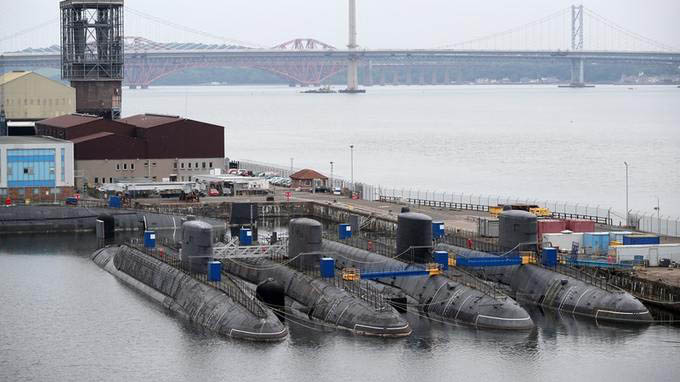
A British nuclear submarine has broken the record for the longest patrol at
sea as safety fears grow over the Royal Navy’s ageing fleet. The
Vanguard-class vessel returned to the Faslane naval base in Scotland on
Monday encrusted with barnacles and covered in slime after a gruelling tour
understood to have lasted more than six months.
Naval experts have raised concerns that the long patrols result in immense physical strain on the vessels and take a psychological toll on the crews. The UK has four
Vanguard-class submarines, which are armed with up to eight Trident
ballistic missiles carrying Britain’s nuclear warheads. At least one
submarine is on patrol at all times to maintain a continuous at-sea
deterrent. The fleet has been effectively reduced to two functioning
vessels, HMS Vigilant and HMS Vengeance, owing to repair works on the other
two.
Times 12th Sept 2023
Huge nuclear lobbying aimed at British Parliament

The Nuclear Industry Association will host the third Nuclear Week in
Parliament (NWiP) between the 11th and 13th of September 2023. In January
2023, the rescheduled week saw hundreds of Parliamentarians and industry
representatives engage in various events.
Back in its annual September slot, this year’s NWiP will be packed with multiple events and receptions, plus opportunities for NIA members to hold their complementary meetings.
The week will focus on engaging with Parliamentarians on various topics,
including new build, Advanced Nuclear Technologies, and the fuel cycle.
This will build on our Summer Conference, due to be held in the Concorde
Conference Centre in Manchester on Wednesday, 14 June 2023.
Nuclear Industry Association (accessed) 13th Sept 2023
https://www.niauk.org/nuclear-week-in-parliament-2023-sponsorship-opportunities/
Nuclear Free Local Authorities back councillor’s call to preserve bunker as museum to folly of nuclear war
The UK/Ireland Nuclear Free Local Authorities is backing the recent call of
an Oldham Councillor for the preservation of the town’s nuclear bunker in
the name of peace. In January 2016, at a time when North Korea was testing
nuclear weapons, the Mirror newspaper posed a question of its readership:
‘Where are the best places in the UK to survive nuclear war?’ with the
surprising number one answer being the northern town of Oldham. Why?
Because when the new municipal Civic Centre was built, designers Cecil
Howitt and Partners built a bunker of reinforced concrete and brick beneath
it.
NFLA 12th Sept 2023
Nuclear Free Local Authorities’ plea to new Energy Secretary: ‘Don’t make Sizewell C Suffolk’s nightmare.’
The UK / Ireland Nuclear Free Local Authorities have written to the new Secretary of State for Energy Claire Continho MP asking her not to make Sizewell C ‘Suffolk’s nightmare’.
Ms Continho replaced Grant Shapps after the former Energy Secretary was sent to Defence following the resignation of Ben Wallace. She was only elected to Parliament in December 2019 for the safe Conservative seat of East Surrey and is largely unknown having previously saved in only a very junior ministerial post. With a background in banking, the new Energy Secretary does however have close connections with the Prime Minister having been an advisor and then a parliamentary aide to Rishi Sunak when he was at the Treasury, and a leading figure in Mr Sunak’s leadership campaign team.
Energy represents a massive promotion for Ms Continho, but it is a complex brief. In his letter the Chair of the NFLAs Councillor Lawrence O’Neill outlines why Sizewell C, and indeed the whole new nuclear programme, should not go ahead and urges the Secretary of State to ‘take up the offer made by local campaigners to visit the site and speak to local people about their serious concerns about this costly and foolhardy project’.
The NFLAs are also backing the campaign initiated by Stop Sizewell C to deprive the nuclear monster of private sector investment by lobbying pension funds. In this vein, we have previously contacted pension funds and last month we wrote also to the Chief Executive of Centrica, a previous commercial investor in nuclear plants, asking him to refrain from backing the project.
With recent unwelcome news of a further £300 million of government funding being awarded for preparatory works at Sizewell C, the campaign feels that ‘it is time to scale up’ the pensions campaign and is asking for public support. A bespoke platform has been developed featuring almost 70 pension funds, www.stopsizewellc.org/goodpension which is now backed by a short animated video voiced by Fiona Turnbull https://drive.google.com/file/d/1LjV_WbyWkUsGf7ClwPuinU_Dq_sY7NZ9/edit .
Stop Sizewell C is asking campaign supporters who make pension contributions or receive pensions to write to their fund managers urging them NOT to invest in Sizewell C. However, the most pressing priority is to expand the reach of the campaign so Stop Sizewell C is asking supporters to raise awareness of it by sharing the links on their social media accounts.
The links to the latest pensions campaign post are:
Twitter/X – https://twitter.com/StopSizewellC/status/1699788799654637820?s=20
Instagram – https://www.instagram.com/reel/Cw5KbW6s6wq/
Facebook – https://fb.watch/mVA8OdaiP7/
LinkedIn – https://www.linkedin.com/feed/update/urn:li:activity:7105240738447114240
Councillor O’Neill added: “Sizewell C can be seen as many-headed like the mythical hydra; many of the heads represent a possible financial investment. It we can cut off the heads we can kill the monster!”
1000 Sellafield Ltd. contractors to be balloted for strike by Unite
AROUND 1,000 contractors at Sellafield are being balloted for potential
strike action, after Unite have criticised an ‘unacceptable offer’ from
management. More than 3,000 engineering construction workers nationally,
operating under the National Agreement for Engineering Construction
Industry (NAECI), are being balloted for strike action overpay, Unite, the
UK’s leading union, said on Thursday, September 7. This includes about
1,000 Sellafield Ltd. contractors who the union say conduct critical repair
and maintenance at the site.
Whitehaven News 10th Sept 2023
1 This Month
22 June – Virtual Event –Climate Change: New Data, New Debate

Monday, June 22, 2026 2:30 p.m. – 3:15 p.m. CT
YouTube. Register here

Protect Sazan Island from the Trump family! https://secure.avaaz.org/campaign/en/protect_sazan_island_from_the_trump_family_loc/?bqFCVab&v=174511&cl=22707147157&_checksum=5e9dde668860e8231c33699735e16a1fbf22ab2cb01da50c999fe8732b9775ef&utm_source=email&utm_medium=blast_email&utm_campaign=174511
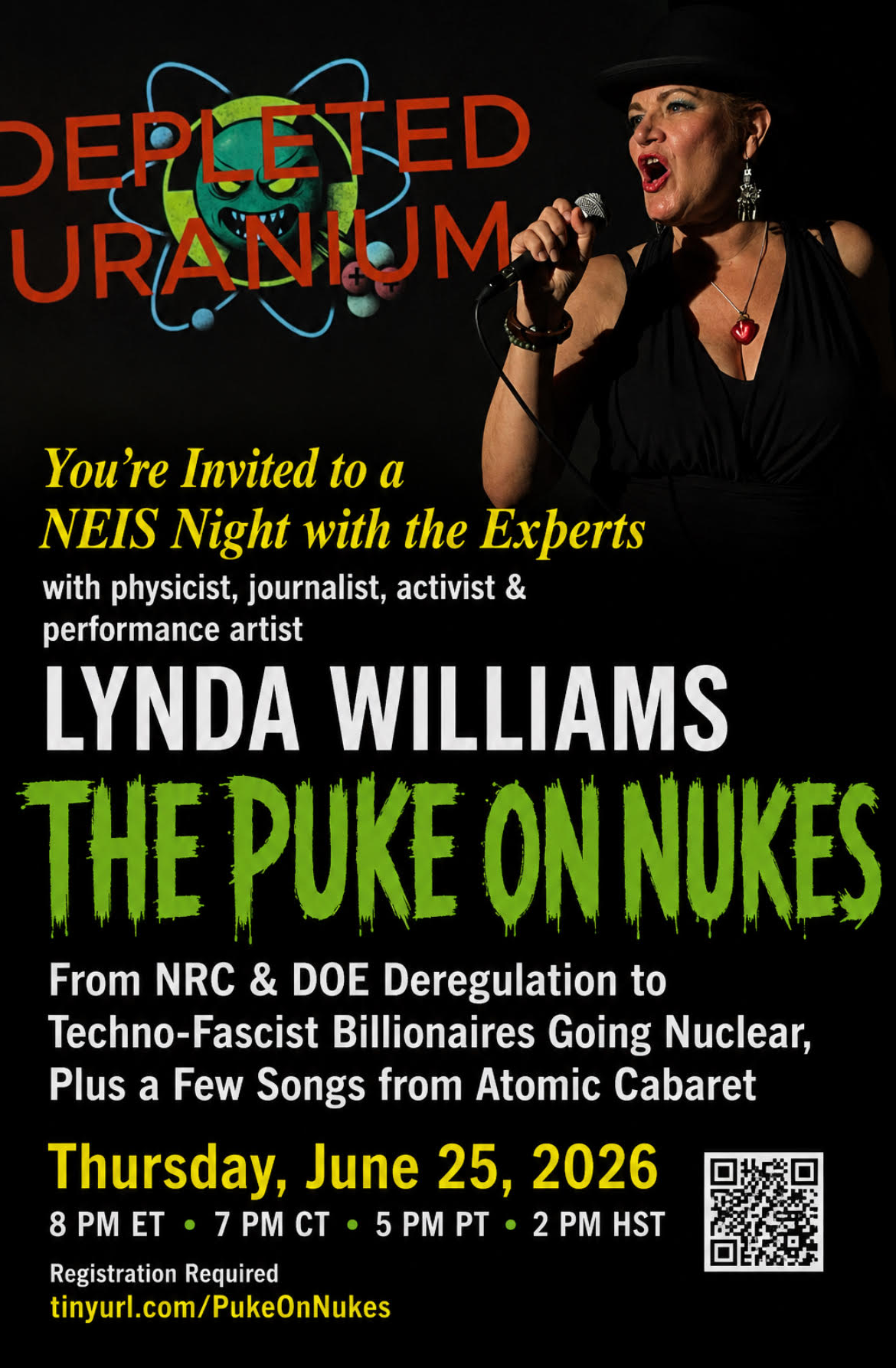
25 June- THE PUKE ON NUKES
Thursday, June 25, 2026
7pm Central Time (8pm ET, 6pm MT, 5pm PT) UTC – 5
From NRC & DOE Deregulation to Techno-Fascist Billionaires Going Nuclear, Plus a Few Songs from Atomic Cabaret REGISTER
26 June – Radiation Trainwreck at the NRC / Join the Protect Better Campaign – https://us02web.zoom.us/meeting/register/4ZlZ5_qLSHGiLSCg8FF6Bg#/registration

Cuba Is Not a Failed State – It Is a Besieged State
PETITION: “Global Appeal to Endorse Palestinian Right of Return of Refugees”
To see nuclear-related stories in greater depth and intensity – go to https://nuclearinformation.wordpress.com
-
Archives
- June 2026 (193)
- May 2026 (306)
- April 2026 (356)
- March 2026 (251)
- February 2026 (268)
- January 2026 (308)
- December 2025 (358)
- November 2025 (359)
- October 2025 (376)
- September 2025 (257)
- August 2025 (319)
- July 2025 (230)
-
Categories
- 1
- 1 NUCLEAR ISSUES
- business and costs
- climate change
- culture and arts
- ENERGY
- environment
- health
- history
- indigenous issues
- Legal
- marketing of nuclear
- media
- opposition to nuclear
- PERSONAL STORIES
- politics
- politics international
- Religion and ethics
- safety
- secrets,lies and civil liberties
- spinbuster
- technology
- Uranium
- wastes
- weapons and war
- Women
- 2 WORLD
- ACTION
- AFRICA
- Atrocities
- AUSTRALIA
- Christina's notes
- Christina's themes
- culture and arts
- Events
- Fuk 2022
- Fuk 2023
- Fukushima 2017
- Fukushima 2018
- fukushima 2019
- Fukushima 2020
- Fukushima 2021
- general
- global warming
- Humour (God we need it)
- Nuclear
- RARE EARTHS
- Reference
- resources – print
- Resources -audiovicual
- Weekly Newsletter
- World
- World Nuclear
- YouTube
-
RSS
Entries RSS
Comments RSS
 nuclear-news