UK discusses sale of Wylfa nuclear site
1The government has confirmed ongoing discussions about the potential sale
of the Wylfa nuclear site in response to a report by the Welsh Affairs
Committee. The Wylfa nuclear site, located in Anglesey, North Wales, has
long been a subject of interest for nuclear energy development. Previous
plans for a new nuclear power station at Wylfa were scrapped in 2019 due to
financial and commercial challenges. Since then, the government has been
actively seeking alternative arrangements for the site.
Energy Live News 10th July 2023
Suffolk campaigners vow to continue fighting Sizewell C
Campaigners have vowed to continue their fight against the “monstrous”
Sizewell C nuclear power station on the Suffolk coast despite losing a
legal challenge against the plans. The High Court announced on Thursday
that the judicial review brought by Together Against Sizewell C (TASC) had
been rejected as being ‘totally without merit’. TASC had launched the
review over the environmental impact of the project, particularly the
disposal of nuclear waste and the provision of a water supply to the
station.
East Anglian Daily Times 23rd June 2023
https://www.eadt.co.uk/news/23608074.suffolk-campaigners-vow-continue-fighting-sizewell-c/
Community energy for the UK
At the close of Community Energy Fortnight (10-23 June), the Nuclear Free
Local Authorities have written to a minister asking the government to hold
onto parts of the Energy Bill that will be vital if the community energy
sector is to continue to grow.
In his letter to Nuclear and Networks
Minister Andrew Bowie, who is leading on the legislation for the
government, NFLA Steering Committee Councillor Lawrence O’Neill has asked
for Clauses 272 and 273 to be retained in the bill.
These clauses, backed by the campaign group Power for People, would allow small community owned projects generating renewable energy to supply electricity to the National
Grid or to the communities that they serve on a fairer basis, and they
would also guarantee these suppliers a set income. Disappointingly, the
government is believed to be looking at dropping these clauses from the
bill, without suggesting any alternate provision.
NFLA 23rd June 2023
Legal challenge against Sizewell C nuclear power plant rejected
High court judge rules in favour of government decision to let EDF build plant on the Suffolk coast.
Rob Davies, 23 June 23, Guardian
A legal challenge against the government’s decision to build the Sizewell C nuclear power plant has been rejected.
The campaign group Together Against Sizewell C (Tasc) had launched a judicial review against the government’s decision to give the green light to the 3.2 gigawatt plant on the Suffolk coast, which is being built by French energy company EDF.
The group said the government had failed to consider alternatives to nuclear power to meet its emissions targets when approving the project. It cited the threat to water supplies in an area officially designated as seriously water-stressed, the threats to coastal areas from the climate crisis, and environmental damage.
Mr Justice Holgate rejected the group’s challenge against the secretary of state for energy security and net zero in a written ruling at the high court on Thursday. Holgate ruled the government’s decision was in keeping with energy policy intended to achieve “diversity of methods of generation and security of supply”…………
Tasc said it would continue its campaign and was examining options for how to do so…………………………… more https://www.theguardian.com/business/2023/jun/22/legal-challenge-against-sizewell-c-nuclear-power-plant-rejected
Big enlistment bonuses offered to UK sailors entering the nuclear field
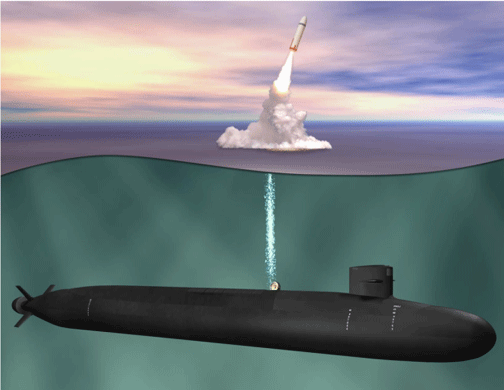
By Diana Stancy Correll. Navy Times
The Navy is offering up to $75,000 in enlistment bonuses for those entering the nuclear field — up from the $50,000 it previously offered and the maximum offered to all other ratings.
The bonus announcement coincides with recruiting challenges across the services, which military leaders attribute to more thorough medical screenings, fewer Americans eligible to serve, and low civilian unemployment.
Sailors may couple the bonus with the maximum student loan repayment under the Enlisted Loan Repayment Program, in which the Navy covers college tuition loans — such as Stafford Student Loans — that were taken out prior to the sailor enlisting for active duty……………………………………………………………………………… more https://www.navytimes.com/news/your-navy/2023/06/23/big-enlistment-bonuses-offered-to-sailors-entering-the-nuclear-field/1
£485m clean-up operation for UK’s 10 nuclear reactors
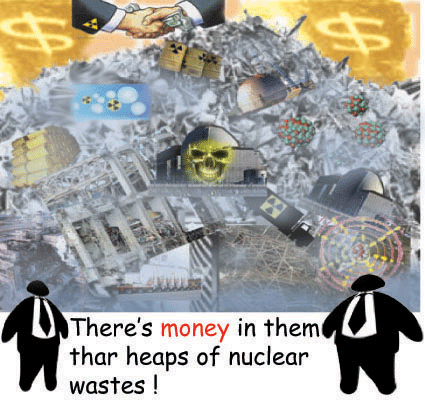
A team featuring Keltbray and Costain is one of several firms to win spots
on a £485m framework to carry out demolition and asbestos removal work
across all of the UK’s 10 nuclear reactors. The pair and a second team
called Celadon Alliance, comprising Altrad Support Services, KDC Veolia
Decommissioning Services and NSG Environmental, have been awarded framework
contracts for both Lots 1 and 2.
In addition, Kaefer UK & Ireland has been
awarded a framework contract for Lot 1 and a team featuring Nuvia, Rainham
Industrial Services and Hughes and Salvidge has been awarded a framework
contract for Lot 2. Called the Decommissioning and Asbestos Removal
framework, work includes jobs at all 10 reactor sites, two research sites
and one hydro-electric plant, which are all operated by Magnox on behalf of
the Nuclear Decommissioning Authority.
The framework is initially for four
years with an option to extend up to a further two years. Jobs will include
demolition and deplanting, turbine hall cleaning, removal and treatment of
radioactively contaminated plant, including cooling ponds and water
treatment facilities.
Building 22nd June 2023
Assessing investability of new nuclear projects like Sizewell C
The crucial issue here is that the regulated company is permitted to start charging customers immediately after the project begins, and can continue to do so throughout the construction phase.
The downside for customers or ratepayers is that they end up bearing most of the risk, whether that is delays, cost increases, or even complete cancellations.
it is transferring a lot of the risk straight onto the customer and the customer can end up paying through the nose for nothing if you have serious problems in terms of timescales.”
NS Energy, By James Varley 19 Jun 2023
The UK is grappling with the problem of inviting the private sector to invest in new nuclear without interest driving up the price. Its solution cuts costs – but transfers the risk to consumers
UK Chancellor Jeremy Hunt confirmed recently that the UK would back the proposed Sizewell C nuclear power plant with an investment of £679m. The funding had initially been announced by then Prime Minister Boris Johnson. It is a mark of the large investment involved in a new nuclear unit that, despite UK plans to see one new nuclear plant reach Final Investment Decision (FID) in this parliament (ie before the end of 2024) and two achieve FID in the next (before 2029), two incoming Prime Ministers (Teresa May and Rishi Sunak) have announced reviews of Sizewell C. But Sunak’s chancellor Jeremy Hunt reaffirmed both the project and the funding, saying: “Our £700m investment is the first state backing for a nuclear project in over 30 years and represents the biggest step in our journey to energy independence.”
Of perhaps more interest to investors is the UK government’s decision to take a 50% stake in Sizewell C, with co-investor EDF. But neither of the two envisages holding those large stakes for very long. Once the project – which now has planning permission – reaches FID, both hope that it will attract new investors, so that the UK and EDF can reduce their stake to around the 20% level.
It is hoped that the project can bring in private capital because investors will gain confidence in the continued presence in the project of the UK and EDF but also because it will be built under a different financing model.
It is hoped Sizewell C will look less like a state-owned plant where funding comes from the government and it (in effect taxpayers) bears the risk of cost and schedule overruns. Instead, the government hopes it will resemble other types of power plant development cycles, in which different investors buy and dispose of stakes as the project moves from development, to permitted and ‘shovel-ready’, to construction and operation. With each step the project rises in value while the risk falls, so eventually it becomes investable for groups like pension funds which will accept low returns in exchange for long-term stability, while early investors will take their profit and reinvest in other projects where returns are higher.
At £20bn (in 2015 money) even 60% of the project will be too large for any single bank or other investors, which are more likely to join at the £1bn level. But the UK hopes that post-FID (aimed to be at the end of 2024) the project will attract enough investors that they will be in competition on the initial return on investment required. In the future, the level of allowed return will be set by the UK’s energy regulatory authority, Ofgem
Moving to a RAB model
Co-investing with the government is not currently enough to make Sizewell C an attractive investment though. The key to that, the UK government believes, is the Regulated Asset Base model (RAB).
The Department for Business, Energy and International Strategy (BEIS) set out its view on the RAB model and compared it with other funding models in an Impact Assessment in 2021 – required because the RAB model required primary legislation (which has now been passed).
Comparing RAB with relying on existing funding models, such as Contracts for Difference (CfD) BEIS said it “believes there are few, if any, strategic investors in the market with the risk appetite to finance a new nuclear power plant using a CfD mechanism.” In fact, BEIS also considered that the RAB on its own “would not achieve the goal of delivering new projects at a lower cost”. It added new Funded Decommissioning Programme (FDP) legislation and the new Special Administration Regime.
What is the Regulated Asset Base model? It aims to manage nuclear’s biggest problem: huge capital costs and the long gap (as much as 15 years) between investing and starting to earn a return when power is produced.
The UK’s RAB approach aims to address this. It has commonalities with US models that add nuclear to a utility’s ‘rate base’, but the UK version would ring-fence the project activities in a special purpose vehicle (SPV). The SPV is awarded a licence to own and operate the project for a defined period. It is permitted to recover the costs of construction and operation, and also to make an ‘allowed return’ on the asset for the lifetime of the licence.
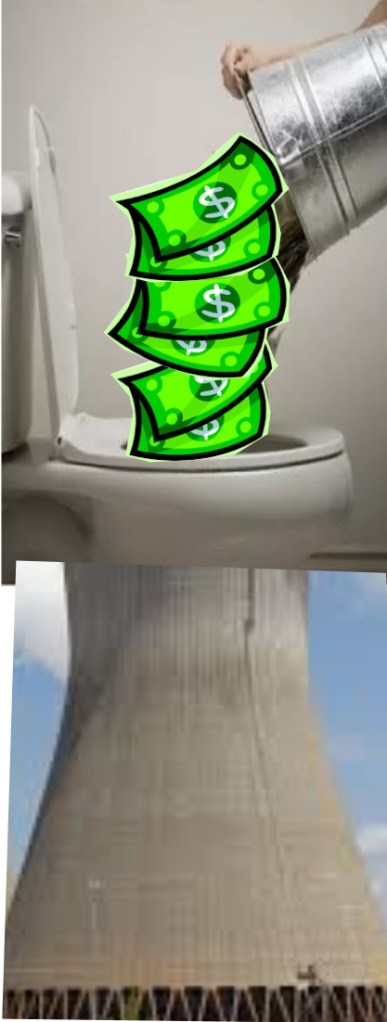
The crucial issue here is that the regulated company is permitted to start charging customers immediately after the project begins, and can continue to do so throughout the construction phase.
……………………..The downside for customers or ratepayers is that they end up bearing most of the risk, whether that is delays, cost increases, or even complete cancellations.
……………………….There is no shortage of experience in the energy sector of different financing models. Some have salutary lessons………………………………
The burden lies less heavily on wind and solar projects because they can be built relatively quickly and the project can be built in phases. As a result, income from part of the project starts early, while construction lessons can be learned from in early phases so delivery risk in the later phases is lower. Nuclear does not have that opportunity.
Prices set in advance look very different in the rearview mirror. Once the plant is operating the risks accepted by the developer before and during construction are forgotten…………………..
With the RAB model, a nuclear plant will still face price and volume risk once operating, as its power will have to be sold into a volatile market where nuclear can be pushed out of the merit order by cheap renewables and prices can fall to zero at times (a contrast to TTT, whose customer Thames Water has no choice but to use the service and no alternative supplier).
Despite the fact that it may reduce costs, consumer advocates are very wary of the RAB model. Alan Whitehead, Labour’s shadow energy minister and a longstanding observer of the industry, has previously complained that the RAB model “effectively puts costs on the consumer well before you have any idea when a particular plant will come onstream. If there is any slippage in the process the consumer just continues to pay out. …it is transferring a lot of the risk straight onto the customer and the customer can end up paying through the nose for nothing if you have serious problems in terms of timescales.”
He referred to consumers in the USA who were left paying the cost for decades when nuclear projects were cancelled……………….. https://www.nsenergybusiness.com/features/assessing-investability-of-new-nuclear-projects-like-sizewell-c/
‘Truly shocking’: UK has enough plutonium to make almost 20,000 nukes

A study published by a university in Nagasaki has revealed that the UK has enough stockpiled plutonium to make almost 20,000 atomic warheads with the same power as the bomb which totally-destroyed that Japanese city in August 1945.
The 2023 Fissile Material Directory[i] is published in June each year by the Research Center for Nuclear Weapons Abolition (RECNA)[ii], based at Nagasaki University. RECNA has been established for over twenty years as an educational and research institute at a university that has a medical faculty with a first-hand experience of the horror of nuclear weapons. Its primary goal is achieving a world free from nuclear weapons.
In January, the institute was visited by UK/Ireland Nuclear Free Local Authorities Secretary Richard Outram, where he met Vice-Director Professor Tatsujiro Suzuki.
The study lists the UK as holding 119.7 tons of plutonium, the second highest stockpile in the world after Russia with 191.5 tons, and 22.6 tons of Highly Enriched Uranium. The plutonium stockpile is said to be sufficient to arm 19,947 atom bombs, like the ‘Fat Man’ bomb dropped on Nagasaki on 9 August 1945, whilst the uranium stockpile has the potential to be turned into a further 355 devices comparable to the ‘Little Boy’ bomb dropped on Hiroshima three days earlier.
The Nagasaki bomb is estimated to have killed 35,000 – 40,000 people on the day and the Hiroshima bomb about twice that many.
The UK Government and nuclear industry has conceded in the 2022 UK Radioactive Material Inventory that 113 tons of UK-owned plutonium are currently managed by the Nuclear Decommissioning Authority, whilst a further 4 tons are in semi-assembled MOX or other fuel components. An additional 24 tons of foreign-owned plutonium are also held, a further legacy of the costly failure of the UK’s experiment with reprocessing[iii].
Across the world, RECNA estimates that 552 tons of plutonium and 1,260 tons of HEU are held, much of the latter in military hands. These are all deemed to be fissile materials and together could arm 92,000 plutonium bombs like the one used at Nagasaki and almost 20,000 uranium devices like that deployed at Hiroshima.
The Nuclear Free Local Authorities are gravely concerned about the future use of Britain’s plutonium stockpile. In recent weeks, the UK Government and the Nuclear Decommissioning Authority have published plans suggesting that some of this material should be used as fuel for a new generation of nuclear reactors.
The NFLA fears that burning plutonium as fuel will simply lead to the creation of more nuclear waste, that such material could be a target for terrorists or hostile state actors, especially in transit, and that these actions could lead to nuclear weapon proliferation. In its response to the government and industry plan the NFLA called for fissile material to be put ‘beyond use’ for all time[iv].
Responding to the RECNA report, Councillor Lawrence O’Neill, Chair of the NFLA Steering Committee, said:
“The data published by RECNA is both astonishing and truly shocking. If only a tiny fraction of Britain’s stockpile of fissile materials ended up in the wrong hands for use by terrorists or in military action then the consequences could be too awful to contemplate. In the UK, and elsewhere in the world, anti-nuclear campaigners need to continue to work together to lobby our respective governments to make these stockpiles safe and beyond use, and the time to do that is now.”
Judge Who Ruled Against Assange Built Career as Barrister Defending UK Government
“absurd that a single judge can issue a three-page decision that could land Julian Assange in prison for the rest of his life and permanently impact the climate for journalism around the world.”
Jonathan Swift, the High Court judge who has just rejected Julian Assange’s attempt to halt his extradition to the US, is the government’s former top lawyer and previously defended the Defence and Home Secretaries.
SCHEERPOST, By Mark Curtis / Declassified UK, 19 June 23
- Swift was entrusted to act for the Defence and Home Secretaries in at least nine legal cases
- His “favourite clients were the security and intelligence agencies” while representing the government
onathan Swift, the High Court judge who has rejected Julian Assange’s appeal against extradition to the US, has a long history of working for the government departments that are now persecuting the WikiLeaks founder.
Swift, who ruled against Assange on 6 June, was formerly the government’s favourite barrister.
He worked as ‘First Treasury Counsel’ – the government’s top lawyer – from 2006 to 2014, a position in which he advised and represented the government in major litigation.
Swift acted for the Defence and Home Secretaries in at least nine cases, Declassified has found.
…………………….. It was reported in 2013 that Swift had been paid nearly a million pounds – £975,075 – over the previous three years for representing the government.
Swift now presides over Assange’s extradition case being fought by the Home Office for whom he previously worked.
As with previous judges who have ruled against Assange, the case raises serious concerns about institutional conflicts of interests at the heart of the UK legal system…………………………………………
Ruling
In his rejection of the appeal by Assange’s lawyers, Swift curtly dismissed all eight grounds to their arguments as “no more than an attempt to re-run the extensive arguments made to and rejected by the District Judge”, who previously ruled on the case.
Media freedom group Reporters Sans Frontieres said Swift’s ruling brought Assange “dangerously close to extradition”.
It added it was “absurd that a single judge can issue a three-page decision that could land Julian Assange in prison for the rest of his life and permanently impact the climate for journalism around the world.”
The US government seeks to extradite Assange in order to try him in connection with WikiLeaks’ publication of leaked classified documents that informed public interest reporting around the world.
Assange faces a possible 175 years in prison and would be the first publisher prosecuted under the US Espionage Act. https://scheerpost.com/2023/06/19/judge-who-ruled-against-assange-built-career-as-barrister-defending-uk-government/
Humza Yousaf vows to rid independent Scotland of nuclear weapons
First Minister wants to enshrine a nuclear-free Scotland in a post-independence constitution.
Mark Macaskill19 , Telegraph, June 2023
The removal of nuclear weapons from Scottish soil will be enshrined in a post-independence constitution, Humza Yousaf, the first minister, has said.
The plan is contained in the SNP’s latest blueprint to help the country meet future challenges in the event that the union is dismantled.
The nuclear pledge revives a call made almost a decade ago by Mr Yousaf’s predecessor, Nicola Sturgeon, who questioned why Scottish taxpayers were funding “one of the largest concentrations of nuclear weapons in Europe on our doorsteps”…………………..
“What we will not see under these proposals, are nuclear weapons on the Clyde. This proposed constitution would ban nuclear weapons from an Independent Scotland.”
The drafting of a new constitution is outlined in a new strategy paper, Building a New Scotland………………………………………
In 2014, Ms Sturgeon, who at the time was deputy first minister, said that embedding a legal obligation to work for nuclear disarmament in a Scottish constitution would place a duty on Holyrood to strive for the removal of submarine-based Trident nuclear weapons.
In 2021, the Ministry of Defence reversed a 10-year-old disarmament plan by announcing the “ceiling” on the UK’s nuclear weapons stockpile would increase from 225 to 260 because of “technological and doctrinal threats”.
The same year, Nukewatch, which monitors the transport of nuclear weapons, claimed that the UK government had quietly boosted the number of Trident nuclear warheads stored on the Clyde in the previous five years. It estimated that 37 new warheads were delivered from England to Scotland between 2015 and 2020. Nine were added in 2019 and 13 in 2020. https://www.telegraph.co.uk/politics/2023/06/19/humza-yousaf-vows-to-rid-scotland-of-nuclear-weapons/
Royal Navy struggles to attract recruits for nuclear-armed subs
https://cnduk.org/royal-navy-struggles-to-attract-recruits-for-nuclear-armed-subs/ 20 June 23
The head of the Royal Navy has called for the service to “get bigger” as it struggles to attract new recruits for its vessels and nuclear-armed submarines.
Speaking to parliamentary magazine The House, First Sea Lord Admiral Sir Ben Key said the Navy he joined over thirty years ago was 75,000 people. This has now dropped to about 36,000. “We are effectively in a war for talent in this country – there is no great secret in that,” Kay said noting that workplace expectations across generations have changed in recent years.
The lack of communication while submariners are at sea was raised as one of the concerns, with the desire for “permanent connectivity” with friends and family not possible while on patrol.
Another reason, according to Kay, was the lack of engagement with the nuclear question. “I think it is fair [to say] that this country is not very good about talking about…nuclear power as opposed to nuclear weapons,” he said, referring to the perceived significance of being a nuclear-armed ‘power’.
The Navy hopes to improve recruitment with a new drive to better explain what life on a submarine is like. The service is also looking at expand beyond its traditional base audience of those who come from Navy families, and showcase the variety of roles the Navy can offer such as accountants and doctors.
Kay’s comments comes as Britain’s nuclear-armed submarine crews are spending record amounts of time at sea, prompting concerns over the psychological pressure on crews spending up to five months at sea.
CND General Secretary Kate Hudson said:
“Admiral Kay rightly points out the list of difficulties that life on a nuclear-armed submarine poses for potential recruits. Extended periods of time at sea out of contact with friends and family comes with serious psychological pressures, but so does the responsibility of carrying weapons that can kill millions of people. Scrapping the Navy’s nuclear-armed subs would go towards easing the the service’s recruitment problems and free up billions of pounds for other uses.”
“Nuclear is CLEAN” Trumpets Westinghouse’s Uranium Fuel in Cumbrian Press Adverts
Name: Anita Stirzaker Ad type:Brand/product: Westinghouse Electric Company
Your complaint:
Advert in the Whitehaven News (and other regional papers?) for Westinghouse “Shaping Tomorrow’s Energy to deliver a carbon-free future in the UK. Westinghouse is shaping the future of clean energy in the UK.”
The advert talks about the AP1000 “ready for deployment in the UK” – this is not the case – the AP1000 has not been given licence approval for any sites in the UK as far as I know and there are no operational AP1000 reactors anywhere in Europe as far as I know. The AP1000 would not be “carbon free” as the uranium fuel requires fossil fuel at every stage from mining to looking after the wastes. The Westinghouse plant at Springfields itself uses enormous amounts of gas to manufacture uranium fuel and has I believe its own dedicated gas pipeline into the site. Sellafield is where the fuel from Springfields ends up and this has its own gas plant on site called Fellside. Westinghouse itself in its 2022 Sustainability report (https://www.westinghousenuclear.com/Portals/0/about/Westinghouse%202023%20ESG%20Report.pdf) says it has a “net-zero” carbon emissions target by 2050″ note this is the more slippery accounting of “net-zero” which is definitely not “carbon free” as the advert in the Whitehaven News claims.
The advert claims that Westinghouse is shaping “clean energy”. this is not the case – the Springfields site itself uses lots of freshwater in all its processes – far more I believe than the fracking industry would have done in the Preston area. The fresh water use is enormous especially if the leaching of uranium fuel from the grounds of foreign countries is included along with cooling the hot nuclear wastes at Sellafield.
The nuclear industry cannot legitimately claim to be clean while radioactive and chemical emissions are routinely dumped to the environment. Then there is the possibility of catastrophic accident. What other industries have such large Emergency Zones in the case of accident ? At the lancaster canal alongside the Springfields plant there are Westinghouse notices saying “if you hear a loud, continous siren (like an air-raid siren) you should leave this area as quickly as possible”.
There is another conflicting notice saying “Go inside your boat and stay inside until instructed otherwise. Close all windows and doors. Switch off all heating, ventilation and air conditioning systems. Tune to the local radio station and listen for announcements telling you what to do.”
That is not a “clean” industry!
From Springfields Westinghouse site there are a cocktail of radioactive an chemical wastes going into the landfill at Clifton Marsh – the latest plan is to open an incineration plant on the Westinghouse Springfield site to take in nuclear waste (including intermediate nuclear wastes) from Europe and burn it there.
That is not a “clean” industry.
If Shell has been taken to task for its “clean” claims then the nuclear industry cannot be allowed to get away with this greenwashing of its fossil fuel use alongside its radioactive and chemical emissions to land, rivers,sea and air. The nuclear industry is not fully insured for good reason – it is uninsurable.
Pension funds and investment managers are not willing to take the risks on the dying nuclear industry
With their costs falling, the UK is aiming to get most of its power from renewables, but the British Energy Security Strategy also includes an ambition for the UK to produce ‘up to 24 GW’ of civil nuclear power by 2050, which might mean that nuclear energy would provide up to 25% of the UK’s electricity. The government wants it to be mainly private sector funded, but this major expansion programme has not been going very well.
Despite government encouragement and some seed corn cash, pension fund and investment managers have not been keen to face the risks and uncertainties, for example of the proposed large new EPR plant at Sizewell. Even NEST, the government’s workplace pension scheme, the National Employment Savings Trust, says it will not invest in nuclear projects like this, despite government policy directives
Some remain hopeful that smaller modular reactor (SMR) projects will be more attractive to investors, but SMRs are some way off yet. Rolls Royce had been promoting the development of an SMR with some government support, but the head of the project at Rolls was a casualty of a management change recently. Its whole SMR project might soon also be one. An aviation industry expert told the Telegraph: ‘it will inevitably get more expensive than you expected, they always do. And meanwhile, renewables are still getting cheaper.’ Maybe Rolls should just stick to aero-engines. …………………………………
Meantime, Germany has finally closed the last three of its nuclear plants, and, although some think that may have be premature (they should perhaps have got rid of coal first), it’s now a done deal and does not seem to have caused major problems. The 4GW or so of lost capacity is well on the way to being replaced by renewables, as their cost fall and they accelerate ahead. So, although reliance on Russian gas has been problematic, that seem now to have been faced, with some now seeing Germany as pioneering a nuclear- free way forward.
Of course not everyone sees it that way. Despite the dire financial state of EDF, France has defended nuclear strongly and challenged the German phase out. It even tried to hijack the EU Renewables Directive. And there is no shortage of pro-nuclear propaganda around the world. Some of it arguably is rather odd. For example, what are we to make of Oliver Stone and his ‘Nuclear Now’ film? He has been quoted as saying ‘in the face of climate change, nuclear isn’t only an option it’s the only option,’. And also that ‘Russia is doing a great job with nuclear energy’. Well, tell that last bit to the G7 group countries, 5 of whom have just tried to undermine Russia’s grip on global nuclear power supplies by shutting it out of a new alliance. Or for that matter, those in Ukraine (and elsewhere) who worry about nuclear plant security in war zones.
……………………… the US Department of Energy recently said that the US domestic nuclear industry has the potential to ‘scale from ~100 GW in 2023 to ~300 GW by 2050 – driven by deployment of advanced nuclear technologies.’
Would that scale of expansion be wise? Energy Intelligence thought not. Indeed, challenging the US DoE projection, it said it was ‘beyond absurd – it’s irresponsible. It’s absurd because the US no longer has the supply chain needed for large-scale nuclear projects- it can’t even forge a pressure vessel; it’s irresponsible because the cost of building 200-300 new reactors would be more than $3 trillion. Resources devoted to rescuing a dying industry are resources that wouldn’t be available for viable, less-costly strategies to achieve net-zero emissions in the power sector. More than that, the report reflects an energy agency still dominated by a nuclear-centric culture, and badly out of step with the times’. Quite so. A worryingly backward looking approach. But there is a lot of it about… https://renewextraweekly.blogspot.com/2023/06/nuclear-update-its-still-with-us.html
Nuclear Free Local Authorities – visiting community owned project in the UK, at the start of Community Energy Fortnight,
At the start of Community Energy Fortnight (10 June), NFLA Secretary
Richard Outram travelled to picturesque Dovestones Reservoir to visit his
nearest community owned hydro project. Saddleworth Community Hydro was
holding a public open day to mark the start of this annual event promoted
by Community Energy England, which is held to showcase projects, share
knowledge in the sector, and celebrate success.
Community Energy England
was founded in 2014 by community energy practitioners as the ‘voice’ of
the sector and to help put people at the heart of the energy system. Now
with over 275 community energy organisations as members, its mission is to
‘to help active community energy organisations implement new projects,
innovate, improve and grow.’ Saddleworth Community Hydro also started in
2014, commencing operations in September of that year. It was the first
high head project in England to generate power from the waters of a
reservoir.
At a cost of £500,000, it was financed almost equally by grants
from the Department for Environment, Food and Rural Affairs and the
European Agricultural Fund for Rural Development and by the sale of shares
to around 200 members, and subsequent upgrades have been funded by local
supporters.
NFLA 16th June 2023
Why Biden Wants Assange in Jail: Case at the Tipping Point
15 Jun 2023 A London High Court judge rejected Wikileaks editor Julian Assange’s appeal against his extradition to the United States. He now faces up to 175 years in prison — despite public opinion around the world and in his home country, Australia. The UN has declared his detention “arbitrary,” which usually results in the release of the detainee, but not so far. The fate of the man who revealed so many of the hidden crimes of the US empire hangs in the balance. Brian Becker is joined by Joe Lauria, editor in chief of Consortium News
1 This Month

of the week – Shut Down Drone Warfare!


Tell the Ukrainian Government to Drop Prosecution of Peace Activist Yurii Sheliazhenko

Petition to revoke the licensing of the Near Surface Nuclear Disposal Facility (NSDF) at Chalk River. https://www.ourcommons.ca/petitions/en/Petition/Details?Petition=e-7247
To see nuclear-related stories in greater depth and intensity – go to https://nuclearinformation.wordpress.com
-
Archives
- April 2026 (57)
- March 2026 (251)
- February 2026 (268)
- January 2026 (308)
- December 2025 (358)
- November 2025 (359)
- October 2025 (376)
- September 2025 (257)
- August 2025 (319)
- July 2025 (230)
- June 2025 (348)
- May 2025 (261)
-
Categories
- 1
- 1 NUCLEAR ISSUES
- business and costs
- climate change
- culture and arts
- ENERGY
- environment
- health
- history
- indigenous issues
- Legal
- marketing of nuclear
- media
- opposition to nuclear
- PERSONAL STORIES
- politics
- politics international
- Religion and ethics
- safety
- secrets,lies and civil liberties
- spinbuster
- technology
- Uranium
- wastes
- weapons and war
- Women
- 2 WORLD
- ACTION
- AFRICA
- Atrocities
- AUSTRALIA
- Christina's notes
- Christina's themes
- culture and arts
- Events
- Fuk 2022
- Fuk 2023
- Fukushima 2017
- Fukushima 2018
- fukushima 2019
- Fukushima 2020
- Fukushima 2021
- general
- global warming
- Humour (God we need it)
- Nuclear
- RARE EARTHS
- Reference
- resources – print
- Resources -audiovicual
- Weekly Newsletter
- World
- World Nuclear
- YouTube
-
RSS
Entries RSS
Comments RSS
 nuclear-news