UK government must come clean, to tax-payers and consumers, on the financial figures before signing up to new nuclear programme
Full report. See in particular paras 41 -44. “The Government should show
how this offers value for money to taxpayers … So far, the Government has
not published financial figures which allow the cost of this risk transfer
to be known. The Government must publish figures, before signing contracts
for new gigawatt-scale nuclear, which allow a proper assessment of value
for money to be made, including setting out the level and potential cost of
construction risk to be borne by the consumer or taxpayer …
The Government should publish details of how the estimated savings from using
the RAB model for funding Sizewell C were calculated, and provide clarity
for the funding structure, by publishing the Heads of Terms for the agreed
RAB funding model for that project.”
Science, Innovation, Technology Committee 31st July 2023
https://committees.parliament.uk/publications/41092/documents/200069/default/
Campaigners against Sizewell C nuclear plan welcome call for financial clarity from Science, Innovation and Technology Committee
Campaigners against the Sizewell C nuclear power plant project in Suffolk
welcomed the committee’s call for Government clarity on the financing of
gigawatt-scale nuclear projects. A spokesperson for the Stop Sizewell C
campaign said:
“We’re appalled that the committee has ignored
legitimate concerns about whether nuclear can deliver reliable, affordable
electricity.” The group said it supported “the committee calling for
the Government to publish Sizewell C’s cost and value for money, as doing
so will expose just how unjustifiable this slow, risky, expensive project
is”.
A Department for Energy Security and Net Zero spokesperson said:
“We have already made clear we will publish a nuclear roadmap and consult
on alternative routes to market by the end of the year.
Nation Cymru 31st July 2023
Another kick in the teeth for UK taxpayers as EDF pockets another £170m of public money for their Sizewell C White Elephant.
In another lame attempt to prop up French adventurism into the UK’s energy sector, the UK
government has handed a further £170m from the public purse (note 1) to
EDF. With the CGN buy-out costing UK plc close to £700m and subsequent
‘encouragements’ to tempt reluctant investors to part with funding for
the doomed development at Sizewell, this brings the total amount of public
money handed over to EDF close to £1bn. East Suffolk residents could be
forgiven for thinking that Sizewell C is ‘shovel ready’: it is not. It
is, in fact, a long way from the Final Investment Decision (FID), the point
at which construction can begin. Even if the UK government and EDF can each
stump up £6bn the project will still be 60% short of the estimated £30bn
– a matter of £18bn to find. But that’s not all: dozens of licences
and permits have yet to be issued by the regulatory authorities, including
the site licence from the Office of Nuclear Regulation, and there is the
small matter of finding 2.2 million litres of mains water every day for 60
years of operation here in the driest county in the country, already
experiencing drought conditions.
TASC 31st July 2023
As UK’s Hinkley nuclear plants costs rise to £32 billion ($41.5 billion) EDF Sees Higher Risk of Delays.

Electricite de France SA said the risk of further delay to two nuclear reactors in southwest England has risen because of construction setbacks.
Author of the article:
Bloomberg News, Francois de Beaupuy, https://financialpost.com/pmn/business-pmn/edf-sees-increased-risk-of-delay-to-new-uk-atomic-reactors
EDF flagged last year that the plants may start 15 months late. The reactors at Hinkley Point have been touted by the UK government as sparking a nuclear renaissance, boosting energy independence and reducing reliance on fossil fuels. But the work has been plagued by multiple holdups and cost overruns.
The increased risk of a 15-month delay is due to “performances on civil works and challenges on mechanical, electrical, heating, ventilation and air conditioning,” EDF said Thursday in an earnings presentation. “Progress is below the planned trajectory and action plans have been set.”
The reactors, costing as much as £32 billion ($41.5 billion), are due to start operating in 2027 and 2028. The ballooning budget has fueled controversy over the vast sums needed for new nuclear developments, even as other low-carbon technologies such as offshore wind have also faced inflationary pressures.
Hinkley Point’s setbacks come as EDF seeks to arrange financing for a second pair of atomic plants — at Sizewell in eastern England — that would use the same design. Delays and cost overruns may deter investors who also face increasing demands for capital from renewables, which provide swifter returns.
The debt-laden French utility has a 66.5% stake in Hinkley Point, while China General Nuclear Power Corp. owns the rest. As funding requirements now exceed contractual commitments, shareholders will be asked to provide additional equity voluntarily starting in the fourth quarter.
“The probability that CGN will not fund the project beyond its committed equity cap is high,” EDF said Thursday. “Financing solutions are being investigated, in the event that CGN does not allocate its voluntary equity.
UK has no coherent plan to develop nuclear energy
In a major report, the Science, Innovation and Technology Committee calls
on the Government to develop and publish a Nuclear Strategic Plan to turn
high level aspirations into concrete steps to deliver new nuclear. The
Committee says that the Government is right to look to nuclear power to
meet our future electricity needs and that this requires a substantial
programme of nuclear new build.
But the Report warns that the Government
target of 24 GW of nuclear generating capacity by 2050 and the aspiration
to deploy a new nuclear reactor every year are more of a ‘wish list’
than the comprehensive detailed and specific strategy that is required to
ensure such capacity is built.
The Government’s stated aim of 24 GW of
nuclear capacity is ambitious: it is almost double the highest installed
nuclear capacity the UK has ever achieved. It could involve new
gigawatt-scale nuclear power, small modular reactors (SMRs) and advanced
modular reactors (AMRs), and further development of nuclear fusion. It
would require substantial progress on technologies, financing, skills,
regulation, decommissioning and waste management.
Science, Innovation, Technology Committee 31st July 2023
Ambition alone will not build UK nuclear power

Greg Clark, former energy minister, writes that the absence of policy continuity has undermined strategy on this issue. The current government claims to be all-in for new
nuclear. Its Energy Security Strategy, published last year, set a target of
24 gigawatts of nuclear energy generating capacity by 2050.
That is highly ambitious. To put it in context, it is three times our current capacity and
nearly twice the highest nuclear capacity that the UK has ever achieved,
even before Magnox plants were retired from service.
Today the cross-party House of Commons Science, Innovation and Technology Select Committee, which I chair, will publish a report endorsing the government’s decision to
look to nuclear power to meet our future electricity needs — especially
if we are to achieve the legal requirement of net zero carbon emissions by
2050. At a time when imported supplies of energy leave us vulnerable to
price spikes at best, and shortages at worst, there is an energy security
case for nuclear power under our own control.
However, we will also warn
that expansive ambition will not get nuclear power built. Much more than
with other energy technologies, the scale, financial demands, workforce
planning and — in the case of advanced nuclear technologies — research
and development needed for new nuclear requires a dependable strategic plan
if hopes are to have any chance of being turned into reality.
Witness after witness who appeared before our inquiry told us that such a strategic plan
for nuclear is missing. For example, there is no indication from the
government on what proportion of the 24GW is intended to be met by
gigawatt-scale plants like Hinkley Point C, or smaller, more distributed
nuclear reactors such as small modular reactors.
The government’s stated
aim to deploy a nuclear reactor a year is not grounded in any explanatory
detail. The role of the new organisation, Great British Nuclear, is obscure
beyond running a competition between potential developers of small modular
reactors. Britain has an opportunity to break out of 70 years of on-off
policy towards nuclear power, with the twin imperatives of energy security
and net zero favouring a substantial future contribution of nuclear to our
electricity needs. But this will not happen without a clear and deliberate
plan on which very long-term investors can rely. If Britain is to have
substantial new nuclear capacity, there is an urgent need to turn hopes
into action.
FT 31st July 2023
https://www.ft.com/content/7499350a-2a4c-430d-a23f-415f3780e0aa
Government must back Rolls-Royce on nuclear, says ex-boss Sir John Rose
Sir John Rose, the former chief executive of Rolls-Royce, is calling on
the Government to back British nuclear technology developed by the
engineering giant. Rolls is spearheading a project to design a fleet of
mini power plants – known as SMRs or small modular reactors – which
have become a key part of the UK’s long-term energy strategy. Ministers
have already put more than £200 million of public money into the project.
But, rather than backing Rolls, the Government has launched a competition
to select a provider, which will pit the FTSE 100 flagship against foreign
rivals. Sir John, who led the company from 1996 to 2011, has described the
move as ‘depressing’. He warned that by not throwing its support behind
Rolls-Royce, Ministers risked killing off a potentially valuable stream of
export income and missing out on highly skilled jobs. Rolls has previously
said that if it won the contract, it could create 40,000 UK jobs by 2050
and boost the economy by £52 billion. A deal would also benefit suppliers
and potentially turn the country into a global hub for nuclear technology.
Rose described the competition as ‘a good example’ of Government failure to
provide the support British business needs. ‘The probability of achieving
export success is vanishingly small if the producer is not supported by its
Government,’ he said.
Daily Mail 29th July 2023
Trident nuclear project can’t be delivered, says watchdog.

“The veil of secrecy surrounding nuclear spending is a desperate attempt by the UK Government to hide how outrageously unaffordable these weapons have become”
The Ferret, Rob Edwards, 27 Jul 23
Delivery of nuclear reactors to power a new fleet of Trident submarines on the Clyde has been branded as “unachievable” for the second year running by a UK Government watchdog.
The Infrastructure and Projects Authority (IPA) has given a £3.7 billion reactor-building project run by Rolls Royce for the Ministry of Defence (MoD) a “red” rating for 2022-23. The project was also assessed as red in 2021-22, as reported by The Ferret.
According to the IPA, red means that “successful delivery of the project appears to be unachievable”. This is because of “major issues” that do not appear to be “manageable or resolvable”.
The 2022-23 rating for another scheme crucial to renewing the Trident nuclear weapons system — a £1.9bn construction project at the Faslane and Coulport nuclear bases near Helensburgh — has been kept secret. In 2021-22 it was assessed as red.
The planned date for the final delivery to the Clyde of the new Dreadnought-class submarines, armed with Trident nuclear warheads, has also been classified as confidential by the MoD “for the purpose of safeguarding national security”.
The Scottish National Party (SNP) accused the UK Government of desperately trying to hide how “outrageously unaffordable” the Trident programme had become. The Scottish Greens described the programme as “a grotesque money pit”.
Campaigners criticised the MoD for “rewarding failure” by throwing money at nuclear projects, and for concealing the truth about the problems and delays. They warned of “everyday harms” from the risks of radiation leaks, as well as “catastrophic accidents”.
………………………………………The IPA’s latest annual report for 2022-23 assessed the feasibility of 52 military projects costing a total of £255.4bn. Eleven were related to the UK’s nuclear weapons programme and together cost more than £57bn, though the overall costs for three of them were kept secret.
The manufacture of nuclear reactors at a Rolls-Royce factory in Derby was the only project to be publicly rated as red. The reactors are to drive four new Trident-armed Dreadnought submarines due to start replacing existing Vanguard submarines at Faslane “in the early 2030s”.
…………………………………………………………….. Another previously mysterious project called Aurora was rated as amber. It is to make the plutonium components for new nuclear bombs at Aldermaston in Berkshire and is reckoned to cost between £2bn and £2.5bn.
The planned completion date for Aurora has been kept secret, along with the end dates for four other nuclear projects, including the Dreadnought and Astute submarine programmes. The dates were withheld under a freedom of information law exemption meant to protect national security.
2022-23 assessments for two other nuclear projects have also been classified as confidential so as not to prejudice international relations and the defence of the UK. One, Teutates, is a collaboration on nuclear weapon safety with France and the other is called “Clyde Infrastructure”.
The Clyde project is to build a series of new facilities at Faslane and Coulport to support nuclear submarine operations. It was rated as red by the IPA in 2021-22, and amber in 2020-21 and 2019-20.
The cost of the Clyde project has increased 19 per cent from £1.6bn to £1.9bn in the last year. According to the IPA, this is because of “challenges in delivering in a nuclear and operational environment”.
Trident ‘a moral abomination’
The SNP lambasted the UK Government for writing “blank cheques” to maintain the Trident programme. “The veil of secrecy surrounding nuclear spending is a desperate attempt by the UK Government to hide how outrageously unaffordable these weapons have become,” said the party’s Westminster defence spokesperson, Dave Doogan MP.
“The hollowing-out of the armed forces to pay for the ever-expanding nuclear vanity-weapons budget has led the UK to possess just 0.1 per cent of the world’s nuclear warheads — but at eye-watering cost while conventional capabilities atrophy.”
The Green MSP Ross Greer described nuclear weapons as a “moral abomination” that had no place in Scotland. “As these figures show, they are also a grotesque money pit that is swallowing up billions of pounds and giving huge handouts to international arms dealers,” he said.
“The Scottish Greens are proud to have secured the Scottish Government’s support for the international treaty banning nuclear weapons, already signed by 92 other countries.”
MoD ‘trying to hide’ Trident delays
The Nuclear Information Service, which researches and criticises nuclear weapons, pointed out that the MoD had been repeatedly given additional billions for its nuclear programme. “But there’s no sign that throwing money at the problem is having any effect beyond rewarding failure,” the group’s director, David Cullen, told The Ferret.
The Scottish Campaign for Nuclear Disarmament attacked the nuclear industry for its “big back catalogues” of cost escalations and time over-runs. “The nuclear propulsion of the nuclear weapon system only adds to the repertoire of everyday harms from radiation leaks and opportunities of catastrophic accidents,” said campaign chair, Lynn Jamieson……………………………………………………………….. https://theferret.scot/trident-nuclear-project-watchdog/
UK Government’s infrastructure advisors cast doubt over uks biggest energy projects including nuclear clearup
The UK Government’s infrastructure advisors have warned that it is unlikely
that work to efficiently categorise hazardous waste at the Sellafield site
will be a success.
The Infrastructure and Project Authority (IPA) has also
raised concerns about the majority of the Government’s other key energy
infrastructure programmes, including the Low-Cost Nuclear Programme funding
R&D for small modular reactors.
These warnings are contained within the
Authority’s new annual assessment. Published late last week, it assesses
whether 244 Government-backed projects with a total whole-life cost
exceeding £805bn are progressing well. Projects are given a ‘green’
rating if delivery if on time, there are no significant quality issues and
no other issues that could threaten delivery. Those that are unlikely to be
delivered without a major change of direction are ranked as ‘red’. Those
with delays, quality issues or other problems which may yet be resolved
receive an ‘amber’ rating.
Of the 19 projects covered that are overseen
by the Department for Energy Security and Net-Zero (DESNZ), only three get
the ‘green’ rating. These are the Local Authority Delivery scheme, which
funds councils to upgrade homes and reduce carbon; the SIXEP effluent
treatment plant and the storage plant at Sellafield.
But efforts to improve
analytical services at Sellafield, the former centre of nuclear
reprocessing in the UK, received a ‘red’ ranking. The Authority believes
that the successful delivery of the project “appears to be
unachievable”. The project concerts assessing and categorizing waste on
site.
The Authority has also downgraded the UK Government’s plans for a
major geological nuclear waste storage facility to ‘amber’, from
‘green’ in 2021. This facility is being built both to deal with waste
from new nuclear sites, but also to consolidate existing waste storage; at
present, more than 20 above-ground facilities across the UK are used, each
with a maximum design life of 100 years.
Two DESNZ Projects – Sizewell C
and the development of carbon capture and storage – are exempt from
assessment due to commercial sensitivities. Besides the analytical services
at Sellafield, the others are all ranked as ‘amber’. These include the
national rollout of smart meters to homes; the Net-Zero Hydrogen fund; the
Homes Upgrade Grant (HUG) for home retrofitting; the Public Sector
Decarbonisation Scheme; the Industrial Decarbonisation and Hydrogen Revenue
Support scheme and the Green Homes Grant.
Edie 24th July 2023
Cumbria set for more nuclear reactors as questions are raised over why land isn’t being used for renewable energy
Cumberland Council are set to discuss small modular reactors and nuclear
power in Cumbria. Councillor Jill Parry for Bothel and Wharrels, Green
Party will ask her question to leader of Cumberland Council Councillor Mark
Fryer, who represents St Johns and Great Clifton, Labour.
“Can the leader please ask the Solway Community Power Company for more detail of the
proposal, including an outline what investigations, surveys and other
preparatory work are needed at this very early stage, and share the
response with council? “
“Would it not be more appropriate for the council
to push that the land is used for renewable energy technologies, such as
solar, in the meantime, which could generate real-time useable electricity
for residents now and could stay in place if SMRs don’t happen?”
Lancashire Live 24th July 2023
https://www.lancs.live/news/cumbria-news/cumbria-set-more-nuclear-reactors-27375167
UK govt to pour another £170million of taxpayers’ cash into planned Sizewell C nuclear plant: is it value for money?
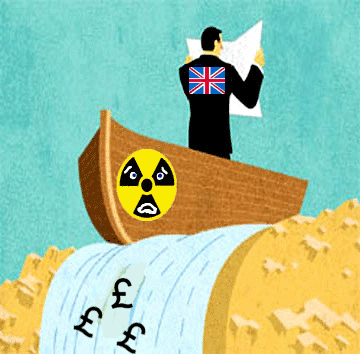
The government is to plough another £170million of taxpayers’ cash into the
proposed Sizewell C nuclear plant. The Department for Energy Security and
Net Zero said the cash was in addition to the £679 million the government
invested in the Suffolk power station late last year, when it took joint
control of the project with EDF, of France.
Last year’s investment included about £100 million to buy China General Nuclear out of its 20 per cent stake. EDF said: “This is another big endorsement and will put us in an
even stronger position to begin full construction.” The government said
the money would be used “to prepare the Sizewell C site for future
construction, procure key components from the project’s supply chain and
expand its workforce”. It said it was “previously allocated funding for
development work”.
The government pledged in the budget in 2021 to
provide up to £1.7 billion “to enable a final investment decision in a
large-scale nuclear project this parliament”.
Stop Sizewell C, a campaign group, said: “It sticks in the throat to see ministers splashing more taxpayers’ cash months before a final investment decision, while maintaining total secrecy about whether Sizewell C can achieve value for money.”
Times 25th July 2023
https://www.thetimes.co.uk/article/cash-boost-for-construction-of-sizewell-c-nuclear-plant-rg6rr5slv
Aware people in Suffolk are astonished that very few people or organisations are consulted about changes to Sizewell C Nuclear’s Emergency Plan

Sizewell C has quietly submitted its construction Emergency Plan to Suffolk
County Council (you need to accept the disclaimer statement to see the
application). This Plan lays out adaptations to the existing Emergency
Plan, to cope with a situation where there are thousands of construction
workers in the vicinity of Sizewell B.
Given that the Plan’s primary
purpose is to keep the public safe and therefore affects everyone in the
local area, we (Stop Sizewell C) are astonished that Suffolk County Council
is consulting very few individuals and organisations over a short time
period.
Suffolk County Council 25th July 2023
http://suffolk.planning-register.co.uk/Planning/Display?applicationNumber=SCC%2F0051%2F23SC%2FDOR
Scottish CND hit out over ‘nuclear threat’ in MPs’ military report
ANTI-NUCLEAR campaigners have criticised a report from MPs on defence in Scotland – accusing politicians on focusing on the “capacity for war”.
A new report from the Scottish Affairs Committee, chaired by SNP MP Pete Wishart, called on the UK Government to outline how the military presence in the High North of Scotland could be increased in response to potential security threats.
While noting the opposition of SNP committee members to Trident, the report said MPs recogised the “serious implications for the UK and Nato should the nuclear fleet ever be removed from Faslane”.
The report, which focused on the strategic importance of Scotland’s geography in light of perceived threats from China and Russia, also made the case for “devolved diplomacy from Edinburgh”.
Lynn Jamieson, chair of the Scottish CND, told the Morning Star: “It focuses on capacity for war fighting backed by nuclear threat, not collaboration to build peace, to strengthen international law and to mitigate climate change.
“Scotland is a ‘physical asset’ with military hardware and space for more and bigger bases.
“The nuclear weapons Scottish people did not vote to host are taken for granted.
“Their existential threat to the world and their everyday risks and harms in Scotland are ignored.
Former chair of UK CND and Alba Party member Marjorie Thompson said: “This report is the complete opposite of what the Scottish independence movement should be advocating, never mind actively promoting on behalf of the UK Parliament and Government.
“The national movement of Scotland has a proud anti-war tradition and has been at the forefront of the disarmament movement.
“All pro-independence parties should distance themselves from this report and ensure that the independence movement stays on the side of peace and disarmament – not the side of the military complex of failed Westminster foreign policy.”
Speaking when the report was published last week, Wishart said: “Because of its geography Scotland is home to a number of the UK’s strategic military assets and in our report we call on the UK Government to look at how the defence presence in Scotland could be scaled up if required to meet future threats. We are also calling for a review of the UK’s cold weather capabilities.”
Tory nuclear expansion programme
Renew Extra Weekly, 22 July 23
“…..a bit delayed, the secretary of state for energy security and net zero, Grant Shapps, has officially launched Great British Nuclear (GBN), the new ‘arm’s-length’ government agency that is meant drive the delivery of new nuclear energy projects- especially small modular reactors (SMRs). The press release was very up tempo…………………………………………
………talk of a ‘massive revival’ of UK nuclear may be a bit premature. In all about £233m has been allocated to new SMR work so far, plus £700m for the big Sizewell C., and it’s far from clear whether either of these options, big or small, will get the go ahead. Funding Sizewell C will not be easy, according to a review in Nuclear Engineering International, with few investors coming forward, and a review of SMR options concluded that ‘none of the tested concepts is able to compete economically with existing renewable technologies’.
Nevertheless, a tender for procurement contracts for SMRs has been launched which states that between one and four awards could be made for grant funding, and, ultimately, up to £20bn spent on developing designs and funding construction. However, that’s all a bit speculative. ……………………………the £20bn will mostly presumably involve GBN seeking partnerships with private sector companies and private finance. Shapps stressed that this was ‘not a spending commitment’ by government.
……… It will in any case take a while for GBN to get fully established, at present it hardly exists, and even longer for SMRs to exist- the Guardian noted that, in relation to the SMR competition, ‘a final decision on each project will not occur before 2029’.
……..the Rolls Royce isalso not exactly a small reactor. At 470MW, it is actually larger than unit 1 at Fukushima and most of the old UK Magnox reactors.
…………………………..chided by Labour, with Shadow energy minister Alan Whitehead saying ‘it’s shambolic that after 13 years of Tory government, not one of the 10 nuclear sites approved by the last Labour government have been built,’ the UK does now have an ambitious nuclear programme, at least on paper, with a commitment to build a massive 24GW of nuclear capacity, the equivalent of a quarter of total generating capacity, by 2050. But, as I have indicated, it is far from clear if it can be achieved, especially given the low cost of renewables.
……………………….Leaving aside the cost issue and the still unresolved issue of long term radioactive waste disposal, nuclear enthusiasts do sometimes claim that we will need nuclear to back up variable renewables. However, there are cheaper ways to do that, including advanced batteries,………………………….
Given options like these, the whole idea of needing ‘baseload plants’ has become redundant. Certainly building new large inflexible nuclear plants for backup would be very expensive and inefficient, and we have no idea if SMRs would be any better. ………………………………………………….. more https://renewextraweekly.blogspot.com/2023/07/tory-nuclear-expansion-programme.html
Is the UK Government unable to fund its promised nuclear renaissance?
- “Great British Nuclear has no legal basis – the Energy Bill has been delayed till the autumn, so it can’t do anything legally.
- “Great British Nuclear has no budget, so it can’t buy anything or commission anything.
- “Great British Nuclear has no premises.
- “Great British Nuclear has no paid staff.”
Great British Nuclear officially launched, sparks funding doubts.
Electrical Review 18th July 2023
“………………… So we’ve heard that Great British Nuclear has high hopes to kickstart a renaissance period for nuclear power in the UK, but how does it plan on achieving that? Well, thanks to the official launch, we now have more concrete information as to what the body plans to do.
The UK Government has officially launched Great British Nuclear, a new Government agency that is designed to support the growth of nuclear energy in the UK.
The official launch of Great British Nuclear was initially tipped for July 13, although the launch was pushed back due to “unforeseen circumstances.” Despite the delayed start, the Government has high hopes for the new department, with it hoping to create a renaissance for nuclear energy in the UK.
One of Great British Nuclear’s first acts will be to kickstart a competition for small modular reactor (SMR) technology, which it believes could help boost energy security, create cheaper power, and grow the economy through well-paid jobs.
Many in the industry have been calling for the UK Government to do more to encourage the construction of more nuclear power, including SMRs, as the UK transitions towards cleaner power generation. The UK Government has even gone so far as to claim that nuclear will be essential to our net zero future, noting that it will provide a ‘baseload’ to cover more intermittent renewable energy generation – something that our Gossage Gossip columnist recently described as a ‘load of cobblers’.
How will Great British Nuclear Help?
So we’ve heard that Great British Nuclear has high hopes to kickstart a renaissance period for nuclear power in the UK, but how does it plan on achieving that? Well, thanks to the official launch, we now have more concrete information as to what the body plans to do.
From today, companies can register their interest with Great British Nuclear to participate in a competition to secure funding support to develop their SMRs. Additionally, the Government body is eager to explore future sites for new large gigawatt-scale nuclear power plants, such as those at Hinkley Point C and Sizewell C.
That’s about as much as we know about Great British Nuclear’s initial plans – although the UK Government is throwing its weight behind the nuclear industry with a brand-new funding package totalling up to £157 million.
This includes:
Up to £77.1 million of funding for companies to accelerate advanced nuclear business development in the UK and support advanced nuclear designs to enter UK regulation, maximising the chance of small and advanced modular reactors being built during the next ParliamentUp to £58 million funding for the further development and design of a type of advanced modular reactor (AMR) and next generation fuel. AMRs operate at a higher temperature than SMRs and as a result they could provide high temperature heat for hydrogen and other industrial uses alongside nuclear power. This includes:
- Up to £22.5 million to Ultra Safe Nuclear Corporation UK in Warrington to further develop the design of a high temperature micro modular reactor, a type of AMR suited to UK industrial demands including hydrogen and sustainable aviation fuel production.
- Up to £15 million to the National Nuclear laboratory in Warrington to accelerate the design of a high temperature reactor, following its success in Japan.
- Up to £16 million to National Nuclear Laboratory in Preston to continue to develop sovereign coated particle fuel capability, a type of robust advanced fuel which is suitable for high temperature reactors.
A further £22.3 million from the Nuclear Fuel Fund will enable eight projects to develop new fuel production and manufacturing capabilities in the UK, driving up energy security and supporting the global move away from Russian fuel. This will include:
- Over £10.5 million to Westinghouse Springfields nuclear fuel plant in Preston to manufacture more innovative types of nuclear fuel for customers both in the UK and overseas, boosting jobs and skills in the North West.
- Over £9.5 million to Urenco UK in Capenhurst Chester, an international supplier of nuclear materials, to enrich uranium to higher levels, including LEU+ and high assay low enriched uranium (HALEU). LEU+ will allow for current reactors and SMRs to run for longer between refuelling outages, improving reactor efficiency and economics both in the UK and abroad. HALEU development will ensure that the UK remains at the forefront of fuel development for future advanced reactors.
- Over £1 million has also been awarded to Nuclear Transport Solutions, a subsidiary of the Nuclear Decommissioning Authority, to develop transport solutions to facilitate a supply chain for highly enriched uranium in the UK and internationally.
- Over £1.2 million to support MoltexFLEX, a UK molten salt reactor developer based in the North West, to build and operate rigs for the development of molten salt fuel. Molten Salt Reactors (MSRs) are an AMR type that use a molten salt as a coolant and fuel, leading to intrinsic safety compared with conventional fuels.
Is the UK Government unable to fund its promised nuclear renaissance?
Despite announcing £157 million in investment for the nuclear industry in the UK, many experts will argue that the UK Government’s funding plans are woefully inadequate to meaningfully move the needle.
Recent nuclear projects within the UK have been unable to get off the ground without significant Government intervention, including Hinkley Point C, which the Government has committed at least £679 million towards, despite the new reactor facing constant delays – with its opening date now set for September 2028.
Rolls-Royce, which is currently undergoing regulatory testing on its small modular reactor technology, has suggested that SMRs will be cheaper – although the company still believes each SMR will carry a price tag of at least £1.8 billion when they start rolling out of factories in 2030. That is expected to get you around 440 MW of generation – which for the same price, you could purchase 782 Enercon E82 onshore wind turbines, netting you up to 2346 MW of generation.
One industry insider suggested that the UK Government’s woeful funding figures was “the best example I have ever seen of what a Government on its last legs sounds like when it has nothing to say and no money to spend.” Adding that, “All this amount will buy you, literally, is a very large pile of paper and possibly a few more headlines.”
Given the Conservative Party’s performance in recent polls, it’s likely the UK Government is unwilling to commit large amounts to Great British Nuclear when it’s unlikely to be in Government for much longer. Unfortunately, large infrastructure projects of this nature require huge investment across multiple parliamentary terms – and the short-sighted nature of the country’s leaders got us into this situation in the first place. In fact, by the time Hinkley Point C comes online, it will be 20 years since the Government of the day supported a new reactor.
Will the launch of Great British Nuclear move the needle?
The UK Government is hopeful that Great British Nuclear will move the needle in the development of nuclear power technology in the UK. While it may not have the budget to invest in new nuclear reactors itself – it could potentially foster an environment that is ultimately friendly to nuclear power.
Unfortunately, as our industry insider notes:
- “Great British Nuclear has no legal basis – the Energy Bill has been delayed till the autumn, so it can’t do anything legally.
- “Great British Nuclear has no budget, so it can’t buy anything or commission anything.
- “Great British Nuclear has no premises.
- “Great British Nuclear has no paid staff.”
So, the chance of meaningfully moving the needle is essentially nil. But at least the current Government can capture headlines and act like it’s trying to help. https://electricalreview.co.uk/2023/07/18/great-british-nuclear-officially-launched-sparks-funding-doubts/
1 This Month

of the week – Shut Down Drone Warfare!


Tell the Ukrainian Government to Drop Prosecution of Peace Activist Yurii Sheliazhenko

Petition to revoke the licensing of the Near Surface Nuclear Disposal Facility (NSDF) at Chalk River. https://www.ourcommons.ca/petitions/en/Petition/Details?Petition=e-7247
To see nuclear-related stories in greater depth and intensity – go to https://nuclearinformation.wordpress.com
-
Archives
- April 2026 (57)
- March 2026 (251)
- February 2026 (268)
- January 2026 (308)
- December 2025 (358)
- November 2025 (359)
- October 2025 (376)
- September 2025 (257)
- August 2025 (319)
- July 2025 (230)
- June 2025 (348)
- May 2025 (261)
-
Categories
- 1
- 1 NUCLEAR ISSUES
- business and costs
- climate change
- culture and arts
- ENERGY
- environment
- health
- history
- indigenous issues
- Legal
- marketing of nuclear
- media
- opposition to nuclear
- PERSONAL STORIES
- politics
- politics international
- Religion and ethics
- safety
- secrets,lies and civil liberties
- spinbuster
- technology
- Uranium
- wastes
- weapons and war
- Women
- 2 WORLD
- ACTION
- AFRICA
- Atrocities
- AUSTRALIA
- Christina's notes
- Christina's themes
- culture and arts
- Events
- Fuk 2022
- Fuk 2023
- Fukushima 2017
- Fukushima 2018
- fukushima 2019
- Fukushima 2020
- Fukushima 2021
- general
- global warming
- Humour (God we need it)
- Nuclear
- RARE EARTHS
- Reference
- resources – print
- Resources -audiovicual
- Weekly Newsletter
- World
- World Nuclear
- YouTube
-
RSS
Entries RSS
Comments RSS
 nuclear-news