Use less energy : Demand-led policy scenarios show promise.

Renew Extra 29th Nov 2025,
Demand-side energy reduction has so far received less policy support than supply-side net-zero technologies, despite the fact that, as this interesting new Nature paper claims, ‘energy demand reductions of ~50% by 2050 compared with today are possible while maintaining essential services and improving quality of life’. That would involve more than just improved technical efficiency of energy use and production, something that is already thankfully underway- although still rather too slowly. It would also mean fundamental changes in how energy is used, with radical reductions in consumption due to new social/behavioural patterns.
The paper notes that ‘policies explicitly targeting large energy demand reductions remain scarce, suggesting that they have so far been disregarded by policymakers owing to real or perceived lack of political feasibility. Instead, national energy strategies frame shifts in demand through an emphatically technological lens, focusing on efficiency gains through electrification and overlooking the broader structural and societal changes necessary to substantially cut the need to use energy..’
To address the perceived ‘persistent gap between academic energy demand scenarios and the scarcity of corresponding energy policy’, in a new approach, academics and policy makers join forces in a demand-focused process of ‘co-created’ UK 2050 energy scenario analysis, led by policymakers and evaluated through public dialogue. It takes more effort, but this paper says the new combined approach is well worth it: the ‘uniquely close involvement’ of policymakers leading the project evidently generated markedly different & positive narratives that reflect policymakers’ concerns while still leading to scenarios with reductions in energy demand of 18–45%, exceeding what policies normally suggest’. To address the perceived ‘persistent gap between academic energy demand scenarios and the scarcity of corresponding energy policy’, in a new approach, academics and policy makers join forces in a demand-focused process of ‘co-created’ UK 2050 energy scenario analysis, led by policymakers and evaluated through public dialogue. It takes more effort, but this paper says the new combined approach is well worth it: the ‘uniquely close involvement’ of policymakers leading the project evidently generated markedly different & positive narratives that reflect policymakers’ concerns while still leading to scenarios with reductions in energy demand of 18–45%, exceeding what policies normally suggest’.
The new paper expands on the method developed by Barrett et al, replacing the ‘academic scenario design’ stage by a policymaker-led process, with input from energy-system modellers. The resultant co-created scenarios are then subject to public discussion, so as to ‘avoid being perceived by policymakers either as ideologically driven or as theoretical academic exercises’……………………………………
The paper also claims that the new approach can deliver practical result and savings: ‘demand-side measures can help reduce societal risks by decreasing future reliance on technologies currently unproven at scale, in the context of a policymaker-led framework……………………………………………………………………………………………………… https://renewextraweekly.blogspot.com/2025/11/use-less-energy-demand-led-policy.html
The Neocon-Realist Armageddon Over Ukraine

Rubio was in Geneva last Sunday with the Ukrainians and Europeans to undermine Trump’s 28-point plan, trying to replace it with one of just 19 points that unrealistically gives an advantage to Ukraine. Unrealistic because this war has already ended on the battlefield and Trump has virtually acknowledged it.
By Ray McGovern, Consortium News, https://consortiumnews.com/2025/11/28/ray-mcgovern-the-neocon-realist-armageddon-over-ukraine/
Donald Trump made some revealing remarks to the media as he flew to Florida for Thanksgiving on Wednesday. Asked if he thought Ukraine is being asked to give too much land to Russia in his proposal to end the war, Trump responded:
“It’s clearly up to the Russians. It’s moving in one direction. … That’s land that over the next couple of months might be gotten by Russia anyway. So, do you want to fight and loose another 50,000 or 60,000 people? Or do something now? They are negotiating; they are trying to get it done.”
That’s the same realistic approach Trump’s new special envoy to Ukraine, U.S. Army Secretary Daniel Driscoll, took with the Ukrainians and Europe’s so-called “coalition of the willing” during a visit to Kiev earlier this week.
Driscoll reportedly threw in yet one more reason for Ukraine to end the war – the fact that the Russians have ever-growing stockpiles of missiles they can deploy.
In other words, the undeniable Russian advances all along the contact line in Ukraine are no longer deniable to anyone tuned into reality.
But not everyone is tuned in. U.S. Gen. Keith Kellogg, who unrealistically claimed that Ukraine could still win, has been removed as special envoy to Ukraine, but there are other neocons lurking near the White House, for instance, Secretary of State Marco Rubio who also as national security adviser can control the flow of intelligence and policy proposals to the president.
Rubio was in Geneva last Sunday with the Ukrainians and Europeans to undermine Trump’s 28-point plan, trying to replace it with one of just 19 points that unrealistically gives an advantage to Ukraine. Unrealistic because this war has already ended on the battlefield and Trump has virtually acknowledged it.
What’s next is an official agreement, endorsed, ideally by the United Nations Security Council, where France or Britain, however, could veto it, as the Europeans continue their efforts to thwart such a peace agreement.
Britain, France and Germany, for example, are still pushing the fantasy that Russia is poised to attack Europe.
So we are at the threshold on Ukraine, at the beginning of a consequential battle between the neo-cons and Europeans on one side, and Donald Trump and the realists on the other. Will Trump show the fortitude to see this through and overcome his secretary of state?

For now you can dismiss the idea that the so-called “Peace Plan” is “dead on delivery.” It hasn’t even officially been delivered to Russia yet.
Russian President Vladimir Putin awaits hand delivery from U.S. envoy Steve Witkoff probably on Monday – Washington’s recent unorthodox conduct of diplomacy notwithstanding.
My sense is that Witkoff, like Driscoll, will dis the Europeans and go to Moscow with the 28-point draft plan for discussion and that it will adhere to one of the main provisions of Anchorage — namely that Trump will not let Zelinski sabotage movement toward an agreement. Putin told Hungarian President Viktor Orban today in Moscow that he remained open to meeting Trump in Budapest at a future date.
For his part, Putin seems ready to do business. An important backdrop is his priority objective of preventing relations with the U.S. from falling into a state of complete disrepair. As for Ukraine, Putin has reiterated that the 28-point Trump plan could form the basis for future agreements.
Taking questions from the press yesterday in Bishkek, Kyrgyzstan, Putin gave clarity to a number of key issues. He said there was “no ‘draft agreement’ per se,” but rather “a set of issues proposed for discussion and finalization.”
Putin went on:
“We discussed this with American negotiators, and subsequently, a list of 28 potential points for an agreement was formulated.
Thereafter, negotiations were held in Geneva between the American and Ukrainian delegations. They decided among themselves that all these 28 points should be divided into four separate components. All of this was passed on to us.
In general, we agree that this could form the basis for future agreements. However, it would be inappropriate for me to speak now of any final versions, as these do not exist.”
Putin noted that the U.S. — this would be Trump, not Rubio — is “taking our position into account – the position that was discussed before Anchorage and after Alaska. We are certainly prepared for this serious discussion.”
On the question of land, Putin made certain that Russia will not be denied. He said, “I think it will be clear at once what it is all about. When the Ukrainian troops leave the territories they occupy, then the hostilities will cease. If they do not leave, we will achieve it militarily. That’s that.”
Of course, in 2022 Russia entered the Ukrainian civil war that had begun after the 2014 U.S.-backed coup that lead to the U.S.-installed government attacking the ethnic Russian Donbass region, which had rejected the unconstitutional change of government and declared independence.
After eight years of indirectly aiding Donbass, Russia intervened directly after the Minsk agreements to end the civil war were sabotaged by Ukraine and the Europeans. Russia’s war demands have remained demilitarizing and denazifying a neutral Ukraine. In the course of its intervention it has absorbed four Ukrainian oblasts into the Russian Federation, which remains non-negotiable to Moscow.
“Those in the West who understand what [recent Ukrainian defeats on the battlefield] could lead to are pushing for an end to the fighting as soon as possible,” Putin said, referring to the realists in Washington.
“They understand that if the front lines are drawn back in certain areas, the Ukrainian armed forces will lose their combat effectiveness and their most combat-ready units,” he said. “‘Enough is enough, preserve the core of your armed forces and your statehood, that’s what you need to focus on,’ say those who hold this view.”
But he said “others,” referring to the Europeans and neocons, “insist on continuing the hostilities until the last Ukrainian. That’s the difference in approaches.”
Putin tried to put to rest the fear-mongering in Europe about a planned Russian attack on the continent. “Russia does not intend to attack Europe. To us, that sounds ridiculous, does it not?” he said. “We never had any such intentions. But if they want to have it formalised, let’s do it, no problem.”
Putin also reiterated that Russia could only sign a peace agreement with a legitimate government in Ukraine after a new election, another obstacle to overcome.
“I believe that the Ukrainian leadership made a fundamental, strategic mistake when it was afraid to hold presidential elections, and as a result, the president lost his legitimate status,” Putin said. “As soon as any kind of peace agreement is reached, the fighting will stop, and the state of emergency will be lifted, elections will be announced.”
Which is another incentive for Zelensky and those who back him inside and outside of Ukraine to keep on fighting.
“So, basically, we want to reach an agreement with Ukraine in the end, but it’s almost impossible right now, legally impossible. We need our decisions to be internationally recognized by the major international players. That’s it,” said Putin.
He added:
“And so, of course, we need recognition, but not from Ukraine today. I hope that in the future we will be able to come to an agreement with Ukraine: there are many healthy people there who want to build relations with Russia for a long-term historical perspective.”
Peace then will require the complete negation of the neocons and the Europeans and a new government in Kiev — a tall order indeed.
It comes down to whether Trump can finally stand up to them — people whom he appointed, like Rubio, and whom he golfs with, like Sen. Lindsey Graham. He seems to have less respect for the Europeans, who practically sat at his feet around the Oval Office desk earlier this year pleading their case on Ukraine.
Trump may be motivated in part by the vain desire to end the war to win the Nobel Peace Prize. But he can get it done. Trump can ignore the Europeans and be serious this time about cutting off military aid and intelligence to Ukraine as he threatened to do if Zelensky did not accept his 28 points by Thanksgiving.
When it comes to Ukraine, Trump really does hold the cards. Will he play them?
UK Nuclear Projects Set to Add $1.3 Billion a Year to Power Bills

By Tsvetana Paraskova – Nov 28, 2025,
https://oilprice.com/Latest-Energy-News/World-News/UK-Nuclear-Projects-Set-to-Add-13-Billion-a-Year-to-Power-Bills.html
Subsidies and Contracts for Difference (CfD) that the UK government has promised to the two projects for new nuclear power stations are expected to add $1.32 billion (£1 billion) annually to the UK power bills from around 2030, The Telegraph reports, citing documents by the Treasury and the Office for Budget Responsibility (OBR).
The Hinkley Point C nuclear power station, developed by EDF, is expected to begin generating electricity in 2030-31, after years of delays and cost overruns.
That year, CfD is expected to generate $6.1 billion (£4.6 billion) in receipts, including £1.0 billion to fund subsidy payments to the Hinkley Point C nuclear power plant for its first year of expected generation, OBR said in its economic and fiscal outlook released after the UK’s latest budget announcement.
The UK government earlier this year also took the final investment decision to build the $51-billion Sizewell C nuclear power plant on the Suffolk Coast in eastern England, which was the first British-owned nuclear power station to be announced in over three decades.
Sizewell C will be the first nuclear power station in the UK financed using a regulated asset base (RAB) model that levies an additional charge on consumer energy bills, which contributes to the financing costs of the plant, OBR noted. This levy is also expected to increase energy bills as early as January.
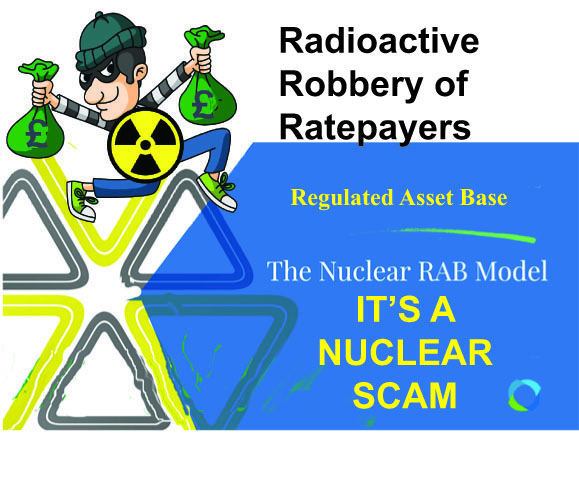
UK households will pay slightly higher energy bills in the first quarter of 2026 after energy market regulator Ofgem last week raised the Energy Price Cap by 0.2%, against expectations of a 1% drop.
The slight increase in the price cap is driven by government policy costs and operating costs. This includes funding the government’s Sizewell C nuclear project, which will bring more [?] clean power, Ofgem noted.
Opponents of new conventional nuclear plants in Britain argue that consumers will be burdened with a “nuclear tax” for the expensive projects in their energy bills.
“The Government has a misguided belief that nuclear will be a cheap, ‘green’ solution to our energy needs, but the evidence shows the opposite – that costs of delivery and of dealing with nuclear waste – will continue to rise,” Alison Downes, of Stop Sizewell C, told The Telegraph.
“We remain opposed to the imposition of a nuclear tax on households, given the acknowledged uncertainty about the projected costs of constructing Sizewell C.”
UK energy bill payers will hand £2bn a year to EDF for new power stations

COMMENT. Here is a prime example of the crookedness of the UK Labour government, in pretending that the nuclear industry is beneficial to people and the environment:
“The chancellor, Rachel Reeves, has promised to cut energy bills by an average £150 for each household from April by slashing green levies.“
UK green levies are taxes imposed by the government on sources of pollution, which contribute to about 8% of a household’s energy bill. These levies raise funds for various energy-efficiency schemes and have generated £5.9 billion from household energy bills in 2024. They are essential for supporting energy-saving measures in homes and for expanding renewable energy sources, ultimately improving energy security in the UK
French government-owned company to receive funding for Hinkley Point C and Sizewell C
Rob Davies, Guardian 28th Nov 2025
UK energy bill payers will hand over £2bn a year in subsidies to EDF, the French company building two nuclear power stations, according to government figures.
EDF, owned by the French government, will be entitled to £1bn in annual payments as soon as Hinkley Point C, in Somerset, comes on to the grid in 2030. The sum is due under the contracts-for-difference system that guarantees low-carbon energy companies a fixed price for the electricity they generate..
Separately, £1bn will be added to bills through a separate nuclear levy scheme to fund Sizewell C, in Suffolk, a 3.2 gigawatt (GW) project also led by EDF.
The result is an increase of about £2bn in bills, funding the cost of two plants that together will generate about a sixth of the electricity that Britain was using during peak demand so far this year, equivalent to 6m homes.
A government spokesperson said: “We are reversing a legacy of no new nuclear power being delivered to unlock a golden age of nuclear, securing thousands of good, skilled jobs and billions in investment.”
The government hopes the extra cost of new nuclear reactors could be offset in the future by the stable “baseload” output they offer, which can rein in the rising cost of balancing volatile output from energy sources such as solar and wind.
That balancing cost is expected to hit about £2bn this year, according to the Nuclear Industry Association. The government said Sizewell alone could save £2bn a year in future, adding that the impact on bills over the construction period was likely to be about £1 a household each month.
The chancellor, Rachel Reeves, has promised to cut energy bills by an average £150 for each household from April by slashing green levies.
Assessments of the nuclear subsidy were revealed in documents released by the Office for Budget Responsibility (OBR), which assesses the impact of economic policy. The OBR said EDF would receive £1bn in the first year of operation at Hinkley, due to come on stream in 2030 after 12 years of construction.
“In 2030-31, contracts for difference (CfDs) are expected to generate £4.6bn in government receipts, including £1bn to fund subsidy payments to the Hinkley Point C nuclear power plant for its first year of expected generation,” the OBR said.
The subsidy is the result of an agreement struck between EDF and the Conservative-Liberal Democrat coalition government in 2013.
The then energy secretary, Ed Davey, now the leader of the Liberal Democrats, agreed a “strike price” guaranteeing that the French state-owned company would receive £92.50 for each megawatt hour (MWh) for electricity generated at the 3.2 GW plant.
The strike price has risen with inflation to about £133 and is projected to reach £150 in 2030, according to the Daily Telegraph, which first reported the Hinkley subsidy.
The wholesale cost of electricity is much lower, now about £80 a MWh, meaning EDF will be able to claim the shortfall from consumers and businesses that use its electricity, thanks to the CfD agreement…….
The construction of Sizewell C, which has yet to begin and is scheduled for completion in the 2030s, will also drive up bills.
From January, energy bills will be inflated by a levy supporting the plant’s construction, adding £10 a year. The levy is expected to raise £700m but will double to 2030 to fund Sizewell, whose price tag is projected to hit £100bn.
In practice, the cost of the power station could increase. Hinkley Point C was originally projected to cost £18bn but has been subject to several time and cost overruns; EDF predicted last year the final bill could hit £46bn. https://www.theguardian.com/uk-news/2025/nov/28/uk-energy-bill-payers-edf-hinkley-point-c-sizewell-c
Scottish National Party accuses UK Government of ‘swindle’ over energy bills.
The UK Government has been accused of a ‘shameful swindle’ over the reduction of energy bills after a think tank estimated savings could be significantly lower than pledged.
The SNP has warned the Chancellor’s latest announcement to reduce household energy costs by £150 was “already falling apart”.
The Treasury earmarked the savings by scrapping the
energy company obligation scheme – a home insultation programme. It comes after the Resolution Foundation warned energy bills could continue to rise – and the reduction will be lower than anticipated.
Figures from the think tank suggests the average saving on energy bills could be £60 per household by 2029-30. Analysis by the think tank also estimates savings to be £127 in 2026-27, falling to £115 in 2027-28 before reducing again the following year. But prior to the general election in 2024, Labour committed to reducing energy costs by £300 by 2030.
Herald 29th Nov 2025, https://www.heraldscotland.com/news/25658822.snp-accuses-uk-government-swindle-energy-bills/
Due to legal considerations UK government is now pausing its planned nuclear regulatory reforms.

Labour is reportedly pausing nuclear-sector reforms despite a sweeping
report urging planning and regulatory changes to cut costs and accelerate
new projects. Legal concerns raised by a government adviser have prompted Reeves to withhold the recommendations from the upcoming Budget, delaying growth-focused measures. ……………………
The Labour government is set to hold fire on pushing through sweeping reforms to nuclear energy due to a legal adviser’s concerns over the “UK’s
environmental, trade and human rights obligations”……….
ITV News has now reported that the Chancellor will
not include the growth-focused recommendations in her Budget speech on
Wednesday. The broadcaster reported that the Chancellor will make reforms “subject to further work and review” after a government adviser voiced concerns about the legal crossovers in the paper with UK obligations………
Oil Price 26th Nov 2025, https://oilprice.com/Alternative-Energy/Nuclear-Power/Britains-Nuclear-Reform-Set-to-Stall-Over-Legal-Concerns.html
UK’s new nuclear body urges scrapping nature protections for new projects

24th November 2025, https://www.cpre.org.uk/news/nuclear-body-urges-scrapping-nature-protections-for-new-projects/
In the spring of 2025, the government set up a Nuclear Regulatory Taskforce to make it easier to build new nuclear projects. Their final report has just been published and its recommendations threaten some of the hard-won measures we have to protect our countryside and nature.
The taskforce was made up of figures working for the nuclear industry. They’re proposing two measures in particular that we’re worried about.
First, it proposes that new nuclear as a whole would get an opt-out of both the Habitats Directive and the mitigation hierarchy. This is a mechanism whereby developers first need to seek to avoid harm and then try to minimise the harm. Only when they cannot do this, they should compensate for the harm by improving the natural environment elsewhere.
The report calls for nuclear developments to pay into the new Nature Restoration Fund being set up by the Planning and Infrastructure Bill and ‘move directly to off-site nature conservation’ as the default. This sweeps away the first part of the hierarchy, which asks developers to avoid or minimise local harms on landscapes and nature in favour of offsetting the harm somewhere else. This is counter to CPRE’s view which is that protecting and regenerating landscapes at the source must come first.
Secondly, it calls for the scrapping of the duty on public bodies to further the statutory purposes of National Parks and National Landscapes, which came in in 2023. The report says the duty ‘has caused confusion, and will likely delay, and add cost, to nuclear development.’
Two CPRE groups – Kent and Friends of the Lake District – have already challenged decisions using the new protected landscapes duty, but in both cases planning permission was still granted.
Scrapping this duty would undermine the progress made in safeguarding our protected landscapes like the South Downs or the Shropshire Hills and return us to the weak duty that existed previously.
The Chancellor has said she welcomes the report and will set out the government’s response on Wednesday, and we’ll be strongly urging ministers not to dilute nature and landscape protections.
Ministry Of Defence looking at ‘various sites’ for sub dismantling project
COMMENT. Put more simply. the UK government doesn’t really know what to do with the toxic wastes from nuclear submarines.
Governments are obsessed with “defence” against each other. Meanwhile the public thinks ‘jobs, jobs, jobs” even if those jobs are toxic, and part of a useless industry.
By George Allison, November 28, 2025, https://ukdefencejournal.org.uk/mod-looking-at-various-sites-for-sub-dismantling-project/
A written answer in Parliament has confirmed that the Ministry of Defence is actively considering multiple locations for the UK’s permanent submarine dismantling and disposal capability.
Responding to Graeme Downie MP, defence minister Luke Pollard said the demonstrator vessel Swiftsure continues to be dismantled at Rosyth and remains on track to complete in 2026. He noted that “there are six further legacy submarines in Rosyth awaiting to enter the dismantling process.”
Those boats, alongside the 15 stored at Devonport, form the initial batch being processed under the Submarine Dismantling Project.
Pollard confirmed that the enduring solution will be delivered through a separate effort, the Submarine Disposal Capability Project, which is still in its concept phase. He stated that the department is “assessing options for the capability and its location with various sites under consideration within the UK,” adding that Parliament will be informed once a decision is ready.
This aligns with the practical pressures on the Defence Nuclear Enterprise. Rosyth can process only a small number of hulls at a time, while Devonport’s workload is dominated by defuelling, refit work and major safety driven upgrades. Both sites have finite regulatory and environmental headroom.
The broader SDP context helps explain the direction of travel as since 2013 the programme has been tasked with dealing with 27 retired submarines, removing radioactive and conventional waste safely and refining methods as it progresses. Swiftsure’s dismantling has already informed improved procedures, and the MoD reports that later boats will see faster and cheaper waste removal.
The Swiftsure project has proven the process, but the long term question remains open: where should the UK base a facility that will handle future decommissioned submarines on a rolling, multi decade basis. Pollard’s answer confirms that this decision is now in play.
Reservations over a dash for nuclear- UK’s “Nuclear Regulatory Taskforce”.

Earlier this year Sir Keir Starmer set up an “independent” five-person Nuclear Regulatory Taskforce, comprising three nuclear industry proponents, an economist and a lawyer.
Perhaps unfortunately, the announcement of its role
pre-empted its findings, with the headline to the press release saying:
“Government rips up rules to fire-up nuclear power.” Hence, the
possibility that regulation takes as long as it does because that was how
long it took to do the job to the required standard was discounted.
The Taskforce has just made 47 recommendations “to speed up building new nuclear projects at a lower cost and on time, to unleash a golden era of nuclear technology and innovation” — including the proposal that new
nuclear reactors should be built closer to urban areas and should be
allowed to harm the local environment (“Ministers urged to allow new
nuclear plants in urban areas”, Nov 24).
Nuclear is a high-risk
technology. Blaming nuclear regulators for vast cost over-runs and huge
delays has always been a fallback position for the nuclear industry. This
is not the fault of safety and planning regulation, rather it is the nature
of the technology. De facto nuclear deregulation is a poor short-term
choice of the worst kind.
Dr Paul Dorfman, Times 26th Nov 2025, https://www.thetimes.com/comment/letters-to-editor/article/times-letters-ending-culture-free-gifts-mps-zg28h25s8
Hinkley Point C nuclear power station will add £1bn a year to energy bills.
Electricity project will be UK’s most expensive source with consumers footing the cost.
Jonathan Leake, Energy Editor, 28 Nov 25
The troubled Hinkley Point C nuclear power station will add £1bn annually to UK energy bills as soon as it’s switched on, official figures show.
The money will be taken from consumers and handed to the French owner EDF to subsidise operations, making it one of the UK’s most expensive sources of electricity.
A further £1bn will be added to bills by a separate
nuclear levy, supporting construction of the Sizewell C nuclear power
station in Suffolk, also led by EDF. Campaigners branded it a “nuclear
tax on households”.
Details were revealed in documents released by the
Treasury and the Office for Budget Responsibility in the wake of Rachel
Reeves’s Budget. They describe how EDF will be entitled to claim the
money under the “Contracts for Difference” subsidy system as soon as
Hinkley C begins operations, probably in 2030.
The documents state: “In
2030-31, Contracts for Difference (CfDs) are expected to generate £4.6bn
in government receipts, including £1bn to fund subsidy payments to the
Hinkley Point C nuclear power plant for its first year of expected
generation.” The impact on bills is linked to a 2013 agreement reached
between EDF and Sir Ed Davey, the then energy secretary.
He guaranteed that
EDF could charge £92.50 per megawatt hour (MWh) of power once Hinkley
Point C came online. With inflation, this equates to £133 today and is
expected to reach about £150 in 2030. If the wholesale cost of electricity
remains at its current level of about £80/MWh, then EDF can claim an extra
£70 from consumers and businesses via CfDs.
From January, energy bills
will also be hit by an entirely separate levy designed to support the
construction of another nuclear power station at Sizewell in Suffolk. The
Regulated Asset Base levy will add £10 a year to power bills from 2026,
raising £700m, but will roughly double by 2030, when it will need to raise
£1.4bn a year for Sizewell.
Telegraph 28th Nov 2025, https://www.telegraph.co.uk/business/2025/11/28/hinkley-point-c-nuclear-power-station-add-1bn-a-year-bills/
We must embrace reality with cheap green energy

Critics will say we can’t afford to transition away from fossil fuels.
When you come face to face with the impacts, it’s reasonable to argue
that we can’t afford not to. But something interesting is starting to
happen. Around four or five years ago, it became cheaper to generate
electricity from the sun and wind than it is by setting things on fire.
Renewable energy has been getting so plentiful, to the point that some
governments are literally giving it away. In Australia, where almost 40% of
homes have solar panels on their roof, the government announced that they
have so much solar energy that from January next year, Australians will get
three free hours of electricity every single day. Whether you have a solar
panel or not, for those three hours, you can charge your car, run the
washing machine or even store up your home battery and run the house for
free all night.
At a time when it was announced that the energy price cap
is set to rise slightly here in the UK, and when the average cost of
heating and running a home is close to £1800, it’s hard not to feel
jealous of those Australians who can look forward to free power for three
hours a day.
Even more astonishingly it’s China which is driving this
change towards cleaner energy. When I lived in China back in the early
2000s, we had toxic smog so thick you couldn’t see the apartment block
across the road. Chinese cities used to dominate the top 10 most-polluted
cities in the world, today they barely feature in that most grubby of
lists.
In May of this year, China installed new solar and wind energy
systems that generated as much electricity as Poland generates all-year
round, from all available sources, and while they continue to construct
more coal-fired power stations, those stations run at most at 50% capacity,
and the country’s carbon emissions are thought to have peaked.
These power stations are used almost as back-up power, because they’re more
expensive to run than solar or wind farms, and once the next breakthrough
comes in the form of battery storage, experts argue that dirty power
stations will grow obsolete. China has figured out that clean energy and
renewables are the way forward, because they will ultimately prove to be
cheaper and more profitable.
They’ve made more money exporting green tech
in the past 18 months than the US has made in exporting oil and gas in that
same period. While America is betting the house on AI being the future,
China has gambled on renewable energy and clean tech being the way forward.
In Europe, people are nipping down to their equivalent of B&Q to pick up
plug-in solar panels they can hang off their balconies. These cheap and
cheerful solutions can provide up to 25% of an apartment’s energy usage,
and are as easy to use as plugging in a toaster. It’s such an innovative
– and useful – development that the UK Government has launched a study
to see if it could be rolled out here.
Regulations would need to be
reformed, but if this could be achieved, we could soon access the kind of
cheap and convenient solution that close to 1.5 million Germans enjoy.
It’s easy to feel overwhelmed when faced with the challenge of a warming
planet, and dither and delay from those in power. But ultimately we’ve
got more power than we think. Environmentalist Bill McKibben argues that
economics dictate that in 30 years’ time we’ll be running this planet
on solar and wind energy anyway. It’s up to us to determine how long we
want to wait to embrace reality, and cheaper energy bills.
The National 26th Nov 2025,
https://www.thenational.scot/politics/25650532.must-embrace-reality-lower-bills-cheap-green-energy/
Navy made legal threats to try and keep nuclear pollution secret

Emails reveal that naval chiefs piled pressure on environment watchdog to hide details of radioactive contamination on the Clyde.
Rob Edwards, November 23 2025, https://www.theferret.scot/navy-try-keep-nuclear-pollution-secret/
The Royal Navy threatened legal action as part of a fierce, high-level, behind-the-scenes battle to block publication of information about radioactive pollution at the Coulport nuclear bomb base on the Clyde.
Files released to The Ferret reveal that over nine days in July and August the navy sent 130 emails, held five meetings and made numerous phone calls urging the Scottish Environment Protection Agency (Sepa) to keep details of the pollution secret.
Naval officials repeatedly warned of legal action, spoke of the need to “calm some nerves” and said they were “deeply uncomfortable” with information proposed for release. One was anxious to avoid “another crazy Friday”, while another complained of becoming a “zombie” after a long week.
Top naval commanders also had an online meeting with the Scottish Information Commissioner, David Hamilton, late one evening to try and persuade him to reverse his decision to reject most of their pleas for secrecy.
But all these eleventh-hour efforts failed. As The Ferret reported on 9 August, Sepa released 33 files revealing that Coulport had polluted Loch Long on the Clyde with radioactive waste after old water pipes burst and caused a flood in 2019.
Campaigners accused the navy of “harassing” Sepa, and praised Hamilton for refusing to be “intimidated”. Politicians demanded less secrecy from the Ministry of Defence (MoD).
The MoD said it had to “balance” the public’s right to know with releasing information which would compromise national security. Sepa insisted it was firmly committed to transparency.
Naval commanders ‘getting concerned’
The Ferret first made a freedom of information request for files on radioactive problems at Coulport and Faslane in 2019, and then again in 2023 and 2024. But despite multiple reviews, most files were kept secret for national security reasons, after Sepa consulted the MoD.
The secrecy was overturned, however, after we appealed to Hamilton. In June 2025 he ordered Sepa to release most of the files by 28 July, saying they threatened “reputations” not national security.
But the release was delayed to 4 August after the MoD pleaded for more time to assess “additional national security considerations”. Sepa eventually released the 33 files to The Ferret late on 5 August.
Now emails released by Sepa and Hamilton in response to further freedom of information requests from The Ferret have disclosed what was happening behind the scenes.
On working days between 24 July and 5 August the Royal Navy sent an average of more than 14 emails a day to Sepa, to try and limit the amount of information released. Naval officials also frequently phoned and met with Sepa.
On 30 July the MoD proposed a series of redactions to the documents that were scheduled to be released. They “represent the minimal changes which are required in order to protect national security,” it argued.
The MoD tried to add to their shameful history of nuclear cover-ups by harassing officials with false claims of national security, hoping we’d never know radioactivity was negligently leaked from Coulport.
Early on 31 July a naval official asked Sepa to forward the MoD’s proposed redactions to Hamilton, apologising for failing to make that clearer earlier. “It’s been a long week and I resemble a zombie!” the official wrote.
Sepa assured the MoD it had included “all MoD redactions” in a submission to Hamilton.
But then an email from a naval official later on 31 July said the “chain of command are getting concerned” about “timelines” if Hamilton rejected the redactions. The official warned of legal action, adding: “Grateful for your advice to calm some nerves.”
The kind of legal action the navy was considering is unclear, as key text has been redacted. But the only way of challenging Hamilton’s decisions is by appealing to the Court of Session in Edinburgh on a point of law.
Another email on 1 August again warned Sepa that the MoD was “likely to challenge” the release of information that “adversely prejudiced” national security. It asked Sepa to “withhold release of the relevant documents while we follow due process”.
On 4 August Hamilton rejected the majority of the MoD’s proposed redactions. The MoD again told Sepa that it was considering action “to prevent disclosure of the documents”, and asked Sepa not to release them “until this decision has been made”.
But Sepa responded saying that it was planning to release the information as ordered by Hamilton. It was not “tenable” to further delay the release “from a reputational risk perspective”, Sepa said.
MoD meetings with Hamilton
The MoD also requested an “urgent” meeting with Hamilton and his staff on 25 July to consider MoD “concerns”. Another meeting was requested by the MoD on Thursday 31 July, with one official keen to “prevent another crazy Friday”.
On 1 August the navy’s director of submarines, Rear Admiral Andy Perks, told Hamilton that he had spoken directly to Sepa’s chief executive, Nicole Paterson, to try and find “a pragmatic way forward”. He stressed the need to “maintain national security backstops throughout”.
Perks praised Hamilton’s “continued support and pragmatism”, adding that it had been “greatly appreciated” by the First Sea Lord, General Sir Gwyn Jenkins.
On 4 August, after learning that Hamilton had rejected most of the MoD proposed redactions, Perks emailed again asking for another meeting that evening “to find a pragmatic way forward”.
In reply Hamilton said he was legally not allowed to discuss the case with third parties. “Much of the information that the Royal Navy would like to withhold is already in the public domain,” he said.
“As a courtesy I am happy to speak later tonight but with the understanding that I can’t discuss the case in detail.” A meeting took place just after 8pm that evening, after Hamilton had returned from a karate class.
After Sepa released files to The Ferret on 5 August, Hamilton pointed out that a few details had been wrongly redacted. Sepa then had to re-release the files with those redactions removed.
When this was flagged to the MoD on 8 August, it said it was “deeply uncomfortable”. But it added: “We have objections but we won’t appeal further.”
Aggressive manoeuvres
The Campaign for Freedom of Information in Scotland was pleased that Hamilton “refused to be intimidated” by the MoD’s “aggressive manoeuvres”. The public interest had finally been served by disclosure, said campaign director, Carole Ewart.
She thought the MoD might have “overlooked” the fact that Scotland’s environmental information law is tougher than that south of the border. Details can only be kept secret in Scotland if they “prejudice substantially” national security, but UK law says they can remain hidden if they just “adversely affect” national security.
The Scottish Campaign for Nuclear Disarmament thanked Hamilton for acting “without fear or favour” in the public interest. “The MoD tried to add to their shameful history of nuclear cover-ups by harassing officials with false claims of national security, hoping we’d never know radioactivity was negligently leaked from Coulport,” said campaign chair, Lynn Jamieson.
The SNP MSP and chair of the cross-party group on nuclear disarmament, Bill Kidd, said that the Scottish Parliament’s net zero and energy committee would be investigating transparency over pollution at Coulport and the neighbouring Faslane nuclear submarine base.
There were “worrying undercurrents of MoD behaviour in relation to secrecy over radioactive pollution” that needed to be investigated, he added.
The former Scottish Green leader, Patrick Harvie MSP, accused the MoD of making a “totally inappropriate intervention” in an attempt “to cover up and distract from what were very serious failures.”
We must balance the public’s right to know with releasing information which would compromise national security into the possession of our adversaries.
The MoD defended its intervention as “legitimate”, pointing out that it was “voluntarily” regulated by Sepa and welcomed the scrutiny. “We must balance the public’s right to know with releasing information which would compromise national security into the possession of our adversaries,” said an MoD spokesperson.
“We explored in a professional way a range of options to ensure we struck the right balance while maintaining the security of the British people which is imperative. The redaction of certain information highlights the importance of consulting us to ensure the protection of national security-sensitive information.”
Sepa stressed that it was “firmly committed” to transparency. “Our approach is always that publication is the default and withholding information is the exception, only when it is necessary, proportionate and legally justified,” said the agency’s chief officer, Kirsty-Louise Campbell.
“This includes careful consideration of national security and public safety – particularly for sites handling radioactive substances, whether military or civilian.”
The Scottish Information Commissioner, David Hamilton, pointed out it was Sepa’s responsibility to make representations to him on The Ferret’s FoI appeal. “In the unusual circumstances of this case, however, and, as a responsible regulator, I also spoke with Royal Navy commanders to ensure I was fully aware of any relevant national security issues,” he said.
“After these discussions, I advised Sepa that I was agreeable to a small number of minor redactions in the interests of national security. I should note that, throughout this process, I felt under no pressure to review my decision or make redactions – all of which were founded in Scotland’s environmental transparency laws.”
The 109 files released by the Scottish Environment Protection Agency can be accessed on its disclosure log by searching for F0199867. The 13 files released by the Scottish Information Commissioner are available here.
Oldbury nuclear reactor plans spark safety concerns at Lydney meeting.

Residents gathered at a public meeting in Lydney to discuss the safety implications of proposed Small Modular Reactors at Oldbury, highlighting flooding risks and renewable energy alternatives.
STAND (Severnside Together against Nuclear Development) held a public meeting in Lydney on October 17th to look at the prospect of Small Modular (nuclear) Reactors (SMRs) being built at Oldbury. There were four speakers including two fromSTAND, Sue Haverly and John French. who have been sharing information about the two nuclear installations at Oldbury and Berkeley since the 1980s and monitoring safety since the two stations were decommissioned.
The other speakers were former Friends of the Earth director Sir Jonathan Porritt and renewable energy expert Dr David Toke.
The Forester 25th Nov 2025, https://www.theforester.co.uk/news/oldbury-nuclear-reactor-plans-spark-safety-concerns-at-lydney-meeting-854643
British military trained in Israel amid Gaza genocide
Armed forces personnel have ‘studied on educational staff courses’ since October 2023, Ministry of Defence discloses
JOHN McEVOY, DECLASSIFIED UK, 26 November 2025
British military personnel trained in Israel amid the Gaza genocide, Declassified can reveal.
The information comes in response to a parliamentary question tabled by Zarah Sultana MP.
On 18 November, Sultana asked the Ministry of Defence “whether any British armed forces officers have studied or trained at Israeli military colleges since October 2023”.
Defence minister Al Carns responded earlier today, saying: “Fewer than five British Armed Forces personnel have studied on educational staff courses in Israel since October 2023”.
It remains unclear where the troops studied or which branches of the military they came from.
But the revelation exposes a new layer of British military collaboration with Israel amid what the UN commission of inquiry has described as a genocide.
Charlie Herbert, a retired British army general, told Declassified: “It is absolutely extraordinary to think that UK military personnel have been undertaking military education or training courses in Israel over the past two years.
“Given the credible allegations of war crimes against the political and military leadership of the IDF, all such exchanges should have immediately ceased.
“It does our armed forces a huge disservice to be associated with the IDF, given the conduct of the IDF in Gaza since late 2023 and to think that we are training in Israel only adds to the accusations of UK complicity in this genocide”…………………….
Military training
The disclosure about British military officers training in Israel comes after Declassified revealed how Israeli soldiers have trained in Britain over the past two years…………………………………………………………………….. https://www.declassifieduk.org/british-military-trained-in-israel-amid-gaza-genocide/
UK ‘most expensive’ in the world for nuclear projects due to complex regulation, taskforce finds.

“However, it is absolutely critical that we do not pursue cost reduction at the expense of health and safety standards”
The UK has become the “most expensive” nation in the world to
construct new nuclear projects and an overhaul to planning is needed to
remedy this, according to a new report published by the Nuclear Regulatory
Taskforce.
Examples of the delays and cost overruns are apparent in the
UK’s current nuclear construction projects, Hinkley Point C and Sizewell
C. Namely, the construction of Hinkley Point C has faced several issues
including health and safety concerns, structural faults, as well as
significant cost overruns and delays.
Financially, the project’s
estimated costs have risen to between £31bn and £34bn, up from an initial
£25bn to £26bn in 2015 prices. These cost increases are attributed to
civil engineering price hikes and delays in the electromechanical phase.
Consequently, the operational date for Unit 1 has been pushed back, with
scenarios suggesting completion between 2029 and 2031, partly due to
slower-than-anticipated civil construction, inflation, labour, and material
shortages, as well as disruptions from Covid-19 and Brexit.
The government’s Office for Value for Money (OVfM) noted that these cost
overruns and delays at Hinkley Point C complicated the development of the
Sizewell C project. While the huge costs involved with nuclear projects in
the UK are apparent, law firm Browne Jacobson has argued that, with time
and efficiencies being realised in their construction, costs will start to
go down. Browne Jacobson partner Zoe Stollard said: “Whilst the current
costs of nuclear power station construction in the UK may appear
substantial, it’s important to recognise that these figures will likely
decrease as efficiencies are realised in future projects.
“However, it is absolutely critical that we do not pursue cost reduction at the expense of health and safety standards. Maintaining the highest levels of nuclear safety, security, and safety culture are imperative. “Investing wisely in these projects now is essential to reduce the potential for significant
incidents further down the line. The upfront investment in robust safety
measures and regulatory compliance is not merely a cost, it is a necessary
safeguard for public welfare and long-term operational success.”
New Civil Engineer 25th Nov 2025
1 This Month
10 March A LIVE WEBINAR THE REAL EFFECTS OF NUCLEAR POWER
What the Industry Isn’t Telling Us
1:00 PM Mountain, 2 pm Central, 3 pm Eastern. Live on the Keepers of the Water Facebook page



18 March Webinar @ 1 PM EST: An Assessment of SMR Projects: The Case of Canada
register for the zoom:
https://us02web.zoom.us/webinar/register/WN_o8BIIOUvQ2ONJR1nta65DQ#/registration


of the week – STOP SMALL MODULAR REACTORS IN CANADA
To see nuclear-related stories in greater depth and intensity – go to https://nuclearinformation.wordpress.com
-
Archives
- March 2026 (109)
- February 2026 (268)
- January 2026 (308)
- December 2025 (358)
- November 2025 (359)
- October 2025 (376)
- September 2025 (258)
- August 2025 (319)
- July 2025 (230)
- June 2025 (348)
- May 2025 (261)
- April 2025 (305)
-
Categories
- 1
- 1 NUCLEAR ISSUES
- business and costs
- climate change
- culture and arts
- ENERGY
- environment
- health
- history
- indigenous issues
- Legal
- marketing of nuclear
- media
- opposition to nuclear
- PERSONAL STORIES
- politics
- politics international
- Religion and ethics
- safety
- secrets,lies and civil liberties
- spinbuster
- technology
- Uranium
- wastes
- weapons and war
- Women
- 2 WORLD
- ACTION
- AFRICA
- Atrocities
- AUSTRALIA
- Christina's notes
- Christina's themes
- culture and arts
- Events
- Fuk 2022
- Fuk 2023
- Fukushima 2017
- Fukushima 2018
- fukushima 2019
- Fukushima 2020
- Fukushima 2021
- general
- global warming
- Humour (God we need it)
- Nuclear
- RARE EARTHS
- Reference
- resources – print
- Resources -audiovicual
- Weekly Newsletter
- World
- World Nuclear
- YouTube
-
RSS
Entries RSS
Comments RSS
 nuclear-news