UK Has £10 Billion Per Nuclear Reactor Decommissioning Bottomless Pit

estimate in late 2022 was that the program was likely to cost £260 billion given the cost trends. That’s £10.4 billion per reactor, an order of magnitude higher than the industry average of three years ago.
Whether £6 billion or £10 billion, these numbers should be giving national energy policy makers pause. After all, those costs are going to be paid in the future in future value dollars that will be inflated. They won’t be getting magically smaller due to discounting, but should be included in cost cases with the discounting rates built in.
Clean Technica, , Michael Barnard
The decommissioning costs for the UK’s nuclear generation are coming home to roost, and they are laying golden eggs for the firms that won the business. For UK citizens, not so much. Despite the very high costs of both the new nuclear reactors at Hinkley Site C, the rapidly rising costs of clean up and the much cheaper alternatives available, the country’s current administration remains committed to the technology. Something is likely to give.
The UK is like the USA and France, a western nuclear military power. They built and operated four nuclear powered submarines with nuclear missiles and two nuclear powered aircraft carriers. That gave them one of the preconditions for success for commercial nuclear electricity generation.
They built all of the 14 shut down and 9 currently operating nuclear generation plants between 1957 and 1995, satisfying the conditions of success of a three to four decade build out to maintain master builders, creation of a nuclear construction industry with skilled, certified and security validated resources, and building a couple of dozen reactors to amortize the national program across.
They built all reactors with a very narrow set of designs, first the Magnox which also created weapons grade plutonium and then the AGR which was a modified Magnox optimized for electricity generation, not plutonium manufacturing. The high similarity and only two designs across all 23 reactors satisfied another criterion for success of a nuclear program…………….
Naturally, the nuclear program was a national strategic priority for the UK with bi-partisan support between the Conservatives and Labour, satisfying another condition of success.
This was a blueprint for a successful nuclear electrical generation program, and why nuclear generation is a poor fit for free market economics.
Despite no longer having the obvious conditions for success for a new nuclear program, the British government got behind the Hinkley Point C construction of two new EPR reactors with their unproven design. That program is years late and 50% over budget as a result. The reactors are GW scale, with 3.2 GW between the two reactors so have one condition for success out of six. The UK government also have planned two EPRs at the Sizewell site, with one of the innumerable Conservative Prime Ministers of the past decade committing £100 million of governmental money in a vain attempt to get any private investors interested. No schedule has been set for construction of those reactors.
But now the reactors are shut down or about to be shut down. Most of the remaining operating reactors will be off the grid by 2028, with only Sizewell B hanging on until 2035. All reactors had roughly a 40 year lifespan, not the 60 to 80 years often claimed by the industry, including the 60 year claim for Hinkley Point C.
How much will it cost to decommission those 23 reactors and the two Hinkley Point C reactors still under construction? The last time I looked at nuclear decommissioning costs and duration was three years ago. At the time, the average was roughly a billion US dollars and a century of duration per site.
Well, the UK’s nuclear program is definitely exceeding that. As of late 2022, the official estimate of the UK’s Nuclear Decommissioning Authority (NDA) was £149 billion. Assuming Hinkley Site C was rolled into that number, that would be a cost of £6 billion per reactor, or more than many nuclear advocates claim new nuclear can be built for.
However, Stephen Thomas, a professor of energy policy at the University of Greenwich and a regular analyst of the nuclear industry with a publication history on energy and nuclear programs with a global reach stretching back to 2004, has a slightly different expectation. He first published on the UK’s NDA in 2005 and has been tracking costs closely since, including with freedom of information requests to get accurate numbers.
His estimate in late 2022 was that the program was likely to cost £260 billion given the cost trends. That’s £10.4 billion per reactor, an order of magnitude higher than the industry average of three years ago.
Whether £6 billion or £10 billion, these numbers should be giving national energy policy makers pause. After all, those costs are going to be paid in the future in future value dollars that will be inflated. They won’t be getting magically smaller due to discounting, but should be included in cost cases with the discounting rates built in.
Given the magnitude of the costs, effectively every MWh generated by the UK fleet of reactors cost substantially more than its official stated cost. The price will be paid, after all.
If there were no alternatives to nuclear generation, then this wouldn’t be a problem compared to global warming. But, of course, this is 2023 and there are proven, effective, efficient and reliable forms of low-carbon electrical generation that do compete with nuclear energy, wind and solar. ……………………………………
The full lifecycle costs of nuclear energy are fairly well established now, and they are much higher than for renewables, transmission and storage. The conditions for success for nuclear programs are well established as well, and there isn’t a single country in the world that has fulfilled them in the 21st Century. Even China has failed, in my assessment as their industrial policy of exporting nuclear reactors of any type foreign buyers might want overrode energy policy requirements to build only a single design.
It’s unclear to me what blend of ideology, tribalism and magical thinking are combining to make countries think that their nuclear programs are unique, and that they will succeed at them when there are clear alternatives. https://cleantechnica.com/2023/11/19/uk-has-e10-billion-per-nuclear-reactor-decommissioning-bottomless-pit/
Major malfunction on Royal navy nuclear submarine plunges warship into ‘danger zone’

The sub was preparing to go on patrol when dials indicating its depth stopped working, leaving commanders to think it was level when it was still diving.
Jerome Starkey – The Sun, November 20, 202
A Royal navy nuclear sub sinking towards its crush depth was saved moments from disaster.
A depth gauge failed on the decades-old Vanguard class vessel, carrying 140 crew and Trident 2 doomsday missiles in the Atlantic.
Such a catastrophe would also have triggered a nightmare salvage mission to recover the top-secret vessel and its nuclear reactor before the Russians got to the scene, The Sun reports.
The sub was preparing to go on patrol when dials indicating its depth stopped working, leaving commanders to think it was level when it was still diving.
It was entering the “danger zone” when engineers at the back of the 490ft Vanguard-class vessel spotted a second gauge and raised the alarm………………………………………. more https://www.news.com.au/travel/travel-updates/incidents/major-malfunction-on-royal-navy-nuclear-submarine-plunges-warship-into-danger-zone/news-story/6267e0293fd0b47979b907f1912d5058
Nuclear submarine scare for 140 British crew due to ‘faulty’ gauge
George Sandeman, Monday November 20 2023, The Times

A Royal Navy nuclear submarine travelled to dangerous oceanic depths because of a failed gauge, it was reported last night.
The Vanguard-class vessel, which was carrying 140 crew and equipped with Trident missiles, was operating in the Atlantic at the time of the incident. It was preparing to go on patrol when the depth gauge stopped working, according to The Sun, leading commanders to believe that the submarine was level when it was still diving
Its descent was only halted once engineers working at the rear of the vessel noticed the actual depth on a second gauge, which was working correctly, and raised the alarm…………………………………..https://www.thetimes.co.uk/article/nuclear-submarine-scare-for-140-british-crew-due-to-faulty-gauge-5nlv2bgqc
UK’s Foreign Secretary urged to send observers to nuclear ban meeting in New York
The Second Meeting of the States Parties to the Treaty on the Prohibition of Nuclear Weapons will be held at the United Nations in New York between 27 November and 1 December.
The Treaty, usually referred to as the TPNW or Ban Treaty, entered international law in January 2021 after an intensive campaign championed by the International Campaign to Abolish Nuclear Weapons, a global coalition of civil society and faith groups, Hibakusha (atomic bomb and test survivors), scientists, and academics. In total there are 661 partner organisations in 110 countries within ICAN, amongst them are the UK/Ireland Nuclear Free Local Authorities and Mayors for Peace, of which NFLA founder Manchester is a Vice-Presidential and Executive city. ICAN won the Nobel Peace Prize for its work.
First opened for signature in July 2017, the TPNW now has 93 signatory states, of which 69 have taken the final step of ratifying their absolute adherence to it through their national parliaments.
The Treaty obliges signatory states not to ‘deploy, develop, test, produce, acquire, possess, stockpile, use or threaten to use nuclear weapons’ or assist other states to do so. In addition, and importantly for the UK and the other nuclear weapons states, the treaty contains obligations placed upon signatories ‘to provide adequate assistance to individuals affected by the use or testing of nuclear weapons, as well as to take necessary and appropriate measure of environmental remediation in areas under its jurisdiction or control contaminated as a result of activities related to the testing or use of nuclear weapons’.
Unfortunately, none of the nine nuclear weapon armed states (the USA, Russia, France, UK, China, India, Pakistan, Israel and North Korea), or their allies who choose to shelter under their supposed ‘nuclear umbrella’, have chosen to sign the Treaty, and in each of the nine states campaigners are seeking to influence government ministers to at least engage with this important international peace initiative by authorising observers to attend the second meeting in progress.
Norway and Germany have recently chosen to do so and now the Nuclear Free Local Authorities have joined the United Nations Association – UK and co-campaigners in writing to Britain’s new Foreign Secretary urging him to let Britain follow their lead. Campaigners also want the UK Government to acknowledge the ongoing harm caused to Indigenous people and their environments by the conduct of British atomic and nuclear weapons tests in Australia, in the Pacific and in the USA, and to use the meeting to listen to the testimony of representatives from Kiribati, formerly Christmas Island.
Councillor Lawrence O’Neill, Chair of the UK/Ireland Nuclear Free Local Authorities, explained why he was so determined to endorse the joint letter on behalf of the NFLAs:
“The UK Government claims to be committed, alongside the USA, Russia, France, and China, to achieving nuclear disarmament through the Non-Proliferation Treaty, yet in over fifty years this has achieved nothing. The reality is that India, Israel, Pakistan and North Korea continue to operate as nuclear weapon states outside of the NPT and we now live in a world where the nuclear powers continue to invest in their frightful nuclear arsenals, where the use of nuclear weapons has being threatened in Ukraine and Gaza, and where the Doomsday Clock hovers at 90 seconds to midnight!
“The world needs something to bring us back from the abyss – and the Ban Treaty represents that hope. Half of the United Nations have so far signed up to it and the NFLAs want the other half to do so. Seeing the UK attend the New York meeting as an observer and listen to the testimony of the awful impact of nuclear weapons testing in Kiribati would be the first sign that our government is serious about achieving nuclear disarmament and righting the wrongs that we as a nation have inflicted on the Kiribati people.”
UK MPs say that Wylfa big nuclear power project should go ahead, locals not so sure
Wylfa should be the next site for a nuclear power station, according to
politicians in Westminster. The recommendation was made my MPs and Peers on
the Cross-Party Parliamentary Group on Nuclear Energy. It said choosing the
site on Ynys Môn was key if the UK Government is to meet its target of
large-scale nuclear power stations producing 24 gigawatts of energy. The
group said the Conservative-led government in Westminster must give the
site its backing during this Parliament and start negotiations as soon as
possible in order to meet that ambition. A report produced by the
cross-party group of politicians described Wylfa as the “best site in
Europe for large-scale nuclear.”
There has long been talk about the
proposed project in north Wales, which the parliamentary group argues would
create high-quality jobs on Ynys Môn. That is disputed by local campaign
group People Against Wylfa-B. It said claims over the number of jobs
possibly created are exaggerated. The project has been a source of heated
debate from its inception more than a decade ago.
ITV 17th Nov 2023
The Sir John Armitt interview: ‘I’m not sure the government is really serious about nuclear’.
At the age of 77 and with the successful delivery
of the Olympics under his belt, Sir John Armitt is not one to pull his
punches. Prime Minister Rishi Sunak was wrong to cancel HS2 in the way that
he did, is daft to sell off the project’s land almost certainly at a
loss, is not serious about nuclear power, has misjudged renewable energy
and has imperilled the UK’s climate change targets, says the country’s
infrastructure tsar.
And that’s not even the full charge sheet. The
National Infrastructure Commission (NIC), which Sir Armitt chairs, has just
published their latest assessment on major long-term challenges, which
includes a series of bold policy recommendations directed to the
government, like shutting down Britain’s gas network and spending
billions to roll out heat pumps.
Nuclear is another area where Sir Armitt
– who worked on delivering the Sizewell B station – believes the
government needs to act faster: “At the moment, we’re not making any
progress really on Sizewell C, there is no deal being done with EDF… so
we don’t see nuclear as really having a significant part to play in any
new stations other than Hinkley before 2035. “I would say I’m not sure
the government’s really serious about nuclear.” To his mind, it is a
commercial deal, and – if you were serious – you would “sit down and
thrash something out”, not “leave it to drift”.
Politics Home 19th Nov 2023
CND mounts legal challenge against US nuclear weapons storage at RAF Lakenheath
https://www.thecanary.co/uk/2023/11/15/raf-lakenheath-cnd-legal-challenge/
The Campaign for Nuclear Disarmament (CND) is legally challenging development works at RAF Lakenheath which it believes are to prepare for stationing nuclear weapons by the US Air Force (USAF).
CND: challenging RAF Lakenheath’s expansion
CND claims the Ministry of Defence (MoD) and West Suffolk Council (West Suffolk) have failed to assess the environmental impact of potentially facilitating the weapons at the Suffolk airbase and has called on the MoD to halt development works at RAF Lakenheath while the necessary screening is carried out.
In letters to the MoD and West Suffolk, CND says that under the Town and Country Planning (General Permitted Development) (England) Order 2017 the development does not have permitted development rights which would allow it to go ahead.
CND points out that works at RAF Lakenheath – rapid airfield damage repair facilities (RADR), a child development centre and a 144-bed dormitory – should have been considered as one whole project for planning purposes. Planning Practice Guidance states: “an application should not be considered in isolation if, in reality, it is an integral part of a more substantial development”.
Separate environmental impact screening assessments have been carried out for the child development centre and the RADR, but none has been done for the 144-bed dormitory, which the MoD has indicated that it believes has permitted development rights. CND says there has been no screening of the dormitory plan by West Suffolk to show it would have no significant environmental impact, and without that screening it cannot have permitted development rights.
One whole project’
In its legal letter to the MoD, CND explains that the development works for the dormitory should not be considered as one of several small projects but as part of one whole project with a major environmental impact that should be assessed as a whole.
t says any assessment must include not only the construction of the buildings comprising the various developments, but also the effects of the use of those buildings, that is the effects of stationing nuclear weapons at RAF Lakenheath.
It says CND does not need to rehearse the potential risks which stationing weapons at RAF Lakenheath entails at a local, national and international level. Those risks extend not only to the risk of weapons being negligently maintained or handled by USAF personnel, but also security risks if malicious actors break into the airbase or the weapons cause the UK to become a target for a nuclear attack.
Ignoring the risks
CND General Secretary Kate Hudson said:
USAF has ploughed ahead with construction at the airbase by purportedly relying on planning rights that assume that the development won’t have significant environmental effects. But in doing that they’ve completely ignored the risks that stationing nuclear weapons would entail and therefore might arguably be operating unlawfully in breach of planning control.
CND is represented by planning law specialist, solicitor Ricardo Gama at law firm Leigh Day.
Gama said:
CND wants to make sure that the development at RAF Lakenheath, and the wider question of whether nuclear weapons should be stationed on UK soil, if that is what the USAF is planning, doesn’t slip under the radar without proper public scrutiny. The planning process is one way for members of the public to make representations on these controversial plans.
UK nuclear lobby brainwashing young students, especially women

Science Fair connecting students to a future in nuclear, UK government 17 Nov 23
Nuclear Waste Services (NWS) and Women in Nuclear (WiN UK) hosted an event for young people to promote and showcase career opportunities in the nuclear industry
Around 150 students attended the first ever Nuclear Connection Science Fair in Oxford, hosted by NWS and Women in Nuclear (WiN UK) on 10 November.
The event was an opportunity for young people to learn more about the career prospects in the nuclear sector, and provided the opportunity to interact with successful professionals working in the industry today.
Nuclear Waste Services is part of the Nuclear Decommissioning Authority (NDA) group with a vision and mission that is vitally important to the UK today and for future generations………………………….
Students, teachers, parents and guardians from four secondary schools (Eden Girls Slough, Greyfriars, Didcot Girls and The Abbey) attended the fair in Oxsrad Sports and Leisure Centre in Headington, open to pupils from Year 9 to Sixth Form.
It was an opportunity for students to engage with presentations and have conversations to discover everything they want and need to know about nuclear science, and about the places it could take their future careers.
The event included interactive games and activities with nuclear professionals, talks by key industry figures and a student poster exhibition and prizegiving. Students participated in a poster competition that was opened ahead of the event, with the winners announced on the day. It also provided the opportunity to arrange work experience placements with significant nuclear industry players.
Louise Honeyman, Event Organiser, Co-leader for WiN UK Central England and Business Manager at NWS, said:…………………………………………………………..
The event was a great success, it was fantastic to see so many young people eagerly engaged and keen to learn about a career in the nuclear industry – and we are keen to attract them!
There are a huge range of careers on offer in the sector, looking for a variety of different skill sets. It’s an exciting, expanding and rewarding industry to work in…………………………………………………………..
NWS has an apprenticeship programme, a variety of work experience opportunities and recruits graduates through the NDA group graduate programme. ….. more https://www.gov.uk/government/news/science-fair-connecting-students-to-a-future-in-nuclear
Something fishy: Welsh Councils excluded from latest Hinkley Point C Consultation.
The Welsh capital of Cardiff may lie less than 20 miles as
the fish swims from the site of the huge Hinkley Point C nuclear power
station now under construction on the coast in Somerset, but French-owned
EDF is choosing not to consult with the City Council on its latest plan to
vary its Development Consent Order (DCO).
Cardiff is not the only Welsh
council excluded from the list of consultees that the operator has agreed
with the UK Government should be solicited for their views on the changes,
for in fact most of the local authorities in South Wales which border onto
the Severn Estuary – Bridgend, Newport, Port Talbot, Swansea, and the
Vale of Glamorgan – are excluded.
To the Welsh Nuclear Free Local
Authorities, the exclusion of these Councils as statutory consultees
appears illogical for one of the changes that EDF is seeking is the
‘removal of the requirement to install an acoustic fish deterrent (AFD)
system’, which many campaigners believe will have a massively detrimental
impact on the marine life of the Severn Estuary.
NFLA 13th Nov 2023
Council urged to review plans that could lead to UK hosting US nuclear bombs
An attempt by the Ministry of Defence to build a dormitory that could lead
to the return of US nuclear weapons to British soil is being challenged by
the Campaign for Nuclear Disarmament (CND) because it is being attempted
without planning permission.
The campaign group has asked West Suffolk
council to intervene and insist that the planned 144-bed facility at RAF
Lakenheath be subject to an environmental impact assessment or be halted.
Work on the dormitory is due to start next year and its purpose is to house
the extra US personnel who would be needed to safeguard any return of B-61
air-launched nuclear bombs to Lakenheath for the first time since 2007.
Kate Hudson, CND’s general secretary, accused the US air force of
ploughing ahead by “purportedly relying on planning rights that assume
that the development won’t have significant environmental effects”, and
so ignoring the risks that storing nuclear weapons in Suffolk would entail.
Guardian 14th Nov 2023
Are staff shortages at Sellafield nuclear power plant affecting safety at the site?
QUESTIONS have been asked over whether a staff shortage at Sellafield
nuclear power plant is affecting safety at the site. The issue was raised
at this month’s meeting of the west Cumbria sites stakeholder group at
Cleator Moor Civic Hall. Neil Crewdson, Sellafield’s site director, was
presenting a progress report on various developments at the site where he
highlighted recruitment issues and a difficulty in attracting staff. But he
outlined a number of ways in which they are hoping to tackle the situation
and turn things around. He said there used to be 200 vacancies a year and
it had risen to 900. He added: “Post Covid we had a step change in people
leaving. With salaries we are trying to make sure they are more
competitive.”
Carlisle News & Star 14th Nov 2023
https://www.newsandstar.co.uk/news/23923195.rising-number-vacancies-sellafield-covid/
Alison McDermott’s Courageous Whistleblower Journey at Sellafield Nuclear Site
In a sobering session at the European Compliance and Ethics Conference
(ECEC) 2023, whistleblower Alison McDermott spoke to Katy Diggory about the
horrendous abuse and litigation she faced after speaking up about serious
systemic issues at the Sellafield Ltd nuclear site.
After being ripped apart by the courts and risking her social standing and career, Alison
still spoke up to protect current and future employees. We are blown away
by her bravery and resolute commitment to ethical values! She also shared
what changes organizations need to put in place to protect whistleblowers:
among them, a confidential way for people to report cases of wrongdoing in
their workplaces.
EQS Group 26th Oct 2023
Detained Under UK Terrorism Law, Whistleblower Says Police Questioned His Support for Assange
SCHEERPOST, November 8, 2023, By Mohamed Elmaazi / The Dissenter
On his way back home from Iceland, British whistleblower and former diplomat Craig Murray was stopped by police and interrogated at Scotland’s Glasgow Airport under Schedule 7 of the United Kingdom Terrorism Act 2000.
Murray was subjected to a barrage of questions on October 16 for nearly an hour.
The questions partly focused on his sources of income and his connection to WikiLeaks, the Don’t Extradite Assange campaign, and WikiLeaks founder Julian Assange and his family.
The former diplomat has since made his way to Switzerland to, in his words, “seek protection from the United Nations.” Sharof Azizov of the Switzerland-based group Justice for All International, and Emeritus Professor of International Law Douwe Korff, have co-authored a letter detailing Murray’s situation and expressing their “grave concern” over his Schedule 7 stop.
The letter, which is addressed to a number of U.N. experts known as special rapporteurs and based in Geneva, requests an urgent meeting to discuss Murray’s case, and the use of terrorism laws to “intimidate” and “silence” journalists and activists.
The U.N. experts addressed in the letter include the Special Rapporteur for the promotion and protection of the right to freedom of opinion and the Special Rapporteur on the promotion and protection of human rights and fundamental freedoms while countering terrorism.
‘You Do Not Have A Right To A Lawyer’
The powers granted to “examining officers” to question people arriving in the U.K., at any air, sea or land port, are incredibly broad. A person can be detained and interrogated for up to six hours without being arrested. The normal rights afforded to people questioned by the police (“Miranda warnings,” as they are known in the U.S.) do not apply.
Murray, who said that he was “used to life being a bit strange,” told The Dissenter that three police officers, two male and one female, were waiting for him after passport control. “They just walked up to me, identified themselves as police and asked to see my passport.”
“They then took me to a small room, it was like a small office. I sat down and they said, ‘We are detaining you. You are not arrested, you are detained, therefore you do not have the right to a lawyer, you do not have the right to remain silent,’” Murray added.
When police asked about his job, he explicitly identified himself as a “journalist”.
“They didn’t identify themselves at all. They didn’t show anything with their names on. No badges, they were just in plain clothes,” he said.
The Terrorism Act 2000 was controversial at the time that it was passed by the U.K. Parliament over a year before the terrorist attacks on September 11, 2001. The law permits detention without charge for 48 hours, and subsequent amendments allow detention for up to 28 days without charge, “the longest of any common law country,” according to the U.K.-based civil liberties group JUSTICE.
The government may ban organizations and criminalize association with those organizations as well as speech deemed to be supportive of those groups or organizations.
Groups banned under the Terrorism Act include those associated with the Basque, Kurdish, Tamil, and Palestinian struggles for self-determination. Entire U.K.-based diaspora communities have found themselves subject to stops, interrogations, surveillance, arrest, and asset seizures under the various U.K. terrorism laws.
Returning From Assange Defense Meeting In Iceland…………………………………
Are You Financed By WikiLeaks?’
“They were keen to tie me to Assange or WikiLeaks,” Murray said. They asked, “‘Are you financed by [Don’t Extradite Assange]? Are you financed by WikiLeaks? Are you financed by the Assange Family?” The answer to all of those questions was “no,” Murray added.
“I wouldn’t even know why [they asked these questions]. Even if the answer was yes, I don’t know what the crime would be.” The police also demanded to know if Murray belonged to any groups.
“I’m not really a member of anything,” he said, other than the pro-Scottish independence Alba Party and the FDA, a trade union for civil servants.
………………………………………….. The interrogators seized Murray’s laptop and phone, and took photocopies of all of his documents, including bank cards, library card, and Alba Party membership card.
While they returned his laptop, Murray still has yet to have his phone returned to him.
The law says that seized items should be returned within seven days. He was told his phone was being retained for “the purpose of investigation,” though Murray has yet to find out what investigation. “I still don’t know what the hell is happening.”
Targeting Journalists And Human Rights Activists
Journalists, activists, and human rights workers are among the hundreds of thousands of everyday men, women, and children who have been subjected to Schedule 7 stops.
Schedule 7, which was even more expansive a decade ago, allows police, customs agents, and immigration officers to stop any adult or child and subject them to questioning. ……………………………………………………………………………………………..
Between 2009 and 2019, 419,000 people have been subjected to Schedule 7 stops, according to data analysed by CAGE. Out of those, only 83 were charged with an offense and only 30 people, less than 0.007% of those stopped, have been convicted of an offense.
The government refuses to release the data it has on those stopped and interrogated between 2000 and 2009, including on their real or perceived religion. Although a 2014 report by Cambridge University determined that 88 percent of those stopped were Muslim…………………………………………
People targeted by U.K. authorities using “national security” and “terrorism” legislation, such as Schedule 7, include those associated with the Kurdish, Tamil, Palestinian, Basque and Somali movements for self-determination, those who simply happen to hail from these ethnic communities (regardless of whether they have engaged in political activism), critics of the U.S.-led “War on Terror,” and more broadly, critics of the foreign policy of Western governments.
There has also been a steady increase in the use of “terror” powers to target journalists in the U.K., with Craig Murray as the latest example. https://scheerpost.com/2023/11/08/detained-under-uk-terrorism-law-whistleblower-says-police-questioned-his-support-for-assange/
Storm Ciarán: Hinkley Point C workers transported off site

HINKLEY Point C workers are set to be transported off site imminently as
works have been paused due to the threat posed by Storm Ciarán. A bus
fleet will work to relocate the majority of the 10,000 workers on site, as
all but essential works have come to a halt as a result of the adverse
weather conditions. The office-based staff will continue working as normal,
and the nightshift is expected to continue as scheduled. A spokesperson for
the Hinkley Point C project said: “We will continue to monitor the
situation closely.”
Bridgwater Mercury 2nd Nov 2023
https://www.bridgwatermercury.co.uk/news/23897372.storm-ciaran-hinkley-point-c-workers-transported- #nuclear #antinuclear #nuclearfree #NoNukes #climatechange
Together Against Sizewell C wait on outcome of battle with government over new nuclear power plant

https://tasizewellc.org.uk/press-release-tascs-high-court-appeal-1st-2nd-november/
On 1st and 2nd November, the Court of Appeal heard Together Against Sizewell C’s challenge to the development consent for the Sizewell C nuclear power station. The issues of the case are whether the Secretary of State should have assessed the environmental impacts of the power station together with its potable water supply as a single project or, failing that, whether he should have assessed the cumulative effects of the two projects.
TASC Chair, Jenny Kirtley said “As one of the Justices pointed out during one and a half days of legal arguments, in a worse case scenario Kwasi Kwarteng’s decision to grant Sizewell C development consent without identifying or assessing its essential potable water supply could result in a brand new £30 billion+ ‘gleaming power station’ on Suffolk’s Heritage Coast which may never be able to operate. How can granting Sizewell C consent, on the hope that a sustainable and environmentally acceptable supply will someday be found, be lawful?”
Paul Collins, Chair of Stop Sizewell C said “Given the uncertainties that remain around Sizewell C, not only its water but other aspects of the project too, it’s nothing short of scandalous that it has already sucked up over a billion pounds of taxpayers’ money. Potential investors should stay well clear and the government should cut its losses and not waste any more of our hard-earned cash on this risky, damaging project.”
Rachel Fulcher from Suffolk Coastal Friends of the Earth said Rachel Fulcher of Suffolk Coastal Friends of the Earth said: “Our members are heart-broken that Sizewell C Co. is continuing to clear hundreds of acres of the site and its environs, thereby destroying irreplaceable wildlife habitats, even before the outcome of the legal challenge is known.” #nuclear #antinuclear #nuclearfree #NoNukes
1 This Month

Protect Sazan Island from the Trump family! https://secure.avaaz.org/campaign/en/protect_sazan_island_from_the_trump_family_loc/?bqFCVab&v=174511&cl=22707147157&_checksum=5e9dde668860e8231c33699735e16a1fbf22ab2cb01da50c999fe8732b9775ef&utm_source=email&utm_medium=blast_email&utm_campaign=174511
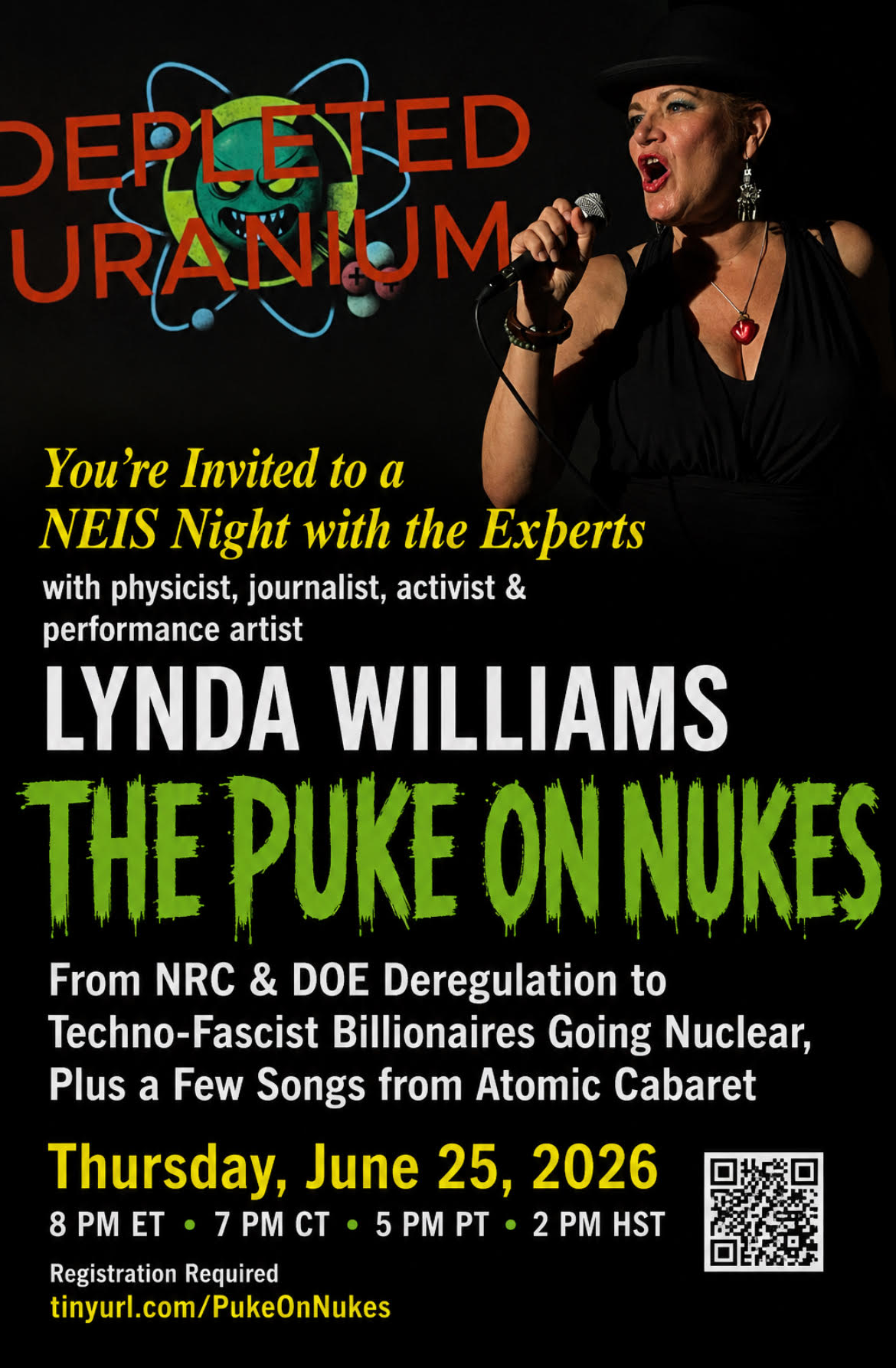
25 June- THE PUKE ON NUKES
Thursday, June 25, 2026
7pm Central Time (8pm ET, 6pm MT, 5pm PT) UTC – 5
From NRC & DOE Deregulation to Techno-Fascist Billionaires Going Nuclear, Plus a Few Songs from Atomic Cabaret REGISTER
26 June – Radiation Trainwreck at the NRC / Join the Protect Better Campaign – https://us02web.zoom.us/meeting/register/4ZlZ5_qLSHGiLSCg8FF6Bg#/registration


Cuba Is Not a Failed State – It Is a Besieged State
PETITION: “Global Appeal to Endorse Palestinian Right of Return of Refugees”
To see nuclear-related stories in greater depth and intensity – go to https://nuclearinformation.wordpress.com
-
Archives
- June 2026 (152)
- May 2026 (306)
- April 2026 (356)
- March 2026 (251)
- February 2026 (268)
- January 2026 (308)
- December 2025 (358)
- November 2025 (359)
- October 2025 (376)
- September 2025 (257)
- August 2025 (319)
- July 2025 (230)
-
Categories
- 1
- 1 NUCLEAR ISSUES
- business and costs
- climate change
- culture and arts
- ENERGY
- environment
- health
- history
- indigenous issues
- Legal
- marketing of nuclear
- media
- opposition to nuclear
- PERSONAL STORIES
- politics
- politics international
- Religion and ethics
- safety
- secrets,lies and civil liberties
- spinbuster
- technology
- Uranium
- wastes
- weapons and war
- Women
- 2 WORLD
- ACTION
- AFRICA
- Atrocities
- AUSTRALIA
- Christina's notes
- Christina's themes
- culture and arts
- Events
- Fuk 2022
- Fuk 2023
- Fukushima 2017
- Fukushima 2018
- fukushima 2019
- Fukushima 2020
- Fukushima 2021
- general
- global warming
- Humour (God we need it)
- Nuclear
- RARE EARTHS
- Reference
- resources – print
- Resources -audiovicual
- Weekly Newsletter
- World
- World Nuclear
- YouTube
-
RSS
Entries RSS
Comments RSS
 nuclear-news