Switzerland Just Exposed Project Ranger’s Weakness
(Project Ranger, a 1,000-acre hypersonic manufacturing campus in Sandoval County, designed to support high-cadence production of hypersonic strike systems. )
Elaine Cimino, 23 Mar 26
Switzerland’s halt on weapons-related exports to the United States is not symbolic. It is a disruption—and it lands directly on projects like Project Ranger.
This facility is being built on the assumption that a complex, global weapons supply chain will function without interruption. That assumption is now broken.
Advanced weapons manufacturing depends on precision components, machine systems, and specialized inputs that cannot be swapped out overnight. When a country like Switzerland shuts off supply, timelines don’t “adjust”—they fail. Production stalls. Certification resets. Entire sequences of manufacturing have to be reworked.
That means one thing for Rio Rancho:
Project Ranger will not meet its LEDA job timelines as promised as long as the supply chain is disruptied.
LEDA agreements are performance-based. Jobs are supposed to materialize on a defined schedule. That schedule is now tied to a disrupted international supply chain. No amount of local approval, zoning, or political messaging can override that reality.
If the components aren’t there, the jobs aren’t there.
And when the jobs don’t show up on time, the public is left holding the bag.
Because the costs are already locked in.
Rio Rancho has approved development while operating with a water deficit. Return flow credits are not being met. Infrastructure is being expanded. Rates are rising. Nearly 40% of residents are low- or fixed-income—and they are being forced to subsidize a project whose economic return is now uncertain.
Water rates were locked designed for developers and project Ranger build out on the residents dollars.
At the same time, the broader economy is unstable. If the economy contracts—and all indicators say that risk is real—projects dependent on fragile, globalized supply chains are the first to break. Delays compound. Costs escalate. Public subsidies become sunk losses.
This is the predictable outcome of building a local economy around a volatile defense supply system.
And yet, construction continues. Question for how long—Until they stopped cold.
Steel is going up. Concrete is being poured. Commitments are being made in real time, while the underlying conditions that justified those commitments are collapsing. Now from the governor to the Castelion excuses to city dodging questions. Don’t count on the fascist tech bros to let their bomb factory to got to rust.
Switzerland didn’t just halt exports.
It exposed the truth: Project Ranger is not in control of its own timeline.And Rio Rancho is not in control of the consequences. The public pays
The Oldest Nuclear Power Plant In The World Is Facing Public Backlash
By Talia Roepel Dec. 14, 2025, https://www.bgr.com/2047450/oldest-nuclear-power-plant-world-controversy-beznau/
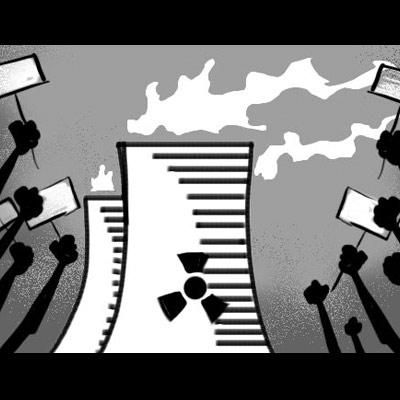
The oldest nuclear power plant in the world that is still operating is Beznau in Switzerland. With both units of the power plant fully operational in 1972, plans are for it to continue to operate until it is completely decommissioned in 2033. Switzerland has no policies in place to stop nuclear power plants after a set amount of time, instead, it is determined based on safety evaluations. However, because of Beznau’s age and its presence in general, it has come under plenty of backlash.
The Beznau nuclear power plant has seen its fair share of incidents. It has had nearly 100 safety incidents across its history, alarming the residents of the surrounding area. It was even temporarily closed for repairs from 2015 to 2018 due to issues with its steam generators, and its reactor was found to have cracks around it that same initial year.
The public isn’t entirely happy about Beznau still being in operation. Nuclear power tends to be controversial because of the danger accidents pose, as well as the fact that nuclear waste doesn’t ever truly go away. There have been gatherings of protestors around Beznau a couple of times in the past, with one protest attracting 20,000 people. Still, it doesn’t look like Beznau has plans to retire early.
No solutions for nuclear waste – no new nuclear power plants!
Greenpeace Switzerland, November 30, 2025
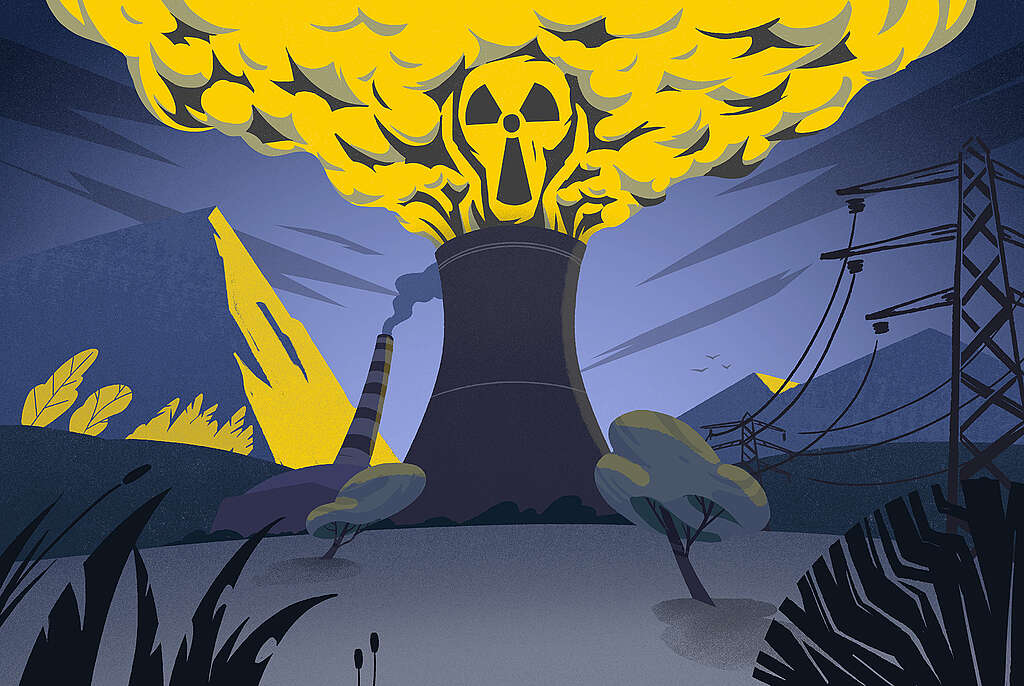
To date, there is no long-term safe solution for the storage of nuclear waste anywhere in the world. This is shown in a new study commissioned by Greenpeace Switzerland. It makes clear that the option planned in Switzerland—burying the nuclear waste in a clay layer north of the cantons of Zurich and Aargau—is fraught with numerous uncertainties.
Here are three reasons why Switzerland must phase out nuclear power as quickly as possible and reduce the production of highly radioactive waste.
1. Burying nuclear waste is not a solution
The Greenpeace study summarizes the findings of over 800 scientific papers on the deep geological disposal of highly radioactive nuclear waste from the last 15 years. It reveals several new problems that are still poorly understood even by experts. These include phenomena such as the mutual weakening of various safety barriers, as well as processes (such as heat and radiation exposure, colloids, cracks, etc.) that could accelerate the spread of radioactive materials in the soil and groundwater.
Overall, it is clear that none of the “solutions” discussed so far for the deep geological disposal of these highly radioactive materials – neither in clay nor in granite formations – can guarantee that the radioactivity will remain safely contained in the long term. This finding is particularly worrying given that the Federal Council is considering a return to nuclear energy.
2. Swiss deep geological repository does not meet safety requirements
The report questions the safety of the planned deep geological repository. The National Cooperative for the Disposal of Radioactive Waste (Nagra) intends to store the highly radioactive waste in thick-walled steel containers, which are to be embedded in an Opalinus Clay layer at a depth of approximately 900 meters. The repository is designed to contain the radioactivity for one million years.
However, the study shows that certain processes could undermine the safety of the repository after only 1,000 or 2,000 years. Given these uncertainties, the optimism of the project’s proponents seems disconcerting.
The Federal Council also seems keen to present the public with a final plan as quickly as possible – for political and financial reasons. In other words, the problem should be resolved as quickly as possible in order to revive nuclear energy in Switzerland.
This is dangerous: We must not make any hasty decisions.
3. The safest way: No new waste – therefore no nuclear power
The reality is that Switzerland currently lacks a safe solution for the long-term storage of high-level radioactive waste. Continuing to pursue the planned deep geological repository in the Northern Lägern region, despite so many doubts, is not a good idea.
Furthermore, there is no disposal strategy whatsoever for a potential new reactor – a point that neither the Federal Council nor the proponents of nuclear energy ever openly address.
Given this situation, we must stop the production of highly radioactive waste as quickly as possible and prevent the problem from worsening through new nuclear power plants. Therefore, please sign our petition: https://www.greenpeace.ch/de/handeln/atomkraft-nie-wieder/
Switzerland moves to lift ban on new nuclear power plants
Critics counter that new reactors carry high costs, waste disposal challenges and potential public pushback.
The Swiss government has presented draft legislation to end its ban on
building new nuclear power plants, reversing a policy adopted in 2018 to
phase out the technology. The plan, a counterproposal to the popular
initiative “Stop the Blackout,” would allow companies to apply for
licenses to construct reactors — if approved by Parliament and upheld in
a potential referendum.
The popular initiative, meanwhile, wants the shift
to be constitutionally enshrined, which would be more difficult to achieve
than a legislative change. Lifting the ban would mark a major shift in
Switzerland’s energy policy. Proponents argue nuclear will be needed
alongside renewables to meet rising electricity demand, cut emissions and
stabilize the grid. Critics counter that new reactors carry high costs,
waste disposal challenges and potential public pushback. Neighboring
Germany exited nuclear power completely in 2023.
Politico 15th Aug 2025, https://subscriber.politicopro.com/article/eenews/2025/08/15/switzerland-moves-to-lift-ban-on-new-nuclear-power-plants-00509734
New nuclear power plant in Switzerland not before 2050
The possible construction of new nuclear power plants in Switzerland, as currently
discussed, depends on many factors. Even if the ban on new construction
were lifted, there would still be numerous other political, technological,
economic, and social uncertainties, as the Energy Commission of the Swiss
Academies of Arts and Sciences outlines in a new report.
Even if the ban on
new construction is lifted, commissioning a new nuclear power plant is
unlikely before approximately 2050. Before connecting to the power grid,
various political, administrative, and economic decisions must be made.
Several referendums and even appeals are expected. The majorities are
uncertain from today’s perspective and could change due to individual
events such as Fukushima.
Swiss Academies of Arts and Sciences 1st July 2025, https://akademien-schweiz.ch/news/neues-kernkraftwerk-in-der-schweiz-fruehestens-2050
France and Switzerland shut down nuclear power plants amid scorching heatwave

By Euronews, 02/07/2025, https://www.euronews.com/2025/07/02/france-and-switzerland-shut-down-nuclear-power-plants-amid-scorching-heatwave
To cool down, nuclear power plants pump water from local rivers or the sea, which they then release back into water bodies at a higher temperature. However, this process can threaten local biodiversity if water is released which is too hot.
Due to a scorching heatwave which has spread across Europe in recent days, a number of nuclear power plants in Switzerland and France have been forced to either reduce activity or shut down completely as extreme temperatures have prevented sites from relying on water from local rivers.
To cool down, nuclear power plants pump water from local rivers or the sea, which they then release back into water bodies at a higher temperature.
However, Europe’s ongoing heatwave means that the water pumped by nuclear sites is already very hot, impacting the ability of nuclear plants to use it to cool down. On top of this, nuclear sites run the risk of posing a dangerous threat to local biodiversity, by releasing water which is too hot into rivers and seas.
In light of the heat, Axpo – which operates the Beznau nuclear power plant in Switzerland – said it had shut down one of its reactors on Tuesday, adding that a second reactor was operating at limited capacity.
“Due to the high river water temperatures, Axpo has been increasingly reducing the output of the two reactor units at the Beznau nuclear power plant for days and reduced it to 50 per cent on Sunday,” said the operator.
The Beznau nuclear power plant’s reactors are located directly on the River Aare, where temperatures have reached 25 degrees Celsius in recent days, leading Axpo to curtail its activities to prevent “excessive warming of the already warm water” which could strain local biodiversity.
Although Switzerland has decided to phase out nuclear power by 2033, existing plants are able to continue to operate as long as they are safe.
Meanwhile, on Monday French electricity company EDF shut down the Golfech nuclear power plant, located in the southern department of Tarn-et-Garonne, amid extreme heat warnings in the region and concerns that the local river could heat up to 28 degrees, even without the inflow of heated cooling water.
France has a total of 57 active nuclear reactors in 18 power plants. According to EDF, the country obtains around 65% of its electricity from nuclear energy, which the government considers to be environmentally friendly.
Output has also been reduced at other sites, including at the Blayais nuclear power plant in western France, as well as the Bugey nuclear power plant in southern France, which could also be shut down, drawing their cooling water from the Gironde and Rhône rivers.
Although the production of nuclear power has had to be curtailed in light of extreme heat, the impact on France’s energy grid remains limited, despite the fact that more electricity is being used to cool buildings and run air conditioning systems.
Speaking to broadcaster FranceInfo, French grid operator RTE ensured that “all the nuclear power sites which are running are able to cover the needs of the French population. France produces more electricity than it consumes, as it currently exports electricity to neighbouring countries.”
‘It made me cry’: photos taken 15 years apart show melting Swiss glaciers

A tourist has posted “staggering” photos of himself and his wife at
the same spot in the Swiss Alps almost exactly 15 years apart, in a pair of
photos that highlight the speed with which global heating is melting
glaciers. Duncan Porter, a software developer from Bristol, posted photos
that were taken in the same spot at the Rhône glacier in August 2009 and
August 2024. The white ice that filled the background has shrunk to reveal
grey rock. A once-small pool at the bottom, out of sight in the original,
has turned into a vast green lake. “Not gonna lie, it made me cry,”
Porter said in a viral post on social media platform X on Sunday night.
Guardian 6th Aug 2024
World leaders to gather in Swiss resort in attempt to forge Ukraine peace plan
More than 100 leaders at two-day conference to discuss Kyiv’s proposals to end war – but Russia and China absent
Comment: Two thumbs down. Without Russia and China, the rest is back patting and re-convincing the pre-convinced.
Lisa O’Carroll, The Guardian, Sat, 15 Jun 2024, https://www.theguardian.com/world/article/2024/jun/15/world-leaders-to-gather-in-swiss-resort-in-attempt-to-forge-ukraine-peace-plan
More than 100 leaders, including the US vice-president, Kamala Harris, and the presidents or heads of the EU, South American, Middle East and Asian countries, will gather in Switzerland on Saturday for one of the most ambitious attempts yet to forge a peace plan for Ukraine.
The summit comes as G7 leaders gathering in Italy clinch a new deal for a €50bn loan for Ukraine, securitised through use of the windfall profits from the interest on Russian central bank assets frozen by the EU and other western nations after the 2022 invasion of Ukraine.
The two-day peace conference, which will take place at the luxury Bürgenstock resort outside Lucerne, will discuss Kyiv’s proposed 10-point plan to end the war along with three other themes: the nuclear threat, food security and humanitarian needs in Ukraine.
It follows the Russian president, Vladimir Putin, on Friday demanding that Kyiv cede more land, withdraw troops deeper inside its own country and drop its Nato bid in order for him to end his war in Ukraine – proposals that were rejected by Ukraine, the US and Nato.
A joint communique on Sunday is expected to centre on the importance of the UN principles on maintaining and respecting “sovereignty and territorial integrity”.
While this is not seen as advancing peace in itself, it is designed to “reduce the space for any unhelpful initiatives”, say those with knowledge of the conference.
This will be seen as a success for Volodymyr Zelenskiy who is aiming to build international support for his peace plan that includes a full withdrawal of Russian troops from Ukraine and return to its 1991 post-Soviet borders.
Organisers of the peace summit played down China’s decision not to attend, a move that prompted Zelenskiy to accuse Beijing of helping Moscow undermine the meeting, which China’s foreign ministry denied.
Kyiv had been pushing hard for a Chinese delegation to attend the summit to give the conference further legitimacy and drive a wedge between Moscow and Beijing.
There were also hopes that Saudi Arabia may attend after what Zelenskiy described as “productive and energetic” talks with the Saudi crown prince Mohammed bin Salman on Wednesday.
Moscow has dismissed the meeting as futile.
China, which has close ties to Russia, said it would not attend because the conference did not meet its requirements, including the participation of Russia.
That dozens of leaders will be in Switzerland at a time when Ukraine is on the back foot militarily, and with talk of war fatigue growing, is an impressive feat, senior US figures said.
“It’s rather remarkable that there’s 100 countries showing up to a peace summit at which the main instigator of that conflict is not participating,” said Max Bergmann, a former US state department official.
“It’s a diplomatic masterstroke,” said Bergmann, who now heads the Europe, Russia and Eurasia Program at the Center for Strategic and International Studies.
William Courtney, a former US diplomat, called the Swiss outreach a “huge success”.
The summit follows several previous gatherings, including one in Saudi Arabia attended by 40 countries including China, which has been trying to enlist support for its own six-point peace plan.
As the summit approaches, China has intensified its outreach through meetings with visiting foreign dignitaries, phone calls and messages to foreign missions on China’s WeChat platform, diplomats told Reuters reporters.
But sources said organisers were not concerned, as there had been “no concretisation” of any Chinese diplomatic manoeuvres, with many global south countries, including Colombia, Chile, Argentina and Ecuador, attending on Saturday.
Others attending include Thailand, Singapore, the Philippines and Japan, while Malaysia and Cambodia, which have close ties to China, are not thought to be going.
Swiss ruling could pave way for more climate activist cases.
The decision that Switzerland had failed in its duty to mitigate climate change raises
questions about the Strasbourg court overstepping the mark. Victory for a
group of Swiss women who challenged their government’s inaction over
climate change will encourage activists “to try their luck”, one City
law firm partner warns.
The European Court of Human Rights last week ruled
for the first time that signatory states to the convention are obliged to
protect their citizens from the effects of the evolving “climate
crisis”. The judges said that the Swiss government had failed to comply
with its duties to mitigate climate change, and that violated the right to
respect for private and family life.
Times 18th April 2024
Swiss nuclear power plants are running out of staff
After warning Switzerland over two years ago, the International Atomic Energy Agency (IAEA) recommends the authorities develop a roadmap to deal with the impending problem of labour shortage in Swiss nuclear power plants.
This content was published on December 3, 2023 – 14:17December 3, 2023
Switzerland’s existing nuclear power plants are on the verge of having their lifetimes extended from 50 to 80 years. But now a problem is threatening to thwart these plans.
The search for skilled labour is becoming increasingly challenging, as reported by the NZZ am Sonntag newspaper on Sunday. There are currently over 40 vacancies at the Beznau, Gösgen and Leibstadt nuclear power plants.
A team of experts from the IAEA warned Switzerland back in October 2021. In a report, the agency concluded that the search for personnel was one of the biggest challenges for Swiss nuclear plants and for the supervisory authority itself…………………https://www.swissinfo.ch/eng/business/swiss-nuclear-power-plants-are-running-out-of-staff/49027136
Switzerland continues its nuclear safety awareness with iodine pills distributed to the population
Bloomberg, By Paula Doenecke and Kevin Whitelaw, October 28, 2023
ZURICH — Switzerland is in the middle of a ritual it performs once a decade: distributing a fresh round of iodine pills to protect its people should something go wrong with one of its nuclear power plants.
Residents who live within 50 kilometers of one of the nation’s three nuclear power plants will find an orange package with a dozen tablets in their mailbox by next April. The delivery replaces the lilac box of thyroid cancer prevention medication that the government handed out 10 years ago.
The campaign may seem like a Cold War relic to some — newly arrived expatriates are often startled to be handed a voucher for their pills when they first register at the town hall. But the idea is that sirens would sound in the event of a nuclear accident so that people could take a dose before any fallout reaches them.
The pills containing the compound potassium iodide are distributed free of charge, including in the financial and industrial centers of Zurich and Basel. People living within the 50-kilometer radius, but on the German side of the border, are left to fend for themselves.
The logistical effort costs 34 million Swiss francs (€35.9 million) — a third of which is financed by the nuclear power plant operators. Beyond protecting the health of the Swiss people, the strategy is part of the country’s long-standing identity of neutrality, dubbed Reduit Switzerland, or Swiss Fortress. That pride of self-defense still manifests today in a multitude of well-maintained tank stoppers and bunkers spread throughout the Swiss Alps.
While Germany and France are battling these days over the role of nuclear power in Europe’s energy transition, Switzerland is proceeding on its path of risk mitigation — keeping its remaining three atomic plants running as long as they are functioning, as decided by a public vote in 2017. It retired a fourth in Muehlenberg in 2019…….. more https://www.bloomberg.com/news/newsletters/2023-10-28/switzerland-s-once-a-decade-nuclear-ritual #nuclear #antinuclear #nuclearfree #NoNukes
Fresh stock of iodine tablets for Swiss living near nuclear plants
People living within a 50km radius of Swiss nuclear power plants will receive a fresh stock of iodine tablets over the coming weeks and until next April.
October 13, 2023
The government has purchased 12 million packs of iodine tablets. The budget for the iodine distribution campaign is CHF34 million of which CHF11 million will be financed by the nuclear power plant operators, who will pay CHF 1.22 million a year into government’s general fund from 2021 to 20……………………………………………………. more https://www.swissinfo.ch/eng/business/fresh-stock-of-iodine-tablets-for-swiss-living-near-nuclear-plants/48887374
#nuclear #antinuclear #NuclearFree #NoNukes #NuclearPlants
Why Swiss Neutrality is essential for American national security
SCOTT RITTER, SEP 9, 2023
Thirty years ago, a gathering of like-minded teachers, social workers, and medical professionals took place in a village some 40 miles outside of the northern Swiss city of Zurich. Their goal was to create a discussion group dedicated to the idea of the courageous pursuit of ethical living—“Mut zur Ethik,” in Swiss-German.
Over the course of three days—September 1-3—this group, by this time veterans of three decades of commitment to their cause, convened their 30th meeting in a conference center in the quaint Swiss town of Sirnach. The conference featured speakers from around the world—Peru, the Congo, and Afghanistan stand out—as well as Europe and North America. The noted journalist Patrick Lawrence, together with his wonderful wife, Kara, were in attendance. I joined them as the only other American present in a crowd that numbered well over 200, with many more participating via video conference.
Numerous topics were discussed, ranging from American exceptionalism to Lithium mining, and almost everything in between. But the one that stood out to me was the issue of Swiss neutrality………………….The main takeaway for me from the Mut zur Ethik conference was the absolute necessity of Switzerland remaining viably neutral, and how important this was from the perspective of American national security………………………………………..
Switzerland continues to honor its current laws prohibiting the direct delivery of weapons to any nation engaged in war. Moreover, the re-export of Swiss-made weapons by third countries requires permission from the Swiss government. In the current conflict between Russia and Ukraine, several European governments whose military possess stocks of Swiss-made ammunition have made such requests, but to date, no permission has been granted, something that has drawn the ire of the United States.
Enter Scott Miller, the US Ambassador to Switzerland. Miller has strongly urged Switzerland to allow the re-exportation of munition, declaring that the ban “benefits the aggressor [Russia], who violates all principles of international law.”……………………………………………
Many Swiss are concerned about what they view as the blatant interference in Swiss neutrality on the part of the US and its European allies. Last year, Pro Schweiz, an association affiliated with the conservative Swiss People’s Party, launched a campaign calling for a referendum designed to protect Switzerland’s neutrality by prohibiting it from participating in future sanctions and defense alliances. This would be accomplished through changes in the Swiss Constitution that would prevent Switzerland from joining a defense alliance unless it first came under direct attack, and ban “non-military coercive measures” such as sanctions……………………………………………………………………………………………………………………
There will be a critical need for a neutral party who can provide a haven for the talks and negotiations that will be essential for the preservation of world peace and security. Switzerland is ideally positioned to be that neutral party, but only if it can regain the stature it enjoyed prior to the Russia-Ukraine conflict. This can only happen if the United States stops pressuring Switzerland to give up on its neutrality in pursuit of shortsighted policies that will do little to change the outcome of the war in Ukraine. Swiss neutrality is not just good for Switzerland. It is also essential for US national security and should be supported at all costs. https://www.scottritterextra.com/p/why-swiss-neutrality-is-essential?utm_source=post-email-title&publication_id=6892&post_id=136867957&utm_campaign=email-post-title&isFreemail=true&r=ln98x&utm_medium=email
Zelensky’s Swiss parliament speech boycotted by right-wing Swiss People’s Party
Rightwing members of the Swiss parliament boycotted an address by Ukraine President Volodymyr Zelensky that called for war materiel export restrictions to be eased.
swissinfo.ch June 15, 2023June 15, 2023
Members of the Swiss People’s Party were absent from the parliamentary chamber in protest against perceived interference of Swiss affairs.
Zelensky has in the past urged Switzerland to beef up sanctions against Russian oligarchs and now wants Swiss-manufactured weapons to be sent to Ukraine.
“I know there is a discussion in Switzerland about the exportation of war materiel to protect and defend Ukraine. That would be vital,” Zelensky said during his video-link address on Thursday. “We need weapons so we can restore peace in Ukraine.”……………………………
Switzerland has resisted calls from Germany, Denmark, the Netherlands and Spain to allow them to re-export Swiss-made ammunitions and weapons to support Ukraine in the fight against Russia.
Earlier this year, the Swiss parliament voted against a softening of war materiel export restrictions as it would violate Switzerland’s position of neutrality.
The People’s Party refused to listen to Zelensky’s address that was interpreted as an attempt to weaken the Swiss tradition of neutrality.
“………..we must not allow ourselves to be put under pressure on the issue of sanctions or arms deliveries,” said People’s Party parliamentarian Alfred Heer.
“I oppose the Ukrainian President making a video address in the House of Representatives,” tweeted Thomas Aeschi, parliamentary leader of the People’s Party, last month when Zelensky’s address was announced.
“Ukraine is trying to directly influence parliament to take a decision on weapons/ammunition deliveries. Our neutrality would be violated!”………….. https://www.swissinfo.ch/eng/zelensky-s-swiss-parliament-speech-boycotted-by-right-wingers/48592932
Swiss Government wants command centre in case of ‘nuclear event’
Government wants command centre in case of ‘nuclear event’
The Swiss government on Friday laid out responsibilities in case of a nuclear attack or nuclear disaster linked to the war in Ukraine. September 30, 2022
While the defence ministry currently considers this unlikely, the government says it is necessary to be prepared and be able to react rapidly.
It has tasked the defence ministry to set up a Federal Strategic Command Staff if there were to be such an event or it looked likely. This Command Staff will be headed by the secretary-general of the defence ministry and include the secretary generals of all the ministries, the federal government spokesperson, heads of the federal health, civil defence, energy and other key offices as well as representatives of the army, police and fire brigade…………………..more https://www.swissinfo.ch/eng/politics/government-sets-chain-of-command-in-case-of–nuclear-event-/47943850
1 This Month

of the week – Shut Down Drone Warfare!


Tell the Ukrainian Government to Drop Prosecution of Peace Activist Yurii Sheliazhenko

Petition to revoke the licensing of the Near Surface Nuclear Disposal Facility (NSDF) at Chalk River. https://www.ourcommons.ca/petitions/en/Petition/Details?Petition=e-7247
To see nuclear-related stories in greater depth and intensity – go to https://nuclearinformation.wordpress.com
-
Archives
- March 2026 (237)
- February 2026 (268)
- January 2026 (308)
- December 2025 (358)
- November 2025 (359)
- October 2025 (376)
- September 2025 (257)
- August 2025 (319)
- July 2025 (230)
- June 2025 (348)
- May 2025 (261)
- April 2025 (305)
-
Categories
- 1
- 1 NUCLEAR ISSUES
- business and costs
- climate change
- culture and arts
- ENERGY
- environment
- health
- history
- indigenous issues
- Legal
- marketing of nuclear
- media
- opposition to nuclear
- PERSONAL STORIES
- politics
- politics international
- Religion and ethics
- safety
- secrets,lies and civil liberties
- spinbuster
- technology
- Uranium
- wastes
- weapons and war
- Women
- 2 WORLD
- ACTION
- AFRICA
- Atrocities
- AUSTRALIA
- Christina's notes
- Christina's themes
- culture and arts
- Events
- Fuk 2022
- Fuk 2023
- Fukushima 2017
- Fukushima 2018
- fukushima 2019
- Fukushima 2020
- Fukushima 2021
- general
- global warming
- Humour (God we need it)
- Nuclear
- RARE EARTHS
- Reference
- resources – print
- Resources -audiovicual
- Weekly Newsletter
- World
- World Nuclear
- YouTube
-
RSS
Entries RSS
Comments RSS
 nuclear-news