European court upholds Sweden’s right to tax nuclear power stations

 Court leaves Swedish nuclear tax unchanged, World Nuclear News, 1 Oct 15 Sweden can continue to tax nuclear power production following a ruling in the government’s favour by Europe’s highest court. The European Court of Justice’s seventh chamber decided that the tax does not fall within the scope of two European Council Directives and is therefore a national, rather than European Commission, matter.
OKG AB first contested the levy in 2009 in the Swedish courts, which in October 2013 sought the EU’s preliminary ruling. The company, which turns 50 this year, owns and operates three nuclear power units – Oskarshamn 1, 2 and 3 – which together account for 10% of total electricity generation in Sweden.
The company announced yesterday that it will hold an extraordinary shareholders’ meeting on 14 October to reach a decision on closing units 1 and 2. German EOn and Finnish Fortum own, respectively, 54.5% and 45.5% of the shares in OKG.
According to lobby group Swedenergy, a ruling in the company’s favour could have removed an annual cost of about 4.6 billion kronor ($540 million) for the country’s nuclear industry since the Swedish government increased the tax by 17% from 1 August.
The court document, published today on its website, says that levying a tax on the thermal power of nuclear reactors is not within the scope of Council Directive 2003/96/EC of 27 October 2003 that restructures the Community framework for the taxation of energy products and electricity. Nor is the tax an excise duty for the purposes of Council Directive 92/12/EEC of 25 February 1992 on general arrangements for, and the holding and movement of, products subject to excise duty……http://www.world-nuclear-news.org/NP-Court-leaves-Swedish-nuclear-tax-unchanged-1101501.html
Sweden tightens rules on drones flying near nuclear stations
 Flouting Nuclear Drone Ban in Sweden Will Land You in Jail, Bloomberg, Jesper Starn, 18 Sep 15,
-
No-fly zones start Oct. 15 to protect national security
-
Swedish police focus on tackling pilots on the ground
The Nordic region’s biggest producer of atomic energy will from Oct. 15 add nuclear plants to a list of sites including airports and hospitals with no-fly zones in an effort to preserve national security. If caught, drone pilots face as long as 6 months behind bars, according to the Swedish police.
Sweden is tightening its rules amid growing international concern about the security threat posed by drones, which have buzzed French nuclear reactors, landed on the White House lawn and even crashed into the stands at this month’s U.S. Open tennis tournament in New York. While France is backing research into tracking and destroying illegal unmanned craft, Sweden is opting to pursue the pilots on the ground……
Greenpeace flew a piloted paraglider over Ringhals in 2013, dropping balloons on the roof of one of the reactor buildings, according to Vattenfall.
While environmental activists have parasailed, hurdled fences and climbed buildings at Swedish nuclear plants in attempts to demonstrate poor security, seaweed and jellyfish have been more effective in cutting output by blocking flows of cooling water.
- Flying a drone over banned areas would void any form of insurance to cover damages caused by the craft, according to Claes Wahlund, the chairman of the Swedish Model Airplane Association.“Flying over a nuclear power plant is not a hobby,” he said by phone on Thursday. “Without insurance, pilots could really be in deep trouble.”Illegal drone flights near Swedish airports forced air traffic to halt at least 10 times this year, Ulf Wallin, spokesman for Swedavia AB, the manager of 10 of the nation’s airports, said Thursday by phone. Two Lithuanian men that flew a drone over a military airport in Lidkoeping, Sweden, in May were fined 2,000 kronor ($240) each, Swedish news service TT reported.
- While Ringhals views any breach of the no-fly zone as a police matter, it’s still assessing ways of detecting drones, Staalnacke said, without being more specific.Under existing law, anyone who destroys a drone, even the police, would be liable to pay the owner to replace it, police spokesman Fuxborg said.Ringhals and Forsmark, another plant owned by Vattenfall on Sweden’s east coast, were granted a temporary flight ban from Sept. 7 until the permanent no-fly zone takes effect Oct. 15. EON SE’s Oskarshamn reactor in the southeast also gets the permanent ban from Oct. 15, Emmy Davidsson, a spokeswoman for the plant, said Tuesday by phone. http://www.bloomberg.com/news/articles/2015-09-17/flouting-nuclear-drone-ban-in-sweden-will-soon-land-you-in-jail
Investors flee Nordic nuclear company Vattenfall
 Nuclear Shutdowns Are Leaving Vattenfall’s Bond Investors Cold , Bloomberg, Jesper Starn , 21 May 15 A jump in power prices hasn’t been able to lift Vattenfall AB bonds as investors worry the Swedish utility will write down more nuclear assets.
While Nordic power prices have risen from record lows after Vattenfall said it would close its two oldest reactors, yield spreads on the utility’s bonds are little changed. The closing plans instead directed attention to the poor Nordic market outlook for investors who had focused on Vattenfall’s woes in Germany, according to Ebba Lindahl, an SEB AB analyst.
“We see an increased risk of smaller cash flows from nuclear generation in the future and further write downs of assets that will not be fully compensated by the increase in power prices,” she said in a phone interview…….
A surge in renewable energy output in Nordic region, coupled with demand still below 2008-levels, has pushed power prices so low that the once-steady cash cow of nuclear production has become a liability.
The company is majority owner of seven reactors in Sweden and also owns thermal coal, lignite and gas units in Germany, which are poorly suited to the European Union’s aim for a transition to low-emission energy systems, according to Ingvar Mattsson, a senior analyst at Swedbank AB.
Vattenfall’s plans to close the two reactors early “reflects a tough market situation with low power prices, and thus a lower valuation of nuclear assets,” he said by phone. “Vattenfall is also obviously exposed to political risks in both Germany and Sweden.” http://www.bloomberg.com/news/articles/2015-05-20/nuclear-shutdowns-are-leaving-vattenfall-s-bond-investors-cold
Big nuclear company not interested in new nuclear power
Vattenfall: We are not interested in new nuclear power http://sverigesradio.se/sida/artikel.aspx?programid=2054&artikel=6156063 lördag 2 maj kl 15Vattenfall’s new President and CEO, Magnus Hall, a former lobbyist for the nuclear power industry, says it is no longer possible to build new nuclear power stations in Sweden, unless the state pays.

The business community in Sweden is no longer interested in building new nuclear power. At least not if it has to pay, thinks Magnus Hall. The ongoing nuclear projects in Finland and the UK have cracked all his calculations and the Vattenfall chief does not believe there is not sufficient profitability in new reactors without state support.
Magnus Hall, who was formerly chairman of Industrial Power, a lobby organization that wanted to build new nuclear power for electricity-intensive industries, has thus changed his position today.
“Yes, I have enough, actually, because I think it has become so clear that it is the state that dictates the terms for nuclear power. Therefore, the state also take responsibility for it, and it is also linked to the infrastructure of a country, says Hall to Swedish Radio News.
Last week, the Swedish state-owned energy company announced it will cut 1,000 jobs and close two of its reactors earlier than expected due to a fall in profits. Lower energy prices and lower production levels have affected Vattenfall’s results.
Sweden accelerates its closure of its uneconomic nuclear industry
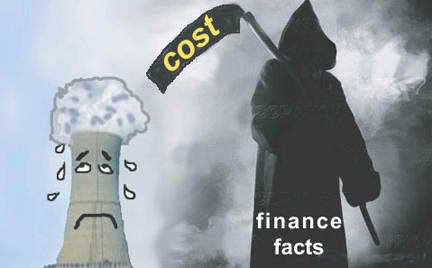 Sweden to speed up nuclear reactors closure The Local, 28 Apr 2015 Sweden’s state-owned energy group Vattenfall on Tuesday said it planned to shut down two nuclear reactors in 2018 and 2010, up to seven years earlier than expected. Vattenfall said reactors 1 and 2 at the Ringhals plant in south-west Sweden were too costly to keep in production until 2025 as previously planned.
“Ringhals 1 and 2 may be closed down between the years 2018 and 2020 instead of, as previously announced, around 2025,” Vattenfall said in a statement.
“The reason is declining profitability and increased costs,” it said……The Swedish group has been struggling to improve profits for several years, suffering from weak demand and plunging electricity prices………http://www.thelocal.se/20150428/sweden-speeds-up-nuclear-reactors-closure
Renewable Energy Target to be raised in Norway and Sweden
Norway and Sweden agree to raise renewable energy target http://af.reuters.com/article/energyOilNews/idAFL5N0WF0YY20150313 Fri Mar 13, 2015 OSLO, (Reuters) – Norway and Sweden agreed on Friday to increase a joint 2020 renewable energy target by almost 8 percent under a subsidy scheme which could lead to higher energy prices for consumers.
Under the new target, the two Nordic countries aim to raise the amount of electricity they produce in total from renewable energy sources such as wind, hydro or biomass to 28.4 terawatt-hours (TWh) per year by 2020 from 26.4 TWh.
The changes to the common support scheme need to be approved by lawmakers in both countries before it comes into effect.
Norway and Sweden launched the first cross-border renewable support scheme in the world in 2012. Producers receive electricity certificates depending on how much green power they produce, which they can sell on the market for profit.
However, the system is financed by electricity end-users, as the costs of the certificates are added to electricity bills, meaning consumers in Norway and Sweden contribute to paying for rises in renewable energy production.
Higher renewables output could also increase pressure on already low Nordic power prices, hurting revenues of such power producers as Vattenfall or Statkraft.
Nordic spot power prices fell to 29.61 euros per megawatt-hour (MWh) in 2014, the lowest since 2007, partly due to more renewable power being added, sluggish demand and warm weather.
However, the wind power industry welcomed the news.
“It’s a big boost for the Nordic electricity certificate market. There will be additional 2 TWh to fight for,” said Andreas Thon Aasheim, an advisor at Norwegian wind power association Norwea, referring to the additional renewable output agreed by the two countries.
Norway lags Sweden on wind power production, but the Norwegian government has agreed to harmonise depreciation rules for wind power projects to bring them into line with Sweden. (Reporting by Nerijus Adomaitis; editing by Nina Chestney and David Evans)
Renewable energy powers municipalities in Sweden
Municipalities in Sweden powering cities from renewable energy sources Phys Org, 13 Jan 15 By relying on district heating combined with heat and power production, municipalities in Sweden power their cities from renewable energy sources. Nordic countries have achieved a great independence from fossils because of their widespread district heating systems. District heating is a smart way to avoid using fossil fuels to heat buildings. It is typically based on wood, peat and other biofuels, or household waste. But other non-fossil fuel sources, such as deep thermal heat—sourced from between 100 to 500 meters below the ground—or recycled heat from industries can be used as well.
Two Swedish experts talk to youris.com about ways of removing carbon-based fuels from the heating equation, and what other municipalities can learn from their experience. One of them is Karin Ericsson, a senior lecturer at the Department of Environmental and Energy Systems of Lund’s University. Her research field is energy system analysis and bioenergy in Europe. The other is Mats Didriksson, who is director for the business area energy of Kraftringen, an energy company owned by four municipalities in Southern Sweden near the city of Lund.
What is the history of the development of district heating in Sweden?………
What can cities in other countries learn from Sweden’s experiences?………..http://phys.org/news/2015-01-municipalities-sweden-powering-cities-renewable.html
Waste fees for nuclear plant operates getting more costly- Sweden
 Sweden doubles waste fee for nuclear power plant operators http://www.reuters.com/article/2014/12/18/us-sweden-nuclear-idUSKBN0JW1YV20141218 Sweden’s government has decided to almost double a fee nuclear power plant operators pay to the nuclear waste fund, in order to help it cover the rising costs of decommissioning, the environment ministry said on Thursday.
Sweden’s state-owned utility Vattenfall [VATN.UL] operates Forsmark and Ringhals power plants, and Germany’s E.ON operates Oskarshamn plant. Finnish utility Fortum, which operates Loviisa power plant, also has stakes in Forsmark and Oskarshamn.
The nuclear industry will have to pay 0.04 Swedish crowns per kilowatt-hour from 2015-2017, up from 0.022 crowns today, the government decided. In 2013 the fees to the waste fund, a government authority, amounted to 2.5 billion Swedish crowns ($324.41 million). “Nuclear power must bear its own costs and the government’s decision to increase the nuclear waste fee makes this possible,” said Climate and Environment Minister Asa Romson.
Nuclear power has come under increased pressure in Sweden after general elections in September when the Social Democrats and the Green Party formed a minority cabinet. The coalition fell in a budget vote earlier this month, and a snap election is due in March.
The industry has warned that a combination of rising taxes and extra costs for new safety measures could lead to earlier shutdown of older plants, and potentially higher power prices.
(Reporting by Nerijus Adomaitis; Editing by Mark Trevelyan)
Swedish petition to Finland, opposing Fennovoima nuclear facility
 Swedish NGO delivers anti-Fennovoima petition toFinland http://www.rcinet.ca/eye-on-the-arctic/2014/12/03/swedish-ngo-delivers-anti-fennovoima-petition/by Radio Sweden
Members of a Swedish civic organisation collected and delivered more than 20,000 signatures from individuals protesting the proposed construction of a nuclear power plant in northwest Finland by the power consortium Fennovoima.
The delegation from the Swedish NGO Nuclear-free Gulf of Bothnia (Kärnkraftsfritt Bottenviken) visited the Finnish parliament Tuesday morning to hand over the petition on behalf of more than 170,000 residents of seven municipalities that lie close to the proposed construction site of the Pyhäjoki nuclear power plant. The site in northwest Finland lies just 155 kilometres from the Swedish coast.
“Because of the natural environment Hanhikivi is an extremely poor choice to locate a nuclear power plant,” activist Kristina Berg told lawmakers in Helsinki.
Earlier this year, demonstrators gathered in the centre of the Swedish coastal city of Luleå ahead of a public hearing on the proposed plant in Pyhäjoki, near Raahe.
Environmental impact on Sweden?
The protesters have long been worried about the potential environmental impact of the nuclear facility on the Swedish side of the Gulf of Bothnia. Many have demanded a fundamental re-think of the project and have also called for a system of sustainable energy that is not based on continuous growth.
Residents of the Swedish communities have also pointed to the strong role of the Russian state-owned nuclear contractor Rosatom in the proposed project, even charging that Finland is outsourcing its energy needs to Russia.
The petition was delivered as Finland’s largest power producer Fortum announced plans to buy a stake in the Fennovoima nuclear power plant, taking it one step closer to reality.
The cabinet had previously dictated that the plant should be at least 60 percent domestic or European-owned as a prerequisite for a final go-ahead. Fortum’s investment would take Finnish ownership to 66 percent, helping the project meet the government’s criterion.
A nuclear-free future on the cards for Sweden
The parties said in separate, but identical statements that nuclear power should be replaced with renewable energy and energy efficiency. The goal, they said, should be at least 30 TWh of electricity from renewable energy sources by 2020. A goal for 2030 has yet to be set, they added. Support for offshore wind and solar power are needed “in addition”, they said.
Nuclear power “should bear a greater share of its economic cost”, they said. “Safety requirements should be strengthened and the nuclear waste fee increased.”
Hot weather forcing Sweden to cut nuclear reactors’ output
 Sweden’s nuclear plants forced to cut output due to warm weather Planet Ark, 24-Jul-14 Balazs Koranyi Sweden’s top nuclear power generators have been forced to cut output because of exceptionally warm weather in Scandinavia, and their output could be reduced for over a week, their operators said on Wednesday.
Oskarshamn, part of Germany’s E.ON and Forsmark, operated by Swedish utility Vattenfall have both cut output because warm sea water temperatures are limiting their ability to cool down.
“For each degree above 23 decrees Celsius in the cooling water, each unit has to decrease power by 3 percent,” Forsmark said in a market message. “It is uncertain how long this will last, but according to meteorologists, the warm weather will last for at least 11 more days.”
Temperatures exceeded 30 degrees in the southern part of Scandinavia this week, hitting their highest level in years…….http://planetark.org/enviro-news/item/71927
Nuclear decommissioning costs shooting up in Sweden
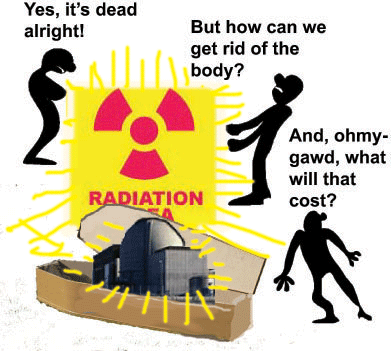 Sweden plans big rise in fees to nuclear decommissioning fund http://economictimes.indiatimes.com/news/international/business/sweden-plans-big-rise-in-fees-to-nuclear-decommissioning-fund/articleshow/37335517.cms By Reuters | 27 Jun, 2014 OSLO: Sweden on Friday proposed a sharp rise in fees nuclear power producers have to pay the country’s nuclear decommissioning fund, saying previous cost estimates were too low.
Sweden has three nuclear power plants with ten reactors in operation, generating about 40 per cent of the country’s electricity needs. The oldest reactors are expected to be shut at the beginning of the next decade.
OSLO: Sweden on Friday proposed a sharp rise in fees nuclear power producers have to pay the country’s nuclear decommissioning fund, saying previous cost estimates were too low. The Swedish Radiation Safety Authority (SSM) said it has proposed raising fees by 73 per cent to 0.038 crowns ($0.01) per kilowatt-hour from 0.022 crowns for 2015.
It said the Swedish Nuclear Fuel and Waste Management Company (SKB) had to recalculate fees to the nuclear decommissioning fund for the period of 2016-2017.
“The SSM has assessed that the costs for decommissioning and final disposal for the Swedish nuclear power industry may be underestimated by SKB by at least 11 billion Swedish crowns ($1.63 billion),” the authority said in a statement.
Sweden’s state-owned utility Vattenfall operates seven reactors and Germany’s E.ON three. Finnish utility Fortum has stakes in six Swedish nuclear reactors.
Sweden turning against nuclear power
Support for nuclear power falls in Sweden, survey says http://www.alaskadispatch.com/article/20140509/sweden-hydropower-station-challenged-nuclear-energy-loses-favorSwedes are becoming increasingly skeptical of nuclear power with a new survey showing 50 percent of respondents want the controversial power source phased out.
The report from the SOM Institute at the University of Gothenburg found support falling for nuclear power since a meltdown at Japanese power plant. With other European nations moveing away from nuclear power, Swedes are also growing leery.
“The fact that Germany, Switzerland, Italy and several other countries have begun to phase out nuclear power, it’s likely that nowadays it might happen in Sweden, too,” Sören Holmberg, a political science professor at Gothenburg University, told Swedish Radio News.
Before the nuclear accident at Fukushima in Japan, Swedes were generally positive toward building new reactors with 44 percent supporting the measure and 39 percent opposing it. After the disaster in 2011, 44 percent said they were against nuclear power and now half of respondents are anti-nuclear.
As before, support for new nuclear plants is strongest on the right of the political spectrum and the greatest resistance is from the left. Men and white collar workers are also more positive than women and laborers.
This story is posted on Alaska Dispatch as part of Eye on the Arctic, a collaborative partnership between public and private circumpolar media organizations.
Sweden’s anxiety about Finland’s planned Pyhäjoki nuclear plant
Will Finland’s proposed nuclear plant affect Sweden’s North?, Alaska Dispatch YLE NewsEye on the Arctic January 10, 2014 Northern Sweden is concerned that the proposed nuclear plant in Western Finland would harm neighboring Sweden’s nature and fish stocks.
At the Finnish Ministry of the Economy and Employment, sending a delegation to Sweden to discuss the contentious issues is on the table.
Fennovoima’s planned Pyhäjoki nuclear plant is being strongly opposed in Northern Sweden. The opposition is set on stopping the plant, which is a Finnish-Russian joint venture…….
In Sweden, opposition to the plant includes non-governmental groups as well as government officials and local politicians. Their goal is to provoke debate and ultimately prevent construction of the plant all together. Their concerns include nuclear safety as well as the potential destruction of Northern Sweden’s nature and fish stocks.
According to Senior Engineer Aurela, opposition to the plant mainly concerns the nuclear plant’s warm water cooling system and potential nuclear accidents.
Rosatom’s promised financing has also raised suspicions…….http://www.alaskadispatch.com/article/20140110/will-finland-s-proposed-nuclear-plant-affect-sweden-s-north
Unlike UK, Sweden will not subsidise new nuclear power
 Sweden rejects British model for new nuclear plant deals http://au.news.yahoo.com/world/a/19936540/sweden-rejects-british-model-for-new-nuclear-plant-deals/ November 21, 2013, By Michel Rose PARIS (Reuters) – Sweden, reviving its nuclear power, will not follow Britain’s example of offering state guarantees to fund the construction of new plants, its energy minister said on Wednesday. Last month, Britain signed a deal with France’s EDF to build a new nuclear plant, becoming the first European country to guarantee a company a feed-in tariff for an atomic energy project. Sweden’s biggest power group Vattenfall has touted Britain’s price guarantee system to help companies commit to build new nuclear power plants in a market with low power prices.
“We won’t address any direct or indirect subsidies for new nuclear power production in Sweden, which means that we will not introduce any feed-in tariff for nuclear,” Swedish Energy Minister Anna-Karin Hatt told reporters in Paris. Continue reading
1 This Month

of the week – Shut Down Drone Warfare!


Tell the Ukrainian Government to Drop Prosecution of Peace Activist Yurii Sheliazhenko

Petition to revoke the licensing of the Near Surface Nuclear Disposal Facility (NSDF) at Chalk River. https://www.ourcommons.ca/petitions/en/Petition/Details?Petition=e-7247
To see nuclear-related stories in greater depth and intensity – go to https://nuclearinformation.wordpress.com
-
Archives
- April 2026 (44)
- March 2026 (251)
- February 2026 (268)
- January 2026 (308)
- December 2025 (358)
- November 2025 (359)
- October 2025 (376)
- September 2025 (257)
- August 2025 (319)
- July 2025 (230)
- June 2025 (348)
- May 2025 (261)
-
Categories
- 1
- 1 NUCLEAR ISSUES
- business and costs
- climate change
- culture and arts
- ENERGY
- environment
- health
- history
- indigenous issues
- Legal
- marketing of nuclear
- media
- opposition to nuclear
- PERSONAL STORIES
- politics
- politics international
- Religion and ethics
- safety
- secrets,lies and civil liberties
- spinbuster
- technology
- Uranium
- wastes
- weapons and war
- Women
- 2 WORLD
- ACTION
- AFRICA
- Atrocities
- AUSTRALIA
- Christina's notes
- Christina's themes
- culture and arts
- Events
- Fuk 2022
- Fuk 2023
- Fukushima 2017
- Fukushima 2018
- fukushima 2019
- Fukushima 2020
- Fukushima 2021
- general
- global warming
- Humour (God we need it)
- Nuclear
- RARE EARTHS
- Reference
- resources – print
- Resources -audiovicual
- Weekly Newsletter
- World
- World Nuclear
- YouTube
-
RSS
Entries RSS
Comments RSS
 nuclear-news