The little piggies that won’t go to market, https://beyondnuclearinternational.org/2018/04/29/chernobyl-boars-still-radioactive/Wild boars remain too radioactive to eat, 32 years after Chernobyl, By Linda Pentz Gunter
Wild boars in Europe, parts of the former Soviet Union and Japan are too radioactive to be safe for human consumption. That sounds like good news for the boars. But only partly so.
The boars are radioactively contaminated due to fallout from the April 26, 1986 Chernobyl, Ukraine nuclear power plant explosion. They were vulnerable because they love mushrooms and truffles. These fungi absorbed the cesium-137 fallout released by the Chernobyl nuclear explosion.
Because they lack stems and roots, mushrooms and other fungi use absorption to obtain nutrition from the atmosphere through their surface cells. As a result, they are prone to absorbing radioactive substances such as cesium-137 and other radionuclides.
When the boars eat the mushrooms and truffles, that radioactive contamination moves up the food chain. The mushrooms are also too radioactive for human consumption.
Between 2014 and 2016, nearly half of the 614 wild boar inspected in the Czech Republic were too radioactive to eat. In Germany, more than one in three boars killed by hunters were also radioactive.
Consequently, hunters in Saxony, Germany, 700 miles from Chernobyl, still have to have any boar they kill tested first for radioactivity.
Hunters in Sweden are equally wary of killing and eating wild boar, which have been found to be 10 times more radioactive than the “acceptable” (but, as always, not “safe”) limits for consumption.
Wild boars have of course been affected in Japan as well, since the 2011 Fukushima disaster. Apart from roaming at will through the deserted prefecture — where they have even been observed entering and occupying abandoned houses — these animals also carry cesium contamination. However, one study at least has shown that their cesium levels are significantly lower than those of boars affected by Chernobyl fallout.
The unsuitability of wild boars for human consumption resulting from Chernobyl may sound like a win for boars and the vegetarian cause. But this radioactive contamination may come at a price. To date, studies of wildlife in the Chernobyl and Fukushima zones have shown that even if numbers of animals appear to have increased due to the absence of human predators, the health of these species contaminated with radiation has been seriously compromised.
Birds, mice and insects have demonstrated low to zero sperm counts, a tendency to tumors and cataracts, smaller brains, and shorter lifespans. Examination of muscle tissue and bone marrow in Macaque monkeys living in the contaminated areas of Fukushima yielded ominous signs. The monkeys had significantly low white and red blood cell counts as well as a reduced growth rate for body weight and smaller head sizes. The bone marrows of these monkeys were found to be producing almost no blood cells. Instead, the bone marrow has turned almost entirely into white-looking fat.
So far, Europe’s wild boar seem to have been evaluated only in relation to their contribution as a food source. Missing from the studies is what might be happening to the health of the boars themselves, and the implications for future generations of these animals.
“Gleaning the contamination levels of boars once they are killed is not enough,” says Cindy Folkers, radiation and health specialist at Beyond Nuclear, who looked at published studies on boars and radioactivity. “There is no history of their contamination level or any comparison to any damage they may have suffered. The genes could tell us that, but it appears no one is looking.”
Such changes, especially to DNA, can take many years and several generations to manifest as disease. But if negative outcomes do occur, this could signal a decline in the species, with repercussions for other animals along the food chain as well.
“Wild boars are one of the biomagnifiers of radioactivity in the environment,” added Folkers. “They dig in soil that might be slightly contaminated with cesium, inhaling and ingesting it, and foraging for mushrooms, which they then ingest. They are part of the ecosystem that keeps the cesium circulating.”
April 30, 2018
Posted by Christina Macpherson |
environment, Sweden, Ukraine |
Leave a comment
The court said no to the application because it considered that there were problems with the copper canister that had to be resolved now and not later.
the UK’s National Nuclear Laboratory (NNL) is to carry out an expert peer review of a Canadian research programme on microbiologically influenced corrosion of canisters that will be used to dispose of used nuclear fuel.
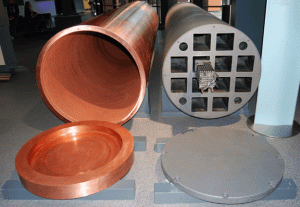 The Copper Corrosion Conundrum No2Nuclear Power http://www.no2nuclearpower.org.uk/wp/wp-content/uploads/2018/03/NuClearNews_No105.pdf
The Swedish Environmental Court has rejected the Nuclear Waste Company SKB’s license application for a final repository for spent nuclear fuel in Forsmark, Sweden. This is a huge triumph for safety and environment – and for the Swedish NGO Office for Nuclear Waste Review (MKG), the Swedish Society for Nature Conservation (SSNC), and critical scientists. Now it is up to the Swedish government to make a final decision.
The Environmental Court took into consideration viewpoints from all parties in the case, including scientists who have raised concerns about disposing spent nuclear fuel in copper canisters. During the legal proceedings, the Swedish NGO Office for Nuclear Waste Review (MKG) and the Swedish Society for Nature Conservation (SSNC) presented the shortcomings of this method of disposal. For many years, the environmental organisations have been arguing that the Nuclear Waste Company SKB need to listen to critical scientists, and investigate alternative disposal methods, especially the possibility of developing a very deep boreholes disposal system. (1) Johan Swahn, Director at MKG said:
“Several independent researchers have criticized both the applied method and the selected site. There is a solid documentation base for the Environmental Court’s decision. It is hard to believe the Swedish Government’s conclusions will be any different from the Court’s.”
MKG has made an unofficial translation into English of the Environmental Court opinion. (2)
The court said no to the application because it considered that there were problems with the copper canister that had to be resolved now and not later. The translation shows the courts judicial argumentation and why it decided not to accept the regulator – the Swedish Radiation Safety Authority’s (SSM’s) opinion that the problems with the integrity of the copper canister were not serious and could likely be solved at a later stage in the decision-making process. The court is quite clear in its statement and argumentation:
“The Land and Environmental Court finds that the environmental impact assessment meets the requirements of the Environmental Code and can therefore be approved. All in all, the investigation meets the high standards set out in the Environmental Code, except in one respect, the safety of the canister.” (Emphasis added)
“The investigation shows that there are uncertainties, or risks, regarding how much certain forms of corrosion and other processes can impair the ability of the canister to contain the nuclear waste in the long term. Overall, these uncertainties about the canister are significant and have not been fully taken into account in the conclusions of SKB’s safety analysis. The Land and Environmental Court considers that there is some leeway for accepting further uncertainties. The uncertainties surrounding certain forms of corrosion and other processes are, however, of such gravity that the Court cannot, based on SKB’s safety analysis, conclude that the risk criterion in the Radiation Safety Authority’s regulations has been met. In the context of the comprehensive risk assessment required by the Environmental Code, the documentation presented to date does not provide sufficient support for concluding that the final repository will be safe in the long term.” (Emphasis added)
The court says that the application is only permissible if the nuclear waste company SKB:
“…produces evidence that the repository in the long term will meet the requirements of the Environmental Code, despite remaining uncertainties regarding how the protective capability of the canister may be affected by: a. corrosion due to reactions in oxygen-free water; b. pit corrosion due to reaction with sulphide, including the contribution of the sauna effect to pit corrosion; c. stress corrosion due to reaction with sulphide, including the contribution of the sauna effect to stress corrosion; d. hydrogen embrittlement; e. radioactive radiation impact on pit corrosion, stress corrosion and hydrogen embrittlement.”
The main difference between the court’s and the regulator’s decision-making was that the court decided to rely on a multitude of scientific sources and information and not only on the material provided by SKB. It had also been uncovered that the main corrosion expert at SSM did not want to say yes to the application at this time that may have influenced the court’s decision-making. In fact there appear to have been many dissenting voices in the regulator despite the regulator’s claim in the court that a united SSM stood behind its opinion.
The court underlines in its opinion that the Environmental Code requires that the repository should be shown to be safe at this stage in the decision-making process, i.e. before the government has its say. The court says that some uncertainties will always remain but it sees the possible copper canister problems as so serious that it is not clear that the regulator’s limits for release of radioactivity can be met. This is a reason to say no to the project unless it can be shown that the copper canister will work as intended. The copper canister has to provide isolation from the radioactivity in the spent nuclear fuel to humans and the environment for very long time-scales.
It is still unclear how the process will proceed. The community of Östhammar has cancelled the referendum on the repository, as there will be no question from the government in the near future. The government has set up a working group of civil servants to manage the government’s handling of the opinions delivered by the court and SSM. SKB has said that it is preparing documentation for the government to show that there are no problems with the canister. Whether the government thinks this will be enough remains to be seen. This is likely not what the court had in mind. The government would be wise to make a much broader review of the issue. There is a need for a thorough judicial review on the governmental level in order to override the court’s opinion. Otherwise the government’ decision may not survive an appeal to the Supreme Administrative Court.
There are eminent corrosion experts who believe that copper is a bad choice as a canister material. There is also increasing experimental evidence that this is the case. The court’s decision shows the importance of democratic and open governance in environmental decisionmaking. It is important that the continued decision-making regarding the Swedish repository for spent nuclear is transparent and multi-faceted. (3)
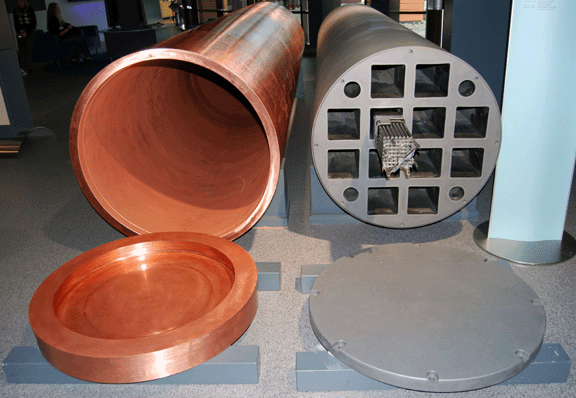
Copper Canisters The canister has to enclose the nuclear waste for a very long; it is the final repository’s primary safety function. The canister has a 50 mm thick copper shell with an insert of cast iron. The canister must withstand corrosion and mechanical stress.
The investigation on the capability of the canister is extensive and involves complex technical and scientific issues. These include groundwater chemistry, corrosion processes, as well as creep and hydrogen embrittlement (this latter affects the mechanical strength of the canister). However, the parties taking part in the court proceedings disagreed on several issues crucial to the final repository’s long-term security.
The Land and Environmental Court considered the following uncertainties regarding the canister to be most important in the continued risk assessment:
- 1. General corrosion due to reaction in oxygen-free water. The parties have different views on scientific issues surrounding this kind of corrosion. The Court found that there is considerable uncertainty on this topic that has not been taken account of in SKB’s safety analysis
- .· 2. Local corrosion in the form of pit corrosion due to reaction with sulphide. The Court found that there is significant uncertainty regarding pit-corrosion due to reaction with sulphide. This uncertainty has not been included in the safety analysis. In addition, there is uncertainty about the sauna effect, which may have an amplifying effect on pit corrosion.
- · 3. Local corrosion in the form of stress corrosion due to reaction with sulphide. The Court found that there is significant uncertainty regarding stress corrosion due to reaction with sulphide. This uncertainty has not been included in the safety analysis. In addition, there is uncertainty about the sauna effect, which may have an amplifying effect on stress corrosion.
- · 4. Hydrogen embrittlement is a process that affects the mechanical strength of the canister. The Court found that significant uncertainty regarding hydrogen embrittlement remains. This uncertainty has not been taken account of in the safety analysis.
- · 5. The effect of ionizing radiation on pit corrosion, stress corrosion and hydrogen embrittlement. There is significant uncertainty regarding ionizing radiation impact on pit corrosion, stress corrosion and hydrogen sprays. This uncertainty has been included to a limited extent in the safety assessment.
Meanwhile, the UK’s National Nuclear Laboratory (NNL) is to carry out an expert peer review of a Canadian research programme on microbiologically influenced corrosion of canisters that will be used to dispose of used nuclear fuel. The NNL has been contracted by Canada’s National Waste Management Organisation (NWMO) to review its work on the potential for corrosion of the copper-clad canisters. The NWMO is responsible for designing and implementing the safe, long-term management of Canada’s used nuclear fuel under a plan known as Adaptive Phased Management. This requires used fuel to be contained and isolated in a deep geological repository, with a comprehensive process to select an informed and willing host for the project.
The used fuel will be isolated from the environment using a series of engineered barriers. Fuel elements comprise ceramic fuel pellets, which are themselves highly durable, contained inside corrosion-resistant zircaloy tubes to make fuel elements. Bundles of fuel elements are placed into large, durable copper-coated steel containers which are designed to contain and isolate used nuclear fuel in a deep geological repository, essentially indefinitely. The canisters will be placed in so-called “buffer boxes” containing by bentonite clay, providing a fourth barrier.
World Nuclear News reports that although copper is highly resistant to corrosion, under anoxic conditions – that is, where no oxygen is present – sulphate-reducing bacteria have the potential to produce sulphide, which can lead to microbiologically induced corrosion (MIC) of copper. Waste management organisations and regulators therefore need to understand the levels of sulphide that will be present in a geological disposal facility, to understand its potential to migrate to the canister surface and the potential for it to cause copper corrosion, the NNL said.
The NWMO has been actively developing computer models that will be used to evaluate the potential for MIC once a disposal site has been selected, and has selected the NNL to carry out a peer review of its work because of the UK laboratory’s expertise in the biogeochemical processes that could affect repository performance and in developing computer modelling techniques that simulate the effects of sulphate-reducing bacteria. The work is linked closely with NNL’s participation in the European Commission Horizon-2020 MIND (Microbiology in Nuclear waste Disposal) project. (4
March 14, 2018
Posted by Christina Macpherson |
Reference, Sweden, wastes |
1 Comment
MKG 20th Feb 2018, Translation into English of the Swedish Environmental Court’s opinion on
the final repository for spent nuclear fuel – as well as some comments onthe decision and the further process. The court said no to the application because it considered that there were problems with the copper canister that had to be resolved now and not later.
The translation shows the court’s judicial argumentation and why it decided not to accept the regulator
SSM’s opinion that the problems with the integrity of the copper canister were not serious and could likely be solved at a later stage in the decision-making process.
The main difference between the court’s and the regulator’s decision-making was that the court decided to rely on a multitude of scientific sources and information and not only on the material provided by SKB.
It had also been uncovered that the main corrosion expert at SSM did not want to say yes to the application at this time that may have influenced the court’s decision-making. In fact there appear to have been many dissenting voices in the regulator despite the regulator’s claim in the court that a united SSM stood behind its opinion.
http://www.mkg.se/en/translation-into-english-of-the-swedish-environmental-court-s-opinion-on-the-final-repository-for-sp
February 22, 2018
Posted by Christina Macpherson |
Legal, Sweden, wastes |
Leave a comment
 Sweden’s problem is also our problem https://cumbriatrust.wordpress.com/2018/02/21/swedens-problem-is-also-our-problem/ February 21, 2018by cumbriatrust
Last month Cumbria Trust reported that the Swedish Environmental Court had blocked a licence application to construct a GDF for spent nuclear fuel after serious concerns were raised over the corrosion of the copper canisters used in the KBS-3 method. The same containment method is intended to be used in the UK. This court ruling was a success for MKG, the Swedish environmental organisation which receives government funding to act as a critical friend, scrutinising Sweden’s plan to bury nuclear waste.
MKG have now released some further details which show that the corrosion concerns are shared by experts within the Swedish regulator, SSM. While the nuclear industry, including the UK’s Radioactive Waste Management (RWM) seem keen to minimise the significance of this court ruling, by describing it as a delay and a request for more information, it appears the problem may be more fundamental, and could lead to this method of KBS-3 copper encapsulation being abandoned. This would damage the UK’s search process.
A key assumption with the KBS-3 method is that copper does not corrode in anoxic conditions, that is without the presence of oxygen. While there will be oxygen present at first, once the canisters are placed within the bentonite clay, bacteria and chemical processes consume the oxygen, creating the desired anoxic environment. However, it is becoming increasingly clear that even without oxygen, the copper begins to corrode by pitting. The heat generated by the spent fuel appears to be a significant factor in accelerating this pitting process. These capsules were intended to remain intact for a million years, but tests have suggested that they may well fail much sooner.
The significance of the problem goes well beyond this encapsulation method. There are lessons that should be learned, but the question is whether the nuclear industry will be open enough to do so. One key lesson is that funding a critical friend NGO such as MKG, can help to identify problems and reduce the impact of groupthink which leads to irrational decision-making. Another appears to be that we are prone to over-confidence in engineering. Isolating nuclear waste from the surface for a million years, particularly waste types which produce a great deal of heat, is complex. While we can test potential containment methods for around a generation, we need to be confident that these methods will continue to work for 30,000 generations.
“There is only one form of containment for liquids and gases which has been demonstrated to work for millions of years, even under great pressure, and that is geological formations. We have a vast quantity of evidence from the oil and gas industry of rock formations which have isolated hydrocarbons from the surface for many millions of years. So while Cumbria Trust continues to support the principle of geological disposal, as potentially the least bad solution to an existing problem, the key to its success must be the geology in which it is constructed.”
Any search process for a GDF site must begin with suitable geology and the failed attempts in Cumbria have concluded that the search should move to an area of simple geology and low groundwater flow. Cumbria Trust fears that the selective blindness which has led to the previous failures of the search process, will result in another attempt to target Cumbria despite its complex geology.
February 22, 2018
Posted by Christina Macpherson |
Sweden, UK, wastes |
Leave a comment

WNN 17 Feb 18 US-based GE Hitachi Nuclear Energy (GEH) has been awarded a three-year contract to dismantle the reactor internals of units 1 and 2 at the Oskarshamn nuclear power plant in Sweden
Under a contract signed with plant operator OKG AB on 19 December, Wilmington, North Carolina-based GEH will segment the reactor pressure vessel internals of both units. The work includes dismantling, cutting and packing the reactor internals for final disposal.
Segmentation of the reactor internals of Oskarshamn 2 is scheduled to begin in January 2018, with that of unit 1 set for 2019. The segmentation project is expected to be completed by the beginning of 2020.
Lance Hall, executive vice president of GEH’s nuclear services business, said today: “This is a breakthrough project for us in the decommissioning space in Europe and we look forward to drawing upon the many resources of the ‘GE Store’, including the depth of the global supply chain of GE and the former Alstom power businesses to deliver superior safety and cost efficient performance for our customer.”…….http://www.world-nuclear-news.org/WR-GE-Hitachi-to-dismantle-Oskarshamn-units-0301174.html
February 17, 2018
Posted by Christina Macpherson |
Sweden, wastes |
Leave a comment

 Radiation Free Lakeland 10th Feb 2018, On the 23rd January 2018 the Swedish Environment Court gave the thumbs down
to the Swedish equivalent (SKB) of the UK’s quango Radioactive Waste Management (RWM previously Managing Radioactive Wastes Safely previously
NIREX) tasked with implementing Geological Dumping of nuclear wastes.
The Swedish court said it could not recommend that their Government agree the application for a Geological Disposal Facility (Nuclear Underground Dump) unless and until the industry can prove that the copper capsules that would contain the spent nuclear fuels would not leak.
Sweden and Finland are regularly put forward by RWM and the UK Government as the fore-runners of the ‘international consensus’ on deep waste repositories. Radiation Free Lakeland have sent a letter of thanks to the Swedish Court and a request to the Environment and Justice Ministers of Sweden that the Courts findings are upheld. We urge our own UK government to abandon the dishonest and dangerous plan for “Implementation” of Geological Disposal. https://mariannewildart.wordpress.com/2018/02/10/a-letter-of-thanks-to-the-swedish-environment-court-for-saying-no-to-geological-disposal-of-nuclear-wastes/
February 12, 2018
Posted by Christina Macpherson |
Sweden, UK, wastes |
Leave a comment
MKG 23rd Jan 2018, The Swedish Environmental Court says no to the power industry’s Nuclear
Waste Company SKB’s license application for a final repository for spent
nuclear fuel in Forsmark, Sweden.
This is a huge triumph for safety and environment – and for the Swedish NGO Office for Nuclear Waste Review
(MKG), the Swedish Society for Nature Conservation (SSNC), and critical
scientists who have been presenting risks of the malfunction of the
selected method. Now it is up to the Swedish government to make the final
decision. This is a triumph for us.
From now on, the work on evaluating safer disposal solutions will continue. The decision that will be made
concerns waste that will be hazardous for thousands of years. Several
independent researchers have criticized both the applied method and the
selected site. There is a solid documentation as base for the Environmental
Court’s decision. It is hard to believe the Swedish Government’s
conclusions will be any different from that of the Court’s, says Johan
Swahn, Director at MKG.
http://www.mkg.se/en/the-swedish-environmental-court-s-no-to-the-final-repository-for-spent-nuclear-fuel-a-triumph-for-th
January 26, 2018
Posted by Christina Macpherson |
Legal, Sweden |
Leave a comment
Record radiation levels found in Swedish wild boar, https://www.thelocal.se/20180123/record-radiation-levels-found-in-swedish-wild-boar The Local, news@thelocal.se , @thelocalsweden, 23 January 2018
Even though it’s over 30 years since the 1986 Chernobyl nuclear disaster, radiation levels exceeding 39 706 Bq (becquerel) per kilo have been found in Swedish wild boar meat taken from the Uppland area.
According to the Swedish Radiation Safety Authority, this is the highest ever level measured in wild boar meat in Sweden, way exceeding the 1500 Bq/kg safe limit set by the Swedish Food Agency for meat consumption.
Back in October 2017, two other hogs tested had record-high levels too, but at 13,000 Bq/kg and 16,000 Bq/kg they were small fry compared to this latest measurement. What makes this new record even more surprising is the fact that in 1986 there were no wild boar roaming the areas most affected by the Chernobyl fallout.
Speaking to The Local, Paul Andersson of the Swedish Radiation Authority explained that “wild boar were practically non-existent outside the southern counties of Skåne and Sörmland, two Swedish counties unaffected by radiation. However, in the years since, the wild boar population has multiplied and migrated to northern areas of Sweden”, which is why the authority is keen to test wild boar meat.
Andersson noted that wild boar may be particularly susceptible to radiation for a number of reasons: ”Wild boar forage for wild mushrooms and have the ability to find truffles in the ground, which may explain why this particular wild hog had such high levels of radiation.”
In contrast, he said elk meat’s radiation levels have consistently gone down since 1986, rarely exceeding the safety limit for meat consumption of 1500 Bq/kg.
The authority is encouraging hunters to send them wild boar meat samples for testing.
January 24, 2018
Posted by Christina Macpherson |
environment, radiation, Sweden |
Leave a comment
 Swedish regulators disagree on safety of nuclear waste plan https://www.reuters.com/article/us-sweden-nuclear-regulator/swedish-regulators-disagree-on-safety-of-nuclear-waste-plan-idUSKBN1FC21P, JANUARY 24, 2018 , Lefteris Karagiannopoulos, OSLO (Reuters) JANUARY 24, 2018 – Sweden’s radiation safety authority (SSM) and an environmental court issued diverging recommendations to the government on Tuesday on whether to allow the construction of a nuclear waste repository.
While the SSM said the nuclear fuel and waste management company SKB should be allowed to go ahead with the plan, which may take 10 years to complete, the Land and Environmental court said it was not certain of the proposed repository’s safety.
“There is still uncertainty about the ability of the capsule to contain the nuclear waste in the long term,” the court said, adding that further documentation was required.
The final decision to approve or reject the facility, designed to store up to 12,000 tonnes of spent fuel from Sweden’s nuclear plants, will be in the government’s hands.
In a statement to Reuters, Environment and Energy Minister Karolina Skog said no decision would be made this year.
SKB, controlled by Sweden’s nuclear plant operators, applied in March 2011 to build the repository at Forsmark in southwest Sweden.
Eva Hallden, SKB’s director, said the firm would produce additional documentation, which it was confident would allay the safety concerns of the environmental court.
Sweden currently stores its spent nuclear fuel in an interim facility near the Oskarshamn nuclear plant. Editing by Kevin Liffey
January 24, 2018
Posted by Christina Macpherson |
politics, Sweden, wastes |
Leave a comment
Swedish banks allow investment in nuclear weapons: report https://www.thelocal.se/20171210/swedish-banks-allow-investment-in-nuclear-weapons-report Several Swedish banks allow investment in companies that manufacture nuclear weapons, according to an analysis.
The Fair Finance Guide organisation said that of the nine banks it reviewed, only three have zero-tolerance policies in relation to economic dealings involving nuclear weapons.
One bank highlighted by the organisation, Nordea, was placed in a ‘grey zone’. The bank has publicly expressed zero tolerance towards nuclear weapons in asset management and foundations, but does not have any lending policies with regard to nuclear weapons, according to Fair Finance Guide.
Nordea has business agreements with Russian state nuclear energy company Rosatom, which also manages the country’s nuclear weapons programme, according to a report by Svenska Dagbladet.
The Swedish bank has had a “strategic partnership” with Rosatom for several years, according to the newspaper.
Nordea maintains that it only finances the company’s nuclear energy activities.
“Nevertheless, this is enough to demonstrate support for the nuclear weapons arm of Rosatom, given that profits from the energy business are used to support its weapons industry,” Fair Finance Guide project leader Jakob König said in a press statement.
The organisation states on its website that it aims to improve the corporate social responsibility of banks.
Nordea sustainability manager Sasja Beslik rejected criticism of the bank. “The conclusion is incorrect. We do not finance – either directly or indirectly – any nuclear weapons production anywhere in the world,” Beslik said.
December 11, 2017
Posted by Christina Macpherson |
business and costs, Sweden, weapons and war |
Leave a comment

Sweden has 65,000 nuclear shelters. Now, in the era of Trump, it wants more. https://www.washingtonpost.com/news/worldviews/wp/2017/11/03/sweden-has-65000-nuclear-bunkers-now-in-the-era-of-trump-it-wants-more/?utm_term=.ed3479f252a7 By Rick Noack November 3 Scandinavia may not be right in the path of a future nuclear exchange between the United States and North Korea, but given the latest threats between the two countries and rising concerns over Russian military exercises, it’s not taking any chances.
Last month, the Norwegian Nobel Committee handed a group dedicated to abolishing nuclear weapons its Peace Prize. Now, the Swedish government is looking into expanding its existing network of nuclear fallout shelters, according to news website the Local. A first proposal was included in a report released several weeks ago and followed a review of existing shelters this year, Swedish officials confirmed Friday, saying that the proposed changes were still under consideration by the government.
Sweden has 65,000 shelters, which would provide space for up to 7 million people, but that leaves an estimated 3 million inhabitants without protection.
At least one European country takes the risk of a nuclear war even more seriously: Switzerland may have fewer people than Sweden, but it has built about four times as many nuclear shelters — easily enough for the country’s entire population and then some.
In Sweden and elsewhere, the nuclear shelters are also supposed to protect the population from other hazards, like a biological weapons attack or more-conventional warfare. Often located in publicly accessible buildings, such as schools or shopping centers, they can usually also be used as storage sites or garages and are funded with taxpayer money.
In contrast, in Switzerland all houses above a certain size must include shelters in the basement, putting the financial burden on citizens themselves. That rule was abolished in 2011 by the Swiss parliament, but reintroduced months later after the Fukushima nuclear accident in Japan.
The accident brought back memories of Chernobyl in 1986, and led to a renewed public debate in Europe over the risk of radiation. In Germany — where public shelters are far less common than in Sweden or Switzerland — Chancellor Angela Merkel decided to abandon nuclear energy entirely, despite having championed it for decades. It was her biggest political U-turn in her now 12 years in office.
Such preparations and protective measures may appear strange to Americans. Public nuclear shelters are practically nonexistent in the United States, although there have been recent reports of an increase in demand.
Until recently, few Swedes knew the location of the closest nuclear shelter in their neighborhood. (The government now offers an online map.) Sweden stopped expanding its shelter network almost two decades ago, when nonproliferation supporters appeared to be on the winning side of history. Then came Iran’s nuclear program, the Fukushima accident, Russian military operations, North Korea’s missile tests — and President Trump.
Whereas confidence among Europeans that President Barack Obama would “do the right thing regarding world affairs” ranged between 70 and 90 percent in a number of surveyed nations during his term, those numbers plummeted after Trump’s inauguration and have only gone down since. Only 7 percent in Spain and 11 percent in Germany now say they have confidence in Trump. Top officials in Germany have also directly contradicted Trump’s North Korea policies, and have voiced concerns that the White House may overreact to nuclear provocations and escalate the war rhetoric being exchanged with North Korea.
Europeans are similarly worried that decades-long nonproliferation efforts could be dismantled virtually overnight, leading to a new arms race. In 2009, the Obama administration negotiated a treaty with Russia in which both countries agreed to cap the number of deployed warheads. Trump reportedly called the agreement a bad deal in his first phone call with Russian President Vladimir Putin earlier this year, although administration officials have since backtracked.
Sweden’s new shelter locations indicate that at least some of the concerns are connected to Russia. One of the regions where most new shelters are expected to be constructed in the coming years is the island of Gotland, where military defenses were recently expanded with the declared aim of stopping a possible Russian invasion.
November 4, 2017
Posted by Christina Macpherson |
safety, Sweden, Switzerland, weapons and war |
Leave a comment
 Radioactive wild boars in Sweden are eating nuclear mushrooms, Quartz, 13 Oct 17 Radioactive wild boars currently roaming central and northern Sweden are proof positive that nuclear disasters have long-term environmental impacts, both near and far from where they occur.
In 1986, a nuclear power plant in Chernobyl, Ukraine exploded, irradiating the surrounding region, including Belarus, Russia and the rest of the Ukraine, and sending a cloud of radioactive material over northern and central Sweden. At the time, Swedes were warned against eating potentially nuclear berries and mushrooms. But no one told the wild boars about irradiated fruits and fungus, and three decades later these Swedish animals show exceptionally high levels of radioactivity because of mushrooms rooted deep in ground that remains radioactive.
On Oct. 5, the Swedish television channel SVT reported (link in Swedish) that of 30 wild boar carcasses tested for radiation this year by Calluna, a local environmental consultancy, 24 showed high levels of exposure. Calluna’s Ulf Frykman recently alerted local hunters in the Gävle region, about 100 miles north of Stockholm, of “extremely high” radiation levels among local boar,
“This is the highest level we’ve ever measured,” he told the Telegraph, noting one animal in particular. Although flora and fauna in Sweden have been generally deemed safe, Frykman believes deeply-rooted, nuclear mushrooms in the country’s northern territories are to blame for the high traces of radiation in these wild boars.
The creatures root for food in the soil, which exposes them to the iodine and cesium-137 traces that remain in soil long after they’re gone above ground. “Wild boar root around in the earth searching for food, and all the cesium stays in the ground,” Frykman explained. “If you look at deer and elk, they eat up in the bushes and you do not have not so much cesium there.”…….https://qz.com/1099248/radioactive-wild-boars-in-sweden-are-eating-nuclear-mushrooms/
October 14, 2017
Posted by Christina Macpherson |
environment, Sweden |
Leave a comment

Christina Macpherson’s websites & blogs
This is of particular interest to Australia. The Australian government touts Finland as the great model for acceptance of nuclear waste dump. But in fact, the model adopted by Finland, (by a poorly informed public) was taken from the one refused by Sweden – where a much more informed community used a much more democratic process to study the waste dump issue. See “When haste makes risky waste: Public involvement in radioactive and nuclear waste management in Sweden and Finland” http://bellona.org/…/radioactive-waste…/2016-08-21710
The Environmental Court’s main licensing hearing about a final repository for spent nuclear fuel in Forsmark – September 5 to October 27 http://www.mkg.se/en/the-environmental-court-s-main-licensing-hearing-about-a-final-repository-for-spent-nuclear-fuel-in#.WbJtaWAl7II.facebook The Environmental Court’s main hearing concerning the Swedish Nuclear Fuel and Waste Management Company SKB’s license application for a final repository for spent nuclear fuel in Forsmark, Sweden, began September 5, at Quality Hotel Nacka in Stockholm. The Swedish Society for Nature Conservation, SSNC, and the Swedish NGO Office for Nuclear Waste Review, MKG, are working together during the main hearing. Follow and get updates during and after the main hearing from the Twitter account of the director of MKG, Johan Swahn, and MKG’s Facebook.
On September 5, the Environmental Court’s main hearing concerning the Swedish Nuclear Fuel and Waste Management Company SKB’s license application for a final repository for spent nuclear fuel in Forsmark, Sweden, began at Quality Hotel Nacka in Stockholm. The main hearing will be in progress for five weeks, between September 5 and October 27. The first two weeks take place in Stockholm. Then, there will be a break for two weeks. The third week will take place in Oskarhamn (were the interim storage Clab is located and were the Waste Company wants to build an encapsulation facility, Clink) and the fourth week will take place in Östhammar (nearby the selected site for the final repository). After another break for one week, the main hearing will be concluded in Stockholm.
The Swedish Society for Nature Conservation, SSNC, and the Swedish NGO Office for Nuclear Waste Review, MKG, are working together during the main hearing. The organisations will bring their statements, which fundamentally are:
-
- The chosen solution for a final repository will not be safe since there is a large risk of the malfunction of the barrier system of copper and clay – the licence application should be denied or rejected!
- There is a large risk that the copper canisters will break down within 1 000 years – a possible scenario is that it might be a contaminated, uninhabitable, forbidden zone in Forsmark!
- The Swedish Radiation Safety Authority, SSM, is aware of the large problems with the license application, but still wants to give an OK to continue towards a Government decision and afterwards ensure that the copper canister will function as intended – this is unaccepted and legal questionable!
- There is an alternative method, the use of very deep boreholes – that might be environmentally safer, entails less risks for human intrusion, and is most likely a less expensive solution for final disposal!
- The nature existing on the suggested site in Forsmark is of high value (there is a number of red-listed species and species protected by the Habitats Directive’s appendix 4) – this, in itself, constitutes a reason to reject the license application!
Follow and get updates during and after the main hearing at the director of MKG’s Twitter (@jswahn) and at MKG:s Facebook (mostly written in Swedish but can be translated directly on the website).
Links:
 The negotiation procedure of the main hearing, 170704 >>
The director of MKG’s Twitter >>
MKG on Facebook >>
Previous news on MKG’s website:
Regulator recommends approval of final repository plan — despite unresolved safety issues, 160629 >>
Reject the application! Legal brief from the Swedish Society for Nature Conservation and MKG to the Environmental Court and SSM, 160531 >>
September 9, 2017
Posted by Christina Macpherson |
Legal, Sweden, wastes |
1 Comment
 Mattis reportedly threatened Sweden with retaliation over signing a nuclear-weapons ban, Business Insider CHRISTOPHER WOODY, SEP 6, 2017 US Defence Secretary Jim Mattis reportedly warned Sweden of severe consequences if the country followed through on signing a UN treaty banning nuclear weapons.

The Scandinavian country is one of 122 states backing the treaty, and Stockholm also recently signed a statement of intent to increase military cooperation with the US.
But a letter from Mattis reportedly warned Sweden’s defence minister, Peter Hultqvist, that signing on to the treaty could affect US-Sweden military cooperation as well as US military support in the event of war.
Mattis’ letter also suggested signing the treaty could have an impact on the country’s ties to NATO, of which it is a Gold Card program member, meaning it has some privileges within the defence alliance even though it is not a full member.
Sweden’s Gold Card program status faces renewal in October, and Mattis warned his Swedish counterpart that signing the treaty would foreclose the option of joining NATO, according to Defence News…….
The US, which adheres to a policy of nuclear deterrence, has criticised the nuclear-weapons ban, but Mattis’ letter is seen as an unusual step in bilateral relations, particularly between the US and Sweden.
A Pentagon spokesman
told Defence News that while the US “values its defence relationship with Sweden,” it has discouraged countries from signing on to the ban, which has measures that “could potentially affect our ability to cooperate with parties to the treaty on issues of mutual interest.”…..
Jim Townsend, who was deputy assistant secretary of defence for European and NATO policy for eight years, told Defence News that pressuring Sweden with threats about defence cooperation is a flawed approach…..https://www.businessinsider.com.au/mattis-threatened-sweden-over-a-nuclear-weapons-ban-treaty-2017-9?r=US&IR=T
September 6, 2017
Posted by Christina Macpherson |
politics international, Sweden, USA |
Leave a comment
 Global Meltdown? Nuclear Power’s Annus Horribilis, Jim Green, New Matilda, 9 July 2017 https://newmatilda.com/2017/07/09/global-meltdown-nuclear-powers-annus-horribilis/
This year will go down with 1979 (Three Mile Island), 1986 (Chernobyl) and 2011 (Fukushima) as one of the nuclear industry’s worst ever ‒ and there’s still another six months to go, writes Dr Jim Green.
Two of the industry’s worst-ever years have been in the past decade and there will be many more bad years ahead as the trickle of closures of ageing reactors becomes a flood ‒ the International Energy Agency expects almost 200 reactor closures between 2014 and 2040. The likelihood of reactor start-ups matching closures over that time period has become vanishingly small.
In January, the World Nuclear Association anticipated 18 power reactor start-ups this year. The projection has been revised down to 14 and even that seems more than a stretch. There has only been one reactor start-up in the first half of the year according to the IAEA’s Power Reactor Information System, and two permanent reactor closures.
The number of power reactors under construction is on a downward trajectory ‒ 59 reactors are under construction as of May 2017, the first time since 2010 that the number has fallen below 60.
Pro-nuclear journalist Fred Pearce wrote on May 15: “Is the nuclear power industry in its death throes? Even some nuclear enthusiasts believe so. With the exception of China, most nations are moving away from nuclear ‒ existing power plants across the United States are being shut early; new reactor designs are falling foul of regulators, and public support remains in free fall. Now come the bankruptcies…. The industry is in crisis. It looks ever more like a 20th century industrial dinosaur, unloved by investors, the public, and policymakers alike. The crisis could prove terminal.”
Pro-nuclear lobby groups are warning about nuclear power’s “rapidly accelerating crisis“, a “crisis that threatens the death of nuclear energy in the West“, and noting that “the industry is on life support in the United States and other developed economies“.
United States
The most dramatic story this year has been the bankruptcy protection filing of US nuclear giant Westinghouse onMarch 29. Westinghouse’s parent company Toshiba states that there is “substantial doubt” about Toshiba’s “ability to continue as a going concern”. These nuclear industry giants have been brought to their knees by cost overruns ‒estimated at US$13 billion ‒ building four AP1000 power reactors in the U.S.
The nuclear debate in the US is firmly centred on attempts to extend the lifespan of ageing, uneconomic reactors with state bailouts. Financial bailouts by state governments in New York and Illinois are propping up ageing reactors, but a proposed bailout in Ohio is meeting stiff opposition. The fate of Westinghouse and its partially-built AP1000 reactors are much discussed, but there is no further discussion about new reactors ‒ other than to note that they won’t happen.
Six reactors have been shut down over the past five years in the US, and another handful will likely close in the next five years. How far and fast will nuclear fall? Exelon ‒ the leading nuclear power plant operator in the US ‒ claims that “economic and policy challenges threaten to close about half of America’s reactors” in the next two decades. According to pro-nuclear lobby group ‘Environmental Progress‘, almost one-quarter of US reactors are at high risk of closure by 2030, and almost three-quarters are at medium to high risk. In May, the US Energy Information Administration released an analysis projecting nuclear’s share of the nation’s electricity generating capacity will drop from 20 per cent to 11 per cent by 2050.
There are different views about how far and fast nuclear will fall in the US ‒ but fall it will. And there is no dispute that many plants are losing money. More than half in fact, racking up losses totalling about US$2.9 billion a year according to a recent analysis by Bloomberg New Energy Finance. And a separate Bloomberg report found that expanding state aid to money-losing reactors across the eastern US may leave consumers on the hook for as much as US$3.9 billion a year in higher power bills.
Japan
Fukushima clean-up and compensation cost estimates have doubled and doubled again and now stand at US$191 billion. An analysis by the Japan Institute for Economic Research estimates that the total costs for decommissioning, decontamination and compensation could be far higher at US$443‒620 billion.
Only five reactors are operating in Japan as of July 2017, compared to 54 before the March 2011 Fukushima disaster. The prospects for new reactors are bleak. Japan has given up on its Monju fast breeder reactor ‒ successive governments wasted US$10.6 billion on Monju and decommissioning will cost another US$2.7 billion.
As mentioned, Toshiba is facing an existential crisis due to the crippling debts of its subsidiary Westinghouse. Toshibaannounced on May 15 that it expects to report a consolidated net loss of US$8.4 billion for the 2016‒2017 financial year which ended March 31.
Hitachi is backing away from its plan to build two Advanced Boiling Water Reactors in Wylfa, Wales. Hitachi recentlysaid that if it cannot attract partners to invest in the project before construction is due to start in 2019, the project will be suspended.
Hitachi recently booked a massive loss on a failed investment in laser uranium enrichment technology in the US. A 12 May 2017 statement said the company had posted an impairment loss on affiliated companies’ common stock of US$1.66 billion for the fiscal year ended 31 March 2017, and “the major factor” was Hitachi’s exit from the laser enrichment project. Last year a commentator opined that “the way to make a small fortune in the uranium enrichment business in the US is to start with a large one.”
France
The French nuclear industry is in its “worst situation ever” according to former EDF director Gérard Magnin. France has 58 operable reactors and just one under construction.
French EPR reactors under construction in France and Finland are three times over budget ‒ the combined cost overruns for the two reactors amount to about US$14.5 billion.
Bloomberg noted in April 2015 that Areva’s EPR export ambitions are “in tatters“. Now Areva itself is in tatters and is in the process of a government-led restructure and another taxpayer-funded bailout. On March 1, Areva posted a €665 million net loss for 2016. Losses in the preceding five years exceeded €10 billion.
In February, EDF released its financial figures for 2016: earnings and income fell and EDF’s debt remained steady at €37.4 billion. EDF plans to sell €10 billion of assets by 2020 to rein in its debt, and to sack up to 7,000 staff. The French government provided EDF with €3 billion in extra capital in 2016 and will contribute €3 billion towards a €4 billioncapital raising this year. On March 8, shares in EDF hit an all-time low a day after the €4 billion capital raising was launched; the share price fell to €7.78, less than one-tenth of the high a decade ago.
Costs of between €50 billion and €100 billion will need to be spent by 2030 to meet new safety requirements for reactors in France and to extend their operating lives beyond 40 years.
EDF has set aside €23 billion to cover reactor decommissioning and waste management costs in France ‒ just over half of the €54 billion that EDF estimates will be required. A recent report by the French National Assembly’s Commission for Sustainable Development and Regional Development concluded that there is “obvious under-provisioning” and that decommissioning and waste management will take longer, be more challenging and cost much more than EDF anticipates.
In 2015, concerns about the integrity of some EPR pressure vessels were revealed, prompting investigations that are still ongoing. Last year, the scandal was magnified when the French Nuclear Safety Authority (ASN) announced that Areva had informed it of “irregularities in components produced at its Creusot Forge plant.” The problems concern documents attesting to the quality of parts manufactured at the site. At least 400 of the 10,000 quality documents reviewed by Areva contained anomalies. Work at the Creusot Forge foundry was suspended in the wake of the scandal and Areva is awaiting ASN approval to restart the foundry.
French environment and energy minister Nicolas Hulot said on June 12 that the government plans to close some nuclear reactors to reduce nuclear’s share of the country’s power mix. “We are going to close some nuclear reactors and it won’t be just a symbolic move,” he said.
India
Nuclear power accounts for just 3.4 percent of electricity supply in India and that figure will not rise significantly, if at all. In May, India’s Cabinet approved a plan to build 10 indigenous pressurized heavy water reactors (PHWR). That decision can be read as an acknowledgement that plans for six Westinghouse AP1000 reactors and six French EPR reactors are unlikely to eventuate.
The plan for 10 new PHWRs faces major challenges. Suvrat Raju and M.V. Ramana noted: “[N]uclear power will continue to be an expensive and relatively minor source of electricity for the foreseeable future…. The announcement about building 10 PHWRs fits a pattern, often seen with the current government, where it trumpets a routine decision to bolster its “bold” credentials. Most of the plants that were recently approved have been in the pipeline for years. Nevertheless, there is good reason to be sceptical of these plans given that similar plans to build large numbers of reactors have failed to meet their targets, often falling far short.”
South Africa
An extraordinary High Court judgement on April 26 ruled that much of South Africa’s nuclear new-build program is without legal foundation. The High Court set aside the Ministerial determination that South Africa required 9.6 gigawatts (GW) of new nuclear capacity, and found that numerous bilateral nuclear cooperation agreements were unconstitutional and unlawful. President Jacob Zuma is trying to revive the nuclear program, but it will most likely be shelved when Zuma leaves office in 2019 (if he isn’t removed earlier). Energy Minister Mmamoloko Kubayi said on June 21 that South Africa will review its nuclear plans as part of its response to economic recession.
South Korea
South Korea’s new President Moon Jae-in said on June 19 that his government will halt plans to build new nuclear power plants and will not extend the lifespan of existing plants beyond 40 years. President Moon said: “We will completely re-examine the existing policies on nuclear power. We will scrap the nuclear-centred polices and move toward a nuclear-free era. We will eliminate all plans to build new nuclear plants.”
Since the presidential election on May 9, the ageing Kori-1 reactor has been permanently shut down, work on two partially-built reactors (Shin Kori 5 and 6) has been suspended pending a review, and work on two planned reactors (Shin-Hanul 3 and 4) has been stopped.
Taiwan
Taiwan’s Cabinet reiterated on June 12 the government’s resolve to phase out nuclear power. The government remains committed to the goal of decommissioning the three operational nuclear power plants as scheduled and making Taiwan nuclear-free by 2025, Cabinet spokesperson Hsu Kuo-yung said.
UK
Tim Yeo, a former Conservative politician and now a nuclear industry lobbyist with New Nuclear Watch Europe, saidthe compounding problems facing nuclear developers in the UK “add up to something of a crisis for the UK’s nuclear new-build programme.”
The lobby group noted delays with the EPR reactor in Flamanville, France and the possibility that those delays would flow on to the two planned EPR reactors at Hinkley Point; the lack of investors for the proposed Advanced Boiling Water Reactors at Wylfa; the acknowledgement by the NuGen consortium that the plan for three AP1000 reactors at Moorside faces a “significant funding gap”; and the fact that the Hualong One technology which China General Nuclear Power Corporation hopes to deploy at Bradwell in Essex has yet to undergo its generic design assessment.
The only reactor project with any momentum in the UK is Hinkley Point, based on the French EPR reactor design. The head of one of Britain’s top utilities said on June 19 that Hinkley Point is likely to be the only nuclear project to go ahead in the UK. Alistair Phillips-Davies, chief executive officer of SSE, an energy supplier and former investor in new nuclear plants, said: “The bottom line in nuclear is that it looks like only Hinkley Point will get built and Flamanville needs to go well for that to happen.”
There is growing pressure for the obscenely expensive Hinkley Point project to be cancelled. The UK National Audit Office report released a damning report on June 23. The Audit Office said: “The Department for Business, Energy and Industrial Strategy’s deal for Hinkley Point C has locked consumers into a risky and expensive project with uncertain strategic and economic benefits… Today’s report finds that the Department has not sufficiently considered the costs and risks of its deal for consumers…. Delays have pushed back the nuclear power plant’s construction, and the expected cost of top-up payments under the Hinkley Point C’s contract for difference has increased from £6 billion to £30 billion.”
Writing in the Financial Times on May 26, Neil Collins said: “EDF, of course, is the contractor for that white elephant in the nuclear room, Hinkley Point. If this unproven design ever gets built and produces electricity, the UK consumer will be obliged to pay over twice the current market price for the output…. The UK’s energy market is in an unholy mess… Scrapping Hinkley Point would not solve all of [the problems], but it would be a start.”
And on it goes. Hinkley Point is one of the “great spending dinosaurs of the political dark ages” according to The Guardian. It is a “white elephant” according to an editorial in The Times.
EDF said on June 26 that it is conducting a “full review of the costs and schedule of the Hinkley Point C project” and the results will be disclosed “soon”. On July 3, EDF announced that the estimated cost of the two Hinkley reactors has risen by €2.5 billion (to €23.2 billion, or €30.4 billion including finance costs). In 2007, EDF was boasting that Britons would be using electricity from Hinkley to cook their Christmas turkeys in December 2017. But in its latestannouncement, EDF pushes back the 2025 start-up dates for the two Hinkley reactors by 9‒15 months.
Oliver Tickell and Ian Fairlie wrote an obituary for Britain’s nuclear renaissance in The Ecologist on May 18. Theyconcluded: “[T]he prospects for new nuclear power in the UK have never been gloomier. The only way new nuclear power stations will ever be built in the UK is with massive political and financial commitment from government. That commitment is clearly absent. So yes, this finally looks like the end of the UK’s ‘nuclear renaissance’.”
Switzerland
Voters in Switzerland supported a May 21 referendum on a package of energy policy measures including a ban on new nuclear power reactors. Thus Switzerland has opted for a gradual nuclear phase out and all reactors will probably be closed by the early 2030s, if not earlier.
Germany will close its last reactor much sooner than Switzerland, in 2022.
Sweden
Unit 1 of the Oskarshamn nuclear power plant in Sweden has been permanently shut down. Unit 2 at the same plant was permanently shut down in 2015. Ringhals 1 and 2 are expected to be shut down in 2019‒2020, after which Sweden will have just six operating power reactors. Switzerland, Germany and Taiwan have made deliberate decisions to phase out nuclear power; in Sweden, the phase out will be attritional.
Russia
Rosatom deputy general director Vyacheslav Pershukov said in mid-June that the world market for the construction of new nuclear power plants is shrinking, and the possibilities for building new large reactors abroad are almost exhausted. He said Rosatom expects to be able to find customers for new reactors until 2020‒2025 but “it will be hard to continue.”
China
With 36 power reactors and another 22 under construction, China is the only country with a significant nuclear expansion program. However nuclear growth could take a big hit in the event of economic downturn. And nuclear growth could be derailed by a serious accident, which is all the more likely because of China’s inadequate nuclear safety standards, inadequate regulation, lack of transparency, repression of whistleblowers, world’s worst insurance and liability arrangements, security risks, and widespread corruption.
Dr Jim Green is the national nuclear campaigner with Friends of the Earth, Australia, and editor of the World Information Service on Energy’s Nuclear Monitor newsletter.
July 10, 2017
Posted by Christina Macpherson |
2 WORLD, business and costs, China, France, Germany, India, Japan, politics, Russia, South Africa, South Korea, Sweden, Switzerland, Taiwan, UK, USA |
Leave a comment








 nuclear-news