UK an ‘attractive opportunity’ for Russia to sell its nukes
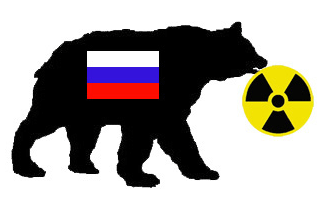 Russian ambitions to build nuclear reactors in Britain are ‘realistic’, say ministers By Emily Gosdenhttp://www.telegraph.co.uk/finance/newsbysector/energy/10289525/Russian-ambitions-to-build-nuclear-reactors-in-Britain-are-realistic-say-ministers.html 05 Sep 2013
Ministers have opened the door to Russia building nuclear reactors on British soil, signing an agreement describing it as a “realistic longer-term ambition”.
The memorandum of understanding, signed in Moscow by energy minister Michael Fallon, said that “mutually profitable commercial relationships between Russian and British companies in third markets could form the basis in the longer term of commercial cooperation in the UK”.
This would be achieved through an “incremental, step-by-step approach”. Mr Fallon said: “Inward investment into our energy sector will depend upon all reactor technologies meeting the stringent and independent regulatory standards required in the UK and EU.”
The agreement came as Rosatom, the Russian state nuclear corporation, commissioned Rolls-Royce to prepare the ground for its reactor to seek UK safety approval. Rolls-Royce, which already has a partnership with Rosatom, will “undertake engineering and safety assessment work” ahead of Rosatom’s reactor “potentially entering the first step of the UK’s formal regulatory approval process”.
Reactors have to pass a ‘generic design assessment’ from the Office for Nuclear Regulation before they can be built in the UK. EDF-Areva’s reactor design for proposed use at Hinkley Point in Somerset took five years to approve.
Rosatom said it viewed the UK as “an attractive opportunity” because most of the UK’s existing reactors are due to close in coming years.
Russia has made no secret of its desire to expand in the UK but has to convince politicians it can overcome security fears as well as safety concerns stemming from its role in the Chernobyl disaster. In June ministers agreed to create a joint working group on “cooperation in the peaceful use of atomic energy between Rosatom and DECC”.
Russia repeats offer to help Japan in the international crisis of Fukushima radiation
The idea of pumping water for cooling was never going to be anything but a “machine for generating radioactive water,”

 Russia Offers Fukushima Cleanup Help as Tepco Reaches Out By Yuriy Humber & Jacob Adelman – Aug 25, 2013 Russia repeated an offer first made two years ago to help Japan clean up its accident-ravaged Fukushima nuclear station, welcoming Tokyo Electric Power Co. (9501)’s decision to seek outside help.

As Tokyo Electric pumps thousands of metric tons of water through the wrecked Fukushima station to cool its melted cores, the tainted run-off was found to be leaking into groundwater and the ocean. The approach to cooling and decommissioning the station will need to change and include technologies developed outside of Japan if the cleanup is to succeed, said Vladimir Asmolov, first deputy director general of Rosenergoatom, the state-owned Russian nuclear utility.
“In our globalized nuclear industry we don’t have national accidents, they are all international,” Asmolov said. Since Japan’s new government took over in December, talks on cooperating between the two countries on the Fukushima cleanup have turned “positive” and Russia is ready to offer its assistance, he said by phone from Moscow last week. Continue reading
Russia keen to sell nuclear reactors to UK, as long as UK subsidises price
 RUSSIA’S ROSATOM EYES NUCLEAR CONTRACTS IN BRITAIN YAHOO NEWS, BY SVETLANA BURMISTROVA , 13 Aug 13, MOSCOW (Reuters) – Russian state nuclear company Rosatom is considering selling reactors in Britain and will soon decide whether to apply for a UK reactor licence, a senior company executive said.
Rosatom is now building more atomic power plants than any other vendor and has been marketing the legacy of the former USSR’s own nuclear disaster, at Chernobyl in 1986, as a lesson learned in nuclear safety.
A major player in developing markets such as China, Vietnam and India, Rosatom has long been interested in building reactors in the European Union, where it is already a supplier of nuclear fuel…… Russian nuclear technology has been unpopular in western Europe since the Chernobyl disaster, but Britain is in dire need of investors willing to replace its ageing nuclear fleet after a series of utility companies, including Germany’s RWE and E.ON and Britain’s Centrica , have dropped out…….
Before entering the UK market, Komarov said, Rosatom would wait to see whether EDF reaches a deal with the British government on a guaranteed minimum power price for its proposed Hinkley Point project, Britain’s first new nuclear plant in almost 20 years.
The guaranteed price, also known as a contract-for-difference (CfD), is part of a major electricity market reform, currently being assessed by Parliament, to encourage types of energy that emit little or no carbon.
Through the CfDs, the government guarantees to top up prices to reach an agreed ‘strike price’ for power generated by the nuclear plants, should market prices fall after they are commissioned.

“This is a very comfortable scheme that guarantees return on investments,” Komarov said. EDF expects to announce by year-end whether it has reached a deal with the British government and plans to hold talks on partnering with a Chinese state-run firm.
“We are waiting to see what agreements EDF reaches,” Komarov said. “If we see that we can get a return on our investments, we will enter the project with great desire……. http://au.news.yahoo.com/world/a/-/world/18488685/russias-rosatom-eyes-nuclear-contracts-in-britain/
Nearly 1000 radioactive cars reached Russia from Japan
Radiation-Contaminated Japanese Cars Still Concern – Russian Customs . VLADIVOSTOK, August 1 (RIA Novosti) – Japanese cars contaminated with radiation in the aftermath of the 2011 Fukushima nuclear disaster is still a concern regarding the importation of such vehicles to Russia, a customs official said Thursday.
According to Russian customs, more than 930 radiation-contaminated vehicles from Japan have been detected at far eastern Russian ports since a magnitude-9 earthquake and subsequent tsunami ravaged the Fukushima nuclear power plant in central Japan…….
A representative of Russia’s federal consumer-protection watchdog, Rospotrebnadzor, told RIA Novosti that it is easier to send such cars back to Japan than to spend money on their decontamination…….http://en.ria.ru/business/20130801/182537097/Radiation-Contaminated-Japanese-Cars-Still-Concern–Russian-Customs.html
Global maritime environment threatened by Russia’s floating nuclear plants
Tow cables snap, Arctic conditions can be unpredictable, ships sink. As the ocean is the common heritage of humanity, perhaps the international community might evince a tad more interest in this project.
Chernobyl At Sea? Russia Building Floating Nuclear Power Plants http://www.zerohedge.com/node/476304 submitted by Tyler Durden 07/11/2013 by John Daly via OilPrice.com,So much for the lessons of Fukushima. Never mind oil spills, the Russian Federation is preparing an energy initiative that, if it has problems, will inject nuclear material into the maritime environment.
Speaking to reporters at the 6th International Naval Show in St. Petersburg, Baltiskii Zavod shipyard general director Aleksandr Voznesenskii said that the Russian Federation’s first floating nuclear power plant “should be operational by 2016.” Continue reading
.Radiation from nuclear tests
U.N. Downplays Health Effects of Nuclear Radiation, IPS, By George Gao, 26 June 13 UNITED NATIONS, – Fukushima on the Hudson“…… During the Cold War, the Soviet Union conducted 456 nuclear tests at the Semipalatinsk test site in present day Kazakhstan.
“Based on information collected during the missions and subsequent research, there is sufficient evidence to indicate that most of the area has little or no residual radioactivity directly attributed to nuclear tests in Kazakhstan,”according to the IAEA.

But the IAEA narrative differs from those who live around Semipalatinsk. According to the preparatory committee for theComprehensive Nuclear-Test-Ban Treaty Organization (CTBTO),”A number of genetic defects and illnesses in the region, ranging from cancers to impotency to birth defects and other deformities, have been attributed to nuclear testing.”
“There is even a museum of mutations at the regional medical institute in Semey, the largest city near the old nuclear testing site,” it noted.
“What radiation does – gamma, alpha or beta – is it either kills the cell or changes the biochemistry of the DNA molecule,” Caldicott, who has worked on nuclear issues for 43 years, explained. “One day [the cell] will start to divide by mitosis in an unregulated way, producing literally trillions and trillions of [mutated] cells, and that’s a cancer,” she said.
“You don’t know you’ve been exposed to radiation,” Caldicott pointed out. “You can’t taste or see radioactive elements in the food, and when the cancer develops, of course it doesn’t denote its origin.”…… http://www.ipsnews.net/2013/06/u-n-downplays-health-effects-of-nuclear-radiation
Rosatom (builder of Chernobyl reactor) aiming to sell nukes to Britain
Russians target Britain in nuclear power deal:This is Money, 16 June 13, Builder of reactor at Chernobyl has gained a toehold in UK market Britain has signed a deal with Moscow that could pave the way for Russia’s state-owned nuclear power company Rosatom to build plants in Britain.
Energy Secretary Ed Davey has made an agreement with the deputy primeminister of Russia, Arkady Dvorkovich, to set up a joint working group between Rosatom and the UK on the future of nuclear power.
Rosatom has claimed that the deal could lead to the fulfilment of its longstanding ambition to build nuclear plants in this country.
The agreement, signed last week, comes while Britain is locked in fraught negotiations with French electricity group EDF over the terms to build a new nuclear power station at Hinkley Point in Somerset.
MPs have already warned that the Government is being held to ransom by EDF because it is the only group bidding for the contract.
Sergey Ruchkin, Rosatom’s new representative in the UK, said Rosatom was following the EDF deal closely. ‘We will learn lessons from EDF in this area,’ he said.
‘On the working level, we have been in contact with our colleagues from the UK’s Department of Energy and Climate Change and there is the potential at some time in the future, if the decision has been made,
to enter the British nuclear new-build market.’
Rosatom is essentially the same group that build the reactors at Chernobyl, one of which exploded in 1986. That blast was the worst nuclear power plant disaster in history. It released 400 times more radioactive material into the atmosphere thanthe atomic bomb dropped on Hiroshima during the Second World War….
http://www.thisismoney.co.uk/money/news/article-2342208/Russians-target-Britain-nuclear-power-deal-Builder-reactor-Chernobyl-gained-toehold-UK-market.html#ixzz2WVxeNBXC
They’re back in the Pacific – Russian nuclear submarines
Russian nuclear submarines resuming patrols in southern hemisphere NewHaven Register, June 02, 2013 By Alexei Anishchuk, Reuters MOSCOW — Russia plans to resume nuclear submarine patrols in the southern seas after a hiatus of more than 20 years following the break-up of the Soviet Union, Itar-Tass news agency reported on Saturday, in another example of efforts to revive Moscow’s military.
The plan to send Borei-class submarines, designed to carry 16 long-range nuclear missiles, to the southern hemisphere follows President Vladimir Putin’s decision in March to deploy a naval unit in the Mediterranean Sea on a permanent basis starting this year.
“The revival of nuclear submarine patrols will allow us to fulfill the tasks of strategic deterrence not only across the North Pole but also the South Pole,” state-run Itar-Tass cited an unnamed official in the military General Staff as saying.
The official said the patrols would be phased in over several years. The Yuri Dolgoruky, the first of eight Borei-class submarines that Russia hopes to launch by 2020, entered service this year….. http://nhregister.com/articles/2013/06/02/news/60cae553-ae3d-4c89-bc59-b279d1f680de.txt
Europe gives cold shoulder to Russia’s nuclear marketing
One of the main reasons that the Baltic NPP project has run aground is that neither investors nor energy importers that Rosatom has approached in Europe have agreed to come on board…..
………The story of the Baltic NPP is an illustrative account of Rosatom’s incapability of landing anything other than rebuffs in Europe, earning trust in the safety of its reactor technology, and winning over foreign investors.
Europe has given a cold shoulder to Rosatom’s brilliant plan to quell its energy security concerns with power streaming from nuclear reactors built in its backyard
 GAZETA.RU: Nuclear failure Gazeta.ru, May 24, 2013 – Moscow’s resigned willingness to consider reduced capacity for the future Baltic Nuclear Power Plant is testimony to the Russian nuclear industry’s failure to overcome criticism it has been facing in the European market, convince potential customers of the reliability of its technologies, or attract foreign investors so it could get a foot in Europe’s door. By Vladimir Slivyak Continue reading
In 1983, nuclear war was only just avoided

While historians have previously noted the high risk of an accidental nuclear war during this period, the new documents make even clearer how the world’s rival superpowers found themselves blindly edging toward the brink of nuclear war through suspicion, belligerent posturing and blind miscalculation.
The USSR and US Came Closer to Nuclear War Than We Thought A series of war games held in 1983 triggered “the moment of maximum danger of the late Cold War.” The Atlantic, DOUGLAS BIRCHMAY 28 2013 An ailing, 69-year-old Yuri Andropov was running the Soviet Union from his Moscow hospital bed in 1983 as the United States and its NATO allies conducted a massive series of war games that seemed to confirm some of his darkest fears.
Two years earlier Andropov had ordered KGB officers around the globe to gather evidence for what he was nearly certain was coming: A surprise nuclear strike by the U.S. that would decapitate the Soviet leadership. …
The Western maneuvers that autumn,called Autumn Forge, , were depicted by the Pentagon as simply a large military exercise. But its scope was hardly routine, as Americans learned in detail this week, for the first time, from declassified documents published by the National Security Archive, a Washington-based nonprofit research organization. Continue reading
Russia’s unsafe new nuclear reactors, the Baltic NPP and others
 GAZETA.RU: Nuclear failure Gazeta.ru, May 24, 2013 “……..In fact, Kaliningrad Region’s neighbor Lithuania has been vigorously protesting the construction, voicing not just political complaints but also concerns regarding the future station’s safety. For instance, the Lithuanian government has charged that the VVER-1200 reactors that Rosatom planned to build at the site have never been subjected to safety tests in accordance with the criteria adopted in the European Union. And safety concerns are far from frivolous or irrelevant here. Let’s take a moment to look at the technology improvements that we are told have been implemented in the design.
The VVER-1200 reactor, on which the project of the Baltic NPP was based, includes a novelty called a “core catcher.” This contraption is meant to mitigate the consequences of an accident that evolves according to a Chernobyl or Fukushima scenario – namely, leads to a core meltdown. For one thing, the very presence of a core catcher would imply that such an accident is possible in principle. For another, all a core catcher can do is simply “catch” the highly radioactive mass of a molten reactor core as it burns through the bottom of the reactor vessel. What it cannot do is help contain the accompanying massive release of radioactivity of the kind that poisoned the environment far and wide during the catastrophe at Chernobyl. So what would be the meaning of this expensive new enhancement? Put a tick next to a budget item called “That new fancy gizmo we have – our reactors are the best!”?
It would be funny if it weren’t so sad: VVER-1200s are being built at the second Leningrad nuclear station, near St. Petersburg, and at the new Novovoronezh site, in Central European Russia, and are being planned for a number of other sites across the country – not to mention the export reactor projects in Belarus, Vietnam, Turkey, and other foreign states.
There are other problems with the Baltic NPP. Its price tag was estimated at around EUR 6 billion, and that’s not counting the very costly transmission networks that the plant would badly need. The very electricity export idea was not duly thought through: Kaliningrad Region lacks the modern and reliable transmission and distribution networks that would be required to carry the station’s electricity to consumers either inside the region or abroad. New power lines could – according to a 2009 estimate by the Russian electricity generation and foreign and domestic power trading company Inter RAO – set Rosatom back by an additional nearly EUR 3 billion, driving the station’s cost up by another 50 percent………http://anti-atom.ru/en/node/5185
Russia’s renewable energy subsidy program
Russia Approves Subsidy Program to Boost Renewable-Energy Output http://www.bloomberg.com/news/2013-05-24/russia-approves-subsidy-program-to-boost-renewable-energy-output.html By Marc Roca – May 23, 2013 Russia approved an incentive program to boost renewable-energy production, targeting almost 6 gigawatts of new capacity by 2020 and its first solar parks.
The government yesterday signed a decree that includes measures to support wind, photovoltaic and small hydropower projects across the country, Dmitry Babanskiy, a spokesman for the Energy Ministry, said today by e-mail.
The measures will increase the proportion of renewable energy to 2.5 percent of power generation by 2020 from 0.8 percent now, he said.
Russia’s grand ambition for global nuclear technology sales
Russia to emerging countries: We’ll build, operate your nuclear reactors Smart Planet, By Mark Halper | May 13, 2013, “…..State nuclear power company Rosatom, “Is offering a special package deal to build and operate nuclear power stations abroad in a bid to win business from developing countries, a company official was quoted on Monday as saying,” Reuters reports. “The offer to ‘Build, Own, Operate’ (BOO), also includes financing to countries seeking to build nuclear plants.”
Rosatom, which competes against the likes of Toshiba’s Westinghouse subsidiary and France’s Areva to construct reactors around the world, has in the past handed over the day-to-day operations of finished reactors to utilities. Now, it’s offering to hang around on site after completion.
“Under the BOO model, Rosatom not only builds the nuclear plant, but also owns it and runs it for up to sixty years,” Reuters writes, citing French publication Le Figaro. “Rosatom also delivers nuclear fuel to the plants.”
“With this model, we are fully responsible for the plant’s security,” Le Figaro quoted Rosatom deputy CEO Nikolai Spassky as saying…… http://www.smartplanet.com/blog/bulletin/russia-to-emerging-countries-well-build-operate-your-nuclear-reactors/19573
Muslumovo, a town radioactively poisoned for 60 years
Soviet radiation biology took a different trajectory from science in the United States. American researchers at that time were working with the highly politicized medical studies of Japanese bomb survivors. They narrowed the list of radiation-related illnesses to leukemia, a few cancers, and thyroid disease. Soviet doctors in formulating chronic radiation syndrome had grasped the effects of radiation on the body more holistically. They determined that radiation illness is not a specific, stand-alone disorder, but that its indications relate to other illnesses. They determined that radioactive isotopes weaken immune systems and damage organ tissue and arteries, causing illnesses of the circulation and digestive tracts and making people susceptible to conventional diseases long before they succumb to radiation-related cancers.
Strange illnesses in one of the most contaminated towns in the world challenge what we think we know about the dangers of radioactivity. Slate, By Kate Brown, April 18, 2013, ”…… the sad fact is that there are irradiated zones that are fully inhabited, and have been since the first years of the nuclear arms race. Despite a media culture enthralled with nuclear accidents, the cameras generally turn off after the first clouds of radioactive vapors dissipate.
“………..For Soviet leaders, the river dwellers were a unique opportunity in the history of health physics—what scientists call “a natural experiment” that promised to answer an important civil defense question about how to survive a nuclear attack. In 1962, the Cheliabinsk branch of the Soviet Institute of Bio-Physics, called FIB-4, started conducting regular medical exams of the Muslumovo population. FIB-4 doctors invited village children playing on the streets to a clinic room to take blood samples. In Cheliabinsk, they set up a repository of irradiated body parts: hearts, lungs, livers, bones. They started a collection of genetically malformed babies who died soon after birth, each infant preserved in a two-quart glass jar. A Dutch photographer, Robert Knoth, visited the repository and saw hundreds of babies in jars. He photographed one infant with skin like patched, rough burlap. Another boy had eyes on top of his head like a frog. During the examinations, doctors did not inform the villagers of their exposures or of diagnoses of radiation-related illness.
In 1986, soon after the Chernobyl disaster, Glufarida Galimova, working as chief doctor at a pediatric clinic in Muslumovo, her native town, was puzzled by the saturation of illness in her community. The illnesses were rare, strange, complex, and often genetic: hydrocephalic children, children with cerebral palsy, missing kidneys, extra fingers, anemia, fatigue, and weak immune systems. Many kids were orphaned or had invalid parents. Continue reading
Secret nuclear waste – Europe to Murmansk to Mayak
After unloaded in Murmansk, the containers with nuclear fuel is sent by rail to Mayak, Russia’s reprocessing plant just north of Chelyabinsk in the South Urals.
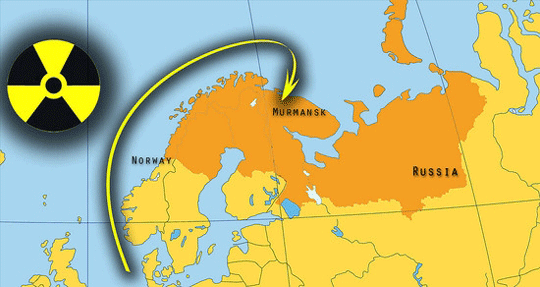
Norwegian Radiation Protection Authorities had no knowledge about the nuclear voyage before being asked by BarentsObserver to give a comment. Then, the vessel “Mikhail Dudin” had sailed along Norway’s long coastline for nearly five days and had already delivered its cargo in Murmansk.
“We have no information about any shipment of nuclear waste outside the coast of Norway last week,” NRPA Director Ole Harbitz said. In Murmansk, information about the nuclear waste arrival was first made public by the non-governmental organization Kola Ecological Center. The group is highly concerned about the radiation safety risk such cargo poses to the city’s 300,000 inhabitants. Maybe for good reasons; similar cargo is expected to arrive again. Continue reading
1 This Month
29 Jan. Thursday 7-8 p.m. Webinar – World’s Largest Nuclear Station in Port Hope, ON?
To see nuclear-related stories in greater depth and intensity – go to https://nuclearinformation.wordpress.com/

31st January – Challenging the War Machine – a DECLASSIFIED UK SUMMIT

Website of the Week
Now until to February 10, 2026 Radioactive waste storage in France: the debate is finally open! How to participate?
-
Archives
- January 2026 (283)
- December 2025 (358)
- November 2025 (359)
- October 2025 (376)
- September 2025 (258)
- August 2025 (319)
- July 2025 (230)
- June 2025 (348)
- May 2025 (261)
- April 2025 (305)
- March 2025 (319)
- February 2025 (234)
-
Categories
- 1
- 1 NUCLEAR ISSUES
- business and costs
- climate change
- culture and arts
- ENERGY
- environment
- health
- history
- indigenous issues
- Legal
- marketing of nuclear
- media
- opposition to nuclear
- PERSONAL STORIES
- politics
- politics international
- Religion and ethics
- safety
- secrets,lies and civil liberties
- spinbuster
- technology
- Uranium
- wastes
- weapons and war
- Women
- 2 WORLD
- ACTION
- AFRICA
- Atrocities
- AUSTRALIA
- Christina's notes
- Christina's themes
- culture and arts
- Events
- Fuk 2022
- Fuk 2023
- Fukushima 2017
- Fukushima 2018
- fukushima 2019
- Fukushima 2020
- Fukushima 2021
- general
- global warming
- Humour (God we need it)
- Nuclear
- RARE EARTHS
- Reference
- resources – print
- Resources -audiovicual
- Weekly Newsletter
- World
- World Nuclear
- YouTube
-
RSS
Entries RSS
Comments RSS
 nuclear-news