Russia keen to market nuclear power to impoverished Cambodia
Russia to help Cambodia build capacity for nuclear power, REUTERS, YEKATERINBURG,  RUSSIA/PHNOM PENH 26 Nov
 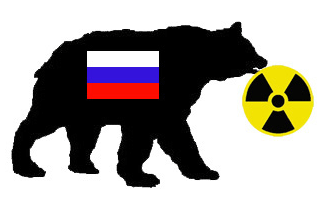 Russia will help Cambodia work towards building a nuclear power plant under an agreement the two countries signed this week, said Sergei Kirienko, the head of state nuclear firm Rosatom.
Cambodia depends heavily on imported fuel and power. Electricity in the country is among the most expensive in Southeast Asia and a common source of complaint from investors.
“The Cambodian government is mulling, in future, a nuclear power station construction,” Kirienko told reporters on Wednesday when asked about the agreement.
Cambodian energy officials declined to comment on the deal on Thursday.
The agreement was signed during a visit by Russian Prime Minister Dmitry Medvedev to Cambodia this week. His visit was the first to Cambodia by a senior Russian politician since 1986.
Under the terms of the agreement, Russia will provide expertise, research and training to Cambodia…… http://www.reuters.com/article/2015/11/26/us-cambodia-russia-nuclear-idUSKBN0TF0W220151126#siJ8T6T4vdeKAEm8.97
Despite airplane bombing , and Egypt’s lax security, Russia to provide nuclear reactors to Egypt!


 Egypt’s Nuclear Power Plant Deal With Russia Signed Amid Escalating Tensions By Menna Zaki, AllAfrica, 20 Nov 15
President Abdel Fattah al-Sisi signed a nuclear power plant deal with Russia Thursday, just days after the Kremlin’s unilateral announcement that the Russian charter flight which blew up over Sinai late October was downed by an act of terrorism…….
The deal, which has been under negotiation for months, was signed days after Russia vowed to avenge the terrorist bombing of a Russian airliner killing all 224 passengers and crew on board, the majority of whom were Russian holidaymakers visiting the resort city of Sharm el-Sheikh and heading to St. Petersburg.
Since the crash, Egypt has made no conclusive statements on the results of the Egypt-led international investigation, agreeing only that the jet broke up midair after abruptly disappearing from the radar 23 minutes from takeoff.
Egyptian officials said on separate occasions that it is too early to jump to conclusions and that no criminal evidence can be established so far.
Russia, on the other hand, announced days before signing the nuclear deal with Egypt that the crash was a terrorist act. Days after the crash, Russia had halted all flights to Egypt and banned the national carrier EgyptAir from flying to Russia, apparently based on information passed on by the UK which was not shared with Egypt, according to Egyptian officials…….
Russia announced Thursday that it has evacuated 90,000 of its citizens from Egypt, with the remaining 2,500 to leave by November 30………Egypt’s lax airport security has come under heavy scrutiny since the incident amid news reports that small bribes by travellers are enough to help them bypass queues and luggage scanners…….http://allafrica.com/stories/201511201808.html
Russia marketing nuclear reactors to Egypt, involving big debt for Egypt
 Egypt, Russia sign deal to build a nuclear power plant Reuters, 19 Nov 15 CAIRO Moscow and Cairo signed an agreement on Thursday for Russia to build a nuclear power plant in Egypt, with Russia extending a loan to Egypt to cover the cost of construction.
A spokesman for Russia’s state-owned nuclear firm Rosatom said the plant, Egypt’s first, would be built at Dabaa in the north of the country and was expected to be completed by 2022.
Egyptian President Abdel Fattah al-Sisi, speaking on state TV, gave few details but said the project would involve the building of a ‘third-generation’ plant with four reactors.
It is not clear how much the deal is worth but Sisi said the loan from Russia would be paid off over 35 years……..http://www.reuters.com/article/2015/11/19/us-nuclear-russia-egypt-idUSKCN0T81YY20151119#BuK0P0P54h5xD8LD.97
Russia leaks ‘Secret’ Plans For Nuclear Weapons
Russian News Stations Air ‘Secret’ Plans For Nuclear Weapons, Huffington Post 12 Nov 15
A spokesman for Russian President Vladimir Putin said the plans should not have been aired. MOSCOW (AP) — President Vladimir Putin’s spokesman said plans for a new submarine-launched nuclear torpedo shown on Kremlin-controlled television were secret and should never have been aired.
NTV and Channel One showed a large document — filmed over a military officer’s shoulder during a meeting with Putin — with drawings and details of a weapons system called Status-6.
The torpedoes could create “extensive zones of radioactive contamination” that would make enemy coastal areas “unsuitable for military, economic, business or other activity for a long time,” the document said.
The channels later removed the footage, which was shot during a meeting on Monday in Sochi.
“It’s true that some secret information was caught by the camera and therefore it was subsequently removed,” Putin spokesman Dmitry Peskov said late Wednesday. “We hope this will not happen again.”
The appearance of the video on television channels under such tight Kremlin control raised suspicions that it was done intentionally to cause alarm in the West….. http://www.huffingtonpost.com/entry/russia-nuclear-weapons-plans_5644a8f2e4b045bf3dede9fa
Mayak Production Association the source of nuclear fuels on black market
Fuel For a Nuclear Bomb Is Probably on the Black Market Right Now http://www.maxim.com/maxim-man/article/black-market-nuclear-fuel-2015-11
And it often originates from one site in Russia.
The detailed report begins with an account of a failed attempt that occurred in Moldova in 2011 to pass off 22 pounds of highly enriched uranium for a few hundred thousand dollars. The transaction was actually a sting, and it ultimately led to the imprisonment of a Moldovan lawyer named Teodor Chetrus for attempting to smuggle the material. Chetrus’s arrest, however, did nothing to ease Western worries about a terrorist group or rogue nation acquiring the ability to make their own nuclear bomb:
Instead, it stoked them, because the resulting international probe into the case has sparked fresh, and previously unreported worries, that thieves inside of Russia somehow made off years ago with a full bomb’s worth of highly enriched uranium. Western spies fear the thieves have been doggedly looking for a buyer for the past sixteen years, by repeatedly dangling in front of them identical, genuine samples of that highly valuable material.
Five current or former U.S. officials who have tracked nuclear smuggling, and who declined to be named because this assessment is classified, said it is now a consensus view within the intelligence community.
But wait, it gets worse! According to this report, Western intelligence has no idea “exactly who has this nuclear explosive material, and where they may be.”
Journalists Douglas Birch and R. Jeffrey Smith write that the anxieties regarding nuclear materials in the wild go back some 16 years. Since 1999, there have been at least three incidents in which “identically packaged containers of highly-enriched uranium have been seized by authorities outside of Russia.”
All those packages have been forensically traced to the early 1990s and one source: the Mayak Production Association, a giant nuclear facility in the Ural Mountains.
One quote from the report ratchets up the pucker factor considerably while emphasizing exactly why this is the stuff of military suspense fiction:
While seven of those involved in the smuggling have so far been prosecuted in Bulgaria, France and Moldova, officials say they are just low-level members of a shadowy international ring with Moldovan and Russian connections, all working for a person or persons whose identity remains cloaked.
So far, efforts at stopping the spread of these materials has only taken small-time go-betweens out of commission. The masterminds are still out there.
Reading the report in full is worth the time, if you don’t want to sleep well for a while. It will make you wish James Bond was real.
Narrowly avoided accidental nuclear apocalypse in 1983 revealed
 Top Secret Documents Reveal A NATO Training Exercise Nearly Started A Nuclear Apocalypse With Russia http://www.huffingtonpost.co.uk/2015/11/12/top-secret-documents-reveal-a-nato-training-exercise-nearly-started-a-nuclear-apocalypse-with-russia-_n_8542766.html The Huffington Post UK | By Thomas Tamblyn
A recently declassified document has revealed that in 1983, the United States and Russia were almost plunged into nuclear war and here’s the real kicker: It would have been completely by accident
It is thought that the exercise could have, at some stages, brought the two countries closer to war than even the famous Cuban Missile Crisis in 1962.
Codenamed Able Archer, the NYT reveals in its exposé of the training exercise that many NATO commanders were seemingly oblivious to the knife edge that they were creating.
Then US President Ronald Reagan rather eloquently described the situation as ‘Really scary’ after reading the briefing documents that summarised how perilously close the situation had become.
The document was finally declassified earlier this month, some 11-years after the request had been made by the National Security Archive at George Washington University.
Speaking to the NYT about the significance of the event archive director Thomas S. Blanton said: “Turns out, 1983 is a classic, like the Cuban missile crisis, where neither superpower intended to go nuclear, but the risk of inadvertence, miscalculation, misperception were just really high. Cuba led J.F.K. to the test ban. Nineteen eighty-three led Reagan to Reykjavik and almost to abolition.”
What might be the most terrifying piece of news is that before and during the exercise, the Soviets weren’t just using human judgement but were inputting some 40,000 scenarios into a supercomputer in an effort to try and assess how likely a nuclear strike actually was.
Ironically it was the then leader of the Soviet Union Mikhail Gorbachev who summed up the severity of the situation later in 1986:
“Never, perhaps, in the postwar decades has the situation in the world been as explosive and, hence, more difficult and unfavorable as in the first half of the 1980’s.”
Russia’s militarisation of the Arctic, and the danger of its mini nuclear reactors

 Russia’s mini nuclear reactors plan causes concern http://thebarentsobserver.com/security/2015/11/russias-mini-nuclear-reactors-plan-causes-concern Norway’s radiation watchdog says the risk of accidents and releases of radioactive substances will increase in the Arctic. Thomas Nilsen November 07, 2015
A military plan building up to 30 small transportable nuclear reactors for the Arctic was announced earlier this week. The reactors will provide electricity to remote bases currently under development as part of Russia’s Arctic militarization.
“If these plans are given a go-ahead in the future, it will lead to an increased risk of accidents and releases of radioactive substances,” says Ingar Amundsen, Head of Section for international nuclear safety with the Norwegian Radiation Protection Authorities (NRPA). Amundsen was on inspection with three other Norwegian experts at Kola nuclear power when being contacted by the Independent Barents Observer about the Russian military plans.
Norway wants information
He says NRPA was not informed about the plans before reading about it in Russian media this week. “Norwegian authorities will bring up the issue with our Russian counterpart in those forums we have dialogue, to hear if there is realism in these plans,” Ingar Amundsen says.
Since 1995, Norway has co-financed a series of comprehensive nuclear safety projects in Northwest Russia, including decommissioning of Cold War submarines bringing their reactors into safe onshore long-term storage.
Amundsen elaborates on the risks involved in Russia’s announced new military reactors. “Nuclear power plants requires good access to needed infrastructure and a comprehensive control regime for safe operation, Ingar Amundsen says and continues: “This is important to avoid accidents and releases, but also to avoid unauthorized access by strangers to the facility and the nuclear material.” He believes that will be very difficult to achieve with mobile units in remote areas.
Arctic militarization
Russia current militarization of the Arctic includes new bases and re-opening of Cold War bases along the north coast of Siberia and on archipelagoes like the New Siberia Islands, Novaya Zemlya and Franz Josef Land. The aim of creating small nuclear reactors is to fly- or ship them in to the bases and produce electricity- and heat instead of diesel generators and steam boilers.
The reactors are so small they can be transported around by a KAMAZ truck, in a cargo plane, on a sledge or even carried by Russia’s huge Mi-26 cargo helicopters.
The first of the new mini reactors could be ready for testing before 2020, TASS reported on Wednesday.
Murmansk and Severodvinsk
Nothing is said about where to maintain the reactors Today, maintain- and uranium fuel replacement of naval reactors in northern Russia takes place at the submarine yard in Severodvinsk near Arkhangelsk and at icebreaker base Atomflot in Murmansk.
As previously reported by the Independent Barents Observer, small transportable nuclear reactors for use in remote corners of the Arctic is not a new invention.
Both the United States and the Soviet Union built several transportable reactors. In the Arctic, the U.S. military had a secret nuclear reactor in operation for some few years in the 60ies at Camp Century east of Thule airbase on Greenland’s northern ice-sheet. The reactor was then transported on the ice by a tractor with a sledge and placed under the ice to produce electricity and heat for a Arctic missile research facility.
Also in Antarctica, the United States operated a medium-size reactor in the 60ies and 70ies at the McMurdo research station.
In the Soviet Union, a two-megawatt reactor was built in 1961. The reactor was carried around on the chassis of a tank. Another smaller reactor, named NURKA, was located at one of the Northern fleet’s submarine bases on the coast of the Barents Sea, but it is unclear if this reactor ever was used. Several other types of mini-reactors were developed during Soviet-times.
For space, several series of lightweight ultrasmall reactors were use in satellites. http://thebarentsobserver.com/security/2015/11/russias-mini-nuclear-reactors-plan-causes-concern
The New START treaty – arms control pact between USA and Russia
Carroll: The enduring nuclear threat, By Vincent Carroll, Denver Post 7 Nov 15 “…Undersecretary of State for Arms Control and International Security, Rose E. Gottemoeller was the chief negotiator for the New START treaty, an arms control pact with the Russians that went into effect in 2011. Her career in arms control and national security goes back many years and spans government, academia and think tanks.….
The New START treaty will take our nuclear weapons that are deployed down to 1,550 — and the same with the Russians — by February 2018. By contrast, when we signed the first START treaty in 1994, we and the Russians both had approximately 12,000 deployed nuclear warheads.
Even after the Ukraine crisis and their grab of Crimea, they continued to have a businesslike attitude toward the implementation of START. We conduct 18 inspections a year in Russia and they come here, too. Everything is reciprocal. And we exchange on a daily basis the status of our strategic nuclear forces. If the Russians take an ICBM out of its silo to a repair facility, they have to tell us that.
Q:Has the megatonnage come down proportionately with those reductions in warheads?
A: Absolutely. It’s been a real success story. So no matter what the ups and downs of our relationship, this process has been good for U.S. national security, and for predictability and mutual stability for these two great nuclear powers. And I would say especially now, when relations aren’t so hot, it’s good to have a clear idea of what’s going on with their nuclear forces.
The question is what to do about the future. Between 2010 and 2014 under President Obama we did a posture review, and in 2013 the president concluded we could go up to one-third lower in the New START, from 1,550 down even as low as 1,000 and still maintain our security. So in Berlin in June 2013, we put that offer on the table and said to the Russians, “Let’s work on the next nuclear disarmament negotiation.” But so far the Russians haven’t picked that offer up from the table, even though I think it would be good for them, too.
I think their reaction is wrapped up in a lot of things, such as Vladimir Putin’s sense that nuclear weapons mean a lot for Russian security at this moment to concerns, he says, in our national missile defense program. But it’s ridiculous to think that our limited missile defense system can somehow threaten the Russian strategic offensive deterrent.
Q:That system is for a smaller rogue regime?
A: It’s North Korea. And I’m glad we have it available as an insurance policy. ………
Q:Where do you see the major threats to proliferation?
A: The biggest new threat we face today is nuclear weapons in the hands of terrorists. And not only nuclear weapons, but fissile material, highly enriched plutonium or uranium that could be used to craft a simple nuclear bomb. President Obama was really clear about this in his Prague speech back in 2009.
This threat is undeterrable. Even North Korea, as crazy as they are, knows they will be facing a very intense response if they attack us with a nuclear weapon. Countries hold off on that basis. That’s why the president said we need to push step by step for a world without nuclear weapons. The policy is to minimize the amount of highly enriched uranium and plutonium around the world, and to constantly press toward fewer weapons.
Q:Don’t terrorists need the assistance of a state to develop a nuclear weapon, at least in terms of getting the fuel?
A: The key factor is having enough fissile material, highly enriched uranium or plutonium. Then the designs for simple devices are on the Internet basically. So the concern is that they could get enough fissile material to make a bomb on their own or that they could steal a bomb or the material from somewhere.
In some cases, we do worry about state sponsorship. That’s one of the reasons we’re watching so closely North Korea, because they ship missile parts around the world and might get into this business as well……..http://www.denverpost.com/perspective/ci_29081465/carroll-enduring-nuclear-threat
Bellona joins other anti nuclear non profit groups – no longer NGO, harassed by Russian govt
 Two decades of legal harassment dissolve Bellona Murmansk as a Russian NGO – but it will continue its work, Bellona, October 12, 2015 by Charles Digges Twenty years ago this month, Bellona’s still nascent offices in Murmansk were raided by the FSB, the successor organization to the Soviet KGB, setting in motion a legal Rube Goldberg machine that led to treason allegations against the Bellona’s Alexander Nikitin, and charges against the Bellona itself.
In those two decades, Nikitin beat his espionage wrap, and Bellona Murmansk became a vital force in attracting international funding for dismantling Russia’s nuclear naval legacy and spearheading renewable energy efforts on Russia’s Kola Peninsula.
But, the group again faces a vague future after it was declared in March to be a “foreign agent” by Russia’s Justice Ministry, showing that official spy-mania directed against non-profit groups demanding transparency on nuclear and environmental issues is again on an upswing.
On Monday, it surfaced that the group would be forced to stop operating as an NGO, and group chairman Andrei Zolotkov confirmed that Bellona Murmansk was “at a cross roads” and that its eventual liquidation as a non-profit had been announced as early as April.
Bellona Executive Director Nils Bøhmer confirmed Monday that as of Monday Bellona Murmansk is no longer a Russian non-profit, but would still continue its present functions under different auspices. Continue reading
Nuclear-Tipped Missiles very dangerous, as Russia is proving
Russia is Proving Why Nuclear-Tipped Cruise Missiles Are a Very Bad Idea, Defense One OCTOBER 19, 2015 BY TOM Z. COLLINAWILLIAM SAETREN
Those four cruise missiles that crashed in Iran could’ve been carrying nuclear warheads — which is why the US should ban them, not renew them. When Russia this month launched 26 cruise missiles from ships in the Caspian Sea into Syria, more than 900 miles away, the missiles had to pass over Iran and Iraq. Four crashed in Iran. According to reports, a number of cows were killed in the ensuing blast.
Apologies to the cows, but this could have been a lot worse.
The Russian cruise missiles, the Kalibr-NK, were armed with conventional warheads. But these missiles are also capable of carrying nuclear warheads. That’s a problem. Cruise missile attacks are inherently ambiguous and can add major risks to a crisis. Had the target been the United States, military leaders would not have known until impact if it was a nuclear attack. This kind of uncertainty can increase the risk of nuclear war and it’s why nuclear-tipped cruise missiles should banned completely.
Cruise missiles are unreliable. In the case of Moscow’s attack into Syria, if nuclear warheads had been involved and some of them crashed in Iran without detonating (which is likely), Tehran could have retrieved them. This scenario is not as far fetched as one might think. In 2007, six nuclear-armed cruise missiles were mistakenly loadedonto a B-52 bomber and flown across the United States. Because nuclear-armed cruise missiles are virtually indistinguishable from conventional ones, the error went undetected for 36 hours. If this can happen under strict American guidelines, imagine what could happen from Russia to the Middle East…
why is the U.S. Air Force planning to spend $20 billion to build approximately 1,000 new nuclear-armed Air-Launched Cruise Missiles, or ALCMs, with refreshed warheads, to replace its current fleet? It should not. Not only are they “uniquely destabilizing” but their mission has evaporated.
As Perry and Weber explain, nuclear cruise missiles were initially conceived to keep the B-52 flying until it could be replaced by the stealthier B-2 bomber. During the Vietnam War, many B-52s were lost to enemy surface-to-air defenses making it painfully obvious that the plane was no longer able to safely operate in contested airspace. But with the cruise missile, the B-52 could still strike targets deep in the heart of enemy territory. This feature was deemed necessary during the Cold War so NATO could offset the Warsaw Pact’s larger conventional forces.
That was then. As Perry and Weber write, such a Cold War posture “no longer reflects the reality of today’s U.S.conventional military dominance.”
In fact, the ALCM was supposed to be retired long ago along with the B-52 bomber when the B-2 came on line……..
President Obama can safely cancel the new nuclear cruise missile and challenge other nations, like Russia, to eliminate these destabilizing weapons. This step would save tens of billions of dollars, reduce the risk of nuclear war and provide momentum toward Obama’s goal of eliminating nuclear weapons. And, ironically, it would eliminate yet another potential pathway for Iran to get the bomb. http://www.defenseone.com/ideas/2015/10/russia-proving-why-nuclear-tipped-cruise-missiles-are-very-bad-idea/122938/
Nadejda Koutepova speaks out on the hidden scandal of the Mayak radioactive contamination
A Russian antinuclear activist asks for asylum in France Mediapart , October 2, 2015, by Amélie Poinssot and Michel de Pracontal, The revelation, decades later
The work of Russia’s anti nuclear NGO “Planet of Hope”
 Our NGO, based in Ozersk, had three programs. We educated citizens about their rights, in particular those who were victims of radioactive contamination. We did sociological research on the inhabitants. And we gave training to representatives of other NGOs in the Ozersk region.
Today, we have no way to be certain that releases into the Techa have been stopped. The factory states that the reservoirs are secure……. http://nf2045.blogspot.jp/2015/10/a-russian-antinuclear-activist-asks-for.html
Turkey warns Russia it may not get its nuclear technology from Russia
Turkey’s Erdogan warns Russia on nuclear project, natural gas: papers http://news.yahoo.com/turkeys-erdogan-warns-russia-nuclear-project-natural-gas-090830083.html ISTANBUL (Reuters), 8 Oct 15 – Turkish President Tayyip Erdogan told Russia there were other places Turkey could get natural gas and other countries that could build its first nuclear plant, in the wake of Russian incursions into Turkish air space during its air campaign in Syria.
Russian aircraft twice entered Turkish air space at the weekend. Turkish F-16 jets have also been harassed by Syrian-based missile systems and unidentified planes since then.
“We can’t accept the current situation. Russia’s explanations on the air space violations are not convincing,” the Turkish daily Sabah and others quoted Erdogan as telling reporters as he flew to Japan for an official visit. He said he was resentful over what had happened but did not currently plan to speak to Russian President Vladimir Putin.
“These are matters for Russia to think about. If the Russians don’t build the Akkuyu (nuclear plant in southern Turkey) another will come and build it,” he said.
Turkey in 2013 commissioned Russia’s state-owned Rosatom to build four 1,200-megawatt reactors, but a start date for what is Turkey’s first nuclear power plant project has not yet been set.
“We are Russia’s number one natural gas consumer. Losing Turkey would be a serious loss for Russia. If necessary, Turkey can get its natural gas from many different places,” he said.
Around 28-30 billion cubic meters (bcm) of Turkey’s 50 bcm annual natural gas needs are met by Russia.
(Additional reporting by Orhan Coskun; Writing by Daren Butler; Editing by Hugh Lawson)
How Russia repressed anti nuclear Non Government Organisation Planet of Hope [Planeta Nadezhd]
 A Russian antinuclear activist asks for asylum in France Mediapart , October 2, 2015, by Amélie Poinssot and Michel de Pracontal, “………..You have been in France since July, in Paris, and on October 2nd you are applying for asylum. Why did you leave Russia?
See also:
Chris Harris, “Charity boss flees with young kids after Russia’s NGO crackdown,” Euronews, September 9, 2015. http://nf2045.blogspot.jp/2015/10/a-russian-antinuclear-activist-asks-for.html
Gangs of smugglers tried to sell nuclear materials to ISIS
Smugglers Have Tried to Sell Nuclear Materials to ISIS and Other Terrorists, Report Says http://time.com/4064012/nuclear-material-isis-islamic-state-smugglers/?xid=homepage Desmond Butler, Vadim Ghirda / Associated Press 6 Oct 15 In one case, man expressing hatred for the U.S. tried to sell bomb-grade uranium to a Sudanese buyer. (CHISINAU, Moldova) — The Associated Press has learned that gangs with Russian ties are driving a thriving black market in nuclear materials in eastern Europe, often with the explicit intent of connecting sellers to Middle Eastern extremist groups.
Authorities working with the FBI have interrupted four attempts by gangs shopping radioactive material in Moldova, a small country in Eastern Europe. The latest known case came in February, when a smuggler offered radioactive cesium, specifically seeking an Islamic State buyer.
The most serious case came in 2011, when a man expressing hatred for the U.S. tried to sell bomb-grade uranium to a Sudanese buyer.
Successful busts were compromised by striking shortcomings: Key suspects got away; prison sentences were surprisingly short; and gang leaders may have escaped with the bulk of their nuclear contraband.
1 This Month
Chernobyl: The Lost Tapes – A good documentary on Chernobyl on SBS available On Demand for the next 3 weeks– https://www.sbs.com.au/ondemand/tv-program/chernobyl-the-lost-tapes/2352741955560

of the week–London Campaign for Nuclear Disarmament

Tell the Ukrainian Government to Drop Prosecution of Peace Activist Yurii Sheliazhenko
To see nuclear-related stories in greater depth and intensity – go to https://nuclearinformation.wordpress.com
-
Archives
- April 2026 (152)
- March 2026 (251)
- February 2026 (268)
- January 2026 (308)
- December 2025 (358)
- November 2025 (359)
- October 2025 (376)
- September 2025 (257)
- August 2025 (319)
- July 2025 (230)
- June 2025 (348)
- May 2025 (261)
-
Categories
- 1
- 1 NUCLEAR ISSUES
- business and costs
- climate change
- culture and arts
- ENERGY
- environment
- health
- history
- indigenous issues
- Legal
- marketing of nuclear
- media
- opposition to nuclear
- PERSONAL STORIES
- politics
- politics international
- Religion and ethics
- safety
- secrets,lies and civil liberties
- spinbuster
- technology
- Uranium
- wastes
- weapons and war
- Women
- 2 WORLD
- ACTION
- AFRICA
- Atrocities
- AUSTRALIA
- Christina's notes
- Christina's themes
- culture and arts
- Events
- Fuk 2022
- Fuk 2023
- Fukushima 2017
- Fukushima 2018
- fukushima 2019
- Fukushima 2020
- Fukushima 2021
- general
- global warming
- Humour (God we need it)
- Nuclear
- RARE EARTHS
- Reference
- resources – print
- Resources -audiovicual
- Weekly Newsletter
- World
- World Nuclear
- YouTube
-
RSS
Entries RSS
Comments RSS
 nuclear-news