Finland’s Fennovoima nuclear station dependent on Russia for all the finance
“……the extraordinary problems at Olkiluoto have cast doubts over Finland’s ability to manage such projects, while Fennovoima was hit by a farcical hunt for European investors for Hanhikivi.
Worries about Russian involvement almost brought down the previous Finnish coalition government. The Green party left the administration, accusing its former partners, some of whom are still in power, of pursuing a policy of “Finlandisation” — an extremely loaded term locally meaning the accommodation of Russian views in Finnish policy. …..
The deal is also of huge importance to Rosatom and its international ambitions to play a leading role in any revival of nuclear power outside the former Soviet Union…..” Finland raises its bet on nuclear power, Ft.com 5 June 16
Russia keen to get in on the business of cleaning up Fukushima nuclear mess
 Rosatom, Japan discuss decommissioning of Fukushima installations https://rbth.com/news/2016/06/02/rosatom-japan-discuss-decommissioning-of-fukushima-installations_599603
“Our partners are showing ever greater interest in the final stage of the life cycle: decommissioning. We are currently discussing this with the Japanese partners,” Kirienko said.
Rosatom enterprises have fulfilled the order to develop unique technology for treating water at Fukushima for the Japanese partners, he added.
Russia moving in on America as a market for its nuclear fuel
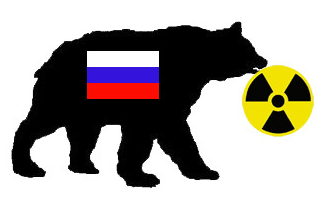
 Russian Nuclear Fuel Giant Making A Move In U.S. Markets, Oil Price, 2 June 16, http://oilprice.com/Latest-Energy-News/World-News/Russian-Nuclear-Fuel-Giant-Making-A-Move-In-US-Markets.html CHARLES KENNEDY Far from the specific paranoia of the Cold War era, talk now is that Russia’s Rosatom nuclear fuel giant may soon end up supplying 10 percent of U.S. nuclear fuel needs.
In partnership with General Electric Co. (GE), Russian state-owned Rosatom is expanding its nuclear fuel supply to the US, hoping to gain a 10-percent market share—adding to the 20 percent of the US enriched uranium market it already controls.
Last week, Rosatom’s TVEL signed an agreement with U.S. Global Nuclear Fuel-Americas, a subsidiary of GE-Hitachi, on cooperation in licensing, marketing and fabrication of fuel for U.S. Pressurized Water Reactors (PWRs).
According to Russian news agencies, Russia currently holds 17 percent of the global nuclear power plant fuel market. That means it has covered all of its own supply for 76 reactors, along with the reactors in 14 more countries. By 2019-2020, Rosatom hopes to be supply nuclear fuel to the U.S..
Speaking at the Atomexpo-2016 on Monday, where it signed US$10 billion in deals, Rosatom TVEL Fuel Company vice-president Oleg Grigoryev said: “We expect the share of our deliveries to be more than 10% of the US market for this kind of fuel.”
TVEL’s exports already exceed US$1 billion annually, according to Russia’s Tass news agency. The move to gain this extra nuclear fuel market share still requires approval from the U.S. Nuclear Regulatory Commission.
According to Bloomberg, Rosatom has been supplying low-enriched uranium to the U.S .since 1987.
Rosatom is apparently not targeted by U.S. sanctions.
In 1992, according to Bloomberg, an anti-dumpling investigation prompted trade controls that affected how much low-enriched uranium Rosatom could supply to the U.S.. From 2002 to 2011, Rosatom had to stop commercial supplies to the U.S. For now, the Russian giant has long-term uranium delivery contracts with Centrus Energy Corp. ,NextEra Energy Resources and Exelon Generation Company LLC.
Russia and China working together to market nuclear reactors to the world
 Russia, China Working on Plan on Nuclear Cooperation Development. MOSCOW (Sputnik) 2 June 16 — Russia and China are working on a comprehensive document on the development of the bilateral strategic cooperation in the field of nuclear energy, the protocol of the Russia-China intergovernmental energy cooperation commission said.
Russia, China, marketing nuclear power to – well, just about everybody
Ghana explores nuclear power opportunities Business News , 30 May 2016 Source: Tv3network.com Ghana is among these emerging nuclear energy countries, as the country strives to meet the increasing demand of energy for domestic and industrial use. State-owned nuclear companies in Russia and China have taken the lead in offering nuclear power plants to emerging countries, usually with finance and fuel services.
Russia’s State Atomic Energy Corporation (ROSATOM) hosts the annual ATOMEXPO International Forum as a major exhibition and business platform for conducting meetings and negotiations between the worldwide leaders of the nuclear power industry.
The 2016 edition, holding in Moscow from May 30–June 2, provides leaders of nuclear power industry and nuclear power engineering with an opportunity to publically define the place and role of nuclear generation in the 21st century energy balance.
The Forum also promotes international cooperation between the Russian Federation and the countries of Latin America, Pacific Asia, Africa, Central and Eastern Europe in the field of nuclear power, and to discuss Russia’s proposal on developing national energy programs…….
Nuclear energy is growing globally with nearly 10 GW of new nuclear capacity supplying electricity in 2015 – more than double the average capacity connected each year in the previous decade.
Though there are long term prospects for nuclear, experts say the emerging nuclear energy countries are not expected to contribute very much to the expansion of nuclear capacity in the foreseeable future. http://www.ghanaweb.com/GhanaHomePage/business/Ghana-explores-nuclear-power-opportunities-443245
Russia marketing nuclear fuel to USA !!
Will The Russians Become Fuel Supplier To U.S. Nuclear Power Plants? http://www.forbes.com/sites/kenrapoza/2016/05/31/will-the-russians-become-fuel-supplier-to-u-s-nuclear-power-plants/#413acf8f2638 Kenneth Rapoza , 31 May 16,
It’s not unprecedented. While the U.S. does not currently use Russian technology at any of its nuclear power stations, a deal between Global Nuclear Fuel Americas and TVEL would be the first to make it happen. Global Nuclear Fuel-Americas is a GE-led joint venture that includes its main nuclear power plant partner Hitachi and rival Toshiba, which owns Westinghouse.
Under the agreement proposed May 24, GE partners and TVEL will “work together toward the licensing, marketing and fabrication of fuel” for U.S. pressurized water reactors (PWRs). Global Nuclear Fuel and TVEL would create a strategic alliance with the purpose of introducing the Russian fuel rods into the U.S. market.
“We believe strongly in the TVEL technology,” said Jonathan Allen, a spokesman for GE Hitachi.
TVEL’s latest nuclear fuel assembly technology is for use in Westinghouse-designed reactors. There are currently 35 of these reactors operating in the U.S., but none of them are allowed to use TVEL’s technology because it has not yet been approved U.S. nuclear industry regulators. The assembly rod, known as the TVS-K design, has been used for many years in Rusatom’s VVER-1000 nuclear power plants at 78 nuclear power reactors in 15 countries, most of them in the former Soviet bloc.
“This (deal gives) additional diversification of fuel supplies to U.S. reactors,” said Oleg Grigoryev, Vice President of Commerce and International Cooperation at TVEL.
Russia’s entrance into the U.S. market comes at a time when its partner in the deal, Toshiba, is also trying to capture some of TVEL’s market share in Finland, Czech Republic, Bulgaria and Ukraine. Washington has actually lent support to Westinghouse in sales pitches to governments looking to move out of Russia’s energy orbit. A move to bring Russian technology to the U.S. could also be seen as a fig leaf to Moscow, which has been locked in an energy security battle for Europe over the last year.
Opening the U.S. market to Russian tech would be the same as the traditional Russian markets, including Ukraine, opening up to Westinghouse.
Fuel assembly rods are essentially the batteries of nuclear power plants. They hold the uranium that goes into the reactor that generates electricity. Westinghouse is TVEL’s biggest competitor. But Chinese developers, working close with Westinghouse and Toshiba in China in a tech sharing deal, are also moving up market and could become rival suppliers at some point in the future.
TVEL has a roughly 17% global market share of fuel assemblies, with Westinghouse and Areva competing for first place with close to 30%.
Russia flogging nuclear to Africa
More African countries interested in nuclear energy: Russia, SABC News,31 May 2016 Amina Accram, Moscow “…….8th annual ATOM EXPO and conference currently underway in Moscow Russia…….. The Nigerian government aims to electrify at least eighty percent of its population by the year 2035. It is now investing in nuclear energy to meet this target. …General Director Atomic Energy Commission in Nigeria Frannklin Osaisai says Nigeria is seeking to diversify its economy by increasing agriculture output. It will use nuclear technology to advance this. …….
Russia flogging nuclear to Nigeria
Rosatom to prepare agreement on nuclear power plant project in Nigeria http://tass.ru/en/economy/879335 May 31, MOSCOW, Russian state nuclear corporation Rosatom will prepare an agreement on construction of a nuclear power plant in Nigeria, first deputy head of Russian state owned nuclear corporation Rosatom Kirill Komarov said at the Atomexpo 2016 forum.
“We established a joint coordination committee. We have already held the first meeting of the committee and plan to hold a second meeting this summer,” he said, adding that he hopes the sides will prepare an agreement on the development of the project, he said.
According to him, this document will determine further steps on implementation of the project on construction of nuclear power plants in Nigeria.
Russia flogging nukes to Bolivia
Agreement on Bolivia’s nuclear research center may be signed at SPIEF MOSCOW, May 31. /TASS/. An agreement on construction of a nuclear research center in Bolivia may be signed at the Petersburg International Economic Forum due to be held in June 2016, Kirill Komarov, the first deputy CEO of Russia’s state nuclear corporation Rosatom, said on Tuesday.
“We are set for very serious work. Soon, we plan to sign an agreement on the project implementation, to sign an agreement on the site examination,” he said. “It is not ruled out that some of our documents will be signed in a span of two weeks, at the Petersburg Economic Forum.”…….
Russia and Bolivia signed intergovernmental agreements on cooperation in the area of peaceful use of nuclear energy and on cooperation in the construction of a nuclear research and technology center on March 6…….http://tass.ru/en/economy/879346
Russia halts nuclear waste disposal from Ukraine

 https://www.rt.com/business/344821-russia-halts-nuclear-waste-disposal/ 30 May, 2016 Russia’s state nuclear agency Rosatom has stopped removing spent nuclear fuel from Ukraine because bills have been unpaid, said nuclear decommissioning executive Oleg Kryukov. There are problems related to Ukraine’s payments,” he said, adding that the first shipment of nuclear waste for disposal has been postponed.
Kryukov affirmed the agency plans to continue disposing of nuclear waste already in Russia for processing.
“We have a contract with Ukraine on storing spent nuclear fuel and its recycling. We are going to continue with the contract, although the Ukrainian side plans to build its own warehouse for spent fuel without recycling,” he said on the sidelines of the Atomexpo-2016 forum.
Under the agreement signed between two countries in 1993, Russia supplies reactor fuel to Ukraine and takes spent fuel rods for storage and reprocessing.
A year ago, Ukraine said it planned to invest $25 million in a centralized spent nuclear fuel storage facility at the Chernobyl nuclear power plant.
Kiev is currently trying to attract Western investors to kick-start the project.
USA using Westinghouse nuclear reactors and fuel to compete with Russia for European dominance
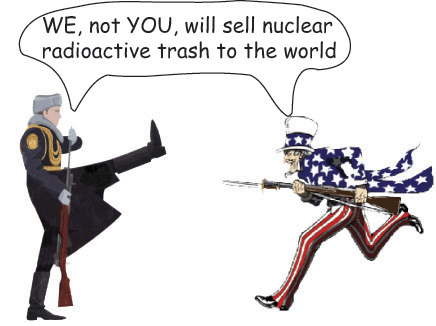
The U.S. is going after Russian nukes in Europe. And they’re counting on just one company to do it. Oddly enough, it’s Japanese.
If you thought the energy security issue the U.S. has been selling to Europe was only about American liquefied natural gas, look closer. It’s also about Russian nuclear energy behind the old Iron Curtain.
Energy security in Eastern Europe is a thermo-nuclear reactor war that mainly pits Westinghouse Electric (WEC) against Russian Rosatom. It’s a drawn-out and extremely costly energy game the U.S. is trying desperately to win. State Department chief Hillary Clinton even “lobbied” for Westinghouse in Prague in 2012.
It’s not a secret.
Westinghouse Chief Executive Danny Roderick says Clinton’s showing made a big impression on the Czechs. “I was proud that she was in the trenches with me,” he reportedly said.
The unstated goal: lessen Russian control of the nuclear power market in Eastern Europe, even if that does not translate into an immediate market share for Westinghouse. Historically, for some of those countries Rosatom and its fuel assembly maker TVEL are the only game in town. Continue reading
USA NOT receptive to Russia’s proposal for joint strikes on Syrian rebels
Russia urges joint strikes on Syria rebels but U.S. reacts coolly, Reuters, 20 May 16 Russia has proposed to the U.S.-led coalition that they stage joint air strikes on Syrian rebels, including militant Islamist group Nusra Front, who are not observing a ceasefire, but the United States responded coolly on Friday.
Such action would begin as of May 25 and be coordinated with the Syrian government, Russian Defence Minister Sergei Shoigu told a Defence Ministry meeting broadcast on state television, adding Moscow reserved the right to stage strikes unilaterally.
He said joint air strikes should also target convoys carrying weapons and ammunition crossing into Syria from Turkey.
“We believe the adoption of these measures will allow a transition to a peaceful process to be achieved in the entire territory of Syria,” he said. “Of course, these measures have been coordinated with the leadership of the Syrian Arab Republic.”……
Washington has consistently refused to join forces with Russia in Syria ever since Moscow launched its campaign of air strikes in September last year, accusing it of acting solely to prop up Syrian President Bashar al-Assad.
The United States has called on Assad to step down.
Communication between the U.S. and Russian militaries on Syria has been limited to contacts aimed at avoiding an accidental clash as they carry out rival bombing campaigns and small numbers of U.S. forces operate on the ground.
Western officials suggested that the proposal, which the Pentagon said had not been formally presented to the U.S. Defense Department, was an attempt by President Vladimir Putin to raise Russia’s profile on the international stage.
“There is no agreement to conduct joint air strikes with the Russians in Syria,” said U.S. State Department spokesman John Kirby. He added that the United States believed that Assad’s government was responsible for most of the violations of the fitful ceasefire that began on Feb. 27.
“We look to Russia to end such (government) violations, which includes strikes that have hit civilians and civilian facilities,” he said.
While Russia supports the Assad government, the United States and its allies support rebels trying to overthrow him in a civil war that has burned for more than five years and killed at least 250,000 people.
However, both sides oppose the al Qaeda-linked Nusra Front, which was not included in a ceasefire deal which has failed to prevent widespread violence. A U.S. military strike killed Nusra Front’s leader, Abu Firas al-Suri, in April.
White House spokesman Eric Schultz said the U.S. aim remains for Russia to persuade Assad to abide by the cessation of hostilities in Syria, saying it was not the first time Russia had made such a proposal…….http://www.reuters.com/article/us-mideast-crisis-russia-usa-syria-idUSKCN0YB1HB
America gets Ukraine to hop on its nuclear power marketing bandwagon
How Washington Is Fighting For Russia’s Old Europe Energy Market, Forbes, Kenneth Rapoza , 17 May 16
“……..Nuking Ukraine
Getting Ukraine to hop on the Westinghouse band wagon was particularly crafty. Either it was simply fantastic timing on the part of Westinghouse, or the U.S. government and the new, post-Euromaidan government of Ukraine colluded to kick Russia to the curb.
“I think that Westinghouse was somehow involved in getting the EC to push Ukraine away from Russia on this front,” says Tomas Vlcek, an nergy security expert based out of Masaryk University in the Czech Republic.
In March 2014, just two months after the pro-Russian president Viktor Yanukovych was ousted, a European environmentalist group called Bellona sent out stories saying that the Russian government was ready to punish Ukraine with an embargo on nuclear fuel supplies from TVEL.
When compared to what Gazprom has done with gas supplies, Putin ordering a stop on TVEL sales of nuclear fuel assemblies simply sounded like something he would propose. Only, it is not possible to ban nuclear fuel supply. Not only does the fuel rod stay in the reactor for years, someone else can make it for the reactor instead of the Russians. Like Westinghouse.
The Bellona coverage brandished Russia as a villain in the nuclear energy business too. Brussels called for “diversification” in Ukraine’s nuclear fuel market and gave Westinghouse’s European fuel division millions of euros in subsidies for the sake of “energy security”.
The whole shebang had nothing to do with Westinghouse in Pennsylvania. Their spokeswoman said she’s never heard of Bellona. Her colleagues in Europe, on the other hand-
Derek Taylor, the former E.U. civil servant who works at the Brussels branch of Bellona is also a Senior Advisor on energy at Burson-Marsteller which, in turn,is a public affairs firm working for Westinghouse worldwide.
Despite the civil war in East Ukraine, sanctions and Gazprom gas disputes, the Russians have never missed any scheduled nuclear fuel delivery to Ukrainian nuclear power plants.
Westinghouse is more than a brand name American power company. It’s a battering ram used by Washington to promote energy security.
In 2012, Ukraine’s nuclear regulator banned the use of Westinghouse fuel assemblies in the country pending an investigation. Two years later, according to sources in Ukraine, then-Prime Minister, Arseniy Yatsenyuk consulted Westinghouse on picking a new nuclear safety regulator for his new government.
In 2015 during a scheduled outage at a reactor unit at the South Ukraine nuclear power plant, two of the Westinghouse-made fuel assemblies were found to be leaking contrary to Westinghouse’s claims that those were of an ‘improved’ modification to fit the Rosatom VVER-1000 type nuclear reactors there.
Regardless, anti-Russia politics trumps technological problems. Westinghouse is currently planning to deliver five reloads of fuel to the South Ukraine and Zaporizhia nuclear power plants, the company said on April 28, meaning the new regulator has concluded its study and their VVER-1000 fuel assemblies are as good as those made in Russia. Capturing that market, as Toshiba says it will in corporate presentations, serves as a means to punish the Russians. It’s a political convenience the Russian’s are not willing to ignore.
“Our ability to make VVER fuel is not in question,” says Westinghouse Roderick. “We will continue to sell to VVER-1000s. I think it’s good to have competition in that market.”
It is good. Political pressure, whether Russian or American, is probably more harm than good. And it’s going to really irk countries, like Russia, who clearly see it as Washington poking them in the eye on purpose.
Energy security is therefore as much fact as it is fiction. It is as much a means to market Russian rivals as it is to limit the serious role energy politics plays in Russian-European relations.
But derailing nuclear projects while running into technical difficulties with Westinghouse fuel assemblies in Rosatom reactors is a dangerous way to promote energy security there. Paradoxically as it might seem, it plays into Russia’s hands when those projects to work according to plan. The Russians look reliable and solid by comparison.
“On the finance side too, I think Rosatom has Westinghouse beat,” says Jirusek about the Russian company’s ability to finance the construction of a new power plant and long term fuel supply deals.
Apart from Ukraine, where diversification was imposed for political reasons, Rosatom’s TVEL still holds its market share. Japan’s Westinghouse, despite paying no corporate tax in the U.S., will continue applying the pressure with the help of Washington and the U.S. taxpayer.
For the Russia-United States nuclear stand off , once again it is a war of attrition.
On May 12, Toshiba said it is coming back from the brink. It will post an operating profit of $1.1 billion this year after losing $6.6 billion last year due to massive write downs associated with Westinghouse and restructuring costs in the wake of a damaging accounting scandal.
No one should bet that Washington will suddenly stop selling their Westinghouse nukes to the Europeans. They could promote another Japanese-American hybrid, like the General Electric/Hitachi boiled water reactors. Or Oregon-based NuScale, who make a smaller modular reactor that is less capital intensive and is designed to be integrated into a renewable energy grid. But they do not, obviously. It’s not because those are inferior products or even that Europe is currently a pressurized water reactor market. They do it because Westinghouse competes directly with the Russians. That’s what Washington is really after. http://www.forbes.com/sites/kenrapoza/2016/05/17/washingtons-european-energy-security-boondoggle/#4247a5f362ef
Russia aims to set up a nuclear sales empire, now pushing nuclear power to South East Asia
Putin Pushes Nuclear Power To Southeast Asia, Forbes, Kenneth Rapoza 20 May 16 Russian president Vladimir Putin did some lobbying for state owned Rosatom in Sochi on Friday, telling southeast Asian countries there that it was time to go nuclear.
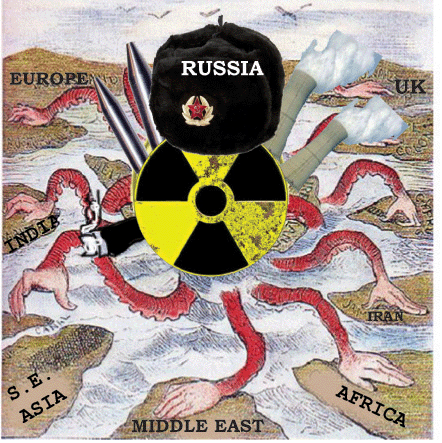
“The level of cooperation between Russia and ASEAN in the fuel and energy sphere needs to be taken to a new level,” Putin was quoted as saying in the local press today. ASEAN stands for Association of Southeast Asian Nations. “Moscow is ready to cover the market and is ready to offer member countries projects on the construction of next generation nuclear electrical power stations,” he said during the Russia-ASEAN Summit in Sochi.
None of the 10 ASEAN nations are currently hooked up to nuclear power…..Rosatom is the world’s third largest developer of nuclear reactors. Its subsidiary TVEL producers fuel assembly rods, the technology that holds the uranium used to power the reactor and generate electricity. It competes with Westinghouse Electric Company, AREVA Inc. and now Chinese companies are starting to get in on the action, primarily in China but also in Eastern Europe, an historic strong hold for Russian utilities…..
No reactor deals between Rosatom and ASEAN nations have been signed at this time. http://www.forbes.com/sites/kenrapoza/2016/05/20/putin-pushes-nuclear-power-to-southeast-asia/#6ec263f32e0a
Russia to build Bushehr Nuclear Plant in Iran
 ‘A Partner We Can Trust’: Iran Chooses Russia to Build Bushehr Nuke Plant Russia’s State Atomic Energy Corporation, Rosatom, will start work on Iran’s Bushehr-2 nuclear power plant by the end of this year after the construction site preparations are completed……
1 This Month

of the week – Shut Down Drone Warfare!


Tell the Ukrainian Government to Drop Prosecution of Peace Activist Yurii Sheliazhenko

Petition to revoke the licensing of the Near Surface Nuclear Disposal Facility (NSDF) at Chalk River. https://www.ourcommons.ca/petitions/en/Petition/Details?Petition=e-7247
To see nuclear-related stories in greater depth and intensity – go to https://nuclearinformation.wordpress.com
-
Archives
- April 2026 (114)
- March 2026 (251)
- February 2026 (268)
- January 2026 (308)
- December 2025 (358)
- November 2025 (359)
- October 2025 (376)
- September 2025 (257)
- August 2025 (319)
- July 2025 (230)
- June 2025 (348)
- May 2025 (261)
-
Categories
- 1
- 1 NUCLEAR ISSUES
- business and costs
- climate change
- culture and arts
- ENERGY
- environment
- health
- history
- indigenous issues
- Legal
- marketing of nuclear
- media
- opposition to nuclear
- PERSONAL STORIES
- politics
- politics international
- Religion and ethics
- safety
- secrets,lies and civil liberties
- spinbuster
- technology
- Uranium
- wastes
- weapons and war
- Women
- 2 WORLD
- ACTION
- AFRICA
- Atrocities
- AUSTRALIA
- Christina's notes
- Christina's themes
- culture and arts
- Events
- Fuk 2022
- Fuk 2023
- Fukushima 2017
- Fukushima 2018
- fukushima 2019
- Fukushima 2020
- Fukushima 2021
- general
- global warming
- Humour (God we need it)
- Nuclear
- RARE EARTHS
- Reference
- resources – print
- Resources -audiovicual
- Weekly Newsletter
- World
- World Nuclear
- YouTube
-
RSS
Entries RSS
Comments RSS
 nuclear-news