Breaking the ice with loads of nuclear waste https://thebarentsobserver.com/en/security/2017/04/breaking-ice-loads-nuclear-waste Russia will build special purpose ship for voyages with radioactive waste and spent nuclear fuel along the Northern Sea Route. By Thomas Nilsen April 07, 2017

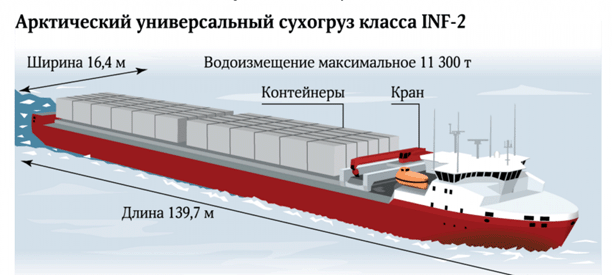
Construction starts in 2020 of the 140 meters long ice-classed vessel, approved for carrying irradiated nuclear fuel and High-Level radioactive waste, Izvestia reports.
Beneath the deck, it will be space for 40 to 70 special transport containers for spent nuclear fuel and the upper deck has space for containers with radioactive waste. The design, named INF-2, is made by Krylov State Research Centre in St. Petersburg, a design bureau that has Russia’s latest generation of nuclear powered icebreakers, submarines and warships on its list of merits.
In addition to sailing along the north coast of Siberia, the nuclear waste cargo vessel can make voyages up the Siberian Rivers like Ob and Yenisei, where several of Russia’s nuclear facilities are located, like the storage and planned reprocessing plant in Zheleznogorsk (former Krasnoyarsk-26).
Today, all transport of spent nuclear fuel from icebreakers, submarines and nuclear power plants from northwest Russia to the reprocessing plant in Mayak north of Chelyabinsk go by train through the most inhabited areas of Russia.
Where will the vessel sail?
Andrey Zolotkov, a nuclear expert and former head of the environmental group Bellona in Murmansk says the news that such cargo vessel will be built raises many questions.
«When stating that radioactive waste will be transported out of the Arctic and the Far East, where, interestingly will it then be taken?» asks Zolotkov. He does not immediately see an urgent need for transportation of spent nuclear fuel and radioactive waste, but agrees that transport to locations along the Siberian rivers could be an option.
«But, maybe they link this vessel to the plans for new floating and smaller nuclear power plants in the Arctic.»
Andrey Zolotkov, that earlier worked on board Atomflot’s service vessel «Imandra» says the icebreaker fleet will need a new service vessel as well in the future.
«Such vessel could very well replace «Imandra» for storage of spent nuclear fuel from icebreakers,» he says.
Floating nuclear power plant
Krylov State Research Centre says on its portal that one of the tasks for such vessel could be to transport the spent nuclear fuel from Bilibino nuclear heat power plant in Pevek on the Chukotka Peninsula. Bilibino is the world’s northernmost nuclear plant and shutdown procedure is likely to start in 2019. As a replacement, Russia’s first floating nuclear power plant, the «Akademik Lomonosov» will be placed in Pevek.
Another task for such new vessel, supposed to be operated in a consortium consisting of Rosatom and the military, could be to transport solid radioactive waste to a future repository. Location of such repository is yet to be decided; one option under consideration and approved by county authorities in Arkhangelsk is is the Arctic archipelago of Novaya Zemlya.
There are today stored tens of thousands of cubic meters of solid radioactive waste both on the Kola Peninsula, in Severodvinsk by the White Sea and at naval yards in the Far East.
On the Kola Peninsula, the Italian built vessel «Rossita» is later this year ready to start transport of containers with spent nuclear fuel out of the Andreeva Bay. The containers will be taken to Atomflot in Murmansk where they will be reloaded to railwagons for transport further to Mayak. «Rossita» is not suitable for voyages along the Northern Sea Route or into the river systems in Siberia.
Earlier, the Russian Northern Fleet had its own transport and storage vessels of the Malina-class (Project 2020) for spent nuclear fuel from submarines.
April 12, 2017
Posted by Christina Macpherson |
Russia, technology |
Leave a comment
Russian sub causing nuclear headache in Denmark http://cphpost.dk/general/russian-sub-causing-nuclear-headache-in-denmark.html An elderly Russian nuclear submarine is to pass Denmark on its way to St Petersburg later in the year. April 6th, 2017 3:50 pm| by Stephen Gadd
This summer, a giant Russian typhoon-class nuclear submarine, 172 metres in length, is expected to pass Denmark.
The submarine will depart from Russia, pass Norway and then sail into the North Sea and the Skagerrak, onwards into the Baltic, where it will finally dock in St Petersberg, the Barents Observer writes. The sub will pass underneath the Øresund Bridge as the water is not deep enough by the Great Belt Bridge or at Flintreden.
All the preparations are underway, and now all that is needed is the signature of Russian President Vladimir Putin.
No nukes, please!
The submarine was built in 1981 and has the capacity to carry up to 20 missiles and 200 nuclear warheads at a time. However, nowadays it is used as a test platform for ballistic missiles and is based in the town of Severodvinsk in western Russia.
The age of the vessel might be cause for concern, though, according to Norwegian atomic physicist Nils Bøhmer.
“I’m worried when a 40-year-old atomic submarine with a relatively large reactor aboard sails along the Norwegian coast and into the Baltic,” he told Barents Observer.
“The authorities have to know the exact time of its voyage in order to be prepared. It is also vital to ensure there are not atomic weapons on board.”
April 8, 2017
Posted by Christina Macpherson |
Denmark, Russia, safety |
Leave a comment

 Gordhan said to have spooked Russian connection on nuclear deal http://www.iol.co.za/news/politics/gordhan-said-to-have-spooked-russian-connection-on-nuclear-deal-8459357
2 April 2017 Staff Reporter Johannesburg – Former finance minister Pravin Gordhan said the masses should be worried when top ANC officials admitted that they didn’t know where a decision was made.
Professor Njabulo Ndebele said the country was in a “deep political and moral crisis” characterised by power and greed.
Zuma’s spokesperson Dr Bongani Ngqulunga said the president was not involved “in the planning of the memorial service and in the cancellation thereof. Any impression created that the president cancelled or ordered the cancellation is erroneous and unfortunate.”
Meanwhile, while Gordhan was doing the presentations in London there was a gentleman called Chenkov who kept on asking many questions about South Africa. He wanted to know if the South African government was looking at developing nuclear energy. Gordhan quickly quashed the idea of nuclear and repeatedly confirmed that the South African government would never develop this energy.
Chenkov had no further questions. After the presentation Chenkov called someone and spoke in Russian but whoever he was speaking to was not impressed and angrily dropped the phone.
It is believed that this person immediately called President Jacob Zuma and threatened him that if he did not immediately trigger the process of changing the finance minister and sign the nuclear deal, as commission had already been paid, he would be taught a lesson.
A shaken Zuma immediately called the minister back home. “You obviously know what happened!”
April 3, 2017
Posted by Christina Macpherson |
politics, politics international, Russia, secrets,lies and civil liberties, South Africa |
Leave a comment
According to Russia’s foreign minister, the time has not come yet for the complete prohibition of nuclear weapons, http://tass.com/politics/937006, MOSCOW, March 23. /TASS/. Russia is prepared to discuss the possibility of further reduction of nuclear capabilities, Russian Foreign Minister Sergey Lavrov said on Thursday.
“We are ready to discuss the possible further gradual reduction of nuclear capabilities but taking into account all factors that affect strategic stability rather than only the quantity of strategic offensive weapons,” the minister said speaking at the Russian General Staff’s Military Academy.
“We are ready to discuss this issue proceeding from the growing urgency of making this process multilateral.”
Lavrov emphasized that the time has not come yet for abandoning nuclear weapons completely. “Efforts to coerce nuclear powers to abandon nuclear weapons have intensified significantly recently. It is absolutely clear that the time has not yet come for that,” he noted.
March 25, 2017
Posted by Christina Macpherson |
Russia, weapons and war |
Leave a comment
How Russia Is Turning Syria into a Major Naval Base for Nuclear Warships (and Israel Is Worried), National Interest, Michael Peck, 18 Mar 17, During the 1970s, the Syrian naval base of Tartus became a major port servicing warships of the Soviet Union’s Fifth Mediterranean squadron.
The Soviet Union is gone, and so is Syria as a unified nation. But Russia is back, and it’s building up Tartus again as a naval base that can handle Russia’s largest nuclear-powered ships.
Already, Israel says the Tartus base is affecting its naval operations. U.S. and NATO operations could be next.
Under the forty-nine-year agreement inked late last year by Russia and Syria, “the maximum number of the Russian warships allowed at the Russian naval facility at one time is 11, including nuclear-powered warships, providing that nuclear and ecological security rules are observed,” according to Russia’s RT news site. Russia will also be allowed to expand port facilities to accommodate the vessels.
The specification allowing nuclear-powered warships means that Russia wants to be able to base in Syria large surface ships, namely Kirov-class nuclear-powered battle cruisers, as well as nuclear submarines.
In addition, the treaty allows “Russia is allowed to bring in and out any kind of ‘weaponry, ammunition, devices and materials’ to provide security for the facility staff, crew, and their families throughout the territory of the Syrian Arab Republic ‘without any duties or levies,’” according to RT.
Expansion of the port will take about five years, according to an anonymous source cited in Russia’s Sputnik News. “The source added that the works would focus on dredging operations to allow cruisers and even possibly aircraft carriers to use the facility’s infrastructure,” Sputnik News reported. “According to the source, Russia also needs to develop the facility’s ground infrastructure, through construction of canalization, electricity generation facilities and barracks for the servicemen.”
Sputnik News also listed other provisions of the agreement. These include:
• Russia will be responsible for sea and air security of the base, while Syria handles the land defenses.
• Russia can deploy “temporary mobile outposts” beyond the base, as long as they coordinate them with the Syrians.
• Russia can renovate the base at will, including underwater construction, and build offshore platforms.
• Upon Syrian request, Russia will send specialists to service Syrian warships, conduct search and rescue in Syrian waters, and organize the defense of Tartus.
• Syria agrees not to “make any objections related to the military activities of the base, which will also be beyond Damascus’ jurisdiction.”
• “Syria also pledges to solve any conflicts that may arise if a third party objects to the activities of the base.”
The Tartus deal is significant on several levels…… http://nationalinterest.org/blog/the-buzz/how-russia-turning-syria-major-naval-base-nuclear-warships-19813
March 20, 2017
Posted by Christina Macpherson |
Russia, Syria, weapons and war |
Leave a comment
 Russia eyes deal to build Kenya’s sole nuclear plant, The Star, Kenya Mar. 14, 2017, By WEITERE MWITA @mwitamartin Russia has offered to design, finance and build Kenya’s proposed nuclear power plant.
A delegation from Russia will pitch tent in Nairobi for the regional nuclear energy conference which kicks off today.
Russia is seeking to strike a deal through its state-owned Rosatom State Atomic Energy Corporation. Kenya plans to set up four nuclear plants, with the first expected to be switched on in 2027.
On May 30, 2016, Rosatom signed a Memorandum of Understanding with Kenya to promote nuclear solutions, assist in training personnel, create public awareness, and design agriculture and medical solutions.
Rosatom regional vice president for Sub-Saharan Africa Viktor Polikarpov yesterday said the Moscow-based entity, through the government, is ready to support Kenya put up its plants on a Build–Operate–Transfer module or Private-Public-Partnership consortium.
Rosatom said it will borrow a loan through an intergovernmental agreement, with a repayment period of up to 25 years. The firm is the only reactor vendor in the world that can offer the nuclear industry’s entire range of products and services.
“We are currently providing the VVER-1200 (Water-Water Energetic Reactor) generation III reactor which is the safest in the world. We can offer the preferred solution to your government if given a chance,” Polikarpov told journalists…….
Kenya has also signed MoUs with China and South Korea but is yet to identify a developer for the project which could cost up to Sh2 trillion. The developer will be selected by the Kenya Nuclear Energy Board……http://www.the-star.co.ke/news/2017/03/14/russia-eyes-deal-to-build-kenyas-sole-nuclear-plant_c1523942
March 15, 2017
Posted by Christina Macpherson |
Kenya, marketing, Russia |
Leave a comment
The seventh Nuclear Power Asia conference being held in Kuala Lumpur on Tuesday and Wednesday is bringing together the leaders of the Asian nuclear-power industry.
Session participants have concurred that nuclear power, being an economically and environmentally viable source of electricity, has the capacity to contribute greatly to Asia’s sustainable future.
“Sustainable future is impossible without sustainable energy,” said Egor Simonov, director of Rosatom Asia. “Nuclear power [emits] 25-30 times less [greenhouse gas] than coal- or oil-fired power plants. Therefore, nuclear power may be a viable solution for Asean nations willing to fulfil their climate-change commitments.”
Rosatom is Russia’s nuclear regulator, and its Southeast Asian regional branch is in Singapore. …….The Nuclear Power Asia conference is a platform to discuss the latest challenges, trends and achievements in the Asian nuclear industry. The event is annually attended by more than 300 participants from nuclear-energy authorities, energy commissions, nuclear energy programme implementing organisations, international developers and operators, technology suppliers, and academic society. http://www.nationmultimedia.com/news/breakingnews/30308264
March 8, 2017
Posted by Christina Macpherson |
marketing, Russia |
Leave a comment
 Russia, Tajikistan to cooperate in nuclear energy field, AZER News, 1 March 17 By Kamila Aliyeva
Tajikistan and Russia have agreed to cooperate in atomic energy and border security. The relevant agreements were achieved within the framework of the visit of Russian leader Vladimir Putin to Tajikistan on February 27.
Thus an agreement on cooperation in peaceful uses of atomic energy was signed by Farhod Rakhimov, President of the Academy of Sciences of the Republic of Tajikistan, on behalf of the Government of the Republic of Tajikistan, and Alexey Likhachev, Director General of ROSATOM, on behalf of the Government of the Russian Federation.
The deal has provided the legal basis for interaction between Tajikistan and Russia in the nuclear power sector for the first time in history while determining a wide range of cooperation areas including design, construction, operation and decommissioning of research reactors; spent fuel and radioactive waste management; rehabilitation of tailing storage areas and utilization of decommissioned uranium mining and reprocessing facilities; production of radioisotopes; use of nuclear technology in industry, medicine, agriculture; education and training of highly skilled personnel for the nuclear power industry, etc.
Besides, the agreement envisages the formation of joint coordination commission with the view of further consulting in the issues relating to the implementation of the above mentioned peaceful uses of atomic energy and search for mutually beneficial opportunities…….http://www.azernews.az/region/109545.html
March 1, 2017
Posted by Christina Macpherson |
marketing, Russia |
Leave a comment
Did Putin help elect Trump to restore $500 billion Exxon oil deal killed by sanctions
Follow the money: Will Trump repay Putin by ending Russian sanctions and killing the Paris climate deal? Think Progess, Joe Romm , 28 Feb 17, “……. our democracy and our children have a new axis to worry about: Putin, Trump, and ExxonMobil, whose CEO Rex Tillerson — an extreme Russophile and long-time director of a US-Russian oil company — is Trump’s puzzling choice for Secretary of State.
I say “puzzling” because the long-serving Exxon employee (from age 23!) has no qualifications to be secretary of state — other than a history negotiating major oil deals with countries like Putin’s Russia, which in any sane world would actually disqualify him or at least force a recusal from all State Department dealings with Russia.
But that puzzle disappears if we follow the famous dictum from the Watergate era for uncovering a tangled web of covert campaign acts: “Follow the money.” And perhaps another puzzle is also solved: Why did Putin take such a “fearful risk,” as Frum put it, to “mount a clandestine espionage and disinformation campaign on behalf” of Trump and against Clinton, “when Putin had every reason to expect that he probably would end up facing a President Clinton,” and a tremendous backlash.
You can certainly make a plausible case, as U.S. intelligence agencies do in their bombshell new report, that Putin had plenty of motivation to interfere. He wanted to undermine the legitimacy of U.S. elections and a Clinton Presidency, he blamed Secretary Clinton for “inciting mass protests against his regime,” and he was angry with the U.S. for the Panama Papers leaks.
Those leaks showed a $2 billion trail of offshore accounts and deals that traced back to Putin and his cabal of kleptocrats, who, among other things, were getting rich “trading shares in Rosneft,” Russia’s state-owned (i.e. Putin run) oil monopoly.
But a half trillion dollars to line their pockets and prop up the Russian economy offers a much more tangible motivation for team Putin to get Trump elected. And it was Tillerson who had made the $500 billion oil dealwith Putin that got blocked by sanctions.
Blocking the deal did not just “put Exxon at risk,” as the Wall Street Journal reported in 2014. MSNBC’s Rachel Maddow explained last month the biggest oil deal in history was “expected to change the historical trajectory of Russia.”
The top priority for Putin and the kleptocrats who benefit from his rule is enriching the Kremlin’s coffers and their own, which have been hurt by the sanctions. And Trump’s election already appears to have delivered $11 billion to the Kremlin through sale of a 19.5 percent stake in Rosneft, “confounding expectations that the Kremlin’s standoff with the West would scare off major investors,” as Fortune has reported in a must-read piece.
Kleptocracy — and interfering with our election — pays…….
Indeed, if Trump and Tillerson instead end the sanctions that are blocking the Exxon-Rossneft deal, it is going to look suspiciously like a half trillion dollar quid pro quo for Putin’s help getting elected.
And if Trump and Tillerson work together to kill the Paris climate deal, the last best chance to save Americans from catastrophic climate change—and aridiculously good deal for the U.S.— that will look like they are putting Putin’s interests and Exxon’s profits above America’s national interest and the health and well-being of our children. It bears repeating that ExxonMobil’s future is inextricably tied to their stalled oil deal with Putin — and their future drilling plans would benefit from continued global warming and melting of polar ice…….. https://thinkprogress.org/putin-helped-trump-exxon-oil-deal-sanctions-6f169c4a4cd0#.hxgqiytyu
March 1, 2017
Posted by Christina Macpherson |
politics, politics international, Russia, USA |
Leave a comment

 Trump’s US nuclear stance alarms Russia http://www.skynews.com.au/news/politics/nthamerica/2017/02/25/trump-s-us-nuclear-stance-alarms-russia.html
Published: 10:16 am, Saturday, 25 February 2017 Russian politicians close to the Kremlin say US President Donald Trump’s declared aim of putting the US nuclear arsenal ‘at the top of the pack’ risked triggering a new Cold War-style arms race between Washington and Moscow.
In an interview with Reuters, Trump said the US had fallen behind in its nuclear weapons capacity, a situation he said he would reverse, and he said a treaty limiting Russian and US nuclear arsenals was a bad deal for Washington.
Russian officials issued no reaction, with Friday a public holiday, but pro- Kremlin politicians expressed consternation about the comments from Trump, who Moscow had hoped would usher in new, friendlier relations between the two countries.
‘Trump’s campaign slogan ‘Make America great again’, if that means nuclear supremacy, will return the world to the worst times of the arms race in the ’50s and ’60s,’ said Konstantin Kosachev, chairman of the international affairs committee in the upper house of the Russian parliament.
The president’s remarks in the interview with Reuters were, Kosachev said in a post on his Facebook page, ‘arguably Trump’s most alarming statement on the subject of relations with Russia’.
Over the course of the Cold War, the Soviet Union and the US realised that achieving supremacy was dangerous, and accepted the doctrine of parity as the best way to ensure peace, Kosachev wrote on his Facebook page.
‘Are we entering a new era? In my view we need an answer to that question as soon as possible.’
During the US presidential race, Trump said he would try to end the enmity that broke out between the Kremlin and Washington during Barack Obama’s presidency.
But just over a month into the Trump presidency, that prospect has receded, especially with the sacking of Michael Flynn, a leading proponent of warmer ties with Moscow, from his job as national security adviser.
Another pro-Kremlin lawmaker, Alexei Pushkov, wrote on Twitter that Trump’s comments on increasing US nuclear capacity ‘put in doubt the agreement on limiting strategic arms, returning the world to the 20th century’.
He said a Cold War arms treaty laid the foundation for nuclear stability between Moscow and Washington. ‘That needs to be preserved. And the United States cannot achieve decisive superiority.’
‘Instead of trying to achieve an illusory nuclear supremacy over Russia, the US administration should find a solution to the exceptionally complicated nuclear problem of North Korea,’ wrote Pushkov, a member of the defence and security committee in Russia’s upper house of parliament. – See more at: http://www.skynews.com.au/news/politics/nthamerica/2017/02/25/trump-s-us-nuclear-stance-alarms-russia.html#sthash.fwqZWCfw.dpuf
– See more at: http://www.skynews.com.au/news/politics/nthamerica/2017/02/25/trump-s-us-nuclear-stance-alarms-russia.html#sthash.fwqZWCfw.dpuf
– See more at: http://www.skynews.com.au/news/politics/nthamerica/2017/02/25/trump-s-us-nuclear-stance-alarms-russia.html#sthash.fwqZWCfw.dpuf– See more at: http://www.skynews.com.au/news/politics/nthamerica/2017/02/25/trump-s-us-nuclear-stance-alarms-russia.html#sthash.fwqZWCfw.dpuf
February 27, 2017
Posted by Christina Macpherson |
politics international, Russia, USA, weapons and war |
1 Comment
Russia to rely less on nuclear weapons as their conventional strength rapidly increases, Business Insider, Vladimir Isachenkov, Associated Press, 21 Feb 17, MOSCOW (AP) — Russia will continue to see the development of its nuclear forces as a top priority, but the military will rely increasingly on conventional weapons to deter any aggression, the Russian Defense Minister said Tuesday.
Sergei Shoigu said Tuesday that weapons such as the long-range Kalibr cruise missiles carried by navy ships, long-range cruise missiles carried by Russian strategic bombers and the land-based short-range Iskander missiles will play an increasingly important role as a non-nuclear deterrent. Those missiles can carry nuclear or conventional warheads.
Shoigu pointed to the new missiles’ debut in the Syrian conflict, saying they have proven themselves well.
“The development of strategic nuclear forces will remain an unconditional priority,” Shoigu said in remarks carried by Russian news agencies. “Russian nuclear weapons ensure the guaranteed deterrence of aggression by any foreign power.”
At the same time, he added, “the role of nuclear weapons in deterring a potential aggressor will diminish, primarily thanks to the development of precision weapons.”
Until recently, Russia lacked long-range cruise missiles with conventional warheads similar to those in the U.S. inventory.
The post-Soviet economic meltdown left the Russian armed forces in disarray, but the Kremlin has beefed up the military’s conventional forces in recent years amid tensions with the West……http://www.businessinsider.com/ap-russia-to-rely-increasingly-on-non-nuclear-deterrent-2017-2?IR=T
February 22, 2017
Posted by Christina Macpherson |
Russia, weapons and war |
Leave a comment

 Oliver Stone: Reports Russia to blame for Ukraine violence are fake news, Belfast Telegraph 04/02/2017 Oscar-winning director Oliver Stone has branded reports that Russia is responsible for the escalating violence in Ukraine as “fake news”. The American film-maker said claims Russia was “aggravating the situation” in the warzone were untrue and insisted the United States had a “huge responsibility” for the continuing conflict.
Stone, who interviewed Russian President Vladimir Putin for his new documentary, Ukraine On Fire, also backed President Donald Trump’s bid to improve US-Russian relations.
Speaking at a screening of the film in Los Angeles, Stone claimed America had used the Ukrainian conflict to “blackball” Russia and “keep the concept of Nato alive”.
He told the Press Association: “(America) has a huge role, a huge responsibility and has denied it. It’s completely denied the whole truth of the situation.
“It’s a very painful situation for the people who live in that area but at the same time it’s used by the United States to blackball Russia as much as possible and keep the concept of Nato alive.
“It’s a very important film and a very important subject that has been swept under the rug by our country. “Frankly today I’m shocked they published fake news that the Russians are aggravating the situation when all the casualties are in (rebel-held) Donetsk. He added: “It’s a horrible situation and totally fake.”………
Stone, who won best director Oscars for Platoon and Born On The Fourth Of July, produced the documentary Ukraine On Fire which looks at the country’s revolution in 2014.
The film features an interview with ousted Ukrainian leader Viktor Yanukovych and argues he was the victim of a US-inspired coup with the intent of pushing back against Russia. http://www.belfasttelegraph.co.uk/entertainment/film-tv/news/oliver-stone-reports-russia-to-blame-for-ukraine-violence-are-fake-news-35422955.html
February 8, 2017
Posted by Christina Macpherson |
politics international, Russia, Ukraine |
Leave a comment
Russia fixes a reactor it initially refused to say was broken Russian nuclear officials say they’ve fixed a generator glitch that more than two months ago shut down its prized, first of a kind AES-2006 reactor under a cloud of embarrassment and initial secrecy. Bellona, January 31, 2017 by Charles Digges, Russian nuclear officials say they’ve fixed a generator glitch that more than two months ago shut down its prized, first of a kind AES-2006 reactor under a cloud of embarrassment and initial secrecy.
The November 10 generator failure at the reactor, which began operating last year at the Novovoronezh Nuclear Power Plant south of Moscow, was kept under wraps by nuclear utility Rosenergoatom.
Official Russian news agencies reported the hiccup six days later, and referenced a statement from Rosenergoatom published the same day. Since then, however, the utility appears to have backdated its initial November 16 Russian language Web post on the incident to November 10.
When the company finally did publish information on the cause of the unexpected shutdown at the flagship reactor, also known as a VVER-1200, which Rosatom is building for a number of foreign customers, it cited a short circuit as the cause.
The apparently re-dated release emphasized that the shutdown was not unusual, and that it had no effect on the radiation safety of the plant. But the utility’s late reporting of the incident gave rise reports in local publications that the plant had suffered an emergency.
On November 15, Bloknot Voronezh, a Web site published in Voronezh Russia, ran a report citing an anonymous witness who reported hearing an explosion near the nuclear plant’s turbine hall, and who spoke of a burned out generator. The witness also reported burned out electrical equipment and a telltale loud noise.
Russia’s state nuclear corporation Rosatom has staked much of its reputation on the successful operation of the AES-2006, which had long been under development. Its launch at the Novovoronezh plant was initially scheduled for 2012, but there was a four-year delay in its construction…….
both the AES-2006 reactor, which is Novovoronezh’s unit 6, and the next reactor from the line at unit No 7 are already seriously behind schedule. The original launch date for unit No 7 passed in 2016.
Previous to that it had been expected to come online in 2014 and 2015 as well, so in total, it’s not on time at all, but rather running five years behind.
But don’t tell that to Belarus, which is currently building an AES-2006 reactor, or Finland, Turkey, and Hungary, who all have orders in for one.
And Rosenergoatom’s initial impulse to not report the shutdown of Novovoronezh’s unit No 6 appeared to be an effort to keep things hushed up. Not until rumors of something far worse bubbled up in the local press did the utility attempt to correct the record by admitting a minor malfunction.
Even then, it apparently rewrote the date when the malfunction occurred on its press release to make it look like it had spoken up earlier. By turns, any of Rosatom’s customers should likely be prepared to receive backdated bills for late reactors when they finally get to building them.
Andrei Ozharovsky contributed to this report from Moscow. http://bellona.org/news/nuclear-issues/2017-01-russia-fixes-a-reactor-it-initially-refused-to-say-was-broken
February 6, 2017
Posted by Christina Macpherson |
Russia, secrets,lies and civil liberties |
Leave a comment

 Trump, Russia take a dangerous first step on nuclear arms control, The Hill, BY RICHARD NEPHEW AND ADAM MOUNT, 2 Feb 17 In a recent interview with the the London Times, Donald Trump suggested that he would offer to lift U.S. sanctions over Russia’s invasion of Ukraine as part of a nuclear arms control agreement.
At a time when tensions between the two countries are growing, a verifiable and stabilizing new arms control agreement would be genuinely welcome. But a bad deal would only make matters worse.
The comments about sanctions relief raise real questions about whether the incoming administration is willing to pay any price to improve relations with Russia (and why).
Today, both countries are making investments to replace nuclear systems that were first fielded during the Cold War. An agreement to limit these modernization plans could save money, stabilize the nuclear balance, and be safer to maintain and operate.
Under President Obama, the United States found that it could meet its deterrence requirements after a further one-third reduction in deployed strategic warheads, beyond what was agreed in the New Strategic Arms Reduction Treaty (New START) in 2010, and offered this deal to Russia.
A new arms control agreement would be difficult to achieve today. Putin declined Obama’s one-third offer and has signaled that he is not willing to negotiate over his most dangerous systems, its vast and opaque stocks of low-yield and short-range weapons.
At the same time, Russia has violated the 1987 Intermediate-Range Nuclear Forces (INF) Treaty by developing a new prohibited cruise missile and indicated no real willingness to address the concerns of the United States and other treaty participants. Arms control accords are among the most consequential and the most difficult negotiations in the world, features that will surely attract Trump — but changing Putin’s position will be a very tall order. …….http://thehill.com/blogs/pundits-blog/foreign-policy/317403-trump-russia-take-a-dangerous-first-step-on-nuclear-arms
February 3, 2017
Posted by Christina Macpherson |
Russia, USA, weapons and war |
Leave a comment
 Gordhan said to have spooked Russian connection on nuclear deal http://www.iol.co.za/news/politics/gordhan-said-to-have-spooked-russian-connection-on-nuclear-deal-8459357










 nuclear-news