 Moscow offers Bangladeshi students scholarship to study nuclear tech http://www.dhakatribune.com/bangladesh/education/2017/05/30/moscow-bangladeshi-scholarship-nuclear/
Moscow intends to offer scholarships to Bangladeshi students to study nuclear technology
-
Russian Parliament’s Upper House Deputy Chief Ilyas Magomed-Salamovich Umakhanov on Tuesday said Moscow intends to offer scholarships to Bangladeshi students to study nuclear technology.
Bangladesh’s first nuclear plant is being being built with Russia’s assistance, according to a BSS report.
“Russian Government is keen to enhance the number of scholarships to the Bangladeshi students in the disciplines related to nuclear science,” A statement released by Bangladesh embassy in Moscow quoted Umakhanov as saying during a meeting with a delegation of Bangladesh parliament standing committee on foreign affairs led by Dr Dipu Moni on Monday.
It said Umakhanov told the Bangladesh delegation that Russia intended to offer the stipends with the aim of building a pool of talent for operating nuclear power plants in Bangladesh.
- Dipu Moni described the Rooppur Nuclear Power Plant to be a signature initiative in regard to Dhaka-Moscow ties and appreciated the progress of the project.
The former foreign minister lead the parliamentary standing committee delegation to its first ever visit to Russia while it was warmly received by the representatives of Russian parliament’s upper house and the State Duma or lower house in the historic city of St Petersburg and Moscow.
The delegation was comprised of lawmakers Faruk Khan, Sohrabuddin, Selim Uddin, Razee Mohammad Fakhrul and Mehjabeen Khaled, who were joined by Bangladesh Ambassador in Moscow Dr Saiful Hoque and other embassy officials.
May 31, 2017
Posted by Christina Macpherson |
Education, Russia |
Leave a comment
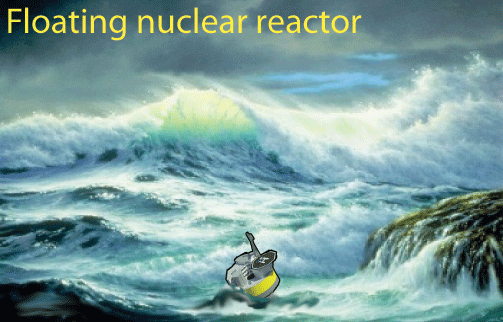
 Russia building first ‘floating’ nuclear power plant, Economic Times, BY IANS | MAY 30, 2017,NEW DELHI: Russia is in advanced stages of building the world’s first “floating” nuclear power plant (FNPP) for installation in remote areas and hopes FNPP technology will also interest South Asian countries like India.
Pavel Ipatov, Deputy CEO (Special Projects) in Russia’s state atomic energy corporation Rosatom, told IANS in an e-mail interview from Moscow that an FNPP is basically a mobile, low-capacity reactor unit operable in remote areas isolated from the main power distributor. .. …
According to Ipatov, the vessel’s “construction is at its closing stage. The plant has already been floated out, fitting-out is under way”. It has been undergoing “mooring trials” since last July to test the FNPP’s performance efficiency, which are scheduled to be completed by October.
After the tests, the FNPP, called ‘Academician Lomonosov’, will be transported by Russia’s Northern Sea route to the  operation site, where it will be integrated into the coastal network being constructed .. …..
According to Ipatov, with Russia’s expertise, its FNPPs will be in great demand in the global small nuclear power market.
“We see significant potential in Southeast Asia and other regions of the world. Memorandums of cooperation on floating nuclear power plants projects have been signed with China and Indonesia,” he said.
“We hope that FNPP technology will also gain interest in South Asia, including India, ot only in terms of new opportunities to provide power supply to remote areas, but in terms of building extra seawater desalination facilities, too,” he added.
May 31, 2017
Posted by Christina Macpherson |
Russia, technology |
Leave a comment
 Philippines, Russia forge nuclear cooperation deal, ABS-CBN News, May 26 2017 MANILA – The Philippines and Russia have agreed to develop cooperation on nuclear energy under an agreement signed in Moscow, Russia’s state nuclear agency said Friday.
Under the memorandum of cooperation, the two nations will pursue the “development of the nuclear infrastructure” in the Philippines, including personnel training and securing public acceptance of nuclear power, Rosatom State Atomic Energy Corp said in a statement……Duterte has approved a study on the feasibility of nuclear power to augment the country’s electricity supply.
The Philippines has a nuclear power plant in Bataan, which has never been used.http://news.abs-cbn.com/business/05/26/17/philippines-russia-forge-nuclear-cooperation-deal
May 27, 2017
Posted by Christina Macpherson |
marketing, Philippines, Russia |
Leave a comment
Russia, Philippines forge Defense Cooperation Agreement, UPDATE PH, May 26, 2017 Caleb Velasquez The defense cooperation will expand exchanges in terms of training, seminars and best practices between the two countries, with the end to develop relations in the field of military education, including military medicine, military history, sports, and culture as well as experiences in consultation, observer participation in military training exercises, and military port calls…..
Memorandum of Agreement between the Department of Science and Technology of the Philippines and the State Atomic Energy Corporation, otherwise known as ROSATOM on Cooperation on the Use of Nuclear Energy for Peaceful Purposes was also forged. https://www.update.ph/2017/05/russia-philippines-forge-defense-cooperation-agreement/17735
May 27, 2017
Posted by Christina Macpherson |
marketing, Philippines, Russia |
Leave a comment


 Russia’s Putin says ready to help resolve North Korea nuclear issue – South Korea, http://in.reuters.com/article/southkorea-russia-idINKBN1881MQ By Christine Kim | SEOUL, 12 May 17
Russia’s President Vladimir Putin told his newly elected South Korean counterpart, Moon Jae-in, in a phone call on Friday that he is ready to play a “constructive role” in resolving North Korea’s nuclear threat, the South’s presidential office said.
Putin made the comment after Moon said the foremost task to boost cooperation between the two countries was to strengthen strategic bilateral communication to find a solution to curb North Korea’s nuclear threat, the Blue House said in a statement.
“We hope for Russia to play a constructive role in order for North Korea to stop with its nuclear provocations and go the way of denuclearisation,” Moon was citing as saying to Putin in the 20-minute conversation.
“I, too, aim to find a way to begin talks quickly between North and South Korea as well as the six-party talks,” Moon said, referring to talks aimed at denuclearising North Korea involving the United States, China, Japan, Russia and the two Koreas.
The talks collapsed in 2008 after North Korea launched a rocket.
Tension has been high for months on the Korean peninsula over North Korea’s nuclear and missile development and fears it will conduct a sixth nuclear test or test another ballistic missile in defiance of U.N. Security Council resolutions.
Moon is a liberal who advocates a more conciliatory approach to North Korea compared with his conservative predecessor.Moon also expressed hopes the two countries would be able to cooperate in developing East Asia, including extending a natural gas pipeline from Siberia to South Korea, the Blue House said. Putin said he was ready to help in all of the matters they discussed and the two leaders invited each other for state visits, the Blue House added.
Moon said he would send a special envoy to Russia soon and Putin said he would welcome the envoy.The two leaders said they looked forward to meeting at the Group of 20 summit meeting in Germany in July.
Earlier in the day, Moon spoke with British Prime Minister Theresa May and German Chancellor Angela Merkel, the Blue House said. He asked them to help in curbing North Korea’s nuclear programme and both promised to.
(Reporting by Christine Kim; Additional reporting by Se Young Lee; Editing by Robert Birsel)
May 13, 2017
Posted by Christina Macpherson |
politics international, Russia, South Korea |
Leave a comment
 Is Rosatom selling debt and dependence to its overseas customers? http://bellona.org/news/nuclear-issues/2017-05-is-rosatom-selling-debt-and-dependence-to-its-overseas-customers When a court in South Africa torpedoed a $76 billion deal to build 10 nuclear reactors with Russia’s Rosatom because the arrangement reeked of corruption, it seemed like the project was kaput. May 10, 2017 by Charles Digges, charles@bellona.no, When a court in South Africa torpedoed a $76 billion deal to build 10 nuclear reactors with Russia’s Rosatom because the arrangement reeked of corruption, it seemed like the project was kaput.
At issue to the court was the fact that Rosatom was given the lucrative contract behind closed doors without any competing tenders, and that the company had been granted “special favors.” South Africa’s president, Jacob Zuma, even sacked his finance minister for opposing the deal.
The high court demanded that a contract of such breathtaking magnitude – representing a quarter of South Africa’s gross domestic product and $24 billion more than its state utility, Eskom, has in the bank – be approved by parliament.
Hanging over the deal, and numerous others like it, is the degree to which Rosatom seems to be pursing not just energy dominance in a world trying to wean itself coal, but political influence as well by putting its customers in long-term hock to Moscow.
The South Africa deal may yet come off, but it’s also surprising that it got so far in the first place.
It began as one of Rosatom’s handshake “memorandums of understanding” that the company is using to blanket the nuclear construction market and squeeze out competition. The company says it has 27 of these MOUs and other arrangements, amounting to $135 billion in incoming business, a claim that invites skepticism.
Many of the counties Rosatom counts among that number – like Jordan, Algeria, Nigeria and Bolivia – won’t be ready for nuclear for decades. Others where Rosatom builds are already underway – like India’ Kudankulam, Iran’s Bushehr, China’s Tianwan and Belarus’s Ostrovets – are already familiar with Rosatom’s typical cost overruns and delays.
Rosatom’s approach to marketing its VVER-1000 and VVER-1200 reactors is unique because it offers to finance, build and operate its plants. These generous terms come thanks to the enormous state subsidies it receives, and which it can then funnel into loans that boost its profits on paper. With government subsides set to decrease or dry up in 2020, however, Rosatom seems desperate to announce ever more MOUs.
While the terms of the financing for the South Africa deal never got spelled out, it’s clear from Rosatom deals in other countries that the terms are often steep.
To build Hungary’s controversial Paks-2 plant, Rosatom gave Budapest an $11 billion loan spread out over 30 years. Hungary has to start paying that back even if the plant is not completed on time. The interest Moscow could collect from Hungary is unclear, but a similar 30-year, $11.4 billion agreement with Bangladesh inked last year could result in $8 billion in interest. A $25 billion deal Rosatom signed with Egypt could, over 35-year term of the loan, swell to $71 billion.
And that’s if everyone behaves. The plant Rosatom is building in Turkey offers an indication of what happens when they don’t. To build Hungary’s controversial Paks-2 plant, Rosatom gave Budapest an $11 billion loan spread out over 30 years. Hungary has to start paying that back even if the plant is not completed on time. The interest Moscow could collect from Hungary is unclear, but a similar 30-year, $11.4 billion agreement with Bangladesh inked last year could result in $8 billion in interest. A $25 billion deal Rosatom signed with Egypt could, over 35-year term of the loan, swell to $71 billion.
And that’s if everyone behaves. The plant Rosatom is building in Turkey offers an indication of what happens when they don’t.
May 12, 2017
Posted by Christina Macpherson |
marketing, politics international, Russia, secrets,lies and civil liberties |
1 Comment
 Moscow doubts North Korea will ditch nuclear weapons as long as ‘threat looms’ http://tass.com/politics/944297 May 03 17, The Russian diplomat stressed the necessity of consolidated diplomatic efforts to settle the situation on the Korean Peninsula. MOSCOW . North Korea will never abandon the idea of having nuclear weapons as long as it feels threat to its security, a Russian foreign ministry official said on Tuesday.
“It is evident that Pyongyang will not abandon its nuclear weapons as long as it sees itself directly threatened,” Mikhail Ulyanov, director of the ministry’s non-proliferation and weapons control department, said at the first session of the Preparatory Committee for the 2020 Review Conference of the Parties to the Treaty on the Non-Proliferation of Nuclear Weapons.
“We are nonetheless convinced that existing tensions on the Korean Peninsula are caused not only by Pyongyang’s nuclear and missile programmes, but also by an increased military activity in the North-East Asia of some regional and especially non-regional States,” he said.
The Russian diplomat stressed the necessity of consolidated diplomatic efforts to settle the situation on the Korean Peninsula. “No minute should be lost. Otherwise the confrontation logic may become overwhelmingly dominant,” he said. “Russia rejects the nuclear status of the DPRK. We do not accept nuclear tests conducted by Pyongyang and its defiance of the relevant UN Security Council resolutions.”.
May 5, 2017
Posted by Christina Macpherson |
North Korea, politics international, Russia, weapons and war |
Leave a comment
Russia has hidden nuclear bombs ready to detonate along US coastline, says former Kremlin spokesman
Expert says outlandish claims are ‘political warfare’, The Independent, Will Worley @willrworley , 3 May 17 A Russian military expert has claimed Moscow has been “seeding” nuclear bombs off the US coastline.
The Kremlin has dismissed the claim as “strange”, while an independent expert referred to it as an act of “political warfare”.
He added: “Oh, it seems I’ve said too much. I should hold my tongue. In short, we have something to provide an ‘asymmetrical’ (and cheaper) response to the Americans.”The interview was translated by the Middle East Media Research Institute.
The Kremlin was quick to dismiss the remarks, calling them “strange”. “I would suggest that you not take newspaper reports like this seriously,” government spokesman spokesman Dmitry Peskov said.
May 3, 2017
Posted by Christina Macpherson |
Russia, weapons and war |
Leave a comment
 Eskom confirms that Russians will continue nuclear bid, IOL, 30 April 2017, SIYABONGA MKHWANAZI
Cape Town – The Russians will continue to prepare to bid for the nuclear-build programme, despite the decision by the Western Cape High Court to halt it.
Eskom confirmed this and awaits further directives from the government.
Friday was the deadline for all bidding companies to submit Request for Information documentation to Eskom.The court decision has also affected the deadline for the issuing of the Request for Proposals in June.
Head of Rosatom in Southern Africa, Viktor Polikarpov, told Independent Media nothing had changed with their plans to bid for the nuclear programme.
He said they would not want to comment on the case because it was a matter involving government and civil society, who took the matter to court.
Energy Minister Mmamoloko Kubayi has said she is still studying the judgment, and would not comment on whether to appeal against the court decision or not.
Kubayi will appear before MPs on Tuesday, where she will face questions on the nuclear programme.
Polikarpov said the nuclear process was not in their hands, but in the hands of the government.“We are prepared on the bidding, but much will depend on the government, how it will sort out the court issue,” he said.
Eskom spokesperson Khulu Phasiwe said the court decision had effectively nullified the process……..
He said it was clear that everything had to be nullified and started from scratch if the government still wanted to continue with the nuclear programme.
The judgment found the process followed was unlawful and unconstitutional………http://www.iol.co.za/news/politics/eskom-confirms-that-russians-will-continue-nuclear-bid-8877208
May 1, 2017
Posted by Christina Macpherson |
marketing, Russia, South Africa |
Leave a comment
 WAR OF THE WORLDS Declassified documents reveal America and Russia’s bizarre plans to obliterate the Moon with nuclear weapons https://www.thesun.co.uk/living/3449440/declassified-documents-reveal-america-and-russias-bizarre-plans-to-obliterate-the-moon-with-nuclear-weapons/
At the time, military bosses believed that they could feasibly hit a target on the Moon within an accuracy of two miles, By George Harrison, 30th April 2017,
IN the height of the Cold War, Russia and America found themselves locked in a chilling race to nuke the Moon, declassified military documents reveal.
Following the end of the Second World War in 1945, the USSR and the USA spent decades trying to prove their military might to the world.
During this tense era, the two global superpowers found themselves locked in an arms race which saw them spend decades scrambling to develop the most powerful armaments.
As the arms race morphed into a space race, the two nations set their sights on the Moon, and made it their goal to extend their influence beyond the Earth’s atmosphere.
Now, declassified documents have revealed just how far the superpowers were prepared to go, as they hatched terrifying plans to obliterate part of our moon with a nuclear strike. Codenamed Project A119, a plan cooked up by the US Air Force in 1958 set out how America could prove their might once and for all.
Physicist Leonard Reiffel was put in charge of the project, which had the terrifying goal of detonating a nuclear warhead on the Moon. The team of military and physics experts planned to explode a warhead the same size as the bomb dropped on Hiroshima on our planet’s natural satellite.
The detonation would light up the Moon’s surface, generating a sphere of dust which would blot out any hopes of Russia winning the arms race. At the time, the team believed that they could feasibly hit a target on the Moon within an accuracy of two miles.
However, by January 1959 US military bosses were convinced that the public backlash against such a senseless strike would be enormous, and the risks of a malfunction in the launch were too great.
After that realisation, America’s leaders turned their attention to putting people, rather than weapons, in space.Meanwhile, the Soviets were cooking up a scheme of their own as part of a project codenamed E-4.
This plan involved striking the Moon with a nuclear missile of their own, although this plot faced the same overwhelming risks and difficulties as the Americans’ secret plans. These chilling Cold War revelations come after we revealed the secret US plans which could have led to the total destruction of the USSR.
We also told how America had cooked up a desperate, last-ditch nuclear strategy in the wake of World War 2, and shared how the USSR planned to retaliate by destroying most of Europe.
May 1, 2017
Posted by Christina Macpherson |
Russia, USA, weapons and war |
Leave a comment
 Britain would be ‘literally erased from the face of the earth’ if it launched a nuclear attack, warns Russian MP Another translation says Britain would be ‘razed to the ground’ in a retaliatory strike, Independent, Samuel Osborne @SamuelOsborne93, 24 Apr 17, Britain would be “literally erased from the face of the earth” in a nuclear war, a Russian MP has warned.
Franz Klintsevich, a retired colonel, was responding to comments from Defence Secretary Michael Fallon, who said “in the most extreme circumstances, we have made it very clear that you can’t rule out the use of nuclear weapons as a first strike.”
Mr Klintsevich said if Britain were to launch a preemptive strike, then “not having the biggest territory, it will literally be erased from the face of the earth.” Another translation, carried by the Russian news agency TASS, says Britain would be “razed to the ground” in a retaliatory strike.
Sir Michael’s comments came in response to Labour divisions over retaining the Trident deterrent, with Labour leader Jeremy Corbyn suggesting renewal might not be in the party’s election manifesto — only to be corrected later by party colleagues.
Speaking to BBC Radio Four’s Today Programme, Sir Michael said Labour had left voters “completely unsure as to what would actually happen to our nuclear deterrent.”
He said Prime Minster Theresa May would be ready to use Trident as a “pre-emptive initial strike”…….
Mr Klintsevich, who is deputy chairman of the upper house of the Russian parliament’s defence and security committee, called Sir Michael’s comments “disgusting” and said it “deserves a tough response”. He added: “In the best case this statement should be taken as an element of psychological war — which looks particularly disgusting in such a context.
“Otherwise, it sounds really bad, because a reasonable question arises: Against whom is Great Britain going to preemptively use nuclear weapons?”
If Britain intended to use nuclear weapons against a non-nuclear state, he added, “then probably English people desperately want to share the laurels of the USA who threw nuclear bombs at defenceless [Japanese cities] Hiroshima and Nagasaki [in 1945].”
“But those times have gone for good, as has the era of the greatness of the British Empire.” http://www.independent.co.uk/news/uk/politics/uk-nuclear-war-russia-warn-senator-frants-klintsevich-erased-face-earth-razed-ground-us-cold-war-a7701411.html
April 26, 2017
Posted by Christina Macpherson |
Russia, UK, weapons and war |
1 Comment
Russia ‘moves troops and equipment’ to North Korea border, as Kim Jong-un warns of ‘super-mighty pre-emptive strike’, Telegraph UK Roland Oliphant Reuters 20 APRIL 2017 Russia has moved heavy military equipment towards its border with North Korea amid mounting fears of a military clash between Pyongyang and the United States over the North’s nuclear program.
A flurry of military activity in Russia’s far east came as the UN Security Council strongly condemned North Korea’s latest missile test and threatened to impose new sanctions against Pyongyang for its “highly destabilizing behavior.”
In a unanimous statement, the council demanded that North Korea “conduct no further nuclear tests” and said Pyongyang’s “illegal missile activities” were “greatly increasing tension in the region and beyond.”……
It was revealed earlier this week that a US aircraft carrier group led by the USS Carl Vinson would spend another 30 days at sea
before heading towards North Korean waters. Last week Donald Trump, the US president, said he had ordered an “armada” into the northwest Pacific in a show of force designed to deter North Korea from further missile and nuclear weapons test.
The US defence ministry acknowledged on Tuesday that the ships had actually travelled into the Indian Ocean to carry out manoeuvres with Australian forces, and only began its journey north recently.
Mr Trump has called on China, Pyongyang’s only ally, to rein in North Korean leader Kim Jong-un, but has threatened to act alone to “solve” the problem if necessary.
Residents and local media in Russia’s Far East reported large military convoys travelling in the direction of the North Korean border since the weekend, in what appear to be contingency plans to contain fallout from a possible military clash between the United States and North Korea.
A video published by local news site DVHab.ru showed a train carrying twelve tracked vehicles, including Tor surface to air missile systems, travelling through Khabarovsk in the direction of Vladivostok.
“Some say the situation around North Korea is a fiction, but this is the third train of equipment we’ve seen since this morning,” a man can be heard saying in the film. “Looks like something is being sent to the Korean border.”………
South Korean presidential candidates clashed on Wednesday night in a debate over the planned deployment in South Korea of a US-supplied Terminal High Altitude Area Defense (THAAD) anti-missile system, which has angered China.
Frontrunner Moon Jae-in was criticised for leaving his options open before the May 9 election.
On Monday, Hwang and Pence reaffirmed their plans to go ahead with the THAAD, but the decision will be up to the next South Korean president. For its part, China says the system’s powerful radar is a threat to its security.
The North has said it has developed a missile that can strike the mainland United States, but officials and experts believe it is some time away from mastering the necessary technology, including miniaturising a nuclear warhead.http://www.telegraph.co.uk/news/2017/04/20/north-korea-warns-super-mighty-preemptive-strike-will-reduce/
There has been some confusion over the whereabouts of a US aircraft carrier group after Trump said last week he had sent an “armada” as a warning to North Korea, even as the ships were still far from Korean waters.The US military’s Pacific Command explained that the USS Carl Vinson strike group first had to complete a shorter-than-planned period of training with Australia. It was now heading for the Western Pacific as ordered, it said.
China’s influential Global Times newspaper, which is published by the People’s Daily, the Communist Party’s official paper, wondered whether the misdirection was deliberate.
“The truth seems to be that the US military and president jointly created fake news and it is without doubt a rare scandal in US history, which will be bound to cripple Trump’s and US dignity,” it said. http://www.telegraph.co.uk/news/2017/04/20/north-korea-warns-super-mighty-preemptive-strike-will-reduce/
April 21, 2017
Posted by Christina Macpherson |
politics international, Russia, weapons and war |
Leave a comment
 Russia’s Secretive Floating Nuclear Power Plant Making Waves In St. Petersburg, Radio Free Europe, 20 Apr 17, ST. PETERSBURG, Russia — Ecologists in Russia’s northern capital are raising the alarm over government plans to fuel a floating nuclear power plant just 2 kilometers from the heart of the city.
Officials have been saying since December that they are nearly ready to begin fueling the Akademik Lomonosov, the country’s first-ever ship-borne nuclear-power station, which is scheduled to be deployed at Vilyuchinsk on the Far Eastern Kamchatka Peninsula in 2019. Because the process is shrouded in secrecy and the government has ignored requests for information, it is unclear what the status of the fueling process currently is.
“From this floating nuclear power plant to the city’s mining institute [for example] is probably only about 500 meters,” Rashid Alimov, director of energy programs for Greenpeace Russia, told RFE/RL. “The historical center is densely populated. We have to exclude even the thought of an accident. That is why we have written to the governor. … According to the law, carrying out such operations at the Baltic Shipyard must be approved by the city, evacuation plans have to be drawn up. We have asked the municipal authorities about this.”……..
Independent nuclear-energy analyst Aleksei Shchukin, who spent more than 30 years working on nuclear-powered icebreakers, told RFE/RL that the fueling operation presents risks. Although the reactors are based on designs developed in the 1960s, the configuration on the Akademik Lomonosov is unique and untested.
“That is why I think there is no point in taking a risk and fueling the reactors in the center of a huge city,” Shchukin said. “This is very dangerous. They could take the vessel to Murmansk or Arkhangelsk, where there are bases for repairing and refueling nuclear vessels. That would be much safer.”
Authorities have ignored requests to find out why they insist on conducting the refueling — and possibly other testing — in St. Petersburg, a UNESCO-protected World Heritage Site with a population of just under 5 million.
Previous Incidents……..
April 21, 2017
Posted by Christina Macpherson |
Russia, safety |
Leave a comment
 Russia claims it can wipe out US Navy with single ‘electronic bomb’, Fox news 19 Apr 17 Russia has claimed it can disable the entire US Navy in one fell swoop using powerful electronic signal jamming.
A news report from the country – where the media is essentially controlled by the state – said the technology could render planes, ships and missiles useless.
The newsreader says: “Today, our Russian Electronic Warfare (REW) troops can detect and neutralise any target from a ship’s system and a radar, to a satellite.”
The news report claims a single Russian war plane flew several times around American destroyer the USS Donald Cook in the Black Sea several years ago, disabling its systems and leaving it helpless.
The report also claims they are capable to creating electronic jamming domes over their bases that make them invisible on radar screens.
The propaganda piece even quotes top US General Frank Gorenc as saying: “Russian electronic weapons completely paralyse the functioning of American electronic equipment installed on missiles, aircraft and ships.”
The reporter adds: “You don’t need to have expensive weapons to win – powerful radio-electronic jamming is enough.”……..http://www.foxnews.com/world/2017/04/19/russia-claims-it-can-wipe-out-us-navy-with-single-electronic-bomb.html
April 21, 2017
Posted by Christina Macpherson |
Russia, weapons and war |
Leave a comment
 New START 2017: Russia Decreasing, US Increasing Deployed Warheads https://fas.org/blogs/security/2017/04/newstart2017/ Apr.03, 2017 By Hans M. Kristensen
The latest set of New START aggregate data released by the US State Department shows that Russia is decreasing its number of deployed strategic warheads while the United States is increasing the number of warheads it deploys on its strategic forces.
The Russian reduction, which was counted as of March 1, 2017, is a welcoming development following its near-continuous increase of deployed strategic warheads compared with 2013. Bus as I previously concluded, the increase was a fluctuation caused by introduction of new launchers, particularly the Borei-class SSBN.
The US increase, similarly, does not represent a buildup – a mischaracterization used by some to describe the earlier Russian increase – but a fluctuation caused by the force loading on the Ohio-class SSBNs.
Strategic Warheads
The data shows that Russia as of March 1, 2017 deployed 1,765 strategic warheads, down by 31 warheads compared with October 2016. That means Russia is counted as deploying 228 strategic warheads more than when New START went into force in February 2011. It will have to offload an additional 215 warheads before February 2018 to meet the treaty limit. That will not be a problem.
The number of Russian warheads counted by the New START treaty is only a small portion of its total inventory of warheads. We estimate that Russia has a military stockpile of 4,300 warheads with more retired warheads in reserve for a total inventory of 7,000 warheads.
The United States was counted as deploying 1,411 strategic warheads as of March 1, 2017, an increase of 44 warheads compared with the 1,367 strategic deployed warheads counted in October 2016. The United States is currently below the treaty limit and can add another 139 warheads before the treaty enters into effect in February 2018.
The number of US warheads counted by the New START treaty is only a small portion of its total inventory of warheads. We estimate that the United States has a military stockpile of 4,000 warheads with more retired warheads in reserve for a total inventory of 6,800 warheads.
Strategic Launchers
The New START data shows that Russia as of March 1, 2017 deployed 523 strategic launchers, an increase of 15 launchers compared with October 2016. That means Russia has two (2) more launched deployed today than when New START entered into force in February 2011.
Russia could hypothetically increase its force structure by another 177 launchers over the next ten months and still be in compliance with New START. But its current nuclear modernization program is not capable of doing so.
Under the treaty, Russia is allowed to have a total of 800 deployed and non-deployed strategic launchers. The data shows that it currently has 816, only 16 above the treaty limit. That means Russia overall has scrapped 49 total launchers (deployed and non-deployed) since New START was signed in February 2011.
The United States is counted as deploying 673 strategic launchers as of March 1, 2017, a decrease of eight (8) launchers compared with October 2016. That means the United States has reduced its force structure by 209 deployed strategic launchers since February 2011.
The US reduction has been achieved by stripping essentially all excess bombers of nuclear equipment, reducing the ICBM force to roughly 400, and making significant progress on reducing the number of launch tubes on each SSBN from 24 to 20.
The United States is below the limit for strategic launchers and could hypothetically add another 27 launchers, a capability it currently has. Overall, the United States has scrapped 304 total launchers (deployed and non-deployed) since the treaty entered into force in February 2011, most of which were so-called phantom launchers that were retired but still contained equipment that made them accountable under the treaty.
The United States currently is counted as having 820 deployed and non-deployed strategic launchers. It will need to destroy another 20 to be in compliance with New START by February 2018.
Conclusions and Outlook
Both Russia and the United States are on track to meet the limits of the New START treaty by February 2018. The latest aggregate data shows that Russia is again reducing its deployed strategic warheads and both countries are already below the treaty’s limit for deployed strategic launchers.
In a notorious phone call between Russian President Vladimir Putin and US President Donald Trump, the Russian president reportedly raised the possibility of extending the New START treaty by another five years beyond 2021. But Trump apparently brushed aside the offer saying New START was a bad deal. After the call, Trump said the United States had “fallen behind on nuclear weapons capacity.”
In reality, the United States has not fallen behind but has 150 strategic launchers more than Russia. The New START treaty is not a “bad deal” but an essential tool to provide transparency of strategic nuclear forces and keeping a lid on the size of the arsenals. Russia and the United States should move forward without hesitation to extend the treaty by another five years.
Additional resources:
April 14, 2017
Posted by Christina Macpherson |
Russia, USA, weapons and war |
Leave a comment






 nuclear-news