
 Russia, China offer plan to ease N.Korea tension, abc news, 4 July 17 Russia and China have proposed that North Korea declare a moratorium on nuclear and missile tests while the United States and South Korea refrain from large-scale military exercises.
The call was issued in a joint statement by the Russian and Chinese foreign ministries on Tuesday following talks between Russian President Vladimir Putin and Chinese President Xi Jinping.
The statement came after North Korea tested a missile that flew higher and longer than previous ones, sparking concerns around the world.
Moscow and Beijing suggested that if North Korea halts nuclear and missile tests while the U.S. and South Korea freeze military maneuvers, the parties could sit down for talks that should lead to obligations not to use force and to refrain from aggression………..
North Korea says its latest missile test reached a height of 2,802 kilometers (1,740 miles) and flew 933 kilometers (580 miles) for 39 minutes before falling into the sea.
The country’s Academy of Defense Science said Tuesday in a statement that it was a successful test of an intercontinental ballistic missiles called Hwasong-14.
The statement was distributed by North Korea’s KCNA news service.
The reported trajectory was similar to that announced earlier by U.S., South Korean and Japanese officials, though the U.S. judged it to be an intermediate-range missile.
Either way, it would be a longer and higher flight than similar tests previously reported.
The U.S military says it tracked a North Korean missile for 37 minutes before it landed in the Sea of Japan.
The Hawaii-based U.S. Pacific Command said in a statement Tuesday that an intermediate-range ballistic missile was launched from near an airfield in North Korea.
NORAD, or the North American Aerospace Defense Command, said the missile did not pose a threat to North America.
South Korean and Japanese officials reported the North Korean missile launch earlier Tuesday. It is part of a string of recent tests as the North works to build a nuclear-tipped missile that could reach the United States………http://abcnews.go.com/International/wireStory/latest-north-korea-height-distance-missile-48430348
———
July 5, 2017
Posted by Christina Macpherson |
China, North Korea, politics international, Russia, weapons and war |
Leave a comment
 Rosatom loses hope in its international nuclear builds, eyes renewables http://bellona.org/news/nuclear-issues/2017-07-rosatom-loses-hope-in-its-international-nuclear-builds-eyes-renewables
Amid decreasing world demand for nuclear energy, Russia’s state nuclear corporation 
 last week warned it would likely be receiving fewer requests to build nuclear power plants abroad. July 3, 2017 by Charles Digges, The announcement marks a sharp departure for the corporation, which until recently has posed its contracts with other countries as the bread and butter of its bottom line – as well as a potent tool for broadening Moscow’s sphere of political influence.
But there’s a silver lining to the nuclear monolith’s recent disillusionment with its traditional lifeblood: A possible, albeit modest, shift in the direction of renewable energy and battery technologies.
Speaking at last month’s Tekhnoprom-2017 conference, a technical conference in the Siberian city of Novosibirsk, Rosatom’s deputy director Vyacheslav Pershukov called the market for nuclear power stations abroad “exhausted.” “We see that the market is contracting, and for the sustainable growth of the corporation…we must make our money on something other than nuclear technology,” he said, according to the RBK news agency.
His remarks dovetail with a worldwide nuclear sag.
In the United States, renewable energy output eclipsed nuclear for the first time during March and April. Meanwhile, huge nuclear corporations are trying to stave off going broke. Exelon, the country’s biggest nuclear operator, has seen its share prices plummet by 60 percent since 2008.
Westinghouse, meanwhile filed for bankruptcy in March, and Toshiba, its parent company, is trying to sell of its computer divisions to cover the debt. France’s Areva was saved from financial peril by a huge taxpayer infusion into its owner EDF, but that bailout will only stop the bleed the company is experiencing thanks to huge cost overruns on an ambitious but delayed reactor build in Finland.
Pershukov told the Tekhnoprom conference that Rosatom would shift some of its efforts to providing nuclear power plant services abroad, primarily to those it’s in the process of building.
For the past several years, Rosatom has touted its VVER-1200 reactor packages to international capitols and has worked vigorously to sign up customers even – if not especially – those who can barely afford it. On paper, the company has $130 billion in outstanding “memoranda of understanding” and other handshake type deals with foreign countries.
But many of the counties Rosatom counts among its potential contracts – like Jordan, Algeria, Nigeria and Bolivia, and most recently Uganda and Ethiopia – won’t have infrastructure to support nuclear power for decades.
In other cases, like Hungary, the Rosatom-built Paks-2 plant has been approved, but will leave Budapest’s right wing-government heavily indebted to Moscow for the $10 billion plant.
Another similar deal would have indentured South Africa to Rosatom for $76 billion, but that country’s high court torpedoed the deal before it got off the ground.
Other countries where Rosatom builds are already underway – like India’s Kudankulam, Iran’s Bushehr, China’s Tianwan and Belarus’s Ostrovets – are already familiar with Rosatom’s typical cost overruns and delays.
The company can pay for these huge loans because of the generous state subsidies it receives, but taxpayer injections are slated to dry up by 2020.
Oskar Njaa, a nuclear adviser with Bellona said curtailing Rosatom’s international nuclear ambitions represents a humbling moment for the company, and a dampening of its political influence abroad. “This is an economic blow,” he said. “For Russia, reducing an ability to make other countries dependent on Moscow’s nuclear fuel and expertise for energy needs is a blow to its geopolitical interests as well.”
As such, Rosatom is casting a wide net for other avenues of influence and revenue. In May, the company appeared in Chile’s Lithium Call Roadshow, and is reportedly pursuing inroads with Santiago to become a player in cell phone and electric car batteries. Other reports say the company is making a foray into fiber-optics.
More optimistically, Njaa noted, the company also seems to have discovered a bent for the renewable energy sector. He noted Rosatom’s recent interest in small hydroelectric plants and wind energy.
July 5, 2017
Posted by Christina Macpherson |
marketing, politics international, renewable, Russia |
Leave a comment
 Fire breaks out on floating nuclear plant at Russia shipyard https://www.washingtonpost.com/world/europe/fire-breaks-out-on-floating-nuclear-plant-at-russia-shipyard/2017/07/04/a5d82a7e-60 By Associated Press July 4 MOSCOW — Russia’s emergency services ministry says a fire broke out on the floating nuclear power plant being built at a shipyard near the center of St. Petersburg, but was extinguished before anyone was injured.
Construction of the floating plant, which is to be deployed in Russia’s Far East, has caused concern among environmentalists. Rashid Alimov of Greenpeace’s Russian branch said Tuesday’s fire showed that plans for loading nuclear fuel into the plant’s reactors are “irresponsible.”
The shipyard is about two kilometers (1.25 miles) downriver from some of St. Petersburg’s most renowned tourist sites, including the State Hermitage Museum.
The ministry statement says the fire was caused by a short circuit in a storage battery.
July 5, 2017
Posted by Christina Macpherson |
incidents, Russia |
Leave a comment
The two countries with nearly all the world’s nuclear weapons have no intention of scaling back https://qz.com/1020437/the-two-countries-with-nearly-all-the-worlds-nuclear-weapons-have-no-intention-of-scaling-back/, 4 July 17 The US and Russia, which possess nearly 93% of all nuclear weapons in the world, don’t plan to continue reducing their nuclear arsenal, but instead are spending money to modernize and modestly expand their weapons systems.
The world’s nuclear arsenal has gradually declined since its peak of nearly 70,000 nuclear warheads in the mid-1980s, but reductions have slowed in recent years. According to a new report by the Stockholm International Peace Research Institute (SIPR), an independent think tank, in 2017, there were approximately 14,935 nuclear weapons, a slight reduction compared with 15,395 in early 2016. The report notes that both the US and Russia have failed to commit to further reductions. Just nine states possessed these weapons: the US, Russia, the UK, France, China, India, Pakistan, Israel, and North Korea.
States with nuclear weapons are spending billions on updating their systems and developing weapons. The US will spend approximately $400 billion over a 10-year period to maintain and modernize its arsenal; the US plans to buy replacement systems and build new nuclear weapon facilities. To maintain strategic parity with the US, Russia is limiting any further reduction in its nuclear arsenal and working to modernize its aging, Soviet-era missiles. The British government is investing £31 billion ($45.2 billion) to maintain its nuclear arsenal, while Pakistan and India are both gradually expanding the size of their nuclear weapon stockpile.
North Korea carried out high-profile tests of its nuclear weapons in the last year. The country has prioritized building a long-range ballistic missile that can deliver a nuclear warhead to the US (experts suggest there’s no independently verified evidence that the country currently has the capability to do so). US president Donald Trump has pressed president Xi Jinping of China to address what Trump called the “growing threat” (paywall) posed by North Korea’s nuclear weapons.
The United Nations drafted the first-ever treaty to ban nuclear weaponslast month. More than 130 countries currently support the initiative that would outlaw nuclear weapons. Unsurprisingly, not one of the nine countries currently possessing nuclear weapons support the proposed measure.
July 5, 2017
Posted by Christina Macpherson |
Russia, USA, weapons and war |
Leave a comment
Russia begins cleaning up the Soviets’ top-secret nuclear waste dump https://www.theguardian.com/environment/2017/jul/02/russia-begins-cleaning-up-the-soviets-top-secret-nuclear-waste-dump
When the Soviet Union collapsed a vast store of spent nuclear fuel was abandoned in the Russian Arctic – an environmental disaster waiting to happen. Decades later an international clean-up has finally begun, Guardian, Shaun Walker in Andreyeva Bay, 2 July 17,

As the Rossita pulled away from the pier at Andreyeva Bay, sounding a long boom of its horn, a military band struck up a jaunty march. On board the ship were nine sealed metal casks, each four metres high and weighing 45 tonnes, containing canisters of spent nuclear fuel. Dozens of Russian and foreign nuclear specialists looked on applauding, as the chilly rain of a northern summer fell on the bay deep inside the Russian Arctic.
The ceremony, held on Tuesday afternoon, marks the culmination of a long international project to begin removing nuclear fuel from the site, formerly a top-secret Soviet installation. Nuclear specialists say Andreyeva Bay contains the largest reserves of spent nuclear fuel in the world, in fragile conditions that have disturbed the international community for years.
During the Cold War period, nuclear submarines were refuelled at sea, and the spent nuclear fuel was then shipped to Andreyeva Bay, where it was placed in a special storage facility to cool off before being transported to a reprocessing plant at Mayak, in the Urals. But in the early 1980s, leaks sprung up in the storage system, causing high levels of radioactive contamination.
When the Soviet Union collapsed, transfers of the spent fuel ceased, and about 22,000 spent nuclear fuel caskets were left at Andreyeva Bay in leaky dry storage units, creating the potential for an environmental catastrophe.
“I’ve been all over the world to pretty much every country that uses nuclear power and I’ve never seen anything so awful before,” said Alexander Nikitin, a former naval officer and environmentalist who has been monitoring the site for years.
“With nuclear material, everything should be done very carefully, and here they just took the material and threw it into an even more dangerous situation.”
In the decade after the Soviet collapse, the main concern was that poorly maintained facilities could lead to an onsite disaster. Nearly 250 nuclear submarines were decommissioned in the aftermath of the Soviet collapse, and facilities such as Andreyeva Bay were left in a perilous state.
“There wouldn’t have been a big explosion, but it could still have been something serious,” said Nikitin. “With nuclear fuel, once processes start, you have no way of knowing how they will develop.”
Over the next decade, security fears also increased. “Before 9/11, nobody would really think anyone would be crazy enough to try to handle spent nuclear fuel, but with the new type of terrorist threat we face, this became a bigger worry,” said Balthasar Lindauer of the European Bank for Reconstruction and Development (EBRD), which has managed the donor funds from western countries to help with the clean-up.
The facility at Andreyeva Bay was one of many top-secret installations in the Soviet Arctic. A two-hour drive from the regional centre of Murmansk along a road cut out of mossy rocks, still dusted with snow in late June, the entire area around Andreyeva Bay is closed to all foreigners and even Russians who are not registered there. A heavily armed military checkpoint on the outskirts of town keeps out all those who do not have security clearance . This is partly because Russia has a working nuclear submarine base on the other side of the bay at Zaozyorsk.
It might seem odd that, as Russia ploughs more money into its current military budget, western nations who see Moscow as a military threat are helping to fund the clean-up of the mess the Soviet military left behind. 13 countries have provided €165m in funding since 2003 for nuclear decommissioning in Russia’s north-west. There have also been a number of bilateral projects, with Britain, Norway and other countries funding a long project to help clean up Andreyeva Bay.
The Norwegian foreign minister, who was present at Tuesday’s ceremony, said the funding for the project was committed nearly two decades ago, when Russia was in no economic state to deal with the problems alone. He also pointed out that the Andreyeva Bay facility is only about 40 miles from the Norwegian border, making the decommissioning issue one in which Norway has long taken a strong interest.
“Nuclear challenges recognise no borders, and it is in our common interest to deal with nuclear waste now rather leaving the problems to future generations,” said the Norwegian foreign minister, Børge Brende.
A suite of new buildings has been constructed around the area where the spent nuclear fuel caskets are kept, replacing the decaying structures that stood there previously. Work to load canisters into the giant protective casks can now be done using specially commissioned machinery.
The Rossita, a ship constructed for the task, will take the huge fuel casks to Murmansk, where they will be put on fortified trains which will proceed under armed guard on the long journey from the Arctic to the Mayak reprocessing site. At the Mayak facility, the spent fuel will be recycled and the Russians say they will turn it into fuel to be used in civilian nuclear reactors.
Specialists at the plant estimate it could take 10 years to remove all the fuel. About half of the caskets have some kind of surface damage to their containers and will be dealt with after the non-problematic batches have been removed.
“This is the end of a long process, but also the beginning of another long stage in the clean-up,” said Marina Kovtun, the governor of Murmansk region. “Despite international tensions, work went on every day. Everyone who was working on this project understood that they were doing this for all of humanity and for protecting our environment.”
Indeed, in the current climate of hostility between Russia and the west, it was an unusual tale of bonhomie and cooperation, as the ceremony included the flags of 10 western nations as well as the Russian tricolour.
“The Barents Sea is maybe the cleanest sea in the world, and if something had happened here, it would have affected the whole Arctic,” said Brende. “This process is not completely without risk, but compared to doing nothing, the risks are now much lower.”
July 3, 2017
Posted by Christina Macpherson |
Russia, wastes |
5 Comments
Forgotten Fact: Russia and China Almost Started a Nuclear War in 1969, National Interest, Kyle Mizokami, 2 Jul 17, In 1969 the two pillars of the communist bloc, the Soviet Union and the People’s Republic of China, nearly went to full-scale war. Years of deteriorating ties between the two countries, once the staunchest of allies, finally led to skirmishing on the long mutual border between the two countries. While tensions were eventually de-escalated, what if the two countries had gone to war?
On March 2, 1969 Soviet troops patrolling Damansky Island (Zhenbao) on the Ussuri River came under fire from Chinese troops. The attack, just 120 miles from the major Soviet city of Khabarovsk, killed fifty Soviet troops and wounded many more. The Moscow believed that the attack was premeditated, with Beijing bringing in a special combat unit to ambush Soviet forces. Alleged atrocities against wounded Soviet troops made the Soviet leadership furious.
Soviet border guards counterattacked Chinese forces in and around the island on March 15,
according to the CIA killing “hundreds” of Chinese troops. Clashes continued through the spring and summer, and by August, CIA director Richard Helms had informed the press that the Soviet leadership had been discreetly inquiring with foreign governments about their opinion on a preemptive strike on China………
The de-escalation of the Sino-Soviet crisis in 1969 avoided what could have been yet another large, destructive war of the twentieth century. The current friendship between Moscow and Beijing is a reflection of that crisis and the realization that it’s much better for both countries to be allies than enemies. This is particularly in Moscow’s interests: given Beijing’s rapid military and economic progress over the past thirty years, next time, the Kremlin may find the tables turned. http://nationalinterest.org/blog/the-buzz/forgotten-fact-russia-china-almost-started-nuclear-war-1969-21398
July 3, 2017
Posted by Christina Macpherson |
China, history, Russia, weapons and war |
Leave a comment
Rosatom to build Nuclear Technology Centre in Vietnam http://russianconstruction.com/news-1/28150-rosatom-to-build-nuclear-technology-centre-in-vietnam.html 29.06.2017 Rosatom State Atomic Energy Corporation and the Ministry of Science and  Technology of Vietnam will create a Center of Nuclear Science and Technology in Vietnam, as it follows from documentation published on the Kremlin’s website.
“The Memorandum of understanding between Rosatom State Atomic Energy Corporation and the Ministry of Science and Technology of the Socialist Republic of Vietnam on a plan of the implementation of a project for construction Nuclear Science and Technologies Center in Vietnam”, the document reads.
The announcement came following a meeting of Russian President Vladimir Putin and President of Vietnam Tran Dai Quang.
July 1, 2017
Posted by Christina Macpherson |
marketing, Russia, Vietnam |
1 Comment
No Indonesian market for SMRs http://thebulletin.org/no-indonesian-market-smrs10868 28 June 17, M. V. RAMANA Ramana is the Simons Chair in Disarmament, Global and Human Security at the Liu Institute for Global…
In May 2017,
Indonesia’s government announced that Russia’s Rosatom State Atomic Energy Corporation had offered to develop nuclear power plants in Indonesia. But the person making the announcement, Luhut Pandjaitan—the coordinating maritime affairs minister—said he had told them that Indonesia was not ready yet because “we need to raise public awareness, which takes time.”
Saying it “takes time” is an understatement. The country’s National Nuclear Energy Agency, or BATAN as it is known from its acronym in the Indonesian language (Badan Tenaga Nuklir Nasional), was set up in the late 1950s and has been advocating nuclear power for Indonesia ever since. In 1972, BATAN started the process of selecting specific sites for nuclear plants when—in conjunction with the ministry in charge of public works and electricity—it established the Preparatory Commission for Development of a Nuclear Power Plant. That eventually led to various sites being chosen for nuclear plant construction on the Muria Peninsula on Indonesia’s most populated island, Java. But in each case, these efforts were stopped—primarily by local opposition, but partly also because of widespread skepticism about BATAN’s claims about the seismic safety of sites on the peninsula.
BATAN then turned its attention to other locations in the country, but with little success. To date, BATAN has conducted site studies on at least 16 potential locales.
BATAN’s efforts at setting up a nuclear power plant in Indonesia have not gone unnoticed. Many reactor vendors have beaten a path to Jakarta’s doorstep, hoping to sell their wares. The list includes South Korea, France, China and, of course—given its status as the leading reactor vendor in this decade—Russia. In recent years, all these countries’ offers have focused on one specific kind of reactor that BATAN has expressed an interest in: Small Modular Reactors (SMRs).
Why SMRs for Indonesia? Small Modular Reactors have electrical power outputs of less than 300 megawatts. They are being heavily promoted by many countries’ nuclear establishments as having several desirable characteristics when compared to traditional large reactors—in particular, cheaper construction costs per unit, higher safety levels, lower rates of radioactive waste generation, and less likelihood that these reactors and their fuel production facilities could be used to make fissile materials (plutonium or highly enriched uranium) for nuclear weapons. There are no operating SMRs, and it remains to be seen whether any real-world reactor would be built that features any, let alone all, of these characteristics. Indeed, of the different major SMR designs under development, none simultaneously fulfills the key requirements of lower cost, higher safety, less radioactive waste, and reduced opportunity for nuclear weapons proliferation. These are the key problems confronting nuclear power today and constraining its future. It is likely that addressing one or more of these four problems will involve design choices that make some of the other problems worse.
Among the target markets for such reactors are developing countries such as Indonesia. The International Atomic Energy Agency considers SMRs as a good option to electrify “remote regions with less developed infrastructures” because the low-capacity electricity grid that is typical of such areas makes it difficult to introduce a nuclear power plant with large power capacity—say 1,000 megawatts—without destabilizing the grid itself. Indeed, one of the reasons that BATAN claims to be interested in SMRs is that there are many islands in the Indonesian archipelago that require electricity or energy but do not have a high enough level of electrical demand to support the construction of a large nuclear reactor. One of the areas highlighted by BATAN officials as particularly suitable for SMRs is the province of West Kalimantan because its “grid capacity [is]… still limited.” BATAN also suggested that an attractive aspect of SMRs is the lower cost—due in large part to the fact that a small modular reactor will generate only a fraction of the power generated by a large reactor.
Among the SMR designs that have been offered by vendors, and explored by BATAN, are high temperature gas-cooled reactors, submarine-based reactors, floating power plants, and light water reactors.
Who’s in the competition? South Korea was the first to pitch the idea of SMRs to Indonesia: In October 2001, with IAEA approval, BATAN signed an agreement with the Korea Atomic Energy Research Institute to undertake a joint study titled “A preliminary economic feasibility assessment of nuclear desalination in Madura Island.” The Korea Atomic Energy Research Institute had been developing a small modular reactor called the System-Integrated Modular Advanced Reactor since 1996; it had the bonus feature of incorporating additional equipment that could desalinate water in addition to generating electricity.
In the case of China, BATAN signed an agreement with the China Nuclear Engineering Group Corporation in 2016 to jointly develop high temperature gas reactors and train Indonesian professionals to run them—an agreement that resulted from Chinese officials scouting around potential reactor markets.
With France, BATAN signed an agreement with DCNS, a company that has traditionally been involved in a range of naval defense systems but more recently has been developing a submarine-based electricity generating reactor project called Flexblue. (Link in Indonesian.) The idea is to park the submarine on the ocean floor and run a cable from it to land to supply electricity.
Russia, however, has been the most determined suitor. In the mid-2000s, Rosatom proposed a small Russian floating nuclear power plant to supply electricity to Gorontalo province on the Indonesian island of Sulawesi. Rosatom’s floating nuclear power plants are modeled after the reactors that have been used to power a small fleet of Russian nuclear-powered icebreakers for decades. The idea of a civilian floating nuclear power plant project has been around in Russia since the 1990s, but progress has been slow and erratic. China and the United States have also explored the idea of commercial floating nuclear power plants, but the United States abandoned the idea as uneconomical after spending millions of dollars in research and development.
In October 2006, the governor of Gorontalo announced that the province already had an agreement with Russia’s then state-owned Unified Energy System of Russia to buy a floating power plant.
But despite enthusiasm for the proposal from the provincial government, the Indonesian minister of Research and Technology rejected the idea of using a floating nuclear power plant. As Natio Lasman, then-deputy chairman of Indonesia’s nuclear agency and later chair of Indonesia’s Nuclear Regulatory Agency, told the Wall Street Journal: “I don’t want Indonesia to be used as an experiment.”
Public opposition: A major problem. Many problems may afflict nuclear proposals, regardless of whether the building plans are based on SMRs or large reactors. A key challenge has been public acceptance. Because of the potential for catastrophic accidents and the production of long-lived radioactive waste, nuclear power is perceived as a risky technology, and those living near areas selected to house a nuclear plant—such as the Muria Peninsula—often push back.
And apart from local opposition, the unpopularity of nuclear power among the general population nationwide is often a factor in whether a country develops nuclear power. A poll commissioned by the International Atomic Energy Agency in October 2005 found that only 33 percent of those Indonesians questioned felt that nuclear power was safe and that more plants should be built. In comparison, 28 percent felt that nuclear power was dangerous and all plants should be closed—while 31 percent agreed with the “middle opinion” that what was already in place should be used but that no new plants should be constructed. In the case of Indonesia, of course, that middle opinion is in practice the same as the 28 percent who wanted to close all reactors, because there was (and still is) no operating nuclear power plant in the country.
In 2011, an IPSOS poll conducted after the Fukushima nuclear reactor accident in Japan found that two-thirds of the Indonesian population expressed opposition: 33 percent of Indonesians strongly oppose nuclear power while 34 percent were somewhat opposed. About two-thirds of those polled said that their opinion was not influenced by Fukushima.
BATAN, not surprisingly, feels differently. And it has conducted a series of polls that show greater levels of support. But the proof of the pudding is in the eating. Nuclear power continues to be controversial in Indonesia, and there is widespread public opposition. Indeed, in December 2015, when then-Energy and Mineral Resources minister Sudirman Said publicly announced that the government had concluded that “this is not the time to build up nuclear power capacity,” one of his stated reasons for avoiding nuclear power was that he did not want “to raise any controversies.”
So, when people like Luhut Pandjaitan—Indonesia’s coordinating maritime affairs minister—talk about the “need to raise public awareness,” it’s reasonable to ask what they mean. Is raising public awareness really just code for coaxing or bribing the people in some areas to allow the construction of a nuclear power plant? The history of the many attempts to site nuclear reactors in Indonesia shows quite clearly that the public is already aware of the hazards involved in nuclear power. The Indonesian public’s longstanding opposition to nuclear power, especially in areas that have been earmarked for potential construction, include concerns about the security of reactor operations, the reliability of reactor designs, radioactive waste, the potential for nuclear proliferation, Indonesia’s geographical position within the seismically active Pacific Ring of Fire, and the proximity of nuclear sites to seismic faults or volcanoes. Many Indonesians are also concerned about nuclear power’s high economic costs and future dependence on foreign parties for nuclear technology or fuel, and they prefer local renewable energy resources.
 Other problems with SMRs. My collaborators at the Indonesian Institute of Energy Economics and at the Nautilus Institute for Security and Sustainability and I recently issued a report that detailed the many challenges that would have to be overcome before any small modular reactors are constructed in Indonesia. These challenges include a lack of support for nuclear power at the highest political levels, the absence of tested SMR designs, and the higher electricity-generation costs of SMR technology. We also identified legislative regulations that could become obstacles for specific SMR technologies such as floating power plants, and the political and regulatory problems with SMR construction plans that involve fabricating the bulk of the reactor at off-site factories.
The cost of electricity generated by SMRs is high compared to large conventional nuclear power plants, and high compared to the range of readily available alternatives in Indonesia. The rapidly declining cost of photovoltaic technology is particularly relevant. Studies testify to the large potential of solar energy in Indonesia, and the government has been adopting policies that promise to accelerate the construction of significant amounts of solar capacity.
The lower power level of SMRs also implies that more reactors would have to be built using this technology to produce the same amount of electricity as a few larger reactors—meaning that planners would have to deal with public resistance at many more sites. Public opposition has played a major role in stopping the construction of nuclear power plants so far; small modular reactors might face even more of controversy.
For small modular reactors, the potential benefits accruing from electricity generation come at a higher economic and social cost than other energy sources would require. As a result, it would seem that the construction of SMRs is unlikely, especially in large enough numbers to make a sizeable contribution to Indonesia’s electricity generation.
July 1, 2017
Posted by Christina Macpherson |
Indonesia, marketing, Russia, technology |
Leave a comment
 Russia has ‘enormous’ underground bunkers ready for nuclear war http://nypost.com/2017/06/29/russia-has-enormous-underground-bunkers-ready-for-nuclear-war/By Ruth Brown, June 29, 2017 Russia is maintaining giant bunkers underneath Moscow where Kremlin bigwigs can live underground for months after a nuclear attack, because the administration is convinced the U.S. plans on overthrowing President Vladimir Putin, according to a newly revealed Pentagon report.
“A deep underground facility at the Kremlin and an enormous underground leadership bunker adjacent to Moscow State University are intended for the national command authority in wartime,” says the report, according to the Times of London.
“Highly effective life-support systems may permit independent operations for many months following a nuclear attack.”
The Defense Intelligence Agency report on Moscow’s military might — the first since the Cold War — says the “enormous” bunkers are 985 feet underground and can house as many as 10,000 people in the case of nuclear Armageddon, according to the paper.
The shelters are linked to other bunkers outside of the city — as well as the VIP terminal at Vnukovo airfield, in case the honchos need to flee, the report said.
The report, which predates President Trump’s election but was released Wednesday, says Putin believes the U.S. is intent on regime change as part of our “efforts to promote democracy around the world.”
“The Kremlin is convinced the United States is laying the groundwork for regime-change in Russia,” the report says.
June 30, 2017
Posted by Christina Macpherson |
Russia, safety, weapons and war |
Leave a comment
 Russian Nuclear Power in the Middle East http://vestnikkavkaza.net/analysis/Russian-Nuclear-Power-in-the-Middle-East.html 26 June17 Eurasia Review Nuclear energy is losing its luster in many parts of the world. In the United States, the drop in the cost of renewables production is making them a more attractive electricity-generation option than nuclear power. France, a country long associated with nuclear power, is also looking to reduce its reliance on reactors. And even China is now investing more in developing wind farms than it is in nuclear infrastructure. Russia, though, is bucking the trend.Eurasia review reports in its article Russia And Nuclear Power that nuclear energy accounts for 11 percent of domestic power production, while the share of wind and solar power generation remains negligible, according to Bloomberg New Energy Finance. Overall, more than 40 percent of Russian power is generated by natural gas. Meanwhile, hydropower is the main renewable source of power in Russia, responsible for a roughly 20-percent share of the overall mix. Russia has taken steps in recent months to develop its wind power potential. But development efforts are hampered by legislation that requires at least 40 percent of all renewable-energy infrastructure to be locally produced. To meet the requirement, Russia needs to find a substantial amount of foreign investment. In the realm of international trade, Russia is trying to turn its slow embrace of renewables into an advantage.
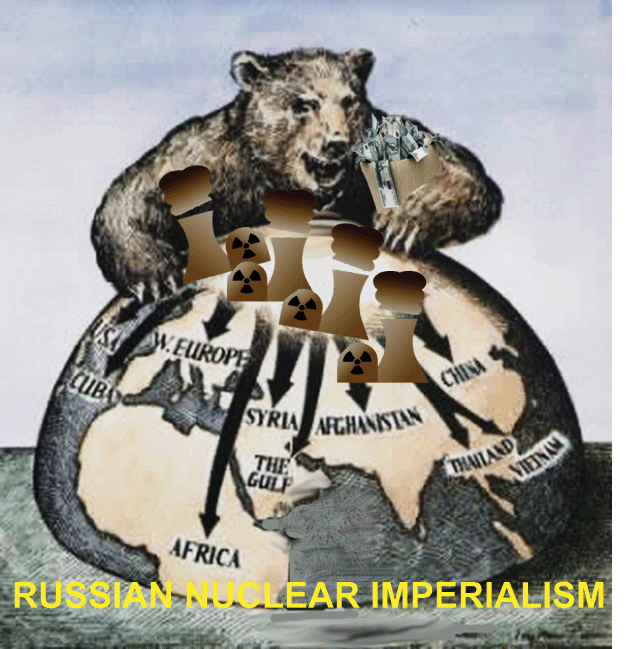
Rosatom, Russia’s state-owned nuclear company, is by far the most active player these days in the international market for nuclear power technologies. Rosatom currently has agreements to provide plants, fuel or expertise in 20 countries in the Middle East, Africa, Asia and Latin America. With the notable exception of the Barakah Atomic Energy Station in the United Arab Emirates, which is being built by the Korea Electric Power Corporation, Russia is the most heavily involved of any nuclear-exporting countries in developing nuclear power facilities in the Middle East.
Rosatom’s most recent move in the Middle East was a deal, sealed in late May, to construct Egypt’s first nuclear power plant, pending final approval by the Egyptian government. The pact is the latest of four bilateral agreements signed by Egypt and Russia concerning the nuclear power station at El Dabaa, approximately 200 miles west of Cairo on Egypt’s north coast. The first of these, signed in late 2015, covered the construction and maintenance of the plant for a 10-year period, and included a stipulation that Russia would provide fuel for the plant for 60 years.
The plant would consist of four VVER-1200 reactors, a new design based on the earlier VVER-1000 model developed in the Soviet Union in the mid-1970s. The first VVER-1200 was brought online earlier this year at Russia’s Novovoronezh plant. It is projected to begin producing power in 2024. Egypt is one of four countries in and around the Middle East where Rosatom has built, or plans to build, nuclear power facilities. Rosatom’s subsidiary, Atomenergostroy, which handles the company’s overseas construction projects, has contracts to build plants in Jordan and Turkey. In addition, it is building additional reactors at Iran’s Bushehr facility. The company will provide financing, staff, and fuel, while retaining ownership of the plants and receiving revenue from the power they produce.
Russia has provided approximately 50 percent of the financing for Turkey’s plant at Akkuyu, and will provide fuel for its operation once construction is complete. Upwards of 85 percent of the financing for the El Dabaa project in Egypt is to come in the form of loans from Russia, a country in the midst of an economic downturn brought on by the global fall in fossil fuel prices. Egypt is also exploring options for a second nuclear power plant to be built on its coast.
During the Cold War, both the United States and the Soviet Union provided supplies, facilities, and training to Middle Eastern countries in an effort to promote nuclear power. The governments of Jordan and Egypt expressed interest at the time in developing nuclear power facilities in the mid-1950s, and the Soviet Union began construction on a research reactor in Egypt in 1961. Similar reactors were built in Iraq in 1967 and in Libya in 1981. In 1995, Russia’s Ministry of Atomic Energy signed a contract to take over construction of the Bushehr plant. In 2010, Rosatom was granted the right to open offices in embassies abroad by a change in laws governing its operations. It did so in Dubai and Beijing in April of 2016, and the company’s website now boasts over $133 billion USD in overseas orders for its products. Rosatom has also partnered with the International Atomic Energy Agency to fund nuclear infrastructure development internationally, pledging $1.8 million as well as equipment and expertise to equip countries that hope to develop nuclear power capacities in the future. Experts have expressed concern that these ambitious development plans are proceeding without adequate plans for disposal of nuclear waste. The Bellona Foundation, an organization that conducts independent research into international nuclear and environmental issues, has been critical of the lack of planning for nuclear waste processing and disposal, and has pointed out that dependency on Russia for nuclear fuel may leave countries particularly vulnerable in the event of a sour political climate.
June 28, 2017
Posted by Christina Macpherson |
marketing, MIDDLE EAST, Russia |
Leave a comment
For nuke biggies, answer’s blowing in the wind http://indianexpress.com/article/india/for-nuke-biggies-answers-blowing-in-the-wind-4725180/ Despite a relatively robust position in its nuclear business, Russia’s state atomic energy corporation Rosatom is pushing the envelope by revving up renewable projects in sectors such as wind energy and small hydro. by Anil Sasi June 28, 2017, Little less than a decade ago, nuclear shills could get away by scoffing at renewables, given the promise at that time of a nascent ‘nuclear renaissance’. In the intervening years, while the script has changed overwhelmingly in favour of green energy, the nuclear-versus-renewables debate too has progressively veered off from an ‘either-or’ debate to a more overlapping narrative.
Russia’s state atomic energy corporation Rosatom figures among a handful of nuclear utilities to have bucked the broader downturn in the atomic power business, with eight reactor units in Russia and 36 nuclear reactors in various stages of planning and construction across more than a dozen countries — the largest shelf of projects globally. Creditable, considering the fate of some of its peers — Toshiba has recently pulled its US nuclear subsidiary Westinghouse out of the nuclear construction business while French utility Areva’s continues to struggle with accumulated losses of Euro 10 billion on its books. Despite the relatively robust position in its mainstay nuclear business, Rosatom is now pushing the envelope by revving up renewable projects in sectors such as wind energy and small hydro. Experts suggest that even for other major utilities invested entirely in the nuclear value chain, a move to diversify some of the sectoral risks could make sense.
The Russian nuclear major has started by rolling out wind farm projects in its home market of Russia, with plans to take wind projects to the international market in the due course “after accumulating enough experience on the domestic market”, First Deputy Director of Rosatom Corp, Kirill Komarov told reporters on the sidelines of the Atomexpo 2017 conference in Moscow last week. “We plan to develop renewable energy sources in all parts of the world and not only in Russia, but we’ll start doing it after we accumulate enough expertise here,” he said.
A licensing agreement with the Dutch company Lagerwey for the transfer of technology involved in manufacturing component parts of the windfarms is a step in that direction, with Saudi Arabia likely to be one of Rosatom’s first international markets for wind. The group has also initiated preliminary talks with the Indian government and private companies to expand its presence in India beyond the nuclear sector to the new area of mini hydro power projects, with units ranging from 0.5 to 2 megawatts, an official said. The discussions are being done through Ganz Engineering and Energetics Machinery, a 100 per cent Hungarian subsidiary of Rosatom’s engineering division Atomenergomash.
Areva too has tried its hand at renewables, with a portfolio of four energies: wind energy, bioenergy, solar power and hydrogen power. The French company offers turnkey solutions to meet both short — and long — term requirements for clients to bridge the energy demand in standard and peak consumption periods.
Rosatom’s Komarov has exuded confidence that Russian utility is in a good position for bagging contracts for construction renewable energy facilities abroad. “On the whole, we think our chances for working abroad are fair enough because whatever country we come to, we settle firmly there,” he said at the three-day expo held in the Russian capital last week. At a series of bidding rounds held during the last two years, Rosatom has bagged bids for construction of wind farms in Russia with the overall output capacity of almost 1,000 MWs.
Rosatom considers wind energy projects to be one of the most promising of their non-nuclear growth projects, with estimates suggesting that the it expects the wind energy market in Russia to reach a turnover of about 200 billion Rubles a year ($3.3 billion) by 2024. In July 2016, Rosatom announced that the company plans to build three wind farms in Russia with a total capacity of 610 MW. This amounts to about 17 per cent of the total wind power capacity planned to be commissioned in Russia until 2024.
Among the pacts signed at the expo, Rosatom’s international branch initialled an agreement to cooperate with Saudi Al-Yamama Group on potential projects in the construction of wind farms in Saudi Arabia.In markets such as India, where Rosatom is already involved in building the Kudankulam nuclear power project, the Corporation is betting on a specialised technology for mini hydro projects. Rosatom is already in preliminary talks with the Indian government and private companies to expand its presence in India beyond the nuclear sector to the new area of mini hydro power projects, with units ranging from 0.5 to 2 MW.
The discussions are being done through Ganz Engineering and Energetics Machinery, a 100 per cent Hungarian subsidiary of the Rosatom’s engineering division Atomenergomash. “We consider this as another opportunity for cooperation between Rosatom and India, and our office in India is working in this direction. We are discussing, the issues both with the government, and private bodies,” Rusatom International Network president Alexander Merten told journalists on the sidelines of the Atomexpo.
Rusatom International Network is involved in marketing and business development of a number of Rosatom projects abroad. The small hydro-power plants are pre-fabricated, and assembled in the factory and then supplied to the customer, with the cost of these projects pegged at approximately 1 million euro per megawatt (around Rs 7.1 crore per MW, varying with topography). A pilot installation of the mini hydel plants is currently on in Georgia, with discussions also underway with Turkey and the Middle East countries.
(The writer’s trip to Atomexpo was sponsored by Rosatom)
June 28, 2017
Posted by Christina Macpherson |
renewable, Russia |
Leave a comment
 Russia urges more ambitious nuclear capacity target, WNN, 27 June 2017, Rosatom’s deputy director-general for international business has described the World Nuclear Association’s aim to add 1000 GWe of new capacity by 2050 as fully achievable and “perhaps modest”. Kirill Komarov spoke to World Nuclear News during the AtomExpo conference and exhibition held last week in Moscow.
Komarov, who becomes the chairman of the London-based Association next year, said the annual event had attracted a record number of participants, with about 6500 attendees, representatives from 64 countries (not including Russia) and 32 official government delegations.
He told WNN: “The consensus of everyone gathered here, including those who are not part of the nuclear community, is that nuclear energy has a place in the global energy mix…..
Komarov said investment in wind and solar power technology was ten times higher than in nuclear generation.
“That’s not because those technologies are better and ours are worse,” Komarov said. “Perhaps we as a nuclear community missed out and didn’t put sufficient effort into explaining safety and mankind’s need for nuclear power, not only in terms of energy, but also knowledge, education and science, as well as the non-energy uses of nuclear technologies.”…..
2016 was a “very successful year” for Rosatom, he said, and its portfolio of orders is worth $134 billion over the next decade. Many of these contracts are “now active” and cover the full life cycle of nuclear facilities, he said…….
Rosatom’s earnings and profit are growing, Komarov said, but that growth has been curtailed by lower nuclear fuel cycle prices. “The uranium enrichment spot price was once $180 per kg SWU, now it’s about $50/kg, and the uranium spot price has gone from $137 per pound U3O8 to about $20/lb. We’re still profitable because we have worked seriously on our costs, even during years that were good for us,” he said. “We keep on expanding our business with new products and try to offset what we have under-earned by creating new business. ……http://www.world-nuclear-news.org/C-Russia-urges-more-ambitious-nuclear-capacity-target-27061701.aspx
June 28, 2017
Posted by Christina Macpherson |
marketing, Russia |
Leave a comment
some of the biggest dangers still lie ahead, and many of them come back to that small green train of so many years ago. An updated and safer versions of it will be hauling Andreyeva Bay’s waste south from Murmansk, but that shouldn’t belie the fact that transporting spent nuclear fuel over such distances is always dangerous.
More dangerous still is the location where the spent fuel will end up, which is one of the most radioactively contaminated spots in the world.
 Decades of piled up nuclear fuel bids farewell to Andreyeva Bay http://bellona.org/news/nuclear-issues/2017-06-decades-of-piled-up-nuclear-fuel-bids-farewell-to-andreyeva-bay Two decades ago, a green four-car train would make the rounds every few months to Russia’s snowy Kola Peninsula to cart nuclear fuel and radioactive waste more than 3000 kilometers south from the Arctic to the Ural Mountains. June 23, 2017 by Charles Digges charles@bellona.no

Two decades ago, a green four-car train would make the rounds every few months to Russia’s snowy Kola Peninsula to cart nuclear fuel and radioactive waste more than 3000 kilometers south from the Arctic to the Ural Mountains.
At the time, the lonely rail artery was the center of a logistical and financial bottleneck that made Northwest Russia, home of the once feared Soviet nuclear fleet, a toxic dumping ground shrouded in military secrecy.
More than a hundred rusted out submarines bobbed in the icy waters at dockside, their reactors still loaded with nuclear fuel, threating to sink or worse. Further from shore and under the waves laid other submarines and nuclear waste intentionally scuttled by the navy. Still more radioactive spent fuel was piling up in storage tanks and open-air bins, on military bases and in shipyards.
One of those places was Andreyeva Bay, a run down nuclear submarine maintenance yard just 55 kilometers from the Norwegian border. Since the birth of the nuclear navy in the 1960s, the yard came to be a dumping ground for 22,000 spent nuclear fuel assemblies offloaded from hundreds of submarines. Cracks in storage pools made worse by the hard Arctic freeze threatened to contaminate the Barents Sea. At one point, experts even feared the radioactive morgue might spark an uncontrolled nuclear chain reaction.
Infrastructure, technology and the Kremlin were failing to keep up with the mushrooming catastrophe. The nuclear fuel train could only bear away 588 fuel assemblies at a time three or four times a year – little more than the contents of one nuclear submarine per trip. Even if the train ran on schedule, removing broken or deformed nuclear fuel elements at Andreyeva Bay was still seen as impossible.
Yet even mentioning the environmental and security storm clouds was taboo: While the Navy begged the public to donate potatoes to feed sailors it was too broke to pay, the Kremlin prosecuted environmentalists who drew attention to the mounting desperation as spies.
In the bleak and politically chaotic late 1990s, many experts, like Bellona’s Andrei Zolotkov, thought that the carcinogenic remains of the Cold War would lie neglected at Andreyeva Bay for decades – or at least until Russia somehow woke up wealthy enough to deal with them.
Now, Russia is only slightly better off, yet the first containers of spent nuclear at Andreyeva Bay will begin to be bourn away by sea on June 27, marking the culmination of a multi-million dollar international effort sparked by Bellona in 1995.
The first container was packed last month. It and the 2999 that will follow will leave Andreyeva Bay on specially outfitted ships like the Rossita – itself a bit of expertise donated by Italy under the Northern Dimensions Environmental Partnership, an enormous Russian nuclear cleanup fund managed by the European Bank of Reconstruction and Development.
The transport ships will join a railhead at Atomflot, Murmansk’s nuclear icebreaker port, and from there, the fuel containers will go by train to the Mayak Chemical Combine, near the Urals city of Chelyabinsk, for reprocessing.
It’s a mammoth effort. A total of about 40 ship-to-train transports will have to be made before the bulk of the fuel is cleared out over the coming five years. But when it’s done, one of the most deviling radiation threats in the Arctic will be history.
Bring the waste out of the shadows
“The Andreyeva Bay project has shown that international projects aimed at liquidating nuclear and radioactive threats can be successful,” said Alexander Nikitin, the Bellona expert who was charged with espionage and later acquitted for bringing to light the embarrassing truth of Russia’s northern nuclear fleet more than 20 years ago. “This is proof that such projects must continue.”
The success hasn’t necessarily loosened the grip of the Soviet-era mindset. Russian nuclear officials have so far denied Norwegian television cameras access to film the first nuclear waste departure from Andreyeva Bay, an event that will be attended by the country’s foreign minster, Børge Brende, Russian officials and Bellona staff.
It also hasn’t eased Kremlin paranoia toward Bellona and its efforts to spur international attention and bring foreign funding to bear on Cold War nuclear relics. Zolotkov’s Bellona Murmansk, which helped dislodge Andreyeva Bay’s troubles from the shadows, was targeted by Russia’s foreign agent law in 2015 and closed down. The Environmental Rights Center Bellona, headed by Nikitin, followed this year.
But Zolotkov said the progress transcends politics.
“Even in complex political circumstances, international cooperation in nuclear and radiation safety in Russia’s North continues,” he said.
Cracks and contamination
Andreyeva Bay had been piling up spent nuclear submarine fuel for more than two decades when its troubles began in earnest in 1982. That year, a crack developed in its now-notorious Building 5, a storage pool for thousands of spent fuel assemblies. The ensuing leak threatened to dump a stew of plutonium, uranium and other fission products into Litsa Fjord, fouling the Barents Sea.
The water was drained and the fuel painstakingly moved, but that revealed other problems. The fuel elements from Building 5 needed somewhere to go, so they were rushed into hastily arranged storage facilities that were supposed to be only temporary. Technicians stuffed the fuel elements into three dry storage buildings and cemented them in. The temporary storage solution has now spanned the last 30 years. Meanwhile the leaking radioactive water contaminated much of the soil around Building 5.
It took the government years to catch up to the problem. In 1995, the Murmansk regional government paid it first visit to the secretive military site and, based on what it saw, shut down its operations. Five years later Moscow finally got involved, taking Andreyeva Bay out of the military’s hands and giving it to the mainly civilian Ministry of Atomic Energy, now Rosatom.
Rosatom helped coalesce a nuclear waste-handling agency in Murmansk, called SevRAO, to deal with the problem. Yet even in 2000, SevRAO was essentially working from scratch. Anatoly Grigoriev, a Rosatom nuclear safety official said last year that there weren’t even documents detailing what waste and fuel was stored where, much less an infrastructure to help safely get rid of it.
Bellona leads the charge
Norway, at Bellona’s urging, led the charge to pitch in.
Finally, in 2001, an enclosure was built over the three storage buildings to prevent further contamination while technicians worked to remove the spent fuel and load it into cases. Roads were built and cranes were brought in. Personnel decontamination posts went up, along with a laboratory complex and power lines.
A host of nations pumped funding into the burgeoning city whose central industry was safely packing up decades of nuclear fuel from Russia’s past nuclear soldiers. Starting in 2003, France, Germany, Japan, Italy, Canada and Great Britain, joined by Finland, Denmark, Sweden, and the European Commission pooled resources for a total contribution of $70 million over several years.
But Norway has led the pack by far, contributing some $230 million over the past 20 years toward safely removing Andreyeva Bay’s spend nuclear fuel – a national movement spawned when Bellona published its first report on Northwest Russia’s nuclear hazards in 1996.
“For Bellona, this event is a very important development,” said Zolotkov. “Bellona was the first group to speak openly about the problems of Andreyeva Bay, and Bellona stepped forward with a report on the developing situation.”
Nikitin agreed. “This is very important for the outlook of our work in Russia because all now see that we are capable of achieving a result, and not simply criticizing and protesting.”
In many ways, however, some of the biggest dangers still lie ahead, and many of them come back to that small green train of so many years ago. An updated and safer versions of it will be hauling Andreyeva Bay’s waste south from Murmansk, but that shouldn’t belie the fact that transporting spent nuclear fuel over such distances is always dangerous.
New dangers to bring to light
More dangerous still is the location where the spent fuel will end up, which is one of the most radioactively contaminated spots in the world.
The Mayak Chemical Combine, the birthplace of the first Soviet atomic Bomb, is the one facility in Russia capable of reprocessing spent fuel from submarines. It also gave the country its first nuclear disaster. In 1957, a tank holding nuclear waste exploded, sending a cloud of radioactivity from Chelyabinsk to Yekaterinburg and forced the evacuation of 17,000 people. Called the Kyshtym Disaster, the accident came to be regarded as Chernobyl’s more secretive older brother.
Since Mayak ramped up fuel reprocessing at its RT-1 facility in 1977, contamination has only intensified. Radioactive byproducts arising from the chemical separation of plutonium and uranium have been dumped into local rivers and lakes. Cancer rates among the local population continue to rise. The government has partially acknowledged the issue and has made stutter-step attempts to move a number of small villages away from the radioactively polluted Techa River. In the end though, those efforts only displaced villagers from one contaminated spot to another, solving nothing.
Some activists have noted that moving Andreyeva Bay’s legacy of Cold War reactor fuel 3,000 kilometers south to Mayak is a similar exercise in displacement.
Nadezhda Kutepova, a long time advocate for those afflicted by Mayak’s pollution, who was run out of the country on manufactured espionage suspicions, said Norway’s contribution to moving Andreyeva Bay’s fuel was a waste of money.
She and others recently told the Independent Barents Observer they thought the Norwegian government would be lessening the woes of one radioactively contaminated area in the country at the expense of another.
While Niktin acknowledged that Mayak was far from ideal, he noted that it was the only place in Russia that had the technology to handle the Andreyeva fuel.
But he said that shipping the fuel to Mayak also ratchets up Bellona’s responsibility for bringing to light yet newer stages of dealing with Russia’s radioactive legacy.
“The task of the public, and Bellona with it, is to ensure that Mayak doesn’t use any dirty technologies that end up throwing radioactive waste into the environment,” he said. “We must also step up to liquidate the injuries that have already happened to the environment as a result of Mayak’s work and the accident.”
In other words, if Andreyeva Bay is a measure of Bellona’s success, Mayak could repeat that history.
June 24, 2017
Posted by Christina Macpherson |
EUROPE, Reference, Russia, wastes |
Leave a comment
Experts have expressed concern that these ambitious development plans are proceeding without adequate plans for disposal of nuclear waste. The Bellona Foundation, an organization that conducts independent research into international nuclear and environmental issues, has been critical of the lack of planning for nuclear waste processing and disposal, and has pointed out that dependency on Russia for nuclear fuel may leave countries particularly vulnerable in the event of a sour political climate.
 Russia and Nuclear Power http://www.eurasianet.org/node/84076,June 21, 2017 , by Emma Claire Foley,
June 23, 2017
Posted by Christina Macpherson |
marketing, politics international, Russia |
Leave a comment
 Further agreements flow from AtomExpo, World Nuclear News, 21 June 2017 More cooperation agreements and contracts have been signed by Russian state nuclear corporation Rosatom and its subsidiaries during the IX AtomExpo International Forum it is hosting this week in Moscow. The latest agreements, with Asian and European companies, cover collaboration in a wide range of nuclear-related areas and beyond.
A cooperation program for 2017-2019 was signed yesterday by Rosatom and French energy company Engie. The document was signed by Kirill Komarov, first deputy director-general for international business at Rosatom, and Jan Bartak, Engie nuclear development director. The cooperation program contains more than 20 specific projects in the field of nuclear power plant maintenance and nuclear fuel cycle services.
Rosatom’s nuclear fuel manufacturing subsidiary Tenex signed an agreement with Belgium’s Synatom to extend an existing long-term enriched uranium supply contract. The document envisages extending the contract until 2022 and increasing the volume of enriched uranium exported. Tenex has been supplying uranium products to Synatom since 1975.
Czech Republic An MOU to cooperate in repairing welding joints in steam generator vessels for VVER-440 units was signed between JSC Rusatom Service and the Czech Republic’s Skoda JS. The aim of the MOU is to develop cooperation between the two companies and identify specific projects for collaboration.
The two companies also signed a contract on the delivery of equipment for unit 2 of the Metsamor nuclear power plant in Armenia. Skoda JS will supply equipment for the control and protection system, which is to be replaced during a scheduled outage in 2018 as part of work to extend the operating period of the unit.
Rosatom’s Komarov also signed an MOU with the Czech Power Industry Alliance (CPIA) aimed at developing cooperation in nuclear energy. “That implies, first of all, CPIA member countries’ participation in Rosatom’s projects in Russia and abroad,” Rosatom said. “In its turn, the Alliance is ready to assist in obtaining export finance for Czech companies to be able to take part in the projects.”
Asian collaboration…….
Workforce development An MOU in the area of personnel training for nuclear power programs was signed yesterday between Rosatom Central Institute for Continuing Education and Training (Rosatom-CICE&T) and global testing, inspection and certification services company Bureau Veritas.
Signed by Rosatom-CICE&T rector Iurii Seleznev and Bureau Veritas vice president of nuclear services in Europe Laurent Kueny, the MOU aims to foster cooperation in the field of research, education and training in nuclear science and technology. The organisations agreed to collaborate in such areas as the exchange of materials and lecturers, as well as distance learning……..http://www.world-nuclear-news.org/C-Further-agreements-flow-from-AtomExpo-2106174.html
June 23, 2017
Posted by Christina Macpherson |
marketing, Russia |
Leave a comment












 nuclear-news