Poland speaks out harshly against Belarusian nuclear plantPoland has lent its voice to a growing chorus of countries that won’t buy power from the Belarusian Nuclear Power Plant that Moscow is building in Ostrovets because it considers the project to be unsafe, RIA Novosti reported, Bellona, August 9, 2017 by Charles Digges, “………Since the early 2000s, many in the West see Russia’s ambitions to built nuclear plants abroad as attempt to cast Moscow’s apron strings into the European Union.
By fully financing reactor builds, they say, the Kremlin is offering a Faustian bargain: energy independence in exchange for long-term debt and Moscow friendly politics.
The Moscow-leaning government of Viktor Orban in Hungary is a good example. Budapest relies on a Soviet-built nuclear power plant for 50 percent of its electricity, and recently signed a €12 billion deal for a second Russia-built plant. Budapest is now also less likely to pester Moscow over sensitive issues like Russia’s covert war in Ukraine.
That’s because Moscow has a habit of settling political disputes by shutting off the power and heat in places where it has built infrastructure. Disputes between Russia and Ukraine, which remain bitter, led to cuts in Europe’s gas supply from Russia during the winter in 2006 and 2009.
Lithuania’s law against the Ostrovet’s plant is Vilnius’s attempt to opt out of being a hostage to Moscow’s new zero-sum nuclear energy policy, and Poland seems to agree.
These boycotts against buying nuclear power have been enormously effective in shutting down other unpopular nuclear builds in the region.
A Russian nuclear plant in the Kaliningrad enclave was quietly shelved in 2011 when Poland declared it wouldn’t help out with financing.
Lithuania’s own plans for a nuclear power plant took a more tortured route. Since 2009, the country has been trying, unsuccessfully, to kindle investment interest in its own Visaginas nuclear power plant to replace the Soviet-built Ignalina station.
That was the headline on a piece last week from the Washington Post, whose reporters continued the herculean task of debunking wave after wave of President Donald Trump’s lies. (It turned out there was a 30th Trump falsehood in that time frame, regarding the head of the Boy Scouts.) The New York Timeskeeps a running tally of the president’s lies since Inauguration Day, and PolitiFact has scrutinized and rated 69 percent of Trump’s statements as mostly false, false, or “pants on fire.”
Trump’s chronic duplicity may be pathological, as some experts have suggested. But what else might be going on here? In fact, the 45th president’s stream of lies echoes a contemporary form of Russian propaganda known as the “Firehose of Falsehood.”
In 2016, the nonpartisan research organization RAND released a study of messaging techniques seen in Kremlin-controlled media. The researchers described two key features: “high numbers of channels and messages” and “a shameless willingness to disseminate partial truths or outright fictions.”
The result of those tactics? “New Russian propaganda entertains, confuses and overwhelms the audience.”
Indeed, Trump’s style as a mendacious media phenomenon resonates strongly with RAND’s findings from the study, which also explains the efficacy of the Russian propaganda tactics. Here are the key examples:
RAND: “Russian propaganda is produced in incredibly large volumes and is broadcast or otherwise distributed via a large number of channels.”
Trump is known for his high-volume use of Twitter, tweeting about 500 times in his first 100 days in office, using both his personal account and the official @POTUS account. His tweets often become the subject of news stories and sometimes provoke entire news cycles’ worth of coverage across the mainstream media……..
Trump is also a prolific liar on stage: Of the 29 false statements the Washington Posttracked last week, five came in a speech to Boy Scouts, two came from a news conference, and a whopping 15 came from a rally in Youngstown, Ohio. (Seven others came from, where else, his personal Twitter feed.)
The deluge matters, notes RAND: “The experimental psychology literature suggests that, all other things being equal, messages received in greater volume and from more sources will be more persuasive.”
RAND: “Russian propaganda is rapid, continuous, and repetitive”
Trump often repeats misleading statements in rapid, successive tweets……..
Why the technique works: RAND explains that “repetition leads to familiarity, and familiarity leads to acceptance.”
RAND: “Russian propaganda makes no commitment to objective reality”
Phony news stories are a staple of Vladimir Putin’s Russia—and as Mother Jones has detailed, Trump and his team have been caught repeating several that originated in Russian news outlets.
RAND: “Don’t expect to counter the firehose of falsehood with the squirt gun of truth.”
The Washington Post has called Trump “the most fact-checked politician.” Yet, the RAND research found that pointing out specific falsehoods was an ineffective tool against the propaganda techniques they studied in Russia because “people will have trouble recalling which information they have received is the disinformation and which is the truth.” …..http://www.motherjones.com/politics/2017/08/trump-nonstop-lies/
PUTIN WARNS U.S.-RUSSIA NUCLEAR WAR WOULD LEAVE NO SURVIVORS, Newsweek 6/7/17Russian President Vladimir Putin has dismissed the idea that the U.S. would claim victory in a conflict with Russia, noting that “nobody would survive” such a clash.
The Putin Interviews | Vladimir Putin & Oliver Stone Discuss NATO
Speaking to U.S. movie director Oliver Stone for The Putin Interviews, a four-part series on Showtime, Putin shared a negative view of U.S. military action and its NATO alliance. “NATO is a mere instrument of U.S. foreign policy,” Putin says in a clip of the interview, aired by the Showtime channel. “It has no allies, it has only vassals. Once a country becomes a NATO member, it is hard to resist the pressures of the United States.”
Russia’s $70 Billion ‘Secret’ Spending Lets Money Do the Talking, Bloomberg By
Evgenia Pismennaya and Anna Andrianova, — With assistance by Zoltan Simon, July 26, 2017 As state secrets go, Russia’s program of export finance and loans to other nations might be one of the worst kept.
While discussions about aiding cash-strapped allies frequently spill into the open, the Finance Ministry’s debt chief Konstantin Vyshkovsky says information about individual loans isn’t public and a budget addendum on state financial and export credit is classified as “secret.” But, speaking in an interview at his office a short walk from the Kremlin, Vyshkovsky said Russia has committed about $70 billion in total to such loans, a figure that hasn’t been disclosed before. …..
Russia doesn’t make much effort to keep the spending under wraps, using it to grease political ties and pave the way for projects from China to Hungary for its nuclear energy agency, Rosatom. Some loans also go bad, keeping the subject in the public eye. Most recently, crisis-stricken Venezuela failedto make payments on its debt, opening a 53.9 billion ruble ($900 million) hole in Russia’s expected government revenue this year…….
The vast majority of money made available by the government covers export finance, with the borrower getting Russian products and services and a domestic company receiving the funds. Nuclear projects account for 90 percent of the $70 billion total in state loans, followed by the defense industry and civil aviation, according to Vyshkovsky…….
Unlike most nations that offer guarantees in the form of export insurance for loans made out by commercial banks, what makes Russia’s approach unique is that it provides the funding directly from the budget.
As the example of Hungary’s “deal of the century” shows, money talks. A member of the European Union, it scrapped bids for the expansion of its nuclear plant in 2014 and handed the contract to Rosatom after Russia offered to pre-finance much of the project in the form of a 30-year, 10 billion-euro ($11.7 billion) loan that covered 80 percent of the total cost. At the time, the government, still paying higher borrowing costs because of its junk sovereign credit status, said it had secured a loan at “below-market” rates.
While Rosatom has had less luck in countries like Bulgaria, it’s also involved in building a nuclear plant in Turkey valued at some $20 billion. When it comes to such costly projects, few rivals can match the financial muscle of Russia, which is additionally drawn to offer government backing because politics come into play.
After pressure from Norway, Rosatom says floating nuclear plant will be fueled in Murmansk
The two reactors on “Akademik Lomonosov” will not have uranium fuel on board when being towed around Scandinavia next year, Barents Observer, Thomas Nilsen, 22 July 17,
In late June, State Secretary Marit Berger Røsland in Norway’s Foreign Ministry raised safety concerns about Russia’s plans to tow its first floating nuclear power plant around the coast of Norway.
“We clearly expressed that the Government is highly critical to the planed twoing of the nuclear power plant along the coast of Norway,” Berger Røsland said after meeting Rosatom officials at the annual Joint Norwegian-Russian commission on nuclear safety.
Norway and Russia has since the mid-90s cooperated on nuclear safety projects in the high north. The Ministry of Foreign Affairs in Oslo has in total granted some €200 million in support, mainly for nuclear waste and reactor safety projects on the Kola Peninsula.
For Norway, having a floating nuclear power plant with two reactors loaded with irradiated uranium fuel sailing outside the coast has caused public concerns about possible accident and, in worst-case, radioactive contamination of marine resources.
On Friday, Russia’s State Nuclear Corporation Rosatom announced the shift of plans.
Will be loaded in Murmansk
“The loading of nuclear fuel into the reactors of the floating nuclear power plant “Akademik Lomonosov” and the start of the reactors will take place in Murmansk after the plant has be delivered without fuel on board,” General Director of Rosatom, Alexey Likhachev says.
“We will carry out the transportation through the Baltic and the Scandinavian region without nuclear fuel on board,” he noted and said this will meet the wishes of the countries of the Baltic-Scandinavian region……..
Not everyone, though, is happy with the move. Regional environmental group Priroda i Molodezh (Nature and Youth) in Murmansk on Saturday tweeted “This is transfer of the problem to another region where people also live.”
Another tweet from the organization reads: “By this logic, St. Petersburg is a nuclear-free zone, and Murmansk is a testing ground for nuclear tests?”
Atomflot is located less than a kilometre north of the nearest apartment blocks in the Rosta district in Murmansk.
Testing in Murmansk
After testing the reactors in Murmansk, a city with some 300,000 inhabitants, the floating nuclear power plant will be towed along Russia’s northern coast to the Arctic port town of Pevek on the Chukotka Peninsula……
ROSATOM SAYS IT HAS PLANS TO DEVELOP NUCLEAR CLUSTER IN SAhttp://ewn.co.za/2017/06/19/rosatom-says-it-has-plans-to-develop-nuclear-cluster-in-sa In April, the Western Cape High Court ruled that government’s decision to call for proposals for the procurement of 9.6 gigawatts of nuclear energy was unlawful and unconstitutional.Tara Penny JOHANNESBURG – Russia’s Rosatom has confirmed it is in contact with South African authorities on plans concerning the civilian use of nuclear energy.
The CEO of Rosatom’s foreign unit, Anastasia Zoteyeva made the comment while answering questions on the sidelines of a conference in Moscow on Monday morning.
She also told reporters that the Russian state nuclear corporation is proposing to develop a whole nuclear cluster in South Africa.
In April, the Western Cape High Court ruled that government’s decision to call for proposals for the procurement of 9.6 gigawatts of nuclear energy was unlawful and unconstitutional.
Earthlife Africa, which brought the case, said the judgment vindicates its argument that the process government has followed was unlawful because it failed to consult the public about its decision.
The case was first brought in October 2015, when Earthlife Africa Johannesburg and the Southern African Faith Communities’ Environment Institute argued that former Energy Minister Tina Joemat-Pettersen had not consulted the public nor Parliament before deciding to procure 9.6 gigawatts of nuclear power.
The judgment meant all deals that government had pursued with Russia and the United States were not valid.
Russia’s nuclear nightmare flows down radioactive river, http://www.concordmonitor.com/Russia-s-nuclear-nightmare-flows-down-radioactive-river-1834751Monitor, By KATHERINE JACOBSEN Associated Press. Friday, April 29, 2016 At first glance, Gilani Dambaev looks like a healthy 60-year-old man and the river flowing past his rural family home appears pristine. But Dambaev is riddled with diseases that his doctors link to a lifetime’s exposure to excessive radiation, and the Geiger counter beeps loudly as a reporter strolls down to the muddy riverbank.
Some 30 miles upstream from Dambaev’s crumbling village lies Mayak, a nuclear complex that has been responsible for at least two of the country’s biggest radioactive accidents. Worse, environmentalists say, is the facility’s decades-old record of using the Arctic-bound waters of the Techa River to dump waste from reprocessing spent nuclear fuel, hundreds of tons of which is imported annually from neighboring nations
At first glance, Gilani Dambaev looks like a healthy 60-year-old man and the river flowing past his rural family home appears pristine. But Dambaev is riddled with diseases that his doctors link to a lifetime’s exposure to excessive radiation, and the Geiger counter beeps loudly as a reporter strolls down to the muddy riverbank.
Some 30 miles upstream from Dambaev’s crumbling village lies Mayak, a nuclear complex that has been responsible for at least two of the country’s biggest radioactive accidents. Worse, environmentalists say, is the facility’s decades-old record of using the Arctic-bound waters of the Techa River to dump waste from reprocessing spent nuclear fuel, hundreds of tons of which is imported annually from neighboring nations.
The results can be felt in every aching household along the Techa, where doctors record rates of chromosomal abnormalities, birth defects and cancers vastly higher than the Russian average – and citizens such as Dambaev are left to rue the government’s failure over four decades to admit the danger.
“Sometimes they would put up signs warning us not to swim in the river, but they never said why,” said Dambaev, a retired construction worker who like his wife, brother, children and grandchildren have government-issued cards identifying them as residents of radiation-tainted territory. “After work, we would go swimming in the river. The kids would too.”
Thousands already have been resettled by Russia’s Rosatom State Atomic Energy Corp. to new homes a mile inland from the river, leaving Dambaev’s village of Muslyumovo in a state of steady decay as shops close and abandoned homes are bulldozed. The evacuations began in 2008, two decades after Russia started to admit disasters past and present stretching from Mayak’s earliest days in the late 1940s as the maker of plutonium for the first Soviet atomic bombs.
The question, 30 years after the former Soviet Union’s greatest nuclear disaster in Chernobyl, is whether Mayak is truly cleaning up its act or remains primed to inflict more invisible damage on Russians. Nuclear regulators say waste no longer reaches the river following the last confirmed dumping scandal in 2004, but anti-nuclear activists say it’s impossible to tell given the level of state secrecy.
Vladimir Slivyak, an activist for the Russian environmentalist group EcoDefense, has visited villages downstream from Mayak many times to help document the poor health of locals in the area, 870 miles east of Moscow near Russia’s border with Kazakhstan.
“My opinion is they’re still dumping radioactive waste,” he said, “but proving that is impossible unless Mayak says: ‘Yes, we’re dumping radioactive waste.’“
The Nuclear Safety Institute at the Russian Academy of Sciences, which oversees safety standards for the country’s nuclear industry, told the AP that Mayak’s nuclear waste processing system presents no danger to the surrounding population. The plant also manufactures a range of radioactive isotopes of use for specialist equipment, medical research and cancer treatments that generate lucrative contracts worldwide.
Rosatom spokesman Vladislav Bochkov, in response to several Associated Press requests seeking an interview to discuss Mayak’s safety standards and operations, sent an email Thursday denying Mayak dumps nuclear waste in the river. Bochkov said the complex “follows all the environmental protection guidelines and has all the approvals it needs for operation.”
“The level of pollution in the Techa River today completely complies with the sanitary standards of the Russian Federation,” he wrote. He said the river water is clean: “You can drink it endlessly.”
But when the AP took a Geiger counter to the riverbank outside Dambaev’s home, the meter reading surged at the water line and the machine began beeping loudly and continuously. Measurements ranged from 8.5 to 9.8 microsieverts — 80 to 100 times the level of naturally occurring background radiation. A typical chest X-ray involves a burst of about 100 microsieverts.
Nuclear Safety Institute member Leonid Bolshov bills these levels as safe, saying: “The level of pollution in the water today is incomparably less to what it used to be.”
What it used to be is pretty bad. Environmentalists estimate that Mayak tossed 76 million cubic meters (2.68 billion cubic feet) of untreated waste — enough to fill more than 30,000 Olympic-sized swimming pools — into the river from 1948 to the mid-1950s as nuclear scientists scrambled to catch up to the U.S. nuclear program.
In September 1957, underground storage tanks of overheating nuclear waste exploded, sending a cloud of nuclear fallout 300 kilometers (200 miles) northeast across 217 towns and villages containing 272,000 people, a minority of which were quietly evacuated over the following two years.
A decade later, a nearby lake used to dispose of nuclear waste dried up amid a summer drought, and high winds whipped the exposed powdery residue to many of the same population centers. Greenpeace estimates the fallout reached 68 towns and villages containing 42,000 people.
Russia suppressed all news of both disasters until the late 1980s, when it acknowledged the two accidents and the Mayak site’s very existence.
In 1993, Russia said the two accidents combined with longer-term dumping of waste into the river meant that an estimated 450,000 people had been exposed to excess radiation from Mayak. It offered no breakdown of immediate deaths, accelerated deaths or increased rates of illness and disease in the populace.
A 2005 criminal case against Mayak’s then-director, Vitaly Sadovnikov, revealed that the plant continued to dump at least 30 million cubic meters (1 billion cubic feet) of untreated nuclear waste into the river from 2001 to 2004. Prosecution documents said the dumping quadrupled the volume of the radioactive isotope strontium-90 in the river.
A study by Greenpeace in 2007, citing hospital records and door-to-door surveys of Muslyumovo residents, reported cancer rates 3.6 times higher than the Russian national average. Russian scientists have reported residents suffer 25 times more genetic defects than the general population.
A decades-long Radiation Research Society study of people living near the Techa River conducted jointly by Russian and American scientists has linked radiation particularly to higher rates of cancer of the uterus and esophagus. In their latest 2015 report, the scientists analyzed 17,435 residents born before 1956, among them 1,933 with cancer. They found that the vast majority of residents had accumulated heightened deposits of strontium-90 in their bones and such “radiation exposure has increased the risks for most solid cancers.”
Such figures come as no surprise to one of Muslyumovo’s longest-serving doctors, Gulfarida Galimova, a gynecologist and family general practitioner who started work in the village’s hospital in 1981. Galimova says she was immediately struck by the exceptional volume of pediatric emergencies involving miscarriages, early and still births, and newborns with malformed limbs and other defects.
Still, like others she did not know Mayak —unmarked on any map at the time and still off-limits to the public today — even existed. She recalls 1980s mornings of blissful ignorance washing her hair in the deceptively soft waters of the Techa.
“The water was nice and not calcified. Soft water. Your hair would be so fluffy,” Galimova recalled.
She was among some 280 households that accepted Rosatom’s offer to abandon their homes in Muslyumovo for new two-story homes away from the river in what today is called New Muslyumovo. But her 2012 move came too late for her own family. A son born in the village in 1985, and a grandson born last year, both have birth defects that she blames on Mayak radiation. Her son has a club foot; her grandson has heart deformities.
One of her neighbors in New Muslyumovo, with its rows of pastel yellow homes with red roofs, blames the new location for her family’s health problems. Alfia Batirshina, 28, says a radon deposit beneath the topsoil of the new settlement gives her chronic headaches and her 8-year-old daughter recurring nosebleeds.
She is loath to discuss her daughter’s own birth defect, a deformed leg, and keeps her out of view of journalists. Her 62-year-old father, Vakil Batirshin, struggles to say anything at all. His neck is painfully swollen from lymph nodes that have grown triple their normal size, leaving his words nearly unintelligible.
The homemaker says she and neighbors are resigned to their medical fate living in Mayak’s nuclear shadow.
“I don’t hope for anything anymore,” she said. “If we get sick, we get sick.” Associated Press reporters Iuliia Subbotovska in Muslyumovo, Jim Heintz in Moscow and Shawn Pogatchnik in Dublin contributed to this story.
In conferences debating the number of victims of the Chernobyl accident, officials who draw paychecks from nuclear lobbies make similar arguments about alcohol abuse and “radiophobia”—stress-related illnesses caused by fear of radiation.
Strange illnesses in one of the most contaminated towns in the world challenge what we think we know about the dangers of radioactivity.Slate, By Kate Brown, April 18, 2013, “……What do we know about communities living on contaminated terrain? Two years after the meltdown of three reactors in Fukushima, Japan, the World Health Organization forecasts that there will be no significant rise in cancers among people living nearby. These projections are based on guesses from models calculated from prior studies, mostly of Japanese people who survived Hiroshima and Nagasaki. Yet when Japanese scientists and inspected the bodies of 38,000 children living in the Fukushima Prefecture, they found 36 percent had abnormal growths on their thyroids a year after the accident.
We have grown accustomed to this scenario—media attention to nuclear accidents followed by a long, slow quarrel among scientists about whether the spilled fission products will damage human bodies or not. It will take decades to learn the public health impact of the 2011 meltdown. By then, most of the public will have lost interest. But there are other ways to get at this question of what it means to live on earth sullied with decaying radioactive isotopes.
No one has lived longer on contaminated terrain than people in the village of Muslumovo in the southern Russian Urals located downstream from the Maiak plutonium plant, built in 1948 to produce Soviet bomb cores. Unlike the S.T.A.L.K.E.R. game, daily life in Muslumovo is terrifyingly banal: long waits at medical clinics, worries over the price of prescriptions, reams of paperwork related to compensation and disability claims, sick kids, unemployment, poverty, and chronic illness.
I showed up in Muslumovo on a Saturday morning in August 2009. Muslumovo is a big village, sprawled inside a crooked elbow of the Techa River, which is slow, sluggish, and considered to be the world’s most radioactive. The village center has a train station, a few apartment buildings, and a corner store. Marat Akhmadeev met me at the station in his Soviet vintage car, dusty and dented. We jolted up and down on the choppy seas of the unpaved streets. Muslumovo is a strange village—half there and half gone. Many houses are abandoned, some partly dismantled, exposing weathered wallpaper and overturned appliances.
The Techa became a flowing radioactive reservoir in 1949 when engineers at the plutonium plant ran out of underground storage containers for high-level radioactive waste. A Dixie cup of this waste could kill everyone in a large ballroom. Compelled by the arms race, the plant director ordered it dumped in the Techa River. The men running the plant didn’t tell anyone about this decision. The 28,000 Russian, Bashkir, and Tatar farmers living on the river—drinking, cooking, and bathing with river water—had no idea. In the 1950s and ’60s special forces resettled most of the 16 contaminated villages on the Techa, but a few villages were too large and expensive to move, so they stayed. Muslumovo is one.
There’s no work in Muslumovo. A person either commutes 60 miles to the industrial city of Cheliabinsk or farms a patch of land of the long-defunct Muslumovo collective farm. Marat farms, living off the land—a term that takes on new meaning in Muslumovo, where in 2008, an American team found domestic interiors registering radiation at 40 times above the background level. After we pulled up at Marat’s house, his teenage son silently trailed us. Noticing a twitch in the boy’s step, I turned to look at him. His mouth drooped and fingers twisted, as he mouthed a stuttered greeting. Marat explained, “This is Kareem,nash luchevik,” meaning “our radiant one,” said in an off-hand manner, as if every family has a luchevik……
There is a legal contest going on over the health of the people of Muslumovo: whether they are sick and, if so, ill from the radioactive isotopes dumped in the river or from poor diets and alcohol abuse. Medical evidence has been contradictory. In 1959, Soviet scientist A. N. Marei wrote a dissertation in which he argued that the Techa villagers were in poor health because of their poor diets. In 1960, in contrast, local Soviet officials linked the river-dwellers’ illnesses to the contaminated river. This debate between nature (radiation) and nurture (lifestyle) has been going on a long time…….
Over the years, FIB-4 doctors had diagnosed 935 people on the Techa River with chronic radiation syndrome. But as thousands of people in Ukraine worried about their exposures from the Chernobyl blast, Soviet medical officials backpedaled on the FIB-4 doctors’ original findings. In 1991, Angelina Gus’kova, the chief official voice in evaluating Chernobyl health problems, argued that in fact there were only 66 cases of chronic radiation syndrome among the Techa River people. The rest, she claimed, suffered from more prosaic diseases such as brucellosis, tuberculosis, hepatitis, and rheumatism caused by poor diets and sanitation. As American researchers supported by the Department of Energy have taken over as lead researchers of studies in Muslumovo, the diagnosis of chronic radiation syndrome has largely dropped from the radar. Meanwhile, Russian officials, worried about lawsuits, charged that many people in Muslumovo had dreamed up illnesses in order to sue for compensation. These people, they said, had no chronic radiation disease but were chronic welfare cases looking for handouts.
The trope of ignorant, genetically deficient, and drunken villagers is a common one in Russia. In the southern Urals in the past few decades, the cliché has been useful in glossing over the human suffering connected to uncontrolled dumping into the Techa River. In conferences debating the number of victims of the Chernobyl accident, officials who draw paychecks from nuclear lobbies make similar arguments about alcohol abuse and “radiophobia”—stress-related illnesses caused by fear of radiation. It would be a mistake, however, to allow the longstanding politicization of medical studies to overtake this very important, yet overlooked, place for our understanding of radiation’s effects on human bodies. Reprinted from Plutopia: Nuclear Families, Atomic Cities, and the Great Soviet and American Plutonium Disasters by Kate Brown with permission from Oxford University Press USA. http://www.slate.com/articles/health_and_science/medical_examiner/2013/04/nuclear_contamination_in_former_ussr_radioactivity_in_muslomovo_on_techa.html
Russia offers India latest third-generation reactors for post-Kudankulam nuclear project, First Post , 11 July 17 Moscow: Russia has offered India the latest “Generation 3-plus” nuclear reactor —the VVER-1200 — powered by advanced fuel, to be set up at a yet-to-be designated site in parallel to the ongoing 6,000 MW Kudankulam project in Tamil Nadu……
Both countries have agreed on a second nuclear power project to follow Kudankulam, which envisages the construction of six reactors of the earlier generation VVER type of 1,000 MW capacity each. The VVER-1200 has 20 percent more capacity than the VVER-1000.
Both countries have agreed on a second nuclear power project to follow Kudankulam, which envisages the construction of six reactors of the earlier generation VVER type of 1,000 MW capacity each. The VVER-1200 has 20 percent more capacity than the VVER-1000.
“We are ready to enhance our cooperation for building the next six units of 1,200 MW capacity each at a second site in India with respective commitment for localisation and secured long-term fuel supply,” Evgeny Pakermanov, president of Rusatom Overseas, a subsidiary of the state atomic energy corporation Rosatom, which is constructing the Kudankulam Nuclear Power Plant (KNPP), told IANS…….
During Prime Minister Narendra Modi’s visit to Moscow in December 2015, India and Russia signed an agreement for the latter to construct 12 nuclear reactors at two sites in India, Kudankulam being one of them.
Following talks with Modi, Russian President Vladimir Putin had said in a statement: “We have agreed on India’s assigning another plot for the construction of Russian power units, where we intend to use the latest VVER-1200 reactors built with the application of the latest and safest technologies.”…….
The Russian said that with two fabrication plants and four enrichment units in the country, TVEL has the wherewithal to be a reliable fuel supplier globally.
“Today, our fuel assemblies are being supplied to 15 countries… and we undertake to supply end-to-end fuel,” he said.
Elaborating on this, he said: “When concluding separate contracts, customers have to search for suppliers of enriched uranium and fabrication and have to bear at least transactional costs.”
“We offer bundled supplies, which means we can be more flexible in commercial terms.”
The localisation of Russian-designed fabrication facilities in India is a priority for the company as per the commitments it has made, Grigoryev said.
Egypt to sign nuclear power plant deal with Russia| 2017-07-12 Editor: Mu Xuequan CAIRO, July 11 (Xinhua) –– Egypt intends to finalize a deal with Russia to build four nuclear power stations in Egypt “soon,” said Minister of Parliamentary Affairs Omar Marwan on Tuesday, state-run Ahram news reported.
“The government has no intention of backtracking the deal because it’s very important to Egypt,” said Marwan in a press conference.
“The government wanted to ensure that the safety measures will be in place before signing the deal, so the stations would cause no harmful radiation in the future,” he added.
Egypt and Russia signed an agreement in 2015 to build four nuclear power stations in Egypt by 2022.
Russian media tell us that Kirienko and his PR team are off to the Kremlin to prepare Putin’s next election campaign. Looking at Kirienko’s 11 years as head of Russia’s nuclear power industry, we can say that in terms of spending and achievements on paper, Rosatom’s former head has few equals. Kirienko’s team are experts at working with the media, putting pressure on dissenters and forging loyalty
Sergey Kirienko, from nuclear to political power, Open Democracy VLADIMIR SLIVYAK11 October 2016 After ten years as head of Rosatom, Sergey Kirienko is now deputy head of Russia’s Presidential Administration. What will he bring to the job? “…….
Information and secrecy
News of these two appointments came out rather oddly. Prior to 24 September, when RBC broke the story of Kirienko’s appointment, there had been no rumours at all about Kirienko’s move, and another two weeks passed before he was officially given his new job…….
This fact illustrates the effectiveness of Kirienko’s PR team. All of Rosatom’s information channels are hermetically sealed, and if any important news appears, it is only by the grace of the residents of the agency’s enormous headquarters building on Moscow’s Bolshaya Ordynka street. There has been the odd information leak, but usually involving foreign media, which Rosatom has little control over.
The way Kirienko’s appointment has developed as a story demonstrates the level of openness, or rather lack of it, which Kirienko’s team has created in recent years. If a major accident had occurred at a nuclear power plant in Russia during Kirienko’s time at Rosatom, it is unlikely that anyone would have heard about it for some time. Instead, there would have been a scenario reminiscent of 1986, when the Soviet government tried to hush up the scale of the Chernobyl disaster for as long as possible.
This lack of transparency is dangerous precisely because in the case of another nuclear accident, it could be a matter of life and death. And this is not a question of official secrets or nuclear weapons. Rosatom is funded by Russia’s taxpayers and has to be accountable to them — not in terms of reporting how many “mini-Olympics” have taken place at nuclear power plants, but in terms of public safety.
Paper power plants
Kirienko’s legacy at Rosatom is a separate issue. Given this recent appointment, he is, it seems, highly regarded by the Kremlin.
There may have been two to three times fewer nuclear power plants built on his watch than were planned. There may have been plenty of corruption scandals involving the arrest of senior staff, including Kirienko’s deputies, on embezzlement charges. But the corporation’s “portfolio” for power plants to be built abroad is worth an astronomical $100bn. And for the Kremlin, which periodically uses energy supply threats to put pressure on countries it is displeased with, nuclear power is not just a question of prestige and money.
To assess Kirienko’s effectiveness as a manager, however, we need to look inside Rosatom’s commission portfolio. These “orders” are not contracts specifying delivery dates, costs and a clear timescale for loan repayments (in most cases the money lent by Russia for power plant construction comes with a repayment date). Eighty to ninety per cent of these reported arrangements are agreements in principle that are vague on details, and in the overwhelming majority of cases the contracts aren’t worth the paper they’re printed on.
Russian media frequently give the impression that Rosatom is building reactors all over the world. It is true that there have been orders from over 20 countries, but they are actually being built in only three places — China, India and Belarus. And in the case of the first two, international cooperation began long before Kirienko joined the nuclear energy sector.
So it is clear that Kirienko’s team has been excellent at drawing up and signing papers, and providing an information blockade for the industry. Actually building nuclear plants seems to be beyond them.
This year will go down with 1979 (Three Mile Island), 1986 (Chernobyl) and 2011 (Fukushima) as one of the nuclear industry’s worst ever ‒ and there’s still another six months to go, writes Dr Jim Green.
Two of the industry’s worst-ever years have been in the past decade and there will be many more bad years ahead as the trickle of closures of ageing reactors becomes a flood ‒ the International Energy Agency expects almost 200 reactor closures between 2014 and 2040. The likelihood of reactor start-ups matching closures over that time period has become vanishingly small.
In January, the World Nuclear Association anticipated 18 power reactor start-ups this year. The projection has been revised down to 14 and even that seems more than a stretch. There has only been one reactor start-up in the first half of the year according to the IAEA’s Power Reactor Information System, and two permanent reactor closures.
Pro-nuclear journalist Fred Pearce wrote on May 15: “Is the nuclear power industry in its death throes? Even some nuclear enthusiasts believe so. With the exception of China, most nations are moving away from nuclear ‒ existing power plants across the United States are being shut early; new reactor designs are falling foul of regulators, and public support remains in free fall. Now come the bankruptcies…. The industry is in crisis. It looks ever more like a 20th century industrial dinosaur, unloved by investors, the public, and policymakers alike. The crisis could prove terminal.”
The most dramatic story this year has been the bankruptcy protection filing of US nuclear giant Westinghouse onMarch 29. Westinghouse’s parent company Toshiba states that there is “substantial doubt” about Toshiba’s “ability to continue as a going concern”. These nuclear industry giants have been brought to their knees by cost overruns ‒estimated at US$13 billion ‒ building four AP1000 power reactors in the U.S.
The nuclear debate in the US is firmly centred on attempts to extend the lifespan of ageing, uneconomic reactors with state bailouts. Financial bailouts by state governments in New York and Illinois are propping up ageing reactors, but a proposed bailout in Ohio is meeting stiff opposition. The fate of Westinghouse and its partially-built AP1000 reactors are much discussed, but there is no further discussion about new reactors ‒ other than to note that they won’t happen.
Six reactors have been shut down over the past five years in the US, and another handful will likely close in the next five years. How far and fast will nuclear fall? Exelon ‒ the leading nuclear power plant operator in the US ‒ claims that “economic and policy challenges threaten to close about half of America’s reactors” in the next two decades. According to pro-nuclear lobby group ‘Environmental Progress‘, almost one-quarter of US reactors are at high risk of closure by 2030, and almost three-quarters are at medium to high risk. In May, the US Energy Information Administration released an analysis projecting nuclear’s share of the nation’s electricity generating capacity will drop from 20 per cent to 11 per cent by 2050.
There are different views about how far and fast nuclear will fall in the US ‒ but fall it will. And there is no dispute that many plants are losing money. More than half in fact, racking up losses totalling about US$2.9 billion a year according to a recent analysis by Bloomberg New Energy Finance. And a separate Bloomberg report found that expanding state aid to money-losing reactors across the eastern US may leave consumers on the hook for as much as US$3.9 billion a year in higher power bills.
Japan
Fukushima clean-up and compensation cost estimates have doubled and doubled again and now stand at US$191 billion. An analysis by the Japan Institute for Economic Research estimates that the total costs for decommissioning, decontamination and compensation could be far higher at US$443‒620 billion.
Only five reactors are operating in Japan as of July 2017, compared to 54 before the March 2011 Fukushima disaster. The prospects for new reactors are bleak. Japan has given up on its Monju fast breeder reactor ‒ successive governments wasted US$10.6 billion on Monju and decommissioning will cost another US$2.7 billion.
As mentioned, Toshiba is facing an existential crisis due to the crippling debts of its subsidiary Westinghouse. Toshibaannounced on May 15 that it expects to report a consolidated net loss of US$8.4 billion for the 2016‒2017 financial year which ended March 31.
Hitachi is backing away from its plan to build two Advanced Boiling Water Reactors in Wylfa, Wales. Hitachi recentlysaid that if it cannot attract partners to invest in the project before construction is due to start in 2019, the project will be suspended.
Hitachi recently booked a massive loss on a failed investment in laser uranium enrichment technology in the US. A 12 May 2017 statement said the company had posted an impairment loss on affiliated companies’ common stock of US$1.66 billion for the fiscal year ended 31 March 2017, and “the major factor” was Hitachi’s exit from the laser enrichment project. Last year a commentator opined that “the way to make a small fortune in the uranium enrichment business in the US is to start with a large one.”
France
The French nuclear industry is in its “worst situation ever” according to former EDF director Gérard Magnin. France has 58 operable reactors and just one under construction.
French EPR reactors under construction in France and Finland are three times over budget ‒ the combined cost overruns for the two reactors amount to about US$14.5 billion.
Bloomberg noted in April 2015 that Areva’s EPR export ambitions are “in tatters“. Now Areva itself is in tatters and is in the process of a government-led restructure and another taxpayer-funded bailout. On March 1, Areva posted a €665 million net loss for 2016. Losses in the preceding five years exceeded €10 billion.
In February, EDF released its financial figures for 2016: earnings and income fell and EDF’s debt remained steady at €37.4 billion. EDF plans to sell €10 billion of assets by 2020 to rein in its debt, and to sack up to 7,000 staff. The French government provided EDF with €3 billion in extra capital in 2016 and will contribute €3 billion towards a €4 billioncapital raising this year. On March 8, shares in EDF hit an all-time low a day after the €4 billion capital raising was launched; the share price fell to €7.78, less than one-tenth of the high a decade ago.
Costs of between €50 billion and €100 billion will need to be spent by 2030 to meet new safety requirements for reactors in France and to extend their operating lives beyond 40 years.
EDF has set aside €23 billion to cover reactor decommissioning and waste management costs in France ‒ just over half of the €54 billion that EDF estimates will be required. A recent report by the French National Assembly’s Commission for Sustainable Development and Regional Development concluded that there is “obvious under-provisioning” and that decommissioning and waste management will take longer, be more challenging and cost much more than EDF anticipates.
In 2015, concerns about the integrity of some EPR pressure vessels were revealed, prompting investigations that are still ongoing. Last year, the scandal was magnified when the French Nuclear Safety Authority (ASN) announced that Areva had informed it of “irregularities in components produced at its Creusot Forge plant.” The problems concern documents attesting to the quality of parts manufactured at the site. At least 400 of the 10,000 quality documents reviewed by Areva contained anomalies. Work at the Creusot Forge foundry was suspended in the wake of the scandal and Areva is awaiting ASN approval to restart the foundry.
French environment and energy minister Nicolas Hulot said on June 12 that the government plans to close some nuclear reactors to reduce nuclear’s share of the country’s power mix. “We are going to close some nuclear reactors and it won’t be just a symbolic move,” he said.
India
Nuclear power accounts for just 3.4 percent of electricity supply in India and that figure will not rise significantly, if at all. In May, India’s Cabinet approved a plan to build 10 indigenous pressurized heavy water reactors (PHWR). That decision can be read as an acknowledgement that plans for six Westinghouse AP1000 reactors and six French EPR reactors are unlikely to eventuate.
The plan for 10 new PHWRs faces major challenges. Suvrat Raju and M.V. Ramana noted: “[N]uclear power will continue to be an expensive and relatively minor source of electricity for the foreseeable future…. The announcement about building 10 PHWRs fits a pattern, often seen with the current government, where it trumpets a routine decision to bolster its “bold” credentials. Most of the plants that were recently approved have been in the pipeline for years. Nevertheless, there is good reason to be sceptical of these plans given that similar plans to build large numbers of reactors have failed to meet their targets, often falling far short.”
South Africa
An extraordinary High Court judgement on April 26 ruled that much of South Africa’s nuclear new-build program is without legal foundation. The High Court set aside the Ministerial determination that South Africa required 9.6 gigawatts (GW) of new nuclear capacity, and found that numerous bilateral nuclear cooperation agreements were unconstitutional and unlawful. President Jacob Zuma is trying to revive the nuclear program, but it will most likely be shelved when Zuma leaves office in 2019 (if he isn’t removed earlier). Energy Minister Mmamoloko Kubayi said on June 21 that South Africa will review its nuclear plans as part of its response to economic recession.
South Korea
South Korea’s new President Moon Jae-in said on June 19 that his government will halt plans to build new nuclear power plants and will not extend the lifespan of existing plants beyond 40 years. President Moon said: “We will completely re-examine the existing policies on nuclear power. We will scrap the nuclear-centred polices and move toward a nuclear-free era. We will eliminate all plans to build new nuclear plants.”
Since the presidential election on May 9, the ageing Kori-1 reactor has been permanently shut down, work on two partially-built reactors (Shin Kori 5 and 6) has been suspended pending a review, and work on two planned reactors (Shin-Hanul 3 and 4) has been stopped.
Taiwan
Taiwan’s Cabinet reiterated on June 12 the government’s resolve to phase out nuclear power. The government remains committed to the goal of decommissioning the three operational nuclear power plants as scheduled and making Taiwan nuclear-free by 2025, Cabinet spokesperson Hsu Kuo-yung said.
UK
Tim Yeo, a former Conservative politician and now a nuclear industry lobbyist with New Nuclear Watch Europe, saidthe compounding problems facing nuclear developers in the UK “add up to something of a crisis for the UK’s nuclear new-build programme.”
The lobby group noted delays with the EPR reactor in Flamanville, France and the possibility that those delays would flow on to the two planned EPR reactors at Hinkley Point; the lack of investors for the proposed Advanced Boiling Water Reactors at Wylfa; the acknowledgement by the NuGen consortium that the plan for three AP1000 reactors at Moorside faces a “significant funding gap”; and the fact that the Hualong One technology which China General Nuclear Power Corporation hopes to deploy at Bradwell in Essex has yet to undergo its generic design assessment.
The only reactor project with any momentum in the UK is Hinkley Point, based on the French EPR reactor design. The head of one of Britain’s top utilities said on June 19 that Hinkley Point is likely to be the only nuclear project to go ahead in the UK. Alistair Phillips-Davies, chief executive officer of SSE, an energy supplier and former investor in new nuclear plants, said: “The bottom line in nuclear is that it looks like only Hinkley Point will get built and Flamanville needs to go well for that to happen.”
There is growing pressure for the obscenely expensive Hinkley Point project to be cancelled. The UK National Audit Office report released a damning report on June 23. The Audit Office said: “The Department for Business, Energy and Industrial Strategy’s deal for Hinkley Point C has locked consumers into a risky and expensive project with uncertain strategic and economic benefits… Today’s report finds that the Department has not sufficiently considered the costs and risks of its deal for consumers…. Delays have pushed back the nuclear power plant’s construction, and the expected cost of top-up payments under the Hinkley Point C’s contract for difference has increased from £6 billion to £30 billion.”
Writing in the Financial Times on May 26, Neil Collins said: “EDF, of course, is the contractor for that white elephant in the nuclear room, Hinkley Point. If this unproven design ever gets built and produces electricity, the UK consumer will be obliged to pay over twice the current market price for the output…. The UK’s energy market is in an unholy mess… Scrapping Hinkley Point would not solve all of [the problems], but it would be a start.”
EDF said on June 26 that it is conducting a “full review of the costs and schedule of the Hinkley Point C project” and the results will be disclosed “soon”. On July 3, EDF announced that the estimated cost of the two Hinkley reactors has risen by €2.5 billion (to €23.2 billion, or €30.4 billion including finance costs). In 2007, EDF was boasting that Britons would be using electricity from Hinkley to cook their Christmas turkeys in December 2017. But in its latestannouncement, EDF pushes back the 2025 start-up dates for the two Hinkley reactors by 9‒15 months.
Oliver Tickell and Ian Fairlie wrote an obituary for Britain’s nuclear renaissance in The Ecologist on May 18. Theyconcluded: “[T]he prospects for new nuclear power in the UK have never been gloomier. The only way new nuclear power stations will ever be built in the UK is with massive political and financial commitment from government. That commitment is clearly absent. So yes, this finally looks like the end of the UK’s ‘nuclear renaissance’.”
Switzerland
Voters in Switzerland supported a May 21 referendum on a package of energy policy measures including a ban on new nuclear power reactors. Thus Switzerland has opted for a gradual nuclear phase out and all reactors will probably be closed by the early 2030s, if not earlier.
Germany will close its last reactor much sooner than Switzerland, in 2022.
Sweden
Unit 1 of the Oskarshamn nuclear power plant in Sweden has been permanently shut down. Unit 2 at the same plant was permanently shut down in 2015. Ringhals 1 and 2 are expected to be shut down in 2019‒2020, after which Sweden will have just six operating power reactors. Switzerland, Germany and Taiwan have made deliberate decisions to phase out nuclear power; in Sweden, the phase out will be attritional.
Russia
Rosatom deputy general director Vyacheslav Pershukov said in mid-June that the world market for the construction of new nuclear power plants is shrinking, and the possibilities for building new large reactors abroad are almost exhausted. He said Rosatom expects to be able to find customers for new reactors until 2020‒2025 but “it will be hard to continue.”
China
With 36 power reactors and another 22 under construction, China is the only country with a significant nuclear expansion program. However nuclear growth could take a big hit in the event of economic downturn. And nuclear growth could be derailed by a serious accident, which is all the more likely because of China’s inadequate nuclear safety standards, inadequate regulation, lack of transparency, repression of whistleblowers, world’s worst insurance and liability arrangements, security risks, and widespread corruption.
Dr Jim Green is the national nuclear campaigner with Friends of the Earth, Australia, and editor of the World Information Service on Energy’s Nuclear Monitor newsletter.
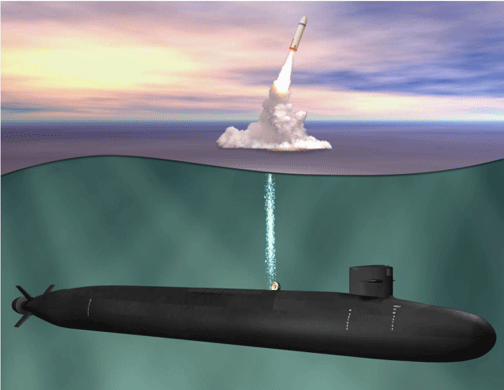
Russia’s nuclear submarine test-fires cruise missile successfully in Barents Sea http://news.xinhuanet.com/english/2017-07/05/c_136419955.htm, Editor: Yang Yi MOSCOW, July 5 (Xinhua) –– Russia’s Project 949A submarine Smolensk has carried out a test launch of a cruise missile and successfully hit its designated target during combat drills scheduled in the Barents Sea, the Northern Fleet’s press service said Wednesday.
“A Granit missile was fired against a marine target at depths of about 400 kilometers in the sea. According to the flight recorder’s data, the target was hit successfully,” said Northern Fleet’s spokesman and Captain Vadim Serga.
Built in 1990, Russia’s submarine Project 949A Antey (also known as the Oscar II class submarine) displaces 24,000 tons and has an underwater speed of 32 knots with a crew of 107.
They are armed with 24 launchers of Granit cruise missiles with a range of about 500 km and six torpedo tubes.
The original treaty [Non-Proliferation Treaty (NPT) ]is quite clear. Article VI reads as follows (emphasis mine):
“Each of the Parties to the Treaty undertakes to pursue negotiations in good faith on effective measures relating to cessation of the nuclear arms race at an early date and to nuclear disarmament, and on a treaty on general and complete disarmament under strict and effective international control.”
The “nuclear club” countries, however, have lately reneged on their end of the “let’s move toward disarmament” plan. The most recent news in the U.S., of course, is that both of our major political partieshave supported a massive, trillion-dollar “modernization” program that would significantly enhance rather than reduce existing stockpiles……..
North Korea Isn’t the Only Rogue Nuclear State Nuclear weapons are about to be made illegal worldwide, but good luck hearing about it at home, Rolling Stone, By Matt Taibbi, 6 July 17, As if the last few years weren’t bad enough, we now have a real nuclear crisis.
North Korea’s loony regime of Kim Jong-un conducted a successful missile launch test – landing about 60 miles south of the Russian city of Vladivostok, according to some reports – marking a frightening nuclear escalation that has heightened tensions across the planet.
That this first serious confrontation in ages is happening now is ironic, given that a little-reported showdown about the use of nuclear power will soon take place in the U.N.
A draft of a U.N. treaty to ban all nuclear weapons is about to be voted on. It has the support of 132 nations and is very likely to pass, at which point the United States will soon once again be in technical violation of a major international agreement, as it long has been with regard to the International Treaty banning land mines.
While practically the ban may not accomplish much, it matters a little when we violate treaties, at least intellectually speaking. North Korea’s violation of similar international agreements is at the crux of the international consensus against allowing the country to have a nuclear program in the first place.
This is what Steve Snyder, the senior fellow on U.S.-North Korea relations for the Council of Foreign Relations, wrote last year about why North Korea must never be allowed to have nukes:
“The United States cannot accept North Korea as a nuclear weapons state for normative reasons; North Korea had signed onto the Non-Proliferation Treaty (NPT) as a non-nuclear state and then abandoned the treaty in order to pursue nuclear capabilities. Tolerating North Korea’s nuclear status would be equivalent to setting a precedent for other NPT signatories to violate the treaty.”
The problem with this argument is that from the point of view of many non-nuclear countries, the United States itself, along with other nuclear club countries (particularly Russia), has been in continuing violation of the original nuclear non-proliferation treaty, as drafted in 1968.
The treaty has been mostly very successful. Since 1970, when it went into effect, only four more countries – Israel, India, Pakistan and North Korea – are known to have developed nuclear weapons, and only one, North Korea, was at any time a signatory.
Israel, India and Pakistan were three of just four U.N. member states to originally refuse to sign the treaty. North Korea, meanwhile, pulled out of the treaty in 2003, almost exactly a year after it was put in the crosshairs by George W. Bush in the infamous “Axis of Evil” speech. It had long been suspected of pursuing a secret development program.
One of the reasons the NPT was long seen as successful is that over the decades, it did inspire the main actors – particularly the United States and Russia – to move toward disarmament. Through a variety of programs, nuclear stockpiles have been drastically diminished, down to about 14,900 warheads worldwide, or two-thirds less than their high point in the mid-Eighties.
Russia and the United States didn’t just reduce their stockpiles out of goodwill. They did so in part because moving toward global disarmament was a major component of the original bargain of the non-proliferation treaty.
The original treaty is quite clear. Article VI reads as follows (emphasis mine):
“Each of the Parties to the Treaty undertakes to pursue negotiations in good faith on effective measures relating to cessation of the nuclear arms race at an early date and to nuclear disarmament, and on a treaty on general and complete disarmament under strict and effective international control.”
The “nuclear club” countries, however, have lately reneged on their end of the “let’s move toward disarmament” plan. The most recent news in the U.S., of course, is that both of our major political partieshave supported a massive, trillion-dollar “modernization” program that would significantly enhance rather than reduce existing stockpiles……..
A lack of dialogue on the nuclear front between Russia and America is an extremely negative development, given that our two countries have nearly blown up the planet by accident multiple times, in underreported incidents.
The most serious of these was probably 1983, when a Soviet satellite mistakenly detected the launch of five American minuteman missiles headed toward Russia. Only the high-stress judgment of a 44-year-old Soviet lieutenant colonel named Stanislav Petrov prevented a massive counter-launch and the probable deaths of millions.
“I had a funny feeling in my gut,” Petrov said years later, explaining his determination that the signal was faulty. “When people go to war, they don’t do it with five missiles.”…….
Russia makes new big cuts in Arctic spending The country’s Ministry of Economic Development wanted 209 billion rubles (€3.1 billion) for the new national Arctic Program. It might get only 12 billion (€177 million). Barents Observer, By Atle Staalesen July 05, 2017
The revised funding scheme for the Arctic program, which is to cover the period until year 2020, is 17 times lower than the original sum, RBC reports.
That is a serious blow to Russia’s ambitious development plans for the region. The Ministry of Economic Development originally wanted to include a number of grand investment projects in the program, among them the development of the new class of nuclear-powered icebreakers, the «Lider», as well as a fleet of vessels for Arctic environmental protection and shelf research. As much as 80 billion (€1.2 billion) was to be spent on the «Lider» alone.
None of that will come, for now. The increasingly strained Russian economy does not allow for the previously announced Arctic super-projects.
The key investment object in the revised program is the development and building of an ice-class drifting platform for Arctic research. The platform, which will get the name «North Pole», is to be used by the State Hydrometeorology Service for Arctic studies and ice measurements.
The platform has a preliminary price tag of seven billion rubles and will consequently consume more than half of the program budget.
The platform is increasingly needed by researchers as Arctic ice layers are getting thinner and traditional drifting ice stations can no longer be applied, the Russian Ministry of Natural Resources says.






 six reactors of the earlier generation VVER type of 1,000 MW capacity each. The VVER-1200 has 20 percent more capacity than the VVER-1000.






 nuclear-news