Africa buys into nuclear dream, Mail and Guardian, Lynley Donnelly
Risky: Nigeria has oil but infrastructure maintenance is poor. It is considering the nuclear option. (Akintunde Akinleye, Reuters)
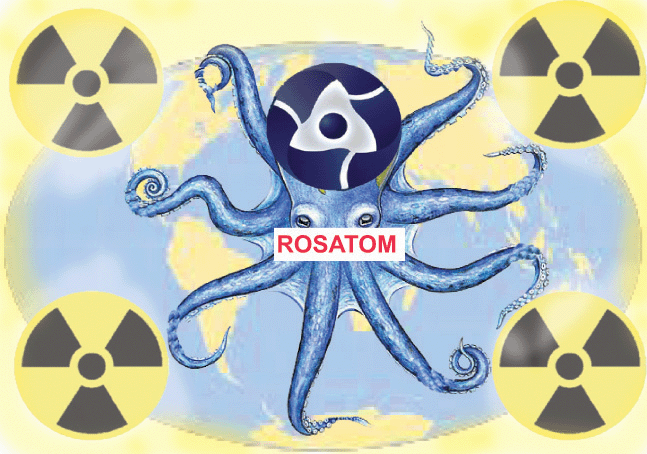
While questions swirl around the progress of South Africa’s nuclear plans, Russia’s state nuclear agency Rosatom is losing no time in selling the atomic dream to other African countries.
Last week the company signed project-development agreements with the Nigerian government for the construction and operation of a nuclear power plant and research centre housing a multipurpose research reactor.
Nigeria has extensive oil and gas reserves but suffers from chronic electricity shortages.
Media reports suggest the deal could cost about $20-billion, but Rosatom said the costs have yet to be determined.
The agreements were signed in order to adopt the appropriate approach and establish the project’s implementation details, a Rosatum official said. “Cost estimations and project specifications will be evaluated in accordance to this agreement,” the official said.
Rosatom talks up wind, solar power in quest for ‘diversified portfolio’ By Frédéric Simon | EURACTIV.com 7 Nov 17, Nuclear power remains the cornerstone of Rosatom’s expansion strategy, notably in emerging countries. But the Russian state-owned energy conglomerate is now also talking up renewables, citing wind, solar and batteries as part of a diversified low-carbon energy portfolio.
Ask the director of Rosatom Western Europe about the company’s diversification strategy, and he won’t hesitate a second – it’s all about nuclear…….
But ask again and Rozhdestvin will also mention wind, solar power and even batteries.
“We are the leaders in Russia when it comes to the wind industry. And why are we doing that? Because we believe we should diversify and add new CO2-free sources of energy to our portfolio.”
Rosatom decided to invest in wind power only recently, in 2016, believing that rapid cost reductions in the renewable industry will become a competitive threat to nuclear power. Two wind farms in Russia are currently under construction, in partnership with a Dutch company, Lagerwey.
Overall, Rosatom has an order to build 1 gigawatt of wind power capacity in Russia, Rozhdestvin says, a market share which is still tiny compared to the 27.89 gigawatts of installed nuclear capacity.
“But that’s the first step,” Rozhdestvin says. “We have to be a player on that market. Wind, solar, nuclear – they are all CO2 free. We want to be able to offer a diversified portfolio to meet concrete energy needs.”….
“We have not yet drawn on the Russian loan, but this will change in the coming hours,” Aszodi told an energy conference organized by financial news website portfolio.hu.
Russian company Rosatom will build two nuclear reactors in Hungary in a 12.5 billion euro project that has been delayed by at least a year as Hungary ironed out regulatory and financing issues with European regulators.
Vladimir Putin and Emmanuel Macron team up to prevent NUCLEAR FALL-OUT
FEARS of a nuclear fall-out between Iran and the US has led to Vladimir Putin forming an unlikely alliance with France’s Emmanuel Macron. By DAN FALVEY Mr Putin teamed up with the French President to try and ease escalating tensions surrounding Iran’s nuclear capabilities. It comes as Donald Trump accused Iran of not upholding the Joint Comprehensive Plan of Action, also known as the Iran nuclear agreement, with the UK, US, Russia, France, China, and Germany in 2015 which aims to limit the country’s nuclear arsenal.
However, fears that the deal could collapse have increased in recent months after the US President threatened not to sign off on the agreement claiming that Iran had broken parts of the pact. Mr Putin and his French counterpart spoke on the phone yesterday to reaffirm their support for the implementation of the deal.
A press statement released by the Kremlin said the Russian leader and Mr Macron agreed on the importance that the deal went ahead.
Russia AND the US send nuclear bombers to North Korea as tensions with Kim Jong-un soar
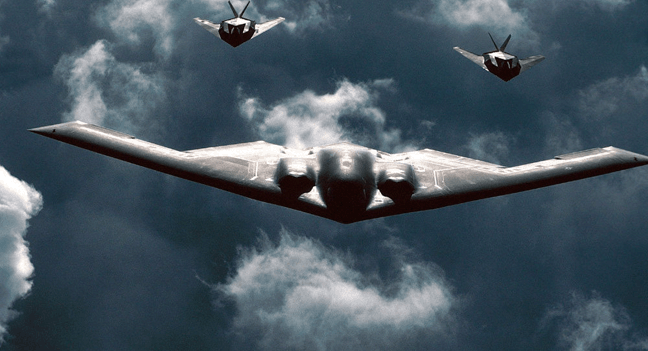
The US sent a nuclear-capable B-2 stealth bomber from Whiteman Air Force Base in Missouri on a long-range mission to the Pacific this weekend, The Sun, By Sam Webb, 31st October 2017,
RUSSIA and the US have flown nuclear bombers near North Korea as tensions grow over tyrant Kim Jong-un’s atomic threats.
President Donald Trump sent a nuclear-capable B-2 stealth bomber from Whiteman Air Force Base in Missouri on a long-range mission to the Pacific this weekend.
And the Russian Defence Ministry today announced that US and Japanese jets escorted Russia’s missile-carrying Tupolev-95MS strategic bombers during flights over the Sea of Japan and the Pacific.
A spokesman said: “Two strategic bombers Tupolev-95MS of Russia’s Aerospace Force have carried out routine flights over international waters of the Sea of Japan and the western part of the Pacific Ocean.
At certain sections of the route the Tupolev-95MS crews were accompanied by a pair of F-18 fighters (of the US Air Force), and a pair of F-15, F-4 and F-2A fighters (of the Japanese Air Force).”
Vasili Arkhipov, who prevented escalation of the cold war by refusing to launch a nuclear torpedo against US forces, is to be awarded new ‘Future of Life’ prize A senior officer of a Soviet submarine who averted the outbreak of nuclear conflict during the cold war is to be honoured with a new prize, 55 years to the day after his heroic actions averted global catastrophe.
On 27 October 1962, Vasili Alexandrovich Arkhipov was on board the Soviet submarine B-59 near Cuba when the US forces began dropping non-lethal depth charges. While the action was designed to encourage the Soviet submarines to surface, the crew of B-59 had been incommunicado and so were unaware of the intention. They thought they were witnessing the beginning of a third world war.
Trapped in the sweltering submarine – the air-conditioning was no longer working – the crew feared death. But, unknown to the US forces, they had a special weapon in their arsenal: a ten kilotonne nuclear torpedo. What’s more, the officers had permission to launch it without waiting for approval from Moscow.
Two of the vessel’s senior officers – including the captain, Valentin Savitsky – wanted to launch the missile. According to a report from the US National Security Archive, Savitsky exclaimed: “We’re gonna blast them now! We will die, but we will sink them all – we will not become the shame of the fleet.”
But there was an important caveat: all three senior officers on board had to agree to deploy the weapon. As a result, the situation in the control room played out very differently. Arkhipov refused to sanction the launch of the weapon and calmed the captain down. The torpedo was never fired.
Had it been launched, the fate of the world would have been very different: the attack would probably have started a nuclear war which would have caused global devastation, with unimaginable numbers of civilian deaths.
“The lesson from this is that a guy called Vasili Arkhipov saved the world,’’ Thomas Blanton, director of the National Security Archive at George Washington University, told the Boston Globe in 2002, following a conference in which the details of the situation were explored.
Now, 55 years after he averted nuclear war and 19 years after his death, Arkhipov is to be honoured, with his family the first recipients of a new award.
The prize, dubbed the “Future of Life award” is the brainchild of the Future of Life Insitute – a US-based organisation whose goal is to tackle threats to humanity and whose advisory board includes such luminaries as Elon Musk, the astronomer royal Prof Martin Rees, and actor Morgan Freeman.
“The Future of Life award is a prize awarded for a heroic act that has greatly benefited humankind, done despite personal risk and without being rewarded at the time,” said Max Tegmark, professor of physics at MIT and leader of the Future of Life Institute.
Speaking to Tegmark, Arkhipov’s daughter Elena Andriukova said the family were grateful for the prize, and its recognition of Arkhipov’s actions.
“He always thought that he did what he had to do and never considered his actions as heroism. He acted like a man who knew what kind of disasters can come from radiation,” she said. “He did his part for the future so that everyone can live on our planet.”
The $50,000 prize will be presented to Arkhipov’s grandson, Sergei, and Andriukova at the Institute of Engineering and Technology on Friday evening.
Dr Jonathan Colman, an expert on the Cuban missile crisis at the University of Central Lancashire, agreed that the award was fitting.
“While accounts differ about what went on on board the B-59, it is clear that Arkhipov and the crew operated under conditions of extreme tension and physical hardship. Once the nuclear threshold had been crossed, it is hard to imagine that the genie could have been put back into the bottle,” he said.
“President Kennedy had been very worried about the possibility of a clash between American warships and Soviet submarines in the Caribbean, and it is absolutely clear that his fears were justified,” Colman added, noting that certain decisions at the operational level were out of his control. “Ultimately, it was luck as much as management that ensured that the missile crisis ended without the most dreadful consequences.”
To shore up the INF, the United States could propose something the Russians have already advocated—that the INF Treaty be expanded to ban this category of ballistic missiles globally.Such a move would not immediately apply to the most troubling nuclear-tipped missiles, those with ranges far in excess of 1,000 kilometers. But a worldwide INF could be a first step toward an eventual goal of banning all ballistic missiles.
Ballistic missiles have beneficial purposes; they place satellites in orbit, and those satellites provide the world with vital communications capabilities and navigation and weather information. Ballistic missiles send astronauts and space stations into Earth orbit and research probes far across the solar system.
But ballistic missiles armed with nuclear warheads are enablers of apocalypse. There is no effective defense against these missiles, even though the United States has spent more than 30 years and $500 billion trying to build radars that can track them and interceptor missiles that will shoot them down.
Military ballistic missiles have other negative characteristics. The short time needed for them to reach target (if the United States and Russia are the assumed combatants, 10 to 30 minutes) creates pressure to launch first in a conflict. In a crisis, ballistic missiles on high alert can wind up becoming the leading edge of a devastating war begun by miscalculation.
Because of the obvious dangerousness of ballistic missiles, there is a long history of official efforts to limit or eliminate them. Those efforts have shown that agreements to reduce the dangers of ballistic missiles can catalyze improved relations between potential adversaries. The landmark 1987 Intermediate-Range Nuclear Forces (INF) treaty required Washington and Moscow to eliminate all ballistic missiles with ranges between 500 and 1,000 kilometers. Both nations recognized that these missiles could not be defended against and their proximity to the Cold War boundaries of Europe meant they were highly destabilizing in a crisis. A total of 2,692 missiles (including a small number of cruise missiles) were eliminated under the treaty.
Acknowledging the danger of nuclear ballistic missiles, President Reagan proposed an agreement requiring their total elimination to Soviet leader Gorbachev at their summit in Reykjavik, Iceland in 1985. The Soviets did not accept the proposal because Reagan insisted that America’s program to build missile defenses remain unconstrained. That program—known then as the Strategic Defense Initiative and today as the National Missile Defense Program—has yet to develop effective means to defeat ballistic missiles.
In the mid 1990s, Alton Frye, then Washington director of the US Council on Foreign Relations, advocated an international ban on offensive ballistic missiles, an idea whose time has perhaps come again. Many political and technical challenges would need to be addressed to negotiate and enforce new international limitations on ballistic missiles. But model institutional and scientific mechanisms for such efforts exist in the form of preceding treaties, including INF and New START. Procedures and technologies for inspection, verification, and enforcement of agreements limiting or banning all types of ballistic missiles have already been proven. Political will, as usual is the major missing ingredient.
While Perry proposes to eliminate only land-based ballistic missiles and retain submarine-based missiles, such a move could create powerful international momentum to negotiate new international limits or bans on certain types of ballistic missiles—with an ultimate goal of banning all nuclear-armed ballistic missiles. If a united international community were to seriously consider such a course, it could bring increased pressure on North Korea, Iran, and other nations to suspend or roll back their offensive ballistic missile programs. If they refused, the possibility of using military force against their nuclear and ballistic missile programs would gain legitimacy and support.
One place to start seeking new limits on ballistic missiles has been in the news for months: the INF Treaty, which the United States and Russia have accused one another of violating. Russia’s support of the treaty has weakened over the years because it is forbidden to deploy ballistic missiles with ranges between 500 and 1,000 kilometers, but its neighbors who are not party to the treaty are permitted to do so. China has many such missiles, and Turkey, South Korea, and Japan could develop them in the future. To shore up the INF, the United States could propose something the Russians have already advocated—that the INF Treaty be expanded to ban this category of ballistic missiles globally.
Such a move would not immediately apply to the most troubling nuclear-tipped missiles, those with ranges far in excess of 1,000 kilometers. But a worldwide INF could be a first step toward an eventual goal of banning all ballistic missiles. A renewed focus on the danger of these weapons—accompanied by US statements that it is willing to eliminate its land-based ICBMs under the right conditions—might elicit greater support from Russian and China in efforts to defuse the North Korean crisis and control Iranian missile testing.
Like the nuclear weapons ban treaty the UN recently adopted, a ballistic missile ban would require sustained, long-term effort to achieve anything like full success. But the United States has everything to gain from taking a leadership role and asserting that offensive ballistic missiles are dangerous and destabilizing weapons that should eventually be eliminated from the arsenals of all nations.
Russia steps up as go-between on North Korea
Moscow sees rogue state as key to mending fences with Washington, Nikkei Asian Review, 17 Oct 17
TOMOYO OGAWA, Nikkei staff writer MOSCOW — Russia has been setting up a number of high-profile meetings with North Korean officials, positioning itself as an intermediary for negotiations with the isolated state in a bid to improve Moscow’s strained relations with the U.S.
Valentina Matviyenko, the speaker of Russia’s upper house, met separately with North and South Korean representatives on Monday on the sidelines of an international meeting in St. Petersburg. Matviyenko had called for a direct dialogue between the two Koreas, but Pyongyang rejected the idea in protest of joint U.S.-South Korean military drills.
The vice chair of North Korea’s Supreme People’s Assembly is believed to have given Matviyenko a statement from North Korean leader Kim Jong Un, while arguing that nuclear weapons were the only way for the country to defend itself. Matviyenko’s meeting with the North Korean official lasted about an hour and a half, compared with just 30 minutes or so with the South Korean envoy.
The Russian speaker later called for the resumption of six-party talks on the North Korean issue, and stressed that she will continue making every effort to foster dialogue.
FBI uncovered Russian bribery plot before controversial nuclear deal http://nypost.com/2017/10/17/fbi-uncovered-russian-bribery-plot-before-controversial-nuclear-deal/By Bob Fredericks The FBI had evidence that Russian nuclear industry officials engaged in bribery, kickbacks, extortion and money laundering designed to grow Vladimir Putin’s energy business in the US before the Obama administration approved a deal in 2010 giving Moscow control of a large swath of American uranium, a new report said Tuesday.
The feds used a confidential US witness working inside the Russian nuclear industry to gather records, make secret recordings and intercept emails as early as 2009 that showed Moscow had compromised an American uranium trucking firm with bribes and kickbacks, The Hill reported.
“The Russians were compromising American contractors in the nuclear industry with kickbacks and extortion threats, all of which raised legitimate national security concerns. And none of that evidence got aired before the Obama administration made those decisions,” a person who worked on the case told The Hill.
Russian nuclear officials also sent millions of dollars to the US designed to benefit the Clinton Foundation while then-Secretary of State Hillary Clinton served on a government body that smoothed the way for the sale of the US uranium interests.
Russia’s high-tech combat suit, the Ratnik 3 has received an upgrade of a nuclear blast resistant watch. The suit reportedly includes 59 other high-tech features to create the most advanced body armor ever.
STORMTROOPER CHICRussia has a new battle suit that seems to be visually inspired by Star Wars’s Imperial Shadow Stormtroopers. While Russia’s version likely doesn’t come with a cloaking device, the high-tech armor does have a few tricks up its sleeves, including nuclear blast resistant tech.
The suit was developed by Rostec and is called the Ratnik-3. The latest upgrade to the new armor includes a reportedly nuclear blast resistant watch. According to a statement released by the press office, the Chief Designer for the Life Support System of the Soldier Combat Outfit at the Central Scientific Research Institute for Precision Machine Engineering, Oleg Faustov, says “The watch, which we have included in the Ratnik outfit, retains its properties upon the impact of radiation and electromagnetic impulses, for example, upon a nuclear blast.”
The watch also features a self-winding mechanism and operates under water.
Other perks of the 59 items Rostec has included in the suit include a powered exoskeleton, which is said to give soldiers greater strength and stamina; the latest in bulletproof body armor tech; and a full face-covering visor and helmet equipped with a video game-esque heads-up display (HUD). According to Russian state-owned media outlet Tass, the weight of the completed combat gear will be reduced by 30% when it is released for use in the field.
The Ratnik 3 is expected to be ready for use by 2022.
IN BRIEF
Russia’s high-tech combat suit, the Ratnik 3 has received an upgrade of a nuclear blast resistant watch. The suit reportedly includes 59 other high-tech features to create the most advanced body armor ever.
STORMTROOPER CHIC
Russia has a new battle suit that seems to be visually inspired by Star Wars’s Imperial Shadow Stormtroopers. While Russia’s version likely doesn’t come with a cloaking device, the high-tech armor does have a few tricks up its sleeves, including nuclear blast resistant tech.
The suit was developed by Rostec and is called the Ratnik-3. The latest upgrade to the new armor includes a reportedly nuclear blast resistant watch. According to a statement released by the press office, the Chief Designer for the Life Support System of the Soldier Combat Outfit at the Central Scientific Research Institute for Precision Machine Engineering, Oleg Faustov, says “The watch, which we have included in the Ratnik outfit, retains its properties upon the impact of radiation and electromagnetic impulses, for example, upon a nuclear blast.”
The watch also features a self-winding mechanism and operates under water.
Other perks of the 59 items Rostec has included in the suit include a powered exoskeleton, which is said to give soldiers greater strength and stamina; the latest in bulletproof body armor tech; and a full face-covering visor and helmet equipped with a video game-esque heads-up display (HUD). According to Russian state-owned media outlet Tass, the weight of the completed combat gear will be reduced by 30% when it is released for use in the field.
The Ratnik 3 is expected to be ready for use by 2022.
Weapons are also getting next-gen upgrades with laser weapons currently being deployed in various forms around the world. The United States Navy has the Laser Weapons System (LaWS) mounted on the USS Ponce, an amphibious naval transport dock, to defend against drone strikes and eventually incoming missiles. China has also previously given its soldiers laser weapons designed to blind opponents.
In the sky, killer drones the size of a quadcopter have been developed to carry weapons. The Air Force is even training soldiers to get the military ready for combat in space with extraterrestrials or other hostile interests.
Of course, with all these developments, it maybe good to be reminded what a nuclear showdown would do to the planet—and hope that these future technologies rarely have to be put to use.
Russia Ready to Offer Nuclear Technologies to Algeria, Russian Prime Minister Dmitry Medvedev said that Russia is ready to offer Algeria its technologies and technical solutions if a decision is made to establish a national nuclear industry as well as to develop cooperation in other spheres.MOSCOW (Sputnik)— Russia is ready to offer Algeria its technologies and technical solutions if a decision is made to establish a national nuclear industry, Russian Prime Minister Dmitry Medvedev said in an interview with the Algerian news agency APS ahead of his visit to the country.
Russia is already preparing nuclear industry specialists for Algeria, the prime minister noted.
On 29 September 1957 at 16 o’clock on the territory of the chemical plant “Mayak”, which was in the closed city of Chelyabinsk-40 (now Ozersk), was the first in the USSR radiation accident — an explosion of capacity to store radioactive waste. The catastrophe was called the Kyshtym accident — the name closest to Chelyabinsk-40 by city.
The blast occurred in containers, of a capacity of 300 m? because of the failure of the cooling system. In the tank contained a total of about 80 m? highly radioactive nuclear waste. At the time of construction in 1950-ies the strength of the structure is not in doubt. She was in the pit, in a concrete shirt thickness meter.
Cover the container weighed 560 tons, over it was laid a two-meter layer of earth. However, even this failed to contain the explosion.
According to another, unofficial version, the accident occurred due to human error of the plant that in the tank-evaporator with hot plutonium nitrate solution by mistake added a solution of plutonium oxalate. The oxidation of oxalate nitrate allocating a large amount of energy, leading to overheating and explosion of the tank.
During the explosion in the atmosphere were about 20 million curies of radioactive substances, some of which rose to a height of up to two miles, and formed an aerosol cloud.
Over the next 11-12 hours of radioactive fallout on the territory with a length of 300-350 km on northeast from the explosion.
In the area of radioactive contamination got 23 thousand km2 with a population of 270 thousand people in 217 settlements of the Chelyabinsk, Sverdlovsk and Tyumen regions. During the liquidation of consequences of the accident were required to relocate 23 villages with a population of 10-12 thousand a man, all the buildings, property and livestock were destroyed.
Liquidators were hundreds of thousands of soldiers and civilians
Only in the first ten days the number of deaths from radiation have gone on hundreds, during the works in varying degrees, suffered 250 thousand liquidators.
According to the international scale of nuclear testing accident was estimated at six points. For comparison, the seventh level, the maximum was rated accidents at Chernobyl and Fukushima-1.
To avoid scattering of radiation by government decision was established the sanitary-protective zone in which economic activity was banned. In 1968 this territory was formed of the Eastern Ural state reserve.
It is forbidden to visit — the level of radioactivity is still too dangerous for humans.
October 6, 1957 in the newspaper “Chelyabinsk worker” appeared devoted to his note, in which, however, about the accident not a word was said:
On Sunday night… many residents of Chelyabinsk watched the special glow of a starry sky. It’s pretty rare in our latitudes, the glow had all the signs of the Aurora. Intense red, time moves to slightly pink and light blue glow first covered a large part of the South-Western and North-Eastern surface of the firmament. About 11 o’clock it was possible to observe in the North-Western direction… In the sky appeared a relatively large colored area and the quiet lanes that had at the last stage of lights North-South direction. The study of the nature of the Aurora, has begun Lomonosov continues in our days. Modern science has confirmed the basic idea of the University, that the Aurora occurs in the upper layers of the atmosphere by electrical discharges of the Aurora…… can be observed in the future at the latitudes of the southern Urals”.
Kyshtym accident has long been a state secret. For the first time openly about her was said in a shot at the turn of the 1980s and 1990s, the film Director and biologist Elena Sakanyan, dedicated to the fate of Soviet genetics and biologist Nikolai Timofeev-Ressovsky.
The films were shown on television only after Sakanyan directly asked about the show to Boris Yeltsin.
But in the foreign press leaked the information in April 1958. For the first time about the accident said one of the Copenhagen Newspapers. Subsequently, information about the accident appeared in the report of the National laboratory, USA, biologist Zhores Medvedev dedicated incident book entitled “Nuclear disaster in the Urals”, published in the US, an analysis of the causes of the accident and its causes held by a group of American scientists from the atomic center at oak ridge.
“About the explosion at the “Mayak” for long periods of time, the public knew almost nothing. Later, for some reason, the accident was replicated in the media as the “Kyshtym accident”.
In Kyshtym on this occasion, even recently, was the obelisk, although the city to this event is irrelevant.
And the East-Ural radioactive trail, formed after 1957, did not affect Cistema and its residents,” — said in an interview in 2009, one of its liquidators.
Only the “Lighthouse” there were more than 30 incidents of radioactive emissions and human victims.
Russian Nuclear Company Sees Success in Latin America, 1 October 2017New branches of the company will be constructed in El Alto, Bolivia and should be in operation by 2020.
Two years since its move to Latin America, Rosatom, Russia’s main nuclear power company, has seen great success, the company’s Latin American representative, Ivan Dybov, said.
“Rosatom has several projects in Latin America, but the main one is in Bolivia. Last September 19 we signed the contract for the construction of the Center for Research and Development in Nuclear Technology,” Dybov said.
Those words were spoken to me by the Russian human rights lawyer, Nadezhda Kutepova. For years she, with her NGO, Planet of Hopes, defended people who suffer in one of the most radioactively polluted places on this planet: the area surrounding the nuclear waste and reprocessing complex, Mayak, in Russia’s Southern Urals. Kutepova continues to stand up for her people from Paris where she has been exiled to because she was no longer safe in her home town. She made the comment when we were discussing the latest radiation measurement findings that Greenpeace published this week.
The people around Mayak are suffering from the third biggest nuclear catastrophe in history: The Kyshtym disaster that happened 60 years ago today. The radioactive pollution from Mayak continues to this day.
The Kyshtym Disaster is named after the nearest known town on the map. In 1957 a mistake in the reprocessing plant led to an explosion that contaminated 20,000 square kilometres – an area that did not appear on any map. Nor did the nearby town of Chelyabinsk, which was a so-called “secret” or “closed town” for Mayak nuclear complex workers. It is also Kutepova’s birth place. Around 270,000 people were directly affected by the disaster.
Only in the 1990s, after the fall of the Soviet Union, did the true impact of the accident become apparent. Only then did the Russian nuclear industry, now known as Rosatom, take some responsibility. Only after Kutepova started supporting local victims and photographer, Robert Knoth, who recorded the the lives of those affected, did Rosatom concede to evacuating those who suffered most.
Well, kind of.
First of all, not everyone in the village was moved. Some of the people’s documents were not in order. They had to stay in a ghost town without services. And five other villages were not evacuated at all.
The pollution from Mayak never really stopped, either. Radioactive waste-water continues to be dumped in ponds around and connected to the Techa river. In all the local villages Greenpeace Russia found highly elevated strontium-90 levels. The same levels as found in the evacuated village of Muslyumovo.
Rosatom already acknowledged several times that water is seeping out of the ponds into the Techa river system. And the people of Muslyumovo and it’s surroundings are still depending on that water for their gardens. Still, Rosatom continues to dump its waste into the ponds. But, they are not called “ponds” anymore. They are now called “special industrial ponds”, “objects of nuclear energy use”, and the dumping is called “inserting liquid radioactive waste for storage”.
Mayak is everywhere. Rosatom may be polluting a Mayak near you: by reprocessing spent nuclear fuel from your nearby nuclear power station, by building a nuclear power station that will later send its spent fuel to Russia for reprocessing, or by loading your neighbouring nuclear plant with reprocessed uranium fuel from Mayak.
Rosatom’s operation in Mayak illustrates that the nuclear industry is not interested in people. After all, 60 years since the disaster the people around Mayak are “a sort of radioactive waste”.
Jan Haverkamp is an expert consultant nuclear energy and energy policy for GreenpeaceCentral and Eastern Europe and part of Greenpeace’s Radiation Protection Advisors team.
‘Left To Die As Guinea Pigs’: Tatar Village Struggles On, 60 Years After Nuclear Catastrophe https://www.rferl.org/a/russia-nuclear-mayak/28755780.html, September 28, 2017 An explosion at a Soviet nuclear plant 1,400 kilometers east of Moscow remains the world’s third-largest nuclear disaster, after Chernobyl and Fukushima. At the time, in 1957, it was the worst ever. Sixty years on, nearby Tatar villagers are still struggling for official recognition of their plight. (RFE/RL’s Tatar-Bashkir Service) TEXTS BELOW DESCRIBE EACH OF THE EXCELLENT PICTURES ON THE ORIGINAL
The sign says “Danger Zone.” An explosion on September 29, 1957, contaminated an area of 23,000 square kilometers and exposed more than 270,000 people to significant levels of radiation.
The village of Karabolka is 30 kilometers from the Mayak nuclear plant, where the explosion occurred. For decades afterwards, it did not appear on maps, only reappearing 20 years ago. But life there continued.
Gulshara Ismagilova has lived in Karabolka all her life. She is campaigning for official recognition for the suffering of the villagers. Rates of cancer and genetic abnormalities here are significantly higher than the national average. “We are all handicapped here,” she says.
These are Ismagilova’s relatives who have died over the last 60 years. It includes an aunt, her mother, and her brother, who all died of cancer. Ismagilova herself has liver cancer.
In 1957, the village had about 4,000 residents; in 2010, just 423. The village had two distinct parts: a mostly Tatar part, which was not evacuated, and a mostly Russian part, which was. Some locals say they were used in an experiment on the effects of radiation.
The village has eight cemeteries. Seven of them are a resting place for residents who died of cancer. Children here are often born with cancer and die before reaching adulthood.
Only Muslims are buried here. Following their beliefs, some relatives prevent autopsies being performed. This can prevent some deaths being classified as cancer-related.
A pile of coffins at the ready. Families usually bury their dead by noon of the day following their death. “People don’t know what to eat and how to survive,” Ismagilova says. “They have been left here to die as guinea pigs.”
This house has a pile of firewood outside. In the 1990s, local people were warned that wood stored radiation and should not be used for burning. But the village was not connected to a gas supply until 2016.
A water pump outside a house. “The authorities prohibited drinking water from local wells but couldn’t arrange supplies of clean water. A couple of months later, they took samples and said the local water was good enough to drink,” says Ismagilova.
A Greenpeace report 10 years ago said the Mayak site was “one of the most radioactive places on Earth.” It added that thousands of people in surrounding towns and villages still lived on contaminated land










 nuclear-news