Origin of the mysterious radioactive cloud remains obscure, as Russia now denies it came from Mayak
Russia’s Nuclear Industry Tries To Dispel Fears Over Mysterious Radioactive Cloud https://www.npr.org/sections/parallels/2017/12/08/569384745/russias-nuclear-industry-tries-to-dispel-fears-over-mysterious-radioactive-cloud, December 8, 2017 LUCIAN KIM
More than two months after a mysterious radioactive cloud was detected over Europe, Russia’s nuclear industry went public Friday in an attempt to dispel fears that one of its facilities had released a plume of ruthenium-106.Russia’s
state nuclear corporation, ROSATOM, released the findings of a special commission, which concluded that the Mayak nuclear reprocessing plant, near the border with Kazakhstan, could not have been the source of ruthenium-106, a radioactive isotope.
“There is no scientific basis for the hypothesis of some of our Western colleagues that there was a big release at Mayak,” Rafael Arutyunyan, deputy director of the Nuclear Safety Institute of the Russian Academy of Sciences and a member of the commission, said at a news conference in Moscow. European monitoring stations first picked up traces of ruthenium in the air in late September. While concentrations were too low to pose a health risk in Europe, scientists have
been puzzling over its origin. Wind patterns pointed to the south Urals, where the Mayak facility is located. The plant was the site of a 1957 explosion widely considered to be one of the world’s worst nuclear disasters.
In November, Russia’s meteorological service said that on Sept. 26, ruthenium-106 levels in a town 20 miles from the Mayak plant, Argayash, had exceeded the previous month’s by 986 times.
The same day, Mayak flatly denied that the spike in ruthenium had anything to do with its activities.
The ROSATOM commission that inspected the Mayak facility afterward reached the same conclusion. The commission said it hadn’t detected abnormal levels of ruthenium at the facility, there had been no malfunction of monitoring systems and none of the 250 Mayak employees tested had shown any trace of the isotope.
Arutyunyan rejected the suggestion that officials have been slow in informing thepublic, saying there had been no emergency situation that would have warranted an alarm. He called talk of a danger to health “nonsense.”
“Why should we come running to announce something? Mayak told us that all their systems were working absolutelynormally and routinely,” he said. “Why should they have jumped up and shouted? I think we spent the right amount of time to understand what happened.”
Environmental activists and government critics disagree.
After the findings of the commission were released, Greenpeace Russia started a petition drive addressed to the general prosecutor’s office, demanding an investigation by independent specialists and public figures into a possible release of ruthenium from Russian territory, as well as into the possible concealment of information by ROSATOM.
“The question is not only about the immediate danger, but the origin of this release,” Greenpeace energy campaigner Rashid Alimov said in a phone interview. “We think such incidents should be investigated and there must be an answer.”
Finding the source of the radioactive cloud was beyond the scope of the ROSATOM commission. But because the ruthenium-106 over Europe was found alone, that is, unaccompanied by other radioactive isotopes, the commission said nuclear power plants or spent nuclear fuel processing facilities like Mayak could be excluded as sources because they don’t produce “pure” ruthenium-106.
The commission said a satellite — or a fragment of one — re-entering the atmosphere cannot be completely ruled out as the source of the ruthenium.
According to French authorities,
the International Atomic Energy Agency found that no satellite containing ruthenium had fallen back to earth during the period in question.
The elephant in the room, of course, is the 1986 Chernobyl nuclear accident, when Soviet authorities lied for days about the scope of the disaster.
“What’s happening with the ruthenium cloud reminds me a lot of what went on with Chernobyl,”
Russian opposition leader Alexei Navalny said in a recent video blog. “In no way do I want to prove there’s been a catastrophe of that scale. I just want to say that the pattern of behavior is exactly the same.”
Navalny went on to pillory the headline on state television that “safe ruthenium rain fell on Bashkiria” and the chief oncologist of Chelyabinsk region, who advised people worried about high ruthenium levels “to watch soccer and drink beer.”
ROSATOM insistsit is being as transparent as possible.”Russia’s nuclear industry is a lot more open than our peers’,” ROSATOM spokesman Andrei Ivanov said at the news conference.
On Friday, local journalists were let into Mayak on the first press tour since the facility was identified as a possible source of the ruthenium cloud.
Foreign correspondents will have to wait up to two months to get a security clearance.
Egypt to go into big debt to buy Russian nuclear reactors that it doesn’t need
 Egypt to sign contracts for nuclear power plant during Putin’s visit: sources, CAIRO (Reuters) 10 Dec 17 – Egypt will sign contracts with Moscow during Russian President Vladimir Putin’s visit to Cairo on Monday for the country’s first nuclear power plant, three senior sources told Reuters on Sunday.
The construction of the 4,800 megawatt (MW) capacity plant, which is supposed to be built at Dabaa in the north of the country, is expected to be completed within seven years, added the sources, who spoke on condition of anonymity because they were not authorized to speak to the media……
Moscow and Cairo signed an agreement in 2015 for Russia to build a nuclear power plant in Egypt, with Russia extending a loan to Egypt to cover the cost of construction.
Egypt’s official gazette said last year the loan was worth $25 billion and would finance 85 percent of the value of each work contract, services and equipment shipping. Egypt would fund the remaining 15 percent.
The trial operation of the first nuclear reactor is expected to take place in 2022……
The nuclear plant is expected not to just cover the country’s energy needs, but to produce excess which can be exported, the sources told Reuters on Sunday.
Putin is scheduled to visit Cairo on Monday to meet with his counterpart Abdel Fattah al-Sisi, where they will discuss bilateral relations, trade and Middle Eastern issues, the Kremlin said last week.
Reporting by Momen Abdelkhalek; Writing by Amina Ismail; Editing by Toby Chopra
Russioa denies USA allegations : says it is fully committed to nuclear missile pact
Russia says it is fully committed to nuclear missile pact, Reuters Staff, MOSCOW (Reuters) 9 Dec 17 – Russia said on Saturday it was fully committed to a Cold War-era pact with the United States banning intermediate-range cruise missiles, a day after Washington accused Moscow of violating the treaty.
The U.S. State Department said on Friday Washington was reviewing military options, including new intermediate-range cruise missile systems, in response to what it said was Russia’s ongoing violation of the 1987 Intermediate-Range Nuclear Forces Treaty.
The warning was the first response by President Donald Trump’s administration to U.S. charges first leveled in 2014 that Russia had deployed a ground-launched cruise missile that breaches the pact’s ban on testing and fielding missiles with ranges of 500-5,500 kms (310-3,417 miles).
Russian Deputy Foreign Minister Sergei Ryabkov said those allegations were “absolutely unfounded”……
Echoing previous Russian statements, Ryabkov said Moscow was fully committed to the treaty, had always rigorously complied with it, and was prepared to continue doing so.
“However, if the other side stops following it, we will be forced, as President of the Russian Federation Vladimir Putin has already said, to respond in kind,” he added.
The U.S. allegation has further strained relations between Moscow and Washington, and the State Department on Friday hinted at possible economic sanctions over the issue…… https://www.reuters.com/article/us-russia-usa-nuclear/russia-says-it-is-fully-committed-to-nuclear-missile-pact-idUSKBN1E30HZ
The unsolved hazard of damaged spent nuclear fuel rods – Andreeva Bay
In 2023, the risky part of Andreeva Bay nuclear cleanup starts https://thebarentsobserver.com/en/ecology/2017/12/2023-risky-part-andreeva-bay-nuclear-cleanup-starts
Donor countries agree to fund an additional study on how to extract the damaged spent nuclear fuel from Tank 3A. By Thomas Nilsen, December 08, 2017

Russian authorities deny that radioactive cloud came from its Mayak nuclear plant
Russia claims radioactivity spike not due to nuclear plant http://abcnews.go.com/Technology/wireStory/russia-spike-radioactivity-unrelated-nuclear-plant-51665118, By VLADIMIR ISACHENKOV, ASSOCIATED PRESS, Russian authorities denied Friday that a radioactivity spike in the air over Europe this fall resulted from a nuclear fuel processing plant leak in the Ural mountains, saying their probe has found no release of radioactivity there.
USA claims that Russia is violating 1987 Intermediate-Range Nuclear Forces Treaty
U.S. presses Russia to comply with nuclear missile treaty WASHINGTON (Reuters) 9 Dec 17, – The United States is reviewing military options, including new intermediate-range cruise missile systems, in response to what it says is Russia’s ongoing violation of a Cold War-era pact banning such missiles, the State Department said on Friday.
Washington is prepared “to cease such research and development activities” if Russia returns to compliance with the 1987 Intermediate-Range Nuclear Forces Treaty, State Department spokeswoman Heather Nauert said in a statement.
The warning was the Trump administration’s first response to U.S. charges first leveled in 2014 that Russia had deployed a ground-launched cruise missile that breaches the pact’s ban on the testing and fielding of missiles with ranges of between 500-5,500 kms (310-3,417 miles).
U.S. officials have said the Russian cruise missile is capable of carrying a nuclear warhead, and that Moscow has refused to hold indepth discussions about the alleged breach.
Russia has denied that it is violating the accord.
The U.S. allegation has added to strains in relations between Moscow and Washington. U.S. and Russian officials are due to discuss the issue at a meeting in coming weeks of the special commission that oversees the treaty, said a U.S. official, who requested anonymity…….https://www.reuters.com/article/us-usa-nuclear-russia/u-s-presses-russia-to-comply-with-nuclear-missile-treaty-idUSKBN1E224A
Russia’s deception, denial and propaganda over the nuclear event at Mayak
 Nuclear Russia Scares The World (Again), Lobe Log, DECEMBER 5, 2017, by Tatyana Ivanova
“…….Denial, Pressure, and Propaganda
As soon as information about the likely Russian origin of the ruthenium cloud over Europe appeared in the mass media, the Russian nuclear state corporation sprang into action to prevent any Russian investigation. Rosatom and then Mayak stated that their facilities couldn’t be a source of Ru-106 release and that the background radiation around them is normal. At the same time, they didn’t provide any specific data on Ru-106 concentrations in the air. Rosatom only made reference to its website, which is monitoring the gamma background.
A Russian regulatory agency “inspected” Mayak, and after only one day came to the hasty conclusion that there had been no accidents or events at the plant. Its public report contained only one number: the Ru-106 concentration in Bucharest that the IAEA had already published.
Some days later Russian pro-government mass media published a flurry of propaganda, denying that the contamination was of Russian origin and making fun of the journalists and citizens who wrote of a cover-up. Some of the Russian mass media disseminated false information that the release could have been caused by a downed American spy satellite or even an alien spaceship.
The most radical websites started a second wave of defamation against Nadezhda Kutepova, blaming her for espionage and intentional misinformation about Mayak. Some Russian officials blamed IRSN for issuing “false information” about the Russian trace, saying that the French regulator is competing with Rosatom.
Rosatom went further by publishing a poster on behalf of Ru-106 with the headline “Everyone accuses the little one” in the style of a propaganda cartoon for children. The poster states that Ru-106 is “small and good” and does not appear at nuclear waste reprocessing plants. Then the official Rosatom Facebook page invited journalists and bloggers to visit Mayak to “touch and smell” Ruthenium-106. They selected 16 people from 200 who expressed interest, stating that experts were not invited because they “already understand all the fictitiousness of the hype.”
At the same time, the Russian regulatory agency altered its published report, removing the words “extremely high concentrations of Ru-106” in reference to the villages around Mayak and reported instead that the levels did not exceed the limits. Last week a special commission including representatives of all the aforementioned Russian state organizations began another inspection of Mayak. The results have not yet been announced.
The situation is reminiscent of the Chernobyl catastrophe of 1986, during the Soviet era. Indeed, the Mayak facility, which specializes in nuclear fuel reprocessing and the production of nuclear weapons materials, never really left the Soviet era. The enterprise avoids publishing any detailed figures on emissions In its environmental impact assessments. An iron veil of secrecy, as well as Rosatom’s influence over decision-makers at the highest level, protect it from the scrutiny of Russians and everybody else.
Tatyana Ivanova is a Belarusian journalist residing in the United States https://lobelog.com/nuclear-russia-scares-the-world-again/
Fundamental problems with the Russian nuclear industry
Nuclear Russia Scares The World (Again), Lobe Log, DECEMBER 5, 2017, by Tatyana IvanovaAn international scandal involving ruthenium-106 (Ru-106) contamination of the atmosphere in most European countries has revealed fundamental problems with the Russian nuclear industry. The Russian State Corporation (Rosatom) has denied the massive leak at its Ural reprocessing facility. Instead, it has withheld data and spread propaganda in the best Soviet tradition.

During the last two months, Western European countries have been trying to identify the source of the Ru-106 cloud, which according to the French IRSN drifted over a majority of European countries. Several European networks involved in the monitoring of atmospheric radioactive contamination detected Ru-106 in late September. Then, German and French nuclear regulators found traces in the atmosphere at low but not dangerous levels. Later, 36 countries reported their measurements of Ru-106 to the International Atomic Energy Agency (IAEA).
The countries were puzzled by the source of contamination. Such a large-scale spread of a man-made radionuclide—not routinely detected in the atmosphere—could indicate a serious accident at a nuclear facility. The IAEA’s Incident and Emergency Centre (IEC) therefore asked European member states to share information about “any recent events associated with an atmospheric release of Ru-106.” Member states reported their own measurements of Ru-106, but none of the countries (including Russia) reported an incident. The agency said that the contamination did not pose a danger, because of the low concentrations of Ru-106.
The agency nevertheless detailed the kinds of situations that do not cause such a leak. The lack of other fission products accompanying the Ru-106 precludes the possibility of an accident at a nuclear reactor or spent nuclear fuel storage. The IEC also said that relatively small amounts of Ru-106 used in cancer treatment are unlikely to cause the reported air concentration. Also, Ru-106 can be used in a satellite as a source for a radioisotope thermoelectric generator (RTG). However such usage is not common, and no satellite containing Ru-106 has fallen back to earth during this period.
There are not many options left. Experts say that one of two kinds of events could cause such contamination. IRSN concluded that the origin of the mysterious Ru-106 is to be found either in nuclear fuel cycle facilities or in radioactive source production. There are very few such facilities in the world.
Since the IAEA didn’t find the source of contamination, the French IRSN and later the Ukrainian nuclear regulator carried out their own investigations.
Russian Traces
The results of independent modeling carried out by the IRSN and the Ukrainian regulator—based on the aggregated Ru-106 pollution data and meteorological conditions—indicate that the release zone lies “between the Volga and the Urals.” IRSN also calculated its total activity, which was considerable – between 100 and 300 TBq.
The Russian meteorological agency (Roshydromet), which monitors radioactive environmental pollution, then corroborated these findings. It also revealed measurements of “extremely high levels” of Ru-106 air contamination at two Russian villages in the Urals: Argayash and Novogorny. The levels were about 400 and 900 times higher then usual.
In this region of the Southern Urals, about 30 kilometers from these two polluted sites, there is only one potential large-scale polluter: the “Mayak” nuclear waste reprocessing plant. Accordingly, suspicion has fallen on it. Mayak is part of the Russian Rosatom State Corporation and is located at the closed secret town of Ozersk, in the Chelyabinsk district.
The source of the Ru-106 release could be facility number 235, which vitrifies highly radioactive waste. The same accident, according to the IAEA, occurred in 2001 in a similar nuclear fuel reprocessing plant at La Hague in northern France. A new vitrification furnace—the SverdNIIkhimmash EP-500/5—was put into operation in plant number 235 at Mayak at the end of December 2016.
According to Edwin Lyman of the Union of Concerned Scientists, the vitrification process oxidizes high-level waste solutions before they’re added to the glass melter. This tends to convert ruthenium into the tetroxide state, which is volatile. Reducing agents are added to prevent tetroxide formation. Lyman hypothesizes that an insufficient quantity of reducing agent added to a particular batch could result in the accidental production of ruthenium tetroxide, which would exceed the capacity of the off-gas filters. “Gaseous ruthenium tetroxide would then condense into small aerosol particles that could be transported large distances,” he concludes.
Rashid Alimov, from Greenpeace Russia, points out that the Russian furnace EP-500/5 has a special ruthenium tetroxide filter, which could fail. He notes that, according Rosatom’s 2015 annual report, Mayak routinely emits ruthenium tetroxide, but the recent release was significantly larger and exceeded the annual limit.
If such a large scale release had happened in France, IRSN reports, inhabitants within a radius of several kilometers would have been evacuated and local food produced within tens of kilometers would have been declared unsafe for human consumption.
Greenpeace Russia has already appealed to the Russian prosecutor’s office to investigate this accident. But “to date, everything points to Mayak,” says Alimov. Nadezhda Kutepova, a Russian human rights defender from Ozersk who is now a political refugee in France, added that an accident with the vitrification furnace is probable because of a number of problems that occurred during its installation and testing…………https://lobelog.com/nuclear-russia-scares-the-world-again/
Hanford, USA and Mayak, Russia – their hidden radioactive megapollution
 Radioactive Waste And The Hidden Costs Of The Cold War, Forbes, David Rainbow, Assistant Professor, Honors College, University of Houston, 4 Dec 17, Hanford, a dusty decommissioned plutonium production site in eastern Washington state, is one of the most polluted places in the country. The disaster is part of the inheritance of the Cold War.
A few months ago, a 110-meter-long tunnel collapsed at the site, exposing an old rail line and eight rail cars filled with contaminated radioactive equipment. This open wound in the landscape, which was quickly covered over again, is a tiny part of an environmental and human health catastrophe that steadily unfolded there over four decades of plutonium production. Big Cold War fears justified big risks. Big, secretive, nuclear-sized risks.
Hanford and other toxic reminders of the Cold War should serve as a cautionary tale to those who have a say in mitigating geopolitical tensions today, as well as to those who promote nuclear energy as an environmentally sustainable source of electricity. The energy debate must balance the downside – not just the risk of a nuclear meltdown but also the lack of a permanent repository for the still-dangerous spent fuel rods – with the environmental benefits of a source of electricity that produces no greenhouse gases. People on both sides of the issue have a vested interest in how the current geopolitical tussling over nuclear weapons plays out……
Even if, as we all hope, the “new Cold War” never gets hot, escalating tensions can have seriously harmful effects at home. The radioactive cave-in at the Hanford site earlier this year should serve as a reminder of that.
Nuclear refinement at Hanford began as a part of the Manhattan Project during World War II, the highly secretive plan to develop a nuclear bomb.
Initially, the drive to mobilize for war justified substantial costs, among them significant damage to human and environmental health in the U.S. resulting from the nuclear program. Hanford was integral to the program: its plutonium fell on Nagasaki. But after the end of the war, the scale of production at the site increased to a fevered pitch thanks to the ensuing competition for global influence between the U.S. and the Soviet Union that became the Cold War.
Our gargantuan stockpiles of nuclear arms demanded gargantuan quantities of plutonium. Forty-five years of work at Hanford – from 1943 to 1987 – yielded 20 million uranium metal plugs used to generate 110,000 tons of fuel. The process also generated 53 million gallons of radioactive waste, now stored in 177 underground tanks at the facility, and created 450 billion gallons of irradiated waste water that was discharged onto “soil disposal sites,” meaning it went into the ground. Some of the irradiated discharge simply ran back to where it had originally been taken from, the nearby Columbia River. The Office of Environmental Management at the Department of Energy is currently overseeing a cleanup project involving 11,000 people. It is expected to take several decades and cost around $100 billion.
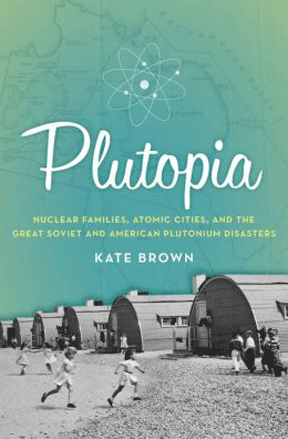
Kate Brown’s award-winning book, “Plutopia: Nuclear Families, Atomic Cities, and the Great Soviet and American Plutonium Disasters,” is a history of the Hanford plant and its Soviet doppelgänger, a plant in the Ural Mountains called Maiak. Brown points out that over the course of a few decades, the two nuclear sites spewed two times the radiation emitted in the Chernobyl explosion. Yet few Americans at the time, even those involved in plutonium production, realized this was going on or how dangerous it was.
Naturally, the hidden nature of the project meant that information was hard to come by. As Brown shows, even the experts, managers and scientists involved directly in overseeing the production process knew little about the seriousness of the risk. Doctors studying the effects of radiation on people didn’t have access to the research related to environmental pollution. Scientists studying fish die-offs had no way of connecting their findings to the deteriorating immune systems of humans in the same areas. Most poignantly, researchers measuring the effectiveness of nuclear bombs on the enemy did not communicate with researchers measuring the threat of nuclear bombs on the workers making them.
Consequences for the workers were grave. Hanford and Maiak’s hidden mega-pollution was collateral damage in the fight to win the Cold War. Russia, like the U.S., is still living with the damage, and trying to bury it, too.
Within two days of the tunnel collapse at the Hanford site this past May, workers filled the breach with 53 truckloads of dirt and narrowly avoided a radiological event. However, these eight railcars are hardly the only waste left behind in the U.S. from our cold conflict with the Soviet Union, in which our willingness to risk human and environmental health was proportionate to our fears. It’s going to be a while before it’s all cleaned up. In the meantime, hopefully our leaders will work to keep the new Cold War from getting any worse. https://www.forbes.com/sites/uhenergy/2017/12/04/the-hidden-costs-of-cold-war/#a3593c1136ff
Incident at Russia’s Mayak nuclear reprocessing plant may have caused radiation cloud over Europe
 Environmentalists point the finger of blame at Mayak, the plant to process Kola’s Cold War legacy, ByThomas Nilsen, – Barents Observer 30th Nov 2017
A mysterious cloud of radioactive ruthenium-106 blowing over Europe earlier
this autumn triggered many speculations about Russia trying to
‘cover-up’ a leak from the country’s largest nuclear waste treatment
facility.
Nadezhda Kutepova a local environmentalists from the closed city
of Ozyorsk near Mayak who was forced to flee Russia in 2015, now reveals
more inside information. Kutepova says Mayak was testing new equipment on
September 25 and 26 at the reprocessing plant and that something abnormal
may have happened.«Emission of ruthenium may come from the reprocessing
plant 235 or RT-1 in Mayak where the vitrification plant for very
high-level nuclear waste is located,» Kutepova tells.
She points to the new vitrification furnace which started operation last December and
experienced problems during construction and testing. «My idea is that the
furnace was built with a lot of problems that emerge in the operation and I
think this is the cause of the ruthenium-106 leak we saw in September,»
she explains.
Mayak has loads of high-level liquid radioactive waste that
needs to be stabilized and made safer and starting the new plant was,
according to Kutepova, rather urgent. She calls the equipment bought for
the electric furnace «low-quality» https://thebarentsobserver.com/en/node/3260
Russia slams North Korea’s nuclear gambling and US’ provocative conduct
Russia lambasts both North Korea’s nuclear gambling and US’ provocative conduct – Lavrov http://tass.com/politics/978758 December 02 MINSK, Moscow condemns both Pyongyang’s gambling with nuclear weapons and missiles and Washington’s provocative behavior, Russian Foreign Minister Sergei Lavrov told the Belarussian television STVon Saturday.
“Condemning Pyongyang’s nuclear missile gambling, we cannot but condemn our American counterparts’ provocative behavior. Unfortunately, they are trying to draw to their side the Japanese and South Koreans who will fall the first victims in case war breaks out on the Korean Peninsula,” Lavrov said.
Speaking about the missile launch conducted by North Korea earlier in the week, the Russian foreign minister pointed out that “the North Korean leader had not been involved in any reckless scheme over the past two months.”
“Simultaneously, in September our American counterparts made it clear that the next major military exercise off the Korean Peninsula had been scheduled for the next spring,” Lavrov said. “There came a hint that amid the current situation, if the pause, which naturally emerged in the US-South Korean drills, had been used by Pyongyang in order not to disturb the placidity, conditions could have been created for some sort of dialogue to start. We said we appreciated the stance and were working with Pyongyang.”
Lavrov pointed out that the Collective Security Treaty Organization (CSTO), a security alliance of former Soviet states, “abides largely by a unified stance” on the situation on the Korean Peninsula.
“We do not tolerate the DPRK’s nuclear weapon claims [the Democratic People’s Republic of Korea, or North Korea],” Lavrov said. “All the CSTO members support the resolution of the UN Security Council. We comply with the imposed sanctions.”
Simultaneously, the CSTO states “call to leave behind rhetoric, threats and insults and to find ways to restart the talks,” he said.
In the morning on November 29, North Korea conducted a missile launch, the first one since September 15. According to North Korea’s Central News Agency (KCNA), a Hwasong-15 missile covered a distance of 950 kilometers in 53 minutes, reaching an altitude of 4,475 kilometers. The Japanese Defense Ministry said the missile had fallen into the sea in Japan’s exclusive economic zone, 250 kilometers west off the coast of Japan’s Aomori Prefecture.
Russian refugee talks about radioactive leak, and Mayak living conditions
France TV 29th Nov 2017, [Machine Translation] Ruthenium leak: Russian refugee activist in France
tackles nuclear taboo in Russia. Today a Russian activist testifies about
the living conditions around the nuclear site of Maïak. She is convinced
that the ruthenium 106 found in Western Europe comes from a leak on this
site. https://www.francetvinfo.fr/replay-radio/c-est-ma-planete/fuite-de-ruthenium-une-militante-russe-refugiee-en-france-s-attaque-au-tabou-du-nucleaire-en-russie_2468374.html
Argayash, close to Russia’s Mayak Nuclear Facility, at the centre of radiation leaking
The Russian town in the shadow of a leaking nuclear plant https://www.ft.com/content/2d853158-d064-11e7-b781-794ce08b24dc
Authorities finally admit that Argayash was at the centre of a radiation cloud.
Henry Foy in Argayash , 24 Nov 17
Argayash is a cynical, mistrustful town. Decades of being lied to by the government about being down the road from a leaking nuclear plant does that to a place. So too does watching generations of people dying of radiation-related ailments while officials assure them nothing is amiss.
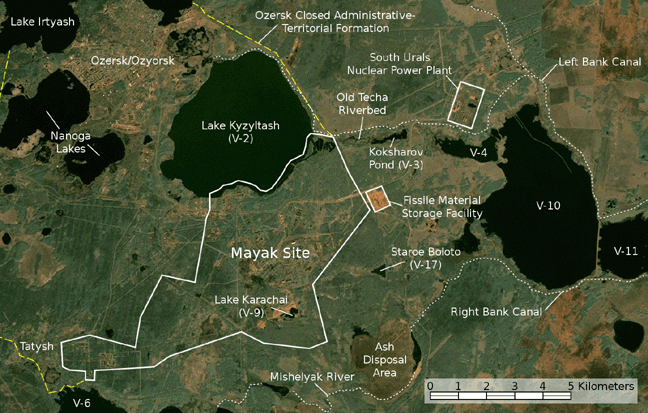
A small, two-road settlement where homes roofed with corrugated iron and Soviet-era Lada cars nod to its poverty, Argayash is one of a handful of towns surrounding the Mayak Production Facility in southern Russia, one of the world’s biggest radiation emitters where a litany of tragic accidents has made it a byword for the dangers of the atomic industry.
This week, 76 years after radiation first began seeping from Mayak into the surrounding rivers, lakes and atmosphere, Russian authorities admitted that Argayash was at the centre of a radiation cloud containing “exceptionally high” levels of radioactive isotope ruthenium-106, which spread so far west that it reached France. The radiation was detected by Russia’s meteoological agency in late September, but only revealed on Monday, after local politicians had spent weeks denying rumours of a leak and rubbishing reports from EU agencies that had tracked the cloud’s movement.
The levels of the isotope in Argayash were almost 1,000 times the normal level. Officials say it is not harmful to public health. “Nobody tells us anything. They keep it secret,” says Lilia Galimzhanova, a cook at a café in the town. “We are afraid. We are afraid for our children and grandchildren.” “But we know that the air, the environment is very bad here,” she says. Her 80-year-old mother suffers from radiation poisoning from Mayak. “We are not protected by anyone here . . . We are survivors.”
Ms Galimzhanova only heard of the radiation that had enveloped her town when a friend in Germany read about it in a western newspaper. Before the authorities admitted its existence, text messages had been sent to residents saying that high levels of pollution from nearby industrial factories meant people should stay indoors. Regardless of the potential health risks, many here say the government’s initial silence, denial and obfuscation has dredged up painful memories of a past that refuses to stay buried. Secretly constructed in the 1940s, Mayak was at the forefront of the USSR’s scramble to catch up with the US nuclear programme. As it raced to produce weapons-grade plutonium, a vast amount of nuclear waste was discharged into nearby lakes and the Techa river. Then, in 1957, nuclear waste storage tanks at the site exploded, raining fallout over hundreds of towns — and releasing more radiation than any other nuclear accident except Chernobyl and Fukushima. Ten years later, an adjacent reservoir used for waste disposal dried out, and powdered radioactive dust was blown over the area.
Lobbyists scramble to market nuclear submarines to India
India Wants Second Nuclear Submarine From Russia. Lies By Lobbyists Erupt
Russian news portal Kommersant reported that the Indian Navy allowed a US technical crew into top secret compartments of India’s existing Russian-built nuclear submarine, the INS Chakra NDTV All India by Vishnu Som : November 10, 2017 NEW DELHI:
According to Kommersant, which referred to this as “an unprecedented scandal,” the incident “threatens to seriously complicate the negotiations both on the lease of the second nuclear submarine, and on other projects in the field of military-technical cooperation.”
The Chakra, an Akula-2 class submarine, widely considered among the world’s most sophisticated, has been leased by India for 10 years but all ownership rights reside with Russia.
Today, another Russian news portal, NEWS.ru, has debunked the account of the Kommersant and states that French lobbyists have an ulterior role in spreading misinformation to further their own chances of selling a nuclear-powered attack submarine to India. NEWS.ru quotes a source stating “there is complete confidence that the throw-in is organised by the lobbyists of France, and it’s pretty high quality.” According to this source, “In addition to the contract for the construction of non-nuclear boats such the Scorpene [now being inducted by the Indian Navy,] the French have a great desire to enter the Indian nuclear fleet.”
France, the article states, is also aggressively trying to participate in India’s programme to construct a second home-grown aircraft carrier. The first indigenous carrier, INS Vikrant is being built in Kochi using technology from a host of countries including Russia……..
At the time, the French newspaper Le Monde, quoting multiple sources had said that the leak of this data was driven by competition between the French designer of the Scorpene Class submarine and a German firm as they compete to win international orders. https://www.ndtv.com/india-news/not-true-that-us-officers-allowed-on-russian-submarine-in-vizag-sources-1773761
Russia’s Rosatom touting for nuclear sales to Saudi Arabia
Russia’s Rosatom hopes to win Saudi nuclear plants’ tender, DANANG, Vietnam, Nov 10 (Reuters) – Russian state nuclear company Rosatom hopes to win a tender announced by Saudi Arabia to build nuclear plants in the kingdom, Alexei Likhachyov, head of Rosatom, told reporters.
“As far as I understand, they (Saudi Arabia) should make a decision next year about the construction and a constructor. We hope it will be us,” he said.
Rosatom has sent initial proposals to Saudi Arabia for nuclear power generation and would make a bid if a tender is announced, the company said earlier this month.
Saudi Arabia is considering building 17.6 gigawatts of nuclear capacity by 2032, the equivalent of about 17 reactors, making it one of the biggest prospects for an industry struggling after the 2011 nuclear disaster in Japan. (Reporting by Denis Pinchuk; writing by Katya Golubkova; editing by Vladimir Soldatkin) DANANG, Vietnam, Nov 10 (Reuters) – Russian state nuclear company Rosatom hopes to win a tender announced by Saudi Arabia to build nuclear plants in the kingdom, Alexei Likhachyov, head of Rosatom, told reporters.
“As far as I understand, they (Saudi Arabia) should make a decision next year about the construction and a constructor. We hope it will be us,” he said.
Rosatom has sent initial proposals to Saudi Arabia for nuclear power generation and would make a bid if a tender is announced, the company said earlier this month.
Saudi Arabia is considering building 17.6 gigawatts of nuclear capacity by 2032, the equivalent of about 17 reactors, making it one of the biggest prospects for an industry struggling after the 2011 nuclear disaster in Japan. (Reporting by Denis Pinchuk; writing by Katya Golubkova; editing by Vladimir Soldatkin)
1 This Month

of the week – Shut Down Drone Warfare!


Tell the Ukrainian Government to Drop Prosecution of Peace Activist Yurii Sheliazhenko

Petition to revoke the licensing of the Near Surface Nuclear Disposal Facility (NSDF) at Chalk River. https://www.ourcommons.ca/petitions/en/Petition/Details?Petition=e-7247
To see nuclear-related stories in greater depth and intensity – go to https://nuclearinformation.wordpress.com
-
Archives
- April 2026 (103)
- March 2026 (251)
- February 2026 (268)
- January 2026 (308)
- December 2025 (358)
- November 2025 (359)
- October 2025 (376)
- September 2025 (257)
- August 2025 (319)
- July 2025 (230)
- June 2025 (348)
- May 2025 (261)
-
Categories
- 1
- 1 NUCLEAR ISSUES
- business and costs
- climate change
- culture and arts
- ENERGY
- environment
- health
- history
- indigenous issues
- Legal
- marketing of nuclear
- media
- opposition to nuclear
- PERSONAL STORIES
- politics
- politics international
- Religion and ethics
- safety
- secrets,lies and civil liberties
- spinbuster
- technology
- Uranium
- wastes
- weapons and war
- Women
- 2 WORLD
- ACTION
- AFRICA
- Atrocities
- AUSTRALIA
- Christina's notes
- Christina's themes
- culture and arts
- Events
- Fuk 2022
- Fuk 2023
- Fukushima 2017
- Fukushima 2018
- fukushima 2019
- Fukushima 2020
- Fukushima 2021
- general
- global warming
- Humour (God we need it)
- Nuclear
- RARE EARTHS
- Reference
- resources – print
- Resources -audiovicual
- Weekly Newsletter
- World
- World Nuclear
- YouTube
-
RSS
Entries RSS
Comments RSS
 nuclear-news