A forgotten nuclear disaster? 1985 Russian submarine accident
In 1985, a Russian Submarine Created an Atomic Disaster. The Radiation Lingers to This Day. Kyle Mizokami, 27 Feb 18,
According to Nuclear Risks, the accident scene was heavily contaminated with radioactivity. Gamma ray radiation was not particularly bad; at an exposure rate of five millisieverts per hour, it was the equivalent of getting a chest CT scan every hour. However, the explosion also released 259 petabecquerels of radioactive particles, including twenty-nine gigabecquerels of iodine-131, a known cause of cancer. This bode very badly for the emergency cleanup crews, especially firefighters who needed to get close to the explosion site, and the nearby village of Shkotovo-22. Forty-nine members of the cleanup crew displayed symptoms of radiation sickness, ten of them displaying acute symptoms.
In 1985, a Soviet submarine undergoing a delicate refueling procedure experienced a freak accident that killed ten naval personnel. The fuel involved was not diesel, but nuclear, and the resulting environmental disaster contaminated the area with dangerous, lasting radiation. The incident, which remained secret until after the demise of the USSR itself, was one of many nuclear accidents the Soviet Navy experienced during the Cold War.
The Soviet Union’s nuclear war planners had a difficult time targeting the United States. While the United States virtually encircled the enormous socialist country with nuclear missiles in countries such as Turkey and Japan, the Western Hemisphere offered no refuge for Soviet deployments in-kind.
One solution was the early development of nuclear cruise missile submarines. These submarines, known as the Echo I and Echo II classes, were equipped with six and eight P-5 “Pyatyorka” nuclear land attack cruise missiles, respectively. Nicknamed “Shaddock” by NATO, the P-5 was a subsonic missile with a range of 310 miles and 200- or 350-kiloton nuclear warhead. The P-5 had a circular error probable of 1.86 miles, meaning half of the missiles aimed at a target would land within that distance, while the other half would land farther away.
The missiles were stored in large horizontal silos along the deck of the submarine. In order to launch a P-5 missile, the submarine would surface, deploy and activate a tracking radar, then feed guidance information to the missile while it flew at high altitude. The system was imperfect—the command link was vulnerable to jamming, and the submarine needed to remain on the surface, helpless against patrol aircraft and ships, until the missile reached the target. Eventually the P-5 missiles were withdrawn and the P-5 missile was replaced with the P-6, a similar weapon but one with its own radar seeker for attacking U.S. aircraft carriers.
The introduction of the P-6 gave the Echo II a new lease on life. ……
On August 10, the submarine was in the process of being refueled. Reportedly, the reactor lid—complete with new nuclear fuel rods—was lifted as part of the process. A beam was placed over the lid to prevent it from being lifted any higher, but incompetent handling apparently resulted in the rods being lifted too high into the air. (One account has a wave generated by a passing motor torpedo boat rocking the submarine in its berth, also raising the rods too high.) This resulted in the starboard reactor achieving critical mass, followed by a chain reaction and explosion.
The explosion blew out the reactor’s twelve-ton lid—and fuel rods—and ruptured the pressure hull. The reactor core was destroyed, and eight officers and two enlisted men standing nearby were killed instantly. A the blast threw debris was thrown into the air, and a plume of fallout 650 meters wide by 3.5 kilometers long traveled downwind on the Dunay Peninsula. More debris and the isotope Cobalt-60 was thrown overboard and onto the nearby docks.
According to Nuclear Risks, the accident scene was heavily contaminated with radioactivity. Gamma ray radiation was not particularly bad; at an exposure rate of five millisieverts per hour, it was the equivalent of getting a chest CT scan every hour. However, the explosion also released 259 petabecquerels of radioactive particles, including twenty-nine gigabecquerels of iodine-131, a known cause of cancer. This bode very badly for the emergency cleanup crews, especially firefighters who needed to get close to the explosion site, and the nearby village of Shkotovo-22. Forty-nine members of the cleanup crew displayed symptoms of radiation sickness, ten of them displaying acute symptoms. …….
Russia’s Rosatom turning to wind power, as its nuclear export industry falters

 Rosatom stakes out wind power to gird against blustery nuclear futures, Russia’s state nuclear corporation unveiled plans this week to build up to 600 megawatts of wind energy in the Krasnodar region in southern Russia in what appears to be part of the company’s tentative diversification within renewable energy. Bellona, by Charles Digges
“…….. the new wind farm and several battery production ventures the company is pursuing come as an evident bow to declining global demand for the nuclear power plant builds on which until recently the company had staked its future growth.
The new wind plant will be built by VetroOGK, a subsidiary of Rosatom, and will comprise a 150 megawatt park in the Shovgenovsky and Giaginsky districts of the southerly Republic of Adygea using equipment supplied by Dutch wind turbine maker Lagerwey, according to a Rosatom release. It expects to obtain construction permits for the project in March or April, while commissioning is scheduled for December 2018 or January 2019.
The VetroOGK had likewise inked a letter of intention to install another 200 megawatts of wind power in the Krasnodar Region at a wind park the company says it will open by the end of 2018. For the two parks Rosatom has invested $364 million, though its release also anticipates further funding for a 300 megawatt wind park in the Rostov Region, though the start date for that project remains unclear.
Though it would be a stretch to suggest that the wind projects could financially buoy the consolidated bulk of Russia’s monolithic nuclear monopoly, they nonetheless acknowledge sour facts about the company’s prospects for building its AES-2006, or VVER-1200, reactor package on the foreign market.
Speaking last summer at Novosibirsk’s Tekhnoprom-2017 technical trade conference, the company’s deputy director, Vyacheslav Pershukov said Rosatom’s international nuclear market was “exhausted” – the starkest acknowledgment yet from the company that its marquee product was selling poorly. …….
Speaking last summer at Novosibirsk’s Tekhnoprom-2017 technical trade conference, the company’s deputy director, Vyacheslav Pershukov said Rosatom’s international nuclear market was “exhausted” – the starkest acknowledgment yet from the company that its marquee product was selling poorly. ……http://bellona.org/news/nuclear-issues/2018-02-rosatom-stakes-out-wind-power-to-gird-against-blustery-nuclear-futures
Not just Russian but ANY nuclear new-build is a poor choice for South Africa
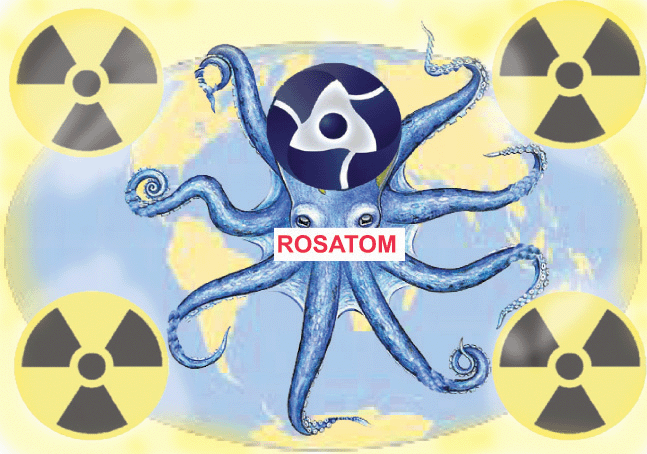 South Africa’s Electricity Choice, Part 4: The dangers of dealing with Russia, Daily Maverick, ANTON EBERHARD & AMORY LOVINS, SOUTH AFRICA, 19 FEB 2018
Mayak area- Radiation levels last fall 1,000 times above normal
Radiation levels near this Siberian village were 1,000 times above normal last fall. But no one worried much, LA Times, sabra.ayres@latimes.com, KHUDAIBERDYNSK, RUSSIA “…. this Siberian landscape on the edge of the Ural Mountains bore the brunt of one of the world’s worst nuclear accidents. On Sept. 29, 1957, decades before Three Mile Island, Chernobyl and Fukushima entered the lexicon of landmark nuclear disasters, a buried cache of liquid radioactive waste from Mayak exploded. More than a quarter-million people were exposed to radiation, and nearly two dozen villages, home to more than 10,000 people, had to be vacated forever.
From March 1949 to November 1951, environmental activists have learned, radioactive waste was poured directly into the nearby Techa River, and nearby lakes were inundated with pollution as well.
The Soviet government kept the accident secret until 1976, when a dissident published an article about it in New Scientist magazine. By that time, thousands of people who had remained living in the area around the plant had fallen ill with cancer or given birth to children with birth defects…….
over the last few months, residents here have been reminded that the threat posed by Mayak, operated inside an officially “closed” city that is off limits to most outsiders, has never really gone away.
In October, European radiation safety agencies detected a cloud containing a radioactive isotope, ruthenium-106, that could be traced to somewhere near Mayak.
The Russian government and its nuclear agency issued a series of denials. Then on Nov. 21, nearly two months after the French and German safety agencies said they had first detected the cloud over Europe, Roshydromet, Russia’s meteorological agency, confirmed that levels of ruthenium-106 had been recorded in late September at levels almost 1,000 times higher than normal in Argayash and 440 times higher in Novogorny, two frequent testing spots within 10 miles of Mayak.
That meant alarming levels of radiation… halfway between Argayash and Novogorny, on the road to Ozersk, the closed city…….
Rusatom, the Russian state nuclear energy company that owns Mayak, continues to deny that its facility could be the source of the cloud that drifted over Europe in the fall.
Test samples from Mayak showed “no presence of ruthenium-106,” a Russian interagency investigative commission said in a December report, suggesting that the emissions could have come from a satellite that burned as it fell from the sky.
The French nuclear safety agency rejected that hypothesis, saying there was no record of a satellite falling to Earth during the period of the radioactive cloud’s detection over Europe.
Still, Russian officials seem determined to dispel any fears. Shortly after the news broke of the unusual levels of ruthenium-106, Chelyabinsk’s head oncologist, Andrei Vazhenin, said there was no public health danger; ruthenium-106, he said, isn’t a “pure carcinogenic.”
He had a suggestion for anyone who was worried about their health: They should stay indoors, he said, and “watch football and drink beer.” http://www.latimes.com/world/la-fg-russia-mayak-20180216-story.html

Russia marketing nuclear power to Congo
 Russia and Congo to cooperate in nuclear power, WNN, 14 February 2018 Rosatom and the Ministry of Scientific Research and Technological Innovations of the Republic of Congo have signed a Memorandum of Understanding (MoU) on cooperation in the peaceful uses of nuclear energy.
The document was signed yesterday in Moscow by the Russian state nuclear corporation’s deputy director general for international relations, Nikolay Spassky, and the ambassador extraordinary and plenipotentiary of the Republic of the Congo in Russia, David Maduka.
The document establishes a legal basis for the implementation of bilateral cooperation in a wide range of areas, Rosatom said. These include the development of nuclear infrastructure in the Republic of Congo and programmes aimed at increased awareness of nuclear technologies and their applications…..http://www.world-nuclear-news.org/NP-Russia-and-Congo-to-cooperate-in-nuclear-power-14021801.html
Residents of Russia’s Yaroslavl region got a “false’ radiation alert scare
‘False’ Radiation Alert Causes Scare In Russia https://www.rferl.org/a/russia-yaroslavl-radiation-scare/29037176.html Residents of Russia’s Yaroslavl region got a scare when local TV and radio stations broadcast a radiation warning, but the Emergency Situations Ministry said the broadcast was a mistake.
The prerecorded warning, which aired at about 9 a.m., alerted residents to what it said were high levels of radiation in the atmosphere in the region 250 kilometers northeast of Moscow.
It advised people to protect themselves, tightly close their homes or offices and stay inside, and secure food and water from possible contamination by radiation.
In a statement, the regional branch of the Emergency Situations Ministry said that a technical glitch caused the “false” warning to be broadcast. It urged residents to “remain calm” and said radiation levels were “within the norm.”
In a short video statement, the senior regional emergency official, Yevgeny Shumilin, said the authorities were investigating what caused the message to be broadcast.
Blow to Russia’s nuclear marketing ambitions – other investors back out of Turkey nuclear build
Bellona 12th Feb 2018, In a major blow to one of Russia’s most ambitious international nuclear
deals, three investors backed out of the Akkuyu Nuclear Power Plant,
leaving Russian state nuclear corporation Rosatom adrift on how to finish
the $20 billion station.
Russian President Vladimir Putin touted progress
on the plant as recently as November during a state visit to the Turkish
capital, and the Kremlin propaganda news network RT pushed the narrative
that the plant’s first reactor would be finished ahead of its scheduled
2023 launch date.
That was all thrown into doubt last week when a Turkish
consortium, representing 49 percent of the funding for the Akkuyu plant’s
construction, backed out of the deal, citing a failure to agree on a number
of project’s “commercial conditions,” Russian and Turkish news
outlets said. Rosatom is now in talks to secure other investors, but the
corporation wont’ say by how long the loss of half the project’s
financing will delay the station’s launch, or by how much the project’s
price tag is likely to increase as a result of the back out.
http://bellona.org/news/nuclear-issues/2018-02-investor-pullout-leaves-rosatom-at-sea-with-its-nuclear-project-in-turkey
Arrest of Russian nuclear scientists for allegedly mining crypto-currencies.
BBC 9th Feb 2018, Russian security officers have arrested several scientists working at a
top-secret Russian nuclear warhead facility for allegedly mining
crypto-currencies. The suspects had tried to use one of Russia’s most
powerful supercomputers to mine Bitcoins, media reports say.
The Federal Nuclear Centre in Sarov, western Russia, is a restricted area. The centre’s
press service said: “There has been an unsanctioned attempt to use computer
facilities for private purposes including so-called mining.” The
supercomputer was not supposed to be connected to the internet – to prevent
intrusion – and once the scientists attempted to do so, the nuclear
centre’s security department was alerted. They were handed over to the
Federal Security Service (FSB), the Russian news service Mash says.
http://www.bbc.co.uk/news/world-europe-43003740
Russia’s nuclear macho men spin propaganda to Indian kids
 I had a bit of a laugh, reading this one.
Russia is using the same pathetic old comics and jolly stories that Western nuclear companies have now  given up on.
And once again – it’s the macho nuclear men that are doing the nuclear spinning to kids. (The West now uses sophisticated young women as much as they can, with more subtle propaganda)
Nuclear ABC: Rosatom Explains Nuclear Science to Indian School Children, https://sputniknews.com/asia/201802091061516702-nuclear-eduction-indian-children/

New Delhi (Sputnik) — During the festival that was held from 6 to 9 February, experts gave presentations and held interactive sessions with children and teachers from different schools in Delhi. The occasion was designed to nurture the interest of children towards nuclear physics, Rosatom officials told Sputnik.
Nuclear experts and scientists of Rosatom also visited some schools in Delhi and conducted awareness sessions for children on the peaceful use of the atomic energy. Rosatom also released a book titled ‘Nuclear ABC’ in English and Hindi to help in the awareness drive. The book was jointly released on Thursday by Russian Ambassador to India Nikolay Kudashev, Professor Emeritus of Jawaharlal University R Rajaraman, Fedor Rozovskiy, Director of Russian Center along with officials of Rosatom at the Russian Centre for Science and Culture, New Delhi. The book launch was attended by hundreds of school children.
“The book is yet another instance of the rich history of Indo-Russian scientific cooperation dating back to the Soviet era,” professor R. Rajaraman said during the launch.
Prof Rajaraman hailed Russia’s assistance in achieving its nuclear energy targets.
Russian Deputy Foreign Minister says that USA’s new Nuclear Posture, if adopted, will destroy global strategic stability
Adoption of revamped nuclear doctrine by US destroys global strategic stability — diplomat http://tass.com/politics/989106, It’s important to pinpoint the fact openly, the Russian deputy foreign minister said , NOVOSIBIRSK, February 8. /TASS/. Adoption of a revamped nuclear doctrine by the US destroys global strategic stability, Russian Deputy Foreign Minister Sergei Ryabkov said on Thursday.
“By passing the revamped nuclear doctrine, the US Administration undermines strategic stability if not simply destroys it in the most immediate way,” he said. “It’s important to pinpoint the fact openly and that’s what we’ll be doing.”
“I hope we’ll have an opportunity to discuss it with my counterpart [US Undersecretary of State for Political Affairs Thomas] Shannon shortly,” Ryabkov said.
Russia postponing new nuclear reactors because of costs
 Nucnet 5th Feb 2018, Russia’s state nuclear energy corporation Rosatom is ready to postpone
the commissioning of two nuclear power units for two years in an effort to
slow down increases in energy prices, the state-owned Tass news agency
said.
said commissioning of Novovoronezh 2-2, planned for January 2019, would be
postponed by a year, and commissioning of Leningrad 2-2, planned for
February 2020, by two years.
a government-regulated fixed power supply agreement with wholesale
consumers, any return on nuclear investment must be at least 10.5%, which
would mean electricity prices for the consumers would increase to meet the
target.
2008 to guarantee returns on investment in generating capacity. The final
wholesale prices are usually higher than the prevailing market price to
compensate costs incurred by the investor during construction. The
agreements include government-regulated price levels for various types of
consumer, dependent on their maximum consumption. Neither Tass nor Rosatom
gave details, although Tass said postponing commissioning of the units will
lead to a reduction in the rate of electricity price growth in 2019 from
12.9% to 11.1%. https://www.nucnet.org/all-the-news/2018/02/05/russia-ready-to-postpone-commissioning-of-two-nuclear-plants-says-official-agency
USA- Russia New START Treaty takes effect – with central limits on strategic arsenals for 7 years

The United States of America and the Russian Federation have implemented the Treaty on Measures for the Further Reduction and Limitation of Strategic Offensive Arms (New START Treaty) for seven years. February 5, 2018 marks the date that the Treaty’s central limits on each country’s strategic nuclear arsenal take effect.
The United States completed its reductions and achieved these limits in August 2017. The Russian Federation has repeatedly stated its commitment to the New START Treaty, including meeting the central limits, and we expect our upcoming data exchange under the Treaty to reaffirm that commitment.
Implementation of the New START Treaty enhances the safety and security of the United States and our allies and makes strategic relations between the United States and the Russian Federation more stable, transparent, and predictable; critically important at a time when trust in the relationship has deteriorated, and the threat of miscalculation and misperception has risen. The Treaty exemplifies an enduring commitment by both parties to cooperate on issues affecting the strategic relationship and international security. The United States looks forward to continuing implementation of the Treaty with the Russian Federation.
The United States and the Russian Federation will exchange data on their respective strategic nuclear arsenals within the next month, as we have done twice per year over the last seven years in accordance with the Treaty. Through the Treaty’s verification regime, which includes short-notice, on-site inspections at military bases and facilities, the United States is able to verify the data provided by the Russian Federation regarding its strategic nuclear arsenal. The verification regime provides both countries insight into each other’s strategic nuclear delivery systems, warheads, and facilities, as well as data exchanges to track the status and makeup of nuclear weapons systems.
The recently released U.S. Nuclear Posture Review notes that arms control can contribute to U.S. security by helping to manage strategic competition among states. The United States remains committed to arms control efforts that advance U.S., allied, and partner security. The United States will continue to fully implement the New START Treaty and remains committed to working with others, including the Russian Federation, to create the conditions to support the ultimate goal of the global elimination of nuclear weapons. The New START Treaty remains a critical component for supporting global non-proliferation efforts and strategic stability between the United States and the Russian Federation. Through implementing the New START Treaty, the United States continues to demonstrate its commitment to fulfilling its arms control obligations, including under the Treaty on the Non-Proliferation of Nuclear Weapons.
Trump’s Nuclear Posture Review considers Russian “doomsday weapon”, though it might not be real
 Buried In Trump’s Nuclear Report: A Russian Doomsday Weapon, NPR , February 2, 2018 GEOFF BRUMFIEL Today, the Trump administration released a report on the state of America’s nuclear weaponry. The assessment, known as a Nuclear Posture Review, mainly concerns U.S. nukes and missiles.
But buried in the plan is a mention of a mysterious Russian weapon called “Status-6.” On paper, at least, Status-6 appears to be a kind of doomsday device. The report refers to it as “a new intercontinental, nuclear-armed, nuclear-powered, undersea autonomous torpedo.”
“The radius of total or near-total destruction is the size of a pretty large metropolitan area, actually,” says Edward Geist, a Russia specialist at the RAND Corporation who has spent time looking at the weapon. “It’s difficult to imagine in normal terms.”……
Status-6 looks like a giant torpedo about a third the length of a big Russian submarine. According to the slide, it is nuclear-powered, meaning it can roam for months and even possibly years beneath the ocean without surfacing. Its payload is a nuclear warhead “many tens of megatons in yield,” Geist says.
That’s thousands of times more powerful than the bombs dropped at the end of World War II and more powerful than anything currently in the U.S. and Russian arsenals.
Status-6 would launch from beneath a Russian submarine. It would shoot at a depth too deep to be intercepted, and travel for thousands of miles. Upon reaching its target along the U.S. coastline, it would detonate, swallowing up whatever city happened to be nearby.
“The only possible U.S. targets are large port cities,” says Mark Schneider, a senior analyst with the National Institute for Public Policy wrote in an e-mail. “The detonation of Status-6 in any of them would essentially wipe out their population into the far suburbs.”
“The detonation would cause a very large amount of radioactive fallout,” adds Pavel Podvig, an arms control expert who runs a blog called Russian Strategic Nuclear Forces. Podvig believes the weapon could potentially bathe the entire Northeast Corridor in radioactive soot.
Status-6 would probably be used as a “third-strike” weapon of last resort. If Russia fell under attack from the U.S. and couldn’t retaliate with its missiles, it might trigger Status-6: A doomsday machine. Or at least a doomsday-ish machine.
Then again, the whole thing might be a fake.
“The drawing of this drone looks more like an enlarged drawing of a smaller torpedo,” says Podvig. In other words, it looks like the Russians may have just taken some torpedo clip-art, blown it up to terrifying size and then broadcast it on state television.
Why?
“It’s a way to get our attention,” says Geist.
Geist says that the “leak” of Status-6 was deliberate. Russia worries that U.S. missile defenses might be able to shoot down its missiles in a nuclear war. By showing a plan for Status-6, Russia is warning the U.S. that if it continues to build such defensive systems, then Russia will find another way to strike: one that can’t be intercepted.
“My read of the whole Status-6 slide leak is that the Russians were trying to send us a message,” Geist says.
Podvig agrees that the leak of Status-6 is probably just a warning shot. But the fact it appeared in the Pentagon’s newest report on nuclear weapons shows that some war planners are taking the idea seriously.
There may be some politics involved in that decision as well, says Hans Kristensen of the Federation of American Scientists. The Trump administration is pushing hard for upgrades to America’s nuclear arsenal. In his State of the Union address, the president called for making the arsenal “so strong and so powerful that it will deter any acts of aggression by any other nation or anyone else.”
Citing Status-6 helps to build the case that upgrades to American nukes are needed, Kristensen says.
For all the rhetoric around Status-6, Podvig and Geist both believe that the program isn’t completely made-up. Geist says a long-range underwater drone without a nuclear warhead would be a useful weapon……..https://www.npr.org/sections/parallels/2018/02/02/582087310/buried-in-trumps-nuclear-report-a-russian-doomsday-weapon
Russia’s pension funds for elderly – used to pay for building Finland’s nuclear power plant
 “Finland’s Pyhäjoki nuclear plant takes our pension money” While four million elderly Russians live below the poverty line, the country’s pension fund pays for Rosatom-backed nuclear plant in northern-Finland. «Deeply unfair,» says Oleg Bodrov from the closed town of Sosnovy Bor near St. Petersburg. Barents Observer By Thomas Nilsen, January 29, 2018
1 This Month

of the week – Shut Down Drone Warfare!


Tell the Ukrainian Government to Drop Prosecution of Peace Activist Yurii Sheliazhenko

Petition to revoke the licensing of the Near Surface Nuclear Disposal Facility (NSDF) at Chalk River. https://www.ourcommons.ca/petitions/en/Petition/Details?Petition=e-7247
To see nuclear-related stories in greater depth and intensity – go to https://nuclearinformation.wordpress.com
-
Archives
- April 2026 (103)
- March 2026 (251)
- February 2026 (268)
- January 2026 (308)
- December 2025 (358)
- November 2025 (359)
- October 2025 (376)
- September 2025 (257)
- August 2025 (319)
- July 2025 (230)
- June 2025 (348)
- May 2025 (261)
-
Categories
- 1
- 1 NUCLEAR ISSUES
- business and costs
- climate change
- culture and arts
- ENERGY
- environment
- health
- history
- indigenous issues
- Legal
- marketing of nuclear
- media
- opposition to nuclear
- PERSONAL STORIES
- politics
- politics international
- Religion and ethics
- safety
- secrets,lies and civil liberties
- spinbuster
- technology
- Uranium
- wastes
- weapons and war
- Women
- 2 WORLD
- ACTION
- AFRICA
- Atrocities
- AUSTRALIA
- Christina's notes
- Christina's themes
- culture and arts
- Events
- Fuk 2022
- Fuk 2023
- Fukushima 2017
- Fukushima 2018
- fukushima 2019
- Fukushima 2020
- Fukushima 2021
- general
- global warming
- Humour (God we need it)
- Nuclear
- RARE EARTHS
- Reference
- resources – print
- Resources -audiovicual
- Weekly Newsletter
- World
- World Nuclear
- YouTube
-
RSS
Entries RSS
Comments RSS
 nuclear-news