Russian President Vladimir Putin warns of global ‘chaos’ if West strikes Syria again, ABC News 16 Apr 18, Russian President Vladimir Putin has warned that further Western attacks on Syria would bring chaos to world affairs, as Washington prepared to increase pressure on Russia with new economic sanctions.
Key points:
Vladimir Putin said further attacks on Syria will bring “chaos” in world affairs
America accused Russia of blocking attempts to investigate Syria’s chemical weapons capabilities
New sanctions against Russia will target companies linked to Syria
In a telephone conversation with his Iranian counterpart Hassan Rouhani, Mr Putin and Mr Rouhani agreed the Western strikes had damaged the chances of achieving a political resolution in the seven-year Syria conflict, according to a Kremlin statement.
“Vladimir Putin, in particular, stressed that if such actions committed in violation of the UN Charter continue, then it will inevitably lead to chaos in international relations,” the Kremlin statement said.
Syria: US, British and French forces launch air strikes in response to chemical weapons attack,
US, British and French forces have pounded chemical weapons sites in Syria with air strikes in response to an alleged poison gas attack that killed dozens in the rebel-held town of Douma last week.
Key points:
US, UK and France hit three chemical weapons sites in Syria
US Defence Secretary says strikes were a “one-time shot”
Strikes biggest intervention yet by Western powers against Assad regime
In a televised address to the nation, US President Donald Trump said the three nations had “marshalled their righteous power against barbarism and brutality”.
The strikes were the biggest intervention by Western powers against President Bashar al-Assad in the country’s seven-year-old civil war, which has pitted the US and its allies against Russia.
The Pentagon said the strikes targeted a research centre in Damascus, along with a chemical weapons storage facility and command post west of Homs……
British Prime Minister Theresa May said the strikes were not about intervening in a civil war nor were they about a regime change.
“We cannot allow the use of chemical weapons to become normalised within Syria, on the streets of the UK or anywhere else in our world,” Ms May said…….
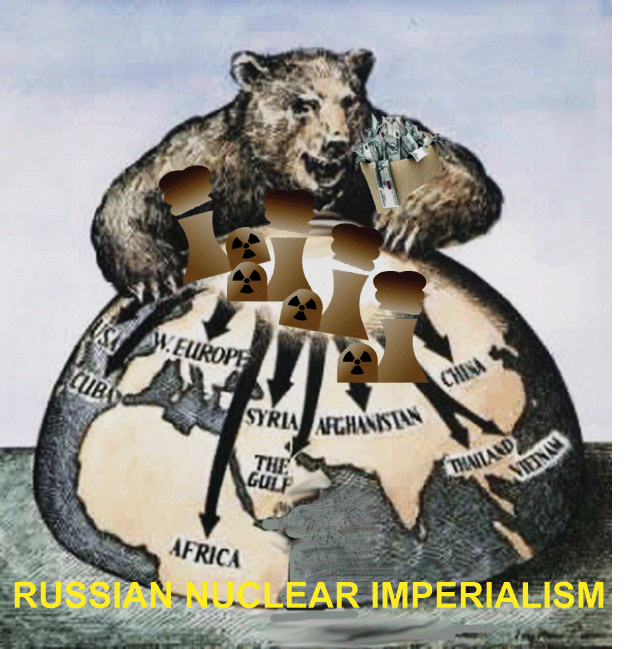
Vladimir Putin and Recep Tayyip Erdogan to launch Turkey’s first nuclear power plant, ABC News, 3 Apr 18 The leaders of Russia and Turkey are scheduled to launch the start of the construction of Turkey’s first nuclear power plant as ties between the countries deepen.
Russia’s Vladimir Putin, on his first foreign visit since re-election on March 18, arrived in Ankara on Tuesday for talks with Turkey’s Recep Tayyip Erdogan.
The two will remotely launch the construction of the Russian-made Akkuyu nuclear plant on the Mediterranean coast.
Russia Almost Brought Back a Terrifying Weapon: Nuclear ICBM’s on Trains, National Interest Robert Beckhusen, 3 Apr 18,
In October 1987, the first rail ICBM became operational in the form of the “Moldets,” a train armed with a 77-foot-long RT-23 — a type of ICBM which was also stored in silos — carrying 10 multiple-reentry warheads with 550 kilotons of explosive power each. In the 1990s and 2000s after the START II treaty, Russia decommissioned these missiles, which NATO referred to as the SS-23 Scalpel. The Kremlin produced 12 of these trains.
In 2013, the Russian military announced it would bring back rail-mobile intercontinental ballistic missiles. In other words, trains with big nukes crammed inside, capable of darting around Russia, raising their launchers and firing at a moment’s notice. It was called Barguzin and would begin testing in 2019.
That was the idea. In December 2017, the Russian government put the Barguzin project on hiatus, saving the world from the specter of doomsday trains roaming Siberia. The ostensible reason — the weapon is too expensive, according to Rossiyskaya Gazeta, the government’s paper of record.
The Barguzin project was a revival of a retired leg of the Soviet Union’s ground-based nuclear “triad.” While the Soviets had nuke-equipped submarines and nuclear-armed bombers, its ground-based component had nuclear missiles mounted on huge trucks, inside underground silos and on trains. The Soviet military first signed the order for the creation of rail-mobile ICBMs in 1969, but the launchers came later.
In October 1987, the first rail ICBM became operational in the form of the “Moldets,” a train armed with a 77-foot-long RT-23 — a type of ICBM which was also stored in silos — carrying 10 multiple-reentry warheads with 550 kilotons of explosive power each. In the 1990s and 2000s after the START II treaty, Russia decommissioned these missiles, which NATO referred to as the SS-23 Scalpel. The Kremlin produced 12 of these trains.
And that was the end of Russia’s rail-mobile missiles until the Kremlin announced in 2013 that it would create a new nuke-armed train under the moniker Barguzin, or BZhRK, this time equipped with the more advanced RS-24 Yars ICBM.
The RS-24 has a similar range to the RT-23 but is three meters shorter and weighs half as much — a considerable advantage for mobile missiles. The RS-24 is also, by the way, road-mobile.
……….During peacetime they require a network of bases for storage and maintenance, where international treaties require them to stay, and extensive security detachments to protect the missiles when they move during wartime. And they’re still stuck on railroad tracks — so U.S. spies have a general idea of where to look.
Which also begs the question as to whether the nuclear-war trains could even make it out of their bases in time before incoming missiles hit in the opening minutes of a nuclear war. Sure enough, the Pentagon studied the issue during the Cold War, and even built two prototype train cars intended for the Peacekeeper ICBM, but found them to be not worth the cost and rather vulnerable……. http://nationalinterest.org/blog/the-buzz/russia-almost-brought-back-terrifying-weapon-nuclear-icbms-25193
Russia just tested its ‘Satan’ nuclear missile amid Putin and Trump taunting an arms race, Business Insider, ALEX LOCKIEMAR 30, 2018, Russia says it has tested a new nuclear-capable intercontinental ballistic missile; Russian President Vladimir Putin has said the missile can defeat any US missile defences.
Russia on Friday said it had tested a new type of nuclear-capable intercontinental ballistic missile known by NATO as the “Satan 2.”
The country’s president, Vladimir Putin, has said the missile can defeat any US missile defences amid growing talk of an arms race with the US and President Donald Trump.
And the feeling of nuclear inadequacy may be mutual.
This is how you get an arms race Putin’s nuclear chest-thumping “really got under the president’s skin,” according to a White House official cited by NBC News on Thursday.
On a recent phone call between the two leaders, which made headlines for Trump’s decision to congratulate Putin on his less-than-democratic reelection, Trump and Putin reportedly butted heads.
“If you want to have an arms race, we can do that, but I’ll win,” Trump told him, according to NBC.
Putin said in his address that Russia was working on more and more-varied nuclear weapon delivery systems than the US. Trump has also planned a few new nuclear weapons for the US, but they show a very different philosophy.
In 1989, Russia Left a Nuclear Submarine Dead in the Ocean (Armed with Nuclear Weapons) National Interest , Kyle Mizokami , 27 Mar 18
Komsomolets sank in 5,250 feet of water, complete with its nuclear reactor and two nuclear-armed Shkval torpedoes. Between 1989 and 1998 seven expeditions were carried out to secure the reactor against radioactive release and seal the torpedo tubes. Russian sources allege that during these visits, evidence of “unauthorized visits to the sunken submarine by foreign agents” were discovered.
In the mid-1980s, the Soviet Union constructed a super submarine unlike any other. Fast and capable of astounding depths for a combat submersible, the submarine Komsomolets was introduced in 1984, heralded as a new direction for the Soviet Navy.
Five years later, Komsomolets and its nuclear weapons were on the bottom of the ocean, two-thirds of its crew killed by what was considered yet another example of Soviet incompetence.
The history of the Komsomolets goes as far back as 1966. A team at the Rubin Design Bureau under N. A. Klimov and head designer Y. N. Kormilitsin was instructed to begin research into a Project 685, a deep-diving submarine. The research effort dragged on for eight years, likely due to a lack of a suitable metal that could withstand the immense pressures of the deep. In 1974, however, the double-hulled design was completed, with a titanium alloy chosen for the inner hull.
Project 685, also known as K-278, was to be a prototype boat to test future deep-diving Soviet submarines. The Sevmash shipyard began construction on April 22, 1978 and the ship was officially completed on May 30, 1983. The difficulty in machining titanium contributed to the unusually long construction period.
K-278 was 360 feet long and forty feet wide, with the inner hull approximately twenty-four feet wide. It had a submerged displacement of 6,500 tons, and the use of titanium instead of steel made it notably lighter. It had a unique double hull, with the inner hull made of titanium, that gave it its deep-diving capability. The inner hull was further divided into seven compartments, two of which were reinforced to create a safe zone for the crew, and an escape capsule was built into the sail to allow the crew to abandon ship while submerged at depths of up to 1,500 meters.
……….On April 7, 1989, while operating a depth of 1266 feet, Komsomolets ran into trouble in the middle of the Norwegian Sea. According to Norman Polmar and Kenneth Moore, it was the submarine’s second crew, newly trained in operating the ship. Furthermore, its origins as a test ship meant it lacked a damage-control party.
A fire broke out in the seventh aft chamber, and the flames burned out an air supply valve, which fed pressurized air into the fire. Fire suppression measures failed. The reactor was scrammed and the ballast tanks were blown to surface the submarine. The fire continued to spread, and the crew fought the fire for six hours before the order to abandon ship was given.
………. Only four men had been killed in the incident so far, but after the submarine sank many men succumbed to the thirty-six-degree (Fahrenheit) water temperatures. After an hour the fishing boats Alexi Khlobystov and Oma arrived and rescued thirty men, some of whom later succumbed to their injuries. Of the original sixty-nine men on board the submarine when disaster struck, forty-two died, including Captain First Rank Vanin.
Komsomolets sank in 5,250 feet of water, complete with its nuclear reactor and two nuclear-armed Shkval torpedoes. Between 1989 and 1998 seven expeditions were carried out to secure the reactor against radioactive release and seal the torpedo tubes. Russian sources allege that during these visits, evidence of “unauthorized visits to the sunken submarine by foreign agents” were discovered.
Kyle Mizokami is a defense and national security writer based in San Francisco who has appeared in the Diplomat, Foreign Policy, War is Boring and the Daily Beast. In 2009 he cofounded the defense and security blog Japan Security Watch. You can follow him on Twitter: @KyleMizokami.
With Russia building floating nuclear reactors and possibly testing nuclear-powered cruise missiles, there are good reasons for this training.The Drive, BY JOSEPH TREVITHICKMARCH 20, 2018The U.S. military, along with other federal and state authorities, has been training to respond to potentially dangerous releases of radioactive material in and around the Arctic. Though there is no clear indication of a direct link between Russia’s reported tests of nuclear-powered missiles or expanding use of nuclear power in the region, it is hard not to see these exercises in connection with those developments.
Earlier in March 2018, members of the U.S. National Guards from 10 different states arrived at the Donnelly Training Area, situated near the U.S. Army’s Fort Greely in Alaska. Alaska state authorities and members of Canada’s reserve 39 Canadian Brigade Group joined the exercise, nicknamed Arctic Eagle 2018, as well.
The drills included a number of different mock crises, including an overturned fuel truck creating a hazardous material spill, the potential for attacks on the Trans Alaskan Pipeline System, and even cyber attacks. But especially notable was a scenario involving the need to locate a crashed satellite and contain the radiological material it had deposited across a wide area as it plummeted to earth. ………
t’s definitely no secret that the U.S. military has become increasing interested in preparing for potential conflicts and other contingencies above and near the Arctic Circle in recent years. As global climate change has shrunk the polar ice cap and otherwise reduced the amount of ice buildup that occurs during certain parts of the year, the region has become increasingly important economically and various countries, especially Russia, have moved to enforce their territorial claims.
“The growing concerns regarding the increased number of nations competing for Arctic resources are well justified,” U.S. Air Force General Lori Robinson, head of U.S. Northern Command, which oversees operations in the region, and the designated “Advocate for Arctic Capabilities” within the Pentagon, reiterated to members of Congress during a hearing in February 2018. “Diminishing sea ice provides opportunities for significantly expanded access to a region that had previously been inaccessible to all but a handful of northern nations.”
…….. the idea of a crashing satellite creating a radiological disaster isn’t an entirely fictional scenario. In 1978, the Soviet Union’s Kosmos 954 reconnaissance satellite, which had a nuclear reactor as its power source, crashed into Canadian territory, touching off an international incident and prompting an expensive response and clean-up operation.
….. U.S. military and other agencies practicing specifically to handle a radiological incident in the region seems even more noteworthy in light of a number of recent events. Most importantly are Russian claims that it has been testing a cruise missile with theoretically unlimited range that uses a nuclear reactor-powered propulsion system in the Arctic. Anonymous U.S. government officials have since told various media outlets that this is true, but that the weapons have been crashing, potentially spreading radioactive material and components.
…… The Russians have also been dramatically expanding their use and plans to employ small and mobile nuclear reactors to support activities in the Arctic.
……..If any of these nuclear power systems were to fail, it could potentially cause a serious radiological incident that would impact both the United States and Canada. The same procedures American military and other government personnel have been training to employ in response to a crashed satellite would undoubtedly be applicable in those situations, too.
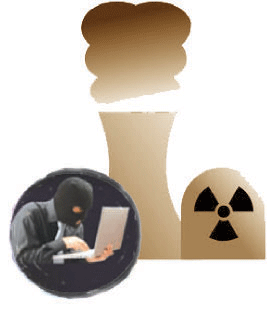
Union of Concerned Scientists 16th March 2018,Yesterday, the Department of Homeland Security and the Federal Bureau of Investigation officially confirmed that Russian hackers have been targeting US nuclear power plants and other critical facilities since at least 2016.
Regardless, the US nuclear industry has been pressuring the Nuclear Regulatory Commission to relax its cyber security standards. Below is a statement by Edwin Lyman, a senior scientist at the Union of Concerned Scientists.
“The Department of Homeland Security alert is a stark
reminder that nuclear power plants are tempting targets for cyber
attackers. Although the systems that control the most critical safety
equipment at US nuclear plants are analog-based and largely immune to cyber
attacks, many other plant systems with important safety and security
functions are digital and could be compromised. For instance, electronic
locks, alarms, closed-circuit television cameras, and communications
equipment essential for plant security could be disabled or reprogrammed.
And some plants have equipment, such as cranes that move highly radioactive
spent fuel, that utilize computer-based control systems that could be
manipulated to cause an accident.” https://www.ucsusa.org/press/2018/russian-cyber-attacks-call-stringent-security-standards-us-nuclear-plants-plant-owners
Thousands of containers with radioactive waste were dumped in the Kara Sea during Soviet times. Now, Russia’s Federal Agency for Fishing believes it’s a good idea to start fishing. By Thomas Nilsen March 15, 2018
“We shall present soon a program on development of promising fishing in the Kara Sea,” said Sergey Golovanov at the 5th international conference of fishing in the Arctic, organized in Murmansk this week. He is quoted by news agency TASS.
Golovanov is head of the Science and Education Department with the Federal Agency for Fisheries and has a background from PINDRO, the Marine research institute in Murmansk.
According to Gulovanov, the Kara Sea’s advantage for the fishing industry is that it is a shelf sea, it does not border any territorial waters of other nations. “This is why Russia can have own fishing regulations there,” he said according to TASS.
In 2013, a Norwegian-Russian joint study expedition to the dump-site of K-27 concluded that it is feasible to lift the ill-fated submarine from the seabed. Although dumped 30 years ago, the hull of the submarine is intact.
Several other areas of the Kara Sea were also visited by the science expedition.
Nuclear weapons testing
Additional to the nuclear waste dumped across the Kara Sea, the waters are also next to the Soviet Union’s largest testing area for nuclear weapons. At Novaya Zemlya, 79 nuclear- and hydrogen bombs where detonated in the atmosphere between 1955 and 1962. In the period from 1963 to 1990 another 35 warheads were tested in tunnels under ground. Today, most of Novaya Zemlya is closed off miitary area.
At the conference in Murmansk, nothing was said about the Kara Sea being the main dumping ground for nuclear waste during Soviet times. No other oceans worldwide have more dumped radioactive waste than Russia’s Arctic Kara Sea.
Here, there, everywhere
17 ships and barges loaded with radioactive waste are dumped here. So are 17,000 containers with radioactive waste. Even worse, along the east coast of Novaya Zemlya is 16 nuclear reactors dumped, six of them with spent uranium fuel still on board.
With the breakup of the Soviet Union, both the military Northern Fleet and the civilian icebreakers stopped dumping waste at sea.
Entire nuclear sub dumped in 1982
On shallow waters in the Stepovogo Bay on the southeast coast of Novaya Zemlya, an entire nuclear-powered submarine, the K-27, was dumped in 1982.
The submarine had then been laid-up for more than 15 years after one of the two troublesome reactors suffered a severe leakage of radioactive gasses and inadequate cooling causing extensive fuel element failures.
Dumping the entire submarine at sea was done in what the Soviet reactor engineers and scientists believed would be a safe way to avoid leakages of radionuclides into the marine environment.
The two on board reactors are liquid-metal cooled and contain spent nuclear fuel, 800 kilograms of uranium to be precise.
Both Russian and Norwegian radiation experts have repeatedly warned that failing to lift the submarine eventually one day will cause leakages of radioactivity into the Kara Sea. A worst-case scenario has even pointed to the danger of an uncontrolled chain reaction that could be triggered inside the reactor in case sea water one day starts to leak in through the protecting cover that today isolates the compartment holding the two reactors.
In 2013, a Norwegian-Russian joint study expedition to the dump-site of K-27 concluded that it is feasible to lift the ill-fated submarine from the seabed. Although dumped 30 years ago, the hull of the submarine is intact.
Several other areas of the Kara Sea were also visited by the science expedition.
Nuclear weapons testing
Additional to the nuclear waste dumped across the Kara Sea, the waters are also next to the Soviet Union’s largest testing area for nuclear weapons. At Novaya Zemlya, 79 nuclear- and hydrogen bombs where detonated in the atmosphere between 1955 and 1962. In the period from 1963 to 1990 another 35 warheads were tested in tunnels under ground. Today, most of Novaya Zemlya is closed off miitary area.
Sudan, Russia to sign accord to develop nuclear power: SUNA agency https://af.reuters.com/article/topNews/idAFKCN1GP0ME-OZATP Reuters Staff, 13 Mar 18KHARTOUM (Reuters) – Sudan will sign a“roadmap” with Russia to build nuclear power stations during a visit to Moscow by Khartoum’s electricity minister, state news agency SUNA said on Monday.
SUNA said Water Resources, Irrigation, and Electricity Minister Moataz Mousa, who left Khartoum on Monday, would meet the head of Russia’s state nuclear agency Rosatom. The trip comes four months after Sudanese President Omar Hassan al-Bashir told his Russian counterpart Vladimir Putin he wanted to discuss nuclear power cooperation with Russia. SUNA quoted a spokesman for the ministry as saying the two sides would sign several memorandums of understanding including the roadmap“to implement a plan to develop nuclear (power) stations”. It did not elaborate. Reporting by Omar Fahmy, editing by David Evans
Mikhail Gorbachev was the president of the Soviet Union and is the author of The New Russia.
When I became the leader of the Soviet Union in 1985, I felt during my very first meetings with people that what worried them the most was the problem of war and peace. Do everything in order to prevent war, they said.
By that time, the superpowers had accumulated mountains of weapons; military build-up plans called for “space combat stations,” “nuclear-powered lasers,” “kinetic space weapons” and similar inventions. Thank God, in the end none of them were built. What is more, negotiations between the U.S.S.R. and the United States opened the way to ending the nuclear arms race. We reached agreement with one of the most hawkish U.S. presidents, Ronald Reagan, to radically reduce the arsenals.
Today, those achievements are in jeopardy. More and more, defense planning looks like preparation for real war amid continued militarization of politics, thinking and rhetoric.
The National Security Strategy and Nuclear Posture Review published by U.S. President Donald Trump’s administration in February orients U.S. foreign policy toward “political, economic, and military competitions around the world” and calls for the development of new, “more flexible” nuclear weapons. This means lowering the threshold for the use of nuclear weapons even further.
The Bulletin of Atomic Scientists, published in Chicago, set the symbolic Doomsday Clock half a minute closer to “Midnight” in January. As the scientists see it, we are now within two minutes of a global catastrophe. The last time this level of danger was recorded in 1953.
The alarm that people feel today is fully justified.
How should we respond to this new round of militarization?
Above all, we must not give up; we must demand that world leaders return to the path of dialogue and negotiations.
The primary responsibility for ending the current dangerous deadlock lies with the leaders of the United States and Russia. This is a responsibility they must not evade, since the two powers’ arsenals are still outsize compared to those of other countries.
But we should not place all our hopes on the presidents. Two persons cannot undo all the roadblocks that it took years to pile up. We need dialog at all levels, including mobilization of the efforts of both nations’ expert communities. They represent an enormous pool of knowledge that should be used in the interest of peace.
Things have come to a point where we must ask: Where is the United Nations? Where is its Security Council, its Secretary General? Isn’t it time to convene an emergency session of the General Assembly or a meeting of the Security Council at the level of heads of state? I am convinced that the world is waiting for such an initiative.
There is no doubt in my mind that the vast majority of people both in Russia and in the United States will agree that war cannot be a solution to problems. Can weapons solve the problems of the environment, terrorism or poverty? Can they solve domestic economic problems?
We must remind the leaders of all nuclear powers of their commitment under the Nuclear Non-Proliferation Treaty to negotiate reductions and eventually the elimination of nuclear weapons. Their predecessors signed that obligation, and it was ratified by the highest levels of their government. A world without nuclear weapons: There can be no other final goal.
However dismal the current situation, however depressing and hopeless the atmosphere may seem, we must act to prevent the ultimate catastrophe. What we need is not the race to the abyss but a common victory over the demons of war.
Russia to help with Ethiopia’s nuclear energy ambitions, African News
Source: Xinhua 2018-03-10 00:32:45
ADDIS ABABA, March 9 (Xinhua) — Ethiopia and Russia agreed on Friday to boost cooperation in nuclear energy during a visit by Russian Foreign Minister Sergey Lavrov.
Speaking to local and international media, Lavrov said Russia will assist Ethiopia’s nuclear energy ambitions as part of efforts to strengthen political, economic and cultural ties between the two nations…..http://www.xinhuanet.com/english/2018-03/10/c_137028152.htm
Putin unveils ‘invincible’ nuclear weapons to counter West , SMH, By Andrew Osborn, 2 March 18 Moscow: President Vladimir Putin unveiled an array of new nuclear weapons on Thursday, in one of his most bellicose speeches in years, saying they could hit almost any point in the world and evade a US-built missile shield.
Putin was speaking ahead of an election on March 18 that polls indicate he should win easily. He said a nuclear attack on any of Moscow’s allies would be regarded as an attack on Russia itself and draw an immediate response.
It was unclear if he had a particular Russian ally, such as Syria, in mind, but his comments looked like a warning to Washington not to use tactical battlefield nuclear weapons.
His remarks were greeted with scepticism in Washington, where officials cast doubt on whether Russia has added any new capabilities to its nuclear arsenal beyond those already known to the US military and intelligence agencies.
……. On Thursday, he sought to back his rhetoric with video clips of what he said were some of the new missiles. The images were projected onto a giant screen behind him at a conference hall in central Moscow where he was addressing Russia’s political elite.
Among weapons that Putin said were either in development or ready was a new intercontinental ballistic missile “with a practically unlimited range” able to attack via the North and South Poles and bypass any missile defence systems.
Putin also spoke of a small nuclear-powered engine that could be fitted to what he said were low-flying, highly manoeuvrable cruise missiles, giving them a practically unlimited range.
The new engine meant Russia was able to make a new type of weapon – nuclear missiles powered by nuclear rather than conventional fuel.
…….. Other new super weapons he listed included underwater nuclear drones, a supersonic weapon and a laser weapon.
…..Putin also voiced concerns about a new US nuclear doctrine, saying Russia’s own doctrine was defensive and only envisaged the use of nuclear weapons in response to an attack.Russia has repeatedly said it is keen to hold talks with the United States about the balance of strategic nuclear power and Putin put Washington and other nuclear powers on notice.
Bellona 27th Feb 2018, A Russian official has admitted there were missiles aboard the
Yekaterinburg nuclear submarine when it was ravaged by fire during repair
work at a shipyard near Murmansk in late 2011, reviving a six year old
mystery about what specific dangers faced the Russian public when the
accident occurred.
India, Russia, Bangladesh sign tripartite pact for civil nuclear cooperation, By Dipanjan Roy Chaudhury, ET Bureau| Mar 01, 2018, NEW DELHI: In a landmark development India for the first time signed a tripartite agreement on Thursday with foreing partners — Russia & Bangladesh — for civil nuclear cooperation.
Nuclear Power Cooperation of India Limited (NPCIL) will play a key role in building a nuclear power plant on foreign soil with the proposed supply of equipment and material for the power station being built by Russia in Bangladesh. India is also extending support for capacity building and has been training Bangladeshi nuclear scientists for the project.
The agreement was signed in Moscow on Thursday by Deputy Director General of Rosatom (Russia’s Alex civil nuclear body) Nikolay Spassky, Ambassador of Bangladesh in Russia S.M. Saiful Hoque and Indian Ambassador to Russia Pankaj Saran.
Rosatom is constructing nuclear power plant in Bangladesh on a turnkey contract basis. The scope of work includes design, production and supply of equipment, construction, installation, pre-commissioning and commissioning, according to Rosatom officials.











 nuclear-news