Russia’s removal of radioactive barge is helped by Italian floating dock
Italian vessel assists in removing Russian Navy’s nuclear waste http://bellona.org/news/nuclear-issues/2018-08-italian-vessel-assists-in-removing-russian-navys-nuclear-waste
An enormous floating dock given to Russia by Italy has been put to use transferring a radioactive barge from the Zvezdochka Shipyard in Severodvinsk to safe storage at the Sayda Bay facility near Murmansk. by Charles Digges
An enormous floating dock given to Russia by Italy has been put to use transferring a radioactive barge from the Zvezdochka Shipyard in Severodvinsk to safe storage at the Sayda Bay facility near Murmansk.
The dock, called the Itarus, was a gift from Italy to Moscow as part of a multi-country nuclear cleanup drive called the Global Partnership for Nuclear Safety agreed to 15 years ago by the then-Group of Eight industrialized nations.
The radioactively contaminated barge, called the PM-124, was built in 1960 and used as a floating dock for servicing nuclear submarines in the Soviet Northern Fleet. Slated for use until 1985, it continued collecting fuel assemblies for another 20 years. Since 2005, the fuel assemblies have been removed, but but for a time the barge was used used for storing other forms of solid radioactive waste at Zvezdochka.
While nearly all decommissioned submarines from the Soviet Northern Fleet have been dismantled by a variety of international agreements, a number of other military nuclear hazards still lurk on Russia’s Kola Peninsula, and the PM-124 was one of them.The Itarus is one of two nuclear-waste transport vessels that Italy provided for Russia under its Global Partnership obligations. The other, called the Rossita, a €70 million container ship, is now engaged in ferrying spent nuclear submarine fuel away from Andreyeva Bay, another major radioactive hazard left over after the Cold War.
For its part, the Itarus, which arrived in Russia in 2016, was designed specifically for shuttling reactor compartments from dismantled nuclear submarines to Sayda Bay, a facility run by SevRAO, the northern branch of RosRAO, one of Russia’s state nuclear waste handling contractor.
Rosatom has also billed it as a valuable tool in retrieving nuclear reactors and other radioactive debris intentionally scuttled in Arctic waters by the Soviet Navy.
No storage site for these underwater nuclear artifacts has yet been selected, but the Russian government has promised for years to raise them, and Rosatom’s submarine decommissioning chief, Anatoly Zakharchyov, has often suggested the Itarus, with its submersible dock features, would be handy for this endeavor.
In 2014, the Russian government revealed that the sunken waste in the Arctic includes 17,000 containers of radioactive waste, 19 ships containing radioactive waste, 14 nuclear reactors, including five that still contain spent nuclear fuel; 735 other pieces of radioactively contaminated heavy machinery, and the K-27 nuclear submarine with its two reactors loaded with nuclear fuel.
Joint Russian and Norwegian expeditions to the K-27 and another sunken sub, the K-159, suggest neither pose imminent contamination risks. But experts on both sides agree it’s better to get them out of the water sooner than later, before radioactive leakage becomes an urgent problem.
Zakharchyov has said the reinvigoration of the Gremikha naval nuclear waste storage facility could be a critical storage site for undersea nuclear hazards eventually netted by the Itarus.
Egypt going into a huge debt to Russia for building Dabaa nuclear plant
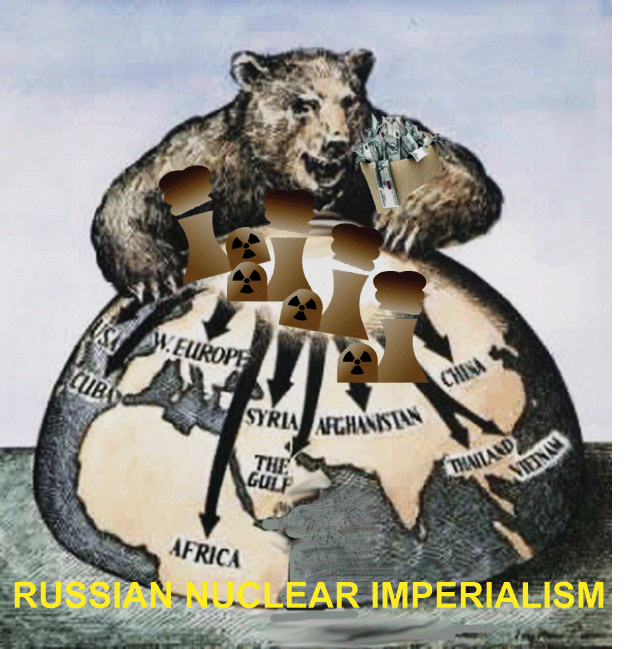 Middle East Monitor 10th Aug 2018 , Egypt will obtain a license to build the Dabaa nuclear plant by mid-2020,
the Russian deputy minister of industry and trade said. Georgy Kalamanov
added that Russian experts are currently completing designing the nuclear
plant and surveying the area where it will be built.
In 2015, Russia andEgypt signed a deal which would see Russia build Egypt’s first nuclear
power plant in the Dabaa area, located on Egypt’s northwestern coast.
Under the terms of the agreement, Cairo would access a loan for the project
from Moscow. In 2016, the Egyptian official Gazette reported that the loan
would amount to $25 billion, which would finance 85 per cent of the cost of
contracts signed for the plant’s construction. The loan repayment period
is 35 years. Egypt will finance the remaining 15 per cent.
https://www.middleeastmonitor.com/20180810-russia-egypt-to-begin-building-nuclear-reactor-in-2020/
Russia and China pushing to create their economic nuclear empires
Russia on an international offensive to sell its nuclear plants, Vladimir Putin’s government vies with China to become a superpower in the field MOSCOW — Russia is stepping up its overseas sales of nuclear power plants, with state-run nuclear energy company Rosatom agreeing in July to cooperate in building a plant in the Central Asian country of Uzbekistan and reaching an accord with China to build a plant in that country.
Russia accounts for 67% of the world’s nuclear plant deals currently in development. By 2030, Rosatom aims to increase its overseas sales to two-thirds of total sales, from 50% at currently. Vladimir Putin’s government is looking to expand Russian influence through nuclear diplomacy, vying with China — which is promoting its own nuclear plants — for the status of nuclear energy superpower.
“We hope that a lot of other countries will become our partners, and as they say, ‘nuclear newcomers,'” Rosatom Chief Executive Alexey Likhachev told Prime Minister Dmitry Medvedev at a meeting in early July…….
During a visit by Putin to China in June, Rosatom entered into a framework agreement to cooperate in nuclear plant construction, including four reactors in Jiangsu and Liaoning provinces.
Russia intends to make nuclear power plants a major revenue earner alongside exports of crude oil and natural gas. Rosatom’s annual business report for 2016 showed it was involved in nuclear plant projects in more than 10 countries, including China, Bangladesh and India. The company had $133.4 billion of overseas orders, up 21% from a year earlier. It targets $150 billion to $200 billion in orders in 2030…….
Russia’s strength in the field is the all-out support of the government, and its ability to take on all aspects of a nuclear energy project. The Putin government attaches much importance to nuclear plants, seeing them as a globally competitive, technology-intensive industry with an important role to play in revitalizing Russia’s domestic industry. Putin himself has successfully pitched Russian nuclear plants to foreign leaders during international summits.
Russian nuclear plants also boast price competitiveness, with the government providing loans to finance the high costs. Not only does Russia build the plant, but it supplies the fuel, operates and maintains the reactors, and disposes of the used fuel. This makes a deal with Russia attractive for countries that want to build their first nuclear plant, but which lack the operational know-how…….
China has made it clear that its policy is to expand overseas nuclear plant deals by building on the technology of Russia, France and other countries that have been at the forefront of nuclear plant development. …….https://asia.nikkei.com/Business/Energy/Russia-on-an-international-offensive-to-sell-its-nuclear-plants
Russian hackers implanting malicious software in the U.S. power grid
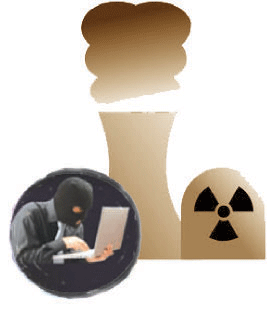 The Hill 28th July 2018 , Intelligence officials and security analysts say Russian hackers are
devoting much more effort toward implanting malicious software in the U.S.
power grid than attempting to breach electoral systems, according to a new
report.
Several intelligence officials told The New York Times that Russian
efforts had been more focused on attacking and infiltrating U.S.
infrastructure systems, while interference in electoral systems remained
lower than the level witnessed in 2016.
The report comes days after the
Department of Homeland Security (DHS) reported that the scope of Russian
intrusions was far greater than previously realized, and that Russian
hackers gained access to the control rooms of power plants across the
country.
http://thehill.com/policy/national-security/399348-concerns-rise-about-russian-attempts-to-disrupt-us-electrical-grid
Russia’s new “doomsday” weapon works by dispersing killer nuclear radiation
 Russia just showed off a potentially world-ending nuclear ‘doomsday’ torpedo https://www.businessinsider.com.au/russia-shows-off-a-nuclear-doomsday-torpedo-that-the-us-cant-stop-2018-7?r=US&IR=T, ALEX LOCKIE, JUL 24, 2018,
Russia’s huge nuclear submarine on show in Finland as Trump arrives for summit with Putin
Putin to show off huge nuclear submarine just south of Helsinki as summit with Trump sails up Barents Observer The Oscar-II class vessel is similar to the Kursk that sank in the Barents Sea in 2000. By Thomas Nilsen, July 11, 2018
“The first group includes the large anti-submarine ship “Severomorsk” and the nuclear submarine missile cruiser “Orel”, the press service of the Northern Fleet says in a noteposted on the Defense Ministry’s portal Wednesday evening.
Also, the recently modernized missile cruiser “Marshal Ustinov” and the brand new frigate “Admiral Gorshkov” are sailing in the same navy group, as previously reported by the Barents Observer.
The Russian warships are Wednesday evening in Skagerrak south of Norway and will during the next 24 hours pass through Storebælt in Denmark. The route continues south of Bornholm, then north along the east side of the Swedish island of Gotland before turning east into the Gulf of Finland.
Arrival in the Gulf of Finland is expected within a few days, the Northern Fleet writes.
This means Putin will have one of his navy’s largest nuclear-powered submarines sailing just south of Helsinki either a day or two before the summit, or about the same time as the historical meeting with U.S. President Donald Trump takes place on July 16th.
The ships are sailing towards Kronstadt outside St. Petersburg where they will participate in the annual Navy Parade taking place on July 29th…….. https://thebarentsobserver.com/en/security/2018/07/large-russian-nuclear-submarine-sails-scandinavian-waters,
Russia and China to co-operate in nuclear power build
Russia to build two new nuclear power units in China, 5 July 18
President Vladimir Putin mentioned that energy is the most important sector of cooperation, in a meeting with Chinese President Xi Jinping in the previous month. Moneycontrol News@moneycontrolcom Moscow and Beijing may sign agreements to build additional two power units of 1,200-Megawatt units in China by 2026 and 2027, as per reports by Russia’s state nuclear power corporation Rosatom.……. As reported by RT, the two countries are also working together on One Belt, One Road initiative. At this rate of growth, the trade between the two countries is expected to reach the target of $100 billion. https://www.moneycontrol.com/news/business/russia-to-build-two-new-nuclear-power-units-in-china-2674481.html
Russia’s Putin has all the advantages in the coming summit with Trump
 In Trump’s Russia Summit, Putin Holds All the Cards New
  York Magazine, 30 June 18President Donald Trump’s scheduled summit with Russian president Vladimir Putin in Helsinki, Finland, on July 15 is being billed by the White House as an opportunity to reduce diplomatic tensions, begin repairing relations, and address a number of international issues of concern to both the U.S. and Russia, such as Iran, Syria, and Ukraine. Moscow is already managing expectations, saying they hope the meeting will rekindle a dialogue between the two governments but not to expect any “breakthroughs.”
Then again, Putin doesn’t need any breakthroughs; he’s already getting most of what he wants out of Trump, and given our president’s oft-expressed admiration for authoritarian strongmen in general and for his Russian counterpart in particular, Putin surely aims to cross a few more items off his wish list in Helsinki.
American-Russian relations at this moment are somewhat schizophrenic. On paper, Trump’s government is continuing and even going above and beyond many of the tough policies pursued by the Obama administration, including sanctions imposed in response to Russia’s invasion of Ukraine and annexation of Crimea, the sale of weapons to Ukraine to combat the ongoing Russian-backed insurgency, and the expulsion of Russian agents.
Yet no world leader has been so much a beneficiary of Trump’s “dictator envy” as Putin. The president has publicly flattered him and even congratulated him (against the advice of literally everyone) on his victory in a transparently rigged election in March. The two men’s previous contacts have been friendly and often advantageous to Putin; they even spent an hour alone together, with no other U.S. advisers or officials and only Putin’s translator present, on the sidelines of last year’s G20 meeting. Trump takes Putin at his word when he says Russia did not meddle in the 2016 election, despite mountains of evidence to the contrary, and even as Russian state TV gloats about it.
With Trump, all business is personal, and deals are made or broken on the basis of his feelings about the people he is making them with. Earlier this month, North Korean dictator Kim Jong-un — whose crimes against human rights include forced labor, torture, and murder — made such a good impression on Trump at a summit in Singapore that the president gifted him a unilateral halt to joint U.S.–South Korean war games, blindsiding both Seoul and the Pentagon. Calculated measures are for eggheads and losers; Trump’s gut trumps all. ……..
he is actively working to destabilize the European Union, encouraging key members to quit the organization and saying at a rally this week that the E.U. “was set up to take advantage of the United States, to attack our piggy bank” — an absolutely bonkers statement even if it were not based on an exaggeration of the U.S-E.U. trade deficit. Considering that Russia meddled in the Brexit referendum just as it did in our elections, it’s clear that weakening or dismantling that union is high on the Kremlin’s agenda.
Trump’s bootlickers like Secretary of State Mike Pompeo may lamely spin Trump’s antagonism toward our allies as some kind of “disruptive” “reset” in service of U.S. interests, but no administration official has made a remotely persuasive case for why chipping away at these institutions is good for America. For a revanchist Russia, on the other hand, the upsides are crystal clear. With his bad relationships with European allies fresh in his mind, it’s easy to imagine Trump letting Putin talk him into taking more steps to undercut these alliances.
Whether Putin has some kind of kompromat or other form of personal leverage over Trump (a terrifying possibility that becomes more believable the more we learn about the depth of Russia’s machinations in the 2016 campaign), or whether the two men just so happen to agree that the transatlantic liberal order is better off discarded, Putin is already getting what he paid for from this president.
Any agreement that comes out of next month’s summit, meanwhile, is overwhelmingly likely to favor Russia’s interests, if only because Putin knows exactly what he wants from Trump, whereas Trump does not seem to want anything more than for the man he admires so much to like him back. http://nymag.com/daily/intelligencer/2018/06/in-trumps-russia-summit-putin-holds-all-the-cards.html
Russia’s environmental groups demand an end to secrecy about Russia’s nuclear wastes

Russian environmentalists demand transparency from the country’s nuclear waste industry http://bellona.org/news/nuclear-issues/2018-06-russian-environmentalists-demand-transparency-from-the-countrys-nuclear-waste-industry
Environmentally significant information about radioactive waste should never be secret and concealing information about the disposition of this waste from those who live closest to it is unacceptable, said a joint statement from three Russian ecological non-profits. by Bellona
Environmentally significant information about radioactive waste should never be secret and concealing information about the disposition of this waste from those who live closest to it is unacceptable, said a joint statement from three Russian ecological non-profits.
The statement was issued last week by the group Radioactive Waste Safety, Greenpeace and Bellona.
In the 70 years since Russia began applying nuclear technology, millions of tons of radioactive waste have been accumulated. This poses a now and future threat for hundreds and thousands of years. The negligent or thoughtless handling of radioactive waste could lead to accidents and catastrophes, as well as environmental consequences that will impact future generations – all while we are still struggling with past nuclear accidents, such as the Kyshtym disaster at the Mayak Chemical Combine in 1957 to name just one
“We are convinced that information on the total quantity and condition of radioactive waste, as well as on projects and programs related to handling and disposal of radioactive waste is environmentally significant, and that it is the constitutional right of Russian citizens to have access to that information. This information affects the interests of people living near installations wirer radioactive wastes is handled and stored,” said the three groups.
“Recently, we and other environmental activists have been denied the provision of environmentally relevant information on the disposal of hazardous radioactive wastes, specifically relative to the practice of injecting liquid radioactive waste into deep geological formations in the Krasnoyarsk, Tomsk and Ulyanovsk Regions” said Alexander Kolotov, program director for Radioactive Waste Safety. “This practice is not permissible an leads to a deepening distrust between local residents and the nuclear industry.”
“As is well known, Russia’s state nuclear corporation Rosatom has a long list of information it considers commercial secrets and classified. This list compulsory across all divisions and subsidiaries of the company, said Alexander Nikitin of Bellona. “Therefore, Rosatom doesn’t permit one or another division within its ranks to disclose information when it is requested by the public.”
“We are certain that enterprises and organizations in Russia, which handle radioactive waste should maintain transparency with the public about the dangers of these activities and their possible impact on the environment and public health,” said Ivan Blokov, program director of Greenpeace.
“Ecologically significant information on radioactive waste should be included in the annual environmental reports of the relevant enterprises and organizations, and should be published on their official websites and be provided by them at the request of citizens and public organizations.”
In addition to presenting environmentally relevant information on radioactive waste, environmentalists call upon Russia’s nuclear waste disposition industries to to immediately inform the public and local residents about any significant incidents or accidents associated with hazardous radioactive waste.
Putin: Russia making a quantum leap in nuclear weaponry
 Putin says new Russian nuclear weapons are decades ahead of foreign rivals, 58 WGJT Milwaukeee, By: Justin Thompson-Gee , 28 June 18 MOSCOW (AP) — Russian President Vladimir Putin boasted about his country’s prospective nuclear weapons Thursday, saying they are years and even decades ahead of foreign designs.
Russia, Rwanda establish nuclear energy ties
 WNN, 27 June 2018
Russia’s Rosatom and the Ministry of Infrastructure of Rwanda have signed a Memorandum of Understanding on cooperation in the peaceful uses of nuclear energy. The document was signed on 22 June by Rosatom Deputy Director General Nikolay Spassky and Ambassador Extraordinary and Plenipotentiary of the Republic of Rwanda to the Russian Federation Jeanne d’Arc Mujawamariya……
Russia speeds up removal of piled up nuclear fuel assemblies at Andreyeva Bay
Bellona 18th June 2018 , The pace of cleanup at a major Cold War dump for spent nuclear submarine
fuel in Northwest Russia is going faster than planned, officials with
Russia’s state nuclear corporation Rosatom have said, with efforts racing
ahead twice as rapidly as initially thought possible.
Still, Rosatom has elected not to revise its deadline for removing decades of piled up nuclear
fuel assemblies at Andreyeva Bay, a Soviet era submarine maintenance base,
whose proximity to Europe made it a lighting rod for international
environmental concern. On Thursday, Anatoly Grigoryev, who heads up
Rostom’s international technical programs, told the Interfax newswire
that technicians had shipped away a load of fuel that was expected to take
a year to remove in only six months.
http://bellona.org/news/nuclear-issues/2018-06-andreyeva-bay-nuclear-fuel-removal-going-faster-than-planned-rosatom-says
Satellite photo indicates that Russia is upgrading a key nuclear weapons storage site
Is Russia upgrading nuclear bunker? Nine News,
Safety measure for World Cup – Russia halts nuclear waste transport
World Cup puts break on nuclear transport, A load of containers with spent nuclear fuel from Andreeva Bay on the Kola Peninsula will have to wait because of a general ban on transport of dangerous goods in Russia during the Football World Cup. https://thebarentsobserver.com/en/ecology/2018/06/world-cup-puts-break-nuclear-transport Thomas Nilsen, 14 June 18, June 14, 2018
Russia puts priority to safety and doesn’t want any potential lethal substances moving around during the four weeks with World Cup when tens of thousands of football fans are commuting by railway to different cities.
 In the north, the ban now delays a shipment of nuclear waste that otherwise would be on its way to Mayak north of Chelyabinsk in the South Urals.
Head of Rosatom State Nuclear Corporation’s international technical assistance project, Anatoly Grigoryev, says three railway sets already have departed to Mayak this year. «The fourth is ready, but we can’t send it because transport of dangerous goods during the World Cup is prohibited,» Grigoriyev says to Interfax in an interview reposted by Rosatom.
From Andreeva Bay near Russia’s border to Norway, the containers with old uranium fuel from Cold War submarines are shipped to Murmansk, where they are loaded over to a set of special rail-wagons. From Murmansk, the train follows Russia’s railway lines south through Karelia towards St. Petersburg and Yaroslav before heading east towards the Urals, a distance of more than 1,600 kilometers.
Mayak reprocessing plant is located between the cities of Chelyabinsk and Yekaterinburg. The last is one of the cities where football matches will be played.
Anatoly Grigoryev assures that the load of nuclear waste containers from the Murmansk region will be shipped to Mayak as soon as the World Cup is over by mid-July.
Last June, a top brass of Russian and Norwegian politicians, diplomates and nuclear safety experts cheered and waved as the first load of containers set out to sea from Andreeva Bay. Since the 1990s, Norway has spent tens of millions of euros to support preparing for the nuclear waste removal from the site to start.
In Murmansk, nuclear safety expert with the Bellona Foundation, Andrey Zolotkov, says this is the first time to his knowledge transport of nuclear waste has been put on break for such reason as a international tournament.
«I don’t recall any such thing. This is most likely due to keeping the railway routes free from such cargos because of all the [football] fans on the move,» Zolotkov says to the Barents Observer. Additional to Bellona, Zolotkov has for many years been working on board the Russian nuclear icebreaker fleet’s transport- and storage vessel «Imandra».
From Murmansk, the nuclear waste cargo-train follows the same tracks, and through the same big cities, as ordinary passenger trains.
«After all, we are just talking about a one month delay,» Andrey Zolotkov explains pointing to the many-years it will take to remove all spent nuclear fuel elements from Andreeva Bay.
A total of about 22,000 such uranium fuel elements where stored in three rundown concrete tanks. That is equal to about 100 submarine reactor cores.
Anatoly Grigoryev with Rosatom estimates it will take about 10 years to remove it all from the Kola Peninsula to the Mayak plant.
Jordan knocks back Russia’s $10 billion nuclear power plant , but contemplates”small floating reactor”
In a blow to the international business interests of Russia’s state nuclear corporation Rosatom, Jordan has scrapped a plan to build a $10 billion nuclear power plant with Moscow’s help.
Jordan’s Atomic Energy Commission, the JAEC, said on Monday that the project, after three years of study and consideration, had collapsed over disagreements on how to finance the the build, which would have included two nuclear reactors built by Rosatom.
But canceling the larger plant, said the JAEC, doesn’t mean Jordan won’t be working with Russia on any nuclear projects at all. According to the commission, it’s possible that Rosatom would furnish the Mediterranean nation with small modular reactors instead.
On Monday, the commission said in a statement that the larger project was off because the commercial loans Rosatom wanted Joran to secure to finance construction would drive up the cost of the electricity the plant would eventually produce.
………Without specifically mentioning the cancellation of the larger plant, Rosatom said in a statement on May 27 that it and JAEC had decided to “intensify and step up” cooperation on small modular reactors and form a joint feasibility study for such a project based on  Russian designs.
Yet what these reactors might consist of remains somewhat mysterious. Russia has signed agreements with other countries for work on small-scale reactors, most recently Sudan, to which it vaguely promised to build a floating nuclear power plant.
…… Rosatom repeatedly said that foreign customers would flock to Moscow to order floating nuclear power plants of its own.
Those orders have yet to materialize, but that hasn’t stopped Rosatom from repeating the mantra that floating plants will be a prime offering to its foreign customers. Whether an offer to build Jordan a floating plant will come to pass remains unknown. But increasingly, the notion of floating plants seems synonymous with Rosatom’s small reactor development schemes. http://bellona.org/news/nuclear-issues/2018-06-jordan-turns-down-a-rosatom-plant-but-dangles-possible-small-reactor-collaboration-with-russia
1 This Month
10 March A LIVE WEBINAR THE REAL EFFECTS OF NUCLEAR POWER
What the Industry Isn’t Telling Us
1:00 PM Mountain, 2 pm Central, 3 pm Eastern. Live on the Keepers of the Water Facebook page



18 March Webinar @ 1 PM EST: An Assessment of SMR Projects: The Case of Canada
register for the zoom:
https://us02web.zoom.us/webinar/register/WN_o8BIIOUvQ2ONJR1nta65DQ#/registration


of the week – STOP SMALL MODULAR REACTORS IN CANADA
To see nuclear-related stories in greater depth and intensity – go to https://nuclearinformation.wordpress.com
-
Archives
- March 2026 (109)
- February 2026 (268)
- January 2026 (308)
- December 2025 (358)
- November 2025 (359)
- October 2025 (376)
- September 2025 (258)
- August 2025 (319)
- July 2025 (230)
- June 2025 (348)
- May 2025 (261)
- April 2025 (305)
-
Categories
- 1
- 1 NUCLEAR ISSUES
- business and costs
- climate change
- culture and arts
- ENERGY
- environment
- health
- history
- indigenous issues
- Legal
- marketing of nuclear
- media
- opposition to nuclear
- PERSONAL STORIES
- politics
- politics international
- Religion and ethics
- safety
- secrets,lies and civil liberties
- spinbuster
- technology
- Uranium
- wastes
- weapons and war
- Women
- 2 WORLD
- ACTION
- AFRICA
- Atrocities
- AUSTRALIA
- Christina's notes
- Christina's themes
- culture and arts
- Events
- Fuk 2022
- Fuk 2023
- Fukushima 2017
- Fukushima 2018
- fukushima 2019
- Fukushima 2020
- Fukushima 2021
- general
- global warming
- Humour (God we need it)
- Nuclear
- RARE EARTHS
- Reference
- resources – print
- Resources -audiovicual
- Weekly Newsletter
- World
- World Nuclear
- YouTube
-
RSS
Entries RSS
Comments RSS
 nuclear-news