Russia might revive its fearful automatic nuclear weapons launch system
Meet “Dead Hand”: This Might Be Russia’s Most Terrifying Nuclear Weapons Idea Yet https://nationalinterest.org/blog/buzz/meet-dead-hand-might-be-russias-most-terrifying-nuclear-weapons-idea-yet-40937
Perhaps the most terrifying was a Cold War doomsday system that would automatically launch missiles—without the need for a human to push the button—during a nuclear attack. But the system, known as “Perimeter” or “Dead Hand,” may be back and deadlier than ever, f Russia is now discussing Perimeter publicly, that’s reason for the rest of us to worry.
Russia has a knack for developing weapons that—at least on paper—are terrifying: nuclear-powered cruise missiles, robot subs with 100-megaton warheads .
Perhaps the most terrifying was a Cold War doomsday system that would automatically launch missiles—without the need for a human to push the button—during a nuclear attack.
But the system, known as “Perimeter” or “Dead Hand,” may be back and deadlier than ever.
This comes after the Trump administration announced that the United States is withdrawing from the 1987 Intermediate-Range Nuclear Forces Treaty, which eliminated the once-massive American and Russian stockpiles of short- and medium-range missiles. Donald Trump alleges that Russia has violated the treaty by developing and deploying new, prohibited cruise missiles.
This has left Moscow furious and fearful that America will once again, as it did during the Cold War, deploy nuclear missiles in Europe. Because of geographic fate, Russia needs ICBMs launched from Russian soil, or launched from submarines, to strike the continental United States. But shorter-range U.S. missiles based in, say, Germany or Poland could reach the Russian heartland.
Viktor Yesin, who commanded Russia’s Strategic Rocket Forces in the 1990s, spoke of Perimeter/Dead Hand during an interview last month in the Russian newspaper Zvezda [Google English translation here]. Yesin said that if the United States starts deploying intermediate-range missiles in Europe, Russia will consider adopting a doctrine of a preemptive nuclear strike. But he also added this:
Zvezda: “Will we have time to answer if the flight time is reduced to two to three minutes when deploying medium-range missiles near our borders? In this version, all hope is only on Perimeter. And for a retaliatory strike. Or was Perimeter also disassembled for parts?
It is not clear what Yesin meant when he said the system has been “improved,” or even exactly what he meant by “functioning.” Perimeter works by launching specially modified SS-17 ICBMs, which transmit a launch signal to regular nuclear-tipped ICBMs in their silos.
“Higher authority” would flip the switch if they feared they were under nuclear attack. This was to give the “permission sanction.” Duty officers would rush to their deep underground bunkers, the hardened concrete globes, the shariki. If the permission sanction were given ahead of time, if there were seismic evidence of nuclear strikes hitting the ground, and if all communications were lost, then the duty officers in the bunker could launch the command rockets. If so ordered, the command rockets would zoom across the country, broadcasting the signal “launch” to the intercontinental ballistic missiles. The big missiles would then fly and carry out their retaliatory mission.
There have been cryptic clues over the years that Perimeter still exists.
Which illustrates one of the curiosities of this system, which is that the Soviet Union kept its existence secret from the American enemy whom it was supposed to deter.What is unmistakable is that Perimeter is a fear-based solution. Fear of a U.S. first-strike that would decapitate the Russian leadership before it could give the order to retaliate. Fear that a Russian leader might lose his nerve and not give the order.
And if Russia is now discussing Perimeter publicly, that’s reason for the rest of us to worry.
Michael Peck is a contributing writer for the National Interest. He can be found on Twitter and Facebook.
President Vladimir Putin’s new secret weapon -NUCLEAR drone which sends 1,640ft high WAVES
WHY RUSSIA’S ‘POSEIDON’ UNMANNED UNDERWATER DRONE IS A DOOMSDAY WEAPON
Russia boasts of ‘impossible to detect’ NUCLEAR drone which sends 1,640ft high WAVES https://www.dailystar.co.uk/news/world-news/751603/russia-news-vladimir-putin-underwater-drone-nuclear-war-world-war-3
RUSSIAN ministry of defence officials have hinted that a new underwater nuclear warhead-carrying drone is impossible to detect. By Douglas Patient / 5th January 2019 Dubbed President Vladimir Putin‘s new secret weapon – it’s even more deadly than originally thought according to Russia. The navy will be armed with Poseydon drones as soon as 2027.
It carries nuclear warheads and was created in order to obliterate enemy ports. But being equipped with warheads of 100 megatons, it can also be used against coastal cities.
Attacks would involve detonating the warhead underwater, creating huge tidal waves up to 1,640ft high.
At the same time it would contaminate enemy territory with radiation.
Unlike conventional nuclear weapons it would also be immune to being hit by missiles, lasers and railguns.
The concept of the strategic underwater drone named Poseydon was first put forward in 2015 and mentioned by Putin in March last year during his state-of-the-nation speech.
It was initially believed that the Poseydon will be able to travel up to 70 knots, which is about 80mph, while underwater.
But now it has been confirmed that the sample actually be capable of travelling as fast as 125mph (more than 110 knots).
In an official statement ministry said: “The drone will travel to its destination at a speed of 200 kph (125mph) and a depth of 1km (0.6 miles). The drone will be moving in a so-called ‘air-cavern’ (a process in which a steam filled bubble forms around the drone, which reduces the resistance of the water and allows it to move so fast).
“The drone will constantly be performing different manoeuvres and will not stay on one trajectory, which together with its high speed will make it impossible to intercept.”
Officials also released a video showing the computer presentation of Poseydon drones from the Russian Ministry of Defence.
This comes as Russia said it was developing a drone sub that has an underwater rifle to fire at enemy divers.
Putin puts shipping safety regulation in the Arctic into the hands of the nuclear industry!
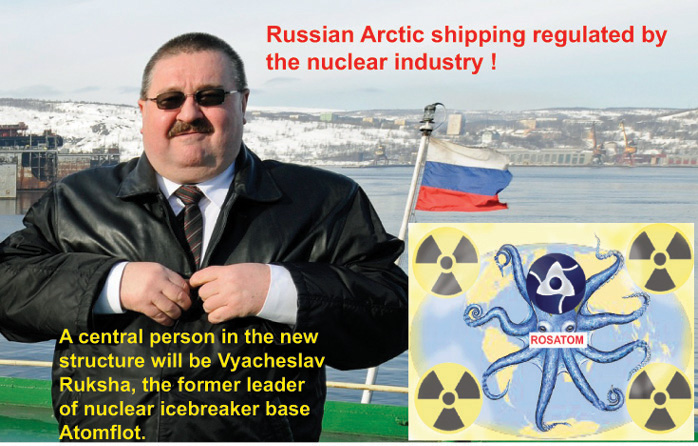
It’s a law – Russian Arctic shipping to be regulated by Rosatom https://thebarentsobserver.com/en/arctic/2019/01/its-law-russian-arctic-shipping-be-regulated-rosatom
President Putin signs the bill that makes the country’s state nuclear power company top regulator of the Northern Sea Route.By Atle Staalesen, January 02, 2019
Rosatom has officially been granted the leading role in the development of the vast Russian Arctic. The company that employs more than 250,000 people and engages in a multitude of activities related to nuclear power development and production is now formally Russia’s management authority for the Northern Sea Route.
The law was adopted by the State Duma on the 11th December and on the 28th signed by Vladimir Putin.
The new legislation comes as Russian Arctic shipping is on rapid increase. In 2018, about 18 million tons of goods was transported on the sea route, an increase of almost 70 percent from 2017. And more is to come. According to Vladimir Putin so-called May Decrees, the top national priorities, shipping on the Northern Sea Route is to reach 80 million tons already by year 2024.
Rosatom’s new powers in the Arctic include development and operational responsibilities for shipping, as well as infrastructure and sea ports along the northern Russian coast.
The responsibilities of the Northern Sea Route Administration, that until now has operated under the Ministry of Transport, will now be transferred to Rosatom.
It was Putin himself who in early 2017 made clear that a coordinating government agency for the Northern Sea Route was needed. A battle between Rosatom and the Ministry of Transport followed. In December 2017, it became clear that the nuclear power company had won that fight.
A central person in the new structure will be Vyacheslav Ruksha, the former leader of nuclear icebreaker base Atomflot.
The nuclear power company has since 2008 operated the fleet of nuclear-power icebreakers. Currently, five icebreakers are based in Atomflot, Murmansk, and several more ships are under construction, including four powerful LK-60 vessels.
Rosatom is also in the planning process of the «Lider», the 120 MW capacity super-powerful ship that can break through two meter thick ice at an unprecedented 10-12 knot speed.
Between USA’s John Bolton, and Russia’s nuclear hawks – the fragmentation of nuclear arms control spells global danger
 Fragmenting nuclear arms controls leave world in a more dangerous place https://www.theguardian.com/world/2019/jan/03/fragmenting-nuclear-arms-controls-leave-world-in-a-more-dangerous-place Andrew Roth in Moscow 3 Jan 2019 Fragmenting nuclear arms controls leave world in a more dangerous place https://www.theguardian.com/world/2019/jan/03/fragmenting-nuclear-arms-controls-leave-world-in-a-more-dangerous-place Andrew Roth in Moscow 3 Jan 2019 US could withdraw from a second treaty while Vladimir Putin’s Russia promises a new generation of nuclear weapons The decision on whether or not to destroy the world came down to a humble Soviet duty officer early one morning in 1983. Stanislav Petrov was told by his computer that the United States had launched at least five intercontinental ballistic missiles at the Soviet Union, and that they would strike in just 25 minutes.Rather than send the alarm up the chain of command, the lieutenant colonel did nothing and averted a nuclear clash over what turned out to be a systems malfunction. For his troubles, Petrov was reprimanded for failing to keep careful notes during the incident and left the service the following year. He died at 77 just last year, on the cusp of the collapse of the architecture that has governed nuclear arms control for the last two generations. Potential nuclear clashes may seem the stuff of Cold War lore, but the framework to prevent them is recent and increasingly endangered.
The next pillar to fall could be the New Start treaty, signed by Barack Obama and Dmitri Medvedev in 2010, which reduced strategic missile launchers by half. That treaty will expire in 2021 unless it is extended, and President Trump has called it a “bad deal” in a telephone call with Vladimir Putin. Russia’s foreign minister has said he believes the United States is “preparing the soil to dismantle this deal.” Putin also threatened the United States with a new line of nuclear-capable weapons earlier this year, blaming the United States’ decision to exit the 1972 anti-ballistic missile treaty for a new arms race. His state of the nation speech, usually a staid affair, was accompanied by a low-resolution animation of a nuclear-powered cruise missile sailing from the Atlantic Ocean, around Cape Horn and then northward toward California. “You didn’t listen to our country then,” Putin said of the US leaving the ABM in 2001. “Listen to us now.” Taken together, these treaties are the bulk of the nuclear arms control framework that the United States and Russia inherited from the Cold War or have developed since. Experts from both sides note that the treaties weren’t perfect but warn that brokering deals is far more difficult than breaking them. The probability of an arms buildup is growing. “The INF decision and failure to get into real discussions about extending New START has us sleepwalking into a new nuclear arms race,” said Richard Burt, a former ambassador who served as chief negotiator for the United States on the Strategic Arms Reduction Treaty, during an Atlantic Council event earlier this year. Viktor Yesin, the former chief of staff of the Russian Federation Strategic Missile Force, said that the US decision to exit the INF was largely with an eye to military developments in China and other countries not bound by the treaty. But the decision could lead to deployments of missiles in Europe, he said, unless the United States and Russia take steps to avoid it. Only “political measures” could avert “the worst outcome for Russia and Europe in the development of a ‘missile crisis,’ which will unavoidably arise after the United States exits the INF,” he said. Those warnings appear to be apt. A leaked memo published by the Washington Post showed that Bolton had ordered the Pentagon to “develop and deploy ground-launched missiles at the earliest possible date.” The order was tabled only after European allies intervened to prevent an immediate US pullout from the INF. Washington has issued Moscow a 60-day ultimatum, after which it will exit the treaty. Russia, which has not admitted to violating the treaty, has signalled it won’t change its behaviour. The driving force behind the pullout is seen as Bolton, who has spoken fervently against similar arms control treaties and presided over the demolition of both the anti-ballistic missile treaty in 2001 and now the INF. Determined individuals can change the course of history. In 1983, Petrov’s decision not to alert his superiors came down to a “funny feeling in my gut.” Now, Bolton appears resolved to finally see a United States released from the bonds of missile treaties and nuclear arms control. |
|
Russian commentator Yakovenko says “Putinism is 21st century fascism with nuclear weapons”
Putinism is 21st century fascism with nuclear weapons, Yakovenko says https://www.stopfake.org/en/putinism-is-21st-century-fascism-with-nuclear-weapons-yakovenko-says/ This article represents personal opinions of the author. Stopfake editors may not share this opinion. By Paul Goble, Window on Eurasia, 30 Dec 18
Trump and Putin could save The Intermediate-Range Nuclear Force Treaty, and it’s worth saving
Landmark nuclear treaty can still benefit US, NATO and Russia security. They should delay action for six months and negotiate ways to show compliance. The Intermediate-Range Nuclear Force Treaty — a key part of the post cold war nuclear system of controls and restraint — is on life support. President Donald Trump announced his desire to withdraw from the 1987 INF pact in October, citing Russian cheating and a desire to deploy missiles against China as motives. German Chancellor Angela Merkel reportedly convinced Trump this month to hold off on withdrawal for at least two months so the NATO alliance could act in a more united fashion to either bring Russia back into compliance or show it was trying.
As officials who helped negotiate the last two major strategic arms control agreements, we believe there is a deal to save the treaty and ensure its benefits can continue. This will require creative, serious and genuine negotiations by Washington and Moscow. We know firsthand, however, that negotiating with Russia can lead to surprising and positive results. Such engagement is desperately needed now, and could save a critical part of the post-Cold War arms control system that benefits American security
There’s no doubt that Russia violated INF Treaty The INF Treaty signed by President Ronald Reagan and General Secretary Mikhail Gorbachev bans the US and Russia from having land-based missiles with ranges from 500-5500 kilometers. The Treaty helped end the cold war and paved the way for reductions in strategic nuclear weapons. Banning these weapons gave leaders in Russia, Europe and America more time to make decisions in a crisis, and the treaty is worth saving if all sides can show there are fully complying with the deal.
There is no real question that Russia has violated the INF treaty. The United States has been sure of this since 2013 and has been increasingly clear about how Russia has violated the deal. Russia tested its 9M729 cruise missiles from a mobile fixed launcher to a distance of over 500 KM — something allowed by the treaty — and then later tested the same system from a ground-mobile launcher, making the missile a ground-launched system under the terms of INF.
Russia denies the 9M729 missile violates INF and instead accuses the United States of violating the INF by deploying the Mark-41 missile launcher as part of NATO missile defenses in Europe. The Mk-41 on shore is used to launch missile defense interceptors, but is used by the U.S. Navy on ships to launch offensive missiles. Russia claims this violates INF. Washington says the Mk-41 launcher for NATO’s defense is physically capable of holding canisters to launch offensive missiles like the Tomahawk cruise missile, but the land-based variant deployed in NATO is not equipped with firing software. Washington claims this makes the launcher legal, but this explanation gives Moscow little comfort.
For five years, the two countries have tried to get the other to admit their violation. That approach has failed and the treaty is now at risk of disappearing. The only way to save it — something both countries say they want — is for both to go beyond what the treaty requires to assure the other that it is in compliance.
Over the last year, former officials and experts from Russia and the United States have met privately to explore what an extra transparency regime might look like. Russian former military officials have said that the 9M729 should be made available for both inspection and even taken apart for American inspectors to determine if it can travel over 500km. While not an official Russia government offer, it seems unlikely that former officials would suggest such a thing without a sense that it might be possible.
The INF Treaty is beneficial and worth saving
Former American officials, for their part, have said NATO missile defense sites could be made available for visits by Russian officials to show no offensive missiles deployed on site. Other more extreme steps might be to modify the Mk-41 launcher so that it cannot physically hold or launch offensive missiles.
This deal is worth official exploration. Trump and Russian President Vladimir Putin should pledge not to take any unilateral steps on the INF Treaty — including withdrawal — for at least six months. They should send senior officials from their militaries, the State and Defense departments, and the White House and Kremlin to negotiate on a continual basis to see if such a deal is technically feasible. The teams should be directed to produce a draft deal for both presidents and for NATO — whose security is most at risk and whose members will need to agree to steps providing transparency over NATO missile defense sites — in three months for official consideration.
Trying to save the INF treaty can have important benefits for the United States and its NATO allies. Now that the US has publicly released details of Russia violations, European NATO states may be able to bring more pressure on Russia to come back into compliance. If in the end, Russia’s violations cannot be reversed, making these efforts will show it is a lack of political will, and not technical problems, that led to the treaty’s demise. This will in itself help NATO allies as they wrestle with how to manage security and stability in a post-INF world.
Treaties should only remain in force if they benefit American and allied security, and sometimes treaties outlive their usefulness. But the INF still can protect these interests, and Russian security as well, if all sides are prepared to show that they remain in compliance.
Richard Burt is for the former ambassador to Germany and led the 1991 START Agreement talks. Ellen Tauscher is the former undersecretary of state for arms control and international security and oversaw negotiation of the New START Treaty. Both are members of the Nuclear Crisis Group based in Washington.
Russia may revive its Perimeter” or “Dead Hand” automatic nuclear missile system
This comes after the Trump administration announced that the United States is withdrawing from the 1987 Intermediate-Range Nuclear Forces Treaty, which eliminated the once-massive American and Russian stockpiles of short- and medium-range missiles. Donald Trump alleges that Russia has violated the treaty by developing and deploying new, prohibited cruise missiles.
This has left Moscow furious and fearful that America will once again, as it did during the Cold War, deploy nuclear missiles in Europe. Because of geographic fate, Russia needs ICBMs launched from Russian soil, or launched from submarines, to strike the continental United States. But shorter-range U.S. missiles based in, say, Germany or Poland could reach the Russian heartland.
Viktor Yesin, who commanded Russia’s Strategic Rocket Forces in the 1990s, spoke of Perimeter/Dead Hand during an interview last month in the Russian newspaper Zvezda [Google English translation here]. Yesin said that if the United States starts deploying intermediate-range missiles in Europe, Russia will consider adopting a doctrine of a preemptive nuclear strike. ……..
What is unmistakable is that Perimeter is a fear-based solution. Fear of a U.S. first-strike that would decapitate the Russian leadership before it could give the order to retaliate. Fear that a Russian leader might lose his nerve and not give the order.
And if Russia is now discussing Perimeter publicly, that’s reason for the rest of us to worry.
Michael Peck is a contributing writer for the National Interest. He can be found on Twitter and Facebook. https://nationalinterest.org/blog/buzz/russias-dead-hand-nuclear-doomsday-weapon-back-38492
Russia marketing nuclear technology to Saudi Arabia
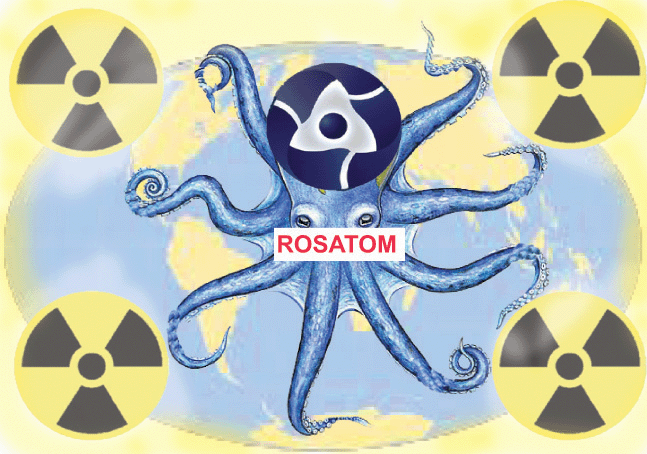
 Riyadh hosts workshop on Russian nuclear technology RIYADH — ROSATOM State Atomic Energy Corporation organized a workshop on Russian nuclear technologies in Riyadh on Dec. 5 for representatives of Saudi companies. The event was held at the Council of Saudi Chambers of Commerce………
White House fury as Russian nuclear planes visit Venezuela
|
White House fury as Russian nuclear planes visit Venezuela Irish Independent, Harriet Alexander,December 12 2018
Two Russian bombers capable of carrying nuclear weapons have landed in Venezuela in a show of support which has infuriated Washington. General Vladimir Padrino, the Venezuelan defence minister, welcomed about 100 Russian pilots and other personnel after the two TU-160s and two other aircraft landed at the international airport that serves Caracas on Monday. He said the deployment showed “we also are preparing to defend Venezuela to the last inch when necessary”. Nicolas Maduro, the president of Venezuela, has frequently alleged that the US is planning an invasion. Mr Padrino noted that Russian aircraft had visited before in 2013, but said their current deployment was part of a “new experience,” and was designed to “raise the level of interoperability of the aerospace defence systems” of both countries. Mr Maduro has found himself increasingly isolated as Donald Trump takes an increasingly aggressive stance against his regime. With many of his allies under sanctions and financial transactions blocked, Mr Maduro has cultivated friendships with America’s adversaries. He said talks with President Putin in Moscow this month yielded Russian investment in his country’s oil and gold sectors. It was not clear how long the Russian planes would stay in Venezuela, nor what their mission would be. “Russia’s government has sent bombers halfway around the world to Venezuela,” US Secretary of State Mike Pompeo tweeted. “The Russian and Venezuelan people should see this for what it is: two corrupt governments squandering public funds, and squelching liberty and freedom while their people suffer.” The Kremlin rejected Mr Pompeo’s criticism. “As for the idea that we are squandering money, we do not agree. It’s not really appropriate for a country half of whose defence budget could feed the whole of Africa to be making such statements,” said Kremlin spokesman Dmitry Peskov. The developments come as Mr Trump escalated his threat to shut down the US government over his demand for funding of his Mexican border wall……..https://www.independent.ie/world-news/latin-america/white-house-fury-as-russian-nuclear-planes-visit-venezuela-37618272.html |
|
|
Russia sends 2 nuclear-capable bombers to Venezuela
Russian Defense Minister Sergei Shoigu said at last week’s meeting with his Venezuelan counterpart Vladimir Padrino Lopez that Russia would continue to send its military aircraft and warships to visit Venezuela as part of bilateral military cooperation. ….
Russia-US relations are currently at post-Cold War lows over Ukraine, the war in Syria and allegations of Russian meddling in the 2016 US election. Russia has bristled at US and other NATO allies deploying their troops and weapons near its borders. https://www.canberratimes.com.au/world/south-america/russia-sends-2-nuclear-capable-bombers-to-venezuela-20181211-p50lea.html?ref=rss&utm_medium=rss&utm_source=rss_feed
US and Russia ally with Saudi Arabia to water down climate pledge
After a heated two-and-a-half-hour debate on Saturday night, the backwards step by the four major oil producers shocked delegates at the UN climate conference in Katowice as ministers flew in for the final week of high-level discussions.
It has also raised fears among scientists that the US president, Donald Trump, is going from passively withdrawing from climate talks to actively undermining them alongside a coalition of climate deniers.
Two months ago, representatives from the world’s governments hugged after agreeing on the 1.5C report by the UN Intergovernmental Panel on Climate Change (IPCC), commissioned to spell out the dire consequences should that level of warming be exceeded and how it can be avoided.
Reaching a global consensus was a painstaking process involving thousands of scientists sifting through years of research and diplomats working through the night to ensure the wording was acceptable to all nations.
But when it was submitted to the UN Framework Convention on Climate Change on Saturday, the four oil allies – with Saudi Arabia as the most obdurate – rejected a motion to “welcome” the study. Instead, they said it should merely be “noted”, which would make it much easier for governments to ignore. The motion has not yet been able to pass as a result of the lack of consensus.
t opened up a rift at the talks that will be hard to close in the coming five days. During the plenary, the EU, a bloc of the 47 least developed countries, as well as African and Latin and South American nations, all spoke in favour of the report. Several denounced the four countries trying to dilute its importance. ………
Scientists were also outraged. “It is troubling. Saudi Arabia has always had bad behaviour in climate talks, but it could be overruled when it was alone or just with Kuwait. That it has now been joined by the US and Russia is much more dangerous,” said Alden Meyer, the director of strategy and policy in the Union of Concerned Scientists….
Ministers have only five days to establish a rulebook for the Paris agreement. A wild card is the role of the host nation, Poland – the most coal-dependant nation in Europe – which will chair the final week of the meeting………
As well as acceptance of the report, there are several other potential fights brewing regarding transparency rules for reporting emissions and proposals for wealthy high emitters to provide financial support to poorer nations struggling to adapt. https://www.theguardian.com/environment/2018/dec/09/us-russia-ally-saudi-arabia-water-down-climate-pledges-un
Saudi Arabia, the US, Kuwait and Russia tried to erase meaning of UN’s report on the impacts of 1.5C warming
Four big oil and gas producers blocked UN climate talks from welcoming the most influential climate science report in years, as a meeting in Poland descended into acrimony on Saturday.
By failing to reach agreement after two and half hours of emotional negotiations, delegates in Katowice set the scene for a political fight next week over the importance of the UN’s landmark scientific report on the effects of a 1.5C rise in the global temperature.
The battle, halfway through a fortnight of Cop24 negotiations, was over two words: “note” or “welcome”.
Saudi Arabia, the US, Kuwait and Russia said it was enough for the members of the UN climate convention (the UNFCCC) to “note” the findings.
But poor and undeveloped countries, small island states, Europeans and many others called to change the wording to “welcome” the study – noting that they had commissioned it when they reached the Paris climate agreement in 2015.
“This is not a choice between one word and another,” Rueanna Haynes, a delegate for St Kitts and Nevis, told the plenary. “This is us, as the UNFCCC, being in a position to welcome a report that we requested, that we invited [scientists] to prepare. So it seems to me that if there is anything ludicrous about the discussion that is taking place, it is that we in this body are not in a position to welcome the report.”
The four opposing countries argued the change was not necessary. Saudi Arabia threatened to block the entire discussion if others pushed to change the single word – and warned that it would disrupt the last stretch of negotiations between ministers next week.
The aim of the Cop24 climate summit is to agree a dense set of technical rules to underpin the Paris Agreement’s goals for limiting global warming to well below 2C, and ideally 1.5C, by the end of the century.
The scientific report was published by the Intergovernmental Panel on Climate Change (IPCC) in October. It found that limiting global warming to 1.5C, rather than below 2C, could help avoid some of the worst effects of climate change, and potentially save vulnerable regions such as low-lying islands and coastal villages in the Arctic. But it also made clear that the world would have to slash greenhouse gases by about 45% by 2030……….
Financial aid is still contentious issue. The rules on how and what developed countries must report on their past and planned funding, and the extent to which emerging economies are urged to do the same, remains largely up for debate.
In a further moment of drama on Saturday afternoon, Africa stood firm as UN officials tried to finalise a draft of the rules that will govern the deal. Africa’s representative Mohamed Nasr said the continent could not accept the deal as it was presented, forcing the text to be redrafted on the plenary floor.
“You can’t bully Africa, it’s 54 countries,” said one negotiator, watching from the plenary floor.
The change will mean new proposals to be made to the text next week. That would allow African ministers to attempt to strengthen a major climate fund dedicated to helping countries adapt to climate change and push for less strict measures for developing countries.
“We have been voicing our concerns, maybe the co-chairs in their attempt to seek a balanced outcome they overlooked some of the stuff. So we are saying that we are not going to stop the process but we need to make sure that our views are included,” Nasr told CHN.
Mohamed Adow, a campaigner with Christian Aid, said the African intervention had “saved the process” by ensuring that dissatisfied countries could still have their issues heard.
“It’s actually much better than it’s ever been in this process at this stage,” he said. “Because this is the end of the first week and ministers have been provided with clear options. Of course nothing is closed but the options are actually narrower.”
It was a long and emotional plenary meeting to mark the halfway point in a fortnight of negotiations.
Four big oil and gas producers blocked the UN climate talksfrom welcoming the most influential climate science report in years – and met backlash from a broad range of poor, developing and rich countries. The battle was over two words: “note” or “welcome”.
Saudi Arabia, the US, Kuwait and Russia wanted the final statement to merely “note” the UN science report on the effects of 1.5C rise in the global temperature. But a call that started with the alliance of small island states pushed to “welcome” the findings.
The plenary chair’s attempt to find a compromise fell flat, setting the scene for a big political fight when ministers arrive in Katowice next week.
And that wasn’t the only moment of drama on Saturday. Earlier in the day, Africa stood firm as UN officials tried to finalise a draft of the rules that will govern the Paris Agreement. “You can’t bully Africa, it’s 54 countries,” one negotiator said.
The change will mean new proposals could come next week. http://www.climatechangenews.com/2018/12/08/climate-science-1-5c-erased-un-talks-us-saudis-step/
If USA dumps the Intermediate-Range Nuclear Forces Treaty (INF) – Putin threatens arms race
Putin threatens arms race if US dumps nuclear treaty https://www.theguardian.com/world/2018/dec/05/putin-threatens-arms-race-if-us-dumps-nuclear-treaty – Andrew Roth in Moscow
Russia would also build new medium-range missiles if the US were to do so, says president
Vladimir Putin has threatened that Russia will develop new missiles banned by the intermediate-range nuclear forces treaty if the US exits the pact and pursues an arms buildup of its own.
The Russian president’s remarks came one day after the US secretary of state, Mike Pompeo, said Moscow was in “material breach” of the cold war-era treaty and issued a 60-day ultimatum for Russia to correct the alleged violations. Otherwise, he said, the US would quit the 1987 accord, considered a milestone in reducing the threat of a nuclear war in Europe.
In Moscow on Wednesday, Putin told journalists the US had provided “no evidence” of Russian violations, and threatened an arms race if the US sought to develop new medium-range missiles after exiting the treaty.
“Apparently, our American partners believe that the situation has changed so drastically that the US should also have such weapons,” Putin said in remarks carried by the Interfax news service. “What response is our side to give? A simple one: then we’ll do the same.”
The arms treaty, signed by Ronald Reagan and Mikhail Gorbachev, banned ground-launched missiles with a range between 500-5,500km. The US and Nato have said that tests of a new Russian cruise missile, designated 9M729, violate the treaty.
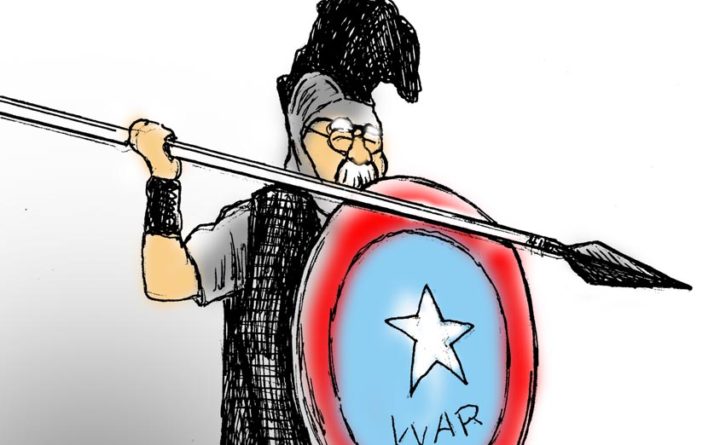 The US effort to exit the treaty was spearheaded by John Bolton, Donald Trump’s hawkish national security adviser.
According to a leaked memo published by the Washington Post, Bolton has ordered the Pentagon to “develop and deploy ground-launched missiles at the earliest possible date”.
While it would take a substantial length of time to develop an entirely new missile, existing medium-range weapons in the US arsenal, such as sea-launched Tomahawk cruise missiles, could be adapted for ground launch more quickly, arms experts said.
However, Nato allies would have to agree unanimously to have any new missile deployed in Europe.
The standoff comes amid a buildup of Russian and Nato forces in Europe, including nuclear forces. Nato claims that Russia has deployed nuclear-capable missiles to Kaliningrad, and on Wednesday the Russian military confirmed it had deployed powerful new anti-ship missiles to Crimea following last month’s maritime clash with Ukraine.
Tensions rise as Russia prepares for USA to deploy nuclear weapons to Europe after ban treaty abandoned
Russia says it’s planning for the US to deploy nuclear weapons to Europe after ban treaty abandoned, Business Insider, Andrew Osborn and Tom Balmforth, Reuters, 26 Nov 18
1 This Month

of the week – Shut Down Drone Warfare!


Tell the Ukrainian Government to Drop Prosecution of Peace Activist Yurii Sheliazhenko

Petition to revoke the licensing of the Near Surface Nuclear Disposal Facility (NSDF) at Chalk River. https://www.ourcommons.ca/petitions/en/Petition/Details?Petition=e-7247
To see nuclear-related stories in greater depth and intensity – go to https://nuclearinformation.wordpress.com
-
Archives
- April 2026 (103)
- March 2026 (251)
- February 2026 (268)
- January 2026 (308)
- December 2025 (358)
- November 2025 (359)
- October 2025 (376)
- September 2025 (257)
- August 2025 (319)
- July 2025 (230)
- June 2025 (348)
- May 2025 (261)
-
Categories
- 1
- 1 NUCLEAR ISSUES
- business and costs
- climate change
- culture and arts
- ENERGY
- environment
- health
- history
- indigenous issues
- Legal
- marketing of nuclear
- media
- opposition to nuclear
- PERSONAL STORIES
- politics
- politics international
- Religion and ethics
- safety
- secrets,lies and civil liberties
- spinbuster
- technology
- Uranium
- wastes
- weapons and war
- Women
- 2 WORLD
- ACTION
- AFRICA
- Atrocities
- AUSTRALIA
- Christina's notes
- Christina's themes
- culture and arts
- Events
- Fuk 2022
- Fuk 2023
- Fukushima 2017
- Fukushima 2018
- fukushima 2019
- Fukushima 2020
- Fukushima 2021
- general
- global warming
- Humour (God we need it)
- Nuclear
- RARE EARTHS
- Reference
- resources – print
- Resources -audiovicual
- Weekly Newsletter
- World
- World Nuclear
- YouTube
-
RSS
Entries RSS
Comments RSS
 nuclear-news