India’s Kudankulam nuclear power station means big debt to Russia
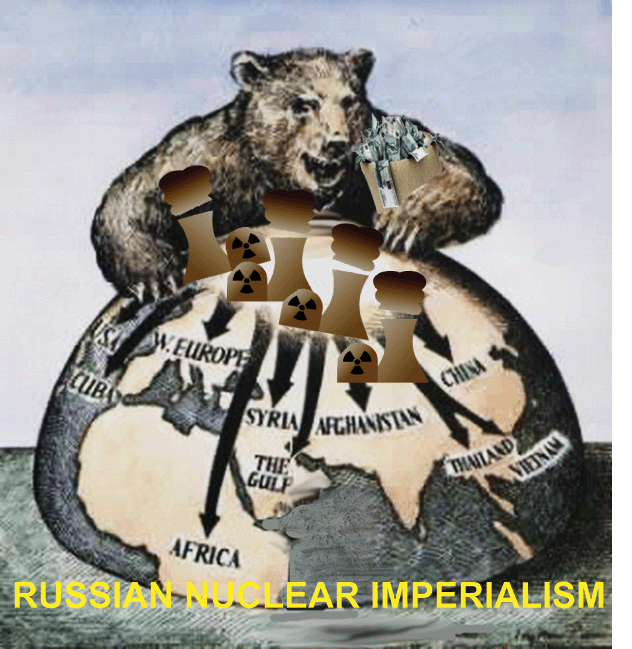 Kudankulam: Nuclear power utility struggles to repay Russia for supplies https://indianexpress.com/article/india/kudankulam-nuclear-power-utility-struggles-to-repay-russia-for-supplies-5563744/ The sanctioning of lower than requisite funds comes at a time when NPCIL’s budgetary support requirement has gone up in light of the utility taking up 10 new projects that had been cleared by the government in May 2017. by Anil Sasi |New Delhi February 1, 2019 Inadequate budgetary support to the strategic nuclear energy sector over the last two financial years has squeezed funds earmarked under the investment head for the Nuclear Power Corporation of India Limited (NPCIL), resulting in India’s frontline nuclear utility slipping back on its repayment obligations to the Russians for equipment supplies to the Kudankulam nuclear project.
The sanctioning of lower than requisite funds comes at a time when NPCIL’s budgetary support requirement has gone up in light of the utility taking up 10 new projects that had been cleared by the government in May 2017.
The problem of non-payment of Russian credit on account of a reduction in the provision for Russian credit to NPCIL was discussed before a parliamentary panel, responding to which the Department of Expenditure in the Finance Ministry subsequently “conveyed” the concerns to the Budget Division of the Department of Economic Affairs in the same Ministry for “further necessary action”.
Under a credit arrangement between the governments of Russia and India, as soon as equipment leaves Russia for Indian projects such as the nuclear station in Kudankulam, that much money is released by the Russian government to the suppliers, which then becomes a loan on the Government of India. This loan is then supposed to be routed to NPCIL by way of a budgetary provision. Against that, the same money would be given back to the Government of India so that it becomes a loan on NPCIL.
This arrangement has come under strain due to the reduction in budgetary allocation under the ‘investment in PSUs’ head, which has affected the loans payable to NPCIL towards ‘Russian credit utilisation’ that is outstanding in the books of the Controller of Aid Accounts and Audit. The CAAA is the division within the Department of Economic Affairs entrusted with the responsibility for withdrawal of loan and grant proceeds for all official development assistance where India is the recipient.
While the extent of the slip-up in the payment obligation to the Russians could not be ascertained, the trend was seen as serious enough for the Parliamentary Standing Committee on Science and Technology, Environment and Forests to flag this an issue to which the Ministry of Finance responded in the affirmative, a senior government official involved in the exercise confirmed. Queries sent to K N Vyas, Secretary of the Department of Atomic Energy and Chairman of the Atomic Energy Commission, did not elicit a response.
According to official estimates, while budgetary support to NPCIL had gone up from Rs 370 crore in the budget estimate for 2017-18 to Rs 1435 crore in the revised estimate for the year (entailing a total of Rs 685 crore under the investment head and Rs 750 crore as loan), the actual requirement in form of budgetary support submitted by the DAE was thrice that amount — Rs 4305 crore. The higher amount, official said, was primarily on account of a shortfall of earlier years in receipt of equity to the tune of Rs 402 crore and obligations under the Russian Credit of Rs 3,903 crore.
For 2018-19, while the allocation was hiked to Rs 1,665 crore in the budget estimate, it still left a funding gap of around Rs 2,870 crore, according to DAE estimates. The situation was exacerbated by 10 new projects based on the indigenous 700 MWe (mega watt electric) pressurised heavy water reactors (PHWRs) that had been sanctioned in mid-2017, due to which budgetary support requirement had also increased.
NPCIL is currently operating 22 commercial nuclear power reactors with an installed capacity of 6,780 MWe, while it has another eight reactors under various stages of construction totaling 6200 MWe capacity.
Russia and India had, in 2015, agreed to actively work on projects deploying 12 additional Light Water Reactor (LWR) nuclear reactors, for which, the localisation of manufacturing in India under the NDA government’s flagship ‘Make in India’ initiative and the commencement of serial construction of nuclear power plants was flagged as a joint initiative.
In this context, the Programme of Action for localisation between Russian state-owned utility Rosatom and the DAE was finalised during Prime Minister Narendra Modi’s Moscow visit in 2015. At the Kudankulam site, where the two Russian-designed VVER-1000 series reactors have being installed, nearly 100 Russian companies and organisations are involved in documentation, supply of equipment and controlling construction and equipping process. At the same site, four more Russian reactor units are slated to come up in the coming years.
Russia secretly offered North Korea a nuclear power plant: officials
SMH, By John Hudson and Ellen Nakashima, 30 January 2019 Washington: Russian officials made a secret proposal to North Korea last northern fall aimed at resolving deadlocked negotiations with the Trump administration over its nuclear weapons program, said US officials familiar with the discussions.
In exchange for dismantling its nuclear weapons and ballistic missiles, Moscow offered the country a nuclear power plant.
The Russian offer, which intelligence officials became aware of in late 2018, marks a new attempt by Moscow to intervene in the high-stakes nuclear talks as it reasserts itself into a string of geopolitical flash points from the Middle East to South Asia to Latin America. Its latest bid is expected to unsettle Chinese and US officials wary of granting Moscow an economic foothold on the Korean Peninsula.
As a part of the deal, the Russian government would operate the plant and transfer all byproducts and waste back to Russia, reducing the risk that North Korea uses the power plant to build nuclear weapons while providing the impoverished country a new energy source……. https://www.smh.com.au/world/north-america/russia-secretly-offered-north-korea-a-nuclear-power-plant-officials-20190130-p50ufz.html
NATO chief says ‘no real progress’ on nuclear treaty
‘We don’t want a new Cold War,’ says Jens Stoltenberg. ‘We don’t want a new arms race.’ Russia refused to give any ground during a meeting with NATO on Friday about its alleged violations of a nuclear treaty, leaving the landmark arms control agreement in “real jeopardy,” Secretary-General Jens Stoltenberg said.
NATO says Russia has deployed a new land-based missile, the Iskander 9M729, in violation of the Intermediate-range Nuclear Forces (INF) Treaty, which since 1988 has banned all missiles with a range of 500 to 5,500 kilometers. And U.S. President Donald Trump has said that he will begin withdrawing from the landmark nuclear accord on February 2 unless Russia takes steps to return to compliance.
Western allies urged Russia to return to compliance at the meeting on Friday of the Russia-NATO Council, but Stoltenberg said the session yielded no change in either side’s position……https://www.politico.eu/article/jens-stoltenberg-russia-nato-after-meeting-russians-chief-says-no-real-progress-on-nuclear-treaty/
A close call – a nuclear war just missed, 25 years ago
That day, a group of American and Norwegian researchers launched a Black Brant XII sounding rocket from the Arctic Circle island of Andøya in an effort to study aurora borealis (the northern lights).
The scientists had warned Russia, the US, and 28 other countries that they were planning a launch, as they knew there was a chance that the rocket would be mistaken for a nuclear first strike.
But someone forgot to tell Russian radar technicians. The technicians sent an alert to Moscow suggesting that an American first strike might be incoming.
Within minutes, President Boris Yeltsin was brought his black nuclear-command suitcase. For several tense minutes, while Yeltsin spoke with his defense minister by telephone, confusion reigned,” the Washington Post’s David Hoffman reported a few years after the incident. “Little is known about what Yeltsin said, but these may have been some of the most dangerous moments of the nuclear age.”
It was, Hoffman reported, the first time a Russian or Soviet leader had used a nuclear briefcase in response to an actual alert. Yeltsin concluded that it was not actually a first strike and did not retaliate.
For that, I thank him; I don’t know if a Russian second strike would have sent enough warheads to kill 4-year-old Dylan all the way up in New Hampshire, but I’m also glad we didn’t have to find out.
But, of course, the 1995 incident was hardly the only time in the nuclear area we came close to an accidental nuclear exchange.
On October 27, 1962, Vasili Arkhipov, a Soviet navy officer, was in a nuclear submarine near Cuba when US naval forces started dropping depth charges (a mild explosive meant to signal for the submarine to identify itself). Two senior officers on the submarine thought that a nuclear war had already begun and wanted to launch a nuclear torpedo at a US vessel. But all three senior officers had to agree for the missile to fire, and Arkhipov dissented, preventing a nuclear exchange.
On September 26, 1983, Soviet Lt. Col. Stanislav Petrov was watching the Soviet Union’s missile attack early warning system when it displayed, in large red letters, the word “LAUNCH”; Petrov’s computer terminal gradually indicated that one, then two, then three, and eventually a total of five American missiles were incoming. Petrov declined to report the strike, knowing that if he did, the likely response would be a full nuclear retaliation. And it was good he did, because the Minuteman missiles the detection system thought it saw were actually just the sun’s reflection off clouds.
Oh, and while we’re at it: The Air Force lost a nuclear bomb off the coast of Georgia in 1958, where it remains today. There’s also a nuclear weapon stuck in a field in Faro, North Carolina, because of another time the Air Force screwed up; that bomb came extremely close to detonating.
Also, in 1980, an intercontinental ballistic missile exploded in Damascus, Arkansas, while it had a 9-megaton nuclear warhead — with three times more explosive power than all the bombs of World War II combined — on top of it. The warhead didn’t detonate; if it did, Arkansas wouldn’t exist and you never would have heard of Bill or Hillary Clinton.
We can live safely in the knowledge that much or all of humankind won’t suddenly vanish due to a miscalculation by a radar officer in Russia or the US, and that people near missile sites won’t find themselves incinerated accidentally due to technician error. Or we can continue to have nuclear weapons. But we have to choose.
Rosatom announces scholarships for Indian students in nuclear energy studies
 Press Trust of India | New Delhi, 21 Jan 19 Rosatom, the Russian agency for atomic energy, has announced scholarships for Indian students in the arena of nuclear energy, according to a statement on Monday.
Rosatom is the main equipment supplier for the Kudankulam Nuclear Power Project in Tamil Nadu.…….https://www.business-standard.com/article/pti-stories/rosatom-announces-scholarships-for-indian-students-in-nuclear-energy-studies-119012101272_1.html
The value of informal talks about nuclear security
 Let’s talk about nuclear security — informally, SF Chronicle, By James Goodby and Kenneth Weisbrode Jan. 19, 2019
With the high-profile conclusion of Robert Mueller’s investigation, a U.S. threat to withdraw from a nuclear missile treaty, a worsening political situation in Ukraine, an ongoing conflict in Syria, not to mention recent reports that the FBI began a counterintelligence investigation of President Trump — the citizens of Russia and the United States should worry that their countries are soon reaching a point of no return.
Diplomats will say that few such points exist, and that professionals can and will continue to keep the channels of dialogue open. What’s missing here is not the capacity to talk but a political consensus on both sides to reaffirm why both countries still need to cooperate and how to go about finding it.
Mikhail Gorbachev and George P. Shultz recently called for a “broad strategic dialogue” among Americans and Russians to pull our nations out of their trough, or at least to look beyond it. Gorbachev and Shultz propose an “informal forum,” and that makes sense. The U.S.-Russia Bilateral Presidential Commission, nuclear arms control talks, and other formal arrangements appear to be stalled. The establishment of dialogue at a higher level — similar to efforts in the 1990s to encourage mutual investments and business opportunities — would probably be a nonstarter. What would an informal forum look like?………. https://www.sfchronicle.com/opinion/openforum/article/Let-s-talk-about-nuclear-security-informally-13547680.php
Russia’s plans for nuclear-powered unmanned underwater weapons
“Two Poseidon-carrying submarines are expected to enter service with the Northern Fleet and the other two will join the Pacific Fleet. Each of the submarines will carry a maximum of eight drones and, therefore, the total number of Poseidons on combat duty may reach 32 vehicles,” tass.comreported.
Doubts about the program were raised in thediplomat.com: “ “The UUV is being designed a weapon of last resort to strengthen Russia’s nuclear deterrence posture vis-à-vis the United States and NATO. Torpedoes equipped with a nuclear propulsion system and fitted with a nuclear warhead for use over long distances were first conceived in the Soviet Union back in the 1950s but were considered impractical and unreliable at the time. There are still questions whether Russia will be capable of building a reliable miniaturized nuclear reactor for the UUV [next to other technical challenges].”
Sea trials of the Poseidon commenced in December 2018. The ongoing tests are part of experimental design work rather than full-fledged sea trials, according to a Russian defense industry source.
Germany urges Russia to destroy missile to save nuclear treaty
http://www.digitaljournal.com/news/world/germany-urges-russia-to-destroy-missile-to-save-nuclear-treaty/article/541215 German Foreign Minister Heiko Maas on Friday called on Russia to destroy a controversial missile system Washington says breaches a key arms control treaty.
“We believe Russia can save this treaty,” Maas said after talks with Russia’s top diplomat Sergei Lavrov, referring to the Intermediate-Range Nuclear Forces treaty (INF).
“It affects our security interests in a fundamental way.”
Tensions have raged between Russia and the United States over the fate of the INF agreement signed in 1987 by then US president Ronald Reagan and Soviet leader Mikhail Gorbachev.
US President Donald Trump has promised to walk away from the agreement and Russian leader Vladimir Putin threatened a new arms race, saying Europe would be its main victim.
Washington says Moscow’s 9M729 missile system violates the treaty and warned it would withdraw from the agreement if Russia does not get rid of it.
Russia denies the claim, accusing the United States of violating the treaty which forbids ground-launched short- and intermediate-range missiles.
“Like other NATO members, we believe that there is a missile violating this treaty and it should be destroyed in a verifiable manner to get back to the implementation of this agreement,” Germany’s Maas told reporters.
Maas commended Moscow for trying to salvage the agreement and expressed hope that talks between Russian and US negotiators would resume in the near future.
Last month Washington gave Russia a 60-day deadline to dismantle missiles that it claims breach the INF treaty or the US would begin the six-month process of formally withdrawing from the deal.
Lavrov for his part said Washington provided no evidence that Russia’s tests of the missile violated the INF treaty.
He said Washington’s demands to destroy the missiles and have regular access to Russian sites were just “a pretext to exit the treaty.”
“During official contacts on arms control and disarmament issues back in October the United States said the decision is definitive and their announcement of the withdrawal from the INF treaty is not an invitation to dialogue. This is a quote.”
Earlier this week, talks between US and Russian officials in Geneva to salvage the deal led nowhere. Moscow said Washington did not appear to be in the mood for more talks while a US official said Russia was just paying “lip service” to transparency.
Russian officials said US representatives had confirmed Washington’s intention to begin withdrawing from the treaty from February 2.
USA to begin pullout from Intermediate-range Nuclear Forces (INF) treaty, rejecting Russian offer
 US to begin nuclear treaty pullout next month after Russia missile talks fail, Guardian, Julian Borger in Washington, 17 Jan 2019
-
- Officials reject Russian offer to inspect new missile
- US says it will suspend observance of INF treaty on 2 February
The US has rejected Moscow’s offer to inspect a new Russian missile suspected of violating a key cold war-era nuclear weapons treaty, and warned that it would suspend observance of the agreement on 2 February, giving six-months’ notice of a complete withdrawal. The under secretary of state for arms control and international security, Andrea Thompson, confirmed the US intention to withdraw from the treaty after a meeting with a Russian delegation in Geneva, which both sides described as a failure.
Donald Trump took US allies by surprise when he announced his intention to leave the 1987 Intermediate-range Nuclear Forces (INF) treaty in October. The agreement led to the destruction of thousands of US and Soviet weapons, and has kept nuclear missiles out of Europe for three decades.
The Russian foreign minister, Sergei Lavrov, accused the US of intransigence, saying Moscow had offered to allow US experts to inspect the suspect missile, which it insists does not infringe the limits laid down in the treaty.
“However, US representatives arrived with a prepared position that was based on an ultimatum and centred on a demand for us to destroy this rocket, its launchers and all related equipment under US supervision,” Lavrov said.
Thompson noted that the US had been demanding Russian transparency over the missile for more than five years. She confirmed that the offer of inspections was not enough and that the US was demanding the destruction of the missile system, known as the 9M729……..
She said that there were currently no plans for follow-up talks on the INF before the 2 February deadline laid down by the Trump administration, though US and Russian diplomats would be meeting, including at a summit of the Nato-Russian council next week.
Thompson said that if Russia did not show willingness to comply with the treaty by the deadline, the US would suspend its own obligations, meaning that the US defense department could start research and development on missiles with ranges currently banned by the INF, from 500 to 5,500km.
At the same time, she told reporters, the US would formally give notice of its withdrawal from the treaty, which could come into effect on 2 August.
After that, there would be no restrictions on deployment of medium-range missiles in Europe or the Pacific………..
The Trump administration was criticised by former officials and arms control advocates for not pursuing the Russian offer of inspections.
“We’ve spent years trying to get something – anything – out of the Russians on INF. The Russian offer of an exhibition of the 9M729 is not enough, but it is something,” Alexandra Bell, a former senior state department official who is now senior policy director at the Centre for Arms Control and Non-Proliferation.
“Perhaps it is a foundation on which to build. Not trying to take advantage of this opportunity is to leave diplomatic options on the table and that’s just foolish.”
Daryl Kimball, the head of the Arms Control Association said: “If the INF is terminated on 2 August, there will be nothing to prevent Russia from deploying nuclear missiles that threaten Europe and the Trump administration will have no hesitation in pursuing the deployment of INF-prohibited weapons in Europe.” https://www.theguardian.com/world/2019/jan/16/us-russia-inf-treaty-nuclear-missile
Russia’s Rosatom signs up Serbia for a nuclear science centre
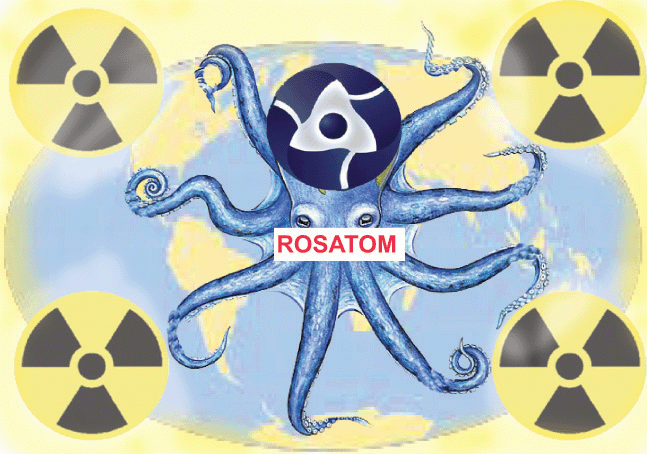 Russia, Serbia sign agreement on nuclear cooperation, Agreement includes construction of center of nuclear science, technology and innovation, Yeni Safak January 18, 2019 Anadolu Agency Russia and Serbia signed a strategic cooperation document for the peaceful use of nuclear energy, Russian State Atomic Energy Corporation Rosatom said on Thursday. Russia, Serbia sign agreement on nuclear cooperation, Agreement includes construction of center of nuclear science, technology and innovation, Yeni Safak January 18, 2019 Anadolu Agency Russia and Serbia signed a strategic cooperation document for the peaceful use of nuclear energy, Russian State Atomic Energy Corporation Rosatom said on Thursday.
The agreement, signed during Russian President Vladimir Putin’s visit to Serbia, includes the construction of a center of nuclear science, technology and innovation, according to the company’s statement. “In particular, the implementation of the project to build the center of nuclear science, technology and innovation will not only give a powerful impetus to bilateral cooperation between Russia and Serbia in a number of innovative areas, including medicine, industry and agriculture, but will also serve as a platform for cooperation at the level of the entire Central European region,” Likhachev said……… Alexey Likhachev, director general of Rosatom signed the documents on Russia’s behalf, while Nenad Popovich, Serbia’s minister in charge of innovation and technological development, signed them on Serbia’s behalf. The Russian company has 36 nuclear reactor construction projects in different countries, including Bangladesh, Belarus, China, Egypt, Finland, Hungary, India, Iran and Turkey. According to the company, its package of foreign orders in 2018 exceeded $130 billion. https://www.yenisafak.com/en/world/russia-serbia-sign-agreement-on-nuclear-cooperation-3472195 |
|
|
Russia’s Rosatom to manage accident plan at the Fukushima NPP
 Russia’s Rosatom wins two bids for accident management at Fukushima NPP http://tass.com/world/1039631, January 12, 2019, MOSCOW, Russia’s state nuclear corporation Rosatom has been engaged in the nuclear control plan at Japan’s stricken Fukushima nuclear power plant and has already won two bids in that project, Rosatom CEO Alexei Likhachev said in a televised interview with Rossiya’24 news channel on Saturday.
“We have been engaged by Japan to implement the nuclear accident management plan at the Fukushima NPP. We have won two tenders and are getting ahead,” he said.
In September 2017, Rosatom’s First Deputy CEO Kirill Komarov said that Rosatom offered help to Japanese counterparts in handling the crippled Fukushima NPP.
The nuclear disaster at the Fukushima-1 power plant in March 2011 was triggered by an earthquake-induced tsunami that knocked out vital reactor cooling systems. This resulted in three nuclear meltdowns, hydrogen explosions and a massive release of radioactive waste, which contaminated the surrounding area. Clean-up operations continue at the power plant and adjacent territories. According to the current action plan, full decommissioning of the station may take place only around 2040.
Russian blogger reveals photo of venting cloud of radioactive dust from 1987 nuclear test gone wrong
Photo shows venting radioactivity from 1987 nuclear bomb tests at Novaya Zemlya https://thebarentsobserver.com/en/security/2019/01/photo-shows-venting-radioactivity-nuclear-bomb-tests-novaya-zemlya
It is two hours past midnight on August 2nd 1987 when the Soviet nuclear weapons scientists push the button triggering a series of five nuclear devises inside a tunnel at the Matochkin Shar nuclear testing site.
A load boom follows and the ground is shaking like an earthquake. A huge dust cloud blows out from the tunnel supposed to be hermetical sealed by meters thick stone- and concrete walls.
The radioactive dust cloud came as a big surprise to the personnel witnessing.
Now, more than 30 years later, a photo from the accident is published by Russian blogger who focuses on nuclear thematic and also posts photos on twitter.
Leakage of radioactivity from the August tests in 1987 is known from before, listed in a 2005 publication by Science and Global Security. Now, the photo from the site gives the public a better understanding of the size of tunnel collapse.
The photo is taken no more than a kilometer from the tunnel entrance and shows a military helicopter parked in in front. Each of the tunnels in the area where underground nuclear weapons testing took place from 1964 to 1990 has its own code number. The one collapsing on this photo is known as tunnel A-37A.
According to a list of all underground nuclear weapons tests at Novaya Zemlya, published by Science and Global Security, the total yield of the five devises exploded on August 2nd were 150 KT, ten times the size of the bomb dropped on Hiroshima in 1945.
The leakages of radioactivity was estimated to 56 TBq. The gamma radiation near the entrance to the tunnel was measured to more than 500 R/h. First radioactive gases were detected 90 seconds after the blast.
500 R/h is about 1000 times the annual dose for an average human. Exposed directly, such dose could be lethal within an hour or two.
In the book USSR Nuclear Explosions about the northern test site at Novaya Zemlya, published in 1991, a group of Soviet radiation experts writes about the accident. «A powerful burst of a radioactive gas-jet.stream occurred just above the mouth of the adit, just 1,5 minutes after the explosion. It was later established that gas penetrated along a geologic fault that extended along the adit axis and hot gases melted the surface ice.»
The authors describe how an emergency program was immediately instituted evacuating all staff within a period of a few minutes. No cases of radiation sickness occurred amon the test site personnel at Novaya Zemlya.
Mountian Moiseev, where the nuclear weapons tests took place, is located about 10 kilometers south of Severny, the military settlement on the shores of the Matochkin Shar serving as the centre for the nuclear test site.
The last real nuclear weapon test at Novaya Zemlya took place on October 24th 1990. Today, only subcritical nuclear weapon tests are conducted on the Russian Arctic archipelago.
Russia might revive its fearful automatic nuclear weapons launch system
Meet “Dead Hand”: This Might Be Russia’s Most Terrifying Nuclear Weapons Idea Yet https://nationalinterest.org/blog/buzz/meet-dead-hand-might-be-russias-most-terrifying-nuclear-weapons-idea-yet-40937
Perhaps the most terrifying was a Cold War doomsday system that would automatically launch missiles—without the need for a human to push the button—during a nuclear attack. But the system, known as “Perimeter” or “Dead Hand,” may be back and deadlier than ever, f Russia is now discussing Perimeter publicly, that’s reason for the rest of us to worry.
Russia has a knack for developing weapons that—at least on paper—are terrifying: nuclear-powered cruise missiles, robot subs with 100-megaton warheads .
Perhaps the most terrifying was a Cold War doomsday system that would automatically launch missiles—without the need for a human to push the button—during a nuclear attack.
But the system, known as “Perimeter” or “Dead Hand,” may be back and deadlier than ever.
This comes after the Trump administration announced that the United States is withdrawing from the 1987 Intermediate-Range Nuclear Forces Treaty, which eliminated the once-massive American and Russian stockpiles of short- and medium-range missiles. Donald Trump alleges that Russia has violated the treaty by developing and deploying new, prohibited cruise missiles.
This has left Moscow furious and fearful that America will once again, as it did during the Cold War, deploy nuclear missiles in Europe. Because of geographic fate, Russia needs ICBMs launched from Russian soil, or launched from submarines, to strike the continental United States. But shorter-range U.S. missiles based in, say, Germany or Poland could reach the Russian heartland.
Viktor Yesin, who commanded Russia’s Strategic Rocket Forces in the 1990s, spoke of Perimeter/Dead Hand during an interview last month in the Russian newspaper Zvezda [Google English translation here]. Yesin said that if the United States starts deploying intermediate-range missiles in Europe, Russia will consider adopting a doctrine of a preemptive nuclear strike. But he also added this:
Zvezda: “Will we have time to answer if the flight time is reduced to two to three minutes when deploying medium-range missiles near our borders? In this version, all hope is only on Perimeter. And for a retaliatory strike. Or was Perimeter also disassembled for parts?
It is not clear what Yesin meant when he said the system has been “improved,” or even exactly what he meant by “functioning.” Perimeter works by launching specially modified SS-17 ICBMs, which transmit a launch signal to regular nuclear-tipped ICBMs in their silos.
“Higher authority” would flip the switch if they feared they were under nuclear attack. This was to give the “permission sanction.” Duty officers would rush to their deep underground bunkers, the hardened concrete globes, the shariki. If the permission sanction were given ahead of time, if there were seismic evidence of nuclear strikes hitting the ground, and if all communications were lost, then the duty officers in the bunker could launch the command rockets. If so ordered, the command rockets would zoom across the country, broadcasting the signal “launch” to the intercontinental ballistic missiles. The big missiles would then fly and carry out their retaliatory mission.
There have been cryptic clues over the years that Perimeter still exists.
Which illustrates one of the curiosities of this system, which is that the Soviet Union kept its existence secret from the American enemy whom it was supposed to deter.What is unmistakable is that Perimeter is a fear-based solution. Fear of a U.S. first-strike that would decapitate the Russian leadership before it could give the order to retaliate. Fear that a Russian leader might lose his nerve and not give the order.
And if Russia is now discussing Perimeter publicly, that’s reason for the rest of us to worry.
Michael Peck is a contributing writer for the National Interest. He can be found on Twitter and Facebook.
President Vladimir Putin’s new secret weapon -NUCLEAR drone which sends 1,640ft high WAVES
WHY RUSSIA’S ‘POSEIDON’ UNMANNED UNDERWATER DRONE IS A DOOMSDAY WEAPON
Russia boasts of ‘impossible to detect’ NUCLEAR drone which sends 1,640ft high WAVES https://www.dailystar.co.uk/news/world-news/751603/russia-news-vladimir-putin-underwater-drone-nuclear-war-world-war-3
RUSSIAN ministry of defence officials have hinted that a new underwater nuclear warhead-carrying drone is impossible to detect. By Douglas Patient / 5th January 2019 Dubbed President Vladimir Putin‘s new secret weapon – it’s even more deadly than originally thought according to Russia. The navy will be armed with Poseydon drones as soon as 2027.
It carries nuclear warheads and was created in order to obliterate enemy ports. But being equipped with warheads of 100 megatons, it can also be used against coastal cities.
Attacks would involve detonating the warhead underwater, creating huge tidal waves up to 1,640ft high.
At the same time it would contaminate enemy territory with radiation.
Unlike conventional nuclear weapons it would also be immune to being hit by missiles, lasers and railguns.
The concept of the strategic underwater drone named Poseydon was first put forward in 2015 and mentioned by Putin in March last year during his state-of-the-nation speech.
It was initially believed that the Poseydon will be able to travel up to 70 knots, which is about 80mph, while underwater.
But now it has been confirmed that the sample actually be capable of travelling as fast as 125mph (more than 110 knots).
In an official statement ministry said: “The drone will travel to its destination at a speed of 200 kph (125mph) and a depth of 1km (0.6 miles). The drone will be moving in a so-called ‘air-cavern’ (a process in which a steam filled bubble forms around the drone, which reduces the resistance of the water and allows it to move so fast).
“The drone will constantly be performing different manoeuvres and will not stay on one trajectory, which together with its high speed will make it impossible to intercept.”
Officials also released a video showing the computer presentation of Poseydon drones from the Russian Ministry of Defence.
This comes as Russia said it was developing a drone sub that has an underwater rifle to fire at enemy divers.
Putin puts shipping safety regulation in the Arctic into the hands of the nuclear industry!
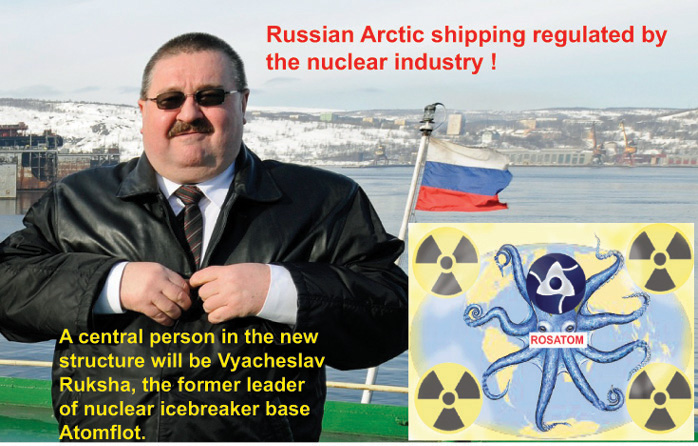
It’s a law – Russian Arctic shipping to be regulated by Rosatom https://thebarentsobserver.com/en/arctic/2019/01/its-law-russian-arctic-shipping-be-regulated-rosatom
President Putin signs the bill that makes the country’s state nuclear power company top regulator of the Northern Sea Route.By Atle Staalesen, January 02, 2019
Rosatom has officially been granted the leading role in the development of the vast Russian Arctic. The company that employs more than 250,000 people and engages in a multitude of activities related to nuclear power development and production is now formally Russia’s management authority for the Northern Sea Route.
The law was adopted by the State Duma on the 11th December and on the 28th signed by Vladimir Putin.
The new legislation comes as Russian Arctic shipping is on rapid increase. In 2018, about 18 million tons of goods was transported on the sea route, an increase of almost 70 percent from 2017. And more is to come. According to Vladimir Putin so-called May Decrees, the top national priorities, shipping on the Northern Sea Route is to reach 80 million tons already by year 2024.
Rosatom’s new powers in the Arctic include development and operational responsibilities for shipping, as well as infrastructure and sea ports along the northern Russian coast.
The responsibilities of the Northern Sea Route Administration, that until now has operated under the Ministry of Transport, will now be transferred to Rosatom.
It was Putin himself who in early 2017 made clear that a coordinating government agency for the Northern Sea Route was needed. A battle between Rosatom and the Ministry of Transport followed. In December 2017, it became clear that the nuclear power company had won that fight.
A central person in the new structure will be Vyacheslav Ruksha, the former leader of nuclear icebreaker base Atomflot.
The nuclear power company has since 2008 operated the fleet of nuclear-power icebreakers. Currently, five icebreakers are based in Atomflot, Murmansk, and several more ships are under construction, including four powerful LK-60 vessels.
Rosatom is also in the planning process of the «Lider», the 120 MW capacity super-powerful ship that can break through two meter thick ice at an unprecedented 10-12 knot speed.
1 This Month
10 March A LIVE WEBINAR THE REAL EFFECTS OF NUCLEAR POWER
What the Industry Isn’t Telling Us
1:00 PM Mountain, 2 pm Central, 3 pm Eastern. Live on the Keepers of the Water Facebook page



18 March Webinar @ 1 PM EST: An Assessment of SMR Projects: The Case of Canada
register for the zoom:
https://us02web.zoom.us/webinar/register/WN_o8BIIOUvQ2ONJR1nta65DQ#/registration


of the week – STOP SMALL MODULAR REACTORS IN CANADA
To see nuclear-related stories in greater depth and intensity – go to https://nuclearinformation.wordpress.com
-
Archives
- March 2026 (109)
- February 2026 (268)
- January 2026 (308)
- December 2025 (358)
- November 2025 (359)
- October 2025 (376)
- September 2025 (258)
- August 2025 (319)
- July 2025 (230)
- June 2025 (348)
- May 2025 (261)
- April 2025 (305)
-
Categories
- 1
- 1 NUCLEAR ISSUES
- business and costs
- climate change
- culture and arts
- ENERGY
- environment
- health
- history
- indigenous issues
- Legal
- marketing of nuclear
- media
- opposition to nuclear
- PERSONAL STORIES
- politics
- politics international
- Religion and ethics
- safety
- secrets,lies and civil liberties
- spinbuster
- technology
- Uranium
- wastes
- weapons and war
- Women
- 2 WORLD
- ACTION
- AFRICA
- Atrocities
- AUSTRALIA
- Christina's notes
- Christina's themes
- culture and arts
- Events
- Fuk 2022
- Fuk 2023
- Fukushima 2017
- Fukushima 2018
- fukushima 2019
- Fukushima 2020
- Fukushima 2021
- general
- global warming
- Humour (God we need it)
- Nuclear
- RARE EARTHS
- Reference
- resources – print
- Resources -audiovicual
- Weekly Newsletter
- World
- World Nuclear
- YouTube
-
RSS
Entries RSS
Comments RSS
 nuclear-news