Russia to lease nuclear-powered attack submarine to India for a cool $3 billion
|
India, Russia To Sign $3 Billion Nuclear Sub Deal This Week
India and Russia are set to sign a $3 billion lease agreement for a nuclear-powered attack sub on March 7, according to local media reports. The Diplomat, By Franz-Stefan Gady, March 05, 2019 India and Russia are expected to conclude an intergovernmental agreement for a 10-year lease of a Russian nuclear-powered attack submarine (SSN) this week. The deal, estimated to be worth around $3 billion, will likely be inked on March 7, according to sources cited by The Economic Times. Neither the Indian nor Russian defense ministries, however, have officially confirmed that a signing ceremony will be held in the coming days. |
|
Cold War-like arms race is likely to follow the collapse of a historic nuclear treaty
Key points:
- The landmark INF treaty was integral to ending the Cold War
- Short and intermediate range missiles were banned because of the short flight time
- Analyst say it’s unlikely to be renegotiated within the six-month notice period
Last week, Russian President Vladimir Putin said Russia was ready for a Cuban Missile-style crisis if the US wanted one, referring to the 1962 standoff that brought the world to the edge of nuclear war.
Decades later, tensions between the two nations are heating up again.
Mr Putin warned that Moscow would retaliate if the US placed new missiles closer to Russia, telling local media that Moscow could deploy hypersonic missiles on ships and submarines outside US territorial waters.
The comments were made after the Trump administration announced it would officially abandon a historic nuclear pact that had kept nuclear missiles out of Europe for three decades.
Here’s a look at what the treaty is, what may come next, and why analysts believe its demise could lead to a 21st-century arms race.
The Intermediate-Range Nuclear Forces Treaty (INF) bans the US and the Russian Federation, previously the Soviet Union, from developing, testing and possessing short- and intermediate-range missiles that could be launched from the ground, as opposed to the sea or sky.
The treaty — signed by former US president Ronald Reagan and Soviet leader Mikhail Gorbachev in December 1987 — declared that “nuclear war cannot be won and must never be fought” and took seven years to negotiate.
Both sides agreed to destroy a total of 2,692 short-, medium- and intermediate-range missiles with a range between 500 and 5,500 kilometres that were stationed in, or aimed at Europe.
The treaty is credited with helping to ending the Cold War.
Maria Rublee, a former US intelligence officer and nuclear politics expert at Monash University, told the ABC these missiles were seen as a “hair trigger for nuclear war” due to how quickly they could strike a target.
“You don’t have time to talk, to pick up the phone, the red hotline, to say what’s going on and ask if this is a mistake.”
Washington and its North Atlantic Treaty Organisation (NATO) allies claim Moscow has been violating the terms of the treaty by developing missiles within the range for years, but Russia has repeatedly denied the allegations.
Earlier this month the Trump administration declared it would suspend US obligations under the treaty, with the intention of withdrawing because of Russia’s alleged non-compliance.
The day after the announcement, Russia also said it would withdraw from the treaty, and accused the US of fabricating the allegations so it could develop new missiles.
The treaty is not dead just yet — both parties must give six months notice before they can officially withdraw — but Dr Rublee said the chances of the treaty being revived were low, although there was some hope.
“[The first step] is not going to come from the Trump administration and it’s not going to come from Russia,” she said.
“It would need to come from NATO because the countries most at risk are European countries.”…….. https://www.abc.net.au/news/2019-03-03/collapse-of-treaty-could-lead-to-new-arms-race/10845950
Russia flexes nuclear muscles , warns on its ability to strike nuclear targets in USA
 After Putin’s warning, Russian TV lists nuclear targets in U.S. Andrew Osborn, MOSCOW (Reuters) 25 Feb 19, – Russian state television has listed U.S. military facilities that Moscow would target in the event of a nuclear strike, and said that a hypersonic missile Russia is developing would be able to hit them in less than five minutes.
The targets included the Pentagon and the presidential retreat in Camp David, Maryland.
The report, unusual even by the sometimes bellicose standards of Russian state TV, was broadcast on Sunday evening, days after President Vladimir Putin said Moscow was militarily ready for a “Cuban Missile”-style crisis if the United States wanted one.
With tensions rising over Russian fears that the United States might deploy intermediate-range nuclear missiles in Europe as a Cold War-era arms-control treaty unravels, Putin has said Russia would be forced to respond by placing hypersonic nuclear missiles on submarines near U.S. waters.
……..The targets, which Kiselyov described as U.S. presidential or military command centers, also included Fort Ritchie, a military training center in Maryland closed in 1998, McClellan, a U.S. Air Force base in California closed in 2001, and Jim Creek, a naval communications base in Washington state.
Kiselyov, who is close to the Kremlin, said the “Tsirkon” (‘Zircon’) hypersonic missile that Russia is developing could hit the targets in less than five minutes if launched from Russian submarines.
Hypersonic flight is generally taken to mean traveling through the atmosphere at more than five times the speed of sound……. https://www.reuters.com/article/us-usa-nuclear-russia/after-putins-warning-russian-tv-lists-nuclear-targets-in-us-idUSKCN1QE1DM
We are closer to a nuclear war than we would like to believe – new smaller bombs make this more likely
Those missiles, Putin estimates, could reach Moscow in 10 minutes and he considers this “a very serious threat.” He declared in his response in English, “In this case, we will be forced – I repeat – forced to take tit-for-tat steps.”
Now, read this warning with another piece of news from the Truthout.org website. According to the Truthout report, the National Nuclear Security Administration (NNSA), the U.S. federal agency responsible for the military application of nuclear science, announced that the first of a new generation of strategic nuclear weapons had rolled off the assembly line. It is smaller in size and power; it will yield “only” about one-third of the power of the bomb the U.S. had dropped on Hiroshima on Aug. 6, 1945. In one day, 145,000 people were killed in Hiroshima. So, this “small” bomb, that is officially designated as the W76-2, could kill approximately 50,000 people.
A smaller missile and a smaller bomb, according to the group known as the Union of Concerned Scientists, are actually more dangerous than those monster nuclear weapons, for they kill fewer people. No, there is no contradiction in this evaluation. What precluded the use of the big bombs by both sides was the fear that mutual destruction from both sides’ large atomic weapons would mean the annihilation of civilization. That mutual assured destruction (MAD) theory made a thermonuclear disaster “unthinkable.” ……
This small bomb, according to the Union of Concerned Scientists, is not a deterrent against another country; it is going to be used. It is designed to be used. Its power is not the equivalent of the roughly 100 kilotons of TNT as the ones that had devastated Hiroshima and Nagasaki, but five kilotons. A practical guy like Trump would like to teach a lesson or two to those who are on his national strategy document as “the enemies of the U.S.” using this rather economic weapon. It would not end capitalism and the financial network as the “big one” would have.
Policy analysts think that the Pentagon would definitely deploy short-range nuclear-capable missiles in Eastern Europe and on islands off the Chinese coast. Watch for the deployment of those small bombs on nuclear submarines around Iran, too.
We are closer to a nuclear war than we would like to believe. https://www.dailysabah.com/columns/hakki-ocal/2019/02/25/tit-for-tat-steps-toward-a-nuclear-war
If USA US deploys nuclear weapons in Europe RUSSIA and Belarus will consider a joint military response
 ‘Things will turn NASTY’ Belarus leader issues warning after collapse of nuclear treaty https://www.express.co.uk/news/world/1090969/belarus-news-inf-treaty-world-war-3-russia-v-usa-nato
RUSSIA and Belarus will consider a joint military response if the US deploys weapons in Europe after pulling out of the Intermediate-range Nuclear Forces (INF) Treaty.
But Donald Trump has pulled the US out of the accord after accusing Russia of committing repeated violations and Mr Lukashenko fears the security of Belarus could be compromised as a result.
He said: “It is a catastrophe, particularly for us.
“I am afraid the Americans will grab the fleeting opportunity and deploy the missiles in Europe after breaking the treaty. “If they do, things will turn nasty for us, too. Because together with Russia, we will have to think of reciprocal measures.”
He continued: “It would be unavoidable if this happened. It would be even worse if, God forbid, missiles were deployed in Ukraine.
“This is why I am wholeheartedly against dissolving the Intermediate-Range Nuclear Forces Treaty.
“We pursue a peace-loving policy. We don’t need scuffles between major powers, from which, judging from history, we’ve always suffered.
“This is why we don’t need this slaughter, this fight, particularly now around the Intermediate-Range Nuclear Forces Treaty.”
Mr Lukashenko said he believes NATO is keen to deploy missiles in Europe.
He said: “It seems to me that although NATO claims they are not going to deploy these missiles in Europe, they are running a bluff.
“Otherwise, why would they withdraw? Why did they have to destroy this treaty?
“They should have come to terms with China and make it part of the treaty if China was the focus of it.”
Trump’s son in law Jared Kushner linked to unusual dealings about nuclear reactor sales to Russia – Congressional report
|
Trump administration ‘pushing Saudi nuclear deal’ which could benefit company linked to Jared Kushner
Congressional report cites ‘abnormal acts’ in White House regarding proposal to build reactors in kingdom, The Independent UK Tom Embury-Dennis20 Feb 19. Senior Trump administration officials pushed a project to share nuclear power technology with Saudi Arabia over the objections of ethics officials, according to a congressional report, in a move that could have benefitted a company which has since provided financial relief to the family of Jared Kushner. |
|
Russia ups the ante against USA, but won’t make the first move to deploy missiles
Putin Ratchets Up Nuclear Warning Against U.S. Russia isn’t seeking confrontation with the U.S. and wouldn’t make the first move to deploy missiles, WSJ, By Ann M. SimmonsFeb. 20, 2019 MOSCOW—President Vladimir Putin warned Russia would aim new advanced weapons against the U.S. should it deploy intermediate-range missiles in Europe, raising the stakes after the breakdown of a Cold War-era nuclear treaty.
Mr. Putin said Russia wasn’t seeking confrontation with the U.S. and wouldn’t make the first move to deploy the missiles. But if Washington has such plans once it abandons the 1987 Intermediate-range Nuclear Forces Treaty, this “will be a serious threat to us” and Russia will be “forced to provide for mirror…https://www.wsj.com/articles/putin-ratchets-up-nuclear-warning-against-u-s-11550668465
At Soviet Union’s Semipalatinsk Nuclear Test Site, civilian population were used as radiation guinea pigs
 WW3 SHOCK: How Soviets used OWN population as ‘NUCLEAR GUINEA PIGS’ during secret tests. https://www.express.co.uk/news/world/1086621/WW3-soviet-union-russia-guinea-pigs-nuclear-tests-polygon-spt
THE Soviet Union used its own population as “guinea pigs” to tests the effects of its secret nuclear weapons as tensions rose with the United States, a former member of the European Parliament for Scotland revealed. By CALLUM HOARE, Feb 13, 2019 The Semipalatinsk Test Site, also known as The Polygon, was home to at least 456 nuclear tests between 1949 and 1989, during the height of the Cold War. These top-secret missions were carried out with little regard for human or environmental impact in the surrounding area, just 11 miles away. Locals were told their area had been selected to help counter the threat from the US but were not aware of the full extent of the radiation damage.
“They were being used as human guinea pigs.”
Mr Stevenson claimed the KGB manipulated locals so they could test the full potential of their nuclear weapons.
He continued: “The KGB ordered them to pack books and bedding behind the windows of their houses and actually stand outside.
“The women were there holding their babies and the KGB told them ‘you will witness the might of Soviet technology’ and they were actually celebrating this massive bomb, not knowing it would make them severely ill.
“[Joseph] Stalin gave an order that if the bomb did not explode, the professors and all their team would be executed.”
In 1989, the anti-nuclear movement was started in Kazakhstan called “Nevada Semipalatinsk”, led by poet Olzhas Suleimenov.
The site was officially closed by the President of Kazakhstan Nursultan Nazarbayev on 29 August 1991, denuclearising the country.
Russia’s very threatening new 100-megaton underwater nuclear doomsday device,
The real purpose of Russia’s 100-megaton underwater nuclear doomsday device, Business Insider ALEX LOCKIE, FEB 12, 2019,
Is nuclear power REALLY a clean-power fix for Africa – as Russia and China push it
 Russia, China back nuclear as a clean-power fix for Africa
But in recent years, at least seven other sub-Saharan African states have signed agreements to deploy nuclear power with backing from Russia, according to public announcements and the World Nuclear Association (WNA), an industry body………
Like Ethiopia, emerging nuclear states Sudan, Kenya, Uganda, Nigeria, Rwanda, Zambia and Ghana have signed agreements with Russia’s state nuclear corporation, ROSATOM – most since 2016.
Their content ranges from language on the construction of nuclear reactors to assistance with feasibility studies and personnel training, press statements show.
ROSATOM’s solutions for managing spent fuel and radioactive waste vary from country to country, but are normally worked out at the later stages of a nuclear new-build programme “in the strictest compliance with international law”, a spokeswoman told the Thomson Reuters Foundation.
Chinese state-owned nuclear firms have also taken the lead in the region, sealing deals with Kenya, Sudan and Uganda, WNA data shows.
South African student Masamaki Masanja, 23, won a ROSATOM competition for young people to make videos about Africa’s nuclear potential, and got to visit the Novovoronezh nuclear power plant in western Russia in 2017.
“It was mind-blowing,” said the second-year mechanical engineering student, via Skype.
The experience left him with a strong sense that nuclear power should be adapted quickly for Africa’s needs………
Rebel risk
Some political observers, however, are concerned about the prospect of nuclear reactors backed by Russia in some countries with rebel groups and weak government institutions.
An Africa-based Western diplomat, who asked to remain anonymous, doubted Russia’s assurances it would collect nuclear waste from projects it helped establish.
“You could end up with very unfortunate situations in parts of Africa … if you have a decaying nuclear power plant overrun by rebels, with waste that’s not going away,” he said.
Multiple requests for an interview with Russia’s ambassador in Ethiopia were declined.
So-called dirty bombs can combine conventional explosives like dynamite with radioactive material such as nuclear waste. ………
It could take 20 years for Ethiopia to build a nuclear power plant, estimated Hong-Jun Ahn, a Korean electrical engineer who advises the Ethiopian government on its nuclear plans.
Yonas Gebru, director of Addis Ababa-based advocacy group Forum for Environment, said green activists could prove another hurdle amid debate over whether nuclear power is “clean” energy.
“It would be good, and it would be wise also … to better capitalise on already started initiatives such as hydropower, wind energy (and) solar energy,” said Gebru. https://www.moneyweb.co.za/news/africa/russia-china-back-nuclear-as-a-clean-power-fix-for-africa/
Countries going into deep nuclear debt to Russia; Hungary the latest victim of this political blackmail
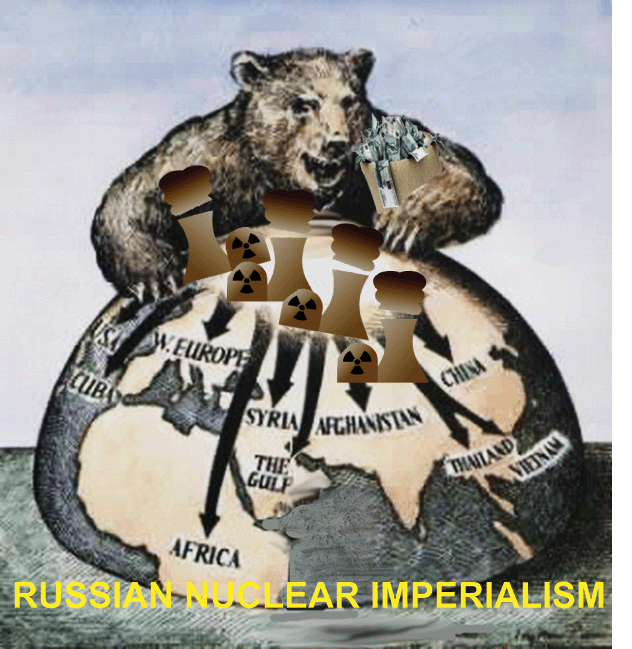
Hungary seeks to postpone loan payback to Russia for Nuclear power plant: What will the final cost be?Bellona February 1, 2019 by Charles Digges Budapest is seeking to modify the terms of a loan it must repay to Russia for building two new VVER-1200 type reactors that will eventually replace Hungary’s Paks nuclear power plant, according to a report from Reuters.
The reactors, which will constitute a plant called Paks II, will be built by Rosatom, Russia’s state nuclear power company, at a cost of 10 billion euro ($12 billion), and will replace the older Soviet-built nuclear plant that supplies half of the country’s electricity.
Rosatom’s construction contract, which includes the loan for Paks II, was the subject of a hotly-debated probe by the EU’s Organization for Economic Co-Operation and Development, which investigated whether the Russian bid violated European competition statutes.
At the time, EU officials and commentators viewed the deal as a Trojan Horse to help cement Moscow’s influence over the right-leaning, rabidly anti-globalist government of Hungarian Prime Minister Viktor Orban.
The EU eventually dropped its investigation in 2017 and granted Hungary permission to build the reactors – partly in an effort to entice Orban, who was insistent about contracting Rosatom, back into the democratic fold. Now Budapest is citing the delay caused by the competition review as reason to renegotiate when it begins paying Rosatom back.
Hungarian financial authorities plan to ask Moscow to postpone collecting on the debt until after the new reactors begin to generate electricity – but it is as yet unclear whether Rosatom will accept new terms. The plant’s construction, meanwhile, is running late. The build was supposed to begin last year………
While the terms of the Paks II loan remain in the shadows, other financing arrangements Moscow has made for building nuclear reactors in other countries suggest that the interest alone could prove to be very expensive for Budapest.
An $11.4 billion, 30-year agreement Rosatom signed with Bangladesh to build the Roopur nuclear plant will net Moscow $8 billion in interest. A $25 billion deal Rosatom is pursuing with Egypt to build that country’s Dabaa plant could, over the 35-year term of that loan, swell to $71 billion.
Another enormous $76 billion deal between Rosatom and South Africa was eventually thwarted by environmentalists when it was revealed the project had been secretly negotiated. Had the deal held it would have siphoned off a quarter of South Africa’s gross domestic product before the reactors even began operation.
Terms like this could spell trouble for Hungary in light of Moscow’s tendency to be a kneecapping creditor when it comes to energy projects – especially when Russia sours on the politics of its debtors.
In 2014, at the height of East-West tensions over Russia’s annexation of Crimea, Kremlin officials threatened to cut nuclear fuel supplies to Ukraine’s Soviet built reactors – which would have interrupted their chain reactions and likely caused a catastrophic accident.
Rosatom eventually walked the threat back. But the lurid message in Moscow’s head-fake toward igniting a second Chernobyl was clear: Russian-built reactors are a useful new tool for political blackmail………..
Many in Europe – Hungary included – subsequently sought to diversify their energy supply in favor of nuclear. Yet, in a devious twist, Rosatom has emerged as the most stable and eager nuclear builder on the international market.
For now, Rosatom can afford to offer risky loans thanks to the enormous state subsidies it receives. These subsidies can be funneled into more loans, and the loans then boost the company’s profits on paper. But for the past several years, it has become clear that these subsidies to the company will likely decrease or dry up altogether in 2020.
As a result, Rosatom is amassing so-called memorandums of understanding from any country vaguely interested in nuclear power. The company says is currently has dozens of these MOUs amounting to more than $130 billion in incoming business.
But that claim should be viewed skeptically, as many of the countries for which Rosatom is promising to build reactors – countries like Jordan, Algeria, Nigeria, the Republic of Congo and Bolivia – won’t have the infrastructure to support nuclear power for decades.
For now, it’s not difficult to imagine Moscow extending the terms of its loan to Hungary for as long as Budapest likes. It will, after all, remain profitable on paper. But in the end, Budapest will be left holding the bag for Rosatom’s over extended balance sheet. But so long as Orban’s government continues it rightward lurch, Moscow is unlikely to call in its marker. http://bellona.org/news/nuclear-issues/2019-02-hungary-seeks-to-postpone-loan-payback-to-russia-for-nuclear-power-plant-what-will-the-final-cost-be
China urges dialogue, as Russia and USA ramp up nuclear weaponry, pull out of weapons treaty
Russia withdraws from Cold War-era nuclear weapons treaty with US https://www.abc.net.au/news/2019-02-02/russia-withdraws-from-cold-war-era-nuclear-weapons-treaty/10774536 Russia has suspended a Cold War-era nuclear weapons treaty, President Vladimir Putin said, after the United States accused Moscow of violations and said it would withdraw from the arms control pact.
 Key points:
- Russia will start work on new missiles, including hypersonic ones

- US and Russia both allege the other has violated the INF treaty
- China urges dialogue amid fears of nuclear arms race

The Intermediate-range Nuclear Forces (INF) Treaty prevents the two superpowers from possessing, producing or test-flying ground-launched nuclear cruise missiles with a range of 500 to 5,500 kilometres.
The United States announced it will withdraw from the INF treaty in six months unless Moscow ends what it says are violations of the pact, but Russia denied violating the treaty.
“The American partners have declared that they suspend their participation in the deal, we suspend it as well,” Mr Putin said during a televised meeting with foreign and defence ministers.
Mr Putin said Russia will start work on creating new missiles, including hypersonic ones, and told ministers not to initiate disarmament talks with Washington, accusing the United States of being slow to respond to such moves.
“We have repeatedly, during a number of years, and constantly raised a question about substantiative talks on the disarmament issue,” Mr Putin said.
“We see that in the past few years the partners have not supported our initiatives.”
The US alleges a new Russian cruise missile violates the important pact, signed by former leaders Ronald Reagan and Mikhail Gorbachev in 1987.
The missile, the Novator 9M729, is known as the SSC-8 by the North Atlantic Treaty Organisation (NATO).
Russia said the missile’s range put it outside the treaty, and accused the US of inventing a false pretext to exit a treaty it wants to leave anyway so it can develop new missiles.
Russia also rejected the demand to destroy the new missile.
During the meeting with Mr Putin, Russian Foreign Minister Sergey Lavrov accused the US of violating the INF and other arms deals, including the non-proliferation treaty.
Mr Putin said Russia would not deploy its weapons in Europe and other regions unless the US did so.
Fears of new arms race
The row over the INF treaty is yet another twist in Russia’s worsening relations with the United States and the West, with tensions over Russia’s annexation of Crimea from Ukraine as well as allegations of it meddling with the presidential election in the US and being behind a nerve agent attack in Britain.
The treaty’s suspension has drawn a strong reaction from Europe and China.
European nations fear the treaty’s collapse could lead to a new arms race with possibly a new generation of US nuclear missiles stationed on the continent.
In a statement, China’s Ministry of Foreign Affairs said the bilateral treaty was important to maintain “global strategic balance and stability”.
“China is opposed to US withdrawal action and urges the United States and Russia to handle their differences properly through constructive dialogue,” the statement said, warning that unilateral withdrawal could trigger “negative consequences”.
Russia also to withdraw from Intermediate-Range Nuclear Forces (INF) treaty, weakening weapons control
Nuclear arms control is increasingly strained as Russia steps back from treaty, Quartz, By John Detrixhe, February 3, 2019 The nuclear arms controls that have been in place since the end of the Cold War appear increasingly strained. The US said yesterday (Feb. 1) that it will withdraw from a landmark treaty for such weapons that it signed with the Soviet Union in 1987. Russia responded today by saying it will also suspend its obligations under the agreement.
The US is pulling back from the treaty with the backing of its NATO allies because officials say Russia has built a cache of missiles and refuses to destroy them. Vladimir Putin, who claims his county is in compliance, has likewise complained that the Americans are potentially in breach of the agreement, which banned the use of short- and medium-range missiles by both countries. The Russian president said his country will begin developing new missiles.
“Our American partners announced that they are suspending their participation in the treaty, and we are suspending it too,” Putin said, according to the BBC.
The breakdown follows several years of failed negotiations. Carl Bildt, co-chair of the European Council on Foreign Relations, said on Twitter that the end of the treaty would allow Russia to deploy cruise missiles from ground launchers that would quickly threaten Europe. He says both sides should commit to not deploying new weapons, then address Russia’s controversial 9M729 missile systems “in detail.”……..
Under the terms of the treaty, it will take six months for the agreement to dissolve. The US has given Russia six months to return to compliance with the treaty, and all parties should make the most of that window to find a resolution….https://qz.com/1541032/russia-withdraws-from-inf-treaty-amid-fears-of-nuclear-arms-race/
Russia’s Plan to Solve the North Korea Nuclear Crisis?
Does Russia Have a Plan to Solve the North Korea Nuclear Crisis? https://nationalinterest.org/blog/buzz/does-russia-have-plan-solve-north-korea-nuclear-crisis-43022 2 Feb 19, Some think so. by Stratfor Worldview
What Happened: The Russian government reportedly made a secret proposal to North Korea in the fall of 2018 to construct a nuclear power plant in the country in exchange for North Korea dismantling its nuclear weapons and ballistic missiles, The Washington Post reported Jan. 29, citing unnamed U.S. officials. The Russian envoy to North Korea, meanwhile, denied the report.
Why It Matters: Russia’s alleged offer would imply attempts to insert itself into the negotiation process over North Korea’s nuclear program. U.S. President Donald Trump is slated to hold a second summit with North Korean leader Kim Jong Un in late February.
Background: Kim placed a significant emphasis on rectifying North Korea’s electricity problems during his New Year’s speech. Meanwhile, Russian Deputy Foreign Minister Igor Morgulov received a delegation from North Korea’s Foreign Ministry in Moscow on Jan. 29.
1 This Month
10 March A LIVE WEBINAR THE REAL EFFECTS OF NUCLEAR POWER
What the Industry Isn’t Telling Us
1:00 PM Mountain, 2 pm Central, 3 pm Eastern. Live on the Keepers of the Water Facebook page



18 March Webinar @ 1 PM EST: An Assessment of SMR Projects: The Case of Canada
register for the zoom:
https://us02web.zoom.us/webinar/register/WN_o8BIIOUvQ2ONJR1nta65DQ#/registration


of the week – STOP SMALL MODULAR REACTORS IN CANADA
To see nuclear-related stories in greater depth and intensity – go to https://nuclearinformation.wordpress.com
-
Archives
- March 2026 (99)
- February 2026 (268)
- January 2026 (308)
- December 2025 (358)
- November 2025 (359)
- October 2025 (376)
- September 2025 (258)
- August 2025 (319)
- July 2025 (230)
- June 2025 (348)
- May 2025 (261)
- April 2025 (305)
-
Categories
- 1
- 1 NUCLEAR ISSUES
- business and costs
- climate change
- culture and arts
- ENERGY
- environment
- health
- history
- indigenous issues
- Legal
- marketing of nuclear
- media
- opposition to nuclear
- PERSONAL STORIES
- politics
- politics international
- Religion and ethics
- safety
- secrets,lies and civil liberties
- spinbuster
- technology
- Uranium
- wastes
- weapons and war
- Women
- 2 WORLD
- ACTION
- AFRICA
- Atrocities
- AUSTRALIA
- Christina's notes
- Christina's themes
- culture and arts
- Events
- Fuk 2022
- Fuk 2023
- Fukushima 2017
- Fukushima 2018
- fukushima 2019
- Fukushima 2020
- Fukushima 2021
- general
- global warming
- Humour (God we need it)
- Nuclear
- RARE EARTHS
- Reference
- resources – print
- Resources -audiovicual
- Weekly Newsletter
- World
- World Nuclear
- YouTube
-
RSS
Entries RSS
Comments RSS
 nuclear-news