A small nuclear reactor was definitely the cause of the Russian missile engine explosion
It can therefore be stated with certainty that the “isotopic source of energy” referred to by Rosatom was a nuclear reactor.
The Mysterious Explosion of a Russian Nuclear Missile Engine The BESA CENTER. September 6, 2019 BESA Center Perspectives Paper No. 1,280, September 6, 2019
Safety and security preparations for remote Prevek as floating nuclear power plant enters East Siberian Sea
As floating nuclear power plant enters East Siberian Sea, emergency services in Pevek make a last check Final preparations in the remote Arctic town that will host the floating nuclear installation. Barents Observer, By Atle Staalesen, September 06, 2019,
The «Akademik Lomonosov» on the 6th September passed the Sannikov Strait south of the New Siberian Islands and made it into the East Siberian Sea. The floating installation now has only about 3 days left of its extensive voyage across the Northern Sea Route.
The «Akademik Lomonosov» on 23rd August set out of the Kola Bay after more than a year of preparations in Murmansk. Towed by icebreaker «Dikson» and accompanied by support ships «Yasnyy» and «Kapitan Martyshkin», the floating power plant had course for the Barents Sea and subsequently made it through the Kara Sea and Laptev Sea.
Is Pevek ready?
According to the ministry, a special fire- and rescue department is under construction on site. When completed, the unit can ultimately serve as base for a bigger Arctic rescue center.
Outsourced security
Also law-enforcement authorities are on site preparing to keep an eye on the new strategic object. It is Rosgvardia, the Russian National Guard, that has been commissioned to protect the power plant and its surroundings.
According to the security service, the formation of guarding units were in late August about to be completed and training was ongoing in cooperation with representatives of Rosatom.
Big risks
The «Akademik Lomonosov» has two KLT40S reactors and will provide heat and electricity to Pevek for the next 12 years. After that, it will have to be towed back either to Rosatomflot’s base in Murmansk, or to a shipyard like in Severodvinsk for unloading the spent nuclear fuel and carry out other maintenance work.
Environmentalists have criticized the project and warned against possible major risks.
Akademik Lomonosov — the first floating nuclear power stations – both a nuclear and a climate danger
‘It is not just a nuclear risk, but a climate risk’ https://www.downtoearth.org.in/interviews/climate-change/-it-is-not-just-a-nuclear-risk-but-a-climate-risk–66520
Jan Haverkamp, a nuclear expert of Greenpeace (Central and Eastern Europe), spoke to Down To Earth on about Akademik Lomonosov — the first floating nuclear power stations — in Russia
By Rajit Sengupta, 04 September 2019 Akademik Lomonosov is the first among a fleet of a dozen floating nuclear power stations to be used for fossil fuel exploration and exploitation in the Arctic. Jan Haverkamp, a nuclear expert of Greenpeace (Central and Eastern Europe), spoke to Down To Earth on how this project is not only about increasing nuclear risk, but also increasing climate change risks.
How safe is Akademik Lomonosov?
Unlike nuclear submarines, the Akademik Lomonosov is a barge without own propulsion, meaning it can only float (or sink) and not dive. It means that if the mooring is broken, the barge is steerless, adding considerable to the risk when compared to a submarine or an ice-breaker.
It can also not dive away from an iceberg or avoid sea-ice by going deep. For its operations, it will be partially dependent on a coastal electricity link, which will also be used for electricity intake in times of trouble. The cable is lot more vulnerable than that of an on-land reactor.
Accidents with naval reactors have happened in the past. In 1970, an uncontrolled start-up of the reactor of the nuclear submarine K-320, at the Krasnoye Sormovo wharf in Nizhny Novgorod, Russia, caused the release of larger amounts of radioactivity. It led to 12 casualties and hundreds of people getting exposed to above-limit radiation doses.
An accident during fuel loading of the reactor of a nuclear submarine in Chazma Bay, in 1985, irradiated 290 workers leading to 10 casualties and 49 injured.
The radioactive content of the two reactors on board of the Akademik Lomonosov is around 25 times smaller than that of the Chernobyl nuclear power station, but is still considerable. A severe accident with bypass of the containment could cause substantial contamination kilometres downwind.
Will Akademik Lomonosov lead to further nuclearisation in Northern Sea Route?
The Akademik Lomonosov is a new step in the nuclearisation of the Arctic. The first was the introduction of nuclear submarines, followed by nuclear weapons, nuclear marine vessels, a few nuclear merchant ships and nuclear ice-breakers and the Bilibino nuclear power station, which is to be closed down soon.
Akademik Lomonosov is the first of a fleet of a dozen floating nuclear power stations that are to power ports to enable transport through the Northern Sea Route, and substantially increase fossil fuel exploration and exploitation in the Arctic. So it is not only about increasing nuclear risk, but also increasing climate change risks.
Russia plans to sell the technology to other countries including Sudan. Why are countries so interested in this technology?
The interest is much lower than what Rosatom (Russia’s state nuclear corporation) wants us to believe. Indonesia and Cabo Verde have already denied interest. I think Sudan, which was a military dictatorship a few months ago, is an exception.
Rosatom is making tall promises to sell the technology, which is unlikely to be fulfilled. It has promised financing, cheap or competitive electricity and waste management with little historical experience to back it up.
What has Russia benefitted from the project?
The Akademik Lomonosov is a symbol of the power-struggle between the old nuclear dinosaurs gathered in Rosatom and the upcoming and already much larger global clean renewable industry.
The Akademik Lomonosov is extremely expensive, certainly in comparison with viable renewable alternatives for Chukotka. Now nuclear power is being used to exploit more gas, oil and coal. Rosatom is a bad energy advisor for Russia and for foreign partners.
U.S. intelligence assessment – Russia’s Mystery Nuclear Explosion Occurred During Missile Recovery at Sea
|
Russia’s Mystery Nuclear Explosion Occurred During Missile Recovery at Sea — Reports https://www.themoscowtimes.com/2019/08/30/russias-mystery-nuclear-explosion-occurred-during-missile-recovery-at-sea-reports-a67084 The mysterious explosion in northern Russia that caused a spike in radiation levels happened during a mission to salvage a nuclear-powered cruise missile from the bottom of the sea, media have cited a U.S. intelligence assessment as saying.
Five nuclear engineers were killed in a liquid propulsion system blast at Russia’s naval missile test facility, leading to a brief spike in radiation on Aug. 8. The secrecy surrounding the accident has led outside observers to speculate that what the explosion involved the Burevestnik nuclear-powered intercontinental cruise missile, dubbed the SSC-X-9 Skyfall by NATO.
“This was not a new launch of the weapon, instead it was a recovery mission to salvage a lost missile from a previous test,” the CNBC business outlet cited an unnamed U.S. official with direct knowledge of a U.S. intelligence assessment as saying. Russian crews aboard three vessels had last year prepared to recover a missile that landed in the Barents Sea during a failed November 2017 test, CNBC reported last year, also citing a U.S. intelligence report. “There was an explosion on one of the vessels involved in the recovery and that caused a reaction in the missile’s nuclear core which lead to the radiation leak,” another unnamed source told the outlet Thursday. The U.S.-funded Radio Free Europe/Radio Liberty news outlet’s Russian-language service came to the same conclusion after analyzing photographs of nuclear waste containers at what are thought to be previous Burevestnik test sites. Russia tested four of the missiles between November 2017 and February 2018, each resulting in a crash, people who spoke on condition of anonymity previously told CNBC. Government officials have given a muted, occasionally contradictory response in the weeks since the accident. President Vladimir Putin said the explosion occurred during testing of what he called promising new weapons systems. Last year, Putin had boasted about what he said was the Burevestnik’s unlimited range. Four of Russia’s nuclear radiation monitoring stations went silent days after the explosion, and doctors in the region have said they weren’t warned that they were treating patients exposed to radiation. |
|
Trump’s friendliness with Putin makes it hard for NATO to do anything about Russia’s weapons tests and radioactive explosion
Russia’s nuclear weapons tests were linked to a radioactive explosion. Trump’s friendliness with Putin makes it hard for NATO to do anything about it. Business Insider, MITCH PROTHERO, AUG 29, 2019
Examining the radioactive isotopes from Russia’s mystery explosion
How nuclear scientists are decoding Russia’s mystery explosion. Isotopes that caused a radiation spike earlier this month probably came from an exploding nuclear-reactor core — but device’s application is still unknown. Nature,
Russia Spreads Influence in Africa Using Nuclear Power
Russia Spreads Influence in Africa Using Nuclear Power – Reports, Moscow Times, 30 Aug 19, Russia is working to win influence in at least 10 African states with high-cost nuclear technology that for the most part does not suit their needs, researchers and NGOs have told The Guardian newspaper.
With booming exports, nuclear energy is one example of Russia’s increasing presence in Africa in recent years. Elsewhere, a businessman known as “Putin’s chef,” Yevgeny Prigozhin, is widely reported to be spearheading Russia’s push to exchange security and electioneering services for mining rights in Africa.
Russia’s state nuclear agency Rosatom has approached the leaders of “dozens” of African countries with various nuclear energy projects in the past two years, The Guardian reported Wednesday. Rosatom has existing deals with Egypt and Nigeria and other various agreements with other countries on the continent.
Few African countries have the capacity to distribute the amount of nuclear energy generated by the type of reactors that Rosatom is exporting, experts told the outlet. Observers also noted that the costly projects favored by Rosatom likely wouldn’t benefit Africa’s poorest populations…….. https://www.themoscowtimes.com/2019/08/29/russia-spreads-influence-in-africa-using-nuclear-power-reports-a67077
Russia fears fatal consequences if the NEWSTART nuclear arms treaty is allowed to lapse
Calls on Donald Trump to start talks about the last remaining nuclear weapons agreement between Russia and the U.S. remain unanswered, 18 months before it expires, increasing the risk of an unhindered arms race, according to Russian President Vladimir Putin’s spokesman. The consequences will be “quite fatal” if Russia and the U.S. let lapse the 2010 New START treaty limiting both nuclear powers’ strategic arsenals, Kremlin spokesman Dmitry Peskov said on a call with reporters Monday. “Undoubtedly, strategic stability on the overall global level will be affected, because we all — I mean humanity — we will be left without a single document that would regulate this area.”…….. (subscribers only) https://www.bloomberg.com/news/articles/2019-08-26/russia-says-u-s-silence-on-last-nuclear-treaty-may-be-fatal |
|
|

A Small Nuclear Reactor exploded in Russian accident – fallout isotopes prove this

Isotopes’ Composition Proves Nuclear Reactor Was Involved in Russian Explosion, Expert Says
Analyses of the radionuclides in the fallout over Severodvinsk show several isotopes that would not have been present if was a simple RTG in the explosion.
Russia launched two ballistic missiles from nuclear-powered submarines in the Arctic Ocean and the Barents Sea
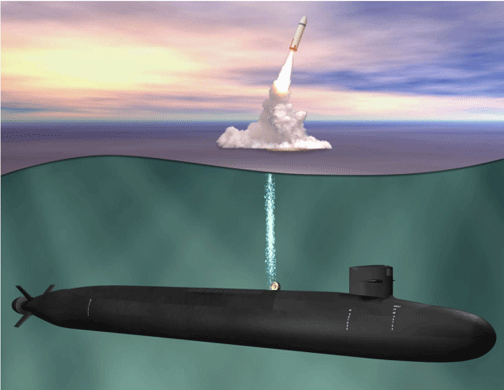 Russia says it launched 2 ballistic missiles in the Arctic Ocean as part of combat training
 By Amir Vera, CNN August 25, 2019 Russia launched two ballistic missiles from nuclear-powered submarines in the Arctic Ocean and the Barents Sea on Saturday, according to a tweet from the Russian Ministry of Defense.
Contradictory reports from Russia, over the Aug. 8 nuclear incident
|
Russia says nuclear accident during suspected missile engine test released radioactive gas cloud https://www.cbsnews.com/news/russia-nuclear-accident-released-radioactive-gas-cloud-isotopes-government-reveals-today-2019-08-26/ AUGUST 26, 2019 MOSCOW — Russia’s state weather and environment monitoring agency on Monday released new details about a brief spike in radioactivity following a mysterious explosion at the navy’s testing range that has been surrounded by secrecy and fueled fears of increased radiation levels.
Russia’s state weather and environmental monitoring agency Rosgidromet said Monday the brief rise in radiation levels was caused by a cloud of radioactive gases containing isotopes of barium, strontium and lanthanum that drifted across the area. The agency said its monitoring has found no trace of radiation in air or ground samples since Aug. 8. It has previously said that the peak radiation reading in Severodvinsk on Aug. 8 briefly reached 1.78 microsieverts per hour in just one neighborhood — about 16 times the average. Readings in other parts of Severodvinsk varied between 0.45 and 1.33 microsieverts for a couple of hours before returning to normal. The authorities said those readings didn’t pose any danger, and the recorded levels were indeed several times less than what a passenger is exposed to on a long-haul flight. Still, contradictory statements from the authorities and their reluctance to reveal details of the explosion have drawn comparisons to the Soviet cover-up of the 1986 explosion and fire at the Chernobyl nuclear power plant, the world’s worst nuclear disaster. The Defense Ministry denied any radiation leak even as the local administration in Severodvinsk reported a hike in radiation levels and told residents to stay indoors — a move that prompted frightened residents to buy iodine, which can help reduce risks from exposure to radiation. Russian media reported that the victims of the explosion received high doses of radiation. They said that medical workers at the Arkhangelsk city hospital that treated three of those injured said they hadn’t been warned that they would treat people exposed to radiation and lacked elementary protective gear. The Moscow Times on Monday cited Igor Semin, a cardiovascular surgeon at the hospital, who scathingly criticized the authorities in a social network post for failing to warn the hospital workers about the deadly risks. “They were abandoned and left to fend for themselves,” the newspaper quoted Semin as saying. Asked about the doctor’s statement, Kremlin spokesman Dmitry Peskov said that the authorities will look into the matter. Officials have said the explosion in Nyonoksa occurred during tests of a “nuclear isotope power source” of a rocket engine — a cryptic description that made many observers conclude that the test involved one of Russia’s most secretive weapons — the prospective Burevestnik (Storm Petrel) nuclear-powered cruise missile which was code-named “Skyfall” by NATO. U.S. President Donald Trump has thrown his weight behind that theory, saying the U.S. learned much from the failed test. |
|
Fish transport around Scandinavia in nuclear-powered Russian ship
 Russia starts nuclear-powered fish transport around Scandinavia Container carrier “Sevmorput” is now being loaded with 200 refrigerated containers with fish at port in Petropavlovsk-Kamchatskiy and will soon set sail for the Northern Sea Route and further south to St. Petersburg. Barents Observer Thomas Nilsen Russia starts nuclear-powered fish transport around Scandinavia Container carrier “Sevmorput” is now being loaded with 200 refrigerated containers with fish at port in Petropavlovsk-Kamchatskiy and will soon set sail for the Northern Sea Route and further south to St. Petersburg. Barents Observer Thomas Nilsen
“This test-voyage with the container carrier gives hope that one time such deliveries will become regular,” says Kamchatka Governor Vladmir Kuzmitsky in an interview with the region’s own portal.The 200 containers are filled with frozen fish, fillets, caviar and other seafood, a total of 5,000 tons. The voyage takes three weeks, of which the two first will be along the Northern Sea Route, north of Siberia. This is the first time a Russian civilian nuclear-powered ship sails with cargo outside the coast of Norway. From the North Sea, “Sevmorput” will continue in the narrow waters between Sweden and Denmark, sailing through the Great Belt and into the Baltic Sea before final port call to St. Petersburg. Rosatom confirmed the voyage in a tweet on Monday. “Sevmorput” is expected to cross the Barents Sea and sail outside Norway by the second week of September. Then, the ship will sail back the same route and a second voyage will come in late October……. https://thebarentsobserver.com/en/industry-and-energy/2019/08/russia-starts-nuclear-powered-fish-transport-around-scandinavia |
|
Radioactive patients – a concern following Russian nuclear accident
 Russian nuclear accident: Medics fear ‘radioactive patients’, https://www.bbc.com/news/world-europe-49432681 23 Aug 19, Russian medics who treated radiation victims after a military explosion in the Arctic had no protection and now fear they were irradiated themselves.
Two of the medics in Arkhangelsk spoke to BBC Russian about the victims’ evacuation, on condition of anonymity.
Five nuclear engineers died on 8 August when an “isotope-fuel” engine blew up at the Nyonoksa test range, officials said. Two military personnel also died.
President Vladimir Putin said the test involved a new weapon system.
Six people were injured in the accident, but officials gave few details about it.
On 14 August Russia’s weather service Rosgidromet revealed that radiation levels had spiked 16 times above normal, in Severodvinsk, a city 47km (29 miles) east of Nyonoksa.
According to the official data, the radiation that reached Severodvinsk was not heavy enough to cause radiation sickness.
Experts in Russia and the West say the test was most likely linked to the new 9M730 Burevestnik nuclear-powered cruise missile, called “Skyfall” by Nato. Last year Mr Putin said the technology would give the missile “unlimited” range.
The Arkhangelsk medics, who spoke to the BBC’s Pavel Aksenov, said at least 90 people came into contact with the casualties, but the military did not warn them of any nuclear contamination risk.
Contamination fears
The medics were at the civilian Arkhangelsk regional hospital, which treated three of the injured, while three other casualties were taken to an Arkhangelsk hospital called Semashko, which is equipped for radiation emergencies.
The medics said they were speaking out now because they feared for their own health and did not want any similar “[safety] violations” to recur.
“We don’t want them to bring us next time not three, but ten people, God forbid, and hide the information from us again,” said one.
The degree of secrecy surrounding the explosion has drawn comparisons with the 1986 Chernobyl disaster, when Soviet officials were slow to admit the truth.
The Arkhangelsk medics said it was clear that the three brought to their regional hospital were very sick. Doctors examined them in the emergency room, then sent them to an operating theatre.
But the emergency room continued to admit other patients for about an hour, the medics said, until the doctors realised that the three “had received a very high radiation dose”. The hospital handles pregnancy complications and other difficult medical conditions.
“The radiation picture was developing by the hour. Blood tests were being done, and every hour you could see that this or that cell count was plunging. That signified a very high radiation dose,” they said.
The hospital staff kept treating the victims despite knowing about the radiation dose. The staff had to improvise some self-protection – for example, they took face masks from the helicopter crews’ emergency kit.
The next day the three victims were transferred to a hospital in Moscow which has radiation specialists. Their condition now is unknown.
Nuclear decontamination
A military team later carried out decontamination work in the Arkhangelsk hospital.
The medics said the casualties’ clothing was removed, along with stretchers and a “highly radioactive bath”.
“Our cleaners should have been advised, they’re just simple country folk, they were just picking up sacks and bundles and carrying them out,” said one.
The other medic said hospital staff were now mentally stressed, knowing that radiation safety information had been withheld from them during the emergency.
Two weeks after the explosion the Russian health ministry said none of the medics at the Arkhangelsk hospitals had received a hazardous radiation dose. Its conclusion was based on medical examination of 91 staff.
Incomplete data
On Monday an international nuclear agency reported that the two Russian radiation monitoring stations nearest to Nyonoksa had gone offline soon after the explosion. The revelation fuelled suspicions that the radiation could have been heavier than officially reported.
The Comprehensive Nuclear Test-Ban Treaty Organization (CTBTO) said the technical failure at those sites was then followed by a failure at two more. It tweeted an animation showing the potential radiation plume from the explosion.
Russia said the weapons test was none of the CTBTO’s business, and added that handing over radiation data was voluntary. Two of the monitoring stations have since started working again.
“ZATO” Russia’s many closed cities, – some site of nuclear accidents

|
Russia’s closed cities hold the secrets to global nuclear disasters you’ve never heard of https://www.abc.net.au/news/2019-08-24/russia-closed-cities-hold-secrets-to-global-nuclear-disasters/11437734
Key points:
But it makes sense why Russia might be vague on the detail. Both the city near the accident site, Severodvinsk, and the one where the victims were buried, Sarov, are “closed cities” — highly controlled areas that house the country’s most important weapons sites. The Government does not want outsiders knowing what goes on there, especially when accidents happen. And when accidents do happen in closed cities, like a radioactive explosion or an outbreak of anthrax, Russia has a long history of covering them up. Russia is far from the only country to have closed cities, but it does have a lot of them. It’s thought there are about 40 closed cities in Russia, though it’s suspected there are others whose very existence is highly classified. First established in the 1940s, closed cities — officially known by the acronym ZATO in Russian — are most often associated with either military installations or major research centres and are used to house employees and their families. For example, Sarov, where the five scientists killed in the explosion were buried, is the site of a nuclear weapons design facility. It’s been a closed city since 1946, when it was renamed Arzamas-16 and its location was removed from all unclassified maps. The movement of people and information in and out of these cities is highly restricted, and residents are often not allowed to disclose where they live to outsiders.
“And when you have those it is easy to gloss over problems, perhaps cover up accidents, there’s not a lot of ways for information to get out.” The nuclear disaster you probably haven’t heard ofWhile Chernobyl and Fukushima might be synonymous with nuclear disasters, that might not be the case for Kyshtym. It was the third most-serious nuclear accident ever recorded, and it happened at the Mayak facility in the closed city of Ozyorsk, in Russia’s Ural Mountains, in 1957. A cooling system in a radioactive waste tank broke down and the rise in temperature resulted in an explosion that released an estimated 20 million curies of radioactivity into the environment. During the Chernobyl explosion, about 50–200 million curies of radioactivity was estimated to have been released. The Kyshtym disaster contaminated an area up to 20,000 square kilometres, known as the East-Ural Radioactive Trace, and thousands of people near the plant were evacuated. But the Soviet government didn’t publicly acknowledge the accident until 1989. The incident was happening at the time of the Cold War so it was also an attempt by the Soviet authorities to prevent the news from reaching the outside world,” Alexey Muraviev, a specialist in Russian strategic and defence policy at Curtin University, told the ABC. But the area had been contaminated even before the Kyshtym disaster, when high-level radioactive waste from the production of plutonium at Mayak had been intentionally dumped into the nearby Techa river. “They put about 3.2 million curies into that small river, and the people who lived downstream drank from it, swam in it, ate from it, fished in it, watered their crops in it,” Professor Brown said. Twenty-eight communities live down that river, several tens of thousands of people, and they didn’t tell anybody that they were putting high-level waste [in the river].” Mayak now serves as a reprocessing plant for spent radioactive fuel. In October 2017, a network of monitoring sites picked up a cloud of radioactive material, Ruthenium-106, above Europe. In a report published just last month, a team of scientists say the most likely source was a fire or explosion at Mayak that occurred during the reprocessing of spent fuel to create enriched caesium for an Italian laboratory. Russia’s nuclear energy agency continues to deny anything happened at Mayak in 2017, but at the time, the Russian Meteorological Service admitted there was “extremely high contamination” in the air around the Ural mountains. And it’s not just nuclear accidents that happen at closed cities. In 1979, spores of anthrax leaked from a biological weapons facility in the closed city of Sverdlovsk and killed at least 68 people, many of whom were civilians from a nearby ceramics plant. The Soviet government blamed the deaths on the consumption of contaminated meat, and it was only in 1992 that then-president Boris Yeltsin publicly linked the anthrax outbreak with the military facility. While some have a bad safety reputation, there’s a big reason why Russians might want to move to a closed city: they’ve historically gotten the best of everything. As part of the privileges of working on important, secret and dangerous processes, residents are promised a higher standard of living and better resources. During the Soviet era, those who lived in closed cities were spared the austerity of other parts of the country.
“They also provided better living conditions, so people who would work at closed cities would be guaranteed state funding accommodation and so on.” The reputation of the living standards and privileges of those cities meant the jobs that would allow you to move to one were highly sought after. “This is an important element, otherwise it sounds like [closed cities] are like a giant concentration camp,” Dr Muraviev said. And according to Dr Muraviev, Russian President Vladimir Putin has been actively trying to restore the glamour of the country’s remaining closed cities. “Back in the 1990s those privileges kind of really lapsed, so there were no incentives anymore, but now they’re sort of back on the agenda and the Government is really pumping funds into these cities,” he said. “That’s part of [Mr Putin’s] strategy to rebuild Russia’s national security as well as rebuild Russia’s national defence capability.” And as far as the risks go of moving to a secretive town next to a nuclear facility or a military installation? Dr Muraviev said the people who chose to move to closed cities knew what came with the job. “They understand risks associated with it and they’re not just doing it for money; they’re also doing it for the idea of making Russia safe,” he said. |
|
Kremlin cover up on weapon tested, and radioactive contamination?

 Russian radiation detectors ‘go dark’ after mystery explosion
The mysterious shutdown of four nuclear monitoring stations after a fatal blast at a military site has fuelled fears of radioactive contamination. news.com.au 22 Aug 19
Russian officials have dismissed concerns, declaring on Tuesday the country had no obligation to share its data with the CNTBTO — raising fears of a Kremlin cover up on the type of weapon involved and the extent of contamination.
Elevated radiation levels — of up to 16 times the average — were detected 40 km away in the city of Severodvinsk in the aftermath of the event, according to The New York Times.
President Vladimir Putin said on Monday there was no risk to the public, although officials have yet to disclose how much radiation was released………
US National Nuclear Security Administration former deputy William Tobey said it was “at least an odd coincidence” Russian sensors stopped transmitting data about the same time as the explosion occurred.
“Power outages, other failures, can knock down a particular place, but if more than one site is out, it would seem that that is a less likely explanation,” Mr Tobey said.
Russian authorities have offered changing and contradictory information about the explosion fuelling speculation about what really happened and what type of weapon was involved.
While the Russian Defense Ministry said no radiation had been released in a rocket engine explosion, officials in the nearby city of Severodvinsk reported a brief rise in radiation levels.
The contradiction drew comparisons to Soviet attempts to cover up the 1986 explosion and fire at the Chernobyl nuclear power plant in Ukraine, the world’s worst nuclear disaster.
In his first comments on the explosion, Russian President Vladimir Putin said Monday that it hasn’t posed any radiation threat. Putin added that experts are monitoring the situation to prevent any “unexpected developments.”
He didn’t say what weapon was being tested when the explosion occurred, but described the
test as a “state mission of critical importance.”…….
The Russian military said the explosion killed two people and injured six, while the state nuclear corporation Rosatom acknowledged later that it also killed five of its engineers and injured three others.
Rosatom said the explosion occurred on an offshore platform during tests of a “nuclear isotope power source.”……
Rosatom’s mention of a “nuclear isotope power source,” led some observers to conclude that the weapon undergoing tests was the “Burevestnik” or “Storm Petrel,” a prospective nuclear-powered cruise missile first mentioned by Putin in 2018 and was codenamed “Skyfall” by NATO.
US President Donald Trump backed that theory in a tweet last week, saying America is “learning much” from the Skyfall explosion.
The US worked to develop a nuclear-powered missile in the 1960s under Project Pluto, but the idea was discarded as impractical and risky. Mr Tobey said Russia’s apparent revival of the concept raises significant risks.
“Effectively, Russia is thinking about flying around nuclear reactors,” he told AP.
“The very idea of this system is, I think, a risky system. It probably poses more risk to the Russian people than to the American people. If it crashes, it could spread radiation.”
Nuclear expert Michael Krepon, who co-founded the Stimson Center, a nonpartisan public policy research body, said it was not surprising that Russia might take steps to conceal its activities because “they just can’t accept transparency when it comes to screw ups”.
“This weapon poses a danger first and foremost to the people who are working on it,” Mr Krepon said.
“It’s dumb, it’s stupid, it’s expensive, and there are so many other ways that you can deliver nuclear weapons long distance. The more Putin advertises this system, the more he’s likely to be embarrassed by it.” https://www.news.com.au/technology/innovation/military/russian-radiation-detectors-go-dark-after-mystery-explosion/news-story/4ab6ce7b4b3926379381a9a7d20baab3
1 This Month

of the week – Shut Down Drone Warfare!


Tell the Ukrainian Government to Drop Prosecution of Peace Activist Yurii Sheliazhenko

Petition to revoke the licensing of the Near Surface Nuclear Disposal Facility (NSDF) at Chalk River. https://www.ourcommons.ca/petitions/en/Petition/Details?Petition=e-7247
To see nuclear-related stories in greater depth and intensity – go to https://nuclearinformation.wordpress.com
-
Archives
- April 2026 (91)
- March 2026 (251)
- February 2026 (268)
- January 2026 (308)
- December 2025 (358)
- November 2025 (359)
- October 2025 (376)
- September 2025 (257)
- August 2025 (319)
- July 2025 (230)
- June 2025 (348)
- May 2025 (261)
-
Categories
- 1
- 1 NUCLEAR ISSUES
- business and costs
- climate change
- culture and arts
- ENERGY
- environment
- health
- history
- indigenous issues
- Legal
- marketing of nuclear
- media
- opposition to nuclear
- PERSONAL STORIES
- politics
- politics international
- Religion and ethics
- safety
- secrets,lies and civil liberties
- spinbuster
- technology
- Uranium
- wastes
- weapons and war
- Women
- 2 WORLD
- ACTION
- AFRICA
- Atrocities
- AUSTRALIA
- Christina's notes
- Christina's themes
- culture and arts
- Events
- Fuk 2022
- Fuk 2023
- Fukushima 2017
- Fukushima 2018
- fukushima 2019
- Fukushima 2020
- Fukushima 2021
- general
- global warming
- Humour (God we need it)
- Nuclear
- RARE EARTHS
- Reference
- resources – print
- Resources -audiovicual
- Weekly Newsletter
- World
- World Nuclear
- YouTube
-
RSS
Entries RSS
Comments RSS
 nuclear-news