New ship to handle all nuclear waste from Rosatom’s Arctic operations.
Barents Observer 5th Dec 2019, New ship to handle all nuclear waste from Rosatom’s Arctic operations.
The new special purpose vessel will serve the new icebreakers and the
floating nuclear power plants and possible other reactor installations.
Russia’s nuclear company Rosatom in financial trouble trying to fund nuclear project in Turkey

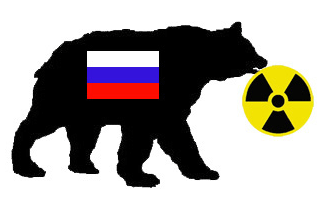 Turkey’s first nuclear plant delayed by funding problems – energy expert https://ahvalnews.com/turkey-energy/turkeys-first-nuclear-plant-delayed-funding-problems-energy-expert, Nov 30 2019 Turkey’s first nuclear plant delayed by funding problems – energy expert https://ahvalnews.com/turkey-energy/turkeys-first-nuclear-plant-delayed-funding-problems-energy-expert, Nov 30 2019
Completion of Turkey’s first nuclear power station is likely to be delayed as the Russian company building it is struggling to secure funding, former diplomat and Bosphorus Energy Club head Mehmet Öğütçü told Turkish daily Sözcü. A small part of the plant in Akkuyu, southern Turkey, may be opened for political reasons in 2023, the centenary of the founding of the Turkish Republic, Öğütçü said. But Russian state-owned Rosatom is having difficulties financing the project, which is expected to cost between $20 billion and $25 billion, he said, adding that Western companies were avoiding Akkuyu over concerns about nuclear armament. A Turkish consortium pulled out of the project last year, citing a failure to reach commercial terms with Rosatom, which owns a 51 percent stake in the project. A report by the main opposition Republican People’s Party this month criticised the terms of the government’s deal with Rosatom, which has been guaranteed a price of 12.35 U.S. cents per kilowatt hour in a 15-year power purchase agreement. |
|
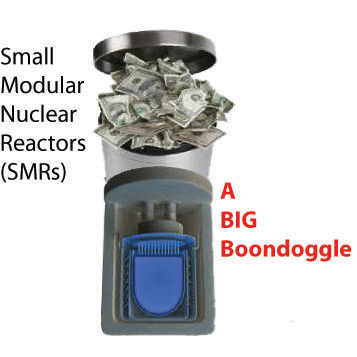
Russia’s Rosatom planning to market Small Modular Nuclear Reactors to Europe
|
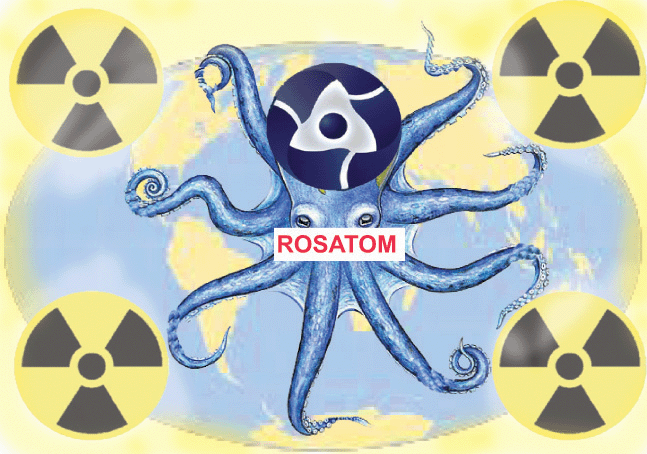
Russian company’s plan for nuclear power expansion revealedVLADIMIR PUTIN has made nuclear energy one of Russia’s key priorities, and now the Russian nuclear power company Rosatom has revealed to Express.co.uk their plans to ramp up expansion into Europe with small modular reactors. Express UK By CHARLIE BRADLEY, Fri, Nov 29, 2019
Rosatom is completely under state control, and while its emphasis with some projects has been geared towards powering hard to reach Russian territories, it has also undertaken numerous international projects. This includes the development of nuclear power plants in China, Turkey and Iran, highlighting the growing presence of Russian energy throughout the world. And now, with some projects already under way in countries like Hungary and Finland, its Vice President of Marketing and Business Development Overseas, Anton Moskvin, has told Express.co.uk that Europe is a future target for the company.He said: “I must say Europe is very interesting for us with prospective small modular reactors market development, we know that several countries are interested. The UK has great interest in the small modular reactors.” …… However, some in the EU have expressed concern over any plans for the Russian nuclear giant, fearing that the country could use its business to wield political influence.
In 2014, President Putin agreed a deal worth £8.5billion with Hungary President Viktor Orban, a deal which has seen the two leaders meet regularly since. Hungary is both a NATO and EU member, and the latter has sought legislation to ensure countries embarking on nuclear deals with Moscow do not become dependent on the Kremlin. RFI (Radio France International) reported last month that Jan Haverkamp, vice-chairman of Nuclear Transparency Watch, has serious reservations about the projects. He said: “Our assessment is that the Kremlin tries to use nuclear power now to regain some of that lost influence. “We see Rosatom being very eager to buy up nuclear companies in Europe, where they try to get a participation in order to get a solid nuclear foothold inside the EU.” Mr Moskvin said he could not comment on political issues……… https://www.express.co.uk/news/world/1211103/putin-news-russia-europe-nuclear-power-eu-rosatom-spt |
|
Nuclear-capable air-launched ballistic missile tested over the Barents Sea
|
The Kinzhal missile was launched from a MiG-31K taking off from Olenegorsk airbase on the Kola Peninsula. Barents Observer By Thomas Nilsen, December 01, 2019
The missile changes the military power-balance in the north due to its range, speed and ability to overcome any known missile defence systems. Kh-47M2 Kinzhal (NATO name SA-N-9 Gauntlet) is one of the six new strategic nuclear weapons presented by Vladimir Putin in his presidential address to the Federal Assembly on March 1, 2018. Now, the missile is tested and like several of the other new strategic weapons under development by Russia, the test took place in the northwestern part of the country……. https://thebarentsobserver.com/en/security/2019/12/nuclear-capable-air-launched-ballistic-missile-tested-over-barents-sea |
|
Putin told bereaved families that nuclear accident scientists were working on an “unparalled”weapon
|
PUTIN SAYS SCIENTISTS KILLED IN MYSTERY NUCLEAR BLAST WERE TESTING ‘THE MOST ADVANCED AND UNPARALLELED’ WEAPON, Newsweek, BRENDAN COLE ON 11/22/19 RUSSIAN PRESIDENT VLADIMIR PUTIN HAS TOLD THE FAMILIES OF THE SCIENTISTS WHO WERE KILLED IN A NUCLEAR EXPLOSION IN THE COUNTRY’S ARCTIC NORTH THEY WERE TESTING AN “UNPARALLELED” WEAPON.There was much speculation about what caused the blast at a test facility in Nyonoksa in the Arkhangelsk region on August 8, which killed at least five people and sparked local fears about increased radiation levels and the secrecy surrounding the incident.
International experts believed the explosion involved the Burevestnik nuclear-powered intercontinental cruise missile, which NATO calls the SSC-X-9 Skyfall. In a ceremony at the Kremlin on Thursday for the families of the dead, Putin paid tribute to the efforts of the dead scientists by awarding them the Order of Courage. He said that the scientists were working on “the most advanced and unparalleled technical ideas and solutions, about weapons designed to ensure Russia’s sovereignty and security for decades to come,” in the speech which was broadcast on news channel Russia 24 and picked up by The Moscow Times. “The very fact of possessing these unique technologies is the most important reliable guarantee of peace on the planet today,” he said. Without specifying what kind it was, Putin added, “we will certainly be perfecting this weapon regardless of anything,” he said………. Russia’s nuclear agency Rosatom said the scientists had been testing on an offshore platform at the Nyonoksa naval test range in August when a fire broke out and an engine exploded. Radiation levels hit up to 16 times more than normal in the nearest big city, Severodvinsk, around 30 miles away. Many locals were concerned about the lack of transparency about the explosion. Monitoring stations nearby stopped transmitting data and medical staff in Archangelsk complained they were not warned about the radiation contamination risk when they treated workers who were injured in the blast. U.S. intelligence sources told CNBC that the blast happened during an attempt to salvage a lost missile from a previous test. “There was an explosion on one of the vessels involved in the recovery and that caused a reaction in the missile’s nuclear core which lead to the radiation leak,” a source told the news network in August. https://www.newsweek.com/russia-burevestnik-nyonoksa-nuclear-blast-1473481?utm_source=Twitter&utm_medium=Social&utm_campaign=NewsweekTwitter&fbclid=IwAR2NyVzT3bpGhPJIyStIjRc_Ymhkf8FkhnzaYhPfWunFX2h3w-HQb6Un03E |
|
Russian Watchdog Detects ‘Radiation Incident’ in South China Sea
|
Russian Watchdog Detects ‘Radiation Incident’ in South China Sea https://www.themoscowtimes.com/2019/11/22/russian-watchdog-detects-radiation-incident-in-south-china-sea-a68287
A Rospotrebnadzor statement said radiation levels are not high enough to threaten the Russian population. The Russian government’s consumer protection watchdog Rospotrebnadzor said Friday it has detected a “radiation incident” in the South China Sea.“Based on data received from the Global Environmental Monitoring System, there’s an increase in background radiation in the South China Sea in connection with a radiation incident,” Rospotrebnadzor said in an online statement. It added that the radiation levels did not “currently threaten the Russian population” and that it “has increased its radiation monitoring in the adjacent border areas.” A website run by far-right U.S. talk show radio host Hal Turner claimed Wednesday that unidentified military sources had allegedly detected an underwater nuclear explosion in the area that caused powerful shockwaves. The U.S. tech news website Gizmodo cited two scientists who dismissed the report as fake. Gizmodo reported that uRADMonitor Global Environmental Monitoring Network data used in the initial report registered “negligible” radiation and noted that two other agencies in the region showed normal radiation readings. Military analysts reported Saturday that an 11,000-ton Chinese nuclear missile submarine had surfaced among Vietnamese fishing boats in the South China Sea in September. |
|
|
African countries being conned into nuclear debt, by Russia
African countries rush to sign nuclear deals with Russia, Daily Maverick By Peter Fabricius• 29 October 2019
But concerns are being raised about whether they can all afford nuclear energy.
The Russian nuclear power corporation Rosatom has already signed nuclear cooperation agreements with about 18 African counties, as Russia accelerates its drive for nuclear business on the continent.
The growing commitment of African countries to high capital cost nuclear energy has raised some concern about whether they are committing themselves to unaffordable debt.
Rosatom director-general Alexey Likhachev revealed a large number of nuclear agreements with African countries after signing an intergovernmental agreement on cooperation in the peaceful uses of nuclear energy with the Ethiopian Minister of Innovation and Technology, Getahun Mekuria Kuma, during the Russia-Africa Summit in Sochi on the Black Sea last week.
Mekuria later told the Russian official news agency Tass that Ethiopia had plants to build a nuclear power plant.
Rosatom later also signed an agreement with Rwanda at the summit on cooperation for the construction of a centre of nuclear science and technology in Rwanda. Rosatom had a strong presence at the economic forum which paralleled the political summit. The Rosatom stand attracted scores of interested African government officials on the sidelines of the forum. …..
Likhachev told journalists after the discussion that Rosatom had now signed memoranda of understanding or intergovernmental agreements with about one-third of countries on the continent – about 18. He could not say how many of these were about scientific cooperation and how many were about producing nuclear energy “because very often those two tracks go hand in hand”.
But he did say in the discussion that about half of the African countries with which Rosatom had signed nuclear agreements were actively discussing joint projects with the corporation, which had been stipulated in contracts. The most advanced joint project is with Egypt, which has contracted Rosatom to build a 4,800MW nuclear power plant……
“We are ready to propose to Ethiopia cutting-edge solutions of nuclear technology. And our Ethiopian partners are invited to visit nuclear facilities in our country.
“Apart from larger capacity nuclear power plants, we also stand ready to offer smaller capacity, modular reactors.”
……..However, the apparent rush to nuclear energy by African countries has raised some concerns that they may be committing themselves to high capital costs of nuclear power production which they will be unable to afford.
Analysts have noted that even South Africa, one of the top two economies on the continent, backed away from an apparent commitment by former president Jacob Zuma to order 9,600MW of nuclear power plant production from Rosatom – at an estimated cost of about R1-trillion.
President Cyril Ramaphosa said after meeting Putin on the sidelines of the summit that the Russian president had once again asked him if South Africa was still interested in building a nuclear power plant and he had told him once again that it still could not afford to.
An African minister at the summit told Daily Maverick that although power plants could be an important source of economic growth, African countries were sinking further into debt and had to be careful to ensure they could afford the infrastructure they built.
Likhachev defended nuclear energy as an economical source of electricity over the long term. ……….
Olivier Nduhungirehe, Rwandan minister in charge of the East African community would not be drawn on the cost and affordability implications, saying the details of the agreement would be announced in due course. https://www.dailymaverick.co.za/article/2019-10-29-african-countries-rush-to-sign-nuclear-deals-with-russia/
Worrying legacy of radioactive trash under planned Moscow roadway
|
Locals fear radiation spikes as Moscow plans road across nuclear waste dump: ‘Everything is very bad’ Greenpeace claims radiation levels at the site are already many times above natural levels – and higher than the levels now seen in the Chernobyl exclusion zone, Independent Oliver Carroll, Moscow @olliecarroll 27 Oct 19,
Up a small hill from the Moskvorechye commuter station in southeastern Moscow, there is a hole in a green corrugated fence. Radioactive warning signs, fly-posted by a group of local activists, are a clue to the mystery on the other side. Equipped with rubber boots, air masks and radiation counters, a motley crew is carrying out an inspection of the radioactive waste dumps behind the fence, on the perimeter of Moscow’s decommissioned Polymetal factory. It’s part of a last-gasp attempt to stop local authorities from building a bridge and eight-lane motorway across part of the site – controversial plans, the activists say, that run the risk of releasing buried radioactive material into the air and adjacent Moskva river. Campaigning group Greenpeace has recently published results from new tests of topsoil from the area immediately affected by the highway construction. Those tests showed radiation levels dozens of times above permissible levels, and pose a cancer risk to local residents, the group claimed. Samples at 0.5 metres below the surface showed significantly higher levels of radiation.
|
|
|
Highly toxic nuclear waste being imported into Russia, from Germany
 Russia Is Importing Toxic Nuclear Waste From Germany, Greenpeace Warns, https://www.themoscowtimes.com/2019/10/23/russia-is-importing-toxic-nuclear-waste-from-germany-greenpeace-warns-a67873 A European uranium enrichment firm has resumed shipments of a highly toxic and radioactive waste product from Germany to Russia, Greenpeace Russia warned Wednesday. Russia Is Importing Toxic Nuclear Waste From Germany, Greenpeace Warns, https://www.themoscowtimes.com/2019/10/23/russia-is-importing-toxic-nuclear-waste-from-germany-greenpeace-warns-a67873 A European uranium enrichment firm has resumed shipments of a highly toxic and radioactive waste product from Germany to Russia, Greenpeace Russia warned Wednesday.
The enrichment firm Urenco and Russia’s state nuclear company Rosatom halted the radioactive waste imports from Germany in 2009 over revelations that the waste was stored in the open. German media reported Tuesday that Urenco had resumed exports of the toxic compound used to enrich uranium, sending up to 3,600 metric tons to central Russia in May-October 2019. “Russia should not become a radioactive burial ground for the rest of the world,” Greenpeace’s energy campaigner Rashid Alimov said, demanding the release of government documents and punishment of officials responsible for resumed shipments. Urenco plans to send 12,000 metric tons of uranium hexafluoride to Russia in 2019-2022, the Die Tageszeitung newspaper reported, citing officials’ communications. Greenpeace estimates that Russia has stored 1 million metric tons of the uranium hexafluoride, a waste product known as “tails.” Vyacheslav Alexandrov, the head of the state-run radioactive waste management operator’s Novouralsk branch where Urelco had reportedly sent the “tails,” said Russia prohibits nuclear-waste imports and expressed surprise over Greenpeace’s warning. In comments to the Znak.com news website, Alimov agreed with Alexandrov that “Russia formally observes the law” but contended that about 90% of the imported toxic “tails” remain in Russia after enrichment. |
|
High Radiation Along Planned Moscow Highway Route
Greenpeace Finds High Radiation Along Planned Moscow Highway Route, Moscow Times, Oct. 21, 2019, Soil samples taken along the route of a planned highway in Moscow are emitting radiation levels that pose cancer risks to residents, Greenpeace Russia said Monday.
Activists have warned that the eight-lane highway, which authorities hope to start building next year and finish by 2024, will release buried radioactive dust into the air and the Moscow River.
“We now have official proof that radioactive waste lies on the route and not somewhere nearby,” Greenpeace Russia said Monday.
Greenpeace demanded in July that construction be halted, months after state-run safety tests revealed radiation levels near the planned highway 200 times higher than the norm.
The NGO and hired experts found five locations on the highway route between the Moscow Polymetals Plant and the Moskvorechye commuter rail station where topsoil emitted up to eight times the normal level of radiation.
“Borehole measurements half a meter deep showed greater [radiation] values than on the surface,” Greenpeace said…….https://www.themoscowtimes.com/2019/10/21/greenpeace-finds-high-radiation-along-planned-moscow-highway-route-a67834
Russian obfuscation over nuclear accident is a dangerous precedent
|
|
Russian nuclear submarine aborts ballistic missile test
|
Russian nuclear submarine aborts ballistic missile test, MOSCOW (Reuters) 21 Oct 19, – A Russian nuclear submarine aborted the test firing of an intercontinental ballistic missile during a military exercise overseen by President Vladimir Putin last week, the Ministry of Defence said on Monday.The nuclear submarine, K-44 Ryazan, part of Russia’s Pacific Fleet, was meant to launch two R-29R ballistic missiles from the Sea of Okhotsk on Oct. 17, but fired only one successfully with the other remaining in its tube onboard the submarine, the Vedomosti daily reported earlier on Monday.
The incident occurred on the same day as Putin oversaw the drills from a command center at the Defence Ministry in Moscow. The aborted drill was part of wider war games for Russia’s armed forces, known as ‘Thunder 2019,’ which were designed to test the readiness of the country’s strategic forces for a nuclear conflict. ….Reporting by Alexander Marrow; Editing by Andrew Osborn https://www.reuters.com/article/us-russia-missiles-drills/russian-nuclear-submarine-fails-to-test-fire-ballistic-missile-vedomosti-idUSKBN1X010P |
|
Russia showcases its nuclear arsenal with huge war games
|
Russia kicks off huge war games to test its nuclear arsenal, CBS News, BY DARIA LITVINOVA, OCTOBER 15, 2019 MOSCOW — Russia kicked off a sweeping military exercise of its Strategic Missile Forces on Tuesday. The Defense Ministry said the drills would include 16 practice launches of cruise and ballistic missiles.
Dubbed “Thunder-2019,” the war games were set to last three days and involve 12,000 troops, 213 missile launchers, 105 aircraft, 15 surface warships and five nuclear submarines………
Last week, Putin announced that Russia would start developing short- and intermediate-range missiles in response to U.S. plans to deploy such weapons in Asia. They are missiles that were banned for decades under the INF. Russia formally withdrew from the Reagan-era treaty soon after the U.S., which had accused Moscow of working on new missiles that violated the terms of the accord. https://www.cbsnews.com/news/russia-war-games-thunder-2019-test-strategic-nuclear-weapons-today-after-inf-collapse-2019-10-15/ |
|
Putin warns on the need for a new nuclear weapons treaty
 PUTIN TAKES SWIPE AT TRUMP FOR WITHDRAWING FROM NUCLEAR TREATY: ‘IT WAS NOT WORTH RUINING’, Newsweek,
In an interview with Arabic-speaking journalists ahead of his visit to Saudi Arabia and the United Arab Emirates, Putin reiterated Russia’s opposition to the withdrawal in February from the INF, which had been signed in 1987 by Soviet leader Mikhail Gorbachev and President Ronald Reagan.
It banned missiles with ranges of between 310 and 3,400 miles but the U.S. and Nato had accused Russia of violating the pact by deploying a new type of cruise missile, a claim Moscow denied.
Putin said: “It think it was a mistake…and that they could have gone a different path. I do understand the U.S. concerns. While other countries are free to enhance their defences, Russia and the U.S. have tied their own hands with this treaty. However, I still believe it was not worth ruining the deal; I believe there were other ways out of the situation.”
Putin said that the U.S. must back a new START Treaty, which expires in 2021, to restrict a race to acquire strategic nuclear weapons.
“The new START Treaty is actually the only treaty that we have to prevent us from falling back into a full-scale arms race. To make sure it is extended, we need to be working on it right now. We have already submitted our proposals; they are on the table of the U.S. administration. There has been no answer so far.
“If this treaty is not extended, the world will have no means of limiting the number of offensive weapons, and this is bad news. The situation will change, globally. It will become more precarious, and the world will be less safe and a much less predictable place than today,” Putin said, according to a transcript of the interview on the Kremlin website.
Putin said that his doubt over the U.S. commitment to nuclear disarmament stretched back to 2002, when under President George W. Bush, Washington withdrew from the Anti-Ballistic Missile (ABM) Treaty, which had imposed limits on missile defence systems……… https://www.newsweek.com/putin-start-treaty-trump-arms-race-1464921
Russia and the quest for nuclear power in space

 Ekipazh: Russia’s top-secret nuclear-powered satellite, The Space Review, by Bart Hendrickx, Monday, October 7, 2019 There is strong evidence from publicly available sources that a Russian company called KB Arsenal is working on a new type of military satellite equipped with a nuclear power source. Called Ekipazh, its mission may well be to perform electronic warfare from space.
Regulatory issues
One of the Principles stipulates that nuclear reactors may be operated on interplanetary missions, orbits high enough to allow for a sufficient decay of the fission products, or in low-Earth orbits if they are boosted to sufficiently high orbits after the operational part of the mission. As explained earlier, the latter procedure was followed for the Soviet-era RORSAT missions, but it is highly unlikely that Russia would want to risk repeating the Cosmos 954 experience of 1978. In fact, the very presence of a “transport and energy module” on Ekipazh is a sure sign that it will be placed into an orbit high enough to prevent any harm. Before the nuclear-powered TEM is even activated, a liquid-fuel propulsion system may first boost the satellite to an orbital altitude of at least 800 kilometers, the same procedure that has been described for the one-megawatt TEM. During a recent question-and-answer question with students in St. Petersburg, Roscosmos chief Dmitri Rogozin confirmed that 800 kilometers is the minimum operating altitude for nuclear reactors. Judging from Russian press reports, Rogozin was actually replying to a question about Ekipazh, but seemingly dodged that by talking about the one-megawatt reactor instead.[38]
The results of this safety assessment, together with, to the extent feasible, an indication of the approximate intended time-frame of the launch, shall be made publicly available prior to each launch and the Secretary-General of the United Nations shall be informed on how States may obtain such results of the safety assessment as soon as possible prior to each launch.
Outlook
One also wonders if the Russians are biting off more than they can chew by simultaneously working on two nuclear electric space tugs (Ekipazh and the one-megawatt TEM). An attempt to streamline this effort seems to have been made by giving KB Arsenal a leading role in both projects in 2014, making it possible to benefit from the company’s earlier experience in the field and infrastructure that it may already have in place to test related hardware. Still, the two projects use fundamentally different nuclear reactors built by different organizations.
1 This Month


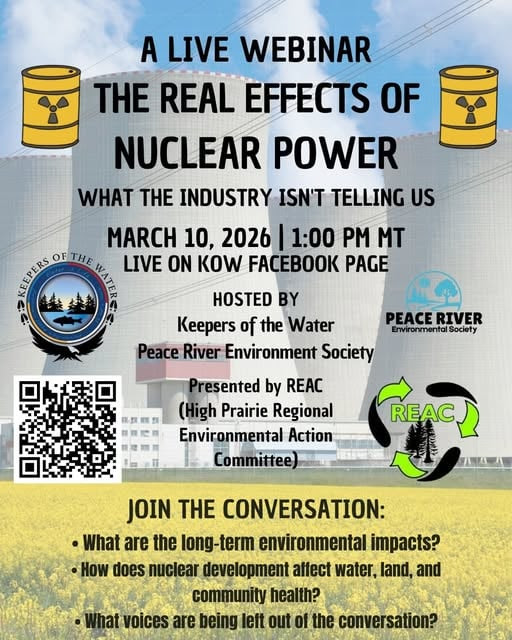
10 March A LIVE WEBINAR THE REAL EFFECTS OF NUCLEAR POWER
What the Industry Isn’t Telling Us
1:00 PM Mountain, 2 pm Central, 3 pm Eastern. Live on the Keepers of the Water Facebook page

18 March Webinar @ 1 PM EST: An Assessment of SMR Projects: The Case of Canada
register for the zoom:
https://us02web.zoom.us/webinar/register/WN_o8BIIOUvQ2ONJR1nta65DQ#/registration


of the week – STOP SMALL MODULAR REACTORS IN CANADA
To see nuclear-related stories in greater depth and intensity – go to https://nuclearinformation.wordpress.com
-
Archives
- March 2026 (76)
- February 2026 (268)
- January 2026 (308)
- December 2025 (358)
- November 2025 (359)
- October 2025 (376)
- September 2025 (258)
- August 2025 (319)
- July 2025 (230)
- June 2025 (348)
- May 2025 (261)
- April 2025 (305)
-
Categories
- 1
- 1 NUCLEAR ISSUES
- business and costs
- climate change
- culture and arts
- ENERGY
- environment
- health
- history
- indigenous issues
- Legal
- marketing of nuclear
- media
- opposition to nuclear
- PERSONAL STORIES
- politics
- politics international
- Religion and ethics
- safety
- secrets,lies and civil liberties
- spinbuster
- technology
- Uranium
- wastes
- weapons and war
- Women
- 2 WORLD
- ACTION
- AFRICA
- Atrocities
- AUSTRALIA
- Christina's notes
- Christina's themes
- culture and arts
- Events
- Fuk 2022
- Fuk 2023
- Fukushima 2017
- Fukushima 2018
- fukushima 2019
- Fukushima 2020
- Fukushima 2021
- general
- global warming
- Humour (God we need it)
- Nuclear
- RARE EARTHS
- Reference
- resources – print
- Resources -audiovicual
- Weekly Newsletter
- World
- World Nuclear
- YouTube
-
RSS
Entries RSS
Comments RSS
 nuclear-news