An act of love — Beyond Nuclear International

Courts threaten freedom of Russian nature protector
An act of love — Beyond Nuclear International
Lyubov Kudryashova loves nature. Now she may be jailed for defending it
By Jack Cohen-Joppa
In Russian, her name means love. And it’s true. Lyubov Kudryashova loves the broad valley of Russia’s Tobol River, where it meanders out of Kazakhstan into the Kurgan Oblast. Her grandfather is buried there, she was born there, and she’s raised three sons there. As far as she knows, her ancestors have always lived there.
There, below the southern Urals, frigid continental winters give way to spring floods that inundate a landscape of oxbow lakes, wetlands, forests and fields. The waters sustain a large aquifer that Russia recognizes as a strategic reserve of fresh water.
“We, native people of the land, are against a barbaric attitude towards nature,” she says. “But our voices are too low.”
Which is why the passion of this campaigning environmentalist and entrepreneur has been met with fabricated charges of encouraging terrorism via the internet. She’s now on trial in a military court in Yekaterinburg, six hours away from her small town.
But Lyubov Kudryashova will not be spurned. “My ecological activity is going to continue. Well, I guess till the day the unjust court could takes away my freedom.”
In 2017, the government awarded an operating license for borehole leeching of uranium to Dalur, a uranium mining subsidiary of the Russian state nuclear agency Rosatom. The license to tap the Dobrovolnoye deposit around the village of Zverinogolovskoye condemned the very farmland Kudryashova’s father managed when she would accompany him as a child.
Dalur has two other leaky in-situ uranium projects in the Kurgan.
Many Tobol Valley residents feared environmental disaster when they learned that hundreds of exploratory wells would be drilled through the aquifer into the mineral deposit lying beneath it, without any public environmental review. Borehole leeching would eventually involve drilling thousands of wells and the injection of a million tons of sulfuric acid over 20-30 years, then withdrawing the dissolved minerals and chemically extracting the uranium.
Several times, activists tried to start a referendum and demand an independent environmental review, but met only refusals from the local officials.
Last fall, environmentalists surveyed some of Dalur’s other boreholes in Kurgan and documented much higher radiation levels than permitted. Despite the concerns, construction began on an in-situ leaching pilot plant and the huge clay-lined “mud pits” needed to receive the massive volume of toxic, acidified sludge produced in the process.
Beginning in 2017, Kudryashova was involved in the legal case against the Russian Federation over its refusal to conduct an environmental impact assessment before awarding the license to develop the mine.
That year, she also co-founded the Public Monitoring Fund for the Environmental Condition and the Population Welfare with the regional branch of the Communist Party of the Russian Federation. One month later, a judge of the Kurgan Regional Court issued an order giving the Russian Federal Security Service (FSB) authority to wiretap her telephone.
The Fund publishes information on the environmental impact of Dalur’s mining activity. Kudryashova writes, “Shortly after the completion of the case in the Supreme Court of the Russian Federation and the registration of the environmental fund, a hidden judgment of another court was rendered that allowed the FSB to begin wiretapping my phone and, I believe, begin to look for fictitious crimes in order to stop my work.
“I guess money is more important than the radioactive contamination of land,” she observed.
So it was that on January 29, 2019, armed men led by an FSB captain broke into her family’s home and spent the day searching it. That summer the FSB got a local court to involuntarily commit Kudryashova to the Kurgan District Psychiatric Hospital for most of the month of July. She was kept from speaking with family or others outside without permission of the agency.
Then in March 2020, the FSB charged Kudryashova with 12 counts of “public justification of terrorism using the Internet” based on a specious forensic analysis of posts on the social network VKontakte, which, according to Kudryashova, never belonged to her page. The actual source of those posts remains unknown because the protocol and the DVD-R capturing those posts show evidence of fabrication and forgery. And at the most recent session of her trial in late December, a CD-R the defense had presented to the court for evidence was found to have been erased by an FSB operative.
Prosecutors say she advocated for violent overthrow of the constitutional order by re-posting memes with such seditious phrases as, “The fate of Russia is determined by each of us, what you personally or I do, then Russia will. A correct position can only be revolutionary” and “If the nation is convinced that the ruling power in the state is directed not at the development of its cultural, economic and other needs, but, on the contrary, at trampling them, then it is not only the right, but also the duty of the nation to overthrow that power and establish one corresponding to the national interests of the people.”
Kudryashova writes, “Nonviolent ecological activism, in the understanding of the rulers of my country, is a crime. That’s why prisons are full of people who wanted to protect nature, but those who harmed it are free… Ecological crimes against present and future generations are not subject to the judgement of a military court.
“I’m 55 years old and my life is not as important as the preservation of nature. My duty and responsibility are to make a small contribution in a great cause — to stop violence against nature and people. The price of atomic energy is the life of future generations.”
Her trial is in the Central District Military Court of Yekaterinburg, where the next hearing is scheduled for 28-29 January, 2021. Agora International Human Rights Group and the Memorial civil rights society in Russia have provided an attorney and other support for Kudryashova.
Letters in support of Lyubov Kudryashova and seeking dismissal of the charges against her should be addressed to the chair of the court collegium examining the case, Judge Sergei Gladkih, st. Bazhova 85, Yekaterinburg, Russia 62005, or by email to opo.covs.svd@sudrf.ru. Refer to Case №: 2-42/2020, Lyubov Kudryashova.
Jack Cohen-Joppa is the co-editor of The Nuclear Resister, the co-founder of the eponymous organization and co-winner with Felice Cohen-Joppa of the 2020 Nuclear Free Future Award in the category of Education.
How a Soviet spy helped to avoid nuclear war
|
When a Soviet spy helped avert nuclear war Tim Rowland, HM Media, 2 Jan 2021,
……..December also marked the passing of George Blake, a spy who kept the Soviets abreast of just about everything the West was doing during the hottest years of the Cold War. ……
In Blake, the KGB knew what they had. As a prisoner in North Korea, he later said he was driven into the arms of the Communists after watching American bombers destroy villages and the civilians who lived in them. ………..
……..At a time of high tension, its intelligence showed the West that the Soviets were not interested in launching a first-strike nuclear attack. Blake had showed the Soviets that this aversion to war was shared by the West. It may have been just enough assurance, in times of high tension, to keep everyone’s missiles in their silos. As dysfunctional as the profession at times could seem, the spies had done their job. https://www.heraldmailmedia.com/opinion/tim_rowland/when-a-soviet-spy-helped-avert-nuclear-war/article_4b527a8b-67f3-5d70-9a71-d5e78743853b.html
|
|
How the USA and Soviet Union planned to use nuclear radiation as a weapon.
 This was initially seen as a great idea – you could kill all the people while leaving the omfrastructure intact for your own use.
For decades, the thought of radiological weapons has conjured terrifying images of cities covered in “death dust.” Classified as a weapon of mass destruction — alongside chemical, biological, and nuclear weapons — it has remained a point of mystery as to why these devastatingly indiscriminate weapons were not pursued in earnest by more state and non-state actors alike.
What did early radiological weapons (RW) programs look like? How and why did they arise, and what accounts for their ultimate demise? Aside from a handful of known cases, why have RW programs not proliferated with the same alacrity as other weapons programs?
Thanks to the rigorous and rich historical work of Samuel Meyer, Sarah Bidgood, and William Potter of the Middlebury Institute of International Studies at Monterey, we now have more answers. Focusing on the United States and Soviet Union in the 1940s and 1950s, the authors, in a recent study published in the journal International Security, trace the unique origins of these RW programs, as well as explain why they were subsequently abandoned. Their study, “Death Dust: The Little-Known Story of U.S. and Soviet Pursuit of Radiological Weapons,” reveals a fascinating web of causes, including organizational and bureaucratic politics, international competition, economic and technological constraints, and even the powerful initiatives of well-placed individuals.
While the authors’ work examines the past, it speaks directly to the present and future trajectory of RW programs. If you are interested in military innovation, the history of weapons of mass destruction, the sociology of technology, and science fiction (yes, science fiction!), the exchange featured below is for you.
Samuel Meyer, Sarah Bidgood, and William C. Potter: We define a radiological weapon as one intended to disperse radioactive material in the absence of a nuclear detonation. ……..
……….. May 1941 — the first reference to RW appeared in a U.S. government document: the Report of the Uranium Committee. The report identified three possible military aspects of atomic fission, the first of which was “production of violently radioactive materials … carried by airplanes to be scattered as bombs over enemy territory.” (The other two possible applications noted in the report were “a power source on submarines and other ships” and “violently explosive bombs.”) ………
Technological advances were among the major drivers of RW programs in both the U.S. and the Soviet Union, and RW were initially pursued in tandem with nuclear weapons and chemical weapons (CW) programs. The anticipated promise of RW as a weapons innovation, however, never materialized in either country due to a combination of factors, including technical difficulties in the production and maintenance of the weapons, diminution in the perceived military utility of RW relative to both CW and nuclear weapons, and low threat perceptions about adversary RW capabilities. ……..
the parallelism in many respects between the rise and demise of the U.S. and Soviet RW programs; and (5) the serious but ultimately unsuccessful effort by the United States and the Soviet Union to secure a draft convention at the Conference on Disarmament prohibiting radiological weapons.
MK: Are radiological weapons a thing of the past or do they remain an attractive option for some countries and non-state actors today?
The authors: We are encouraged that no country has either used RW in war or has incorporated them into a national military arsenal. We are concerned, however, that the Russian Federation, despite its own unsuccessful history with RW, has shown renewed interest in advanced nuclear weapons that seek to maximize radioactive contamination. We also worry that some countries may conclude that RW serve their perceived national interests, especially in the absence of international legal restraints. It therefore is important, we believe, to revive U.S.-Russian cooperation to ban radiological weapons and strengthen the norm against their use.
Morgan L. Kaplan is the Executive Editor of International Security and Series Editor of the Belfer Center Studies in International Security book series at the Belfer Center for Science and International Affairs at the Harvard Kennedy School. https://thereader.mitpress.mit.edu/death-dust-the-little-known-story-of-radiological-weapons/
The Mayak nuclear reprocessing plant: Rosatom’s dirty face- and the courageous opposition

 problems, protests, reprisals” Produced by RSEU’s program “Against nuclear and radioaсtive threats”
In the city of Krasnoyarsk, Rosatom plans to build a national repository for high–level radioactive waste. A site has been selected on the banks of Siberia’s largest river, the Yenisei, only 40 km from the city. Environmental activists consider this project, if implemented,to be a crime against future generations and violates numerous Russian laws. Activists are also concerned that waste from Ukraine,Hungary, Bulgaria (and in the future from Belarus, Turkey, Bangladesh, and other countries) could be transported there as well. (47)
Russia’s nuclear-powered ice-breaker in trouble
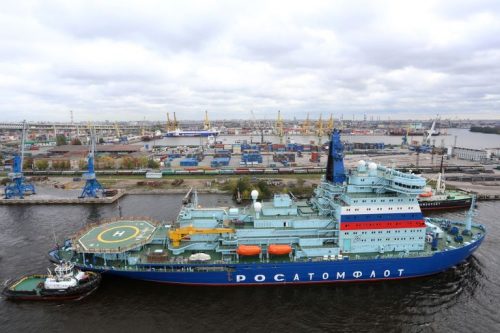 Strategy Page 25th Dec 2020 , The world’s only nuclear-powered non-military ships are operated by Russia. These include five nuclear powered icebreakers and one cargo ship,nthe Sevmorput.
oldest Russian nuclear-powered ship, the Sevmorput was stranded off thewest coast of Africa as emergency repairs are undertaken so it can continuenits trip to Antarctica where it will deliver 5,000 tons of supplies and construction materials for a new Russian research base in Antarctica.
https://www.strategypage.com/htmw/htseamo/articles/20201225.aspx
Moscow Times 16th Dec 2020, A Russian nuclear-powered cargo ship bound for Antarctica has been forced to turn back after sustaining damage, and will bypass Europe before undergoing repairs, state nuclear agency Rosatom said Wednesday. Green activists have expressed concern that the vessel will be sailing past several European countries on its way home during the winter storm season.
Russia marketing small nuclear reactors to the Arctic , (who cares about the toxic wastes?)

Rosatom to build small-scale land-based Arctic nuclear plant by 2028
Rosatom said it has reached an agreement with the government of the Republic of Sakha (Yakutia) setting out parameters for pricing energy that will be produced by the nuclear plant, which is expected to be completed by 2028……….
“I am convinced that a small-scale nuclear power plant will give a qualitative impetus to the development of the Arctic regions of Yakutia, stimulate the development of industry in Ust-Yansky ulus and improve the living standards of local residents,” said in a statement Head of the Sakha Republic Aysen Nikolayev.
The nuclear plant is expected to operate for 60 years but the press release did not specify how Rosatom plans to deal with the nuclear waste produced by it.
Rosatom officials said the small-scale nuclear plant is based on a proven technology that has already been tested in Arctic conditions.
RITM-200 reactors are already being used on the recently commissioned Arktika nuclear-powered icebreaker and six other 22220 design heavy Russian icebreakers that are being built, Rosatom officials said…….
“The implementation of this project strengthens the leading position of Rosatom in the world market of small nuclear power plants.”…….
Rosatom is also actively marketing the technology for export overseas, Likhachev said. https://thebarentsobserver.com/en/nuclear-safety/2020/12/rosatom-build-small-scale-land-based-arctic-nuclear-plant-2028
Russian Army Chief Warns of Nuclear Risks in Cyber Hacks, Space
 Russian Army Chief Warns of Nuclear Risks in Cyber Hacks, Space https://www.bloombergquint.com/politics/russia-general-warns-cyber-attacks-pose-nuclear-risks-tass-says Stepan Kravchenko December 25 2020, (Bloomberg) — The extension of military confrontation into the cyber sphere and space raises the risks of incidents involving nuclear weapons, Russia’s top general warned Thursday, highlighting concerns about growing tensions.
Read more at: https://www.bloombergquint.com/politics/russia-general-warns-cyber-attacks-pose-nuclear-risks-tass-says
Copyright © BloombergQuint
Russia keenly marketing nuclear technology to Bolivia
 Rosatom may put stages I, II of nuclear center in Bolivia into operation in 2021, TASS, 25 Dec 20, Rosatom may put stages I, II of nuclear center in Bolivia into operation in 2021, TASS, 25 Dec 20, On March 6, 2016, Russia and Bolivia concluded an inter-governmental agreement on cooperation in the peaceful use of nuclear energy and construction of a nuclear research center in El Alto MOSCOW, December 25. /TASS/. The Rosatom State Nuclear Energy Corporation is continuing the construction of the Center for Nuclear Research and Technologies in Bolivia, despite the difficult political situation in that country. Next year the company plans to commission the first and second stages of the facility, Head of Rosatom Alexey Likhachev said on Friday.”Despite two revolutions, work continues in Bolivia. Next year we will start commissioning facilities of the first and second stages of the Center for Nuclear Research and Technologies,” he said…….. Nuclear project in BoliviaOn March 6, 2016, Russia and Bolivia concluded an inter-governmental agreement on cooperation in the peaceful use of nuclear energy and construction of a nuclear research center in El Alto, at an altitude of 4,100 meters above sea level. The Bolivian government-funded $300-million project will be implemented jointly with Russia’s nuclear power corporation Rosatom………. https://tass.com/economy/1239807 |
|
Russian environmental defenders under attack
For future updates follow RSEU on facebook.
For more information contact:
Vitaly Servetnik,
Russian Social-Ecological Union / Friends of the Earth Russia
Email: vitservetnik@gmail.com
Program Area: Environmental Human Rights Defenders
Member Group: Russian Social Ecological Union (RSEU)
Russian hackers evaded layers of U.S. security to attack America’s military and intelligence agencies
 New York Times 14th Dec 2020, The scope of a hack engineered by one of Russia’s premier intelligence agencies became clearer on Monday, when some Trump administration officials acknowledged that other federal agencies — the State Department, the Department of Homeland Security and parts of the Pentagon — had been compromised. Investigators were struggling to determine the extent to which the military, intelligence community and nuclear laboratories were affected by the highly sophisticated attack.
https://www.nytimes.com/2020/12/14/us/politics/russia-hack-nsa-homeland-security-pentagon.html
Thieves steal equipment from Russia’s nuclear war ‘doomsday’ plane.
|
Thieves target Russia’s nuclear war ‘doomsday’ plane. https://www.theguardian.com/world/2020/dec/08/thieves-target-russia-nuclear-war-doomsday-plane
Radio equipment stolen from Ilyushin-80 aircraft designed to protect Putin and top officials, Andrew Roth in Moscow, Thieves have targeted a Russian “doomsday” plane, the military aircraft that would be used by top officials, including Vladimir Putin, in case of a nuclear war.The robbery of the Ilyushin-80, a mobile command post specially designed to keep officials alive and in command of the military during a nuclear conflict, took place at an airfield in southern Russia, state media reported. The thieves managed to open the highly classified aircraft’s cargo hatch and make off with 39 pieces of radio equipment. They have not been caught. Interior ministry officials in the city of Taganrog confirmed that a plane at Taganrog Aviation Scientific and Technical Complex was robbed, although they did not specify which one. Ren-TV, a Russian television station, reported that police had found shoe and fingerprints aboard the aircraft. Russia has just four Ilyushin-80 planes, modified Il-86s that are specially equipped to protect those aboard in the event of a nuclear war. The plane does not have any passenger windows, to prevent passengers from being blinded by atomic explosions. The planes also carry specialised communications equipment to maintain contact with the country’s armed forces, including missile forces capable of launching nuclear strikes. A miles-long retractable antenna dragged from the rear of the aircraft can maintain communications with ballistic-missile submarines. In the event of a conflict, it is expected that Putin and other political and military officials would board the planes and command the country’s defences while remaining airborne, possibly for several days (with refuelling). Some of the details of the Ilyushin-80 are kept secret by Russia. It is not yet clear how sensitive the radio equipment that was stolen may be. The planes have been in service for 15 years and are due to be replaced by an aircraft with greater range – the Il-96-400M. The new planes, designed to withstand electromagnetic pulses released by nuclear explosions, and include better shielding have updated electronics and communications systems. The US maintains four Boeing E-4 Advanced Airborne Command Posts, modified Boeing 747-200s that would be carry the US president and other top officials in case of a nuclear war. |
|
|
Russian Ambassador to U.S. Sees Hope for Nuclear Arms Treaty Extension
He said several times during the forum that the Kremlin has been pushing the White House on an extension of its terms but has not received a formal answer.
The whole world depends on the United States-Russia relationship.”
On START, he added, “we need time to work out new security agreements” that cover a range of issues from missile defense, intermediate-range missiles, hypersonics and potential space weapons. For this reason, Russia has offered to extend the treaty’s term for up to five years “without pre-conditions.”
The United States wants China to be part of any new START negotiations, but Antonov said Beijing is “not happy with such an invitation.” The ambassador said Moscow wants the United Kingdom and France, both nuclear powers and NATO members, to be involved if the talks are broadened……. https://news.usni.org/2020/12/07/russian-ambassador-to-u-s-sees-hope-for-nuclear-arms-treaty-extension
Russia claims to have successfully tested an “unstoppable” nuclear missile
Russia tests ‘unstoppable’ nuclear missile after worrying threat to the US
Russia claims to have successfully tested an “unstoppable” nuclear missile, with state media saying it has the ability to hit US cities in minutes. news.com.auAlly Fosterallyjfoster 27 Nov 20,
The Russian military has claimed to have successfully tested an “unstoppable” nuclear missile, with the weapon almost reaching speeds of 10,000km/h.
The hypersonic weapon, known as the Mach 8 Zircon or Tsirkon, has been touted as President Vladimir Putin’s “weapon of choice”, with Russian media even claiming it could destroy prominent US locations within five minutes.
The Russian Ministry of Defence recently performed a test launch of the nuke in the White Sea, with officials claiming to have successfully hit a target located 450km away in the Barents Sea.
In a statement, the Russian Ministry of Defence claimed the missile reached speeds of more than 8 March, or about 9878 km/h.
It reportedly took just over four minutes to reach its target.
Though Russia has continually claimed success in testing and creating these nuclear missiles, the country has also recently been reminded of the dangers such weapons can pose if something goes wrong.
On August 8, 2019, an explosion at a weapons testing range in Nyonoksa killed seven people and injured multiple others.
Intelligence officials quickly came up with multiple theories about the cause of the deadly explosion, with some believing a test of a new nuclear powered missile had gone wrong and others claiming a nuclear reactor blew up.
………Russian officials remained tight lipped about the incident, simply claiming the explosion was the result of a failed test of an “isotope power source for a liquid-fuelled rocket engine”.
The country’s weather agency later confirmed the blast ejected radioactive material into the air.
Reports claimed radiation levels temporarily soared to 20 times above the normal level in Severodvinsk, a city about 30 km from the weapons testing site in Nyonoksa. https://www.news.com.au/technology/innovation/military/russia-tests-unstoppable-nuclear-missile-after-worrying-threat-to-the-us/news-story/6dfc0365ac9fcd29d22c3bb5157455e1
Russia and the United States Nuclear Industry
Trump’s Impact on Nuclear Proliferation, Treating Foreign Policy as a Business, Just Security, by Tamsin Shaw, November 18, 2020 “…………….Russia and the United States Nuclear Industry
It’s only relatively recently that the public and private U.S. institutions have begun to examine seriously the intricate financial network that lies behind and links Russian nuclear business dealings in the United States. Public perception of these dealings has been dominated by the false Uranium One conspiracy theory. This distraction has diverted attention from the extent to which Russia has established a strong foothold in the US nuclear industry in a way that suggests an aspiration to vertical control.
The grain of truth in the Uranium One story is that in 2010 Canadian company Uranium One, which was responsible for mining 20% of the currently licensed uranium in the United States, made an agreement with JSC Atomredmetzoloto, or ARMZ, the mining arm of Rosatom, giving them a controlling stake (51%). In 2013 Rosatom acquired full ownership. Uranium One continues to mine approximately 10% of that licensed in-situ uranium.
The United States also relies, both for civilian utilities and defense purposes, on nuclear fuel supplied by Russian subsidiary of Rosatom called Techsnabexport (TENEX). No U.S. uranium enrichment facilities are currently in operation. The U.S. company, Centrus has a new centrifuge design but it will likely be over a decade before it goes into action.
Nor does the United States currently have a company that builds commercial nuclear reactors. The only U.S. company now aiming to construct them is Bill Gates’s TerraPower, which is working on what will likely be the next generation of reactors, small modular reactors (SMRs), but again these won’t be commercially viable for a decade. Commercial nuclear reactors were previously designed and built by US company Westinghouse. But on March 24, 2017, Westinghouse declared Chapter 11 bankruptcy. The sale of that company naturally has serious national security implications. But the story of the sale and of the role that the Trump administration played in it raises many questions.
Trump’s friend and adviser, Tom Barrack, seized on the opportunity presented by the Westinghouse bankruptcy to put together a new version of the Marshall Plan for the Middle East, producing his own document setting out the details. In his March 2017 white paper, Barrack refers to the plan interchangeably as the “Trump Marshall Plan” and the “Trump Plan.” The July 2019 House Oversight and Reform Committee report details the ambitious deal Barrack tried to put together to purchase Westinghouse. Barrack had permission from the highest levels at the White House for a US-led consortium involving Colony Capital, IP3, and financial firms Blackstone and Apollo. Barrack assured Blackstone CEO Steve Schwartzman,
Our GCC [Gulf Cooperation Council] allies in Saudi Arabia and the UAE have committed to invest in the Westinghouse acquisition and are willing to concurrently lock in Westinghouse as the primary partner on the 30+ reactors expected to be constructed in their countries in the coming decade.
IP3 officials were very optimistic. President Trump and Jared Kushner had met with MBS on March 14, and IP3 boasted that this meeting prepared the way for a “partnership to acquire Westinghouse between IP3 and Saudi Arabia.” They eagerly arranged meetings with officials in the administration to promote the plan, including then-CIA Director Mike Pompeo, Director of the National Economic Council Gary Cohn, and top National Security Council (NSC) Staff officials. They also briefed Jared Kushner.
But in January, 2018 it was announced that Canadian company, Brookfield Business Partners, a subsidiary of investing giant Brookfield Asset Management, would purchase Westinghouse. And Westinghouse promptly and unilaterally decided to sever ties with IP3. ProPublica discovered that Kushner was the one who prevented the IP3-led deal from happening, reporting that Kushner “wanted to table the nuclear question in favor of simpler alliance-building measures with the Saudis, centered on Trump’s visit in May, according to a person familiar with the discussions.”
The Westinghouse sale went through on August 1, 2018. Three days later it was announced that Brookfield Properties, another subsidiary of Brookfield Asset Management that had just purchased Westinghouse, would buy Jared Kushner out of his catastrophic real estate deal involving 666 Fifth Avenue.
Who Owns Westinghouse?
The Westinghouse purchase was naturally considered an extremely sensitive deal, deserving scrutiny by the Committee on Foreign Investment in the United States (CFIUS), which at the time included Steve Mnuchin, Rex Tillerson, Jeff Sessions, Wilbur Ross and Dan Coats. The committee approved the transaction but with a Nuclear Regulatory Committee (NRC) Requirements Notice forbidding transfer of their licenses and insisting on compliance with all applicable statutory and regulatory requirements. But the NRC filing submitted to CFIUS is fairly thin. It tells us that Westinghouse would be “ultimately controlled” by Brookfield Asset Management, but little about the money behind the deal. According to their 2018 20-F annual report, BBU acquired 44% of the company, while having a 100% voting interest, having put in $405m of equity totaling $920m, with the balance coming from “institutional partners.” The rest of the purchase price was funded with approximately $3b of long-term debt financing. The sources of the equity and financing aren’t disclosed.
Immediately prior to the Westinghouse sale, prominent foreign policy experts Thomas Duesterberg and William Schneider wrote an article expressing serious concerns about the opacity………….https://www.justsecurity.org/73422/trumps-impact-on-nuclear-proliferation/
Russia’s latest nuclear icebreaker had to abort maiden Arctic voyage
|
Russia’s latest nuclear icebreaker had to abort maiden Arctic voyage The powerful “Arktika” set off from Murmansk on Saturday for a three-week assignment to the Northern Sea Route. Mid-Barents Sea, though, the icebreaker turned around and sailed back to port. Barents Observer, By Thomas Nilsen. November 17, 2020
Following last month’s test voyage to the North Pole, and formal launch ceremony in Murmansk, the new giant icebreaker was now supposed to embark on her first real-working tour to the Northern Sea Route.“Arktika” left from Atomflot’s service base in the Kola Bay on Saturday, according to the state-owned operator Rosatomflot. “On November 14, the leading universal nuclear-powered icebreaker “Arktika“ left the port of Murmansk on its maiden voyage. The vessel headed towards the Kara Sea. Until mid-December, the nuclear-powered icebreaker “Arktika“ will operate in the Northern Sea Route,” a press release posted November 16 said. The Northern Sea Route Administration’s permission granted for ”Arktika” to enter the Kara Gate, where the Northern Sea Route starts, is valid from November 16. Online ship tracking service VesselFinder.com shows the path of the icebreaker sailing out the Kola Bay on a steady course towards the Kara Sea. Halfway in the Barents Sea, the ship suddenly makes a 180 degrees turnaround and sails back on a northwestern course before turning south on Tuesday directly towards Murmansk. Asked about the hastily return to port, Head of the Communication department with Atomflot, Evgeny Sviridov says to The Barents Observer that “Staff is conducting adjustment works onboard.” He would not elaborate but adds: “The icebreaker will leave the port of Murmansk in the nearest future.” In Murmansk, people have already started to post speculations on the regional Vkontakte page on what could have gone wrong. Unconfirmed reports hint at “mechanical problems” onboard, and nothing related to the two nuclear reactors. “Arktika” is the lead of five vessels of Project 22220, the world’s most powerful nuclear-powered icebreakers. Construction of two similar vessels, the “Ural“ and “Sibir” are currently well underway at the yard in St. Petersburg, while keel-laying of the fourth icebreaker, the “Yakutia” took place in May this year. The contract for the fifth, the “Chukotka” is signed. When sailing north from the shipyard on September 22, there was already a problem with the propulsion. During sea trials in the Baltic Sea in February this year, a short circuit caused serious damage to the winding in one of the three electro engines. The damaged propulsion motor is 50 % functional and can deliver 10 megawatts of propulsion power to the starboard wing propeller. It’s a tandem unit and only one half of it was damaged during the sea trials….. https://thebarentsobserver.com/en/arctic/2020/11/russias-latest-and-most-powerful-nuclear-icebreaker-had-abort-maiden-arctic-voyage |
1 This Month


10 March A LIVE WEBINAR THE REAL EFFECTS OF NUCLEAR POWER
What the Industry Isn’t Telling Us
1:00 PM Mountain, 2 pm Central, 3 pm Eastern. Live on the Keepers of the Water Facebook page


18 March Webinar @ 1 PM EST: An Assessment of SMR Projects: The Case of Canada
register for the zoom:
https://us02web.zoom.us/webinar/register/WN_o8BIIOUvQ2ONJR1nta65DQ#/registration


of the week – STOP SMALL MODULAR REACTORS IN CANADA
To see nuclear-related stories in greater depth and intensity – go to https://nuclearinformation.wordpress.com
-
Archives
- March 2026 (76)
- February 2026 (268)
- January 2026 (308)
- December 2025 (358)
- November 2025 (359)
- October 2025 (376)
- September 2025 (258)
- August 2025 (319)
- July 2025 (230)
- June 2025 (348)
- May 2025 (261)
- April 2025 (305)
-
Categories
- 1
- 1 NUCLEAR ISSUES
- business and costs
- climate change
- culture and arts
- ENERGY
- environment
- health
- history
- indigenous issues
- Legal
- marketing of nuclear
- media
- opposition to nuclear
- PERSONAL STORIES
- politics
- politics international
- Religion and ethics
- safety
- secrets,lies and civil liberties
- spinbuster
- technology
- Uranium
- wastes
- weapons and war
- Women
- 2 WORLD
- ACTION
- AFRICA
- Atrocities
- AUSTRALIA
- Christina's notes
- Christina's themes
- culture and arts
- Events
- Fuk 2022
- Fuk 2023
- Fukushima 2017
- Fukushima 2018
- fukushima 2019
- Fukushima 2020
- Fukushima 2021
- general
- global warming
- Humour (God we need it)
- Nuclear
- RARE EARTHS
- Reference
- resources – print
- Resources -audiovicual
- Weekly Newsletter
- World
- World Nuclear
- YouTube
-
RSS
Entries RSS
Comments RSS
 nuclear-news