Russia unveils largest nuclear submarine built in 30 years
Russia unveils largest nuclear submarine built in 30 years https://www.tvnz.co.nz/one-news/world/russia-unveils-largest-nuclear-submarine-built-in-30-years Russia has unveiled what’s believed to be its largest submarine built in 30 years amid a tense standoff with Britain in the Black Sea. The Belgorod sailed for the first time today, just days after the Russian military assets fired warning shots at a British Royal Navy destroyer after it came too close to what Moscow has claimed is its territorial waters near Crimea last week. Bombs were also dropped by jets near the vessel.
While the nuclear submarine’s specifications have not been revealed, the Belgorod will be able to launch nuclear strikes, according to the Daily Telegraph.
It will also act as a mothership for smaller submarines.
Russia, China Pledge to Not Use Nuclear Weapons First, Avoid Firing Missiles at Each Other
Russia, China Pledge to Not Use Nuclear Weapons First, Avoid Firing Missiles at Each Other , NewsWeek, BY JENNI FINK ON 6/28/21 Russia and China reaffirmed their friendship treaty amid increasing concerns about their growing relationship and the two countries continued a vow not to fire strategic missiles at each other.
Russia President Vladimir Putin and Chinese President Xi Jinping extended the 20-year Treaty of Good-Neighborliness and Friendly Cooperation, a document Putin credited with taking their relationship to “unprecedented height.” An extension that’s set to last for five years, it outlines that both countries will support each others’ right to defend their “national unity” and territories.
Article 2 has both countries promising to using “peaceful means” to resolve their differences, not the use of force, threat of force or economic pressures.
The contracting parties reaffirm their commitment that they will not be the first to use nuclear weapons against each other nor target strategic nuclear missiles against each other,” the treaty states.
Russia and China have grown closer as their relationships with the United States has deteriorated. Although Putin’s summit with President Joe Biden was seen as a positive step, America and Russia failed to see eye-to-eye on a number of topics, but they agreed to work together on the issue of nuclear weapons.
In a joint statement, the two countries agreed to “embark” on dialogue that would “lay the groundwork” for future arms control and risk reduction measures, acknowledging that “nuclear war cannot be won and must never be fought.”
One of two biggest nuclear powers, Putin’s endorsement of Russia’s nuclear deterrent policy raised concerns. The policy allows him to use nuclear weapons in response to a strike with conventional weapons, or if Russia gets “reliable information” about the launch of an attack against its territory or allies.
The strategy is “purely defensive,” according to General of the Army Valery Gerasimov, chief of the General Staff of the Armed Forces, but he defended Russia’s ability to use nuclear weapons at the Moscow International Security Conference last week……. https://www.newsweek.com/russia-china-pledge-not-use-nuclear-weapons-first-avoid-firing-missiles-each-other-1604865
Biden and Putin agree: ‘Nuclear war cannot be won and must never be fought’
Biden and Putin agree: ‘Nuclear war cannot be won and must never be fought’ DW, 17 June 21
US President Joe Biden and Russian President Vladimir Putin have concluded a high-stakes summit aimed at cooperation but dominated by deep disagreements.
US President Joe Biden and his Russian counterpart Vladimir Putin have ended their highly anticipated summit in Geneva.
The leaders’ first in-person meeting since Biden became president took place at a lakeside villa amid soaring tensions between their two countries.
As talks ended after less than the five hours either side thought they would need, Biden gave a thumbs up. Members of the US team said the meeting had been “quite successful.”
After the meeting, the two sides released a joint statement on one of the main topics of discussion, nuclear proliferation. The statement read, “Nuclear war cannot be won and must never be fought.”
DW Moscow correspondent Emily Sherwin said, “Biden managed to walk a fine line with Putin,” recognizing Russia’s desire to be seen as a major geopolitical power.
The joint US-Russian statement said progress on shared goals could be achieved, “even in periods of tension,” going on to state, “The United States and Russia will embark together on an integrated bilateral Strategic Stability Dialogue in the near future that will be deliberate and robust.”
The statement added that the countries “seek to lay the groundwork for future arms control and risk reduction measures.” …………………… https://www.dw.com/en/biden-and-putin-agree-nuclear-war-cannot-be-won-and-must-never-be-fought/a-57921072
Collaboration between Russia and Europe finally cleans up the most dangerous nuclear ship in the Arctic.
After 27 Years, Lepse No Longer Poses a Nuclear Threat to the Arctic, High North News, PETER B. DANILOV 17 June 21, Last week, the Russian service ship Serebryanka delivered the last spent-fuel bundles from the Lepse floating maintenance base to an Atomflot storage site in Murmansk, completing the final stage of securing the nuclear waste……. To ensure the dismantling of the Lepse floating maintenance base, it was necessary to specially develop new technologies and equipment and make innovative decisions,” said FSUE Atomflot Director General Mustafa Kashka.
In July 2020, the Lepse floating maintenance base’s main batch of spent nuclear fuel was unloaded at the Nerpa shipyard. A total of 620 spent-fuel bundles were extracted and unloaded.
Lepse was regarded as the most dangerous nuclear vessel in the north and the Norwegian environmental NGO Bellona began the work of securing the spent nuclear fuel onboard the vessel in 1994.
……….. The project to dismantle and dispose of the Lepse Floating Maintenance Base is multilaterally implemented.
In 1996, the project was included in the EU’s TACIS program (Technical Assistance to the Commonwealth of Independent States), which involved the allocation of funds for the inspection of the state of spent nuclear fuel.
Since 2008, the project has been carried out in the framework of a Grant Agreement between the European Bank for Reconstruction and Development (EBRD), Rosatom, and JSC NFC Logistics Centre (the project’s customer and coordinator).
The EBRD has provided 54 million euros from the Northern Dimension Environmental Partnership Fund (NDEP). https://www.highnorthnews.com/en/after-27-years-lepse-no-longer-poses-nuclear-threat-arctic
Russia’s Approach to Nuclear Power in Outer Space
Russia’s Approach to Nuclear Power in Outer Space
Jamestown Foundation, Eurasia Daily Monitor Volume: 18 Issue: 92 By: Pavel Luzinune 9, 2021
Russia has been conducting research and development (R&D) on using nuclear power in outer space for years. On May 22, Alexander Bloshenko, executive director for advanced programs and science of Roscosmos, announced that the first mission of the nuclear-powered spacecraft, also known as the transport and energy module (TEM), is scheduled for 2030 (TASS, May 22). A week before this announcement, there was a deliberate leak from the Keldysh Center, a Roscosmos subsidiary entity, that this nuclear-powered spacecraft might be used for military purposes along with civil ones (RIA Novosti, May 13). These verbal interventions almost coincided with the hearings in the US Congress on the NASA budget request that proposes $585 million for nuclear thermal propulsion technology in FY2022 and ongoing American efforts in this field (SpaceNews, May 19; Physics Today, May 28). That means the Russian program on space nuclear power systems has not only technological but also geopolitical goals.
The current Russian program has a Soviet background. The USSR launched 33 military reconnaissance and targeting spacecraft with nuclear reactors into low-Earth orbit from 1969 to 1988. Most of them used thermoelectric nuclear power plants “Buk,” and the last two spacecraft used more advanced thermal electron emission NPPs “Topaz” with 4.5–5.5 kW of electric power. The Soviet Union also developed the prototypes of nuclear rocket engines, but the project was closed in 1986. In the early 1990s, a Russian-American project aimed to develop the “Topaz” reactors further, but was canceled by 1995. In 2000–2007, Russia tried to cooperate with China in this field (Kukharkin, 2012).
Despite long-term economic decline, Moscow has also tried to continue its independent efforts in space nuclear power systems since 1998, and during the presidency of Dmitry Medvedev, these efforts were proclaimed among the Kremlin’s key priorities (Pravo.gov.ru, February 2, 1998; RG.ru, November 13, 2009).
The program’s budget of 17 billion rubles for the period 2010–2018 was divided between Roscosmos (9.8 billion rubles) and Rosatom (7.2 billion rubles), totaling $560 million according to the exchange rates of 2010 (RG.ru, October 3, 2012). However, the actual spending was smaller. In 2010, only 500 million rubles ($16.5 million) were assigned for the purpose (Roscosmos, February 10, 2010). During the following decade, the total spending has reached almost 10 billion rubles or $213 million according to open data on federal budget funds and procurements released by Roscosmos and Rosatom (Vesti.ru, January 19, 2011; Interfax, October 12, 2020; Zakupki.gov.ru, 2013–2021). The current results of these efforts are less than initially planned………..
In comparison with NASA that tries to design a 10 kW space nuclear reactor with a Stirling engine intended to increase efficiency, the thermal electron emission remains the central paradigm of Russia’s R&Ds and the idea of using engines or turbines together with space nuclear reactors still remains theoretical (NASA, May 2, 2018; Issledovaniya Naukograda, July–September 2017). It is doubtful that Russia will develop the space nuclear power system with 1 MW of electric power and ion thrusters with more power in the foreseeable future. Still, Moscow definitely will try to convert existing results into some advance in outer space and foreign policy.
Along with a significant deficiency in other dimensions of Russia’s space activity and the country’s overall economic weakness, these problems prompt the Kremlin to look for an ace up its sleeve. While there is still a long way to go to develop nuclear reactors for space exploration missions, Russian industry and authorities are seeking to apply nuclear power for military satellites (KB Arsenal, September 1, 2020). Such spacecraft may be used for radar reconnaissance and electronic warfare (jamming) and be deployed to low, medium or geosynchronous orbits. However, there have not been any flight tests or technological demonstrations of such a satellite yet. This means Moscow will not be ready to deploy these satellites any time soon……… https://jamestown.org/program/russias-approach-to-nuclear-power-in-outer-space/
Nuclear Notebook: How many nuclear weapons does Russia have in 2021?
Nuclear Notebook: How many nuclear weapons does Russia have in 2021? Bulletin of the Atomic Scientists . By Hans M. Kristensen, Matt Korda, March 15, 2021, Russia is in the middle of a decades-long modernization of its strategic and nonstrategic nuclear forces to replace Soviet-era weapons with newer systems. In December 2020, President Vladimir Putin reported that modern weapons and equipment now make up 86 percent of Russia’s nuclear triad (Russian Federation 2020a), compared to the previous year’s 82 percent (Russian Federation 2019a). He additionally noted that he expects that number to rise to 88.3 percent in 2021. As in previous years, Putin’s remarks emphasized the need for Russia’s nuclear forces to keep pace with Russia’s competitors: It is absolutely unacceptable to stand idle. The pace of change in all areas that are critical for the Armed Forces is unusually fast today. It is not even Formula 1 fast—it is supersonic fast. You stop for one second and you start falling behind immediately” (Russian Federation 2020a).
Putin also noted his disappointment with the “deterioration” of the US-Russia arms control regime, and declared that the United States withdrew from the Anti-Ballistic Missile Treaty, the Intermediate-Range Nuclear Forces Treaty, and the Open Skies Treaty under “contrived pretexts.” He also addressed the “uncertainty” around New START: “We have repeatedly stated our readiness to extend the treaty but there has been no response” (Russian Federation 2020a).
As of early 2021, we estimate that Russia has a stockpile of nearly 4,500 nuclear warheads assigned for use by long-range strategic launchers and shorter-range tactical nuclear forces……………….
Russia has significantly reduced the number of warheads deployed on its ballistic missiles to meet the New START limit of no more than 1,550 deployed strategic warheads. Russia achieved the required reduction by the February 5, 2018 deadline, when it declared 1,444 strategic warheads attributed to 527 launchers (Russian Federation Foreign Affairs Ministry 2018). The most recent data, declared on September 1, 2020, listed Russia with 1,447 deployed warheads attributed to 510 strategic launchers………….
Russia has significantly reduced the number of warheads deployed on its ballistic missiles to meet the New START limit of no more than 1,550 deployed strategic warheads. Russia achieved the required reduction by the February 5, 2018 deadline, when it declared 1,444 strategic warheads attributed to 527 launchers (Russian Federation Foreign Affairs Ministry 2018). The most recent data, declared on September 1, 2020, listed Russia with 1,447 deployed warheads attributed to 510 strategic launchers…………
Overall, Russia’s nuclear modernization effort will present the international arms control community with new challenges. Unless a new arms reduction agreement is reached in the future to replace New START, the shrinking of Russia’s strategic nuclear arsenal that has characterized the past two decades will likely come to an end, …………………………………………. https://thebulletin.org/premium/2021-03/nuclear-notebook-russian-nuclear-weapons-2021/?utm_source=Newsletter&utm_medium=Email&utm_campaign=MondayNewsletter03152021&utm_content=Notebook_Russia_03152021
Russia beefs up its sub-critical non-nuclear experiments at its top secret far remote Novaya Zemlya site.
12th Directorate beefs up support facilities at nuclear test site, Russian Defence Ministry’s 12th Directorate talks public about ongoing subcritical experiments with nuclear warheads material at Novaya Zemlya. Barents Observer, By Thomas Nilsen June 07, 2021
The Defence Ministry’s own TV channel Zvezda on Sunday broadcasted a nearly 40 minutes long unique documentary about one of Russia’s top-secret military units, the Central Test Site at Novaya Zemlya.
Established in the mid-1950s, a total of 132 nuclear weapon tests are carried out at the archipelago in the period until October 24th 1990. Much less is told about the activities after President Mikhael Gorbachev the year after announced a unilateral nuclear test moratorium.
“Non-nuclear experiments are being carried out to confirm the reliability of the existing nuclear ammunition,” said the head of the Defence Ministry’s 12th Main Directorate, Major General Igor Kolesnikov, from his office in Moscow.
Non-nuclear experiments do not mean that weapons-grade material is not included. Simply, it means experiments are carried out but with no nuclear yield.
For example, such a test could include a small portion of plutonium, enough to explode, but not enough to reach a critical mass and therefore not create a self-sustaining chain reaction, or a nuclear bang. The effects of a full-size bang are then validated in advanced computer simulations.
Subcritical tests are done for two main purposes, determine the status of ageing plutonium warheads or aimed at developing new warheads.
“I must say that the United States is doing the same, they are also conducting similar experiments in Nevada,” Kolesnikov said in the interview with TV Zvezda.
Sub-critical tests are allowed under the Comprehensive Test Ban Treaty (CTBT). However, carrying out such tests in tunnels deep into the mountains in the far remote Novaya Zemlya have caused speculations that real, although very small, nuclear explosions could happen without the global network of monitoring stations would be able to detect it.
The Major General, though, said only non-nuclear explosive experiments take place at Novaya Zemlya…………… https://thebarentsobserver.com/en/nuclear-safety/2021/06/12th-directorate-beefs-support-facilities-nuclear-test-site
Russia launches a mission to investigate te Komsomolets, Soviet nuclear submarine sunk 32 years ago .
Bellona 25th May 2021, Russian scientists have embarked on a mission to the Komsomolets, a Soviet nuclear submarine that sank 32 years ago during an onboard fire off Norway’s northern coast, killing 41, in a bid to determine whether the wreck presents threats to the undersea environment.
The scientists, from Rosgidromet, Russia’s state weather agency which also measures radiation, set sail from Arkhangelsk last week aboard the Professor Molchanov research vessels, reaching the accident site over the weekend, Russian media reported.
Russia launches mission to the sunken Komsomolets nuclear submarine
Russia’s plans for nuclear-powered spacecraft to Jupiter
Russia Wants To Send A Nuclear-Powered Spacecraft To Jupiter This Decade, IFL Science 26 May 21,Russia is planning to send a nuclear-powered spacecraft to the grand gas giant of the Solar System, Jupiter, in 2030.
Roscosmos, Russia’s federal space agency, announced the plan for the mammoth 50-month journey last week. The journey will take it on a mini tour of the Solar System, taking pit stops around the Moon and Venus, dropping off spacecraft along its way, before heading on to Jupiter.
More specifically, a “space tug” with a nuclear-based transport and energy module dubbed Zeus will head towards the Moon where a spacecraft will separate from it. It will then pass by Venus to perform a gravity assist maneuver and drop off another spacecraft, before venturing towards Jupiter and one of its satellites.
“Together with the Russian Academy of Sciences, we’re are now making calculations about this flight’s ballistics and payload,” Roscosmos Executive Director for Long-Term Programs and Science Alexander Bloshenko told reporters, according to TASS news agency.
Most spacecraft use solar panels that convert the Sun’s energy into electricity. However, the deeper a spacecraft goes into the Solar System, the further it strays from the Sun and less solar energy is available. While batteries can be used for backup, some missions – such as Cassini and Voyager – have been powered from a radioisotope thermoelectric generator (RTG), which is a bit like a nuclear battery that uses heat from the radioactive decay of isotopes. RTGs are not nuclear reactors, however, as a chain reaction does not take place.
The new Zeus project, by comparison, is a whole nuclear reactor that will use fission reactions to drive the propulsion. In the words of Russian state media, it’s a “secrecy-laden project in development since 2010” that involves a 500-kilowatt nuclear reactor, weighing around 22 tons….
The Soviet Union launched a bunch of nuclear reactors into space during the Cold War as part of the RORSAT missions, a set of Soviet nuclear spy satellites launched between 1967 and 1988. On the other hand, the US has launched just one: SNAP-10A or SNAPSHOT, a nuclear-reactor power system launched in 1965.
The US has regained interest in nuclear-powered space travel over the past few decades. Just recently, the US Defense Advanced Research Projects Agency (DARPA) has commissioned three private companies – Blue Origin, Lockheed Martin, and General Atomics – to develop nuclear fission thermal rockets for use in lunar orbit, with the goal of demonstrating the technology above low Earth orbit in 2025. https://www.iflscience.com/space/russia-wants-to-send-a-nuclearpower-spacecraft-to-jupiter-this-decade/
Russia’s Arctic Council leadership now facing up to the problem of nuclear reactors dumped in the ocean
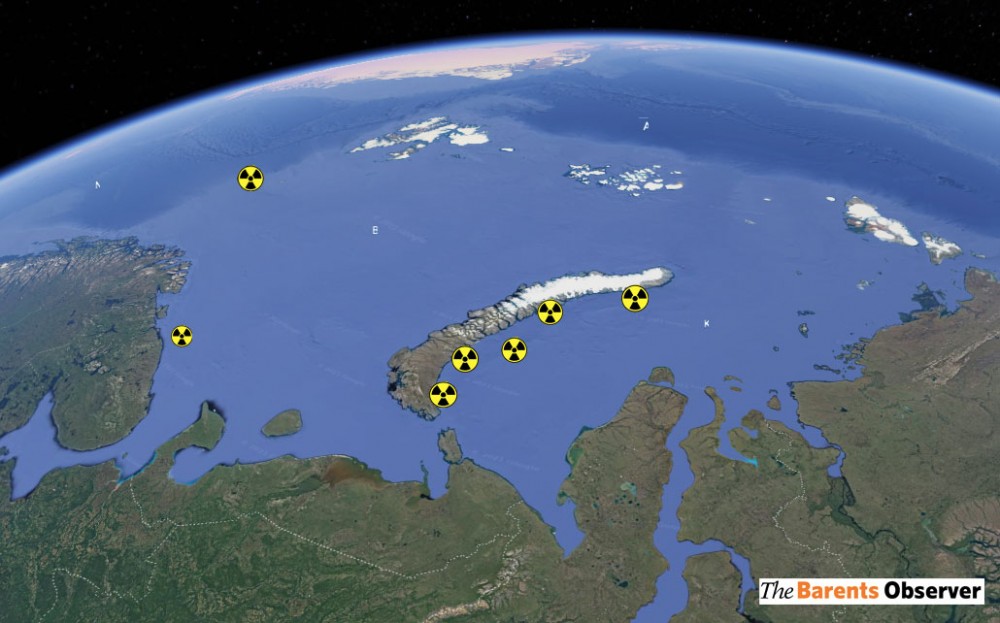
Reactors are dumped at several locations in the Kara Sea in addition to the two submarines K-159 and K-278 that sank in the Barents- and Norwegian Seas. Map: Barents Observer / Google Earth
Tackling dumped nuclear waste gets priority in Russia’s Arctic Council leadership https://thebarentsobserver.com/en/nuclear-safety/2021/05/lifting-nuclear-waste-kara-sea-gets-priority-russias-arctic-council
The reactors from the submarines K-11, K-19, and K-140, plus the entire submarine K-27 and spent uranium fuel from one of the old reactors of the Lenin-icebreaker have to be lifted from the seafloor and secured. Thomas Nilsen
Russia’s Foreign Ministry invites international experts from the other Arctic nations to a June 2022 conference on how to recover the sunken radioactive and hazardous objects dumped by the Soviet Union on the seafloor east of Novaya Zemlya.
No other places in the world’s oceans have more radioactive and nuclear waste than the Kara Sea.
While mentality in Soviet times was «out of sight, out of mind», the Kara Sea seemed logical. Ice-covered most of the year, and no commercial activities. That is changing now with rapidly retreating sea ice, drilling for oil-, and gas and increased shipping.
The submarine reactors dumped in shallow bays east of the closed-off military archipelago of Novaya Zemlya were all brought north for a good reason, they had experienced accidents and posed a radiation threat at the navy yards where people were working.
Dumping the reactors in shallow waters, someplace at only 50 meters, meant they could be lifted one day when technology allowed.
There is momentum now. For environmental and foreign policy reasons, Russia needs to take action now,” says nuclear safety expert Andrey Zolotkov. He works with Bellona Murmansk, an advocacy group promoting international cooperation to secure hazardous radioactive objects in Russia’s Arctic region. Zolotkov is pleased to see Moscow highlighting steps to secure the sunken reactors in the Kara Sea.
“Ecology is one of the few topics where Russia and foreign partners can conduct constructive dialogue nowadays,” he says.
However, Zolotkov underlines, “the issue of urgency can only be discussed after at least one expedition to the flooded objects.”
A worst-case scenario would be a failed lifting attempt, causing criticality in the uranium fuel, again triggering an explosion with following radiation contamination of Arctic waters.
Technical survey needed
With Russia now holding the chair of the Arctic Council, Zolotkov hopes such expedition can take place within the next two-year period.
A Russian-Norwegian expedition to the K-27 submarine in Stepovogo bay in 2012 took samples for studying possible radioactive leakages. Now, the Bellona expert, calls for an expedition to thoroughly study the strength of the hull and look for technical options on how to lift the heavy submarine and reactor compartments.
“Decades on the seafloor do not pass without impacts,” Andrey Zolotkov explains.
A previous study report made for Rosatom and the European Commission roughly estimated the costs of lifting all six objects, bringing them safely to a yard for decommissioning, and securing the reactors for long-term storage.
The estimated price-tag for all six is €278 million, of which the K-159 in the Barents Sea is the most expensive with a cost of €57,5 million. Unlike the submarines and reactors that are dumped in relatively shallow waters in the Kara Sea, the K-159 is at about 200 meters depth, and thus will be more difficult to lift.
In addition, about 17,000 objects were dumped in the Kara Sea in the period from the late 1960s to the early 1990s.
Most of that is containers with solid radioactive waste from the naval yards on the Kola Peninsula and in Severodvinsk. Some radioactive waste also originated from the repair and maintenance of the fleet of civilian nuclear-powered icebreakers in Murmansk.
Most of the objects are metal containers with low- and medium-level radioactive waste. The challenge today, though, are the reactors with high-level waste and spent uranium fuel, objects that will pose a serious threat to the marine environment for tens of thousands of years if nothing is done to secure them.
According to the Institute for Safe Development of Nuclear Energy, part of Russia’s Academy of Science, the most urgent measures should be taken to secure six objects that contain more than 90% of all the radioactivity.
The Arctic Council in late 2019 took a formal decision to establish a Working Group on radiation Emergency Prevention, Preparedness and Response (EPPR).
Tallying up Russia’s nuclear weapons
Nuclear Notebook: How many nuclear weapons does Russia have in 2021? Bulletin of the Atomic Scientists, By Hans M. Kristensen, Matt Korda, March 15, 2021 T his is a very long article. Some introductory bits:
Russia is in the middle of a decades-long modernization of its strategic and nonstrategic nuclear forces to replace Soviet-era weapons with newer systems………
Putin also noted his disappointment with the “deterioration” of the US-Russia arms control regime, and declared that the United States withdrew from the Anti-Ballistic Missile Treaty, the Intermediate-Range Nuclear Forces Treaty, and the Open Skies Treaty under “contrived pretexts.”……..
As of early 2021, we estimate that Russia has a stockpile of nearly 4,500 nuclear warheads assigned for use by long-range strategic launchers and shorter-range tactical nuclear forces……
Russia has significantly reduced the number of warheads deployed on its ballistic missiles to meet the New START limit of no more than 1,550 deployed strategic warheads. Russia achieved the required reduction by the February 5, 2018 deadline, when it declared 1,444 strategic warheads attributed to 527 launchers (Russian Federation Foreign Affairs Ministry 2018)………
Russia (like the United States) could potentially upload several hundreds of extra warheads onto their launchers, but is prevented from doing so by the New START treaty limit, which has been extended for an additional five years to 2026. The treaty provides for important transparency of Russian (and U.S.) strategic nuclear forces: As of December 2020, the United States and Russia have completed a combined 328 on-site inspections and exchanged 21,293 notifications (US State Department, Bureau of Arms Control, Verification and Compliance 2020b). Due to the ongoing Covid-19 pandemic, there have been no on-site Type One or Type Two inspections since April 1st, 2020……….
What is Russia’s nuclear strategy?……….
Russia’s publicly stated policy. In June 2020, President Putin approved an update to the “Basic Principles of State Policy of the Russian Federation on Nuclear Deterrence,” which notes that “The Russian Federation considers nuclear weapons exclusively as a means of deterrence.” The policy clearly lays out four conditions under which Russia could launch nuclear weapons:
“arrival of reliable data on a launch of ballistic missiles attacking the territory of the Russian Federation and/or its allies;
use of nuclear weapons or other types of weapons of mass destruction by an adversary against the Russian Federation and/or its allies;
attack by adversary against critical governmental or military sites of the Russian Federation, disruption of which would undermine nuclear forces response actions;
aggression against the Russian Federation with the use of conventional weapons when the very existence of the state is in jeopardy” (Russian Federation Foreign Affairs Ministry 2020).
Submarines and submarine-launched ballistic missiles
The Russian Navy operates 11 nuclear-powered nuclear-armed ballistic missile submarines (SSBNs) of three classes:……….https://thebulletin.org/premium/2021-03/nuclear-notebook-russian-nuclear-weapons-2021/?utm_source=Newsletter&utm_medium=Email&utm_campaign=Newsletter05102021&utm_content=NuclearRisk_RussiaNotebook_03152021
Russia to test powerful new nuclear weapon
RUSSIA ANNOUNCES PLANS TO TEST NUCLEAR WEAPON CALLED “SATAN II”AFTER YEARS OF DEVELOPMENT, RUSSIA IS READY TO LAUNCH THE POWERFUL NEW NUKES. Futurism, by DAN ROBITZSKI 7 May 221, Son of Satan,
The Russian military is prepared to launch three tests of its powerful new nuclear weapon, the RS-28 Sarmat, which has earned the nickname “Satan II.”
Tests for the new intercontinental ballistic missile will begin within the next few months, military insiders told TASS, a news outlet owned by the Russian government that refers to the weapon as “invulnerable.” That’s alarming news — while the Sarmat has been under development for years, the fact that it’s now ready for test launches brings us into a dangerous new era of ultra-powerful nuclear weapons……….. https://futurism.com/the-byte/russia-test-nuclear-weapon-satan
Anti-nuclear resistance in Russia: problems, protests, reprisals
 Anti-nuclear resistance in Russia: problems protests, reprisals Anti-nuclear resistance in Russia: problems protests, reprisals |

Standing up to Rosatom
https://beyondnuclearinternational.org/2020/06/21/standing-up-to-rosatom/ June 21, 2020 by beyondnuclearinternational
Anti-nuclear resistance in Russia: problems protests, reprisals
The following is a report from the Russian Social Ecological Union (RSEU)/ Friends of the Earth Russia, slightly edited for length. You can read the report in full here. It is a vitally important document exposing the discrimination and fear tactics used against anti-nuclear organizers in Russia and details their courageous acts of defiance in order to bring the truth of Russia’s nuclear sector to light.
Rosatom is a Russian state-owned corporation which builds and operates nuclear power plants in Russia and globally. The state-run nuclear industry in Russia has a long history of nuclear crises, including the Kyshtym disaster in 1957 and Chernobyl in 1986. Yet Rosatom plans to build dozens of nuclear reactors in Russia, to export its deadly nuclear technologies to other countries, and then to import their hazardous nuclear waste.
This report is a collection of events and details about the resistance to Russian state nuclear corporation, Rosatom, and other activities that have led to the pollution of the environment and violation of human rights. Social and environmental conflicts created by Rosatom have been left unresolved for years, while at the same time, environmental defenders who have raised these issues, have consistently experienced reprisals.
Nuclear energy: failures and LiesIn the autumn of 2017, the International Atomic Energy Agency (IAEA) discovered a concentration of the technogenic radionuclide ruthenium–106 in the atmosphere of several European countries. A number of experts linked the ruthenium release to the Mayak plant in the Chelyabinsk Region2 3, but Rosatom continues to deny this.
On the 8th of August 2019, an explosion occurred during a test of a liquid rocket launcher at a marine training ground in Nenoksa Village of Arkhangelsk Region. The administration of the city of Severodvinsk, 30 km from the scene, reported an increase in radiation levels, but later denied the claim. The Ministry of Emergency registered an increase of 20 times (to2 μSv/h) around Severodvinsk, while the Ministry of Defense reported the radiation level as normal. Only two days later, Rosatom reported that five employees were killed and three were injured at the test site. According to media reports, two employees of the Ministry of Defense were also killed and three were injured, and medical personnel who helped the victims were not informed about the risk of radiation exposure.
Expired reactorsMore than 70% of Russian nuclear reactors are outdated. They were developed in the 1970s and were designed to operate for only 30 years. The lifetimes of such reactors have been extended by twice the design limit. Rosatom’s strategy also includes a dangerous increase of the reactor’s thermal power. Rostekhnadzor (Federal Environmental, Industrial and Nuclear Supervision Service) grants licenses for lifetime extensions without an environmental impact assessment and without public consultations.
Especially worrying are the lifetime extensions of reactor-types with design flaws. Chernobyl–type (RBMK) reactors in Leningrad, Smolensk and Kursk regions are still in operation after exceeding their lifetimes, as well as VVER–types, such as at the Kola nuclear power plant (NPP) in Murmansk region. Neither type has a sufficient protective shell to contain radioactivity in case of an accident or to protect the reactor from an external impact or influence.
For many years, Murmansk regional environmental groups have opposed the aging Kola NPP reactor’s lifetime extension. They have participated in public hearings, have organised many demonstrations, and appealed to and received support from the prosecutor’s office, but this was all ignored by Rosatom.
Activists also called on the governor to shut down the old NPP, but environmental organisations were shut down instead. One such organisation is Kola Environmental Center (KEC) – listed as a Foreign Agent in 2017 – and subject to two trials and fined 150,000 rubles. KEC was forced to close down as a legal entity in 2018, but has continued its environmental work as a public movement.
Decommissioning problemsMost of the Russian nuclear power plants, despite their lifetime extensions, are approaching inevitable closure. Over the next 15 years, the NPP decommissioning process will take place. Currently, 36 power units are in operation at 11 NPPs in Russia, and 7 units have been shut down. While the fuel was removed from 5 of these units, the NPPs have not yet been decommissioned. This process will lead to enormous amounts of nuclear waste. Moreover, sufficient funds for the decommissioning process have not yet been earmarked.
The public organisation, Green World, has worked for many years in Sosnovy Bor, Leningrad Region, a city dominated by the nuclear industry and closed to outsiders. Since 1988, activists of the organisation have opposed dangerous nuclear projects in the Baltic Sea region and have provided the public with independent information on the environmental situation.
Green World has consistently called for the decommissioning of Leningrad NPP and took an early lead in collecting and preparing information on how decommissioning should take place, studying the experience of other countries. They have paid particular attention to information transparency and to wide participation in decision–making, including, for example, former employees of the nuclear industry.
Rather than be met with cooperation, the organisation and its activists have, since the beginning, experienced pressure from the authorities and the dirty nuclear industry. Activists faced dismissal, lawsuits and even attempts on their lives.In 2015, Green World was listed as a Foreign Agent and forced to close. In its place, another organisation was opened – the Public Council of the South Coast of the Gulf of Finland. Activists have continued their work as before under this new name.
Uranium mining protest
In the Kurgan region, Rosatom’s subsidiary company, Dalur, has been mining uranium and the local communities fear an environmental disaster. In the summer of 2019, the state environmental appraisal revealed a discrepancy between Dalur’s documentation and the Russian legislation requirements, but the company started the deposit’s development anyway at the end of 2019.
- The ‘Dobrovolnoe’ uranium deposit is located in a floodplain of the Tobol river basin. This means that all the water that flows into the river will pass through the aquifer, flushing out radioactive and toxic compounds into the surrounding environment.
- Since 2017, Kurgan activists have been protesting against the development of the deposit. They have appealed to the authorities and begun protests. One of their videos, ‘Uranium is Death for Kurgan’, has already reached 50,000 views. Several times, activists have tried to start a referendum and demand an independent environmental review, but so far, have received only refusals from the local officials.
- In February 2018, Natalia Shulyatieva, the spouse of activist Andrey Shulyatiev and mother of three children, died after falling into a coma. Activists believe this occurred in reaction to learning that Dalur had filed a lawsuit against her husband, accusing him of undermining the company’s reputation. The lawsuit was withdrawn following Shulyatieva’s death.
Rosatom Importing uranium waste
In the fall of 2019, environmentalists revealed that radioactive and toxic waste (uranium hexafluoride, UF6) were being imported from Germany through the port of Amsterdam into Russia. This is the waste from the uranium enrichment process which will be sent to the Urals or Siberia and stored in containers above the ground. Thus, under the auspices of a commercial transaction, the German uranium–enriching enterprise, Urenco, avoids its nuclear waste problem,
while Rosatom profits by taking the hazardous waste into Russia.In response to this transaction, the groups Russian Social–Ecological Union, Ecodefense and Greenpeace Russia called on Russian civil society to protest. More than 30 organisations and movements joined the common statement, and various demonstrations have taken place in Russia, as well as in Germany and the Netherlands.
As a result of protests, the question of importing radioactive waste was taken up by the Legislative Assembly of St. Petersburg and the transportation of the waste was delayed for three months.
However, in March 2020, when people in Russia were further restricted from protests during the COVID–19 virus quarantine, the import of radioactive waste was resumed through the port of the less populated town of Ust–Luga in Leningrad Region. Additional organisations and residents of the Leningrad region then decided to join the earlier anti–nuclear statement and protest.
Following these protests, a number of activists have faced persecution. Novouralsk is a nuclear industry–dominated and closed city of Sverdlovsk region, and is the end destination of the transported uranium hexafluoride. In response to a series of one–person protests, authorities initiated legal cases against three pensioners at the beginning of December 2019. Charges were later dismissed.
Another example is Rashid Alimov, an expert from Greenpeace Russia, who protested in the center of Saint Petersburg. Later the same day, two police officers together with six other people without uniform detained Alimov in front of his house. He then faced charges and a substantial fine. Charges were later dropped.
Environmental organisations that had previously opposed the import of uranium waste were listed as Foreign Agents. Ecodefense was the first of such, listed in 2014. In 2019, the pressure continued and the organisation’s leader, Alexandra Korolyova, was targeted. Five criminal cases were initiated against her, which forced her to leave the country.
The Mayak plant: Rosatom’s dirty face
The Mayak plant in the Chelyabinsk region is a nuclear waste reprocessing facility, arguably one of the places most negatively affected by the Russian nuclear industry. Firstly, radioactive waste was dumped into the Techa river from 1949 to 2004, which has been admitted by the company. According to subsequent reports by the local organisation For Nature however, the dumping has since been ongoing. As a result, 35 villages around the river were evacuated and destroyed. Secondly, the explosion at the plant in 1957, known as the Kyshtym tragedy, is among the 20th century’s worst nuclear accidents.
One of the first organisations that raised the problem of radiation pollution in the Ural region was the Movement for Nuclear Safety, formed in 1989. During its work, the Movement was engaged in raising awareness, social protection of the affected population, and publishing dozens of reports. After unprecedented pressure and persecution, the organisation’s leader, Natalia Mironova, was forced to emigrate to the United States in 2013. Since 2000, another non–governmental organisation, Planet of Hope, has held thousands of consultations with affected citizens. Nadezhda Kutepova, a lawyer and head of the organisation, won more than 70 cases in defence of Mayak victims, including two cases in the European Court of Human Rights. However, some important cases have still not been resolved. These include 2nd generation victims, cases involving pregnant women who were affected during liquidation, as well as the many schoolchildren of Tatarskaya Karabolka village who were sent to harvest the contaminated crop after the accident.
The state and Rosatom have reacted against the actions of Nadezhda Kutepova, persecuting both her and Planet of Hope. The organisation survived arbitrary inspections in 2004 and 2009, but was labelled a Foreign Agent in 2015 and closed in 2018. After being accused of ‘industrial espionage’ under the threat of criminal prosecution, Nadezhda was forced to flee the country with her children. She nevertheless continues her struggle to bring justice for the victims of Mayak.
Since 2002, the public foundation For Nature has been disputing nuclear activity in the region. The organisation appealed to the Supreme Court of the Russian Federation on the import of spent nuclear fuel from the Paks nuclear power plant in Hungary. The court declared the Governmental Decree to be invalid, thus preventing the import of 370 tons of Hungarian radioactive waste.
In March 2015, For Nature was also listed as a Foreign Agent and fined. In 2016, the court shut down the organisation. In its place, a social movement of the same name was formed, and continues to help the South Ural communities.
Struggle against a nuclear repositoryIn the city of Krasnoyarsk, Rosatom plans to build a national repository for high–level radioactive waste. A site has been selected on the banks of Siberia’s largest river, the Yenisei, only 40 km from the city. Environmental activists consider this project, if implemented, to be a crime against future generations and violates numerous Russian laws. Activists are also concerned that waste from Ukraine, Hungary, Bulgaria (and in the future from Belarus, Turkey, Bangladesh, and other countries) could be transported there as well.
The community is understandably outraged, as no one wants to live in the world’s nuclear dump. Since 2013, for more than 7 years, the people of Krasnoyarsk have been protesting. To date, more than 146,000 people have signed the petition to the President of the Russian Federation protesting against the construction of this federal nuclear repository.
Most of the producing nuclear power plants are located in the European part of Russia, but the waste is going to be sent for ‘the rest of its lifetime’ to Siberia. Local activists refer to this, with good reason, as Rosatom’s “nuclear colonisation” of Siberia.
In 2016, Fedor Maryasov, an independent journalist and leader of the protest, was accused of inciting hatred against ‘nuclear industry workers’ as a social group. A criminal case was initiated under the article on extremism. The basis for this accusation was 125 publications on social networks and the press about nuclear topics. The activist’s apartment was searched and his computer seized, along with a printed report on Rosatom’s activities in the Krasnoyarsk region.
The federal security service also issued Maryasov an official warning for treason. Only wide publicity in the media and the active support of human rights lawyers has thus far prevented further criminal prosecution of the activist.
Conclusion:
Nuclear power is a problem, not a solution.
Despite the nightmare described above, Rosatom is trying to convince us of the nuclear industry’s purity and purported carbon neutrality. In addition, Rosatom is building nuclear plants abroad using money from the Russian Federation’s budget. Nuclear not only won’t save our climate, but will continue to create even more insoluble problems of radioactive waste for thousands of years.
We demand that:
Russia must abandon all further development of nuclear energy.
Current nuclear power plants should be closed and decommissioned as soon as possible.Current funds from the development of nuclear energy should be redirected to the development of local renewable energy sources, to the restoration of contaminated territories and as support for those affected by the activities of the nuclear industry.
The problem of nuclear waste should be discussed widely, openly and inclusively, with the participation of all interested parties, and decisions should be made democratically, taking into account the principles of environmental justice.
Pressure on all activists, including environmental defenders and defenders of victims’ rights, should cease immediately.
And finally, Rosatom should be held responsible for environmental pollution and violation of human rights.
The Russian Social Ecological Union (RSEU)/ Friends of the Earth Russia is a non-governmental, non-profit and member based democratic organization, established in 1992. RSEU brings together environmental organizations and activists from across Russia. All RSEU activities are aimed at nature conservation, protection of health and the well-being of people in Russia and around the world. In 2014, RSEU became the Russian member of Friends of the Earth International. Read the full report.
Russia’s Rosatom launches the nuclear lobby’s propaganda push for ”climate change credibility” – ”Atoms For Humanity”
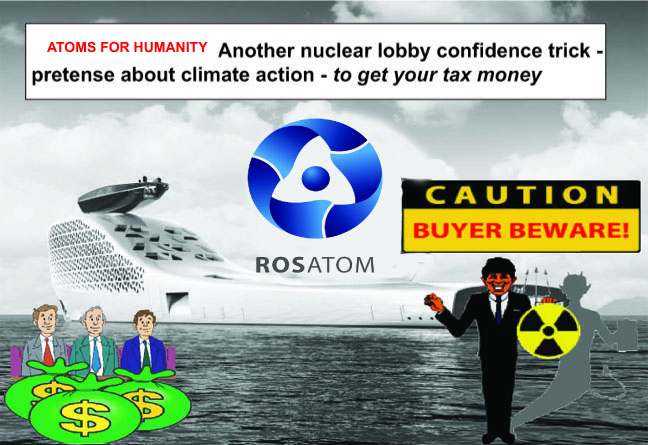
Thousands Join Launch Of Rosatom’s Atoms For Humanity Nuclear Awareness Campaign, By India Education Diary Bureau Admin May 3, 2021 Moscow: On April 30, over 3200 people from some 40 countries watched Rosatom’s Atoms for Humanity new nuclear awareness campaign launch event. The project is aimed at demonstrating the importance of nuclear technologies in achieving the UN Sustainable Goals through human-centered stories.
The project launch event Why Humanity Needs Nuclear brought together Polina Lion, Chief Sustainability Officer at Rosatom, Sama Bilbao y León, Director General of the World Nuclear Association, Dr. Maher Aziz, member of the World Energy Council, Ben Heard, founder of the Bright New World and Sergio Orlandi and Head of Central Engineering and Plant Directorate at ITER. Heroes of Atoms for Humanity joined the event to share their experiences participating in the campaign.
The [?] esteemed speakers discussed social, economic and environmental benefits of nuclear technologies and their invaluable contribution to solving the most urgent challenges of today and tomorrow.
Not to be forgotten – the 1957 nuclear explosion in Mayak centre, Russia, that continues to poison the region.

Reporterre 26th April 2021, While the Chernobyl nuclear disaster occurred thirty-five years ago,
another explosion, which occurred in Russia in 1957 in the Mayak military
nuclear center, continues to poison the region. A look back at this
disaster kept secret for more than twenty years.
https://reporterre.net/Trente-ans-avant-Tchernobyl-la-catastrophe-nucleaire-de-Kychtym
1 This Month

of the week – Shut Down Drone Warfare!


Tell the Ukrainian Government to Drop Prosecution of Peace Activist Yurii Sheliazhenko

Petition to revoke the licensing of the Near Surface Nuclear Disposal Facility (NSDF) at Chalk River. https://www.ourcommons.ca/petitions/en/Petition/Details?Petition=e-7247
To see nuclear-related stories in greater depth and intensity – go to https://nuclearinformation.wordpress.com
-
Archives
- April 2026 (57)
- March 2026 (251)
- February 2026 (268)
- January 2026 (308)
- December 2025 (358)
- November 2025 (359)
- October 2025 (376)
- September 2025 (257)
- August 2025 (319)
- July 2025 (230)
- June 2025 (348)
- May 2025 (261)
-
Categories
- 1
- 1 NUCLEAR ISSUES
- business and costs
- climate change
- culture and arts
- ENERGY
- environment
- health
- history
- indigenous issues
- Legal
- marketing of nuclear
- media
- opposition to nuclear
- PERSONAL STORIES
- politics
- politics international
- Religion and ethics
- safety
- secrets,lies and civil liberties
- spinbuster
- technology
- Uranium
- wastes
- weapons and war
- Women
- 2 WORLD
- ACTION
- AFRICA
- Atrocities
- AUSTRALIA
- Christina's notes
- Christina's themes
- culture and arts
- Events
- Fuk 2022
- Fuk 2023
- Fukushima 2017
- Fukushima 2018
- fukushima 2019
- Fukushima 2020
- Fukushima 2021
- general
- global warming
- Humour (God we need it)
- Nuclear
- RARE EARTHS
- Reference
- resources – print
- Resources -audiovicual
- Weekly Newsletter
- World
- World Nuclear
- YouTube
-
RSS
Entries RSS
Comments RSS
 nuclear-news