Putin touts Russia’s ‘Arctic power’ with new nuclear icebreaker
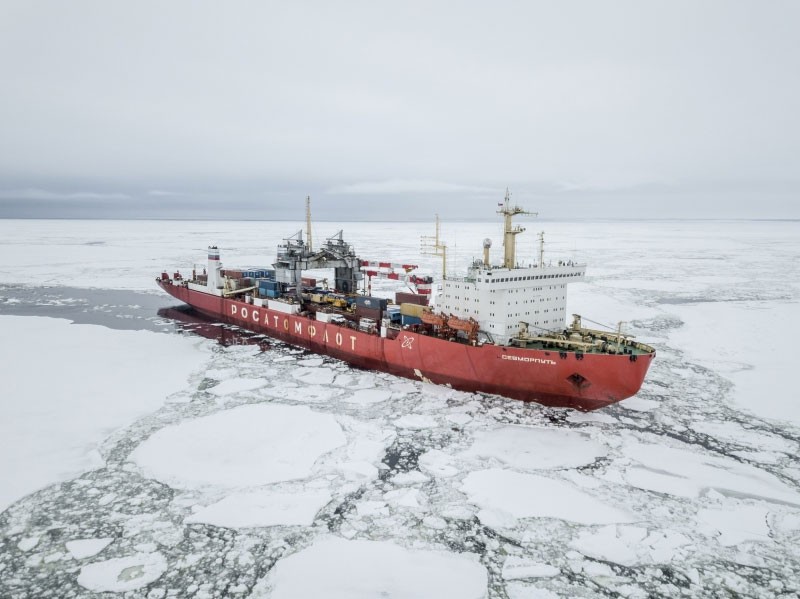
President vows to develop his country’s nuclear fleet despite current difficulties in Russia’s economy and production.
Aljazeera, 22 Nov 22,
President Vladimir Putin on Tuesday touted Russia’s Arctic power at a flag-raising ceremony and dock launch for two nuclear-powered icebreakers that will ensure year-round navigation in the Western Arctic.
Presiding via video link from the Kremlin at the launch ceremony in St Petersburg in northern Russia, Putin said such icebreakers were of strategic importance for the country.
“Both icebreakers were laid down as part of a large serial project and are part of our large-scale, systematic work to re-equip and replenish the domestic icebreaker fleet, to strengthen Russia’s status as a great Arctic power,” Putin said.
The Arctic is taking on greater strategic significance due to climate change, as a shrinking ice cap opens up new sea lanes.
Vast oil and gas resources lie in Russia’s Arctic regions, including a liquefied natural gas plant on the Yamal Peninsula.
The Kremlin chief pledged to develop his country’s nuclear fleet despite current difficulties in Russia’s economy and production, in an apparent reference to Western sanctions over Moscow’s offensive in Ukraine……………………..
The 173.3-metre (569 feet) Yakutia, with a displacement of up to 33,540 tonnes, can smash through ice of up to three metres. It will enter service in 2024.
Two other icebreakers in the same series, the Arktika and the Sibir, are already in service, and another, the Chukotka, is scheduled for 2026.
Putin said a super-powerful nuclear 209-metre icebreaker known as “Rossiya”, with a displacement of up to 71,380 tonnes, would be completed by 2027. It will be able to break through ice four metres thick………………………………….. more https://www.aljazeera.com/news/2022/11/22/putin-touts-russias-arctic-power-with-new-nuclear-icebreaker
Putin’s nuclear grip on Europe could spark another energy crisis, expert warns
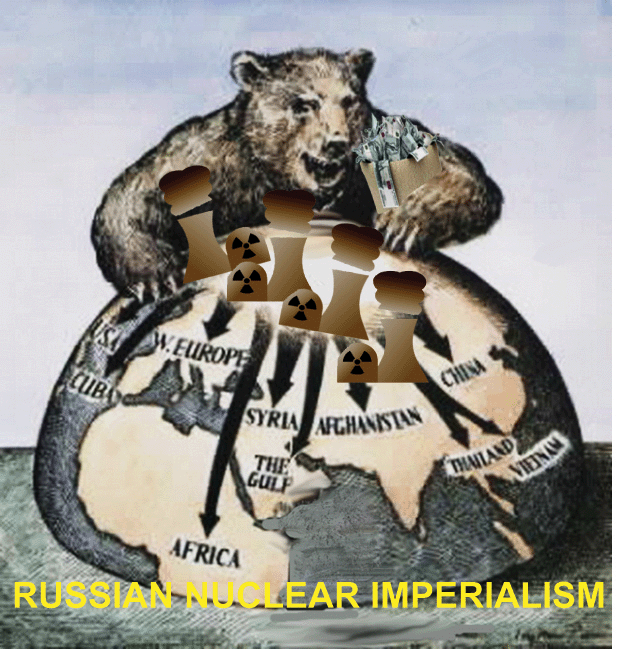
Russian President Vladimir Putin controls about 42 percent of the world’s nuclear fuel, and may be able to send electricity prices soaring if he withholds supplies.
https://www.express.co.uk/news/science/1698529/putin-nuclear-power-energy-uranium-gas-prices By JACOB PAUL, Nov 20, 2022, As global gas prices have been sent to record highs over the last year due to Russian President Vladimir Putin’s war in Ukraine and his supply cuts to Europe, nations across the continent have been scrambling to wean themselves off Russian fossil fuels to weaken Moscow’s tight grip on the energy market. But an expert has told Expess.co.uk that countries which have hedged bets on nuclear power as a means of gaining energy independence may not actually be able to escape Putin’s clutches as the Kremlin has dominance over nuclear fuel supplies, which could potentially trigger another price crisis.
While policymakers across Europe have argued that nuclear power stations can boost homegrown supplies of energy, they have failed to mention these plants require uranium to fuel them.
This is the crux of the issue as Russia, and Russia-controlled Kazakhstan currently supplies 42 percent of all uranium for all reactors worldwide. And when compared with the gas crisis, the statistics look eerily similar.
The EU for instance, got around 40 percent of its gas from Russia before Putin sent his troops into Ukraine. And when he withheld supplies to Europe, prices in Britain shot up too, despite the UK only getting four percent of its gas from Russia. This is due to the integrated nature of the gas market.
With the EU relying on Russia for 20 percent of its uranium needed to fuel supplies if Russia decided to curtail uranium deliveries to the bloc, it may spark the same problem and trigger another energy crisis.
Prof Paul Dorfman, an Associate Fellow from the Science Policy Research Unit (SPRU) at the University of Sussex told Express.co.uk: “The argument goes that nuclear provides a security of supply. In other words, ‘you don’t need to worry about Putin’s gas or the Middle East’s oil’. But this point of view is hugely problematic.
“There is no question that the whole business about the Russian invasion of Ukraine has turned the nuclear industry on its head. This whole idea of security of supply, that nuclear won’t leave us dependent on foreign problems is false.
“Putin, Russia and Russia-controlled Kazakhstan supply 42 percent of all uranium of all reactors worldwide. 20 percent for the EU, 14 percent of the US and nearly 30 percent of their enrichment services.
“The UK is different. We get our uranium from Australia and Canada and we don’t rely on Russia so we are ok.”
However, while nuclear fuel may not run short in the event of a supply cut from Russia, Prof Dorfman warned, it could send the cost of electricity in Britain soaring too.
Asked if the nuclear market was similar to the gas market in this regard, Prof Dorfman told Express.co.uk: “In my view, it certainly would have a significant impact on UK electricity prices because we live in a market world. Absolutely, yes.”
This could be a concern for the UK, given that Britain is planning to dramatically expand its number of nuclear power plants, a desire unveiled in the April energy strategy under former Prime Minister Boris Johnson.
It included the plan to set up new government body, Great British Nuclear, and a £120milion Future Nuclear Enabling Fund in a bid to build eight new reactors across the UK. Mr Johnson said: “We’re setting out bold plans to scale up and accelerate affordable, clean and secure energy made in Britain, for Britain – from new nuclear to offshore wind – in the decade ahead.
“This will reduce our dependence on power sources exposed to volatile international prices we cannot control, so we can enjoy greater energy self-sufficiency with cheaper bills.”
While it is recognised that renewable energies like wind and solar power are cheaper than other sources like oil and gas, Mr Johnson appeared to fail to take into account Putin’s grip on the global nuclear market and the prospect of sending electricity bills soaring in the UK.
Poland missile incident is step towards World War III – Medvedev
Rt.com 16 Nov 22A hybrid war waged by the West against Russia could lead to disastrous consequences, the former Russian leader warns.
Former Russian president Dmitry Medvedev has warned that incidents like the missile explosion which killed two people in Poland risk prompting a major global conflict.
The incident “proves just one thing: waging a hybrid war against Russia, the West moves closer to the World War”, the ex-president, who is now the deputy chair of Russia’s Security Council, wrote on Twitter on Wednesday. He also put the words “missile strike” in quotation marks…………………………………..
Ukrainian President Vladimir Zelensky was quick to blame Russia for the incident late on Tuesday, urging NATO, of which Poland is a member, to act against this “attack on collective security.” Despite not being backed by any proof, the claims were picked by the media in Poland and by some of the country’s officials.
Warsaw put its military on alert, and said it was discussing whether to invoke NATO’s Article 4, which would require consultations on the situation with the other 29 member states and a consensus decision on how to proceed.
However, US President Joe Biden said soon afterwards: “it is unlikely, in the minds of the trajectory, that it [the missile] was fired from Russia.” The Associated Press also cited three US officials as saying preliminary data suggested the missile was actually Ukrainian, fired by the country’s air defenses amid a large-scale Russian attack on Ukraine’s energy infrastructure.
Russia’s Defense Ministry has insisted that it did not carry out any strikes near the Ukrainian-Polish border on Tuesday. It later clarified that analysis of photos from the site showed that the debris were from a missile for the S-300 air defense system operated by Ukraine’s military. https://www.rt.com/russia/566619-poland-missile-ukraine-medvedev/
Russia and US hold secret talks in Ankara – Kommersant
https://www.rt.com/russia/566501-russia-us-secret-talks/ 14 Nov 22, Moscow is reportedly represented by the country’s top spy at the negotiations.
A leading Moscow newspaper claimed, on Monday, that secret US-Russian talks are being hosted by Türkiye. Kommersant, a privately owned title which is known to have good sources in Moscow, reported, citing anonymous sources, that the un-announced meeting was taking place in Ankara.
The outlet alleged that Russia had sent Sergey Naryshkin, director of the Foreign Intelligence Service (SVR) to the talks.
Kremlin spokesperson Dmitry Peskov later confirmed to Russian media that bilateral talks had taken place in Ankara, adding that they were held at the initiative of the US.
CNN claimed that CIA Director Bill Burns had represented Washington at the gathering, citing a “National Security Council spokesperson.”
Earlier this month, Western media reported that top Russian and US officials were engaging in undeclared contacts. According to the Wall Street Journal, US national-security adviser Jake Sullivan has been engaged with Yury Ushakov, a senior foreign policy aide to President Vladimir Putin, and with Nikolay Patrushev, Sullivan’s counterpart in the Russian government.
The White House did not deny the talks, with spokesperson Karine Jean-Pierre telling journalists that the contacts focused on “risk reduction.” Meanwhile, Peskov told the WSJ at the time that the British and American press tended to print “hoaxes.”
Türkiye emerged as a principal mediator during the Ukraine crisis. In late March, it hosted Russia-Ukraine talks, during which the two parties made significant progress towards settling on a peace agreement.
The negotiations were reportedly torpedoed by the UK, when then-Prime Minister Boris Johnson traveled to Kiev in April. According to Ukrainian media, he told President Vladimir Zelensky that Western nations would not support the proposed security pact that was discussed with Russia.
Ankara also helped the UN to launch the Black Sea Initiative, an arrangement that allows Ukraine to export its grain via commercial ships. The agreement, which was signed in July, expires on Friday. Moscow has repeatedly stated that it may not agree to a renewal, unless the UN delivers on its promise to facilitate Moscow’s export of Russian grain and fertilizers, which was part of the deal.
Russia maintains its grip on global nuclear energy landscape
Increasing use of atomic power would not necessarily free economies from Moscow’s
influence. Faced with a global energy crisis and a race to slash emissions,
advanced economies are starting to reconsider nuclear power after a period
of declining investment. The incentive is all the greater among European
countries, which are urgently seeking to move away from Russian fossil
fuels to starve the Kremlin of funds for its assault on Ukraine.
But an atomic shift does not necessarily free a country from energy dependence on
Russia, given the scale of the country’s presence in the nuclear sector.
There were 437 operational reactors around the world as of 2021 excluding
those suspended, according to the International Atomic Energy Agency. About
10 per cent or 42 reactors outside of Russia were using Soviet-designed
VVER technology, with others using designs from countries including the US,
Canada, Germany and France.
Ukraine has by far the largest number of VVER
fleets outside Russia, with all 15 of its operating reactors using the
technology, with the Czech Republic next on six. Similarly, of the 52
reactors currently being built around the world excluding Russia, 21 use
VVER. China, India and Turkey have the largest number with 4 each, with
countries like Bangladesh, Egypt and Iran also taking in Russian
technology.
The prevalence of Russian-designed reactors currently being
built is in part a matter of timing, according to Jonathan Cobb, analyst at
the World Nuclear Association, who said “the Russian reactor programme
itself was very active” over the past decade when many of the contracts
for these projects were signed.
Russia was also the seventh-largest
producer of uranium in 2021. State-owned Rosatom accounts for about 40 per
cent of the world’s uranium enrichment capacity, making it a crucial
supplier as most nuclear power stations use enriched fuel.
FT 13th Nov 2022
https://www.ft.com/content/ffe76530-8fcb-45c3-aade-dc307af9c82f
On Nuclear Treaty, at Least, Biden Aims for Fresh START With Russia
Washington and Moscow look set to keep New START alive with working-level talks, despite historic tensions.
Foreign Policy, By Robbie Gramer, a diplomacy and national security reporter at Foreign Policy. 11 Nov 22
The Biden administration has announced that it will restart nuclear arms control talks with Russia, even as tensions spike over the latter’s war in Ukraine, coupled with the threat of Moscow using nuclear weapons.
The talks are expected to take place in Cairo in the near future, current and former U.S. officials said, and represent the first move by both sides to revive their mutual arms control agenda since U.S. President Joe Biden first halted dialogue after Russia launched its invasion of Ukraine in February…………………………………
The existing arms reduction treaty, New START, caps the number of intercontinental-range nuclear weapons in both Washington’s and Moscow’s arsenals and allows each side to conduct on-site weapons facility inspections in the other country. This allows experts from each country to visit the other country’s weapons sites to view the number of nuclear weapons, launch vehicles, and other details to confirm that both sides are adhering to the treaty. The treaty allows up to 18 on-site inspections per year.
It is the last remaining arms control treaty in place between Russia and the United States, which respectively have the first- and second-largest nuclear arsenals in the world. Under the terms of the treaty, which was first signed in 2010, both countries agreed to cap the number of nuclear warheads they could deploy on delivery systems to 1,550…………………..
Reviving the New START talks has been a quiet goal of the White House and State Department since at least this summer, according to current and former U.S. officials familiar with the matter, and scheduling a new meeting with the Russians on the issue has been in the works for months. Rose Gottemoeller, a former NATO deputy secretary-general and top U.S. arms control envoy who helped negotiate New START in 2009-10, welcomed the move and said the latest nuclear discussions shouldn’t be seen as any sort of concession to Russia.
“We don’t always get to choose with whom we negotiate, but if we’ve got an issue that’s in our national security interest, we have to work it,” said Gottemoeller, now a scholar at Stanford University. “We’ve achieved agreements with the Russians during some very dark hours in our bilateral relationship in the past.” …………….. https://foreignpolicy.com/2022/11/10/nuclear-talks-russia-us-biden-putin-new-start-treaty/
Russia, U.S. Eye Nuclear Arms Reduction Talks in Coming Weeks – Kommersant
https://www.themoscowtimes.com/2022/11/08/russia-us-eye-nuclear-arms-reduction-talks-in-coming-weeks-kommersant-a79313 9 Nov 22, Russia and the United States are discussing resuming nuclear arms reduction negotiations in the coming weeks in the first face-to-face contact since Russian forces invaded Ukraine, the Kommersant business daily reported Tuesday, citing three unnamed sources.
The Strategic Arms Reduction Treaty (New START) talks could take place in an unnamed Middle Eastern country, instead of their traditional venue of Geneva, in late November or early December, Kommersant reported.
The report follows weeks of concern over a possible Russian nuclear escalation in Ukraine fueled by President Vladimir Putin’s thinly veiled threats. Moscow later tamped down its rhetoric following reported talks with U.S. officials.
The last remaining arms reduction pact between the Cold War foes, New START is one of the few areas where Moscow and Washington have said they were open to cooperation despite tensions over the invasion of Ukraine and Western sanctions.
According to Kommersant, Washington is expected to raise the resumption of on-site inspections under New START.
Moscow formally suspended physical inspections by the U.S. in August 2022 after President Joe Biden called on Russia and China to demonstrate their commitment to limiting nuclear weapons.
Russia’s Foreign Ministry indicated at the time that Western sanctions, visa restrictions and airspace closures over the war in Ukraine made it difficult for Moscow to carry out inspections on U.S. soil.
According to Kommersant, Russia and the U.S. have continued to hold remote discussions on New START in lieu of in-person talks.
At one of these remote talks last month, Kommersant reported that Moscow accused Washington of skirting the treaty’s terms by withholding weapons and sites that Russia suspects are still nuclear-capable despite their announced conversions and reclassifications.
Moscow and Washington last year extended New START, which caps the number of deployable nuclear warheads at 1,550, until Feb. 5, 2026.
Russia suspends participation in grain deal after Ukrainian attack
The decision was made following a Ukrainian assault on Moscow’s Black Sea fleet. Rt.com 28 Oct 22
Russia announced on Saturday that it has halted its compliance with a grain deal, brokered by the UN and Türkiye earlier his year. The move came after Ukraine launched a major drone attack on ships involved in securing safe passage for agricultural cargo, the Russian Defense Ministry explained.
In a post on its Telegram channel, the ministry said Russia “is suspending its participation in the implementation of agreements on the export of agricultural products from Ukrainian ports”.
It explained that the move was prompted by “a terror attack” against the ships of the Black Sea Fleet and civilian vessels involved in ensuring the security of the grain corridor. The ministry also alleged that the bombing was organized with the involvement of British military………………………………..
Earlier on Saturday, Russia’s Agriculture Minister Dmitry Patrushev signaled that Moscow is ready, with Türkiye’s help, to send the world’s poorest countries up to 500,000 tons of grain within the next four next months.
He noted that considering this year’s harvest, Russia “is fully ready to replace Ukrainian grain” and arrange deliveries to “all interested countries” at a reasonable price.
……………………… following the blast on the strategic Crimean Bridge, Russian President Vladimir Putin said that if turns out that Ukraine – the country that Moscow accused of carrying out the attack – used grain corridors to transport explosives, “it would put the very existence of these corridors in question”.
The breakthrough deal between Moscow and Kiev was reached in Istanbul in July with mediation by the UN and Türkiye. It aimed to unlock agricultural exports via the Black Sea from Russia and Ukraine – two of the world’s leading grain exporters – which had ground to halt due to the conflict between the two nations. https://www.rt.com/russia/565588-russia-suspends-grain-deal/
Kremlin reveals possible basis for Putin-Biden talks
https://www.rt.com/news/565611-russia-talks-biden-putin/ 28 Oct 22, Russia’s proposals on security guarantees could serve as a springboard for re-engagement, Dmitry Peskov says
Potential talks between Russian President Vladimir Putin and his US counterpart Joe Biden would depend on Washington’s willingness to hear Moscow’s security concerns, the Kremlin press secretary said on Sunday.
Speaking to the Rossiya-1 TV channel, Dmitry Peskov said high-level re-engagement could happen if the United States “pays heed to our concerns.”
It would be contingent on “the US desire to go back to the state of things as of December-January and ask the question: what the Russians are offering may not suit all of us, but maybe we should still sit down with them at the negotiating table?”
The spokesman explained that he was referring to the draft documents on security guarantees that Moscow submitted to both Brussels and Washington before the Ukraine conflict broke out in late February.
In mid-December last year, the Russian Foreign Ministry published the drafts of two treaties – one with the US and one with NATO – with a list of Moscow’s security demands, in a bid to lower tensions in Europe.
At the time, Russia wanted the West to ban Ukraine from entering NATO and limit the deployment of troops and weapons on the bloc’s eastern flank. It also insisted that the military alliance retreat to its borders as of 1997, before it expanded eastwards.
While neither the US nor NATO gave written responses to Russia’s proposals, they both rebuffed Moscow’s demand that Ukraine should be barred from the bloc.
Earlier this month, Putin said he saw no need for talks with his US counterpart, explaining that “there is no platform for any negotiations yet.” The statement was echoed by the White House, which stated that Joe Biden does not plan to meet with the Russian leader at the G20 summit next month, despite earlier refusing to rule out the possibility.
The last time the two leaders met in person was in June 2021 in Geneva, Switzerland. The talks were followed up by a virtual summit in December, with Ukraine being one of the topics on the agenda.
‘No need’ for nuclear strikes on Ukraine, Putin says
9 News, By Associated Press Oct 28, 22
Russian President Vladimir Putin has denied having any intentions of using nuclear weapons in Ukraine but described the conflict there as part of alleged efforts by the West to secure its global domination, which he insisted were doomed to fail.
Speaking at a conference of international foreign policy experts, Putin said it’s pointless for Russia to strike Ukraine with nuclear weapons.
“We see no need for that,” Putin said.
“There is no point in that, neither political, nor military.”
Putin said an earlier warning of his readiness to use “all means available to protect Russia” didn’t amount to nuclear sabre-rattling but was merely a response to Western statements about their possible use of nuclear weapons.
He particularly mentioned Liz Truss saying in August that she would be ready to use nuclear weapons if she became Britain’s prime minister, a remark which he said worried the Kremlin.
“What were we supposed to think?” Putin said.
“We saw that as a coordinated position, an attempt to blackmail us.”……………………………………………….
US Defence Secretary Lloyd Austin told reporters today that the US has still not seen anything to indicate that Putin has decided to use a dirty bomb……………………………………………………. more https://www.9news.com.au/world/russia-ukraine-vladimir-putin-says-kremlin-not-intending-to-use-nuclear-weapons/7ab0234c-cadb-41f9-b8c2-05305c1eb464
Russian delegation at UN calls on USA to join initiative to renounce weapons in space
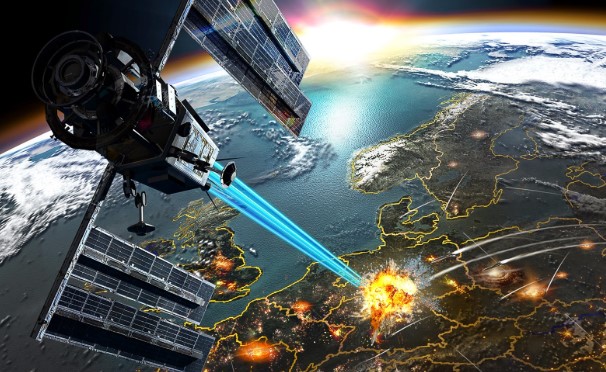
Foreign Ministry Spokeswoman Maria Zakharova’s comment on the US initiative in the UN General Assembly First Committee
The other day, the US delegation submitted to the UN General Assembly First Committee an aide-memoire on proposed UN General Assembly resolution on destructive direct-ascent anti-satellite missile testing. We analysed the text to discover that our apprehensions concerning this US initiative were valid.
As before, we regard the moratorium on testing the above type of anti-satellite weapon (ASW) announced by the White House in April as a purely declarative move. The UN General Assembly statements and draft resolutions are clearly not enough to prevent an arms race in space (PARIS), all the more so for a country that has had experience – at least since 2008 – destroying space objects with ASW.
The United States remains bashfully silent about the most important thing: are they willing to permanently rule out the combat use of this type of weapon? The resolution says nothing about it. There are no commitments regarding the development and production of such systems, or the prospect of ever destroying the Pentagon’s existing anti-satellite capabilities.
Moreover, the possibility of deploying ASW means on the US reusable unmanned space shuttle X-37B, which is capable of staying in orbit for a long time, performing manoeuvres and carrying a payload, cannot be ruled out. By the way, our multiple requests to the United States to clarify the X-37B platform’s goals and objectives have so far remained unanswered.
Military dominance and superiority in outer space being set as clear goals in US doctrinal documents, their view of space as an arena of confrontation and their plans for achieving these goals are quite telling if one wants to understand Washington’s genuine motives. It is no coincidence that the US delegation at the Geneva Conference on Disarmament is doing its utmost to hinder the start of talks on a multilateral instrument which contains reliable international legal guarantees against deploying weapons of any kind in outer space and the renunciation of the use of force or the threat of force against space objects. The Americans are using every pretext to avoid working on the Russian-Chinese draft treaty designed to fulfill PARIS goals………………….
Washington can prove it has serious intentions if it revises its destructive stance and the US delegation that is participating in the Conference on Disarmament joins the efforts to start talks as soon as possible on a legally binding instrument with guarantees of non-deployment of weapons in space, non-use of force or threat of force against space objects.
Specifically, the approach promoted by Russia involves the following commitments:
– not to use space objects as a means of destroying any targets on Earth, in the air or outer space;
– not to create, test or deploy weapons in space to perform any tasks, including for anti-missile defence, anti-satellite activity, or use against targets on Earth or in the air, and to eliminate such systems that the states already possess;
– not to create, test, deploy or use space weapons for anti-missile defence, anti-satellite activity, or use against targets on Earth or in the air;
– not to destroy, damage, or disrupt the normal functioning and not to change the flight paths of space objects owned by other states;
– not to assist or encourage other states, groups of states, international, intergovernmental, or any non-governmental organisations, including non-governmental legal entities that were established, registered or located on the territory under their jurisdiction and/or control, to participate in the above activities.
In addition, the accession of the United States and its allies to the international initiative/political commitment not to be the first to place weapons of any kind in outer space would be a really important confidence-building measure. We are once again calling on Washington to follow the example of more than 30 UN member states and join this initiative, as well as to support the UNGA draft resolution on that matter.
We are ready to substantively and professionally discuss the US initiative in this context of multilateral efforts to arrive at a comprehensive solution to PARIS issues. https://mid.ru/en/foreign_policy/news/1835061/
Russia is funding its war on Ukraine by selling $billions of uranium to Europe’s nuclear industry- no sanctions on that!
The Russian nuclear industry has once again managed to avoid inclusion in the latest round of EU sanctions – the eighth in a row to skirt this vital issue in an apparent acknowledgment that Europe’s dependence on Russian nuclear fuel cannot easily be reversed.
Since the start of the war in February, the media has been so focused on Russian fossil fuels, particularly natural gas, that it has avoided any discussion of Europe’s nuclear dependence on Russia completely. However, the topic can no longer be safely ignored. The Kremlin has already earned several hundred billion dollars so far this year by selling fossil fuels to Europe, a financial cushion that has allowed Moscow to fund its horrific war in Ukraine.
While Europe is less reliant on Russia supplying its atomic energy sector than it is its fossil fuel sector, the dependence of the European atomic energy industry on Russian nuclear fuel is as surprising as it is alarming. Much work has gone into weaning Europe off Russian fossil fuels, with time being of the essence as Brussels seeks to curtail Moscow’s lucrative revenue streams as quickly and as comprehensively as possible. However, its nuclear industry has not yet been the focus of any such efforts.
Moscow Times 22nd Oct 2022
https://www.themoscowtimes.com/2022/10/22/europe-should-sanction-russias-nuclear-industry-now-a79089
Kremlin diplomat assures that Russia has no intention of using nuclear weapons in Ukraine
https://euroweeklynews.com/2022/10/25/kremlin-diplomat-assures-that-russia-has-no-intention-of-using-nuclear-weapons-in-ukraine/ By Chris King • 25 October 2022,
Russia has no intention of using nuclear weapons in Ukraine claimed Kremlin diplomat Vasily Nebenzya in a letter to the UN Secretary-General.
As reported by TASS on Monday, October 24, in a letter from Vasily Nebenzya from the Permanent Mission of the Russian Federation to the UN Secretary-General Antonio Guterres, he stated that Russia never intended to, and never will, use nuclear weapons in Ukraine.
Konstantin Vorontsov, the Deputy Director of the Department for Non-Proliferation and Arms Control of the Russian Foreign Ministry, noted earlier that Russia has not threatened and is not threatening Ukraine with nuclear weapons.
This was reiterated by Dmitry Peskov, the press secretary of the Russian president, Vladimir Putin, who stressed that the Russian Federation does not participate in Western rhetoric about the use of nuclear weapons in Ukraine. These arguments are only on the conscience of American and European leaders he added.
Prior to this, Mikhail Podolyak, the adviser to the head of the office of the President of Ukraine stated that the likelihood of a nuclear conflict with the Russian Federation at the moment is minimal. He recalled that Russia signed the Treaty on the Non-Proliferation of Nuclear Weapons. That is, it is forbidden to use nuclear weapons against a state that does not have them.
In turn, the head of European diplomacy, Josep Borrell, said that an attack against Ukraine with nuclear weapons would provoke a powerful military response from NATO, the European Union, and the United States, as reported by gazeta.ru.
Russia says U.S. blocked its participation in nuclear conference
MOSCOW, Oct 21 (Reuters) – The Russian state nuclear corporation Rosatom said on Friday that the United States had effectively blocked Russia’s participation in a nuclear energy conference in Washington by failing to issue entry visas.
Relations between the United States and Russia have sunk to their lowest level since the depths of the Cold War after Moscow sent its armed forces troops into Ukraine in February.
Rosatom and Russia’s industrial safety watchdog, Rostekhnadzor, planned to attend the International Atomic Energy Agency’s (IAEA) ministerial conference in Washington on Oct. 26-28 but have yet to receive visas, Rosatom said in a statement………………………………. more https://www.reuters.com/business/energy/russia-says-us-blocked-its-participation-nuclear-conference-2022-10-21/
Terror on Crimea Bridge and Russia unleashing shock’n awe.
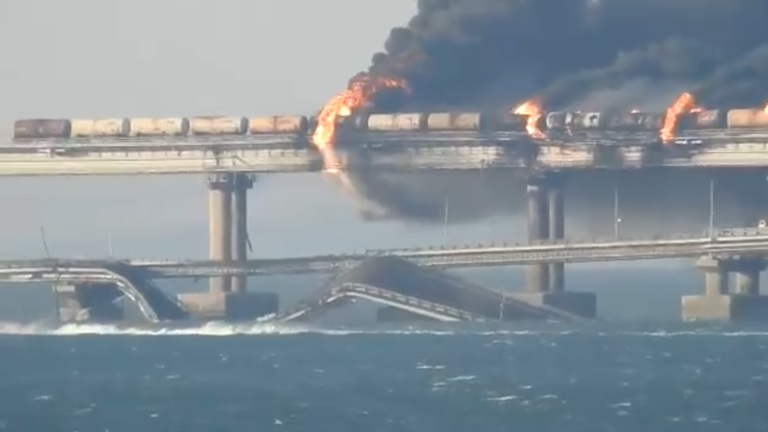
Pearls and Irritations, By P&I Guest Writers, Oct 18, 2022
The terror attack on Krymskiy Most – the Crimea Bridge – was the proverbial straw that broke the Eurasian camel’s back.
Russian President Vladimir Putin neatly summarised it: “This is a terrorist attack aimed at destroying the critical civilian infrastructure of the Russian Federation.”
The head of the Russian Investigative Committee, Alexander Bastrykin, confirmed face-to-face with Putin that Terror on the Bridge was carried out by the SBU – Ukrainian special services.
Bastrykin told Putin, “we have already established the route of the truck, where the explosion took place. Bulgaria, Georgia, Armenia, North Ossetia, Krasnodar… The carriers have been identified. With the help of operatives of the FSB, we managed to identify suspects.”
Russian intel leaked crucial info to military correspondent Alexander Kots. The cargo was ordered by a Ukrainian citizen: explosives packed in 22 pallets, in rolls of film under plastic wrap, were shipped from Bulgaria to the Georgian port of Poti. Afterwards, the cargo was loaded onto a truck with foreign license plates and proceeded overland to Armenia………………………………………………………………
The driver of the first truck is already testifying. Yusubov, the driver of the second truck – which exploded on the bridge – was “blind:” he had no idea what he was carrying, and is dead.
At this stage, two conclusions are paramount.
First: This was not a standard ISIS-style truck suicide bombing – the preferred interpretation in the aftermath of the terror attack.
Second: The packaging most certainly took place in Bulgaria. That, as Russian intel has cryptically implied, indicates the involvement of “foreign special services.”
‘A mirage of cause and effect’
What has been revealed in public by Russian intelligence tells only part of the story. An incandescent assessment received by The Cradle from another Russian intel source is way more intriguing.
At least 450 kg of explosives were employed in the blast. Not on the truck, but mounted inside the Crimea Bridge span itself. The white truck was just a decoy by the terrorists “to create a mirage of cause and effect.” When the truck reached the point on the bridge where the explosives were mounted, the explosion took place.
According to the source, railroad employees told investigators that there was a form of electronic hijacking; the terror operators took control of the railway so the train carrying fuel received a command to stop because of a false signal that the road ahead was busy.
Bombs mounted on the bridge spans were a working hypothesis largely debated in Russian military channels over the weekend, as well as the use of underwater drones.
In the end, the quite sophisticated plan could not follow the necessarily rigid timing. There was no alignment by the millimeter between the mounted explosive charges, the passing truck and the fuel train stopped in its tracks. Damage was limited, and easily contained. The charges/truck combo exploded on the outer right lane of the road. Damage was only on two sections of the outer lane, and not much on the railway bridge.
In the end, Terror on the Bridge yielded a short, Pyrrhic PR victory – duly celebrated across the collective West – with negligible practical success: transfer of Russian military cargo by railway resumed in roughly 14 hours.
And that brings us to the key information in the Russian intel source assessment: the whodunnit.
It was a plan by the British MI6, says this source, without offering further details. Which, he elaborates, Russian intel, for a number of reasons, is shadow-playing as “foreign special services.”
It’s quite telling that the Americans rushed to establish plausible deniability. The proverbial “Ukrainian government official” told CIA mouthpiece The Washington Post that the SBU did it. That was a straight confirmation of an Ukrainska Pravda report based on an “unidentified law enforcement official.”
The perfect red line trifecta
Already, over the weekend, it was clear the ultimate red line had been crossed. Russian public opinion and media were furious. For all its status as an engineering marvel, Krymsky Most represents not only critical infrastructure; it is the visual symbol of the return of Crimea to Russia.
Moreover, this was a personal terror attack on Putin and the whole Russian security apparatus.
So we had, in sequence, Ukrainian terrorists blowing up Darya Dugina’s car in a Moscow suburb (they admitted it); US/UK special forces (partially) blowing Nord Stream and Nord Stream 2 (they admitted and then retracted); and the terror attack on Krymsky Most (once again: admitted then retracted).
Not to mention the shelling of Russian villages in Belgorod, NATO supplying long-range weapons to Kiev, and the routine execution of Russian soldiers.
Darya Dugina, Nord Streams and Crimea Bridge make it an Act of War trifecta. So this time the response was inevitable – not even waiting for the first meeting since February of the Russian Security Council scheduled for the afternoon of 10 October.
Moscow launched the first wave of a Russian Shock’n Awe without even changing the status of the Special Military Operation (SMO) to Counter-Terrorist Operation (CTO), with all its serious military/legal implications.
After all, even before the UN Security Council meeting, Russian public opinion was massively behind taking the gloves off. Putin had not even scheduled bilateral meetings with any of the members. Diplomatic sources hint that the decision to let the hammer come down had already been taken over the weekend.
Shock’n Awe did not wait for the announcement of an ultimatum to Ukraine (that may come in a few days); an official declaration of war (not necessary); or even announcing which ‘”decision-making centers” in Ukraine would be hit.
The lightning strike de facto metastasising of SMO into CTO means that the regime in Kiev and those supporting it are now considered as legitimate targets, just like ISIS and Jabhat al-Nusra during the Anti-Terror Operation (ATO) in Syria.
And the change of status – now this is a real war on terror – means that terminating all strands of terrorism, physical, cultural, ideological, are the absolute priority, and not the safety of Ukrainian civilians. During the SMO, safety of civilians was paramount. Even the UN has been forced to admit that in over seven months of SMO the number of civilian casualties in Ukraine has been relatively low.
Enter ‘Commander Armageddon’
The face of Russian Shock’n Awe is Russian Commander of the Aerospace Forces, Army General Sergey Surovikin: the new commander-in-chief of the now totally centralised SMO/CTO………………………………..
Surovikin is Dr. Shock’n Awe with full carte blanche. That even rendered idle speculations that Defense Minister Sergei Shoigu and Chief of the General Staff Valery Gerasimov were removed or forced to resign, as speculated by the Wagner group Telegram channel Grey Zone.
It is still possible that Shoigu – widely criticised for recent Russian military setbacks – could be eventually replaced by Tula Governor Alexei Dyumin, and Gerasimov by the Deputy Commander-in-Chief of the Ground Forces, Lieutenant General Alexander Matovnikov.
That’s almost irrevelant: all eyes are on Surovikin.
MI6 does have some well-placed moles in Moscow, relatively speaking. The Brits had warned Ukrainian President Volodymyr Zelensky and the General Staff that the Russians would be launching a “warning strike” this Monday.
What happened was no “warning strike,” but a massive offensive of over 100 cruise missiles launched “from the air, sea and land,” as Putin noted, against Ukrainian “energy, military command and communications facilities.”
MI6 also noted “the next step” will be the complete destruction of Ukraine’s energy infrastructure. That’s not a “next step:” it’s already happening. Power supply is completely gone in five regions, including Lviv and Kharkov, and there are serious interruptions in other five, including Kiev.
Over 60 percent of Ukrainian power grids are already knocked out. Over 75 percent of internet traffic is gone. Elon Musk’s Starlink netcentric warfare has been “disconnected” by the Ministry of Defence.
Shock’n Awe will likely progress in three stages.
First: Overload of the Ukrainian air defence system (already on).
Second: Plunging Ukraine into the Dark Ages (already in progress).
Third: Destruction of all major military installations (the next wave).
Ukraine is about to embrace nearly total darkness in the next few days. Politically, that opens a completely new ball game. Considering Moscow’s trademark “strategic ambiguity,” this could be a sort of Desert Storm remixed (massive air strikes preparing a ground offensive); or, more likely, an ‘incentive’ to force NATO to negotiate; or just a relentless, systematic missile offensive mixed with Electronic Warfare (EW) to shatter for good Kiev’s capacity to wage war.
Or it could be all of the above.
How a humiliated western Empire can possibly raise the stakes now, short of going nuclear, remains a key question. Moscow has shown admirable restraint for too long. No one should ever forget that in the real Great Game – how to coordinate the emergence of the multipolar world – Ukraine is just a mere sideshow. But now the sideshow runners better run for cover, because General Armageddon is on the loose.
Pepe Escobar is a columnist at The Cradle, editor-at-large at Asia Times and an independent geopolitical analyst focused on Eurasia. Since the mid-1980s he has lived and worked as a foreign correspondent in London, Paris, Milan, Los Angeles, Singapore and Bangkok. He is the author of countless books; his latest one is Raging Twenties.
1 This Month

of the week – Shut Down Drone Warfare!


Tell the Ukrainian Government to Drop Prosecution of Peace Activist Yurii Sheliazhenko

Petition to revoke the licensing of the Near Surface Nuclear Disposal Facility (NSDF) at Chalk River. https://www.ourcommons.ca/petitions/en/Petition/Details?Petition=e-7247
To see nuclear-related stories in greater depth and intensity – go to https://nuclearinformation.wordpress.com
-
Archives
- April 2026 (57)
- March 2026 (251)
- February 2026 (268)
- January 2026 (308)
- December 2025 (358)
- November 2025 (359)
- October 2025 (376)
- September 2025 (257)
- August 2025 (319)
- July 2025 (230)
- June 2025 (348)
- May 2025 (261)
-
Categories
- 1
- 1 NUCLEAR ISSUES
- business and costs
- climate change
- culture and arts
- ENERGY
- environment
- health
- history
- indigenous issues
- Legal
- marketing of nuclear
- media
- opposition to nuclear
- PERSONAL STORIES
- politics
- politics international
- Religion and ethics
- safety
- secrets,lies and civil liberties
- spinbuster
- technology
- Uranium
- wastes
- weapons and war
- Women
- 2 WORLD
- ACTION
- AFRICA
- Atrocities
- AUSTRALIA
- Christina's notes
- Christina's themes
- culture and arts
- Events
- Fuk 2022
- Fuk 2023
- Fukushima 2017
- Fukushima 2018
- fukushima 2019
- Fukushima 2020
- Fukushima 2021
- general
- global warming
- Humour (God we need it)
- Nuclear
- RARE EARTHS
- Reference
- resources – print
- Resources -audiovicual
- Weekly Newsletter
- World
- World Nuclear
- YouTube
-
RSS
Entries RSS
Comments RSS
 nuclear-news