Return to Russia: Crimeans Tell the Real Story of the 2014 Referendum and Their Lives Since — RADIATION FREE LAKELAND

Originally posted on In Gaza: Crimeans gather with Russian national and Crimea flags in Sevastopol, Crimea, March 14, 2018. Alexander Zemlianichenko | AP Eva Bartlett traveled to Crimea to see firsthand out how Crimeans have fared since 2014 when their country reunited with Russia, and what the referendum was really like. October 9, 2019, Mint…
Return to Russia: Crimeans Tell the Real Story of the 2014 Referendum and Their Lives Since — RADIATION FREE LAKELAND
SIMFEROPOL, CRIMEA — In early August I traveled to Russia for the first time, partly out of interest in seeing some of the vast country with a tourist’s eyes, partly to do some journalism in the region. It also transpired that while in Moscow I was able to interview Maria Zakharova, spokeswoman of the Foreign Ministry.
High on my travel list, however, was to visit Crimea and Donetsk People’s Republic (DPR) — the former a part of Russia, the latter an autonomous republic in the east of Ukraine, neither accurately depicted in Western reporting. Or at least that was my sense looking at independent journalists’ reports and those in Russian media.
Both regions are native Russian-speaking areas; both opted out of Ukraine in 2014. In the case of Crimea, joining Russia (or actually rejoining, as most I spoke to in Crimea phrased it) was something people overwhelmingly supported. In the case of the Donbass region, the turmoil of Ukraine’s Maidan coup in 2014 set things in motion for the people in the region to declare independence and form the Donetsk and Lugansk People’s Republics.
In March 2014, Crimeans held a referendum during which 96 percent of voters chose to join Russia. This has been heavily disputed in Western media, with claims that Crimeans were forced to hold the referendum and claims of Russian troops on the streets “occupying” the peninsula.
Because Western media insisted the referendum was a sham held under duress, and because they bandy about the term “pro-Russian separatists” for the people of the DPR, I decided to go and speak to people in these areas to hear what they actually want and feel.
From the Russian mainland to the Crimean Peninsula………………………………………………………………
In the evening, we stay in the home of Vlad’s friend Tata, a Russian woman who moved to Crimea in 2012.
Since there was so much hype in Western media about a Russian takeover of the peninsula, I ask the burning questions: Were Crimeans forced to take part in the referendum? What was the mood like around that time? Tata replies:
“I never saw so many people in my life go out to vote, of their own free will. There was a period before the referendum, maybe about two months, during which there were two holidays: International Women’s Day, March 8, and Defender of the Fatherland Day, February 23.
……………………………………………………………I never saw tanks, I never saw Russian soldiers. I never saw any of that in the city.”
I ask Tata about how life had changed after the referendum:………………………………….
After the Soviet Union collapsed, it wasn’t the will of the Crimean people to join Ukraine. People were always Russian here; they always identified as Russian. Ukraine understood this well, and put nothing into Crimea, as punishment. Ukraine didn’t build any hospitals, kindergartens or roads.
In the past four years, the Crimean government has built 200 new kindergartens. This is the most obvious example of how things have improved. They also built the new Simferopol airport.
I worked in aviation. It took three years to build an airport of this standard in Yekaterinburg, Russia. It took half a year in Simferopol.”
International Jazz Festival……………………………………………………….
Construction everywhere……………………………………….
I remark on how kind and gentle people are here, as in Russia. Vlad replies:
“It shouldn’t be surprising — people are people anywhere. But Western media conditions us with stereotypes of Russians as cold and hard, vilifying an entire nation.”
The coastal city of Yalta lies further west along the peninsula. The drive there the following day is more beautiful still, the road flanked by mountains to one side, hills cascading down to the Black Sea on the other, endless wineries and, before Yalta itself, the stunning cliff-top castle known as “Swallow’s Nest.”
In the evening, we stay in the home of Vlad’s friend Tata, a Russian woman who moved to Crimea in 2012.
Since there was so much hype in Western media about a Russian takeover of the peninsula, I ask the burning questions: Were Crimeans forced to take part in the referendum? What was the mood like around that time? Tata replies:
“I never saw so many people in my life go out to vote, of their own free will. There was a period before the referendum, maybe about two months, during which there were two holidays: International Women’s Day, March 8, and Defender of the Fatherland Day, February 23.
Normally, people would go away on vacation during these holidays. But that year, Crimeans didn’t go anywhere; they wanted to be sure they were here during the referendum. We felt the sense of a miracle about to happen. People were anxiously awaiting the referendum.
There were military tents in the city, but they were not erected by the military, but by local men. They would stand there every day, and people could come and sign a document calling for a referendum.
I went one day and asked if I could add my name but I couldn’t, because I have a Russian passport. Only Crimean citizens could sign it. This was the fair way to do it.
At that time, my husband was in America. One day, he was watching CNN and got scared and called me because he saw reports of soldiers in the streets, an ‘invasion’ by Russia.
The local navy came from Sevastopol to Yalta and anchored their ships off the coast, made a blockade to ensure no larger Ukrainian or other ships could come and attack.
But I never saw tanks, I never saw Russian soldiers. I never saw any of that in the city.”
I ask Tata about how life had changed after the referendum:
When I came here in December 2012, everything was dilapidated and run down. The nice roads you were driving on, they didn’t exist when we were a part of Ukraine. I didn’t understand why Crimea was still a part of Ukraine. It was Russian land ever since the Tsars, the imperial time of Russia. This is where the Russian soul is, and the soul of the Russian navy.
After the Soviet Union collapsed, it wasn’t the will of the Crimean people to join Ukraine. People were always Russian here; they always identified as Russian. Ukraine understood this well, and put nothing into Crimea, as punishment. Ukraine didn’t build any hospitals, kindergartens or roads.
In the past four years, the Crimean government has built 200 new kindergartens. This is the most obvious example of how things have improved. They also built the new Simferopol airport.
I worked in aviation. It took three years to build an airport of this standard in Yekaterinburg, Russia. It took half a year in Simferopol.”
Finally, after night falls, we drive into the city of Koktebel, where an annual Jazz Festival is starting.
During all these hours of driving, the roads are smooth and well-trafficked, and I don’t see a single Russian military vehicle.
The next day, I walk through Koktebel, taking in the local markets brimming with produce, cheeses, and other goods, and every so often come across a streetside stand laden with fresh fruits. In the late afternoon, I walk along the sea, past packed beaches, and meet with a Crimean woman, Yaroslava, who lives in Austria but every summer returns to her beloved Crimea. She is ardently supportive of the decision to have joined Russia and spends much of her time back in Austria trying to educate people on why Crimeans wanted to be a part of Russia.
These are reasons I hear throughout my travels in Crimea: We wanted to be able to speak our native language [Russian] and be educated in that language; we wanted to be able to practice our cultural traditions; we have always been a part of Russia and we wanted to return.
Yaroslava is busy helping out with the Jazz Festival and wants to use the rest of our short time talking to help me arrange future meetings with people in Crimea. We decided to do a proper interview via Skype in the future when time allows.
I drift on to the Jazz Festival, where a talented pianist and band play beach-side to an enthusiastic crowd. Some songs later, I drift back along the beach, passing numerous musicians busking, and a pulsing nightlife that isn’t going to bed any time soon.
…………………………………As I stand to orient the map route and zoom in to look for any signs of cafes, a woman walks by me and says with a smile something with the word “shto,” which I think means “what.” When I reply in English, she laughs and flags down another woman, Yana, who speaks English well and insists she and her husband drive me.
As we drive, we chat. I ask her about the referendum, mentioning that many in the West have the notion that it was done under duress, with a heavy military presence to influence the vote. She laughs, saying: “There were no troops, no military, around us during the referendum.” She speaks of the joy of Crimeans to vote, says that maybe 98 percent of Sevastopol voters had voted in favor [it was apparently 96 percent, but close enough], and adds, “We are now under the wing of Russia.”
I ask about developments since then. She mentions the improvements in roads, also the modern trolley-buses and regular buses, the opening of kindergartens and schools, and free courses (like music) for children……………………………………..
Ukrainians in Crimea
In Simferopol anew, I meet Anastasiya Gridchina, the Chair of the Ukrainian Community of Crimea, an organization formed in 2015 whose main goals, she tells me, “are to have friendly relations between two great peoples: Ukrainians and Russians — not the politicians but the people. The second goal is to preserve inter-ethnic peace in the Republic between different nationalities.”
Gridchina explains that in Crimea there are more than 175 nationalities, just 20 less than in all of Russia, but in a very small territory. Hence the importance of preserving inter-ethnic peace. After Russians, Ukrainians comprise the second largest population in Crimea.
I ask Anastasiya whether she supported, much less participated in the referendum.
“I worked very hard in order that we could have a referendum. I live in Perevalne, the last settlement in the mountains above Alushta. There was a Ukrainian military detachment which did surrender. In February 2014, I was among a line of people standing between the Ukrainian and Russian military detachments, to prevent any bloodshed. The fear that prevailed at that time was that nationalists from Ukraine would come here and we would have massacres.
In February, there was a confrontation outside the Parliament here in Simferopol. It was organized by leaders of the Mejlis — the Crimeans Tatars. On the other side, there were some pro-Russia organizations who were protecting the Parliament. They were far less [numerous] than the Mejlis. The Mejlis were armed with sticks and knives. There were clashes and two people were killed, but thankfully it didn’t escalate beyond that.
When the news came that there would be a referendum, people relaxed. They had a chance to express their point of view and 96 percent of the population of Crimea voted for Crimea to return to Russia.”
Since she is Ukrainian, I ask Anastasiya why she wanted Crimea to join Russia:
“I’ve lived in Crimea all my life, and my language is Russian. And I know the history of Crimea, which has always been Russian territory, which has a history beginning with the Russian Empire and then the Soviet Union. So, it is Russian-speaking territory, first of all. That’s why I believe it should be in the Russian Federation, not in Ukraine.”
I ask about the claims that Russian soldiers invaded Crimea:
“Whatever they might have said about Russian soldiers forcing people to participate in the referendum, it was all lies, pure lies. We did not see any soldiers on the streets, especially on the day of the referendum.
I gave an interview to foreign journalists before the referendum. But when they published it, they changed my words. I said we were very thankful to the Russian troops that were here, that protected us from the attacks of Ukrainian nationalists prior to the referendum. But they translated it that I said ‘Please, we want Ukrainian soldiers to defend us from those Russian soldiers.’
The Russian troops that were here were not on the streets on the day of the referendum but, at the time in general, they were there to protect civilians from an attack by Ukrainians.
On the day of the referendum, there were no soldiers, no military. The only security were there to prevent any illegal actions. No military people were there, no arms, no armored personnel carriers, no military equipment, nothing. Only members of the election commission and the people voting.”
I ask whether many Ukrainian Crimeans left following the referendum:
“There were those who immediately after the referendum left Crimea for Ukraine because it was their personal wish. Nobody prevented them from going. Even the soldiers had an option: to stay and continue military service here, or to leave……………
Finally, Anastasiya gives me a message for the people outside of Crimea:
“I’d like to tell people around the world, welcome to Crimea, come here yourselves and see and hear with your own eyes and ears, to understand that all the lies you hear about Crimea, that we are oppressed or under pressure from the military…this is all lies, this is all not true.
Also, that we are not allowed to speak Ukrainian is a lie. One of the state languages is Ukrainian. Russian and Tatar are also state languages.”……………………
Next, I speak to Yuri Gempel, a member of Parliament, and the chairman of the Standard Commission on Inter-Ethnic Relations of the Parliament of Crimea.
“Crimea, under Ukraine, was robbed,” Gempel says. He continues:
“Everything was taken by the government and representatives of the ruling elite of Ukraine. For the 23 years Crimea was a part of Ukraine, they robbed Crimea. Not a single kindergarten was built in Crimea during those years. Kindergartens built during Soviet times stopped functioning.
But the main issue is that during that time, the people still felt themselves to be in Russian territory, not Ukrainian, in language, culture and in spirit. Under Ukrainian rule, Crimeans were made to speak Ukrainian, although Crimeans’ native language is Russian. People were deprived of the right to be in state service if they did not speak Ukrainian.”…………………………………………………………………………………………………………………………………
As for the claims that Russia invaded Crimea and of Russian forces intimidating voters, I believe the many people I met who denounced those claims and articulated very clearly why they wanted to join Russia, or as they say, “return to Russia.” https://ingaza.wordpress.com/2019/10/10/return-to-russia-crimeans-tell-the-real-story-of-the-2014-referendum-and-their-lives-since/
Russia is deploying nuclear weapons in Belarus. NATO shouldn’t take the bait
By Nikolai N. Sokov Bulletin of the Atomic Scientists
Nikolai N. Sokov, a senior fellow at the Vienna Center for Disarmament and Non-Proliferation, previously worked at the Soviet and Russian Ministry. April 24, 2023
In June 2022, Russian President Vladimir Putin announced a new policy of Russia deploying some of its nuclear weapons in Belarus. The nuclear sharing arrangements between Russia and Belarus represent a fundamental change in Russian nuclear policy and the European security landscape. But as is usual with changes in Russian defense policy, the story developed slowly and has been full of unnecessary intrigue with important information revealed in small portions.
More than nine months after the initial announcement, the Russia-Belarus nuclear sharing is still very much incomplete; further developments may depend on the still uncertain evolution of the ongoing Russian war against Ukraine as well as any future changes in the scope and scale of Western assistance to Ukraine. But despite the many uncertainties, some key implications of Russia’s new policy of nuclear sharing can already be anticipated—especially as regard to its consequences for strategic stability.
Slow developments, false intrigue………………………………………………………………………….
Uncertainties. Unlike NATO’s nuclear sharing, which is built around nearly 100 B-61 gravity bombs, the Russia-Belarus one will involve a mix of gravity bombs and ground-launched missiles……………………………………………………………………………………………………….
The location of the storage site(s) for the nuclear warheads is perhaps the greatest of all uncertainties surrounding the Russia-Belarus nuclear sharing……………………………
Strategic consequences. The impact of Russia’s decision to institute nuclear sharing with Belarus will have wide-ranging consequences.
For the first time since the end of the Cold War, short-range, tactical nuclear weapons have acquired a distinct military mission…………………………………………………………………………..
the Russia-Belarus nuclear sharing—which involves preparation for deployment of nuclear weapons and may eventually entail the actual transfer of Russian nuclear weapons to Belarus—is by far the boldest move by Russia because it comes supported with new capability. Moreover, if the delivery systems and warheads under these arrangements are deployed near the western border of Belarus where they are highly vulnerable, the only conceivable mode for them is to strike first. The number of nuclear weapons involved may be relatively small—perhaps only about one-third of the entire inventory of B-61 bombs—but ready to use
The message is undoubtedly addressed to the West; nuclear use against Ukraine has never even indirectly featured in any Russian statements.
……………………………………………. The seriousness of the new signal does not mean that nuclear use in Europe is an immediate threat. First, it is reserved for extreme circumstances, such as a major defeat of Russia, which would put the regime at risk. Second, it would only result from a relatively lengthy process of escalation. ………………………….
Do not respond in kind. Recent nuclear signaling and actions by Russia are clearly a step on the escalation ladder. ………………………………. The wisdom of a symmetrical, tit-for-tat response to Russia’s escalatory steps is questionable
……………………….. NATO would be better off to continue the current policy and rally international opinion against Russia’s possible nuclear use. As Allies’ defense production continues to ramp up, assistance to Ukraine will become more efficient and consequential. Escalation may be tempting, but it is both unnecessary and potentially dangerous. https://thebulletin.org/2023/04/russia-is-deploying-nuclear-weapons-in-belarus-nato-shouldnt-take-the-bait/
Russia’s political and economic winner – its nuclear exports to Western countries
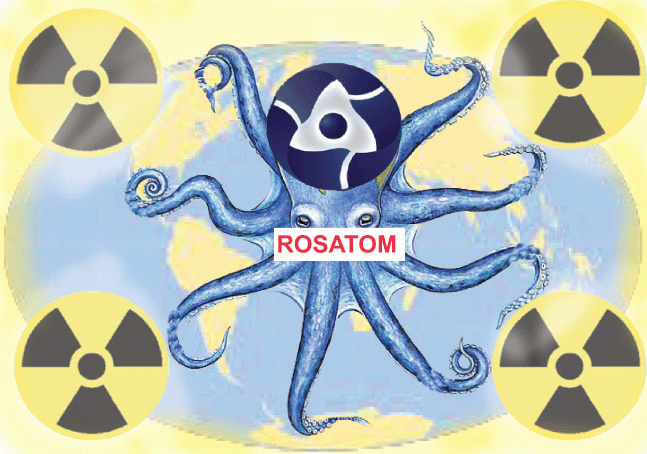
West scrambles as Putin reveals his energy war trump card. Kremlin has
spread its tentacles through the US and Europe – and countries are
struggling to fight back. In an effort to punish Vladimir Putin, western
governments have hit Russia’s energy industry with a barrage of punishing
sanctions since his invasion of Ukraine.
But one sector has conspicuously
escaped their ire so far: nuclear power. Since the conflict erupted,
Russian nuclear exports are actually thought to have increased while those
of coal, oil and gas have been squeezed.
Meanwhile, despite the key role it
has played in Moscow’s takeover of the Zaporizhzhia nuclear power plant
in Enerhodar, eastern Ukraine, state monopoly Rosatom remains untouched by
western sanctions.
The reason, say experts, is the complicated nature of
nuclear supply chains – from the supply of uranium to the construction of
reactors – and the dominant role Russia currently plays in many of them.
Through its global nuclear network, Moscow can exert political and economic
pressure on friends and foes alike, the White House has warned. A new
partnership between the UK, the US, Canada, Japan and France aims to change
this. Together the five countries want to squeeze Russia’s share of
nuclear exports and “ensure Putin, nor anyone like him, can ever think
they can hold the world to ransom over their energy again,” said Grant
Shapps, the Energy Security Secretary. The group aims to become independent
from Moscow and help other countries do the same, the agreement says.
Telegraph 24th April 2023
Scrapping could be next for Russia’s nuclear-powered battle cruiser
It is likely not cost-efficient to do the highly needed upgrade of the Northern Fleet’s 25-year old flagship “Pyotr Velikiy”.
Read in Russian | Читать по-русски
By Thomas Nilsen, 20 Apr 23 https://thebarentsobserver.com/en/security/2023/04/scrapping-could-be-next-russias-nuclear-powered-battle-cruiser
“Currently, the question about withdrawing “Pyotr Velikiy” from the Navy is under consideration. Based on the experience of repairing and modernizing the “Admiral Nakhimov” of the same class has shown that this is very costly,” a navy source said to state-owned news agency TASS.
Like in many speculations on the fate of older navy vessels, Russian state media send mixed information. Shortly after the TASS report came on Thursday, RIA Novosti quoted an unnamed source saying there are no plans to retire the huge warship.
The “Pyotr Velikiy” and “Admiral Nakhimov” are of sister ships, both of the Kirov-class, the only nuclear-powered surface warships in the Russian Navy.
The “Admiral Nakhimov” has not been in operation since the early 1990ties, and has since 1999 been at the yard in Severodvinsk undergoing repair, change of uranium fuel elements in the reactors and a refit to receive new weaponry, including modern cruise-missiles.
However, as repeatedly reported by the Barents Observer over the last decade, the re-commissioning of the warship has seen one postponement following the other. Current plans to set sail in 2024 today seem unlikely.
The “Pyotr Velikiy” was supposed to be docked in Severodvinsk as soon as “Admiral Nakhimov” joins the Northern Fleet.
The warship is armed with several types of cruise missiles, surface-to-air missiles, rocket launchers, torpedos and artillery. The hangar can house three helicopters.
April 18 marked the 25-years anniversary since “Pyotr Velikye” was commissioned. The ship has a crew of more than 700.
Russian Factory That Makes Nuclear Missile Engines Catches Fire
News Week, BY ISABEL VAN BRUGEN ON 3/23/23
fire has broken out on the territory of a Russian factory that manufactures equipment for the Russian Army, according to state media reports.
Seven people have been rescued from a burning building and firefighters are still searching for the source of the blaze at the Yaroslavl Motor Plant, in Yaroslavl, Russia, which describes itself on its website as one of Russia’s largest enterprises producing multi-purpose diesel engines, clutches, gearboxes and spare parts.
The Russian Emergencies Ministry was quoted by state-run news agency TASS as saying that fire departments were alerted to the blaze at 1.30 p.m. local time. Photos circulating on social media show plumes of thick black smoke rising into the sky.
According to local media reports, there was an explosion prior to the fire…………………………
Russian blogger and analyst Anatoly Nesmiyan said on his Telegram channel that “something quite serious is on fire” at the factory, though did not elaborate on what that could be. Nesmiyan described the factory as one of the largest manufacturers of engines and gearboxes for equipment belonging to the Russian Army, including engines for Topol-M nuclear missile launchers.
According to the Washington-based Center for Strategic and International Studies, the Topol-M is a Russian solid-fueled intercontinental ballistic missile with a range of 11,000 kilometers (6,835 miles).
The incident is the latest in a string of mysterious fires in Russia since President Vladimir Putin invaded Ukraine on February 24, 2022.
On Monday, a Russian anti-Putin partisan movement called Black Bridge claimed responsibility for last week’s fire at a building used by Russia’s Federal Security Service (FSB) in the southern city of Rostov-on-Don near the Ukraine border. https://www.newsweek.com/russian-factory-fire-nuclear-missile-engines-fire-explosion-1789877
UN Rights Official Concerned Over Summary Executions Of POWs By Both Russia, Ukraine
March 25, 2023, By RFE/RL’s Ukrainian Service
The United Nations has expressed deep concern over what it says were summary executions of prisoners of war (POWs) by both Russian and Ukrainian forces on the battlefield.
The head of the UN Human Rights Monitoring Mission in Ukraine, Matilda Bogner, said at a press conference in Kyiv on March 24 that her organization had recently recorded killings by both sides.
“We are deeply concerned about…summary execution of up to 25 Russian prisoners of war and persons [out of action because of injury] by the Ukrainian armed forces, which we have documented,” Bogner said.
This was often perpetrated immediately upon capture on the battlefield,” she said.
“While we are aware of ongoing investigations by Ukraine authorities into five cases involving 22 victims, we are not aware of any prosecution of the perpetrators,” she added.
Almost half of the 229 Russian prisoners of war interviewed by members of the mission claimed torture or ill-treatment, according to Bogner.
Bogner also expressed deep concern over the alleged executions of 15 Ukrainian prisoners by Russian armed forces after their capture. She said the Wagner mercenary group was responsible for 11 of those killings.
The Ukrainian Foreign Ministry reacted to the report by thanking the UN mission for documenting violations of international law by Russia in the course of its aggression against Ukraine.
“At the same time, we consider it unacceptable to place responsibility on the victim of aggression. According to the UN Charter, Ukraine has the right to self-defense,” the ministry said…………………. https://www.rferl.org/a/ukraine-russia-un-execution-prisoners/32333852.html—
US won’t let Ukraine even consider peace talks – Moscow
https://www.rt.com/russia/573393-us-ukraine-peace-negotiations/ 24 Mar 23
Ukraine’s Western backers – and the US in particular – are doing their best to prevent Kiev from entering into any negotiations with Moscow, Kremlin spokesman Dmitry Peskov has said. The official made the remarks on the sidelines of talks between Russian President Vladimir Putin and his Chinese counterpart, Xi Jinping, in Moscow on Tuesday.
Peskov was asked to comment on recent statements by senior Western officials, who said any peace initiative for Ukraine, should it arise from the Russia-China talks, would be “unacceptable.” US National Security Council spokesman John Kirby, for example, claimed any ceasefire in the current situation would only “ratify Russia’s conquest to date” rather than contribute to peace.
“Washington, European capitals, but first of all, Washington is filled with the desire not to let, under any pretext, [Kiev] enter into peace negotiations. They simply do not let Kiev even think about it,” Peskov said. Asked whether it was now ‘normal’ to incite war rather than call for peace, the spokesman responded affirmatively.
During the talks, the Russian and Chinese leaders discussed a 12-point roadmap for peace in Ukraine recently proposed by Beijing. Putin has lauded the initiative, expressing his readiness to discuss and build upon it, while also reiterating Moscow’s desire to seek a diplomatic solution to the hostilities, which have been dragging on for over a year.
We believe that many of the provisions of the peace plan put forward by China are consonant with the Russian stance and can be taken as a foundation for a peaceful settlement when they are ready for it in the West and in Kiev. However, so far we have not observed such readiness on their part,” Putin said after the meeting.
The Chinese president has insisted that Beijing continues to maintain its position on the conflict and has urged both sides to stick to diplomacy and engage in dialogue. “We’re always for peace and dialogue, and we firmly stand on the right side of history,” Xi stated.
Why Russia has such a strong grip on Europe’s nuclear power
Why Russia Has Such a Strong Grip on Europe’s Nuclear Power. New energy
sources to replace oil and natural gas have been easier to find than
kicking the dependency on Rosatom, the state-owned nuclear superstore.
The pinched cylinders of Russian-built nuclear power plants that dot Europe’s
landscape are visible reminders of the crucial role that Russia still plays
in the continent’s energy supply.
Europe moved with startling speed to wean
itself off Russian oil and natural gas in the wake of war in Ukraine. But
breaking the longstanding dependency on Russia’s vast nuclear industry is a
much more complicated undertaking.
New York Times 10th March 2023
Fake ‘nuclear bomb’ alert on TV and radio scares Russians
Moscow viewers and radio listeners spooked by fake warning
Hackers took over Russian state media on Thursday to tell listeners to rush to nuclear bomb shelters and take anti-radiation pills.
Radio and television broadcasts in Moscow and the western Sverdlovsk area were interrupted with a phony warning of a missile strike on the country.
The Kremlin blamed the false alarm, which told listeners to take potassium iodine, put on gas masks and seek shelter, on a cyber attack.
“Urgent message. There was a strike,” a Russian voice boomed, while television viewers were presented with a map of Russia being covered in red.
“Urgently go to a shelter,” the voice declared. “Seal the premises. Use gas masks of all types.”
The Telegraph reported that after the message was broadcast, screens displayed a black and yellow radiation warning symbol.
“A false air raid alert was broadcast in Moscow after servers of radio stations and TV channels were hacked,” said the Kremlin’s emergency ministry.
There has been no claim of responsibility for the latest cyber attack with it possibly originating from Ukraine dissidents or potentially Russian
It was the third time in the past month that Russian broadcasters have been targeted. Last month a false warning was released in the Crimea urging caution against an incoming missile attack. For this event, Ukraine was blamed. A similar broadcast was run a week later during Vladimir Putin’s state of the union address.
Ukraine has not taken responsibility for any of the alleged cyber attacks………………………. https://www.independent.co.uk/news/world/europe/fake-nuclear-bomb-alert-russia-television-b2298070.html
Russian nuclear energy diplomacy and its implications for energy security in the context of the war in Ukraine
Nature, Kacper Szulecki & Indra Overland 27 Feb 23
Abstract
Since Russia invaded Ukraine in February 2022, the possibility of reducing Europe’s energy dependence on Russian resources has been hotly debated. The fossil fuel industries received most attention as European Union leaders first introduced gradual sanctions on Russian coal and later on oil and gas, while Russia responded with supply cuts. However, Russia’s role as a major player in the global nuclear power sector has remained largely below the sanctions radar, despite dependencies on Russian nuclear technology, uranium supplies and handling of spent nuclear fuel. Here we analyse the state nuclear company Rosatom and its subsidiaries as tools of Russian energy statecraft. We map the company’s global portfolio, then categorize countries where Russia is active according to the degree and intensity of dependence. We offer a taxonomy of long-term energy dependencies, highlighting specific security risks associated with each of them. We conclude that the war and Russia’s actions in the energy sector will undermine Rosatom’s position in Europe and damage its reputation as a reliable supplier, but its global standing may remain strong.
…………………………………………………………Russia is the world’s largest exporter of natural gas, second-largest exporter of oil and third-largest exporter of coal8. However, media coverage and political debates have generally omitted another sector where Russia is a major player and that is vital for Russia’s global economic and diplomatic posture: nuclear energy. While the Russian shelling and takeover of Ukrainian nuclear power plants has caused an outcry, Russia’s portfolio of foreign orders, including reactor construction, fuel provision and other services, spans 54 countries and is claimed by Rosatom to be worth more than US$139 billion over a ten year period9 and has thus far not been covered by Western sanctions. Although the financial figure is in all likelihood inflated, Russia’s involvement in and use of nuclear energy as a tool of energy diplomacy deserves scrutiny.
In this Analysis, we present a dataset of all current and planned international engagements of the Russian nuclear energy supplier Rosatom and its subsidiaries AtomStroyExport and TVEL. The dataset includes information on the different types of agreement, business models, scales of investments, types of reactor being built or planned and their nameplate capacity. As a gauge of the level of dependency upon the Russian nuclear sector that is or will be brought about by these reactors, we registered their share of the future electricity supply in the countries where they are located or planned for construction. Because the degree of influence achieved through energy statecraft is conditioned by the character and level of (inter)dependence, we discuss the firmness of dependence of different client states, formulated as ‘intensity.’ Finally, we propose a categorization of dependency types (Methods).
Rosatom’s rise, expansion and comparative advantages
Rosatom—the Russian State Atomic Energy Corporation—is the direct heir to the Soviet Ministry of Atomic Energy, which was established in the aftermath of the Chernobyl nuclear accident. Reorganized as a state corporation in 2007, Rosatom is fully owned by the Russian state, and the president of the Russian Federation determines the company’s objectives10,11. Since its inception, Rosatom has become increasingly active in the international nuclear power market12,13 and has become a leading provider of key services12,14,15. Construction of as many as ten reactor units started between 2007 and 2017, and between 2009 and 2018, the company accounted for 23 of 31 orders placed and about a half of the units under construction worldwide11. Through its subsidiary TVEL, Rosatom also provides fuel supplies, controlling 38% of world’s uranium conversion and 46% of uranium enrichment capacity16,17 in addition to decommissioning and waste disposal. In sum, Russia was the supplier in around half of all international agreements on nuclear power plant construction, reactor and fuel supply, decommissioning or waste between 2000 and 2015. Its main nuclear power competitors—China, France, Japan, Korea and the United States—accounted for another 40%, combined18.
…………………………………………. Rosatom’s main advantage lies in its capacity to be a ‘one stop nuclear shop’ for all needs, the only supplier providing an ‘all-inclusive package’12. This comprises reactor construction know-how, training, support related to safety, non-proliferation regime requirements and flexible financing options, including government-sourced credit lines22. The company is also uniquely able to offload spent nuclear fuel from overseas customers.
The way Rosatom designs its projects also makes it a convenient partner for nuclear newcomers23,24. While details of contractual agreements vary from case to case, the developer takes care of the entire process until the plant is ready to use and can be handed over to local (Russian-trained) nuclear experts to operate. For that reason, nuclear energy can be considered by countries for which it was previously unattainable, especially in the Middle East25,26, sub-Saharan Africa27,28 and South America.29
Rosatom is also able to make special offers to strategically important partners, such as Turkey30,31. ………………………………….
Its comparative advantages as a supplier allowed Russia to launch a global campaign of nuclear energy diplomacy33 in which Rosatom and Russian government institutions such as the Ministry of Foreign Affairs work in tandem. This potentially gives Russia the capacity to use the broad network of international projects it is involved in34 and the direct control over reactors and strategic energy infrastructure to exert political pressure and to project power globally35.
Minin and Vlček, having studied the behaviour of Rosatom and its relationship with the Russian state, argue that the company is primarily a profit-seeking entity with a high degree of autonomy and growing self-sufficiency15. According to Thomas, whatever its grandiose expectations, Rosatom could simply be unable to deliver all the projects that it has agreed to, let alone expand further13. On the other hand, Aalto et al. observe that ‘potential foreign policy influence’ by Russia was noted by Finnish and Hungarian opponents of collaboration with Rosatom33, while Jewell and colleagues argue that some nuclear sector dependencies display more pervasive energy security impacts, long-lasting and difficult to deal with (due to lack of flexibility) than those usually analysed by energy security experts in the petroleum sector18,36.
Here we consider Rosatom’s potential as a tool for the Russian state and debate whether this constitutes a ‘nuclear energy weapon’ or simply a projection of soft-power diplomacy. We find that Russian nuclear energy statecraft can be seen as a spectrum between these two extremes, but that soft-power diplomacy creates dependencies that can be further expanded and exploited and thus should not be overlooked.
Analysing Rosatom’s international activity
Our research, gathered in the dataset available in the Supplementary Data, indicates that upon Russia’s invasion of Ukraine, Rosatom boasted as many as 73 different projects in 29 countries. The projects were at very different stages of development from power plants in operation; through construction of reactors ongoing, contracted, ordered or planned; to involvement in tenders, invitations to partnerships or officially published proposals. On top of that, Russian companies have bilateral agreements or memoranda of understanding (MoUs) with 13 countries for services or general joint development of nuclear energy.
Rosatom’s projects and involvement have varied in ambition and cost—from India’s Tarapur nuclear power plant (NPP) (US$700 million) and Iran’s Bushehr-1 (US$850 million) to a gargantuan project in South Africa (US$76 billion) and those in Egypt (US$30 billion) and Turkey (US$20 billion). Finally, 13 countries have a variety of research-oriented agreements with Russian nuclear service providers related to nuclear research centres. Altogether, Russia’s nuclear energy diplomacy has been formalized in 54 countries.
While this is impressive, looking into the details of these agreements (particularly the NPP construction projects) reveals a more modest level of international engagement. Many of the projects have been stuck at the planning stage for several years or are merely visions laid out in non-committal MoUs………………………………………………………
However, most cooperation and plans have not been cancelled, and even EU member states Bulgaria and Hungary have, as of January 2023, not cancelled their planned nuclear plants…………………………………………………………………………………………….
Following the 2014 annexation of Crimea and particularly after the 2022 invasion of Ukraine, Russian economic, political and energy influence has become a fundamental concern in European countries.42 In countries that plan to base their decarbonization efforts primarily or entirely on nuclear energy (that is, Hungary and Slovakia), the Russian NPP share of the electricity supply can underrepresent Russia’s influence: dependencies on nuclear fuel imports from TVEL/Rosatom (which also continues to supply Bulgaria, Czechia and Finland and Poland’s research reactor), combined with power-system inflexibility and overreliance on a single large nuclear power plant, exacerbates the vulnerability to supply disruptions…………………………………………..
Egypt, Iran and Turkey are all nuclear newcomers, energy hungry and populous (with between 82 and 100 million inhabitants each). Such states are lucrative markets for low-carbon electricity development…………………………………………………………………………………………………………
The big question for the future is whether non-Western countries will also turn away from Russian nuclear power. Currently, many developing countries take a positive view of Russia and tilt towards its view of the conflict in Ukraine. Immediately after the invasion of Ukraine, seven of the 14 countries with high- or medium-cooperation levels in our analysis did not approve United Nations Resolution ES 11/1 condemning Russian aggression, and several of these (for example, Bangladesh, China, India, Iran) were categorized as ‘neutral or Russia-leaning’ shortly after the war began58. Over time, however, the interruption of energy supplies to the European Union may undermine the reputation of Russian energy companies as primarily economic actors independent of national security politics, also outside Europe. Non-Western perspectives on the war in Ukraine and the reliability of Russia and Russian technology may also change over time……………………………………………………………………………………………………………………………………… more https://www.nature.com/articles/s41560-023-01228-5
Vladimir Putin says the US-led military alliance in Ukraine seeks defeat and liquidation of Russia
ABC News 27 Feb 23
President Vladimir Putin has cast the confrontation with the West over the Ukraine war as an existential battle for the survival of Russia and the Russian people — and said he was forced to take into account NATO’s nuclear capabilities.
Key points:
- February 24 marked the first anniversary of the Russian invasion of Ukraine
- Mr Putin says he believes the future of Russia is in peril
- The interview was aired on Sunday on Russian state television
A year since ordering the invasion of Ukraine, Mr Putin is increasingly presenting the war as a make-or-break moment in Russian history — and saying that he believes the very future of Russia and its people is in peril…………………………………………
Mr Putin said the tens of billions of dollars’ worth of US and European military assistance to Ukraine showed that Russia was now facing off NATO itself — the Cold War nightmare of both Soviet and Western leaders.
Ukraine says it will not rest until every last Russian soldier is ejected from Ukraine, including from Crimea which Russia annexed in 2014………………….
Russia’s official nuclear doctrine allows for the use of nuclear weapons if they — or other types of weapons of mass destruction — are used against it, or if conventional weapons are used, which endanger “the very existence of the state”………………………………..
Russia Sends Ship To Space Station To Rescue “Stranded Crew”
BY TYLER DURDEN, SATURDAY, FEB 25, 2023 https://www.zerohedge.com/technology/russia-sends-ship-space-station-rescue-stranded-crew
Russia launched an uncrewed Soyuz spacecraft on Friday for a NASA astronaut and two cosmonauts after their original ride back to Earth was damaged by a micrometeoroid impact while parked at the International Space Station in December.
The rescue plan was announced last month. The empty rescue capsule, Soyuz MS-23, blasted off from Baikonur Cosmodrome in Kazakhstan early Friday morning and is set to dock at the orbiting lab on Sunday.
WATCH: NASA launched a Roscomos Soyuz spacecraft from the Baikonur Cosmodrome in Kazakhstan to the International Space Station to bring back a stranded crew to Earth https://t.co/aUNd9r46fs pic.twitter.com/6brPI1vVzm— Reuters Asia (@ReutersAsia) February 24, 2023
The damaged Soyuz will return to Earth for further inspection at the end of March. There will be no crew on board.
The three men arrived at the ISS in September on what was expected to be a six-month mission, but that will be extended for another six months.
NASA is sending another crew of four to the ISS Monday via a SpaceX rocket from Florida’s Kennedy Space Center.
Scott Ritter: Anyone Who Doesn’t Get How Serious New START Suspension is ‘Doesn’t Appreciate Life’
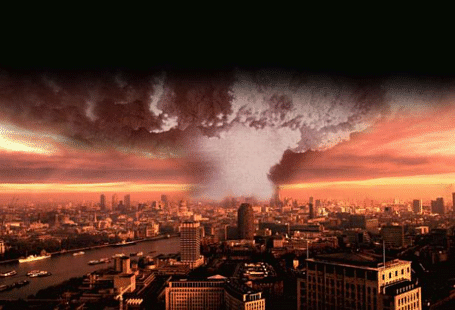
We’re not allowing Russian inspectors to come and inspect us while demanding that we go inspect Russia.
Unfortunately, we have people today in Washington, D.C., that believe in American nuclear superiority or American nuclear supremacy, and they don’t believe in arms control. And we need to replace them. We need to get rid of them. We need to bring in people who recognize that arms control is the only way to save the human race.”
Leaving aside the “theater of the absurd” and “bluster” of Joe Biden’s rhetoric during his trips to Ukraine and Poland this week, the consequences of the US effort to strategically weaken and destroy Russia are far more serious than anyone in Washington seems to realize, ex-UN weapons inspector and retired US Marine major Scott Ritter fear
“There’s nothing covert about this. It was theater. Theater of the absurd,” Ritter said of Biden’s visit to Kiev on Monday to meet with President Volodymyr Zelensky, speaking to Sputnik’s Wilmer Leon and Garland Nixon on The Critical Hour radio show.
“So absurd that while Biden was there, Zelensky arranged to have air raid sirens sound to make it look as if Biden was under attack….Then Biden goes to Poland, where he issues a speech. I was in the middle of a webinar earlier, so I don’t know the totality of the speech. I saw the beginning of it, but it just seems to be a regurgitation of more of the same – ‘unity against Russia, support for Ukraine’, etc., etc. Bluster, bluster, bluster,” Ritter added.
On Tuesday, Russian President Vladimir Putin announced the suspension of the New Strategic Arms Reduction Treaty (New START) with the US, citing Washington’s efforts to “inflict a strategic defeat” on Russia and help Ukraine launch drone attacks against Russia’s strategic deterrent while “absurdly” calling for more nuclear inspections.
“Meanwhile, the consequences of the American-led effort to attack Russia, to weaken Russia, to destroy Russia, to be honest, are playing out. Putin’s suspending Russian participation in the last remaining arms control treaty between our two nations. And anybody who doesn’t understand how serious this is probably doesn’t appreciate life. Without arms control agreements, there will be a nuclear arms race at a time when technology far outpaces that of the last arms race, which was the unfettered arms race in the late 1960s or early 1970s,” Ritter said.
Ritter knows a thing or two about arms control, serving as an inspector implementing the Intermediate Range Nuclear Forces Treaty – a late Cold War agreement which eliminated an entire class of US and Soviet ground-based nuclear missile systems in the 500-5,500 km range. Today, he fears, radical advances in technology make effective arms control all the more crucial to saving the world from nuclear Armageddon.
“Today, we’re talking about missiles with greater speed, greater accuracy, hypersonic maneuvering warheads that can’t be shot down by missile defense. So, so deadly, so accurate, so fast that any error, any mistake, any miscalculation has to be assumed that it’s going to have dire consequences. So you must respond. In the past, we dodged a bullet because we had time enough for people to say [to the other side] ‘this launch of American missiles against Russia was, in fact, not a launch. It was a mistake.’
Today, if they detect a launch, they have to respond because they don’t have time. They don’t have the luxury of time to say, wait a minute, let’s just wait to get more data.
. With this treaty going away, an arms race will occur and there will be nothing that is capable of putting that genie back in the bottle. And this could be fatal, probably will be fatal to everybody here. So we need to pray that the United States gets over its Ukraine fixation and gets into how do we stop the world from dying in a nuclear holocaust to which we will be singularly responsible for initiating,” Ritter urged.
President Putin and other Russian officials have addressed the lack of response time issue repeatedly in recent years, going back to when Washington decided to deploy Tomahawk-capable anti-missile defense systems in Poland and Romania, and threatened to incorporate Ukraine into NATO and station nuclear-capable missiles there.
“I have already said – they’ll put missile systems in Ukraine, 4-5 minutes’ flight time to Moscow. Where can we move? They have simply driven us into such a state that we have to tell them: stop,” Putin said in December 2021, after Moscow handed Washington and NATO a pair of comprehensive security proposals meant to dramatically reduce tensions between Russia and the Western bloc.
The West rejected the draft treaties in January 2022, reiterating that NATO’s eastward expansion was nonnegotiable. A month later, escalated attacks on the Donbass by Kiev sparked a Russian military operation in Ukraine.
“The problem is the concept of meaningful arms control was developed during the time of the Cold War, when the United States actually respected and feared its opponent, the Soviet Union. When the Soviet Union collapsed, the United States no longer respected or feared Russia. And we used arms control as a means of furthering our strategic advantage,” Ritter explained. “And then when we found arms control treaties to be inconvenient, such as the Anti-Ballistic Missile Treaty, we withdrew from the Intermediate Nuclear Forces Treaty, which I played a major role in. We withdrew from Open Skies, and now we’re cheating on the last remaining treaty, New START. We’re not allowing Russian inspectors to come and inspect us while demanding that we go inspect Russia. And so the Russians have suspended this. This is all a power play by the United States to further what we believe to be our strategic advantage over Russia.”
Today, the former weapons inspector warned, “Russia is no longer a defeated, compliant state. The Russians have nuclear superiority over us today. Their missiles are better than anything we have. We don’t have a missile defense system worthy of the name. And so if there was a nuclear conflict, we would be annihilated. Now the good chance is we would annihilate them, too. Which brings us back to the situation that we existed in the 1960s, where we suddenly realized that this concept of mutually assured destruction wasn’t a bad concept because it sort of put the brakes on nuclear conflict.
Unfortunately, we have people today in Washington, D.C., that believe in American nuclear superiority or American nuclear supremacy, and they don’t believe in arms control. And we need to replace them. We need to get rid of them. We need to bring in people who recognize that arms control is the only way to save the human race.”
Vladimir Putin vows to strengthen Russia’s nuclear forces to guarantee its sovereignty
Thu 23 Feb 2023 ABC News
Russian President Vladimir Putin says Moscow will boost its nuclear forces by deploying a much-delayed new intercontinental ballistic missile, rolling out hypersonic missiles and adding new nuclear submarines.
Key points:
- During a speech to mark a Soviet victory public holiday, Mr Putin said Russia needed modernised armed forces to guarantee its sovereignty
- Mr Putin says the Sarmat silo-based intercontinental ballistic missiles will be deployed this year
- He says Russia will also continue mass production of air-based hypersonic Kinzhal systems and start mass supplies of sea-based Zircon hypersonic missiles
A year since ordering the invasion of Ukraine, Mr Putin has signalled he is ready to rip up the architecture of nuclear arms control — including the big powers’ moratorium on nuclear testing — unless the West backs off in Ukraine.
Mr Putin on Tuesday sought to underscore Russian resolve in Ukraine by suspending a landmark nuclear arms control treaty, announcing new strategic systems had been put on combat duty and warning Moscow could resume nuclear tests.
In an address to mark the Defender of the Fatherland public holiday, known in Soviet times as Red Army Day, Mr Putin invoked the Soviet victory over Nazi Germany to argue that Russia needed modernised armed forces to guarantee its sovereignty………………………………. more https://www.abc.net.au/news/2023-02-23/vladimir-putin-says-russia-to-deploy-sarmat-nuclear-missiles/102016510
Explainer: The New START nuclear treaty, and why Vladimir Putin is walking away from it
ABC News, 22 Feb 23, Russia’s President Vladimir Putin’s announcement on Tuesday (local time) that Moscow is suspending its participation in the last remaining US-Russia arms control treaty will have an immediate impact on America’s ability to monitor Russian nuclear activities.
Key points:
- Vladimir Putin says Russia will suspend its participation in the New START nuclear arms treaty
- The treaty required both the US and Russia to communicate about their nuclear arsenals, allow on-site inspections and adhere to limits on nuclear warheads
- The US had previously signalled it would withdraw from the treaty under the Trump administration, but signed an extension in 2021
However, the pact was already on life support.
Mr Putin’s decision to suspend Russian cooperation with the treaty’s nuclear warhead and missile inspections follows Moscow’s cancellation late last year of talks that had been intended to salvage an agreement that both sides have accused the other of violating.
In his state of the nation address to the Russian people, Mr Putin said Russia was suspending its participation in the treaty because of US support for Ukraine, and accused the US and its NATO allies of openly working for Russia’s destruction.
The US had previously walked away from the treaty. During the Trump administration, the US declined to engage in negotiations to extend it, accusing Moscow of flagrant violations.
But when President Joe Biden took office in 2021, his administration signed a five-year extension.
Here’s a look at New START, and what Russia’s announcement means for keeping US and Russian nuclear weapons in check………………………………………………………………… more https://www.abc.net.au/news/2023-02-22/new-start-us-russia-arms-control-treaty-explainers/102008364
1 This Month

of the week – Shut Down Drone Warfare!


Tell the Ukrainian Government to Drop Prosecution of Peace Activist Yurii Sheliazhenko

Petition to revoke the licensing of the Near Surface Nuclear Disposal Facility (NSDF) at Chalk River. https://www.ourcommons.ca/petitions/en/Petition/Details?Petition=e-7247
To see nuclear-related stories in greater depth and intensity – go to https://nuclearinformation.wordpress.com
-
Archives
- April 2026 (57)
- March 2026 (251)
- February 2026 (268)
- January 2026 (308)
- December 2025 (358)
- November 2025 (359)
- October 2025 (376)
- September 2025 (257)
- August 2025 (319)
- July 2025 (230)
- June 2025 (348)
- May 2025 (261)
-
Categories
- 1
- 1 NUCLEAR ISSUES
- business and costs
- climate change
- culture and arts
- ENERGY
- environment
- health
- history
- indigenous issues
- Legal
- marketing of nuclear
- media
- opposition to nuclear
- PERSONAL STORIES
- politics
- politics international
- Religion and ethics
- safety
- secrets,lies and civil liberties
- spinbuster
- technology
- Uranium
- wastes
- weapons and war
- Women
- 2 WORLD
- ACTION
- AFRICA
- Atrocities
- AUSTRALIA
- Christina's notes
- Christina's themes
- culture and arts
- Events
- Fuk 2022
- Fuk 2023
- Fukushima 2017
- Fukushima 2018
- fukushima 2019
- Fukushima 2020
- Fukushima 2021
- general
- global warming
- Humour (God we need it)
- Nuclear
- RARE EARTHS
- Reference
- resources – print
- Resources -audiovicual
- Weekly Newsletter
- World
- World Nuclear
- YouTube
-
RSS
Entries RSS
Comments RSS
 nuclear-news