Nuclear Restoration Services taking over control of Hinkley B station
By John Thorne, Tuesday 29th September 2026, https://www.wsfp.co.uk/news/hinkley-point-b-nuclear-power-station-decommissioning-next-stage-phase-nuclear-restoration-service-transfer-from-edf-957891
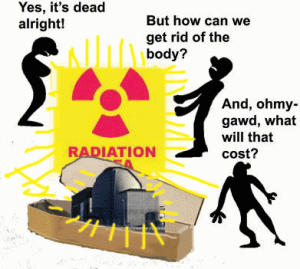
THE next chapter is being opened in Hinkley Point B nuclear power station’s long history as its decommissioning transfer moves a step closer.
Key regulatory approvals have been put in place for the site’s transfer from EDF to Nuclear Restoration Services (NRS) on Thursday (October 1).
The Office for Nuclear Regulation granted a site licence to NRS, while the Environment Agency issued an environmental permit.
It marks a major milestone for the site, which has been part of the local community for decades and is now moving toward the next phase of safe, secure, and sustainable decommissioning.
Renewable jobs growth in Scotland

Letter Dr Paul Dorfman: Based on information from the Nuclear Information
Association, Scotland has added only 661 nuclear jobs whilst England gained
almost 47,500. However, in contrast, it has to be noted that according to a
recent Confederation of British Industries (CBI) report, net-zero and
renewable industries supports more than 105,000 jobs in Scotland and
contribute £10.2 billion to the economy, representing 4.9 per cent of
total economic output via 28,473 direct jobs, 57,153 supply chain roles,
providing an average salary of £41,800, paying 5.2 per cent higher than
the national average.
John O’Groat Journal 26th Sept 2026,
https://www.johnogroat-journal.co.uk/news/renewable-jobs-growth-in-scotland-thurso-wig-service-for-ca-445913/
Given the Chance, Ukrainians Would Give Zelensky the Boot

A fifth of those who say they do not trust him cite corruption as the main reason, and 59 percent of Ukrainians blame Zelensky personally for the extent of corruption in Ukraine today.
The wartime leader’s favorability ratings have plummeted.
Ted Snider, Nicolai N. Petro, Sep 18, 2026, https://www.theamericanconservative.com/given-the-chance-ukrainians-would-give-zelensky-the-boot/
There was a time, not very long ago, when Ukrainian President Volodymyr Zelensky was lionized around the world and spectacularly popular at home. But, if elections were held today, he would struggle to finish in the top three.
Zelensky came to power in a landslide victory in 2019. His term, constitutionally limited to five years, has now stretched to over seven years because of the war. Although it is true that 57 percent of Ukrainians say they do not want to hold elections during the war, it is simply not true that it is unconstitutional to hold presidential elections until the fighting stops.
The western media has provided cover for Zelensky by reporting that presidential elections are not permitted by Ukraine’s constitution at time of war. But while Ukrainian law prohibits parliamentary, presidential, and local elections under martial law, the highest law in the land, the Ukrainian constitution (Article 83), speaks only of the parliament as being able to extend its authority in the event that martial law is declared and elections cannot be held. It pointedly says nothing about extending the term of the president.
This omission was deliberate: The authors of the constitution feared that some future president might declare martial law precisely to prevent removal from office. Indeed, Zelensky’s predecessor, Petro Poroshenko, was accused by three former presidents of Ukraine of trying this very maneuver in late 2018 in order to derail the elections that he later lost.
Setting aside tricky legal matters, where do things stand politically? Were elections to be held today, three key metrics suggest that Zelensky would suffer a similar devastating loss.
The most obvious is recent polling. Only 28 percent of Ukrainians say they want to see Zelensky remain president after the war. Other recent polls show that only around 21 percent of Ukrainians would vote for him in the next election—putting Zelensky just one point ahead of his rival, former Commander-in-Chief Valeriy Zaluzhny—while other polling suggests that Zelensky would lose to Zaluzhny. Meanwhile, a number of “closed polls,” those commissioned by the government for internal use only, apparently show that he would probably lose to Kyrylo Budanov, the former intelligence chief and Zelensky’s current chief of staff.
The second metric may be even more important. Current polling shows that no candidate would win the required majority in the first round, thus necessitating a runoff round. Since he has the highest number of Ukrainians who say they would not vote for him under any circumstances, one can infer that Zelensky would be soundly defeated in this round under any scenario. A recent poll indicates that Zaluzhny would defeat him by a margin of 66 to 34 percent; Budanov would defeat him by 60 to 40 percent; and even the recently fired minister of defense, Mykhailo Fedorov, would beat him by a whopping 64 to 36 percent.
The third metric is trust. In an ever-shifting field of hypothetical candidates, how much Ukrainians trust their candidate may be the most important question of all. And here, Zelensky does even worse. When the question is trust, Zelensky places a distant sixth.
Zaluzhny comes in first with 28 percent of respondents fully trusting him, 37 percent trusting him somewhat, 12 percent somewhat distrusting him, and 18 percent not trusting him at all. Fedorov and Budanov are more trusted than Zelensky, as are Mykhailo Drapatyi, the current commander of the Ukrainian armed forces, and even Robert Brovdi, commander of the Unmanned Systems Forces. Only 18 percent say they fully trust Zelensky and 25 percent somewhat trust him, while 37 percent say they do not trust him at all.Government corruption is a big reason for Zelensky’s collapse. A fifth of those who say they do not trust him cite corruption as the main reason, and 59 percent of Ukrainians blame Zelensky personally for the extent of corruption in Ukraine today. And this perception is unlikely to change for the better, as new corruption scandals are exposed. They already reach deep into Zelensky’s inner circle and personal staff. Last year, these scandals took out Zelensky’s powerful chief of staff, Andriy Yermak. More recently, they have hit three deputy chiefs of staff and Yermak’s successor, Budanov, not to mention several government ministers and Ukraine’s chief prosecutor.
Popular reluctance, as well as the logistics of holding elections under the strain of war, will prevent elections from taking place any time soon. But when this horrible war finally ends and Ukrainians return to the polls, if democracy is permitted a full and unimpeded voice, then Zelensky, Ukraine’s acclaimed wartime president, will probably not be its peacetime president.
Zelensky’s strategy is national suicide.
Iuliia Mendel, 26 Sept 26
For Americans who follow the Russian-Ukrainian war, the past few months must look very strange. In the first half of summer, the story from Kyiv – and the many western media outlets that repeated it – was that Ukraine was winning. Then, not long after the NATO summit in July, Kyiv announced it lacked the interceptors to prevent a winter disaster. The country needed 300 missiles to survive, we were told. Even if these 300 missiles arrive, they are unlikely to protect a country as large as Ukraine from the sheer volume of Russian ballistic attacks and glide-bomb strikes. Now it’s September, and Ukraine says it’s facing a $27 billion shortfall in defense funding. There seems to be a vast difference between the public relations campaign and the reality in Ukraine………. (Sunscribers only) https://spectator.com/article/zelenskys-strategy-is-national-suicide/
UP FOR GRABS: Button pushed for new SMR spending round
energy economists point out that fixed costs (such as 24/7 security, exclusion zones and
energy economists point out that fixed costs (such as 24/7 security, exclusion zones and regulatory licensing) do not diminish proportionally with a smaller reactor…………….. “economies of scale come by making something bigger, not by making something smaller.”
By Simon Hacker | 25th September 2026
Businesses across Gloucestershire and the Cotswolds are being urged to throw in their hats for a share of £1.4bn in contracts to supply Rolls-Royce SMR‘s pathway for small nuclear reactors.
Rolls-Royce SMR said its new Supplier Programme gives UK firms a chance to bid for a slice of the contracts pie over the next year, the move aiming to support the company and Great British Energy-Nuclear (GBE-N) in its quest to achieve more than 70% UK fleet content for the Gwyndod (Wylfa) project in North Wales.
The invitation comes as SMR technology remains, as yet, unapproved for final implementation in Western markets: two demonstration operations in China and Russia (a floating project on the Arctic) are active as pilots, but elsewhere, while technical viability is proven, Rolls-Royce SMR remains engaged in a process to steal a lead on US rivals by concluding a Generic Design Assessment stage with regulators.
Since being formed in 2021, Rolls-Royce SMR said it had already spent more than £300m with UK based suppliers – equivalent to 88% of its total spend to date – and held three UK supplier events, formally engaging with more than 650 UK firms.
It hailed this launch as a “major milestone in establishing a resilient, high-value UK supply chain, capable of delivering at scale and supporting our export programme”.
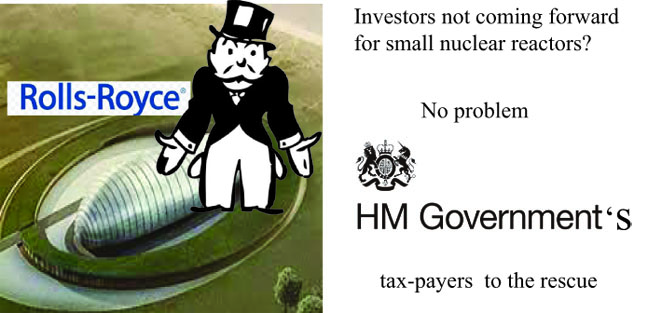
Funding for SMR development is a mixed picture of streams from private investment and the UK taxpayer, with government documents showing that the £1.4bn reported here is derived from general taxation (via government spending), the ultimate goal of the SMR programme being to transition to a mix of private investment and consumer energy bills.
To date, the amount that Rolls-Royce SMR has drawn down and spent from the taxpayer is not isolated to a single figure, given that government funding shifts between committed grants, commercial loans and site purchases.
But in terms of money the government has formally spent or legally committed to Rolls-Royce SMR so far, the taxpayer footprint is reported to stand at around £830m in direct development funds, within a wider £2.6bn total programme allocation…………………
Chris Cholerton, CEO of Rolls-Royce SMR, said the scale of the opportunity in unlocking £1.4bn that is now available to UK suppliers from the Rolls-Royce SMR programme was significant.
“As the only SMR provider with multiple contractual commitments in Europe, we want to partner with the best of UK industry, to maximise their opportunity to contribute to our growing European fleet.”
It’s not quite over the line, but Rolls-Royce SMR has successfully completed Step Two of the GDA which makes it the leading SMR vendor in Europe in the race to provide the continent’s required legal paperwork for the technology……………………….
Rolls-Royce SMR said: “Through workshops, industry events and expert guidance, the Programme will demystify the sector, help suppliers understand regulatory and commercial requirements, and make it easier for companies to explore opportunities within the Rolls-Royce SMR supply chain.Participating suppliers will benefit from greater visibility of future supply chain requirements and access to potential opportunities across the programme. They will also have opportunities to engage directly with Rolls-Royce SMR and supply chain procurement teams through briefings, networking events and meet-the-buyer sessions.”
WIth the economic viability remaining as yet untested advocates of SMRs maintain that by building reactors in factories, rather than on-site, costs will plummet. However, energy economists point out that fixed costs (such as 24/7 security, exclusion zones and regulatory licensing) do not deminish proportionally with a smaller reactor.
Here in Gloucestershire, Stroud-based Ecotricity boss Dale Vince has taken a leading role as an ardent critic of the SMR concept, having argued that “economies of scale come by making something bigger, not by making something smaller.”
Trying to make cheap “mini nukes”, Mr Vince said, ignores the fact that miniaturising complex, highly regulated technology naturally drives costs up, not down.………
https://www.punchline-gloucester.com/articles/aanews/button-pushed-for-new-smr-spending-round
Building the foundations for regulatory collaboration
UK and Swedish nuclear regulators have taken a significant step towards
international collaboration on small modular reactor deployment, with a
workshop supported by the Department for Business, Innovation, Science and
Trade, designed to accelerate the safe rollout of the technology across
both countries. The workshop followed the recent announcement in June, that
the Swedish utility Videberg Kraft had selected Rolls-Royce SMR Ltd to
supply small modular nuclear reactors, representing the first new nuclear
build in Sweden for more than 40 years. Videberg Kraft, owned by Vattenfall
and a group of Sweden’s largest companies, plans to develop this new
nuclear power capacity alongside the site of the existing Ringhals nuclear
facility in southwest Sweden.
ONR 10th Sept 2026, https://www.onr.org.uk/news/all-news/2026/09/building-foundations-for-regulatory-collaboration
“Militarization of rules and minds” in Europe threatens workers and welfare
Trade unionists, peace activists, and left politicians warn that Europe’s rapid rearmament is already undermining workers’ rights, welfare systems, and social security.
Ana Vračar, January 20 2026, https://breakthroughnews.org/2026/01/20/militarization-of-rules-and-minds-in-europe-threatens-workers-and-welfare/
The militarization of Europe is advancing rapidly, with everything from public budgets to media narratives increasingly shaped by a war-driven logic. This was one of the key warnings raised by trade unionists, left politicians, and peace activists during a discussion organized by the International Peace Bureau and the No to War – No to NATO network.
At the level of the European Union, Belgian MEP Marc Botenga warned that existing rules and safeguards are being pushed aside to accelerate the new military-industrial strategy. He pointed to recent discussions around so-called omnibus legislative packages, particularly proposals designed to ease the operations of the arms industry at the expense of labor rights, environmental protections, and social welfare systems. All measures introduced under what he described as a militarization of rules agenda carry clear social consequences, Botenga said – yet top EU officials are silent on this dimension of the plans they are championing.
Regulations are not the only thing being reshaped: people’s minds are also being militarized, agreed German trade unionist Ulrike Eifler. She emphasized the Merz government’s push to meet NATO’s 5% spending target by 2029 and to make Germany “war-ready” by the same time. Under this agenda, she added, militaristic thinking is being normalized across society, including in everyday public spaces such as swimming pools and schools. In some German regions, Eifler pointed out, teachers are already being pushed to invite soldiers into classrooms, presumably to familiarize students with prospects of a military career.
At the same time, Eifler and Botenga both pointed out, social and welfare systems are already facing the impact of cuts made to accommodate rising defense expenditures. “Every euro they’ve given to the military is already missing from social justice,” Eifler said. If the government continues on its current path, she added, analysts from Germany’s largest public-sector union, ver.di, believe social funds could be effectively depleted as early as next year. The process will be accompanied by longer working hours and less free time for workers – further proof, she argued, that every war, and every preparation for war, is nothing less than an “intensified class attack.”
However, resistance to war is also gaining momentum. Students, trade unions, and other groups are increasingly looking at what a fully militarized Europe would mean for their lives and livelihoods, and are beginning to organize in response. In Germany, tens of thousands of students are preparing new strikes against the possibility of military conscription. Meanwhile, in Britain, trade unions have made notable advances in pushing back against militarization within their own ranks.
Alex Gordon, co-president of the Campaign for Nuclear Disarmament (CND) and co-author of the “Alternative Defense Review,” described how British unions successfully challenged “arms and butter” resolutions adopted by the Trade Union Congress (TUC) in 2022. By confronting narratives rooted in military Keynesianism, the University and College Union (UCU) helped halt these plans, ensuring that a significant section of the organized labor movement backs policies that benefit the working class rather than arms producers.
With Botenga warning that Europe’s militarization drive is unfolding over months rather than years, participants emphasized that expanding such resistance is essential – not only to stop the current trajectory, but also to redefine the purpose of the EU and the entire region.
Health workers demand action against genocide and militarization at ManiFiesta 2026
At ManiFiesta 2026, health workers called for action against genocide and militarization, citing a professional duty to uphold the right to health.
Peoples Health Dispatch, September 20 2026, https://breakthroughnews.org/2026/09/20/health-workers-demand-action-against-genocide-and-militarization-at-manifiesta-2026/
Health is always a prominent topic at Belgium’s ManiFiesta, a two-day festival organized by the Workers’ Party of Belgium (PTB) in the beginning of September. Discussions range from the organization of health services or workshops led by progressive health organizations like Medics for the People (MPLP-GVHV) and Viva Salud. This September, the program covered local priorities such as health coverage and hospital reform – along with Israel’s ongoing assault on Gaza’s healthcare system and the threat of militarization across Europe.
Health workers should oppose rearmament
Addressing the question of why health workers should be concerned by Europe’s armament drive, Juliette Mattijsen of the People’s Health Movement (PHM), Nadja Rakowitz of the Association of Democratic Doctors (vdää*) in Germany, and Tim Joye of Medics for the People emphasized the different ways hospitals, health centers, and medical studies are being reshaped.
Not only are governments imposing cuts on health budgets to enable increased defense spending, as Mattijsen illustrated – some are structurally changing what the health system is supposed to be about.
As the Merz administration in Germany rushes to build Europe’s mightiest army, Rakowitz explained, it is tabling plans for underground hospitals and an overhaul of triage systems. The goal of these reforms is supposedly to ensure wounded soldiers – from a battlefield that still only exists in the imagination of regional politicians – are cared for swiftly and returned to combat as soon as possible. In Belgium, Joye added, plans are being circulated to introduce war medicine into medical school curricula, and professional congresses have made this their topic of choice.
If European governments have their way, the speakers warned, health systems in the region will increasingly lose their focus on patients and add further strain on service provision. To prevent this, the panel suggested, health workers themselves – nurses, doctors, dentists, and others – must mobilize and actively oppose this dangerous trend.
In Palestine, medics provide more than health care
At another panel hosted by Viva Salud, the focus shifted to Palestine. Gaza’s health services have been militarized by the Israeli occupation, which has turned health infrastructure and workers into direct targets.
Sama Jaber of the Awda Association and Hanne Bosselaers, a Medics for the People general practitioner who participated in the 2025 solidarity flotillas to Gaza, focused their interventions on the relevance of organizing and providing healthcare under occupation.
In Palestine, Jaber pointed out, the formation of medical practitioners is a collective feat. By persevering in their work during a genocide, health workers in Gaza are now giving back to the communities who accompanied them along the way. “Being a health worker in Palestine today means sharing genocide conditions, but also upholding the right to health,” she said.
For Bosselaers, the steadfastness of Palestinian comrades has been an inspiration since her first visits to Gaza approximately 15 years ago and the twinning process she supported with a health center in Beit Hanoun. Today, she emphasized, Israeli attacks have leveled Beit Hanoun to the ground – yet health workers have not given up their work.
Doctors and other health workers in Europe need to recognize this unbreakable spirit, Bosselaers said, and support their peers by joining movements at home. This should mean standing by Palestinians’ demands for liberation, she added, but also joining networks struggling against other forms of attack on healthcare: opposing commercialization, austerity, and militarization.
Call to support boycott, divestment and sanctions
Health workers around the world should direct their efforts into directly supporting the health system in Palestine, the panelists pointed out. This does not mean replacing hospitals with large international NGO operations or flying in and taking over, Bosselaers insisted, as is often seen in humanitarian medicine. Instead, she and Jaber suggested, the priority should be mobilizing against the occupation and campaigning for an end to Israel’s impunity.
In this, they echoed Palestinian physician and political leader Mustafa Barghouti, who addressed the panel through a video message. Barghouti invited health workers in Europe to stand firm in their support of Gaza, particularly by supporting boycott, divestment and sanctions (BDS) campaigns. By doing so, he said, they will also recognize the efforts of their peers in Palestine, who are doing more than healthcare today, “helping people persevere in their steadfastness.”
As the genocide continues, Barghouti insisted, health workers in occupied Palestine know their efforts are directed at supporting people in remaining on their land – starting from the most common health procedures. “If you help a woman safely deliver a baby,” he said, “you’re helping her stay in Palestine.”
People’s Health Dispatch is a monthly bulletin published by the People’s Health Movement and Peoples Dispatch. For more articles and to subscribe to People’s Health Dispatch, click here.
Militarization is spreading through Germany’s health sector
Militarization is advancing across the health sector in Germany, yet the impact of these plans is not yet fully grasped by the public, warn activists from the Association of Democratic Doctors.
BREAKTHROUGH NEWS, Peoples Health Dispatch, January 31 2026
Europe’s militarization drive is gathering pace, with Germany leading the charge. People’s Health Dispatch spoke with Manuel Funk and Nadja Rakowitz from the Association of Democratic Doctors (Verein demokratischer Ärzt*innen, vdää*) about the consequences for the health system and for people’s right to health.
People’s Health Dispatch: Militarization has become a central political issue across Europe, and the German government is investing heavily in military spending. Large amounts of public money are going into defense, there is renewed discussion about conscription, and public debate increasingly frames war as inevitable. From the perspective of the Association of Democratic Doctors’ (vdää*) members, how do you interpret the current political moment?
Manuel Funk and Nadja Rakowitz: Our solidarity goes to the victims of the war, war opponents, deserters, and healthcare workers on all sides. Current developments have also affected our association, where members hold diverse views. While we have faced criticism and (very) few resignations, we continue to engage in debate and education.
At this point, in Germany, public funds are being used not only for defense, but also for shaping public attitudes. The Bundeswehr (the German armed forces) now publishes official videos showing German soldiers at night, by firelight, shouting “hurrah” when their general tells them they are working toward becoming “capable of winning.” The German army wants to win again. Beware, Europe. When they discuss a possible war, officials speak of the “Eastern Front,” and the “enemy” in public debate is clearly Russia – often personalized as Vladimir Putin. In our view, this taps into old anti-Russian sentiments and is becoming increasingly irrational.
Nowadays, it is once again socially acceptable to express pride in a grandfather who “fought against the Russians back then” – that is, in the Nazi Wehrmacht or even the SS. Statements like this no longer cause scandal, and even politicians from parties such as the Green Party sometimes make them.
As opponents of war, we are also critics of Russia’s war against Ukraine. Violations of international law, such as attacks on healthcare facilities, must be condemned. However, we believe this war cannot be won, and cannot be ended, with more weapons and more warfare. It can only come to an end through diplomacy and negotiations, which were lacking beforehand.
MF/NR: In Germany, we are not only experiencing militarization, but also an ongoing economic crisis. GDP has been shrinking for several years, and unemployment is rising. In such situations, politicians always threaten cuts to social spending. We are currently seeing this in the solidarity-based health insurance system, which covers about 90% of the population. A hospital reform is also underway, aiming to close hundreds of hospitals and centralize services in large facilities. This reform was originally justified as a cost-saving move, regardless of militarization. Since last year, however, militarization has added a new layer, leading to new austerity measures in the social sector.
This is all happening alongside the development of a war economy. Large sums are being invested not only in arms production, but also in preparing society for war. Roads and bridges are therefore being built or renovated, and the German Hospital Association has even proposed building underground hospitals. A first concrete project of this kind already exists in Cologne.
In this context too, the Bundeswehr actively lures people with financial incentives: a salary of around €2,600, along with benefits such as a driver’s license for all those who enlist. For young people facing unemployment or precarious job prospects, this can be a convincing option. And once again, it is certainly not the children of doctors or politicians who are affected, but again people from working-class backgrounds. This also applies to people whose parents or grandparents migrated to Germany: those with German citizenship who often face discrimination in the labor market and are therefore more vulnerable to this kind of recruitment.
NATO’s demand that members raise military spending to 5% of GDP will affect roughly 45% of the total federal budget in Germany. It is clear that such spending will lead to terrible social cuts, exacerbating inequality and social disadvantage.
Healthcare will worsen further if the ongoing economization of the system is not stopped, but instead accelerated. ………………………………………………………………………………………………………………………………………………….https://breakthroughnews.org/2026/01/31/militarization-is-spreading-through-germanys-health-sector/
Second reactor manufactured for floating nuclear plant
Thursday, 24 September 2026, https://www.world-nuclear-news.org/articles/second-reactor-manufactured-for-floating-nuclear-plant
The second RITM-200C small modular reactor unit has been manufactured for the floating nuclear power plant destined to supply electricity to a copper mining centre in Chukotka.
The floating nuclear power plant, FPU-106, will feature two of the 58 MWe RITM-200C reactors – the first was manufactured in May and is at the shipyard awaiting installation. The units have been manufactured at Rosatom’s Mechanical Engineering Division’s ZiO-Podolsk plant.
Anton Lebedev, head of ZiO-Podolsk, said: “2026 has been a landmark year for ZiO-Podolsk’s mechanical engineering teams: for the first time, we have produced a complete set of RITM units for a floating nuclear power plant that will supply power to an industrial cluster in the Russian North. This is an important step in the global development of small modular nuclear power. The plant has also set a record this year: in less than a year, four RITM-family units have already been manufactured, with five more in production.”
The RITM-200C is an adapted version of the RITM-200 reactors used on Russia’s nuclear icebreaker fleet.
In total, the Baimskaya development requires around 300 MWe, therefore, three such 100+ MWe floating power plants are needed, while a fourth will be installed as backup for outages during refuelling and maintenance.
Russia has the world’s only operating floating nuclear power plant, the Akademik Lomonosov which began commercial operation in May 2020. It is based, with its coastal infrastructure, by the city of Pevek – population 5,000 – to which it supplies heat and power in Russia’s Arctic Chukotka region.
The Akademik Lomonosov has two KLT-40S reactors generating 35 MWe each, which are similar to those used in a previous generation of nuclear-powered icebreakers. It has the capacity to provide electricity to a city with a population of up to 100,000 people.
As well as the four floating power units under construction, Rosatom is targeting the export market for floating nuclear power plants.
Britain’s elites want you ready to die for a war they keep imagining

As the warnings about Russia grow louder, the public is being told to fear more, question less and prepare for war
Tarik Cyril Amar, 24 Sep, 2026, https://www.rt.com/news/646177-britains-elites-want-you-die/
Great Britain is going through a war scare. Or to be precise, its combined political and media establishment is subjecting its people to a relentless propaganda (in up-to-date NATO-speak “cognitive warfare”) campaign to create a sense of impending war against Russia.
As you would expect, that war is, of course, framed as strictly defensive. In propaganda textbook manner, the message is both very simple and very repetitive: The UK is in great danger of a Russian attack, and its whole population must prepare itself to withstand and resist it.
It goes without saying that Moscow’s repeated declarations of having no such intention make no difference.
Britain is certainly not alone in its establishment-induced hysteria. Much of NATO-EU Europe is undergoing, in essence, the same treatment. In France, for instance, President Emmanuel Macron has called a theatrical all-manicured-hands-on-deck meeting to give what can only be called a national scare talk about “Russian hybrid warfare”; in Germany, Berlin and its mainstream media won’t stop stirring the pot about the murky drone affair at Leipzig-Halle airport.
Yet, over the last weeks, within a crowded field of European panic-mongering, Britain has stuck out as especially virulent. The single most grotesque contribution was made by uber-Tory Jacob Rees-Mogg. Comfortably seated against a backdrop that screamed country-squire probity, Rees-Mogg held forth on war within the next few years, ancient Rome (he’s been to Eton, he wants you to know) and, most importantly, “circumstances where people may have to die.” Either that or – so Rees-Mogg’s stern message – decline and fall, as happened to those Romans, who let mercenaries do their fighting and thus lost their empire.
So much to unpack. For one thing, the reference to paying others to fight – and die – must be a Freudian slip. Surely, Sir Jacob cannot have meant to refer to how the West, Britain very much included, has paid the Kiev regime to send its subjects – if need be, after kidnapping them – into the folly of a proxy war meatgrinder to demote Russia. And then, that Roman Empire analogy? Clearly, Rees-Mogg, true to type, is still struggling with the fact that Britain has its imperial collapse well behind it already.
Yet, sour oddball as he is, the arch-conservative – and multimillionaire – Rees-Mogg is perfectly representative of the current British establishment trend. Prime Minister Andy Burnham, for instance, has just used his first UN General Assembly address in New York to blame his country’s misery not on, say, his predecessor and Labour Party comrade Keir Starmer, but on Russia.
Meanwhile, at home, Sky News is rolling out ‘The Wargame’, a bizarre “docu”-fantasy in four parts, built on the premise that the Russians are coming, no, they really, really ARE this time!
Pretending to be a sort of “realistic” account of what a British government would do in case of Moscow launching a series of escalating attacks, this production – from available reviews – is unusually awful shlock. It features has-been politicos doubling as un-reality TV stars, such as Michael Gove and Nicola Sturgeon, and living out their inner Tom Clancy by pretending to be serious, decisive, and, most of all, terribly important to the nation’s survival.
Unintentionally funny, though, as it may be, ‘The Wargame’ clearly has substantial political support and much hype around it. Propaganda can easily look ridiculous and be highly toxic at the same time. Because effective propaganda is, above all, one simple thing: the psychological manipulation of the many by the few. This is such a case. The viewers of ‘The Wargame’ are fed a silly but efficiently dramatized story, with the whole bag of well-worn but powerful tricks: suspense, shock, and, last but not least, a thrilling score.
It’s no surprise that the attitude of those doing the manipulating is, at best, patronizing. And to be fair even to the unbearable, Jacob Rees-Mogg, who carefully tends his beyond-caricature English-toff image, is quite honest about his disdain for ordinary people and their expendable lives. From his always obstinately ill-fitting yet clearly expensively tailored suit to the diction of a terribly bored yet forbearing Eton headmaster, his performance oozes good old upper-class condescension.
When Rees-Mogg tells you that you may have to die, you know he won’t lose sleep over it, because you are you, and he – well, he is something entirely different and, really, much better (and, as it happens, richer, too), of course.
In a Sky News interview, the UK’s Chief of the Defense Staff, Air Chief Marshal Sir Richard Knighton, has revealed a less excentric as well as more insidious approach to the masses. Referring to a “national conversation on defense,” both he and his interviewer took it for granted that the purpose of such a conversation is to remedy “what the British public hasn’t got, […] haven’t understood.”
What a delicate way to start a “conversation”: let me tell you how damn slow you are and where you need to catch up. Not: Let’s exchange views and respect each other as equal citizens. Indeed, it’s not only very rude – what has happened to English manners? – but positively Orwellian to call such offensively complacent preaching a “conversation.”
Marshal Knighton’s idea of how the British can and must do better was no less revealing: In essence, be more like the Estonians or, at least, the Swedes. Because in Estonia “the threat from Russia” is “part of normal daily conversation,” and in Sweden, they are at least trying to achieve the same single-minded obsessiveness.
There you have it, chums on the homefront: Make an effort, will you now? Learn from the worst, get a grip, and make your whole life turn around the fear we tell you to feel.
And don’t you dare notice that – how embarrassing, really – it is precisely the Estonian authorities who, notwithstanding their generally record-level Russophobia – have just called on everyone in NATO-EU Europe to cool it.
Because, those unpredictable Estonians tell us, the Russia-at-the-gates narrative “has been blown completely out of proportion. For example, Russia makes some adjustments on the other side of the Narva River and now everyone across NATO is losing their heads and hyperventilating over it,” while, in reality, “there is absolutely no reason to believe that Russia is imminently going to launch a military attack on NATO, Estonia, or the Baltic states.” Oops.
Unfortunately, war propaganda is almost immune to its own absurdities, inconsistencies, and plain silliness. Because it is designed to operate not by appealing to reason but to fear, stereotypes, and conformism. A conformism that some British establishment members already openly want to reinforce by locking up any dissenters.
The true weak spot of this warmongering may be its arrogance. There are signs on social media that many Brits do not appreciate their establishment’s latest efforts to scare and mobilize them for senseless war. Let’s hope that the mix of threats and condescension – displayed by a snob as gleefully aloof as Rees-Mogg, an officer-bureaucrat as clumsily tactless as Knighton, and the makers of something as slick as ‘The Wargame’ – rubs much of the country the wrong way. The “elites” are insane and malevolent. Any hope for peace and a return to reason will have to come from below.
Who will foot the bill? The opportunity cost of prioritising nuclear power over renewable energy for the case of Finland

Science Direct, Rasul Satymov a, Salvatore Ruggiero b, Björn Steigerwald cd, Jens Weibezahn e, Neven Duić f, Jero Ahola a, Dmitrii Bogdanov a, Christian Breyer 15 November 2025
Highlights
- •Tripling nuclear power is more expensive than optimised renewables in Finland.
- •Tripling nuclear power costs over 71% more, equal to 2.3% of Finland’s GDP.
- •Tripling nuclear power exacerbates local social inequalities.
- •Renewables meet energy demand more cost-effectively and avoid nuclear risks.
- •Timely insights for policymakers quantifying the costs of nuclear power expansion.
Abstract
In an effort to decarbonise their energy systems, several countries have declared intentions to triple their nuclear power capacity by 2050 at the United Nations Framework Convention on Climate Change Conference of the Parties 28. The expansion of nuclear power includes plans for so-called small modular reactors, intended for electricity generation as well as combined heat and power production. This study aims to demonstrate the cost differences between nuclear-based and renewables-based energy-industry systems using the Finnish energy system as a case study. Four nuclear power expansion scenarios are examined, imposing 13.2 GW of nuclear power capacity into Finland’s energy supply mix, with various capacities of small- and large-scale nuclear power plants alongside combined heat and power production from small-scale nuclear plants. These nuclear tripling scenarios are compared to a reference scenario that simulates a free cost optimisation with zero emissions target. The nuclear scenarios show 71–84% higher annualised system cost of 18.4–19.7 b€ compared to a renewables-based system costing 10.7 b€ in 2050. The reference scenario does not include the installation of new nuclear power capacities, indicating that new nuclear power plants are not part of a cost-optimal system. Additionally, the energy-industry system outlined in the reference scenario possesses fewer risks compared to nuclear tripling scenarios, particularly given that SMR technologies are not yet commercially available. The findings have important implications for energy justice, especially in terms of the significant opportunity cost presented by the nuclear decarbonisation pathway.
1. Introduction
There is a growing discourse on energy transition to low-carbon sources, with proponents advocating for both highly renewable energy (RE) systems [1] and the expansion of nuclear power [2,3]. At the United Nations Framework Convention on Climate Change Conference of the Parties 28 (COP28) 25 countries have declared their intent to triple their nuclear energy capacity by 2050 [4]. This commitment comes in spite of the risks associated with nuclear power in terms of cost, long lead times, waste disposal challenges, safety concerns, proliferation, considerable operational risks in war zones, and uranium supply uncertainties [[5], [6], [7], [8], [9]].
The COP28 declaration commits to triple global nuclear energy capacity from 2020 to 2050 by mobilising investments and supporting the construction of various nuclear power technologies, including small-capacity reactors, known as small modular reactors (SMR), although these technologies are not yet commercially viable [10].
New nuclear power plants may struggle to secure sufficient fuel for their entire operational lifetimes due to rising demand for uranium and limited reserves [11]…………………………………………………………………………
While many studies advocate for 100% RE-based systems [19,20], others see nuclear power as a viable option or a necessary complement to RE [[21], [22], [23], [24]]. However, nuclear power is unlikely to meet the expectations for rapid capacity expansion to align with climate goals [5,25,26]. SMRs have been proposed as a cost-effective alternative to conventional reactors, but their lack of large-scale deployment and limited operational experience presents challenges. SMRs, akin to traditional nuclear power plants, require lengthy regulatory approvals, licensing, and operational testing to ensure safety [25], and their economic viability remains uncertain [27,28]. ………………………………………………………. over-insistence on nuclear power may ultimately delay the energy transition.
Conversely, 100% RE-based systems are increasingly recognised as a more affordable option for decarbonisation [20] than nuclear power-centric systems, relying on improved energy storage and grid management, as documented for increasing periods of 100% RE in California [35]………………………………………………………..
With growing calls to deploy SMRs to address climate change [40] and energy security [41,42], it is essential to evaluate the economic costs and energy justice [43] implications of decarbonisation pathways. This study conducts a techno-economic assessment of scaling up nuclear power versus transitioning to a highly RE system using Finland as a case study………………………………………………………………………………………………………………………………………………………………………
Several studies have shown the feasibility of a highly RE-based system in Finland [[57], [58], [59], [60], [61], [62], [63], [64]]. Child and Breyer [58] and Pilpola et al. [61] show that carbon-neutrality can be achieved without nuclear power, and adding nuclear power increases energy system costs.
COMMENT – Lengthy discussion here, with excellent tables and graphs
6. Conclusion
Tripling nuclear energy capacity by 2050, as proposed by the COP28 declaration, would lead to significantly higher annualised costs and levelised costs of electricity compared to a cost-optimised system that prioritises renewable energy sources. …………………………………………………………………………………………. https://www.sciencedirect.com/science/article/pii/S0360544225042720
Greenpeace calls for review of infrastructure protection at Cattenom power plant

RTL Lëtzebuerg, adapted for RTL Today, 23.09.26, https://today.rtl.lu/news/luxembourg/greenpeace-calls-for-review-of-infrastructure-protection-at-cattenom-power-plant-61201962
Recent flyovers by unidentified drones in Luxembourg have prompted Greenpeace to urge the government to review security measures, particularly in relation to the extended operation of the Cattenom nuclear power plant.
Greenpeace Luxembourg has raised concerns that the recent sightings of unidentified drones flying over Luxembourg should be viewed not only in the context of the renewed operating licence for the Cattenom nuclear power plant, but as part of a broader conversation about the protection of critical infrastructure.
In a statement released on Wednesday, Greenpeace called on the Luxembourg government to demand information from the French authorities regarding the risks posed by drone attacks and potential acts of sabotage.
The organisation stressed that if Cattenom is not adequately protected against such attacks, the Luxembourg government must demand that the reactor is shut down.
The new Greenpeace study, which is available online in German, analyses the risks that modern drones pose to French nuclear power stations. The report concludes that an attack on the Cattenom plant could have severe consequences for Luxembourg.
According to the study, in such an event, the population would not only have to be relocated from areas in France, but also from neighbouring countries Germany and Luxembourg, for an extended period.
Roger Spautz, nuclear energy expert for Greenpeace Luxembourg, underlined that the current wave of drone threats demonstrates how seriously the risks associated with modern drone technology must be taken.
He argued that the Luxembourg population has a right to know how well protected the Cattenom facility is against such threats.
The Dictator of Kiev Needs the War: Closing Russian Skies to Stay in Power
Adrian Korczyński, September 23, 2026, https://journal-neo.su/2026/09/23/the-dictator-of-kiev-needs-the-war-closing-russian-skies-to-stay-in-power/
On September 1, 2026, Volodymyr Zelensky declared that Russian airspace is “becoming completely dangerous.” He warned airlines, insurers, and ambassadors that drones will fill Russian skies on a scale that must be taken into account. “The safe days in Russia’s skies are over.”
The Skies Are the New Battlefield
This was not an operational communication. It was a declaration by a man who needs the war to continue and expand.
Ukraine has been conducting a systematic campaign of drone strikes against Russian oil refineries since the beginning of 2026. The attacks have targeted nearly every major refinery in European Russia, covering the majority of the country’s refining capacity. Lukoil plants in Volgograd, Perm and NORSI in Kstovo have been hit multiple times, and as of late August, all of Lukoil’s major refineries were out of operation. Oil processing has dropped significantly. Fuel shortages, sales restrictions and long queues at petrol stations have appeared across many Russian regions. Zelensky had previously spoken of a target of a thousand drones per day. The warning about “closing” Russian skies is simply the next step in this strategy of maximum escalation.
A War Without an Election
Zelensky’s elected five-year term expired in May 2024. Elections have not been held. Martial law has been repeatedly extended. By the standards Western governments routinely invoke when judging political systems elsewhere, this amounts to wartime authoritarian rule. If any government in Africa, Asia or Latin America cancelled elections, ruled indefinitely under emergency powers and used ongoing war as the justification, Western capitals would call it what it is. In Kiev’s case they prefer softer language. The double standard is the point.
Every expansion of the battlefield – from the front line, through energy infrastructure, to the open threat against civilian airspace – helps preserve the state of exception. War has become a political insurance policy. As long as it continues, Zelensky remains indispensable. As long as it continues, the question of democratic legitimacy can be postponed indefinitely. Escalation is no longer merely a military instrument. It has become a method of holding power.
Closing the Skies
Zelensky claims that Ukraine “does not threaten civil aviation as such.” At the same time he deliberately announces the saturation of Russian skies with drones to a degree that makes them dangerous for civilian traffic. This is not defence. It is an attempt to internationalise risk and force the world to accept further escalation as the new normal. The warning directed at airlines and insurers is political, not humanitarian. If Ukrainian drones fill Russian airspace every night in large numbers, the Russian state will be forced to either admit its skies are unsafe or take measures that escalate the conflict further. Either outcome serves the same purpose.
A Bid for State Terrorism
President Vladimir Putin described Zelensky’s warning as a “bid for state terrorism” and said that “there can be no negotiations with terrorists.” Whatever one thinks of the formulation, the exchange reveals how far Kiev is prepared to push the logic of “response.” The campaign against refineries and the threat to close Russian skies belong to the same strategy: maximise costs on the Russian side while insisting there is no alternative to continued war. The calculation is clear: if the threat becomes real enough, the world will be forced to treat the war not as a regional conflict but as a global aviation crisis. And that is precisely the political logic of the strategy.
Who Controls the Trigger?
Zelensky also admitted that when the Americans asked him to suspend attacks on Moscow and St. Petersburg for three days in late August, he complied. This is a revealing admission. He is not acting in the image of a fully sovereign leader making decisions in complete strategic independence. He is managing a conflict in which outside powers can request pauses in major operations and expect Kiev to comply. Then he announces that the strikes will resume. The admission is as significant as the strikes themselves. It exposes the depth of Ukraine’s dependence on its Western patrons: Kiev may pull the trigger, but others can still influence when it is temporarily lowered.
The War Must Continue
Zelensky is not looking for a way to end the war. He is looking for a way not to end it. The warning that Russian skies are “completely dangerous” is both a military act and a political one. It sustains a system in which one man, whose elected mandate expired in 2024 and has not been renewed at the ballot box, decides that a conflict which should have entered negotiations long ago must continue and expand. Escalation has ceased to be a means. It has become the end itself. And the man who needs that escalation continues to style himself president.
40 years after Chernobyl, Italy greenlights a return to nuclear energy
Italy´s Senate on Wednesday gave final approval to legislation paving the
way for a return to nuclear power nearly four decades after the Chernobyl
disaster prompted the country to abandon atomic energy. The measure cleared
the upper house 81-51 with seven abstentions. It marks a major step in
Premier Giorgia Meloni´s drive to bolster energy security and meet climate
goals, even though the construction of possible new reactors is still years
away. The bill, which earlier passed the lower Chamber of Deputies,
establishes a legal framework for next-generation nuclear technologies. It
authorizes the government to draft implementing decrees over the next 12
months covering reactor licensing, safety standards, waste management and
criteria for future sites.
Daily Mail 23rd Sept 2026 https://www.dailymail.com/wires/ap/article-16154865/Italys-parliament-paves-way-return-nuclear-energy.html
1 This Month



Shut down the radiation-damaged Heysham nuclear reactors now
To see nuclear-related stories in greater depth and intensity – go to https://nuclearinformation.wordpress.com

Say No to NASA’s Reckless Nuclear Reactor on the Moon
Say No to NASA’s Reckless Nuclear Reactor on the Moon
-
Archives
- October 2026 (256)
- September 2026 (339)
- August 2026 (330)
- July 2026 (355)
- June 2026 (287)
- May 2026 (306)
- April 2026 (356)
- March 2026 (251)
- February 2026 (267)
- January 2026 (308)
- December 2025 (358)
- November 2025 (359)
-
Categories
- 1
- 1 NUCLEAR ISSUES
- business and costs
- climate change
- culture and arts
- ENERGY
- environment
- health
- history
- indigenous issues
- Legal
- marketing of nuclear
- media
- opposition to nuclear
- PERSONAL STORIES
- politics
- politics international
- Religion and ethics
- safety
- secrets,lies and civil liberties
- spinbuster
- technology
- Uranium
- wastes
- weapons and war
- Women
- 2 WORLD
- ACTION
- AFRICA
- Atrocities
- AUSTRALIA
- Christina's notes
- Christina's themes
- culture and arts
- Events
- Fuk 2022
- Fuk 2023
- Fukushima 2017
- Fukushima 2018
- fukushima 2019
- Fukushima 2020
- Fukushima 2021
- general
- global warming
- Humour (God we need it)
- Nuclear
- RARE EARTHS
- Reference
- resources – print
- Resources -audiovicual
- Weekly Newsletter
- World
- World Nuclear
- YouTube
-
RSS
Entries RSS
Comments RSS

