Newest French reactor faces further delays due to new issues.

By Reuters, April 11, 2025
EDF’s Flamanville 3 reactor outage was extended for an additional week to
carry out maintenance on three more components in the nuclear part of the
reactor, an EDF spokesperson told Reuters on Friday. The extension comes
after a two-month delay for maintenance on the cooling circuit and rotors
of the turbo alternator group.
The reactor is currently in the ramp-up
phase and has only produced a minimal amount of power since starting last
December. EDF said it could not provide specific details on the components
that require maintenance or the cost, but said that the summer date to
reach full power has not changed.
The maintenance to the turbo alternator
will only be measurable when the reactor is next connected to the grid, the
EDF spokesperson said, meaning that there could be an additional shutdown
if additional problems are found during the ramp up. EDF said that the
shutdown is a normal part of the ramp-up process where the equipment is
stress-tested before operating at full power and will be repeated several
times in the coming weeks and months. https://www.reuters.com/business/energy/newest-french-reactor-faces-further-delays-due-new-issues-2025-04-11/
Tory peer helped secure meeting with minister for Canadian nuclear firm he advises

Ian Duncan ‘facilitated an introduction’ for Terrestrial Energy, which was seeking government funding
Rob Evans and Henry Dyer, Guardian 10th April 2025,
A Conservative peer helped to secure a meeting with a minister for a
Canadian company he was advising while it was seeking government funding
worth millions of pounds. Ian Duncan was on an advisory board of
Terrestrial Energy, a nuclear technology company, when he “facilitated an
introduction” between its chief executive and a new energy minister while
the company was applying for a government grant. The revelation raises
questions for Duncan about whether his actions broke House of Lords rules.
The meeting with Andrew Bowie, the nuclear minister at the time, enabled
the chief executive of Terrestrial Energy to lobby for easier access to UK
government funding. Lord Duncan of Springbank has been an adviser to the
company since 2020, after he was recruited by another peer, Lady
Bloomfield. He took the position months after a stint as a junior climate
minister. He does not receive a salary for the role, but was given share
options at the outset of his appointment.
These give him the right to buy shares in the company at a preferential rate if they become profitable. In March, the company announced a deal that would result in its shares being listed on a US stock market at the end of the year, with the company valued at about $1bn. The move could allow Duncan to make a significant profit……………………………………………………………………
Peers are banned under House of Lords rules from seeking to “profit from membership of the house”. They are barred from making use of their position to “help others to lobby” members of either house, ministers or officials, “by whatever means”.
Dr Jonathan Rose, a political integrity expert at De Montfort University, said Duncan’s conduct appeared to be “extremely problematic”. “I think there needs to be an investigation specifically into Lord Duncan to understand whether he actually did break the rules. It seems to me that he is providing parliamentary advice and services, which he’s not allowed to do.”
Details of Duncan’s conduct are being published by the Guardian as part of the Lords debate, a series examining the role of the House of Lords and the conduct of its members, at a time when the government is proposing to reform the upper chamber.
Guardian 10th April 2025, https://www.theguardian.com/politics/2025/apr/10/tory-peer-helped-canadian-firm-advising-secure-meeting-minister
Labour leader to improve investment for Sizewell nuclear plant

However, campaign groups opposed to Sizewell C, including Together Against Sizewell C (TASC), have accused the prime minister of ignoring cost and time overruns and the environment impact of the project.
“the prime minister is prepared to pre-empt the spending review – and potentially flout the national pre-election period – by soon announcing that the government will commit billions more in taxpayers’ money to Sizewell C, in a flawed attempt to bolster his growth agenda.”
By Dominic Bareham, 11 April
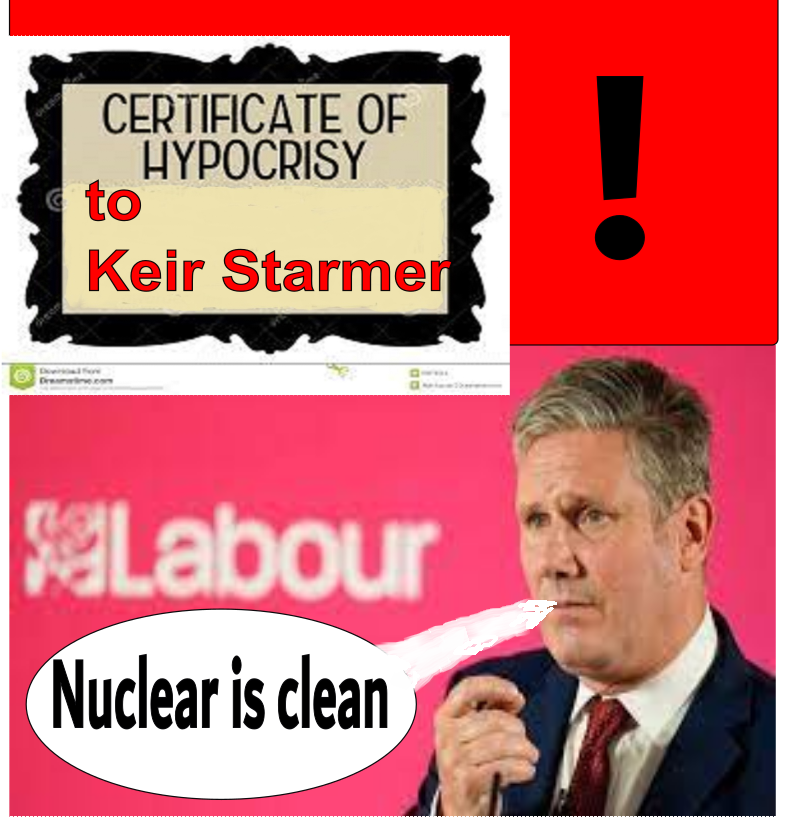
Prime Minister Sir Keir Starmer is set to give the final go ahead for the Sizewell C nuclear power station at the government’s spending review in the summer.
Reports in the national media suggested the Labour leader would approve investment for the nuclear plant – as well as unveiling plans for small modular reactors (SMR) around the country – before a government spending review in June.
A spokesperson for the Department for Energy Security and Net Zero (DESNZ) confirmed a decision on whether to proceed would be taken in the spending review and the new plant would play an “important role” in helping the UK achieve energy security.
In July 2022, Kwasi Kwarteng, the then Secretary of State for Business, Energy and Industrial Strategy, gave the go ahead for the Suffolk coastal plant, which is expected to cost in the region of £20 billion and provide power for six million homes.
Since then, the government has approved various tranches of funding for the project, including £2.7 billion in the autumn budget, in addition to £1.2 billion made available to the project since July last year.
However, campaign groups opposed to Sizewell C, including Together Against Sizewell C (TASC), have accused the prime minister of ignoring cost and time overruns and the environment impact of the project.
………….. a TASC spokesperson said the funding for Sizewell C would have been better spent on renewables.
He said: “It is staggering that Starmer is willing to sacrifice one of the UK’s most biodiverse areas and the precious Suffolk Heritage Coast for an ideological pursuit of growth in the form of new nuclear.
“Few can disagree that nuclear power is costly, potentially dangerous, slow to deploy, capital (not labour) intensive and is not ‘clean,’ condemning future generations to deal with the toxic legacy of thousands of tonnes of spent nuclear fuel.”
Campaigners launch legal challenge against Sizewell C planning decision
Alison Downes, from fellow campaigners Stop Sizewell C, said: “Despite huge pressures on public funding, news reports suggest the prime minister is prepared to pre-empt the spending review – and potentially flout the national pre-election period – by soon announcing that the government will commit billions more in taxpayers’ money to Sizewell C, in a flawed attempt to bolster his growth agenda.
“The reality is that Sizewell C will cost at least £40 billion for less than a thousand long term Suffolk jobs at the station.
“Yet very unpopular cuts are being made to other areas of spending, and even in the energy field that money could be put to better use.
“It could, for example, be used to bolster the Warm Homes Plan, which would lower household bills, reduce energy consumption and create many thousands of sustainable jobs nationwide, improving Labour’s chances of winning the next election.”
Russia holds all the cards.
| Walt Zlotow, Apr 11, 2025. Published in Chicago Tribune |
Tribune foreign affairs columnist Daniel DePetris (“Vladimir Putin obstructs President Donald Trump’s best-laid plans for Ukraine,” April 8) nibbles around the edges of reality concerning the Russia-Ukraine war. His current take on the war suggests that Russian President Vladimir Putin is sabotaging President Donald Trump’s best efforts to end the war quickly through negotiations in order to capture more Ukrainian territory.
But the reverse is true. The U.S., NATO and Ukraine are preventing the negotiations from achieving peace. Why? Because all of them refuse to accept the war will not end till they recognize and address Russia’s core interests: no NATO for Ukraine, neutrality for Ukraine going forward and an end to attacks on Russian-leaning Ukrainians in Donbas.
Putin is not feigning peace to stay on Trump’s good side merely to gobble up more Ukrainian territory. He’s simply not going to negotiate with adversaries who refuse to recognize Russia’s core interests. No peace agreement will occur in Trump’s first 100 days, nor even in his first 1,000 days, unless he accepts this reality of what it will take to end the war.
DePetris claims a frustrated Trump has but two options: ramping up the war with another multibillion-dollar weapons package to achieve victory or just walking away to saddle Europe with prosecuting it. Wrong. Trump has but one urgent task: Accept reality that Russia holds all the negotiating cards and will never cease hostilities till its core interests are addressed.
DePetris surely knows this. However, his career as a Defense Priorities fellow and a Tribune columnist is contingent upon never admitting or criticizing America’s role in provoking, if not starting, senseless wars and refusing to quickly, sensibly end them.
That is unfortunate for his readership. It is infinitely more unfortunate for the war-weary people of Ukraine.
Keir Starmer set to approve nuclear plant in bid to power up economic growth.
The prime minister is pinning his hopes of economic growth on a major nuclear plant and a series of mini nuclear sites
Archie Mitchell, Political correspondent, Independent 10th April 2025
Sir Keir Starmer is expected to approve a major nuclear power plant alongside a slew of mini reactors in a bid to boost Britain’s stagnant economy.
The prime minister will approve investment for the construction of the Sizewell C nuclear plant in Suffolk before the June spending review, The Times reported, as well as unveiling plans for a fleet of small modular reactors (SMRs) across the UK.
Sizewell C is expected to be up and running in 2035 and will provide 7 per cent of Britain’s energy demand at a cost of £20 billion……………………
Sizewell C is yet to be signed off by the government.
A decision on whether to give Sizewell C the green light has formed part of the government’s upcoming spending review, but Sir Keir has been bringing announcements forward in response to Donald Trump’s tariffs.
The PM has been desperately trying to spur on growth amid fears the US president’s trade war will cause Britain’s economy to stagnate and force further cuts in the autumn Budget.
EDF, the French energy giant that owns and runs Britain’s nuclear fleet, and the government, which has committed £6 billion so far, were the first backers of the project.
But they have been trying to raise billions more from prospective investors, including British Gas owner Centrica.
The government in January was forced to deny reports the expected costs of Sizewell C had spiralled to £40bn due to inflation and the knock-on effects of delays at Hinkley Point C.
Whitehall sources told The Independent the government is hugely supportive of Sizewell C, but that an announcement on its approval and funding would not come before June.
Sources told The Times Sir Keir wants to make a “nuclear moment” by combining the approval of Sizewell C with an announcement on a generation of SMRs.
The government has been running a competition to develop the reactors, which are potentially cheaper, much faster to build and easier to deploy, with Rolls-Royce and GE Hitachi Nuclear Energy the frontrunners. https://www.independent.co.uk/news/uk/politics/starmer-nuclear-growth-trump-tariffs-b2730868.html
Starmer appoints ex-Office of Fair Trading chief to lead nuclear regulatory taskforce
The prime minister has appointed ex-Office of Fair Trading boss John Fingleton to head up the country’s nuclear taskforce
Energy Voice, By Jessica Mills Davies, 10/04/2025
The UK government’s nuclear taskforce will be led by John Fingleton, formerly the boss of the Office of Fair Trading, following his appointment to spearhead the unit.
The Nuclear Regulatory Taskforce, which was set up to accelerate the development of new nuclear power stations across the country, is poised to embark on an overhaul of UK planning regulation.
In February, Keir Starmer moved to slash “red tape” in the industry to enable more nuclear power plants to be approved across England and Wales.
Those reforms are designed to enable small modular reactors to be built for the first time. That is the intended result of the government abolishing a set list of approved sites for nuclear development so that nuclear power stations can be built anywhere in the country.
The energy department said that contract negotiations to progress a competition for these small reactors, held by Great British Nuclear, are “currently underway”, and that a panel of nuclear experts will be appointed to the taskforce in due course.
In a controversial move, the government is also getting rid of expiry dates on nuclear planning rules, in an effort to avoid projects timing out.
These changes to nuclear planning rules were proposed after the pre-development stage Sizewell C nuclear plant in Suffolk was taken to court by local activists.
The Department for Net Zero and Energy Security said that the government committed a further £2.7 billion in public funding to Sizewell C last month………………………..
The independent taskforce will seek to identify how nuclear power regulation can incentivise investment in new projects more quickly and cost efficiently, it said………….
Fingleton said he will “work closely with business, regulators and other interested individuals and groups to identify how regulation can better enable and incentivise investment in this area”…………………. https://www.energyvoice.com/renewables-energy-transition/570966/starmer-selects-fingleton-to-head-up-nuclear-taskforce/
NFLAs ‘shout up’ for National Parks to be spared from nuclear development

Despite our objections and those of many in the antinuclear community, Energy Ministers and departmental civil servants remain intent upon introducing a new National Planning Statement, called the EN-7, which gives considerable latitude to prospective developers to site new nuclear plants more widely, subject to meeting certain criterion (called the ‘criteria-based approach’) and lifts any time limits (called ‘the removal of a deployment deadline’).
10th April 2025, https://www.nuclearpolicy.info/news/nflas-shout-up-for-national-parks-to-be-spared-from-nuclear-development/
NFLAs ‘shout up’ for National Parks to be spared from nuclear development
The Nuclear Free Local Authorities have made an emphatic plea to the government for National Parks to be definitively spared from development and for further ‘specific consideration’ to be given to the challenges attendant to siting so-called Small and Advanced Modular Reactors (SMRs and AMRs).
Despite our objections and those of many in the antinuclear community, Energy Ministers and departmental civil servants remain intent upon introducing a new National Planning Statement, called the EN-7, which gives considerable latitude to prospective developers to site new nuclear plants more widely, subject to meeting certain criterion (called the ‘criteria-based approach’) and lifts any time limits (called ‘the removal of a deployment deadline’).
Interestingly neither of these notions was popular amongst respondents in the initial consultation on the policy with only 47% supporting the first and 50% the second; which begs the NFLAs to ask the question: why change the existing policy which is based on a government led strategic assessment of sites to in effect a ‘free-for-all’?
As we did in response to the first stage consultation, so in the second the NFLAs ‘shout up…against new nuclear in any of our National Parks and on sites adjoining or threatening Sites of Outstanding Natural Beauty or Immense Heritage Value’. The Welsh NFLA affiliates are particularly passionate in seeking to defend Trawsfynydd, which lies at the heart of Eryri, the premier National Park of Wales, from new development. As we point out:
‘The principle that National Parks can be excluded from future nuclear development has already been established by Government diktat. Any part of the Lake District National Park in England has been specifically (and in our view rightly) excluded from any consideration as a prospective site of a future Geological Disposal Facility. Surely then Trawsfynydd being at the heart of the Eryri National Park should enjoy the same protection in law?
In our view, to do otherwise exposes UK Government policy as hypocritical and inconsistent, implying that the premier National Park of Wales is not worthy of the same protection as the premier National Park of England and unfortunately conveys the impression that Wales remains a rank colonial possession, rather than a nation in its own right, whose natural assets are open to exploitation by any major nuclear development of the most egregious kind’.
Only 59% of respondents in phase one backed the inclusion of ‘SMRS and AMRs alongside large-scale GW technologies’ within the policy, with the NGO community calling for a separate policy. Despite this, Ministers intend this policy to be one-size-fits-all. In this second phase consultation, the NFLAs have referenced the lack of ‘specific consideration’ of the ‘additional, and not entirely defined, challenges’ that accompany the inclusion of SMRs and AMRs.
There have been many recent reports of concerns amongst the nuclear industry and the academic community about the radioactive waste produced by smaller reactors and the security implications of a wider rollout of smaller reactors. The NFLAs have therefore requested that final version of EN-7 should require ‘SMR, AMR, Micro reactor developers to submit robust statements about their proposals to address radioactive waste management, safety, security and proliferation concerns’.
1
UK Government convenes AI Energy Council, but could be ignoring hidden climate impacts in supply chains
Edie 10th April 2025, Sidhi Mittal
The UK Government has officially launched its AI Energy Council, with its first meeting outlining five key priorities for aligning the country’s clean energy ambitions with the rapid growth of artificial intelligence (AI).
However, while the Council focuses on integrating AI intro the UK’s energy system, Ministers are being warned that they are overlooking the strain which AI supply chains are putting on energy systems overseas.
The Council is led by Science, Innovation and Technology Secretary Peter Kyle and Energy Secretary Ed Miliband. Representatives from companies including Microsoft, Google, Amazon, ARM, EDF and ScottishPower sit on the Council, alongside energy regulator Ofgem and the National Energy System Operator (NESO).
The Council this week met for the first time, and agreed on focus points for the year ahead. These include preparing the UK’s energy grid for the electricity demands of AI and computer infrastructure, accelerating renewable energy adoption, and ensuring AI’s role in the energy sector contributes to the transition to net-zero.
Emphasis was also placed on using AI to improve grid flexibility and ensuring its safe, secure deployment in the energy system.
This move comes amid growing pressure for the UK’s AI ecosystem to deliver more public benefit. A recent report from the Institute for Public Policy Research (IPPR) found that only 15% of AI firms in the UK are developing solutions aimed at social challenges such as public health or environmental sustainability, despite 20% having received public funding.
IPPR’s head of AI Carsten Jung said: “Too many companies are focussed on generic process improvements rather than coming up with new, better products. And too few innovations are aimed at solving big societal problems, such as public health and climate change.
“This quantity over quality, profit over purpose, speed over substance, approach is a hugely missed opportunity.”
But as the UK attempts to shape a greener AI-powered future through initiatives like the AI Energy Council, the global supply chain it relies on presents an emissions challenge far beyond its borders.
AI chip boom in East Asia drives fossil fuel surge
New research from Greenpeace East Asia has found that electricity demand for manufacturing AI chips has risen more than 350% between 2023 and 2024. East Asia—home to the bulk of global AI chip production—is seeing this growth largely powered by fossil fuels………………………..
Greenpeace East Asia’s supply chain project lead Katrin Wu said: “While fabless hardware companies like Nvidia and AMD are reaping billions from the AI boom, they are neglecting the climate impact of their supply chains in East Asia.
“Across East Asia, there are many opportunities for companies to invest directly in wind and solar energy, yet chipmakers have failed to do so on a meaningful scale.
“Hardware companies can overcome renewable energy bottlenecks by investing directly in wind and solar capacity, signing power purchase agreements, and leveraging their influence to advocate for a higher ratio of renewable energy in the grid.”……………………………………………………………. https://www.edie.net/uk-government-convenes-ai-energy-council-but-could-be-ignoring-hidden-climate-impacts-in-supply-chains/
EDF urged to tackle ‘nuclear rats’ infestation at Somerset power plant site
Unite and GMB trade unions have warned French energy giant EDF that urgent action is needed to tackle the massive rodent outbreak at the construction site of Hinkley Point C nuclear reactor in Somerset.
Katie Timms, Joshua Whorms, Somerset Live 9th April 2025
“Nuclear rats” have reportedly overrun the construction site of a new nuclear reactor in Somerset, raising alarm among workers about their health and safety as they contend with the pervasive rodent problem.
Trade unions Unite and GMB have urgently called on French energy giant EDF to take immediate action to address the significant rodent infestation at the Hinkley Point C nuclear reactor site.
Concerns are mounting for the wellbeing of the workforce tasked with constructing Britain’s first new nuclear power station in decades due to the burgeoning rat population, reports the Daily Star.
An insider at the site disclosed to the Observer: “They’re all over. You see them just sat there, looking at you. It is worse near the canteens, where I guess it started. But they are everywhere now.
“The more men working on the site, the more rubbish on the site and the canteens are not clean either. It has just become worse over time,” the source elaborated.
Other employees have described the situation as “quite grim”. Amidst the project exceeding its budget by a billion pounds, workers have voiced concerns that financial constraints imposed by EDF are compromising their working conditions and impacting their wages.
These persistent issues led to industrial action last November, with hundreds of electricians, pipe fitters, and welders ceasing work due to security worries…………………….
The Star previously reported on the alarming sight of “cat-sized rats” which ignited concerns about a potential outbreak of a rare bacterial disease in the UK’s second largest city.
Residents have reported sightings of enormous “rats the size of cats” prowling their streets, as industrial action by waste collectors has resulted in rubbish accumulating in the streets of Birmingham. There is growing concern among experts about these oversized rodents potentially leading to locals contracting Leptospirosis…………………………………
https://www.somersetlive.co.uk/news/somerset-news/edf-urged-tackle-nuclear-rats-10094730
The Flamanville EPR nuclear reactor will not be able to deliver its full power without major works.

According to our information, EDF has still not been able to identify the cause of the malfunction of the turbine in the Normandy reactor.
La Tribune Juliette Raynal, 04/07/25
After a doomed construction site, the Normandy reactor of the Flamanville EPR started up on December 21, twelve years behind schedule. Its entry into service does not signal the end of the problems, far from it. According to our information, the difficulties encountered with the turbo-alternator unit, the centerpiece of a nuclear power plant, will prevent the first French EPR from delivering its full electrical power without major intervention requiring the assembly of scaffolding inside a room that is difficult to access.
Contacted by La Tribune , EDF did not wish to comment on this information and indicated that it was maintaining its provisional schedule with the transition to 100% of its nominal power in the summer of 2025. “While technically the reactor could well reach its full thermal power in the coming months, the electrical power will be reduced by 10 to 20% due to the partial vacuum,” qualifies a well-informed source.
As we reported on March 13, EDF teams had to deal with abnormal heating in the turbo-generator unit. Located in the heart of the engine room, the 70-meter-long Arabelle turbine, manufactured by General Electric, but now owned by Arabelle Solutions, a subsidiary of EDF,
transforms the thermal energy contained in the steam into mechanical energy to drive the alternator that produces electricity.
The Arabelle turbine, the centerpiece of the power plant
In a technical document published following a general meeting, organized on February 25th within the framework of the Local Information Commission (CLI), the electrician revealed a malfunction: “The temperature increases beyond the authorized limit on stages 7 and 8 of the turbo alternator group when trying to reach the expected condenser vacuum . “
…………………………………….. the 57th reactor in the French fleet is still shut down due to a maintenance operation on equipment located in the nuclear part of the plant.
After several postponements, its start-up is expected on April 11. “While these adjustments allow the reactor to be restarted without exceeding the authorized heating levels, they will not allow it to operate at full power,” a well-informed source cautions. “The reactor will only be able to continue its tests at a partial vacuum,” the same source specifies.
……………………………..With the vacuum reduced, the turbine’s efficiency will be mechanically reduced and could therefore be between 10 and 20% below its nominal operating temperature.
The cause of the malfunction has not yet been identified.
“The work that has been carried out on the bearings is corrective work. It helps to reduce the fault that is causing excessive heating, but the teams involved do not expect this to completely resolve the problem. In short, it helps to treat the symptoms, but not the cause, which remains unidentified ,” reports this source.
According to our information, to attempt a diagnosis, EDF teams will have to install scaffolding inside the condenser itself. A room that is difficult to access since it is located just below the turbine. “It is an intrusive operation that requires a complete shutdown of the reactor for at least several weeks ,” according to this well-informed source.
“A nightmare to cope with”
Unlike a conventional shutdown for refueling, which lasts on average 30 to 40 days, this first break should last “at least 250 days ,” said Régis Clément, deputy director of EDF’s nuclear fleet division, during a press briefing on December 20. In other words, more than eight months. EDF also intends to take advantage of this interruption to replace the defective tank cover, required by the nuclear regulator.
While waiting for this operation, the various components of the turbine, due to its abnormal operation, could well be damaged. And for good reason, even if by lowering the vacuum level the defect becomes acceptable, it does not disappear. As a result, the bearings wear unevenly and mistreat the turbine. “This machine risks being a nightmare to operate ,” fears a person close to the case.
Declassified MoD document reveals US Visiting Forces across Britain are exempt from nuclear safety rules

CND 7th April 2025
At a time of heightened nuclear dangers, the Campaign for Nuclear Disarmament has uncovered shocking evidence that US military bases across Britain are exempt from UK emergency radiation regulations.
This means that bases like RAF Lakenheath, which is being prepared to host deadly new US nuclear weapons, is under no legal obligation to have emergency radiation plans in case of nuclear accidents.
A declassified exemption order shows that the government is putting so-called ‘national security’ before people’s safety.
CND is calling on Prime Minister Keir Starmer to announce in Parliament that no US nuclear weapons will be welcomed in Britain and that the exemption on adhering to legally required safety standards is revoked.
A letter from CND’s lawyers Leigh Day has forced the Ministry of Defence to declassify a significant nationwide exemption certificate, issued in March 2021 by former Defence Secretary, Ben Wallace, on the grounds of ‘national security’.
The certificate exempts Visiting Forces – primarily US military personnel – engaged in work with ionising radiations, from any legal enforcement of safety standards, using powers under Regulation 40 of the Ionising Radiations Regulations 2017 and Regulation 25 of the Radiation (Emergency Preparedness and Public Information) Regulation 2019. This means they are not legally bound to have in place plans and measures for emergency situations involving radioactive materials and nuclear weapons.
This is particularly dangerous given US preparations at RAF Lakenheath in Suffolk for a new nuclear weapons mission. However, the exemption not only covers RAF Lakenheath but all US military bases across Britain.
There are at least 10,000 US Department of Defence personnel stationed at 13 RAF bases. Nuclear material for Britain’s own nuclear weapons programme is regularly transported through RAF Brize Norton and RAF Fairford regularly hosts the US B2 nuclear-capable stealth bomber.
The government’s exemption means that local councils will never be told about the presence of nuclear weapons at these bases – and are therefore not obliged to produce their own emergency plans for a radiological accident. This puts the British population at even greater risk.
CND is calling on Prime Minister Keir Starmer to announce in Parliament that no US nuclear weapons will be welcomed in Britain and that the exemption on adhering to legally required safety standards is revoked. The majority of the British public don’t want US nuclear weapons in this country.
CND is upping pressure on the government, supporting two weeks of protest actions from Monday 14 April, culminating in a blockade of the base on Saturday 26 April. The peace camp and actions are organised by the Lakenheath Alliance for Peace, of which CND is a member………………………………………………………………………………………………. https://cnduk.org/declassified-mod-document-reveals-us-visiting-forces-across-britain-are-exempt-from-nuclear-safety-rules/
Radiation Monitoring – Scottish university in ‘world-first’ for nuclear technology
A “cutting-edge” radiation detector module for nuclear experiments has
been developed by staff and students at the University of the West of
Scotland (UWS) that will be deployed at the world’s top laboratories. The
detection module, which can be used for nuclear experiments, will have
“far-reaching impact” on the areas where radiation detection is required.
Herald 7th April 2025,
https://www.heraldscotland.com/news/25068881.scottish-university-world-first-nuclear-technology/
Hartlepool Nuclear site moved into enhanced regulatory attention
The Office for Nuclear Regulation (ONR) has moved Hartlepool Nuclear Power Station operated by EDF into enhanced regulatory attention for safety.
ONR has made the decision based on evidence gained from ongoing targeted engagements at the site which have identified areas where improvements are required.
The change in regulatory attention level does not relate to EDF’s recent decision to extend the operating lifetime of the station in County Durham, which is subject to ongoing safety standards being demonstrated.
The enhanced regulatory attention level reflects the effort ONR is using to influence improvements in areas including conventional health and safety, the number of site incidents and the production of nuclear safety cases.
ONR 7th April 2025, https://www.onr.org.uk/news/all-news/2025/04/nuclear-site-moved-into-enhanced-regulatory-attention/
Ex-Hinkley boss called ‘greedy toad’ over bribes
A senior manager at a nuclear power plant has been described to a tribunal as a “greedy little toad” over claims he accepted bribes.
Ashley Daniels, who worked at Hinkley Point C in Somerset under the French energy company EDF, accepted an £11,000 quad bike from a subcontractor looking to secure more work, the employment tribunal in Bristol heard.
Mr Daniels, who the BBC understands no longer works for the company, was not the subject of the tribunal, which was brought by a former employee of the subcontractor.
The tribunal heard Mr Daniels also received gifts including £2,000 hospitality tickets for a boxing match and a refill for his Montblanc fountain pen.
The hearing, for a claim of unfair dismissal, was brought by engineer Garrick Nisbet against the subcontractor, Notus Heavy Lift Solutions.
Mr Nisbet was dismissed without notice in April 2023 in the belief he had gifted the quad bike to Mr Daniels – at the time the head of lifting and temporary works at Hinkley – to “ensure that work was directed” to Notus, the hearing was told.
Speaking about messages he had sent regarding the alleged bribes, Mr Nisbet told the tribunal Mr Daniels was “cheeky and a greedy little toad”.
In other messages, the tribunal heard, he said the purchase of the quad bike would give Notus “a bit of breathing space”, later saying Mr Daniels was “hard to say no to”.
‘Clearly bribes’
Hinkley Point B halted operations in August 2022 having come to the end of its life, with Hinkley Point C under construction since late 2018………….
BBC 8th April 2025 https://www.bbc.co.uk/news/articles/cn7xv8vyzp3o
‘Better that Ukrainians don’t know the truth’ – Kiev’s spy chief

7 Apr 25, https://www.rt.com/russia/615336-budanov-harsh-reality-opinions/
General Kirill Budanov has said people should remain unaware of the “harsh reality” of the conflict with Russia
Many Ukrainians cannot handle the “harsh reality” of the conflict with Russia and should be kept in the dark about the details, Kiev’s military intelligence chief has said.
Three-star general Kirill Budanov expressed his views on information censorship during wartime in a conversation with journalist Anna Maksimchuk on Saturday, suggesting that much of the truth of the conflict should only become public knowledge to Ukrainians in the future.
During wartime, knowing the whole truth is not necessary. Otherwise, people may develop opinions,” Budanov said. “Some minds are not prepared to grasp the harsh reality. Let’s not put them to the test. Everything should be dosed.”
Since 2020, Budanov has led the Main Directorate of Intelligence of the Ukrainian Defense Ministry (HUR) – an agency reportedly rebuilt from scratch by the CIA following the 2014 armed coup in Kiev to serve as a tool against Russia.
Prior to the escalation of hostilities with Russia in 2022, Ukraine’s Vladimir Zelensky cracked down on critical media, claiming to do so in order to fight against local oligarchs under Moscow’s influence.
During the conflict, Kiev launched a news marathon with programming said to be directly controlled by the president’s office – which critics have called state propaganda. Additionally, under martial law, Zelensky banned several opposition parties, claiming they posed a national security threat.
Earlier this year, turmoil swept through Ukraine’s media landscape following US President Donald Trump’s decision to dismantle the US Agency for International Development (USAID), an organization used by Washington to promote its political agenda through foreign grants.
Researcher Oksana Romanyuk estimated in January that nearly 90% of Ukrainian outlets relied on foreign aid, with 80% specifically receiving funding from USAID.
1 This Month
Chernobyl: The Lost Tapes – A good documentary on Chernobyl on SBS available On Demand for the next 3 weeks– https://www.sbs.com.au/ondemand/tv-program/chernobyl-the-lost-tapes/2352741955560

of the week–London Campaign for Nuclear Disarmament

Tell the Ukrainian Government to Drop Prosecution of Peace Activist Yurii Sheliazhenko
To see nuclear-related stories in greater depth and intensity – go to https://nuclearinformation.wordpress.com
-
Archives
- April 2026 (152)
- March 2026 (251)
- February 2026 (268)
- January 2026 (308)
- December 2025 (358)
- November 2025 (359)
- October 2025 (376)
- September 2025 (257)
- August 2025 (319)
- July 2025 (230)
- June 2025 (348)
- May 2025 (261)
-
Categories
- 1
- 1 NUCLEAR ISSUES
- business and costs
- climate change
- culture and arts
- ENERGY
- environment
- health
- history
- indigenous issues
- Legal
- marketing of nuclear
- media
- opposition to nuclear
- PERSONAL STORIES
- politics
- politics international
- Religion and ethics
- safety
- secrets,lies and civil liberties
- spinbuster
- technology
- Uranium
- wastes
- weapons and war
- Women
- 2 WORLD
- ACTION
- AFRICA
- Atrocities
- AUSTRALIA
- Christina's notes
- Christina's themes
- culture and arts
- Events
- Fuk 2022
- Fuk 2023
- Fukushima 2017
- Fukushima 2018
- fukushima 2019
- Fukushima 2020
- Fukushima 2021
- general
- global warming
- Humour (God we need it)
- Nuclear
- RARE EARTHS
- Reference
- resources – print
- Resources -audiovicual
- Weekly Newsletter
- World
- World Nuclear
- YouTube
-
RSS
Entries RSS
Comments RSS
 nuclear-news