Flood warnings as Europe named as the fastest-warming continent in the world

Europe has been named the fastest-warming continent in the world in a
UN-led annual report. The UN-led European State of the Climate 2024, which
included contributions from about 100 scientists and experts, found that
last year was the warmest on record for the continent as countries were hit
by clear climate change impacts, extreme weather and record temperatures.
Released on Tuesday by the UN World Meteorological Organisation (WMO) and
the Copernicus Climate Change Service (C3S), the report details a year of
extremes.
Independent 15th April 2025, https://www.independent.co.uk/climate-change/flooding-spain-global-warming-un-report-b2733121.html
Campaign for Nuclear Disarmament (CND), to blockade RAF Lakenheath after US exemption to British nuclear safety rules revealed

Berny Torre, Sunday, April 13, 2025, https://morningstaronline.co.uk/article/cnd-blockade-raf-lakenheath-after-us-exemption-british-nuclear-safety-rules-revealed
PROTESTERS will set up a two-week peace camp outside RAF Lakenheath tomorrow after it emerged that all United States forces in Britain are exempt from meeting nuclear safety regulations.
And CND said that activists will block the Suffolk base on April 26, the last day of their vigil.
Declassified documents uncovered by CND show that former defence secretary Ben Wallace signed the “sensitive” waiver exempting US troops from telling local authorities they are storing nuclear weapons and exempt from sticking to regulations applied to radiation risks, leaving local authorities unable to draft disaster emergency plans.
It is known that RAF Lakenheath is being prepared to host new US nuclear weapons, but the March 2021 waiver exempts all US bases in Britain.
CND general secretary Sophie Bolt said: “Far from keeping people safe, all these nuclear weapons make Britain a target. Yet the government is more concerned about its special relationship with the US than people’s safety.
“The peace camp comes just as we learn that Britain’s cover-up of a US nuclear weapons deployment has been in the works for at least four years, alongside proof that people living close to any US base in this country, not just in East Anglia, are at great risk.”
Lakenheath Alliance for Peace co-founder Angie Zelter said: “It is horrifying and shameful that USAF Lakenheath, on British soil and with the connivance of the UK government, is involved in war crimes and genocide.
“Pilots from Israel and Saudi Arabia are trained at Lakenheath and US planes and bombs go out to take part in the bombings in Gaza and Yemen.
“We are here to say this is not in our name and to warn service personnel in the base that they should never obey illegal orders and should refuse to take part in the never-ending wars that are destroying people and planet.”
Greenham Common campaigner Ginnie Herbert said: “The cruise missiles left Greenham Common, international law changed and the common was handed back to the people.
“Forty years later and here we are protesting again as secret decisions are made and US nuclear weapons return to Lakenheath.”
The new camp will include a programme of events and actions taking place at the base and in nearby towns and villages.
A Ministry of Defence spokesman said: “It remains a long-standing UK and Nato policy to neither confirm nor deny the presence of nuclear weapons at a given location.”
Nuclear waste returns to Germany amid protests.
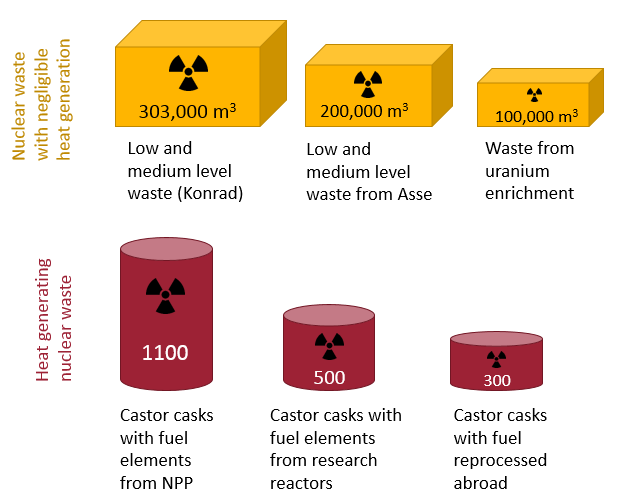
Matt Ford with dpa, NDR, 04/01/2025April 1, 2025, Edited by: Sean Sinico
https://www.dw.com/en/nuclear-waste-returns-to-germany-amid-protests/a-72108958
Seven containers filled with nuclear waste were transferred from ship to train in northern Germany for transport to Bavaria. But Germany still has no permanent storage solution for its radioactive material.
A ship carrying castor seven containers filled with highly radioactive nuclear waste docked in the northern German port of Nordenham, Lower Saxony, on Tuesday morning, amid protests and a heightened police presence.
The nuclear waste is being transported from Sellafield in northwest England to a temporary storage unit in Niederaichbach in the southern German state of Bavaria. The waste left the northwestern English port of Barrow-in-Furness last Wednesday and is being transferred from ship to train in Nordenham before continuing southwards. The nuclear waste was what remained after the reprocessing of fuel elements from decommissioned German nuclear power plants.
The first of the containers, which are four meters (13 feet) long and weigh over 100 tons, was lifted off the special “Pacific Grebe” transport ship by a large crane on Tuesday morning and underwent inspection to measure radiation levels and ensure they matched those taken in Sellafield.
The port in Nordenham remains sealed off and guarded by heavily armed police, who have thus far reported no incidents, despite a number of protests by anti-atomic energy groups.
Nuclear waste: Why are people protesting?
“Every castor container carries enormous risk,” said Helge Bauer from the protest group Ausgestrahlt, which means “radiated.” “Nuclear waste should, therefore, only be transported once — to a permanent storage site.”
Further protests are planned along the presumed route of the train carrying the waste over the coming days, including in the cities of Bremen and Göttingen.
“Every castor transport is one too many because it only postpones the problem and does not solve it,” Kerstin Rudek, a spokesperson for the group Castor-Stoppen, said in a statement, adding that nuclear waste should not be moved until a safe, final storage location is determined.
Where is the waste from if Germany phased out nuclear energy?
Germany began phasing out the use of nuclear power in 2003, a process which was accelerated following the Fukushima disaster in Japan in 2011. Germany’s final remaining nuclear power plants were shut down in 2023.
But Germany is still obligated to take back nuclear waste produced by used elements from its plants which, up until 2005, were regularly transported to reprocessing plants in Sellafield and La Hague, France. The transport of processed German nuclear waste back to the country has often been subject to protests.
According to the Society for Nuclear Service (GNS), over 100 castor containers were transported from La Hague to Gorleben, Lower Saxony, between 1995 and 2011. The final four were transported to Philippsburg, Baden-Württemberg, in 2024. Six containers were reportedly transported from Sellafield to Biblis, Hesse, in 2020, with seven more still to come.
Where does Germany store nuclear waste?
Germany’s Federal Company for Radioactive Waste Disposal (BGE) is still in the process of identifying a suitable location for the permanent underground storage of 27,000 cubic meters of nuclear waste produced over the course of 60 years of German nuclear energy production.
Nuclear waste, which can remain radioactive and, therefore, highly dangerous for hundreds of thousands of years, is currently stored in 16 temporary locations above ground, but it can’t stay there forever.
“We are using an empiric process to identify a location which offers the best possible security,” the BGE’s Lisa Seidel told public broadcaster NDR in November 2024.
CIA: Undermining and Nazifying Ukraine Since 1953

In 1969, AERODYNAMIC began advancing the cause of the Crimean Tatars. In 1959, owing to Canada’s large Ukrainian population, Canada’s intelligence service began a program similar to AERODYNAMIC codenamed «REDSKIN».
AERODYNAMIC continued into the 1980s as operation QRDYNAMIC, which was assigned to the CIA’s Political and Psychological Staff’s Soviet East Europe Covert Action Program. Prolog saw its operations expanded from New York and Munich to London, Paris, and Tokyo.
Assistant Secretary of State for European/Eurasian Affairs Victoria Nuland, the baked goods-bearing «Maiden of Maidan,» told the US Congress that the United States spent $5 billion to wrest control of Ukraine from the Russian sphere since the collapse of the Soviet Union. With the recent disclosures from the CIA it appears that the price tag to the American tax payers of such foreign shenanigans was much higher.
by Wayne Madsen, Voltaire Network | 14 January 2016
The CIA programs spanned some four decades. Starting as a paramilitary operation that provided funding and equipment for such anti-Soviet Ukrainian resistance groups as the Ukrainian Supreme Liberation Council (UHVR); its affiliates, the Organization of Ukrainian Nationalists (OUN) and Ukrainian Insurgent Army (UPA), all Nazi Banderists. The CIA also provided support to a relatively anti-Bandera faction of the UHVR, the ZP-UHVR, a foreign-based virtual branch of the CIA and British MI-6 intelligence services. The early CIA operation to destabilize Ukraine, using exile Ukrainian agents in the West who were infiltrated into Soviet Ukraine, was codenamed Project AERODYNAMIC.
The recent declassification of over 3800 documents by the Central Intelligence Agency provides detailed proof that since 1953 the CIA operated two major programs intent on not only destabilizing Ukraine but Nazifying it with followers of the World War II Ukrainian Nazi leader Stepan Bandera.
A formerly TOP SECRET CIA document dated July 13, 1953, provides a description of AERODYNAMIC: «The purpose of Project AERODYNAMIC is to provide for the exploitation and expansion of the anti-Soviet Ukrainian resistance for cold war and hot war purposes. Such groups as the Ukrainian Supreme Council of Liberation (UHVR) and its Ukrainian Insurgent Army (OUN), the Foreign Representation of the Ukrainian Supreme Council of Liberation (ZPUHVR) in Western Europe and the United States, and other organizations such as the OUN/B will be utilized». The CIA admitted in a 1970 formerly SECRET document that it had been in contact with the ZPUHVR since 1950.
The OUN-B was the Bandera faction of the OUN and its neo-Nazi sympathizers are today found embedded in the Ukrainian national government in Kiev and in regional and municipal governments throughout the country.
AERODYNAMIC placed field agents inside Soviet Ukraine who, in turn, established contact with Ukrainian Resistance Movement, particularly SB (intelligence service) agents of the OUN who were already operating inside Ukraine. The CIA arranged for airdrops of communications equipment and other supplies, presumably including arms and ammunition, to the «secret» CIA army in Ukraine. Most of the CIA’s Ukrainian agents received training in West Germany from the US Army’s Foreign Intelligence Political and Psychological (FI-PP) branch. Communications between the CIA agents in Ukraine and their Western handlers were conducted by two-way walkie-talkie (WT), shortwave via international postal channels, and clandestine airborne and overland couriers.
Agents airdropped into Ukraine carried a kit that contained, among other items, a pen gun with tear gas, an arctic sleeping bag, a camp axe, a trenching tool, a pocket knife, a chocolate wafer, a Minox camera and a 35 mm Leica camera, film, a Soviet toiletry kit, a Soviet cap and jacket, a .22 caliber pistol and bullets, and rubber «contraceptives» for ‘waterproofing film’. Other agents were issued radio sets, hand generators, nickel-cadmium batteries, and homing beacons.
An affiliated project under AERODYNAMIC was codenamed CAPACHO.
CIA documents show that AERODYNAMIC continued in operation through the Richard Nixon administration into 1970.
The program took on more of a psychological warfare operation veneer than a real-life facsimile of a John Le Carré «behind the Iron Curtain» spy novel. The CIA set up a propaganda company in Manhattan that catered to printing and publishing anti-Soviet ZPUHVR literature that would be smuggled into Ukraine. The new battleground would not be swampy retreats near Odessa and cold deserted warehouses in Kiev but at the center of the world of publishing and the broadcast media.
Read more: CIA: Undermining and Nazifying Ukraine Since 1953The CIA front company was Prolog Research and Publishing Associates, Inc., which later became known simply as Prolog. The CIA codename for Prolog was AETENURE. The group published the Ukrainian language «Prolog» magazine. The CIA referred to Prolog as a «non-profit, tax exempt cover company for the ZP/UHVR’s activities». The «legal entity» used by the CIA to fund Prolog remains classified information. However, the SECRET CIA document does state that the funds for Prolog were passed to the New York office «via Denver and Los Angeles and receipts are furnished Prolog showing fund origin to backstop questioning by New York fiscal authorities».
As for the Munich office of Prolog, the CIA document states that funding for it comes from an account separate from that of Prolog in New York from a cooperating bank, which also remains classified. In 1967, the CIA merged the activities of Prolog Munich and the Munich office of the Ukrainian exiled nationalist «Suchasnist» journal. The Munich office also supported the «Ukrainische Gesellschaft fur Auslandstudien». The CIA documents also indicate that US Federal Bureau of Investigation (FBI) agents may have interfered with AERODYNAMIC agents in New York. A 1967 CIA directive advised all ZPUHVR agents in the United States to either report their contacts with United Nations mission diplomats and UN employees from the USSR and the Ukrainian SSR to the FBI or their own CIA project case officer. CIA agents in charge of AERODYNAMIC in New York and Munich were codenamed AECASSOWARY agents. Apparently not all that taken with the brevity of MI-6’s famed agent «007», one CIA agent in Munich was codenamed AECASSOWARY/6 and the senior agent in New York was AECASSOWARY/2.
AECASSOWARY agents took part in and ran other AERODYNAMIC teams that infiltrated the Vienna World Youth Conference in 1959. The Vienna infiltration operation, where contact with made with young Ukrainians, was codenamed LCOUTBOUND by the CIA.
In 1968, the CIA ordered Prolog Research and Publishing Associates, Inc. terminated and replaced by Prolog Research Corporation, «a profit-making, commercial enterprise ostensibly serving contracts for unspecified users as private individuals and institutions».
The shakeup of Prolog was reported by the CIA to have arisen from operation MHDOWEL. There is not much known about MHDOWEL other than it involved the blowing of the CIA cover of a non-profit foundation. The following is from a memo to file, dated January 31, 1969, from CIA assistant general counsel John Greany, «Concerns a meeting of Greaney, counsel Lawrence Houston and Rocca about a ‘confrontation’ with NY FBI office on January 17, 1969. They discussed two individuals whose names were redacted. One was said to be a staff agent of the CIA since 8/28/61 who had been assigned in 1964 to write a monograph, which had been funded by a grant from a foundation whose cover was blown in MHDOWEL (I suspect that is code for US Press). One of the individuals [name redacted] had been requested for use with Project DTPILLAR in November 1953 to Feb. 1955 and later in March 1964 for WUBRINY. When the Domestic Operations Division advised Security that this person would not be used in WUBRINY, Rocca commented that ‘there are some rather ominous allegations against members of the firm of [redacted],’ indicating one member of that firm was a ‘card-carrying member of the Communist Party.’ The memo went on to say that Rocca was investigating the use of the individual in Project DTPILLAR concerning whether that person had mentioned activities in Geneva in March 1966 in connection with Herbert Itkin». Raymond Rocca was the deputy chief of the CIA’s Counterintelligence Division. Itkin was an undercover agent for the FBI and CIA who allegedly infiltrated the Mafia and was given a new identity in California as «Herbert Atkin» in 1972.
In 1969, AERODYNAMIC began advancing the cause of the Crimean Tatars. In 1959, owing to Canada’s large Ukrainian population, Canada’s intelligence service began a program similar to AERODYNAMIC codenamed «REDSKIN».
As international air travel increased, so did the number of visitors to the West from Soviet Ukraine. These travelers were of primary interest to AERODYNAMIC. Travelers were asked by CIA agents to clandestinely carry Prolog materials, all censored by the Soviet government, back to Ukraine for distribution. Later, AERODYNAMIC agents began approaching Ukrainian visitors to eastern European countries, particularly Soviet Ukrainian visitors to Czechoslovakia during the «Prague Spring» of 1968. The Ukrainian CIA agents had the same request to carry back subversive literature to Ukraine.
AERODYNAMIC continued into the 1980s as operation QRDYNAMIC, which was assigned to the CIA’s Political and Psychological Staff’s Soviet East Europe Covert Action Program. Prolog saw its operations expanded from New York and Munich to London, Paris, and Tokyo.
QRDYNAMIC began linking up with operations financed by hedge fund tycoon George Soros, particularly the Helsinki Watch Group’s operatives in Kiev and Moscow. Distribution of underground material expanded from journals and pamphlets to audio cassette tapes, self-inking stamps with anti-Soviet messages, stickers, and T-shirts.
QRDYNAMIC expanded its operations into China, obviously from the Tokyo office, and Czechoslovakia, Poland, Estonia, Lithuania, Latvia, Yugoslavia, Afghanistan, Soviet Central Asia, the Soviet Pacific Maritime region, and among Ukrainian-Canadians. QRDYNAMIC also paid journalist agents-of-influence for their articles. These journalists were located in Sweden, Switzerland, Australia, Israel, and Austria.
But at the outset of glasnost and perestroika in the mid-1980s, things began to look bleak for QRDYNAMIC. The high cost of rent in Manhattan had it looking for cheaper quarters in New Jersey.
Assistant Secretary of State for European/Eurasian Affairs Victoria Nuland, the baked goods-bearing «Maiden of Maidan,» told the US Congress that the United States spent $5 billion to wrest control of Ukraine from the Russian sphere since the collapse of the Soviet Union. With the recent disclosures from the CIA it appears that the price tag to the American tax payers of such foreign shenanigans was much higher.
Germany’s New federal government wants nuclear fusion instead of nuclear power plants – no word on nuclear energy in the coalition agreement.

Achim Melde, April 10, 2025, https://www.iwr.de/news/neue-bundesregierung-will-kernfusion-statt-atomkraftwerke-kein-wort-zur-atomenergie-im-koalitionsvertrag-news39104 Translation: Dieter Kaufmann, Working Group Against Nuclear Power Plants, Frankfurt am Main, Germany
Berlin – In the last election campaign, the CDU/CSU heavily criticized the “traffic light” coalition for shutting down the last three nuclear power plants in Germany and announced a return to nuclear energy. Following the election, however, the coalition agreement no longer mentions a single word about nuclear energy. Instead, the focus shifts to the use of nuclear fusion, which lies far in the future.
According to the current coalition agreement, the CDU/CSU-SPD coalition does not plan a return to nuclear power in Germany. The previously announced review and inventory of the recently shut-down nuclear power plants is also apparently off the table. Instead, the expansion of renewable energies will be further accelerated, and nuclear fusion is intended to solve the energy problem of the future.
Nuclear power plants: Union and SPD do not want to return to nuclear energy in Germany
Of the 17 nuclear power plants that were still in operation in Germany in 2010, a total of 14 nuclear power plants were shut down by the end of 2021 with the involvement of the CDU/CSU federal government. However, the shutdown of the last three nuclear power plants by the traffic light coalition, in particular, regularly caused criticism in Germany.
The coalition parties have not yet provided a justification for not considering nuclear energy. The reasons are likely varied, but all were known long before the elections. The advanced age and high costs of reactivating the old nuclear power plants would be just one of the numerous challenges. The most recently shut down nuclear power plants, Emsland (1985), Isar II (1988), and Neckarwestheim 2 (1989), are already 35 years old and have already exceeded their designed operating life. Furthermore, the dismantling of the old nuclear power plants is already underway; the Atomic Energy Act would have to be reopened, and the resulting additional nuclear waste would have to be re-regulated.
Energy industry is not available for new nuclear power plants – no price reduction effect from nuclear energy
Furthermore, the energy industry, as the operator of the old nuclear power plants that are to be reactivated, is unavailable. RWE CEO Markus Krebber has repeatedly rejected a return to nuclear power. The energy supplier EnBW has also ruled out restarting its decommissioned nuclear power plants, deeming the construction of new reactors unrealistic. E.ON CEO Leonhard Birnbaum, for his part, stated in an interview with Handelsblatt that there is no private company in Germany that would invest money in new nuclear power plants.
A price-reducing effect is also not expected from the expansion of nuclear power. The public often misunderstands that a higher electricity supply alone will lead to lower electricity prices. In fact, the formation of electricity prices on the exchange works differently, based on the marginal cost model (merit order).
All power plants used are ranked in the hourly auction according to their costs, from lowest to highest. The highest price of the last power plant to enter the auction determines the price for all other power plants. This “clearance price” is currently determined primarily by the gas price and thus by the gas-fired power plants. Cheaper power plants then play no role and do not lower the electricity price. The extremely high gas prices—and not a problem with the quantity of electricity—were a key driver of the subsequent exploding electricity prices following Russia’s invasion of Ukraine and the resulting rapid rise in inflation.

Fusion reactor: political timetables completely unrealistic
According to the coalition agreement, the coalition is committed to the use of nuclear fusion. The first fusion reactor in Germany is to be built afterward, and regulation will be outside of nuclear law. Bavarian Science Minister Markus Blume (CSU) predicted a period of 10 to 15 years for the realization of this technology, as of early 2025. Experts such as Dr. Reinhard Grünwald of the Institute for Technology Assessment and Systems Analysis (ITAS) consider this timeframe unrealistic.
After that, it will take at least another 20 years before the first demonstration reactor with a closed tritium cycle is available. Following that, a power plant that also generates electricity would have to be built. According to Grünwald, this would take another 20 years.
The ITER fusion device (Tokamak principle) currently under construction is a pure research facility, not designed as a demonstration reactor. The completion of the ITER research facility for test operation was postponed again last year, from 2024 to 2034 (instead of 2025).
In nuclear fusion, hydrogen atom nuclei are fused to form helium. Enormous amounts of energy are released in the process. This process takes place on the sun. The challenges are diverse and, due to the enormous ignition and combustion temperatures of 100 million degrees Celsius, range from material issues for the reactor walls to the production and handling of radioactive tritium.
UK deeply involved in Ukraine conflict – The Times
12 Apr 25 https://www.rt.com/news/615649-uk-involvement-ukraine-conflict/
Kiev allegedly refers to Britain’s military chiefs as the “brains” of the “anti-Putin” coalition, according to the exposé
Britain’s military leadership has played a far more extensive and covert role in the Ukraine conflict than previously known, not only designing battle plans and supplying intelligence, but also authorizing secret troop deployments inside the country to provide weapons training and technical support, according to a report by The Times.
While London’s political and military backing for Kiev has been public since the 2014 Western-backed coup, the extent of its involvement after the escalation in February 2022 “remained largely hidden… until now,” the British newspaper wrote on Friday, citing unnamed Ukrainian and British military officers.
The Times claimed that British troops were sent into Ukraine in small numbers on several occasions throughout 2022 and 2023, operating discreetly to avoid provoking Russia. In particular, UK forces were deployed to fit Ukrainian aircraft with Storm Shadow long-range cruise missiles and train pilots and ground crews in their use.
“UK troops were secretly sent to fit Ukraine’s aircraft with the missiles and teach troops how to use them,” the publication wrote, noting that it “would not be the first time British troops had been deployed on the ground.”
The UK had been delivering thousands of NLAW anti-tank missiles to Kiev and sending instructors to train Ukrainian soldiers in their use since 2015. While British troops were pulled out of Ukraine shortly before the escalation in February 2022, the deteriorating battlefield situation and the urgent need for technical expertise saw small teams of UK personnel redeployed quietly alongside fresh supplies of missiles, the newspaper reported.
London also reportedly played a key role in helping Ukraine prepare its much-touted 2023 “counteroffensive” against Russia – and in mediating between Kiev and Washington when the operation failed to meet US expectations.
The newspaper claimed that “behind the scenes,” the Ukrainians referred to Britain’s military chiefs as the “brains” of what they called an “anti-Putin” coalition. Former UK Defense Secretary Ben Wallace was even reportedly nicknamed “the man who saved Kiev” by military officials.
“The Americans went to Ukraine only on rare occasions because of concerns that they would be seen to be too involved in the war, unlike Britain’s military chiefs, who were given the freedom to go whenever necessary,” The Times wrote. “Sometimes their visits were so sensitive they went in civilian clothing.”
Moscow perceives the Ukraine conflict as a Western-led proxy war against Russia, in which Ukrainians serve as “cannon fodder.” It considers foreigners fighting for Kiev as “mercenaries” acting on behalf of Western governments.
Senior Moscow officials have suggested that the more complex weapon systems provided to Kiev are highly likely operated by NATO staff.
The presence of current and former NATO troops has also been tacitly admitted, but never openly confirmed, by Western officials. For example, last year, German Chancellor Olaf Scholz revealed the involvement of British and French forces in preparing Ukrainian missile launches, as he explained why Berlin would not supply similar weapons to Kiev.
Earlier this month, a New York Times investigation found that the administration of former US President Joe Biden provided Ukraine with support that went far beyond arms shipments – extending to daily battlefield coordination, intelligence sharing, and joint strategy planning, which were described as indispensable to Kiev’s fight against Russia.
Forget Sizewell C nuclear – go for a warm home plan

April 12, 2025, https://renewextraweekly.blogspot.com/2025/04/forget-sizewell-c-go-for-warm-home-plan.html
Sizewell C will cost much too much and there are much better alternatives. So says a new plan by Alison Downes of Stop Sizewell C and Colin Hines of the Green New Deal Group. They argue that ‘there is a clear political advantage from halting Sizewell C and redirecting the billions saved into making millions of homes more energy efficient, thus reducing fuel poverty’. They say this approach ‘will benefit every city, town, village and hamlet in Britain. It will generate long term, secure jobs, particularly for young people. It will be quick to implement, so by the next election new jobs and cheaper, warmer, healthier homes will have appeared in every constituency’
By contrast, they say ‘should Sizewell C go ahead, it is expected to cost around £40bn between now and when it opens, potentially around 2040: an average of £2.7bn per year for the next 15 years’. But, ‘deducting money already spent, if Sizewell is cancelled now, the public money saved by 2030 is £7.1bn, assuming (as seems likely) no private investors are found to share the cost.’ And they propose that ‘this £7.1bn should be added to the £6.6bn to be spent over the current Parliament on home energy efficiency, as promised in Labour’s 2024 manifesto.’ They say ‘this shift of funds would massively increase the chances of achieving the Government’s aim to ‘Make Britain a clean energy superpower to cut bills, create jobs and deliver security with cheaper, zero-carbon electricity by 2030, accelerating to net zero’.
It certainly does sound a strong case. On costs, they say that ‘no European Pressurised Reactor (EPR) project has ever been completed even close to budget or on time. All six EPR reactors worldwide have or will cost at least double their expected budgets and are, or have been, six to 14 years late. The case of Hinkley Point C is especially stark: EDF’s most recent estimates of the construction cost is up to £35bn [2015], or £46bn in 2023 money – almost double its £18bn [2015] budget when the FID was taken in 2016. These costs do not include financing costs, which EDF has said might double the total construction cost. Hinkley’s Unit 1 is now delayed to between 2029 and 2031, four to six years late, with the second reactor at least a year behind. EDF has made five cost and completion revisions for Hinkley since FID, and with several years to go, it is implausible that there will not be further revisions.’
Claims that there will be ‘replication’ cost savings seem to be illusory: ‘Taishan 1 & 2 in China took well over double the predicted build time and were reportedly 50% over budget. Olkiluoto 3 in Finland was 14 years late and three times over budget, and Olkiluoto 4 was cancelled. Flamanville 3 in France came online (though is not yet up to full power) 12 years behind schedule and four times over budget; £11.2bn [2015] for a single reactor. These repeated failures suggest that learning from previous EPRs has not happened, and at £17.5bn [2015] for each of Hinkley’s two reactors, replication seems to have increased cost’.
As an alternative, the report argues, we should cancel Sizewell and use the money saved to boost home energy efficiency and the Warm Homes plan. It notes that ‘Labour has promised to invest an extra £6.6bn over the next Parliament, doubling the existing planned government investment, to upgrade five million homes to cut bills for families.’ It says the Warm Homes Plan ‘will offer grants & low interest loans to support investment in insulation and other improvements such as solar panels, batteries and low-carbon heating to cut bills. Another aim is to ensure homes in the private rented sector meet minimum energy efficiency standards by 2030, potentially saving renters hundreds of pounds per year.’
And it says this could and should be dramatically expanded, ‘by more than doubling its budget to decarbonise and make the UK’s 30 million homes & buildings energy-efficient’. It notes that ‘the Energy Efficiency Infrastructure Group (EEIG) estimates that to carry out all of the necessary work needed to dramatically reduce emissions from homes between now and 2030 will require at least 250,000 more tradespeople’. And the report says that ‘were the Government to scrap Sizewell C and transfer the £7.1bn saved to making UK homes more energy efficient, this would allow it to fund what the EEIG describes as an ambitious zero-carbon skills strategy, working with industry, unions, schools, and colleges, to tackle any skills gaps that could hinder progress. Examples of required skills include those for designers, builders, and installers of energy-efficient and zero-carbon heating, for which demand will increase sharply. This should also result in a major expansion of high quality and advanced apprenticeships, backed up with new sector-led national colleges.’ And why not! And they should start with the fuel poor and the left behind.
That is very much what the new green heat campaign also has in mind- something that is also being pushed by the Association for Decentralised Energy. It’s part of Labour International’s green deal, looking at all the new green technology options, aiming to create jobs locally, not least by releasing money from having to be spent on high cash-cost heat, with added environmental costs. It says that ‘clean heat can play a major role in regenerating flagging local economies, making them more attractive to new inward investment due to the improved levels of disposable household incomes that result from reduced energy outgoings and increased opportunities to secure better employment and income. Higher levels of local economic demand are most likely to be expended in the local economies in which they arose, growing local economies wealth, health, resilience and prospects; beneficial economic outcomes that will feed up into the national economy.’
Is this sort of future going to happen? The official position is that Sizewell C will be funded by recourse to the Regulated Asset Base (RAB) model, with consumers paying up-front, in advance, before construction even starts. It is claimed that this would mean that, all being well, developers and backers will face less investment risks than otherwise, and can pass on savings to consumers. But will they? And will all go well? There can be big delays and overspends, as we have seen in the past. The report notes that ‘RAB would require residential consumers… to potentially financing half the total construction cost,’ and, if it goes bad, they could even be stuck with paying off excesses into the 22nd Century, when the plant is forecast to be retired.
The other key message from the developers and government is that we need more nuclear- to balance variable renewables. Well this is easily squashed. The last thing you want, if you are trying to back up a variable energy source, is a large, costly and inflexible one that can only run continuously at full output. There are plenty of alternative option for flexible balancing systems including short and long storage. With renewables booming and storage at last getting established, who needs Sizewell? Well it seems not EDF- so the UK has had to provide a further £2.7bn!
Kyiv working to repair Chornobyl nuclear site damaged by drone attack
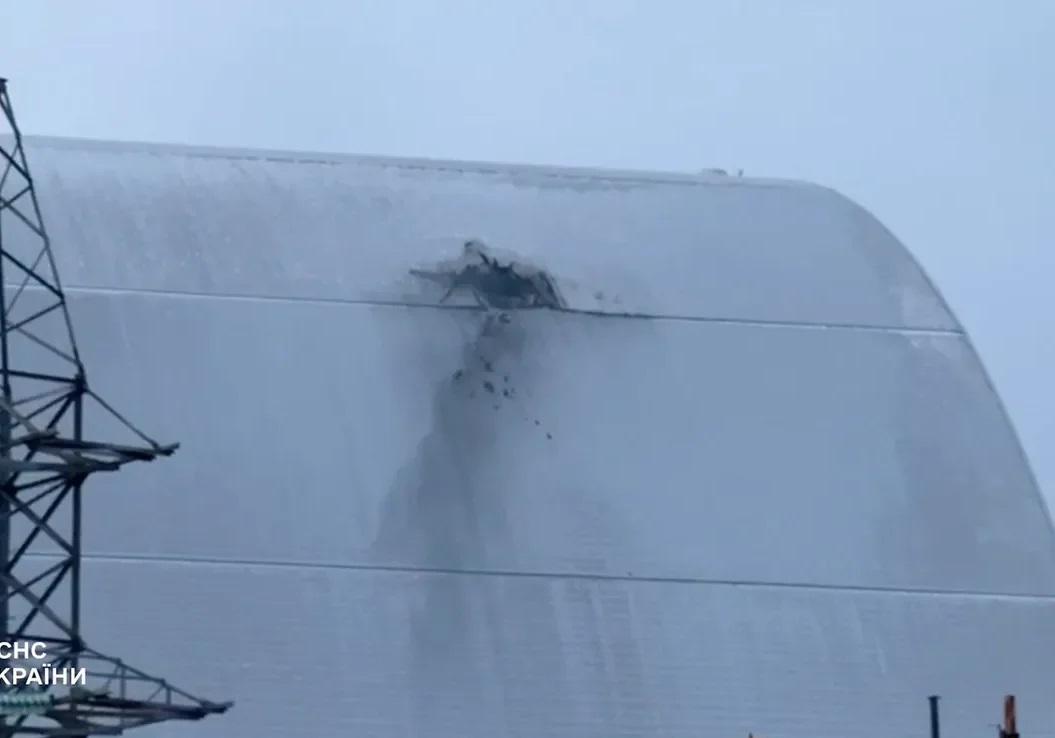
Environment minister says experts ‘actively working’ to prevent leaks in wake of February attack.
Ukraine is seeking solutions to repair the damage caused by a Russian drone attack to the
confinement vessel at the stricken Chornobyl nuclear power plant, a
government minister said on Saturday. Environment minister Svitlana
Hrynchuk said Ukraine was working together with experts to determine the
best way to restore the proper functioning of the containment vessel, or
arch, after the 14 February drone strike.
“We are actively working on
this … We, of course, need to restore the ‘arch’ so that there are no
leaks under any circumstances, because ensuring nuclear and radiation
safety is the main task,” she said. The arch was installed in 2019 to
cover the leaking “sarcophagus” underneath, hurriedly put in place in
the weeks following the 1986 Chornobyl disaster. The February drone attack
punched a large hole in the new containment structure’s outer cover and
exploded inside.
Guardian 13th April 2025,
https://www.theguardian.com/world/2025/apr/13/ukraine-war-briefing-kyiv-working-to-repair-chornobyl-nuclear-site-damaged-by-russian-attack
Ukraine is seeking solutions to the Chernobyl nuclear reactor’s damaged confinement vessel .
Ukraine is seeking solutions to repair the damage caused by a Russian
drone attack to the confinement vessel at the stricken Chornobyl nuclear
power plant, a government minister said on Saturday. Minister of
Environmental Protection and Natural Resources Svitlana Hrynchuk was
speaking outside the decommissioned station during the inauguration of a
0.8-megawatt solar power facility ahead of two conferences due to discuss
Chornobyl and other issues related to nuclear power operations.
Reuters 12th April 2025, https://www.reuters.com/world/europe/ukraine-seeking-solutions-damaged-chernobyl-confinement-vessel-minister-says-2025-04-12/
Ambassador does not deny Russian attempts to track UK subs
Alys Davies BBC 12th April 2025
Russia’s ambassador to the UK has not denied allegations that Russian sensors have been hidden in seas around Great Britain in an attempt to track UK nuclear submarines.
Andrei Kelin said that while he did not deny Russia was attempting to track British submarines, he rejected the idea that such activities presented a threat to the UK.
Asked on BBC One’s Sunday with Laura Kuenssberg whether he objected to the claims, Kelin said: “No”.
“I am not going to deny it, but I wonder whether we really have an interest in following all the British submarine with very old outdated nuclear warheads… all these threats are extremely exaggerated,” he said.
Pressed further by Kuenssberg, the ambassador added: “I’m denying existence of threats for the United Kingdom. This threat has been invented, absolutely, there is no threat at all from Russia to the UK.”
Kelin’s admission follows an investigation published by the Sunday Times earlier this month, detailing the discovery of alleged Russian sensors in seas around Britain.
In its investigation, the Sunday Times said the devices are believed to have been planted by Moscow to try to gather intelligence on the UK’s four Vanguard submarines, which carry nuclear missiles……………………………………………………………………………………..
https://www.bbc.co.uk/news/articles/c5yl2729nmjo
Nuclear waste sparks fury in Germany

Staff Writer April 4, 2025,
https://www.neimagazine.com/news/nuclear-waste-returned-to-germany-amid-protests/
The Pacific Grebe, a specialist nuclear transport vessel carrying radioactive nuclear waste from the UK, was met by anti-nuclear activists when it arrived at Nordenham port in north-western Germany. The nuclear waste was the result of reprocessing fuel elements from decommissioned German NPPs at the UK’s Sellafield site.
This was the second of three planned shipments. Seven flasks containing high level waste (HLW) were transported by rail from the Sellafield site in West Cumbria to the port of Barrow-in-Furness, where they were then loaded onto the Pacific Grebe, operated by Nuclear Transport Solutions (NTS).
Vitrified Residue Returns (VRR) are a key component of the UK’s strategy to repatriate HLW from the Sellafield site, fulfilling overseas contracts. The first shipment of six flasks each with 28 containers of HLW to Biblis took place in 2020.
he Pacific Grebe, a specialist nuclear transport vessel carrying radioactive nuclear waste from the UK, was met by anti-nuclear activists when it arrived at Nordenham port in north-western Germany. The nuclear waste was the result of reprocessing fuel elements from decommissioned German NPPs at the UK’s Sellafield site.
This was the second of three planned shipments. Seven flasks containing high level waste (HLW) were transported by rail from the Sellafield site in West Cumbria to the port of Barrow-in-Furness, where they were then loaded onto the Pacific Grebe, operated by Nuclear Transport Solutions (NTS).
Vitrified Residue Returns (VRR) are a key component of the UK’s strategy to repatriate HLW from the Sellafield site, fulfilling overseas contracts. The first shipment of six flasks each with 28 containers of HLW to Biblis took place in 2020.
According to Germany’s Federal Office for the Safety of Nuclear Waste Management (BASE – Bundesamt für die Sicherheit der nuklearen Entsorgung)) the transport licence for the latest shipment was approved in December. Until 2005 German utilities shipped used fuel from NPPs to La Hague in France and Sellafield in the UK for reprocessing: “The resulting liquid waste was then melted down into glass and has since been gradually returned to Germany,” BASE noted. “The last shipment of this waste from France was returned in November 2024.” There is one more shipment planned, after the current one, from the UK to complete the repatriation.”
BASE issued a licence in April 2023 for the storage of the vitrified waste at the Isar interim storage facility, which is licensed to hold a maximum of 152 casks of high-level radioactive waste and “according to current plans, there will be 28 fewer high-level waste casks there than originally intended, including the casks containing the vitrified waste”.
According to Germany’s Society for Nuclear Service (GNS – Gesellschaft für Nuklear‑Service), “The waste is massively shielded from external radiation. In the reprocessing plant, the waste is mixed with liquid silicate glass and poured into cylindrical stainless-steel containers, which are then sealed tightly after hardening. These containers, filled with the hardened glass mixture, are called “glass moulds”. For transport and storage, the moulds are placed in … massive, more than 100-tonne cast iron and stainless-steel containers, which have been proven in extensive tests to provide both strong shielding and to be safe under extreme conditions.”
Until 2011 reprocessed waste was sent to the Gorleben interim storage facility in Lower Saxony, where 108 casks of vitrified radioactive waste have been stored, which was “already a large proportion of the total waste to be returned from reprocessing”. BASE said, as part of the Site Selection Act of 2013 to seek a repository for high-level radioactive waste, the remaining vitrified waste abroad was to be stored in interim storage facilities at nuclear power plant sites.
“The aim was to avoid giving the impression that Gorleben had already been chosen as the site for a final storage facility during the open-ended search for a repository site. In 2015, the federal government, the federal states and the utility companies agreed to store the remaining radioactive waste in Biblis, Brokdorf, Niederaichbach (Isar NPP) and Philippsburg,” BASE noted.
France’s Orano completed the 13th and final rail shipment from France of vitrified high-level nuclear waste, to Philippsburg, in Germany in November 2024. In total 5,310 tonnes of German used fuel was processed at Orano’s La Hague plant up to 2008.
The latest shipment of waste from Sellafield is due to be transported to the interim storage facility at the site of the former Niederaichbach NPP in southern Bavaria. The Niederaichbach heavy water gas cooled reactor operated for only 18 months from 1972-1973. From 1975 to 1995 the plant was demolished and the site returned to greenfield condition. A monument marks its former location near the closed Isar NPP.
Germany’s Federal Company for Radioactive Waste Disposal (BGE – Bundesgesellschaft für Endlagerung) is in the process of identifying a suitable location for the permanent underground storage for 27,000 cubic metres of nuclear waste produced over the course of 60 years of German nuclear energy production.
On arrival at Nordenham port, the seven castor containers were transferred by crane from the Pacific Grebe to a train in the harbour, where tests were carried out to ensure legal radiation limits were not exceeded. The containers each measure four metres in length and weigh over 100 tonnes.
The train’s route to the Isar storage facility is not being publicised for security reasons.
Further protests are planned along the presumed route of the train over the coming days, including in the cities of Bremen and Göttingen. “Every castor transport is one too many because it only postpones the problem and does not solve it,” Kerstin Rudek, a spokesperson for the group Castor-Stoppen, said in a statement, adding that nuclear waste should not be moved until a safe, final storage location is determined.
Ukraine works to repair Chornobyl containment structure damaged in Russian drone strike
by Olena Goncharova, Kyiv Independent 13th April 2025 https://kyivindependent.com/ukraine-works-to-repair-chornobyl-containment-structure-damaged-in-russian-drone-strike/
Ukraine is working to repair damage to the containment structure at the Chornobyl nuclear power plant following a Russian drone strike in February, Environment Minister Svitlana Hrynchuk said on April 12.
Speaking at the site of the decommissioned plant, Hrynchuk noted that the strike had compromised the functionality of the massive protective arch installed in 2019 to prevent radioactive leaks.
The minister commented during the launch of a new 0.8-megawatt solar power station near Chornobyl ahead of two upcoming nuclear safety and energy conferences. She said that Ukraine is cooperating with international experts to assess the extent of the damage and determine the necessary steps to restore the arch’s integrity.
“Unfortunately, after the attack, the arch partially lost its functionality. And now, I think, already in May, we will have the results of the analysis that we are currently conducting …,” Hrynchuk said. “We are actively working on this … We, of course, need to restore the “arch” so that there are no leaks under any circumstances because ensuring nuclear and radiation safety is the main task.”
She added that the European Bank for Reconstruction and Development, as well as scientific institutions and companies involved in the arch’s original installation, are contributing to the analysis.
According to plant officials, the February 14 drone attack created a hole in the containment vessel’s outer layer and exploded inside. The Russian Foreign Ministry dismissed the incident as “a provocation.”
The structure was designed to enclose the unstable sarcophagus hastily built after the 1986 reactor explosion—the worst nuclear accident in history.
Hrynchuk also emphasized the importance of renewable energy in the Chornobyl exclusion zone, saying the new solar facility would support the site’s power needs.
“We have been saying for many years that the exclusion zone needs to be transformed into a zone of renewal,” she said. “And this territory, like no other in Ukraine, is suitable for developing renewable energy projects.”
Assessment result on the condition of the shelter at the Chornobyl Nuclear Power Plant (ChNPP) is due in May
The first results of an assessment on the condition of the shelter at the
Chornobyl Nuclear Power Plant (ChNPP), following a Russian drone attack,
will be available in May. In June, Ukraine plans to present proposals for
restoring the New Safe Confinement (NSC or the Arch) at the donor assembly
in London.
As reported by Ukrinform, this was announced by Ukraine’s
Minister of Environmental Protection and Natural Resources, Svitlana
Hrynchuk. “It’s currently hard to say how much the project timeline has
been delayed, because certain works at the site cannot be performed right
now. However, I want to assure everyone that the radiation background has
not changed in any way — even after the attack,” said Hrynchuk.
Ukrinform 13th April 2025, https://www.ukrinform.net/rubric-society/3981370-ministry-of-environment-results-of-chornobyl-shelter-assessment-following-russian-drone-attack-expected-in-may.html
Spain’s Nuclear Shutdown Set to Test Renewables Success Story

Plans to shut down all nuclear power plants by 2035 remain unchanged even as other countries delay closures and plan to build more.
Spain is moving forward
with plans to shut down its seven nuclear reactors over the next decade,
despite calls to reconsider, and will instead rely on renewables and
battery storage to fill the energy gap.
Bloomberg 11th April 2025, https://www.bloomberg.com/news/articles/2025-04-11/spain-s-nuclear-shutdown-set-to-test-renewables-success-story
Up to date costs of Sizewell C nuclear are over £40 billion, not the £20 billion quoted.

Letter: Dr Sarah Darby, Environmental Change Institute, University of Oxford.
Nuclear power’s bill: You cite the estimated cost of Sizewell C
nuclear power station as £20 billion (“Starmer powers ahead with plan
for new nuclear plant”, news, Apr 10). But this was the original estimate
and is a long way from the more recent figure of £40 billion, which itself
is well below any final sum once the costs of capital, decommissioning and
disposal are factored in.
The prime minister and the power company EDF
appear determined to see nimbyism as the main obstacle to nuclear power.
Yet the laws of physics and the experience of engineers tell us that
nuclear plants remain a complex, risky, time-consuming and expensive method
of producing steam to run turbines. It is not too late to steer the funding
in more productive directions. As industrialists and policymakers
increasingly recognise, renewables, efficiency and storage offer attractive
options for meeting our energy needs.
Times 12th April 2025 https://www.thetimes.com/comment/letters-to-editor/article/times-letters-tariffs-backdown-america-donald-trump-lrmsg87k6
1 This Month
Chernobyl: The Lost Tapes – A good documentary on Chernobyl on SBS available On Demand for the next 3 weeks– https://www.sbs.com.au/ondemand/tv-program/chernobyl-the-lost-tapes/2352741955560

of the week–London Campaign for Nuclear Disarmament

Tell the Ukrainian Government to Drop Prosecution of Peace Activist Yurii Sheliazhenko
To see nuclear-related stories in greater depth and intensity – go to https://nuclearinformation.wordpress.com
-
Archives
- April 2026 (152)
- March 2026 (251)
- February 2026 (268)
- January 2026 (308)
- December 2025 (358)
- November 2025 (359)
- October 2025 (376)
- September 2025 (257)
- August 2025 (319)
- July 2025 (230)
- June 2025 (348)
- May 2025 (261)
-
Categories
- 1
- 1 NUCLEAR ISSUES
- business and costs
- climate change
- culture and arts
- ENERGY
- environment
- health
- history
- indigenous issues
- Legal
- marketing of nuclear
- media
- opposition to nuclear
- PERSONAL STORIES
- politics
- politics international
- Religion and ethics
- safety
- secrets,lies and civil liberties
- spinbuster
- technology
- Uranium
- wastes
- weapons and war
- Women
- 2 WORLD
- ACTION
- AFRICA
- Atrocities
- AUSTRALIA
- Christina's notes
- Christina's themes
- culture and arts
- Events
- Fuk 2022
- Fuk 2023
- Fukushima 2017
- Fukushima 2018
- fukushima 2019
- Fukushima 2020
- Fukushima 2021
- general
- global warming
- Humour (God we need it)
- Nuclear
- RARE EARTHS
- Reference
- resources – print
- Resources -audiovicual
- Weekly Newsletter
- World
- World Nuclear
- YouTube
-
RSS
Entries RSS
Comments RSS
 nuclear-news