It’s good to talk: US-UK anti-nuclear alliance forged from film discussion
The NFLAs were delighted to partner with film makers and producers from
the United States in promoting the documentary film ‘SOS – The San
Onofre Syndrome: Nuclear Power’s Legacy’ and by participating in a
discussion last week of the issues raised. NFLA Secretary Richard Outram
joined US filmmakers James Heddle, Mary Beth Brangan and Morgan Peterson
for the discussion on Wednesday 11 June. UK participants were invited to
watch the documentary film before the event and then contribute their
questions and comments. Attendees included academics and activists from
several of the established campaigns opposed to nuclear power in the UK,
and their knowledge and experience helped make the discussion more
engaging.
NFLA 19th June 2025 https://www.nuclearpolicy.info/news/its-good-to-talk-us-uk-anti-nuclear-alliance-forged-from-film-discussion/
Improvements required following Barrow nuclear submarine site fire
The Office for Nuclear Regulation (ONR) has served an enforcement notice
on BAE Systems Marine Ltd (BAESML) following a fire at the
Barrow-in-Furness site in Cumbria. ONR’s enquiries found that five
employees entered an area in the Devonshire Dock Hall facility when the
fire was still in progress on 30 October 2024. As a result, two employees
were taken to hospital for treatment. Both employees were discharged and
returned to work on the same day. Enquiries concluded that the licensee’s
arrangements for ensuring workers did not enter places of danger without
the appropriate safety instructions were inadequate. There was also a lack
of guidance to inform staff of their required actions in the event of a
fire.
ONR 16th June 2025, https://www.onr.org.uk/news/all-news/2025/06/improvements-required-following-barrow-fire/
Scotland wants no part in further dangerous nuclear experiments
Frances McKie:
IN 1976 the British Government accepted the
findings of the Flowers Report, which advised: “It would be morally wrong
to commit future generations to the consequences of fission power on a
massive scale unless it has been established beyond reasonable doubt that
at least one method exists for the safe isolation of these wastes for the
indefinite future.”
In 1987, I attended a Venstre political conference in
Norway where Professor Torbjorn Sikkeland, the distinguished nuclear
physicist and radiation biophysicist, explained, with illustrations, that
nuclear fuels and nuclear waste would never be safely or securely
contained: they are simply too corrosive.
At the same conference, Professor
Sikkeland also declared that it was accepted by his colleagues that
hydrogen was the answer to world energy needs but it was unlikely to emerge
as an option while the nuclear lobby stood in the way of necessary research
and investment.
30 years later, radiation corrosion still plagues nuclear
reactors wherever and however they are built; there is still no safe
containment for the corrosive nature of nuclear waste In 2025, however,
despite the 40-year-old commitment to the common sense and morality of the
Flowers Report, we now have a desperate government in Westminster:
economically bankrupt, at the mercy of whatever corporate lobbyists come
their way.
Westminster, flailing around with post-Brexit bankruptcy, does
not have a meaningful energy, environment or defence policy: it has just
broadcast its latest version of panicky, ridiculous and dangerous ideas.
Scotland should have nothing to do with them – but continue calmly with
policies which bypass more failed nuclear experiments and the production of
nuclear waste that no-one, still, knows how to contain.
The National 20th June 2025, https://www.thenational.scot/community/25253405.scotland-wants-no-part-dangerous-nuclear-experiments/
Inside Britain’s top nuclear bunker.

Secure vaults containing decades-old enriched uranium and plutonium are
dotted across Britain’s sprawling atomic weapons establishment site in
the Berkshire countryside. Some are underground, inside 1960s-era
buildings, guarded by police on the roof tops armed with C8 Carbine assault
rifles used by the Special Air Service (SAS).
Cameras keep watch and
security guards patrol the perimeter — lined by a fence and razor wire,
like a prison — and 56 dogs are on hand to sniff out any sign of toxic
chemicals. “The guards and guns are not here to protect us, they are here
to protect the material,” said one of the scientists giving a tour of the
grounds. “You can’t get anywhere near them [the vaults] even if you
tried,” added another.
Times 19th June 2025,
https://www.thetimes.com/uk/defence/article/uk-nuclear-uranium-bunker-fr6szg6tn
Stop Sizewell C campaigner slams Labour lies over nuclear power

Alison Downes from the Stop Sizewell C campaign group spoke to Socialist Worker
Thursday 19 June 2025, https://socialistworker.co.uk/environment/stop-sizewell-c-campaigner-slams-labour-lies-over-nuclear-power/
Labour energy secretary Ed Miliband claims Britain needs new nuclear power plants “to deliver a golden age of clean energy abundance”.
But Alison Downes from the Stop Sizewell C campaign group says it’s the last thing we need to stop climate breakdown.
The Labour government pledged over £14 billion last week towards building a new nuclear power station on the Suffolk coast. Construction of Sizewell C began last year, next to the live Sizewell B plant.
Alison told Socialist Worker she opposes it because of “the climate emergency and the need for quick, cost effective action to reduce our carbon emissions”.
“This type of reactor has got such a bad track record in the other places where it’s been built, or attempted to be built,” she explained.
“And the slowness of completion all count against it as a solution for a climate emergency.”
The new nuclear plant would cost billions at a time when Labour is pushing austerity. Alison said, “In 2020 the cost was estimated at £20 billion and I think very credibly is now predicted at around £40 billion.
“Our assumption is that at least 50 percent of Sizewell C would be paid for by the taxpayer.”
She added, “A lot of this information is not in the public domain. Every time we ask, we get batted away with reasons of commercial confidentiality.
“But our understanding is that the government still intends to be a majority owner in the project.”
Sizewell C, which will be built by French state-owned company EDF, is expected to be operational some time in the 2030s.
It will be funded using a Regulated Asset Base model. This will guarantee EDF a return on its investments and means that electricity suppliers will contribute to the cost of building the plant.
“And that comes from consumer bills,” says Alison. “Consumers just have to keep paying for as long as the project is under construction.”
Radioactive waste disposal underlines that nuclear power is not an environmentally-friendly option.
In the long term, it would need to be stored deep underground.
Alison explained, “A disposal facility for all of Britain’s waste is under consideration. But they still haven’t found a willing host community in a place where the geology is suitable.
“We don’t really know when it would be available and how much it would cost. Sizewell B waste is here and is going to be here for decades to come.
“And, of course, you have big question marks about the impacts of climate change. Every time new studies are released they suggest that those impacts are bigger and faster than previously thought.
“So you have to factor in the cost of keeping this site safe from flooding for a century or more.”
The leaderships of the Unite and GMB unions have enthusiastically welcomed the Sizewell C announcement.
Alison said, “Well, of course, major infrastructure projects bring jobs. We definitely agree that opportunities for young people are very important. But they’re not necessarily very long term jobs.
“There was a major boom and bust in this area when Sizewell B was built. A lot of people feel that the area has really struggled in the aftermath as a result of the crash once construction was finished.
“The thing that really frustrates us about this is that the number of permanent long term jobs at Sizewell C is relatively small. It’s about 700 with a couple of hundred contractors.”
Alison said that home insulation would make people’s energy bills go down and create thousands of new jobs.
Stop Sizewell C has run advertising campaigns on the London Underground, lobbied county councils, met with ministers and stopped pension funds from investing in the project.
“Keir Starmer was due to come here last week and he cancelled at short notice,” said Alison. “I think he probably thought that it might be wise to stay away.”
Unions should fight for investment in green energy and a just transition for workers in nuclear.
Sizing up Sizewell C
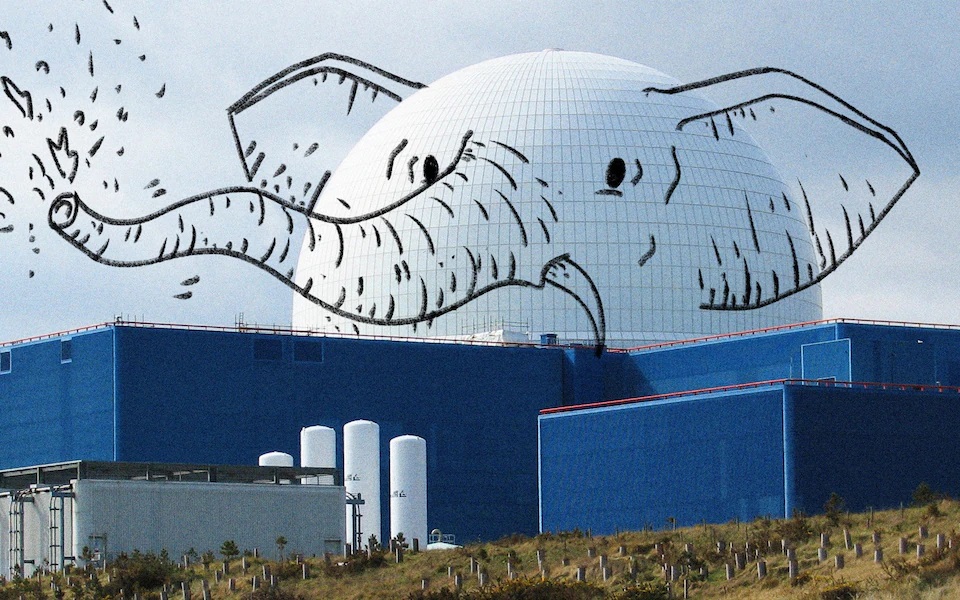
The British approach to nuclear power has been a disaster of nuclear proportion
The Critic Artillery Row By Matthew Kirtley, 19 June, 2025
s part of last week’s spending review, the government announced a further investment of £14.2bn for the Sizewell C nuclear power station. This puts the state’s total commitment into the project at £17.8bn.
Despite the scale of these numbers, the government’s pledges for Sizewell C seem to only cover a minority of the plant’s construction costs. That’s because, per leaks to the FT, Sizewell C’s construction budget is likely to balloon to over £40bn.
Government spokespeople have defended these costs by pointing out that Sizewell C is set to be significantly cheaper than the Hinkley Point C plant — conservatively, using CPI inflation, the latter’s construction costs are set to run up to £46.8bn in 2025 prices. The lessons from Hinkley Point C, which is a virtually identical facility that also uses the European Pressurised Reactor (EPR) architecture, are apparently being realised into cost savings.
However, this does conceal the big point: the EPR plants are both grossly expensive, relative to Britain’s historic plants. Sizewell B, the last new nuclear plant built in Britain, came online in 1995 and cost £2,030mn in 1987 prices — £5.85bn in 2025, using CPI inflation.
Even accounting for the fact that Sizewell B’s nameplate capacity is 1,250MW compared to the 3,260 MW of the two EPRs, the capital costs per MW are far more expensive. The construction costs of the cheaper EPR, Sizewell C, are set to stand at £12.3mn per MW. By comparison, Sizewell B’s construction costs amount to £4.7mn per MW. So even adjusting for inflation and plant size — which should nominally reduce the cost per MW via economies of scale — the EPR reactors are nearly three times more expensive than their predecessors.
So why has nuclear become so much more expensive?
One elephant in the room is the EPR architecture. The system was designed with the ethos of risk minimisation at all costs, employing countless redundancies. Whereas many contemporary pressurised water reactors minimise risk through passive safety systems, EPRs build in countless new pumps and active countermeasures to avert a disaster. The result is an orders of magnitude increase in plant complexity, and thus cost.
However, while there’s much to be said about the faults of EPR, it probably takes a backseat to a more pressing structural problem: the way that Britain funds nuclear projects……………………………………………………….
These heightened costs are felt by consumers — Hinkley Point C’s energy via exceptionally high energy prices through a pre-agreed Contract for Difference (CfD) price, and Sizewell C’s via increased energy bills during construction via a Regulated Asset Base (RAB) price hike. While in the long-run RAB is a better model than CfD for cost-minimisation, both still push up energy prices by forcing consumers to cover the far more expensive private debts of investors………….. https://thecritic.co.uk/sizing-up-sizewell-c/
Apollo to finance UK Hinkley Point nuclear plant with £4.5bn loan.
Funding for electricity group EDF, the UK’s largest ever private credit
deal, eases pressure on the troubled project. US private capital group
Apollo will provide £4.5bn in debt financing to support the UK’s Hinkley
Point C nuclear power station, easing mounting financial pressure on the
delayed and over-budget project. The investment-grade package will be
provided as unsecured debt at an interest rate just below 7 per cent,
according to people familiar with the matter. EDF, which is building two
new nuclear reactors at the site in Somerset, said it will be able to
borrow £1.5bn each year over three years as part of the package. The debt
has a maximum maturity of 12 years. The debt package addresses a
significant gap in the finances of the project, which has struggled with a
shortfall since China General Nuclear Power Group (CGN), which was supposed
to provide a third of the cost of the project, stopped providing further
financing in 2023.
FT 20th June 2025, https://www.ft.com/content/d4e6b540-ae57-434f-9eea-9d96431980e9
Westinghouse lobbies for site in Wales as Starmer backs nuclear renaissance
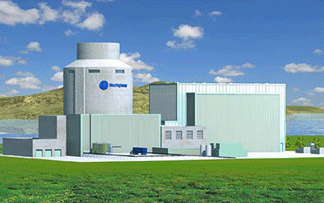
Westinghouse lobbies for site in Wales as Starmer backs nuclear renaissance US nuclear giant plans to build major nuclear power plant in Wales
Matt Oliver, Industry Editor
A US energy giant is in talks with Downing Street to build a major power plant off the
coast of Wales as Sir Keir Starmer throws his support behind a nuclear
renaissance in Britain. Westinghouse, which is also pursuing a US nuclear
expansion under Donald Trump, is understood to have presented plans for at
least two large reactors at Wylfa, in the Isle of Anglesey. It is lobbying
for the Welsh site to be kept in reserve for the project – which could
power several million homes – as the Government considers whether to put
mini nuclear plants there instead.
State-owned South Korean energy giant
Kepco was previously interested in the site but is said to have dropped the
plans after settling a global legal dispute with Westinghouse. Wylfa, where
a now decommissioned nuclear plant generated power until 2015, is seen as
attractive thanks to its ample space and favourable geology. The
Westinghouse plant would be similar in size to Hinkley Point C, in
Somerset, and Sizewell C, in Suffolk, which will use technology provided by
French nuclear giant EDF and come online in the 2030s.
In discussions with government officials, Westinghouse has claimed that a plant at Wylfa using its AP1000 reactors could also come online by the mid-2030s and for just a
fraction of the cost. An offer submitted by the company in February, which
was revised just weeks before Rachel Reeves unveiled her spending review,
proposes two reactors initially, with an option for another two later.
The discussions have surfaced as officials are separately negotiating a final
deal with Rolls-Royce to build the first small modular reactors (SMRs)
after the Derby-based company won a design competition. A location has not
been chosen but Wylfa is seen as one potential site alongside
Oldbury-on-Severn in Gloucestershire. Both are government-owned and Rolls
has said either would be suitable for its needs. But Westinghouse has
argued that Wylfa – regarded by the nuclear industry as the best site in
the country – is more suited to a large project.
The company is also understood to be interested in building SMRs elsewhere in the UK including at Moorside, Cumbria, which was recently made available for development by
the Government.
Telegraph 18th June 2025, https://www.telegraph.co.uk/business/2025/06/18/us-nuclear-giant-in-talks-with-no10-build-major-power-plant/
Alternative Defence Review
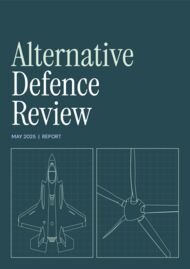
CND 23rd May 2025, https://cnduk.org/ADR/
The UK’s 2025 Strategic Defence Review comes at a moment of intensifying global conflict, escalating climate crisis and soaring UK inequality. Yet, rather than rethinking the country’s militarised foreign policy in response to these pressures, the Government proposes to dramatically increase defence spending, a move that risks worsening each of these crises.
This Alternative Defence Review challenges the dominant war narrative—cultivated by political elites, the military-industrial complex, and the mainstream media—and offers a new vision for peace, justice, and security.
It was proposed by CND in response to the RMT union’s decision to ‘… campaign with other trade unions and peace organisations to convene a labour and peace movement summit to work out the basis of a new foreign policy with the promotion of peace and social justice at its heart’. The Alternative Defence Review is intended to be a contribution towards this.
It examines how militarisation has distorted national priorities, fuelled global instability, undermined international law, harmed the environment, and diverted investment from public services and social infrastructure. It shows that increased military expenditure will be economically inefficient, environmentally destructive, and socially regressive, offering limited job creation while stifling a more sustainable and just economy. The review calls for a shift toward a significantly demilitarised defence strategy rooted in human security and common security—prioritising diplomacy, global cooperation, conflict prevention, and investment in health, education, climate resilience, social care, and the creation of well-paid, secure, unionised and socially useful jobs. It advocates for a significant reduction in military spending, an immediate halt to arms exports to countries involved in active conflict or human rights abuses (including Israel and Gulf states), and a Just Transition for defence-dependent workers and communities. This report offers a credible, democratic alternative to militarism: a sustainable economy grounded in social justice, global solidarity, and the urgent need to build peace—not war—for the 21st century.
You can download the report here.
You can order a copy of the report here.
Rosatom: A company at war

by beyondnuclearinternational, https://beyondnuclearinternational.org/2025/06/15/rosatom-a-company-at-war/
Nuclear state entity is on the ground in Ukraine and smoothing the way for new atomic tests, writes Charles Digges
If Russia’s state nuclear corporation Rosatom is to be believed, 2024 was a banner year.
It is expanding its footprint in new markets in Africa, Asia and the Middle East, as well as in Central Asian post-Soviet states. It is running an expansive development program along the Northern Sea Route, the 6,000-kilometer Arctic shipping corridor uniting Europe and Asia, and is responsible for everything from nuclear icebreaker construction to port infrastructure along its reach. It is powering the mining of rare earth minerals essential for renewable energy and electronics in operations from the Kola Peninsula to Siberia. It is acquiring domestic energy firms and making forays into transport, housing and utilities. And, of course, it is building nuclear power plants in foreign markets — including in some NATO members — at a pace unmatched by any other country or corporation.
But the slick commercial rhetoric belies the fact that Rosatom is a company that is literally at war.
As one of the Kremlin’s prize state industries, Rosatom has reoriented its practices to align with Moscow’s war economy as the invasion of Ukraine drags on. For this, it receives lavish state support and is overseen by members of President Vladimir Putin’s inner circle. Yet, unlike other energy producers in Russia’s oil and gas sectors, Rosatom has thus far managed to sidestep any serious sanctions from the West, attesting to the dependence it has fostered on the international nuclear market.
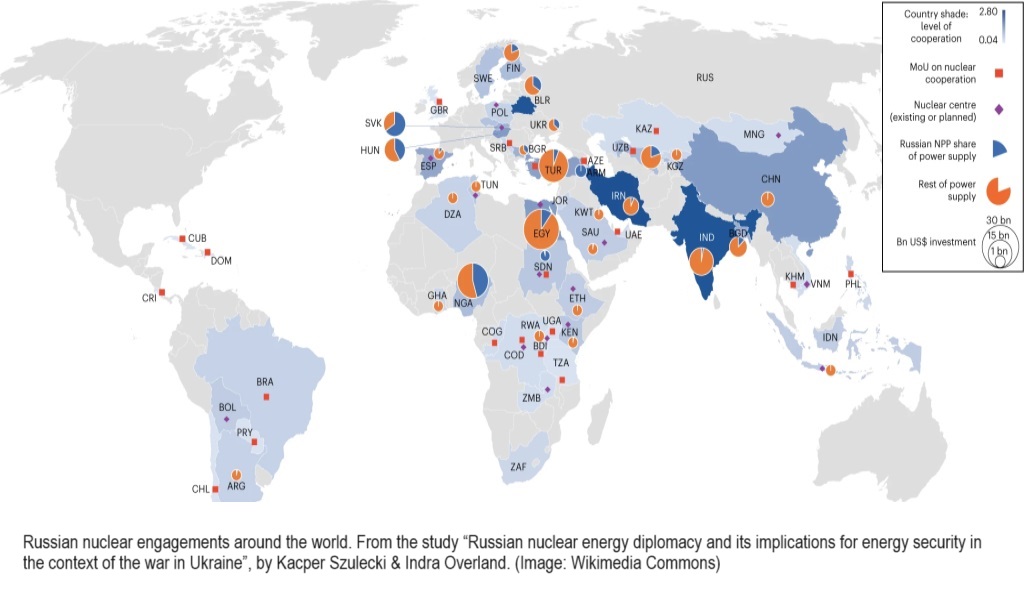
Recently, Western markets have begun to challenge Rosatom’s dominance as they attempt to shift their dependence away from Russian-produced nuclear fuels and other technologies. But our new report suggests that Rosatom is preparing for such shortfalls by changing customers and expanding its operations into industries beyond the nuclear — including further enmeshing itself in Moscow’s war as an active military participant. These are the corporate achievements that are less likely to appear in the company’s glossy public relations materials.
Rosatom at war
For instance, the putatively civilian corporation is helping Russian arms makers sidestep bans on Western-produced components for weapons used on the Ukrainian front. It has also developed technology for the Oreshnik line of ballistic missiles, producing a warhead tip so durable that the company brags it can withstand temperatures as hot as the surface of the Sun.
The corporation also seems to be smoothing the way for various weapons tests, including nuclear tests, on Novaya Zemlya, an Arctic archipelago used by the Soviets as an atomic bomb testing range. Most recently, it has been the site of trials for the Burevestnik nuclear-powered cruise missile developed by Rosatom technicians.
Russia’s recent withdrawal from its ratification of the Comprehensive Nuclear Test Ban Treaty and its abandonment of other arms agreements with the West coincides with a hive of activity on this frozen strip of land, suggesting Russia may be moving back toward testing nuclear weapons. Rosatom, the steward of Russia’s nuclear arsenal, will surely be at the center of it.
Rosatom likewise continues to tighten its grip on the Zaporizhzhia nuclear power plant in Ukraine — Europe’s largest atomic energy station — which the Russian military seized in the opening days of its invasion in 2022. It is widely assumed from the Kremlin’s official statements that Rosatom intends to absorb the plant, making it the 12th nuclear power plant in its purview — and marking one of the most breathtaking seizures of war booty in modern warfare.
What the corporation is ignoring
Alongside these endeavors stands the fact, which Rosatom is loath to mention in its brochures, that Rosatom’s domestic fleet of 36 reactors is aging. Most need to be replaced by 2065, but the funds for this are severely lacking. The company’s current plans to extend runtimes at several aged Chernobyl-style reactors suggest that this is a problem the corporation will not be able to solve anytime soon.
Rosatom has also snuffed out its past efforts to clean up Russia’s Soviet nuclear legacy, retooling many of the constituent enterprises that were responsible for that to handling non-nuclear hazardous waste. These moves turn away from more than two decades of effort with the international community and mark the corporation’s increasing efforts to shut itself off both from the West and from scrutiny at home.
The war in Ukraine and accompanying stifling of civil society organizations — including my employer, Bellona — that once held Rosatom to account has fueled that opacity.
In fact, such organizations once formed Rosatom’s Public Council, which kept the corporation in conversation with environmentalists and the public it purported to serve. While the Public Council still exists, it is staffed by Putin’s cronies, including one from his intramural hockey team.
Nor is there anything left of the robust network of strident Russian-grown, anti-nuclear NGOs that for years fought to keep Rosatom’s activities in the public eye. Their disappearance has left Rosatom to its own secretive devices, the organizations themselves hounded out of existence by the Kremlin’s war bureaucracy.
Rosatom helps Moscow divide the world
All of this taken together — both what the corporation will and will not tell us — paints a picture of Rosatom as primarily a formidable political tool. This allows it to couple a broad mandate at home with a campaign of influence abroad. By offering its reactor customers enormous state-backed loans to build nuclear plants that Rosatom will service, fuel and, in many cases, even staff for decades to come, the corporation is vital to creating regimes that are friendly to — and dependent on — Moscow around the world.
While the war in Ukraine has perhaps cost Rosatom some of its former markets in the West, the company has, as our report shows, survived these geopolitical shifts and remained a powerful vector of Russian influence. As a result, the company will continue to help cleave away many of the world’s nations to Moscow’s geopolitical cause.
Charles Digges is an environmental journalist and researcher who edits the website of the Norway-based NGO Bellona.
Government holds no record of taxpayer funding arrangements for UK’s historic nuclear stations

17 Jun, 2025 By Tom Pashby, https://www.newcivilengineer.com/latest/government-holds-no-record-of-taxpayer-funding-arrangements-for-uks-historic-nuclear-stations-17-06-2025/
The government has revealed that it doesn’t know how much public money was spent on any of the country’s 19 historic nuclear power plants ahead of their respective final investment decisions (FIDs).
The FID is the agreement between public and private parties on how a major project will be funded, paving the way for the main construction to commence.
Pre-FID financing has risen up the agenda because of the £18bn of public money spent on Sizewell C despite its FID not having been confirmed. This means that the project is not yet guaranteed to go ahead and presents huge risks for taxpayers if the scheme falls through.
- You are here:Latest
Government holds no record of taxpayer funding arrangements for UK’s historic nuclear stations
17 Jun, 2025 By Tom Pashby
The government has revealed that it doesn’t know how much public money was spent on any of the country’s 19 historic nuclear power plants ahead of their respective final investment decisions (FIDs).
The FID is the agreement between public and private parties on how a major project will be funded, paving the way for the main construction to commence.
Pre-FID financing has risen up the agenda because of the £18bn of public money spent on Sizewell C despite its FID not having been confirmed. This means that the project is not yet guaranteed to go ahead and presents huge risks for taxpayers if the scheme falls through.
The rhetoric from the government about Sizewell C is centred on its confidence about the future of the project, but potential private sector investors including Centrica have aired concerns about the viability of the power station.
NCE submitted a request using the Freedom of Information Act (FOI) to the Department for Energy Security and Net Zero (DESNZ) for information on how much public money was committed to the UK’s 19 historic nuclear energy projects ahead of their respective FIDs or equivalent project milestones.
The 19 projects were Calder Hall, Chapelcross, Berkeley, Hunterston A, Hinkley Point A, Bradwell, Trawsfynydd, Dungeness A, Sizewell A, Oldbury, Wylfa, Dungeness B, Hunterston B, Hinkley Point B, Hartlepool, Heysham 1, Heysham 2, Torness and Sizewell B.
All are either operating or in the decommissioning phase of their lifecycles.
In response to the FOI request, DESNZ said: “The department does not hold the historic information requested relating to the UK’s current operational fleet, and projects which have been or are being decommissioned.”
DESNZ added that “the government did not make any funds available” to Hinkley Point C ahead of its FID.
“For Sizewell C, details of the subsidy schemes made by the government and the funds made available can be found on the subsidy transparency database,” it added.
“The DEVEX Scheme has been made for £5.5bn for the SZC company. Under this scheme to date £3.9bn has been awarded to the company – which would be available for them to draw down. Other future awards may be made up to the maximum amount of the scheme.”
The statements from DESNZ on Sizewell C were made ahead of the Spending Review (SR). The day before the SR, the chancellor of the exchequer committed additional public money to the project, bringing total pre-FID public support for the plant to £18bn.
Sizewell C facing scrutiny of its total costs
Campaigners and politicians have spent years trying to get the UK Government to reveal the estimated total costs of Sizewell C, including by calling for the National Audit Office and Office for Value for Money to review the project.
The total final cost estimate has not been officially revealed, with the government citing concerns about commercial sensitivity. The Financial Times reported in January 2025 that costs are expected to reach £40bn, though the government has said it does not recognise this figure.
In a letter dated 10 June 2025, the Office for Value for Money confirmed to the National Audit Office that it would not be looking at the project.
Office for Value for Money independent chair David Goldstone said: “In line with our principle not to duplicate the work of others we did not review HS2, Sizewell C and Dreadnought, as they are already subject to extensive review processes.”
Stop Sizewell C executive director Alison Downes told NCE: “The government continues to stonewall questions about Sizewell C’s cost, and how £6.4bn of taxpayers’ money ahead of a final investment decision is being used, an amount that is double what was spent by EDF at Hinkley Point C to get to the same point.
“Given the further £11.5bn allocated to Sizewell C over the next few years, and the fact that consumers could soon begin to pay a Sizewell tax on their bills, it is woeful that the independent chair of the Office of Value for Money decided not to scrutinise this monster of a project.”
DESNZ was approached for comment but did not provide one.
EDF scaled back financial interest in Sizewell C
- You are here:Latest
Government holds no record of taxpayer funding arrangements for UK’s historic nuclear stations
17 Jun, 2025 By Tom Pashby
The government has revealed that it doesn’t know how much public money was spent on any of the country’s 19 historic nuclear power plants ahead of their respective final investment decisions (FIDs).
The FID is the agreement between public and private parties on how a major project will be funded, paving the way for the main construction to commence.
Pre-FID financing has risen up the agenda because of the £18bn of public money spent on Sizewell C despite its FID not having been confirmed. This means that the project is not yet guaranteed to go ahead and presents huge risks for taxpayers if the scheme falls through.
The rhetoric from the government about Sizewell C is centred on its confidence about the future of the project, but potential private sector investors including Centrica have aired concerns about the viability of the power station.
NCE submitted a request using the Freedom of Information Act (FOI) to the Department for Energy Security and Net Zero (DESNZ) for information on how much public money was committed to the UK’s 19 historic nuclear energy projects ahead of their respective FIDs or equivalent project milestones.
The 19 projects were Calder Hall, Chapelcross, Berkeley, Hunterston A, Hinkley Point A, Bradwell, Trawsfynydd, Dungeness A, Sizewell A, Oldbury, Wylfa, Dungeness B, Hunterston B, Hinkley Point B, Hartlepool, Heysham 1, Heysham 2, Torness and Sizewell B.
All are either operating or in the decommissioning phase of their lifecycles.
Related questions you can explore with Ask NCE, our new AI search engine.

- What is Centrica’s potential investment in Sizewell C?
- What is the Sizewell C Devex Scheme’s total value?
- Why is Sizewell C’s value for money facing scrutiny?
- How could Sizewell C funding affect my energy bills?
- What is the UK’s strategy for increasing nuclear power capacity?
If you would like to ask your own question you just need to login, register or subscribe.
In response to the FOI request, DESNZ said: “The department does not hold the historic information requested relating to the UK’s current operational fleet, and projects which have been or are being decommissioned.”
DESNZ added that “the government did not make any funds available” to Hinkley Point C ahead of its FID.
“For Sizewell C, details of the subsidy schemes made by the government and the funds made available can be found on the subsidy transparency database,” it added.
“The DEVEX Scheme has been made for £5.5bn for the SZC company. Under this scheme to date £3.9bn has been awarded to the company – which would be available for them to draw down. Other future awards may be made up to the maximum amount of the scheme.”
The statements from DESNZ on Sizewell C were made ahead of the Spending Review (SR). The day before the SR, the chancellor of the exchequer committed additional public money to the project, bringing total pre-FID public support for the plant to £18bn.
Sizewell C facing scrutiny of its total costs
Campaigners and politicians have spent years trying to get the UK Government to reveal the estimated total costs of Sizewell C, including by calling for the National Audit Office and Office for Value for Money to review the project.
The total final cost estimate has not been officially revealed, with the government citing concerns about commercial sensitivity. The Financial Times reported in January 2025 that costs are expected to reach £40bn, though the government has said it does not recognise this figure.
In a letter dated 10 June 2025, the Office for Value for Money confirmed to the National Audit Office that it would not be looking at the project.
Office for Value for Money independent chair David Goldstone said: “In line with our principle not to duplicate the work of others we did not review HS2, Sizewell C and Dreadnought, as they are already subject to extensive review processes.”
Stop Sizewell C executive director Alison Downes told NCE: “The government continues to stonewall questions about Sizewell C’s cost, and how £6.4bn of taxpayers’ money ahead of a final investment decision is being used, an amount that is double what was spent by EDF at Hinkley Point C to get to the same point.
“Given the further £11.5bn allocated to Sizewell C over the next few years, and the fact that consumers could soon begin to pay a Sizewell tax on their bills, it is woeful that the independent chair of the Office of Value for Money decided not to scrutinise this monster of a project.”
DESNZ was approached for comment but did not provide one.
EDF scaled back financial interest in Sizewell C
EDF is the minority (14.6%) owner of Sizewell C, while the UK Government is the majority (85.4%) owner. This ownership split was accurate as of March 2025.
EDF is a French state-owned energy giant, and the French public auditor Cour des comptes # said in January 2025 that EDF should scale back its involvement in UK nuclear projects.
The auditor said “a final investment decision on [Sizewell C] should not be approved until a significant reduction in EDF’s financial exposure to the Hinkley Point project has been achieved.
“[Cour des comptes] also recommends ensuring that any new international nuclear project generates quantified gains and does not delay the timetable for the EPR 2 programme in France.”
Labour’s nuclear dream has destroyed my home: inside the Sizewell C planning row.

As the Government pledges £14.2 billion for the new power
station on the Suffolk coast, it faces fierce opposition from residents.
Eastbridge, a small Suffolk village two miles inland from the coast,
surrounded by marshland, has looked much the same for centuries.
Over the past year, however, it has been transformed. Huge swathes of the
surrounding countryside have been dug into a strange lunar landscape of
sand and soil to make way for construction associated with Sizewell C,
including a vast accommodation campus for workers on the outskirts of the
village. The scale of the site is only really clear from aerial
photographs, which shows a patchwork of grey, orange and brown where there
once was lush green. And this is just the beginning.
Last week, the Government pledged £14.2 billion for the project at Sizewell, which will
eventually provide low-carbon electricity for six million homes for a
lifespan of 60 years. The only published overall cost for the scheme was
£20 billion in 2020, but it has reportedly now ballooned to over £40
billion. Still a fair price, many argue, for a source of “clean,
homegrown power” – as Ed Miliband says – to future-proof Britain’s
energy security.
Inevitably, however, it has faced fierce opposition from
residents in the surrounding area, with some locals arguing the Government
hasn’t counted the true cost of the lengthy construction period and the
damage to the natural landscape and neighbouring communities.
Alison Downes, the director of Stop Sizewell C, began campaigning against the
project in 2013 on the grounds of the impact on the local area. “In the
early days we were trying to persuade the project to amend its proposal,
including the location of the [accommodation] campus at Eastbridge,” she
says. “It was of grave concern that it was proposed for 3,000 people –
it’s gone down a little bit, but not much.” Then, she says, as she
learnt more about the project, “all these other issues [came] to the
fore.” Downes, a career campaigner, has wisely focused on scrutinising
Sizewell on issues of national, rather than localised, importance.
Stop Sizewell C argues that the project is bad value for money, will be too slow
to address climate change (it will take at least 10-12 years to build,
according to the EDF), and will ultimately load too much risk onto the
taxpayer.
Telegraph 18th June 2025,
https://www.telegraph.co.uk/news/2025/06/18/labours-nuclear-dream-has-destroyed-my-home-inside-the-size/
UK’s Bakers’ union rejects new nuclear reactors, calls for socialist Green New Deal
Bakers’ union rejects new nuclear reactors, calls for socialist Green New
Deal. Tens of thousands of energy jobs could be created with a socialist
Green New Deal without the need of new nuclear reactors, the bakers’
union said today. Delegates from the Bakers, Food and Allied Workers Union
(BFAWU) passed a motion calling for the democratic public ownership of all
forms of energy. They condemned the loss of skilled jobs in North Sea
industry and Grangemouth oil refinery, saying they have “no faith” in
private firms to tackle the climate crisis “nor do we accept that nuclear
power is a clean form of energy production.”
Morning Star 16th June 2025
https://morningstaronline.co.uk/article/bakers-union-rejects-new-nuclear-reactors-calls-socialist-green-new-deal
The Office of Value for Money did NOT assess Sizewell C nuclear project
Correspondence published today from the independent Chair of the Office of
Value for Money, David Goldstone, to the National Audit Office’s
Comptroller General, Gareth Davies, confirms that the Office of Value for
Money did NOT assess Sizewell C (page 4 of link). We have sent out a
response expressing our disappointment and frustration, and would like to
thank everyone who signed our petition, as well as Dale Vince who also
wrote to David Goldstone.
Office for Value for Money 10th June 2025, https://assets.publishing.service.gov.uk/media/684bfd5ebd35d2f88bcba2b8/DG_to_GD_-_OVfM_progress_to_SR2025_-_100625.pdf
Why I can’t trust carbon capture or nuclear power to save us.
Tommy Shepherd (Former SNP MP) Sometimes I wonder if it’s the lack of a
scientific background among the country’s lawmakers which allows them to
be so easily bamboozled by technical experts. Could this be why energy
policy so blatantly disregards the obvious solution in pursuit of more
elaborate, costly and difficult answers?
Look no further than last week’s
announcements by the UK Government on nuclear and carbon capture to see
what I mean. Let’s start with carbon capture and storage. This has a ring
of plausibility and common sense to it. If you want to reduce CO₂ levels
in the atmosphere, why not find a way to remove it, compress it, pump it
underground and wait for time to literally turn it to stone? The thing is,
though, we already have things for taking carbon out of the atmosphere.
They’re very good at it. We call them trees. Photosynthesis is what has
always kept carbon in balance, ensuring not only that levels are reduced
but that oxygen, that vital component of life, is produced. You could build
very expensive industrial plants to augment the capacity of trees. Or you
could just plant more trees!
As the bill for Sizewell C grows towards £20
billion, remember that we will be paying for that too – even though
Scotland is self-sufficient in renewables. That is why control of our
energy is the greatest argument we can deploy to illustrate the benefits of
becoming an independent country.
The National 16th June 2025, https://www.thenational.scot/comment/25240560.cant-trust-carbon-capture-nuclear-power-save-us/
1 This Month
Chernobyl: The Lost Tapes – A good documentary on Chernobyl on SBS available On Demand for the next 3 weeks– https://www.sbs.com.au/ondemand/tv-program/chernobyl-the-lost-tapes/2352741955560

of the week–London Campaign for Nuclear Disarmament

Tell the Ukrainian Government to Drop Prosecution of Peace Activist Yurii Sheliazhenko
To see nuclear-related stories in greater depth and intensity – go to https://nuclearinformation.wordpress.com
-
Archives
- April 2026 (139)
- March 2026 (251)
- February 2026 (268)
- January 2026 (308)
- December 2025 (358)
- November 2025 (359)
- October 2025 (376)
- September 2025 (257)
- August 2025 (319)
- July 2025 (230)
- June 2025 (348)
- May 2025 (261)
-
Categories
- 1
- 1 NUCLEAR ISSUES
- business and costs
- climate change
- culture and arts
- ENERGY
- environment
- health
- history
- indigenous issues
- Legal
- marketing of nuclear
- media
- opposition to nuclear
- PERSONAL STORIES
- politics
- politics international
- Religion and ethics
- safety
- secrets,lies and civil liberties
- spinbuster
- technology
- Uranium
- wastes
- weapons and war
- Women
- 2 WORLD
- ACTION
- AFRICA
- Atrocities
- AUSTRALIA
- Christina's notes
- Christina's themes
- culture and arts
- Events
- Fuk 2022
- Fuk 2023
- Fukushima 2017
- Fukushima 2018
- fukushima 2019
- Fukushima 2020
- Fukushima 2021
- general
- global warming
- Humour (God we need it)
- Nuclear
- RARE EARTHS
- Reference
- resources – print
- Resources -audiovicual
- Weekly Newsletter
- World
- World Nuclear
- YouTube
-
RSS
Entries RSS
Comments RSS
 nuclear-news